CLSKCleanSpark
CleanSpark is a data center developer, until recently focused exclusively on bitcoin mining. 10-K, Item 1
- Headquarters
- Henderson, NV
- CEO
- S. Matthew Schultz
- Next results
- around Nov 24, 2026
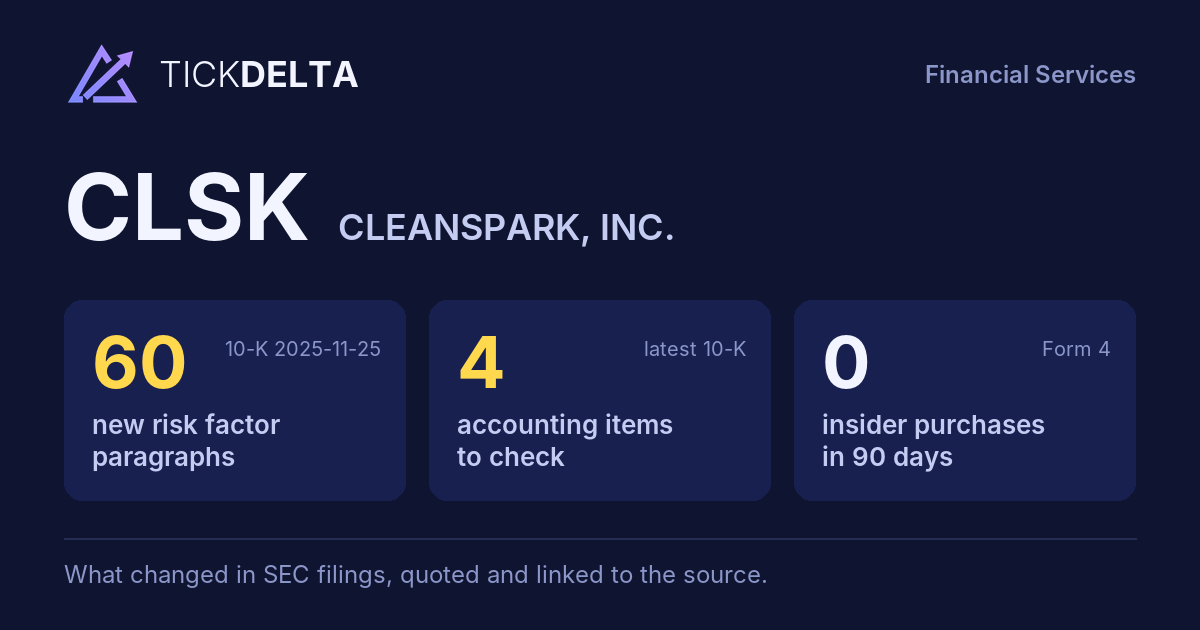
Facts from the latest 10-K that are worth reading about. They are not a verdict on the company.
!
Auditor change
Auditor went from MaloneBailey, LLP to BDO USA, P.C.
!
Late filing notice (NT 10-K or NT 10-Q)
NT 10-K filed 2024-12-02: the company said its 10-K would be late
!
Critical audit matters changed
New this year: Revenue from Bitcoin Mining (“As described in Note 2 to the consolidated financial statements, the Company is a participant in a third-party operated mining pool (the “mining pool”) and enters into contracts with the mining pool operator (the “Customer”) to provide hash calculations (or hashrate) to the mining pool. The Company ”); Accounting for Convertible Notes and Capped Calls (“As described in Notes 2 and 13 to the consolidated financial statements, in December 2024 the Company issued $650 million aggregate principal amount of convertible senior notes due 2030 (the “2030 Notes”). In connection with the issuance of the 2030 Notes, the Company entered into privately negotiat”); F-2 (“We identified the Company’s accounting for the 2030 Notes and 2030 Capped Calls as a critical audit matter. Determining whether the embedded redemption and conversion features related to the 2030 Notes met the criteria for bifurcation to be recognized as separate derivative instruments and whether t”); F-3 (“As described in Notes 2, 5, and 16 to the consolidated financial statements, the Company accounts for stock warrants as either equity instruments or liabilities. In connection with the acquisition of GRIID Infrastructure, Inc. (“GRIID”), the Company issued Public Warrants, Private Warrants, and GEM ”); Classification of Public and Private Warrants Issued for GRIID Acquisition (“As described in Notes 2, 5, and 16 to the consolidated financial statements, the Company accounts for stock warrants as either equity instruments or liabilities. In connection with the acquisition of GRIID Infrastructure, Inc. (“GRIID”), the Company issued Public Warrants, Private Warrants, and GEM ”). No longer listed: Bitcoin Mining Revenue. Same as last year: F-1
!
Material weakness in internal control
“The existence of this material weakness affected the design of internal controls related to various assertions in certain financial statement line items such that internal controls were not effective for cash and cash equivalents, bitcoin, receivable from bitcoin collateral, note receivable from GRIID, property and equipment, deposits on miners, accounts payable, accrued liabilities, loans payable, deferred income taxes, stockholders' equity, bitcoin mining revenue, cost and expenses, share-base”
✓
Going concern language
No statement of substantial doubt about going concern
✓
Restatement (8-K item 4.02)
No 8-K item 4.02 in the last 2 years
Source: Filing index, 8-Ks since 2024-11-10
✓
Material impairment (8-K item 2.06)
No 8-K item 2.06 in the last 2 years
Source: Filing index, 8-Ks since 2024-11-10
✓
Bankruptcy (8-K item 1.03)
No 8-K item 1.03 in the last 2 years
Source: Filing index, 8-Ks since 2024-11-10
–
Receivables growing faster than revenue not applicable
The 10-K does not report receivables for both years.
–
Cash from operations lower than net income not applicable
Not used for financial companies (cash from operations −$461.0M, net income $364.5M)
–
Inventory growing faster than revenue not applicable
The 10-K does not report inventory for both years.
How each check works
what it measures, the threshold, what it does not mean
| Check | What it measures | When it is marked | What it does not mean |
|---|---|---|---|
| Receivables growing faster than revenue | Whether customers owe more, relative to sales, than a year ago. | Receivables grew more than 10 percentage points faster than revenue, and grew. | Not proof that revenue is overstated. A large deal at year end, longer payment terms or an acquisition can do the same. |
| Cash from operations lower than net income | Whether reported profit is backed by cash from the business. | Cash from operations is below net income. Not computed for banks and other financial companies. | Common in fast-growing or seasonal companies. It is a question to ask, not a failure. |
| Inventory growing faster than revenue | Whether stock is piling up relative to sales. | Inventory grew more than 10 percentage points faster than revenue, and grew. | May be a planned build ahead of a product launch or a supply-chain change. |
| Auditor change | Whether the company changed its auditor. | An 8-K item 4.01 in the last 2 years, or a different auditor name in the two latest 10-Ks. | Often routine: rotation, a tender, or an audit firm merger. |
| Going concern language | Whether the 10-K states substantial doubt about continuing as a going concern. | A sentence to that effect is found in the 10-K text. Quoted as filed. | The wording is the company's, not our estimate. It can also appear in a sentence saying the doubt was removed. |
| Restatement (8-K item 4.02) | Whether the company said earlier financial statements should no longer be relied on. | An 8-K item 4.02 in the last 2 years. | Some restatements are small and do not change the picture. |
| Late filing notice | Whether the company asked for more time to file a 10-K or 10-Q. | An NT 10-K or NT 10-Q in the last 2 years. | Delays can be technical and one-off. |
| Critical audit matters changed | Which topics the auditor singled out as most difficult, and whether they changed. | A matter is new in the latest 10-K compared with the one before. | A new matter shows where the auditor spent its effort, not that something is wrong. |
| Material weakness in internal control | Whether the 10-K concludes that internal control over financial reporting was not effective because of a material weakness. | A sentence in the 10-K text concludes that controls were not effective because of a material weakness, quoted as filed. Sentences that say there is none, that one could occur, or that an earlier one was fixed are not marked. | It is the company's or the auditor's own wording, not our estimate. Many are about one account or process and are fixed within a year. It does not say the numbers are wrong. |
| Material impairment (8-K item 2.06) | Whether the company told the SEC it expects a material charge for impaired assets, such as goodwill. | An 8-K item 2.06 in the last 2 years. | A non-cash write-down. It says an earlier value was too high, not that the business is failing or that cash ran out. |
| Bankruptcy (8-K item 1.03) | Whether the company filed for bankruptcy or receivership. | An 8-K item 1.03 in the last 2 years. | The filing is the company's own and is a fact. It does not say what shareholders will get or whether the business continues. |
The 10-point threshold is our choice, not an academic result. Every check cites the filing and the line items it used.
Work on CLSK in a spreadsheet:
Excel workbook (a sheet per section, ten years by column, charts, links to the filings) ·
CSV.
For a Google Sheet that stays up to date, paste =IMPORTDATA("https://tickdelta.com/company/CLSK/export.csv") into a cell.