Added10-Q 2026-10-27 vs 10-K 2026-02-10
There have been no material changes to the Risk Factors as previously disclosed in Part I - Item 1A. Risk Factors in the 2025 Form 10‑K, which Risk Factors are incorporated herein by reference.
Tickdelta is free for now. Sign up and get Pro free
CMS Energy was formed as a corporation in Michigan in 1987 and is an energy company operating primarily in Michigan. 10-K, Item 1
5 paragraphs in Risk Factors of the 10-K filed Feb 10, 2026 with nothing like them in the 10-K filed Feb 11, 2025. Quoted exactly. Paragraphs that were only edited are under 10-K change.
Compared with the Risk Factors in the latest 10-K of the other 30 Utilities companies: a paragraph with at least half its words the same at another company is called similar, and the companies are listed under it. A paragraph most of them have is marked boilerplate. No line means no other company has one like it. This counts text; it does not say how serious a risk is.
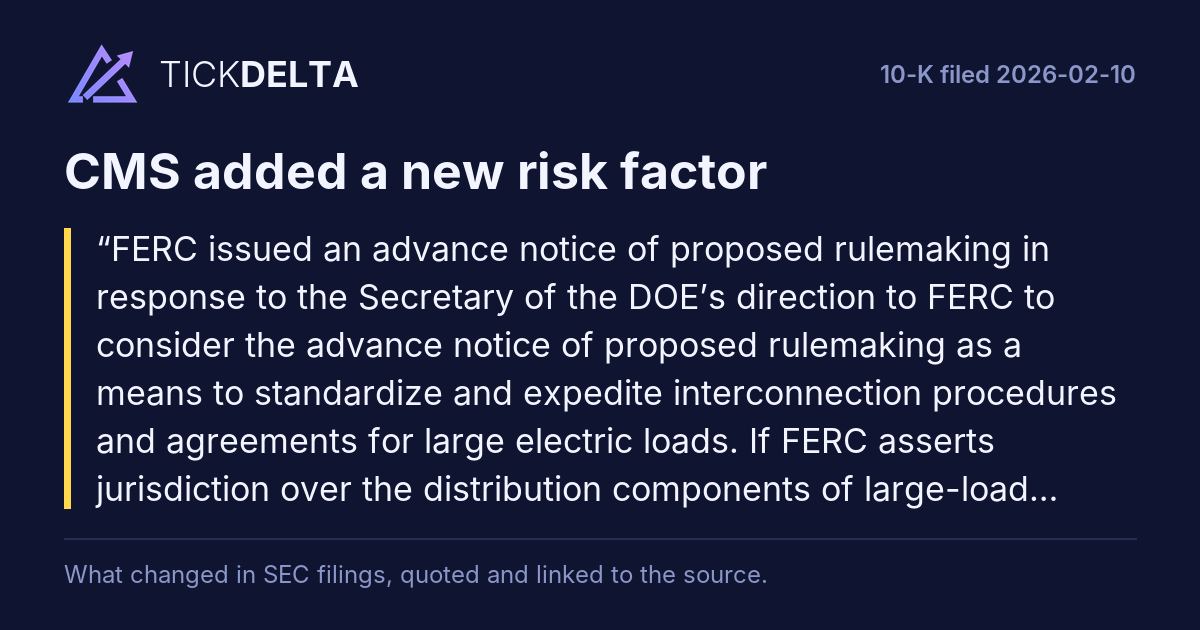
FERC issued an advance notice of proposed rulemaking in response to the Secretary of the DOE’s direction to FERC to consider the advance notice of proposed rulemaking as a means to standardize and expedite interconnection procedures and agreements for large electric loads. If FERC asserts jurisdiction over the distribution components of large-load customers’ interconnections to the transmission system, or allows large-load customers to directly purchase electricity from wholesale markets, it could have a material adverse effect on CMS Energy and Consumers.
Read in the 10-K ↗
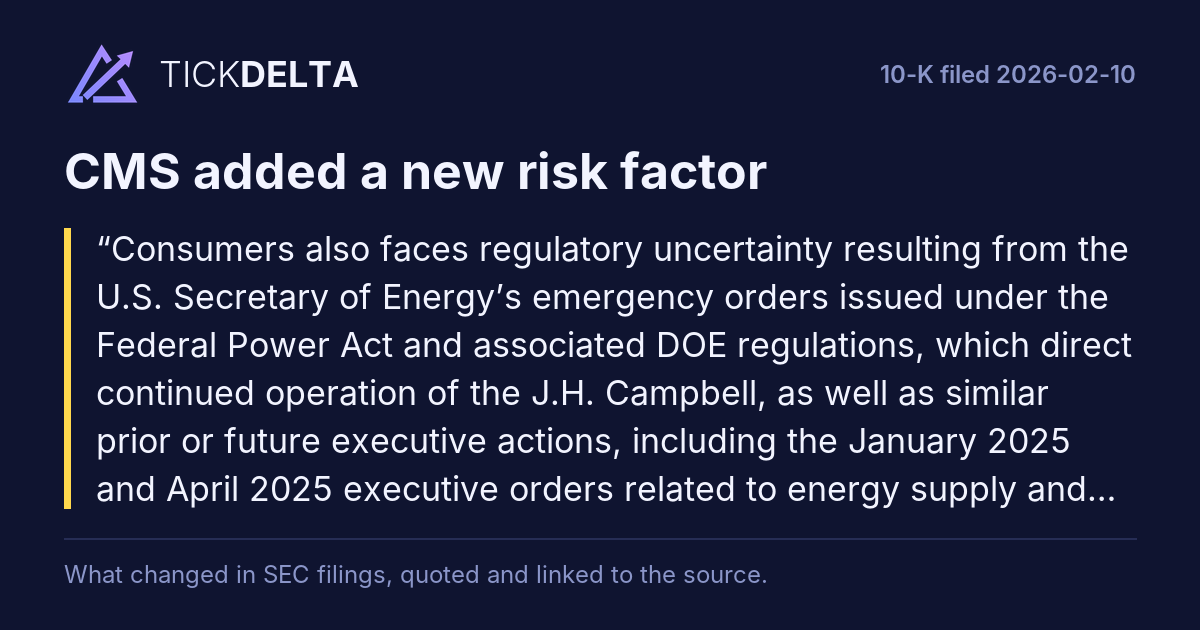
Consumers also faces regulatory uncertainty resulting from the U.S. Secretary of Energy’s emergency orders issued under the Federal Power Act and associated DOE regulations, which direct continued
operation of the J.H. Campbell, as well as similar prior or future executive actions, including the January 2025 and April 2025 executive orders related to energy supply and reliability. The Federal Power Act, DOE regulations, and U.S. Secretary of Energy emergency orders all provide for cost recovery associated with continued operations, but there is not currently a FERC-approved MISO Tariff for recovery of compliance costs associated with the continued operation of J.H. Campbell, and continued operation of J.H. Campbell is not contemplated in Consumers’ current MPSC rates or rate filings at the MPSC. Consumers is pursuing cost recovery at FERC but cannot predict the outcome of those efforts or the impact of other executive actions.
Read in the 10-K ↗
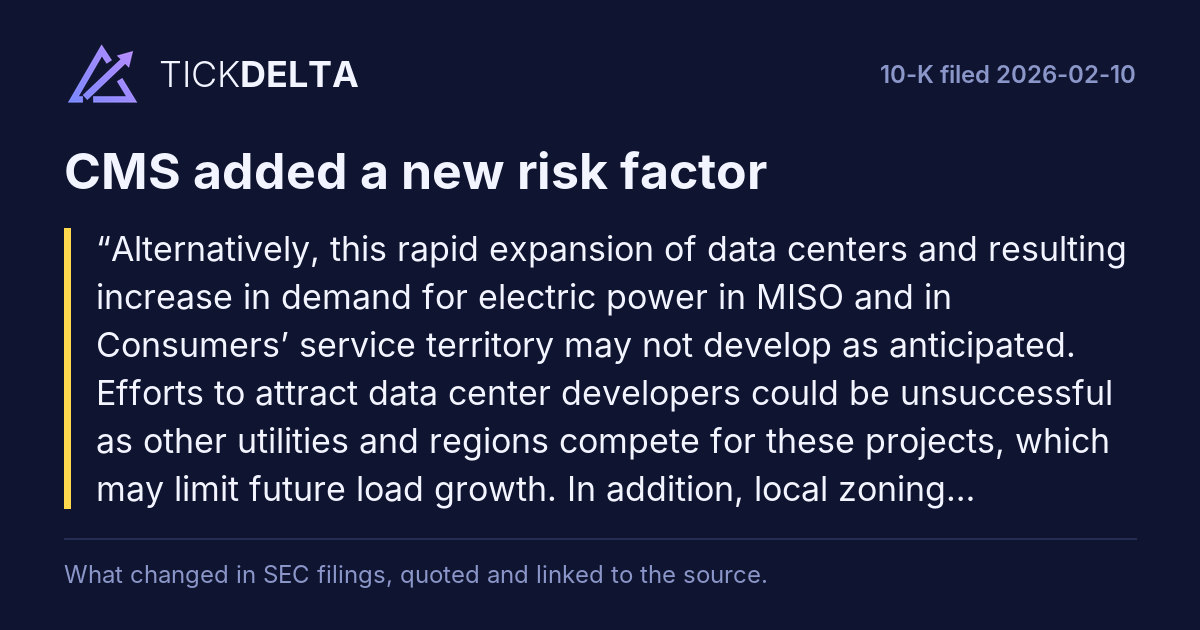
Alternatively, this rapid expansion of data centers and resulting increase in demand for electric power in MISO and in Consumers’ service territory may not develop as anticipated. Efforts to attract data center developers could be unsuccessful as other utilities and regions compete for these projects, which may limit future load growth. In addition, local zoning, permitting, land‑use constraints, and other external factors outside Consumers’ control could impede data center development. If these challenges arise and cannot be effectively mitigated, the anticipated benefits of data center load growth may not materialize. Further, even when data center customers enter into contracts to purchase utility service, there is a risk they may not fulfill their contractual or tariff obligations.
Read in the 10-K ↗
A work interruption or other union actions could adversely affect CMS Energy and Consumers.
Read in the 10-K ↗
40 paragraphs in the 10-Q filed Oct 27, 2026 with nothing like them in the 10-Q filed Jul 28, 2026 (at least half the words must differ; new numbers alone do not count). Quoted exactly, grouped by the item heading above them. This is text that changed, not a judgement of how serious it is.
• the ability to successfully complete asset sales and other significant transactions, including within expected timeframes, and to realize the expected benefits of such transactions
Read in the 10-Q ↗
To maintain reliability during the transition, Consumers purchased the Covert Generating Station, representing 1,200 MW of nameplate capacity, in 2023. Consumers’ updated IRP also includes two proposed natural gas-fueled generating plants totaling approximately 1,375 MW of nameplate capacity. Both facilities are proposed to be placed in service in 2031 and would use existing industrial sites and grid infrastructure, supplemented by necessary natural gas interconnection and related infrastructure improvements.
Read in the 10-Q ↗
The updated IRP includes more than 19 GW of additional renewable and clean energy resources through 2040, including solar, wind, energy storage, and a proposed long-term PPA for clean energy. These resources would be added over time to support customer needs and compliance with Michigan’s renewable and clean energy standards. The portfolio also incorporates Consumers’ REP, which was approved by the MPSC in September 2025. These actions support Consumers’ ability to achieve 60‑percent renewable energy by 2035 and 100‑percent clean energy by 2040, and will also contribute to Consumers’ achievement of the emissions-reduction goals discussed below.
Read in the 10-Q ↗
• filed an updated IRP presenting a 20‑year Electric Supply Plan designed to meet Michigan’s growing energy needs through a balanced portfolio of natural gas generation, solar, wind, battery and pumped storage resources, PPAs, and customer programs while maintaining reliability and affordability
Read in the 10-Q ↗
• received recognition for economic development leadership, as Consumers was named a 2026 Top Utility in Economic Development by Site Selection magazine, reflecting efforts from 2025 that contributed to almost $5 billion of corporate facility investment and nearly 5,000 jobs created within its service territory
Read in the 10-Q ↗
• invested more than $90 million in electric reliability improvements through 1,001 projects across 55 counties, strengthening electric infrastructure and supporting safe and reliable service for customers
Read in the 10-Q ↗
In September 2026, Consumers updated its Electric Supply Plan by filing an IRP with the MPSC. The IRP presents a 20‑year plan designed to meet Michigan’s growing energy needs through a balanced portfolio of natural gas generation, solar, wind, battery and pumped storage, PPAs, and customer programs. The plan is intended to maintain reliability and affordability while achieving the requirements of Michigan’s 2023 Energy Law. The resources and other components included in the IRP are subject to MPSC approval.
Read in the 10-Q ↗
• Resource adequacy and reliability - To maintain reliability during the transition, Consumers purchased the Covert Generating Station, representing 1,200 MW of nameplate capacity, in 2023. Consumers’ updated IRP also includes two proposed natural gas-fueled generating plants totaling approximately 1,375 MW of nameplate capacity. The proposed facilities would include a 456‑MW unit in Bay County, Michigan, and a 919‑MW unit in Genesee County, Michigan. Both facilities are proposed to be placed in service in 2031 and would use existing industrial sites and grid infrastructure, supplemented by necessary natural gas interconnection and related infrastructure improvements.
Read in the 10-Q ↗
• Renewable and clean energy expansion - The updated IRP includes more than 19 GW of additional renewable and clean energy resources through 2040, including solar, wind, energy storage, and a proposed long-term PPA for clean energy. These resources would be added over time to support customer needs and compliance with Michigan’s renewable and clean energy standards. The portfolio also incorporates Consumers’ REP, which was approved by the MPSC in September 2025.
Read in the 10-Q ↗
• Customer programs - The updated IRP incorporates energy waste reduction, demand response, and other customer-powered energy programs that, collectively, can operate as virtual power plants to reduce energy use, manage peak demand, and lower customer costs. Consumers expects these programs could reduce peak demand by up to 3,100 MW; however, these resources cannot fully replace firm generation needed during extended periods of high demand or when customer resources are unavailable.
Read in the 10-Q ↗
Consumers expects to competitively bid new capacity and energy resources, as appropriate, to support a balanced portfolio of renewable, clean, and dispatchable resources. The timing, composition, and cost of the resources proposed in the updated IRP are subject to MPSC approval, future competitive solicitations, permitting, construction, and other developments. Through its IRP, REP, and related customer programs, Consumers seeks to comply with Michigan’s energy requirements while maintaining electric reliability and affordability.
Read in the 10-Q ↗
In September 2026, Consumers extended its waiver of the statutory deadline applicable to the proceeding to provide additional time for discussions among the parties regarding potential resolution of outstanding matters, resulting in an anticipated MPSC order in November 2026.
Read in the 10-Q ↗
In June 2026, NorthStar Clean Energy sold a Class A membership interest in HL Solar Holdings to a tax equity investor. HL Solar Holdings is the holding company of:
Read in the 10-Q ↗
• a 100‑MW solar generation project in St. Clair County, Michigan, which achieved commercial operation in August 2026
Read in the 10-Q ↗
• a 120‑MW solar generation project in Hart Township, Michigan, which achieved commercial operation in October 2026
Read in the 10-Q ↗
In 2015, the EPA lowered the NAAQS for ozone, which could make it more difficult to construct or modify power plants and other emission sources in areas of the country that do not meet the ozone standard. Following a December 2025 court decision affecting the attainment status of a seven-county area in southeast Michigan, the EPA published a proposal in July 2026 to approve EGLE’s request to redesignate the area to attainment with the 2015 ozone standard. NorthStar Clean Energy, which operates one electric generating station within this area, will continue to monitor the decision’s potential impact.
Read in the 10-Q ↗
greenhouse gas emissions and will continue to evaluate potential impacts to its operations, both present and future.
Read in the 10-Q ↗
legal challenges are not yet known, Consumers is committed to pursuing cost recovery as provided for under applicable laws, orders, and proceedings.
Read in the 10-Q ↗
In Millions Level 1 Level 2 Level 3 Long-lived assets held for sale $789 Equity method investments 18
Read in the 10-Q ↗
During the three months ended September 30, 2026, NorthStar Clean Energy committed to plans to sell certain consolidated renewable energy projects. Upon classification as held for sale, NorthStar Clean Energy wrote down the long-lived assets to their fair value of $ 789 million.
Read in the 10-Q ↗
As part of the divestment strategy, NorthStar Clean Energy also committed to plans to sell its investments accounted for under the equity method. NorthStar Clean Energy recognized an other-than-temporary impairment and wrote down its interests in non-consolidated VIEs expected to be sold to their fair value of $ 18 million.
Read in the 10-Q ↗
The fair values were determined using definitive agreements, indicative bids received from prospective buyers, and other market information and may differ materially from actual proceeds received upon completion of the divestment. These valuations used unobservable inputs; therefore, they were classified within Level 3 of the fair value hierarchy. For additional information, see Note 14, Exit Activities and Asset Sales.
Read in the 10-Q ↗
In Millions September 30, 2026 December 31, 2025 CMS Energy, including Consumers Cash and cash equivalents $451 $509 Restricted cash and cash equivalents 102 106 Current assets held for sale 26 — Cash and cash equivalents, including restricted amounts – CMS Energy $579 $615 Consumers Cash and cash equivalents $257 $25 Restricted cash and cash equivalents 68 86 Cash and cash equivalents, including restricted amounts – Consumers $325 $111
Read in the 10-Q ↗
Cash and Cash Equivalents: Cash and cash equivalents include short-term, highly liquid investments with original maturities of three months or less.
Read in the 10-Q ↗
Restricted Cash and Cash Equivalents: Restricted cash and cash equivalents are held primarily for the repayment of securitization bonds and funds held in escrow. These amounts are classified as current assets since they relate to payments that could or will occur within one year.
Read in the 10-Q ↗
Current Assets Held for Sale: During the three months ended September 30, 2026, NorthStar Clean Energy committed to plans to sell certain consolidated renewable energy projects. Accordingly, the cash and cash equivalents of the projects to be sold are presented as held for sale on CMS Energy’s consolidated balance sheet at September 30, 2026. For additional information, see Note 14, Exit Activities and Asset Sales.
Read in the 10-Q ↗
In June 2026, NorthStar Clean Energy sold a Class A membership interest in HL Solar Holdings to a tax equity investor. HL Solar Holdings is the holding company of:
Read in the 10-Q ↗
• a 100 ‑MW solar generation project in St. Clair County, Michigan, which achieved commercial operation in August 2026
Read in the 10-Q ↗
• a 120 ‑MW solar generation project in Hart Township, Michigan, which achieved commercial operation in October 2026
Read in the 10-Q ↗
has classified their assets and liabilities as held for sale. For additional details of these entities, see Note 14, Exit Activities and Asset Sales.
Read in the 10-Q ↗
In September 2026, Consumers extended its waiver of the statutory deadline applicable to the proceeding to provide additional time for discussions among the parties regarding potential resolution of outstanding matters, resulting in an anticipated MPSC order in November 2026.
Read in the 10-Q ↗
CMS Energy launched a sales process for these projects. Certain sales have been completed or are subject to definitive agreements, and CMS Energy is in various stages of negotiations with potential buyers for the remaining projects. At September 30, 2026, the criteria for classification as held for sale were met for four individual disposal groups associated with the planned divestment. Accordingly, the related assets and liabilities were classified as held for sale on CMS Energy’s consolidated balance sheet at September 30, 2026.
Read in the 10-Q ↗
Upon classification as held for sale, each disposal group was measured at the lower of its carrying amount or fair value less costs to sell. The determination of fair value less costs to sell required judgment and included definitive agreements, indicative bids received from prospective buyers, and other market information, adjusted as necessary for estimated costs to sell. CMS Energy recognized aggregate impairment charges of $ 454 million for the three and nine months ended September 30, 2026, of which $ 102 million was attributable to noncontrolling interests, that were recorded in NorthStar Clean Energy impairment, disposal, and exit costs on CMS Energy’s consolidated statements of income. The impairment charges reflected the amount by which the carrying amounts of the disposal groups exceeded their respective estimated fair values less costs to sell.
Read in the 10-Q ↗
Additionally, CMS Energy completed the sale of a 24 -MW solar facility located in Delta Township, Michigan, to an unrelated party during the third quarter of 2026. The sale resulted in a loss of $ 15 million, which was recorded in NorthStar Clean Energy impairment, disposal, and exit costs on CMS Energy’s consolidated statements of income.
Read in the 10-Q ↗
Certain of the entities held for sale are not wholly owned by NorthStar Clean Energy and are VIEs. As the primary beneficiary of these entities, NorthStar Clean Energy consolidates these entities and the remaining ownership interest is presented as noncontrolling interest on CMS Energy’s consolidated balance sheet. The noncontrolling interest associated with these consolidated VIEs held for sale totaled $ 479 million at September 30, 2026, before the attribution of $ 102 million of the impairment loss to the noncontrolling interest. NorthStar Clean Energy is obligated under certain indemnities, with varying durations, that protect the noncontrolling interests against losses incurred as a result of breaches of representations and warranties under the associated membership agreements. At September 30, 2026, the maximum obligation associated with these indemnifications was $ 180 million, and no amount has been recorded.
Read in the 10-Q ↗
CMS Energy expects to complete the divestment within 12 months of the date the disposal groups were classified as held for sale, subject to negotiating contractual terms with third parties, regulatory approvals, and other customary closing conditions. Because the sales process remains ongoing and is subject to market conditions and transaction-specific factors, the losses recognized upon completion of the sales could differ from the impairment charges recorded for the three and nine months ended September 30, 2026.
Read in the 10-Q ↗
In Millions Three and Nine Months Ended September 30 2026 Impairment of long-lived assets held for sale1 $ 454 Loss on sale of long-lived assets 15 Contract termination costs2 33 Retention and severance3 7 Other exit costs 16 NorthStar Clean Energy impairment, disposal, and exit costs $ 525
Read in the 10-Q ↗
2 Includes breakage fees associated with development and equipment purchase contracts. Breakage fees incurred were reported as other current liabilities on CMS Energy’s consolidated balance sheet at September 30, 2026. Additional contract termination costs associated with the divestment strategy are not expected to be significant.
Read in the 10-Q ↗
3 The aggregate cost of the retention incentive and severance program is estimated to be $ 10 million and is expected to be substantially completed by December 31, 2026. Retention and severance amounts incurred to date were reported as other current liabilities on CMS Energy’s consolidated balance sheet at September 30, 2026.
Read in the 10-Q ↗
As part of the divestment strategy, CMS Energy also plans to sell its non-consolidated VIEs, which are accounted for using the equity method and included in investments on CMS Energy’s consolidated balance sheets. CMS Energy determined that declines in the fair values of non-consolidated VIEs below their respective carrying amounts were other than temporary. Accordingly, CMS Energy recognized impairment charges of $ 33 million for the three and nine months ended September 30, 2026. The impairment charges reduced the carrying amounts of the affected investments to their estimated fair values and were recorded in NorthStar Clean Energy impairment of equity method investments on CMS Energy’s consolidated statements of income. The non-consolidated VIEs are reflected in investments on CMS Energy’s consolidated balance sheets in the amount of $ 18 million at September 30, 2026 and $ 54 million at December 31, 2025.
Read in the 10-Q ↗
Item 1A of the 10-Q filed Oct 27, 2026 against Item 1A of the 10-K filed Feb 10, 2026.
A 10-Q repeats only the risks that changed, so a 10-K paragraph that is missing from it is not counted as removed.
Added is a paragraph with nothing like it in the 10-K, Reworded a sentence that is in both with several words changed,
Quiet changes a sentence in both where one to four words changed and one is a hedge or a modal
(cut words struck through, new words highlighted and underlined).
Text on the page, not a score; each links to the filing at sec.gov.
Work on CMS in a spreadsheet:
Excel workbook (a sheet per section, ten years by column, charts, links to the filings) ·
CSV.
For a Google Sheet that stays up to date, paste =IMPORTDATA("https://tickdelta.com/company/CMS/export.csv") into a cell.