Paragraph 39 · 49% changed
Every version of it
Screener
/
SEC EDGAR
/CIK 0001567094
/10-K filed Feb 26, 2026, compared with Feb 28, 2025
/Numbers from the XBRL of the 10-Ks
NYSE
Industrials · Construction Machinery
CNH Industrial N.V. CNH
The 10-K against last year's
316 changes: 91 added, 89 removed, 135 reworded, 1 quiet changes
10-K Feb 26, 2026 vs Feb 28, 2025
Risk Factors
31.0%
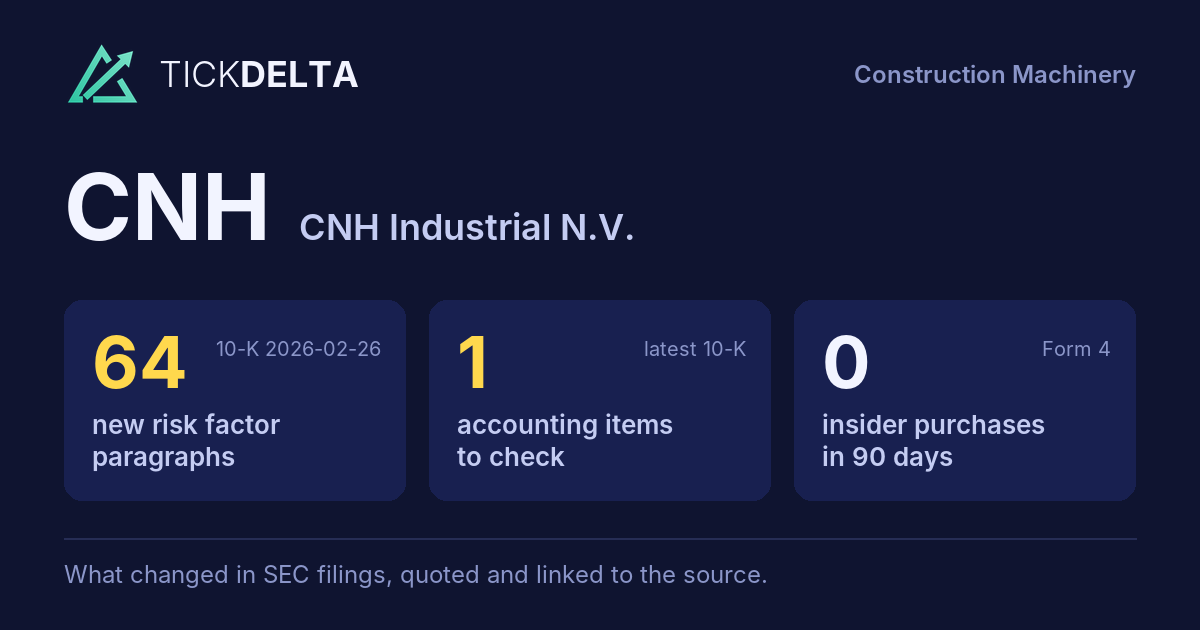
of the text changed · 11,893 words now · 64 new paragraphs, 11 gone
MD&A
36.9%
of the text changed · 11,136 words now · 27 new paragraphs, 78 gone
Legal Proceedings
2.9%
of the text changed · 283 words now
Accounting Policies
35.8%
of the text changed · 5,062 words now
10-K 0001567094-26-000006 (Feb 26, 2026) vs 10-K 0001628280-25-009007 (Feb 28, 2025)
Every paragraph, and how much of it changed
One bar per paragraph, in the order of the 10-K. Height and colour show the share of its words not in the closest paragraph a year earlier; the tallest bars are new paragraphs.
Risk Factors
150 paragraphs · 64 new · 57 reworded · 11 gone · 10-K Feb 26, 2026 against Feb 28, 2025
New paragraph
Reworded (5% of its words or more)
Same or nearly
Paragraph 76 · 46% changed
Every version of it
Paragraph 16 · 44% changed
Every version of it
Paragraph 51 · 42% changed
Every version of it
Paragraph 97 · 40% changed
Every version of it
Paragraph 55 · 39% changed
Every version of it
–International trade in particular jurisdictions, including tariffs, and other counter measures; measures that restrict the import and export of our products, components and raw materials;
Paragraph 92 · 38% changed
Every version of it
Paragraph 49 · 37% changed
Every version of it
Economic conditions vary across regions and countries, and demand for our products and services generally increases in those regions and countries experiencing economic growth and investment. Slower economic growth or a change in global mix of regions and countries experiencing slower economic growth and investment could have an adverse impact on our business, results of operations and financial condition. In a weaker economic environment, dealers and customers may delay or cancel plans to purchase our products and services and may not be able to fulfill their obligations to us in a timely fashion. In addition, changes in the economic environment could have an adverse impact on our Financial Services customers' ability to service their loans in a timely manner or increase the number of defaults. Our suppliers may also be impacted by economic pressures, which may adversely affect their ability to fulfill their obligations to us or the price or availability of supplies we require. These factors could result in product delays, increased accounts receivable, receivable balances, defaults and inventory challenges. Our success largely depends on the vitality of the agricultural industry. Historically, the agricultural industry has been cyclical and subject to a variety of economic and other factors. Sales of agricultural equipment, in turn, are also cyclical and generally reflect the economic health of the agricultural industry. The economic health of the agricultural industry is affected by numerous factors, including farm income, farmland values, and debt levels and financing costs, all of which are influenced by the levels of commodity and protein prices, world grain stocks, acreage available and planted, crop yields, agricultural product demand, soil conditions, farm input costs, government policies, government subsidies and weather and climate conditions. Downturns in the agricultural industry due to these and other factors, which could vary by market, have in the past resulted in, and could in the future continue to result in, decreases in demand for agricultural equipment, adversely affecting our performance. In 2024, unfavorable market conditions resulted in lower sales volumes, lower production, lower manufacturing capacity utilization, higher sales discounts, and a higher provision for credit losses. We expect certain of these conditions to persist in fiscal year 2025. Changes in interest rates and the agricultural market business cycle are driven by factors outside of our control, and as a result we cannot reasonably foresee when these conditions will fully subside. If these conditions persist or worsen, it could continue to have an adverse impact on our business, results of operations and financial condition.
Paragraph 39 · 49% changed
Every version of it
10-K Feb 28, 2025We have significant outstanding indebtedness, which may limit our ability to obtain additional funding and may limit our financial and operating flexibility. As of December 31, 2024, we had an aggregate of $26,882 million (including $23,173 million relating to Financial Services’ activities) of consolidated gross indebtedness, and our equity was $7,713 million, including non-controlling interests. The extent of our indebtedness could have important consequences on our operations and financial results, including:
10-K Feb 26, 2026
•We have significant outstanding indebtedness, which may limit our ability to obtain additional funding and may limit our financial and operating flexibility.
Paragraph 76 · 46% changed
Every version of it
10-K Feb 28, 2025If we are unable to deliver precision technology solutions to our customers, it could materially adversely affect our performance. Our precision technology solutions include both hardware and software components that relate to guidance, connectivity, automation and autonomy. We must be able to successfully acquire, develop and introduce new precision technology solutions that improve productivity and result in sustainable farming techniques in order to remain competitive. We expect to make significant investments in research and development expenses, collaborative arrangements and other sources of technology to drive these outcomes. Such investments may not produce attractive solutions for our customers. We also may have to depend on third parties to supply certain hardware or software components or data services in our precision technology products. Our dealers ability to support such solutions also may impact on our customers, acceptance and demand for such products. Further, we utilize automation and machine learning and artificial intelligence in some of our products. While the use of these emerging technologies can present significant benefits, it also creates risks and challenges. Data sourcing, technology, integration and process issues, program bias into decision-making algorithms, security problems, and the protection of privacy could impair the adoption and acceptance of autonomous machine solutions. If we are not able to deliver precision technology solutions with differentiated features and functionality, or these solutions are not effective, customers may not adopt technology solutions, which could have a material adverse effect on the Company’s reputation and business.
10-K Feb 26, 2026
novel business models without an established track record. Data sourcing, technology, integration and process issues, program bias into decision-making algorithms, security problems, and the protection of privacy could impair the adoption and acceptance of autonomous machine solutions. If we are not able to deliver precision technology solutions with differentiated features and functionality, or if these solutions are not effective, customers may not adopt technology solutions, which could have a material adverse effect on the Company's reputation and business.
Paragraph 16 · 44% changed
Every version of it
10-K Feb 28, 2025We may not be able to realize anticipated benefits from any acquisitions and, further, challenges associated with strategic alliances may have an adverse impact on our results of operations. We have engaged in the past, and may engage in the future, in investments and mergers and acquisitions or enter into, expand or exit from strategic alliances and joint ventures. These involve risks that could prevent us from realizing the expected benefits of the transactions or the achievement of strategic objectives or could divert management’s time and attention. Such risks, many of which are outside our control, include:
10-K Feb 26, 2026
•We may not be able to realize anticipated benefits from any acquisitions and, further, challenges associated with strategic alliances may have an adverse impact on our results of operations.
Paragraph 51 · 42% changed
Every version of it
10-K Feb 28, 2025Economic conditions vary across regions and countries, and demand for our products and services generally increases in those regions and countries experiencing economic growth and investment. Slower economic growth or a change in global mix of regions and countries experiencing economic growth and investment could have an adverse impact on our business, results of operations and financial condition. In a weaker economic environment, dealers and customers may delay or cancel plans to purchase our products and services and may not be able to fulfill their obligations to us in a timely fashion. In addition, changes in the economic environment could have an adverse impact on our Financial Services customers' ability to service their loans in a timely manner or increase the number of defaults. Our suppliers may also be impacted by economic pressures, which may adversely affect their ability to fulfill their obligations to us or the price or availability of supplies we require. These factors could result in product delays, increased accounts receivable, defaults and inventory challenges. Our success largely depends on the vitality of the agricultural industry. Historically, the agricultural industry has been cyclical and subject to a variety of economic and other factors. Sales of agricultural equipment, in turn, are also cyclical and generally reflect the economic health of the agricultural industry. The economic health of the agricultural industry is affected by numerous factors, including farm income, farmland values, and debt levels and financing costs, all of which are influenced by the levels of commodity and protein prices, world grain stocks, acreage available and planted, crop yields, agricultural product demand, soil conditions, farm input costs, government policies, government subsidies and weather and climate conditions. Downturns in the agricultural industry due to these and other factors, which could vary by market, have in the past resulted in, and could in the future continue to result in, decreases in demand for agricultural equipment, adversely affecting our performance. In 2024, unfavorable market conditions resulted in lower sales volumes, lower production, lower manufacturing capacity utilization, higher sales discounts, and a higher provision for credit losses. We expect certain of these conditions to persist in fiscal year 2025. Changes in interest rates and the agricultural market business cycle are driven by factors outside of our control, and as a result we cannot reasonably foresee when these conditions will fully subside. If these conditions persist or worsen, it could continue to have an adverse impact on our business, results of operations and financial condition.
10-K Feb 26, 2026
to a variety of economic and other factors. Sales of agricultural equipment, in turn, are also cyclical and generally reflect the economic health of the agricultural industry. The economic health of the agricultural industry is affected by numerous factors, including changes in general economic conditions farm income, farm input costs, farmland values, and debt levels and financing costs, all of which are influenced by the levels of commodity and protein prices, world grain stocks, acreage available and planted, crop yields, agricultural product demand, soil conditions, farm input costs, government policies, government subsidies and weather and climate conditions. Downturns in the agricultural industry due to these and other factors, which could vary by market, have in the past resulted in, and could in the future continue to result in, decreases in demand for agricultural equipment, adversely affecting our performance. Moreover, the unpredictable nature of many of these factors and the resulting volatility in demand make it difficult for us to accurately predict sales and optimize production. This, in turn, can result in higher costs, including inventory carrying costs and underutilized manufacturing capacity. During previous downturns in the agricultural industry, we experienced significant and prolonged declines in our performance, and we expect our business to remain subject to similar market fluctuations in the future.
Paragraph 97 · 40% changed
Every version of it
10-K Feb 28, 2025We are also subject to regulation and oversight by securities regulatory authorities in the Netherlands and the United States. As of June 30, 2024, we determined that CNH no longer qualifies as a foreign private issuer, as defined under the Exchange Act. As a result, effective as of January 1, 2025, the Company is no longer eligible to use the rules designed for foreign private issuers and is subject to additional reporting requirements and other standards applicable to U.S. domestic issuers. These additional obligations may increase the cost for ensuring compliance with the applicable reporting requirements and may subject us to an enhanced risk of regulatory investigations and private litigation. The ultimate outcome of these legal matters pending against us is uncertain, and although such legal matters are not expected individually to have a material adverse effect on our financial position or profitability, such legal matters could, in the aggregate, in the event of unfavorable resolutions thereof, have a material adverse effect on our results of operations and financial condition. Furthermore, we could in the future be subject to judgments or enter into settlements of lawsuits and claims that could have a material adverse effect on our results of operations in any particular period. In addition, while we maintain insurance coverage with respect to certain risks, we may not be able to obtain such insurance on acceptable terms in the future, if at all, and any such insurance may not provide adequate coverage against claims under such policies. We establish reserves based on our assessment of contingencies, including contingencies related to legal claims asserted against us. Subsequent developments in legal proceedings may affect our assessment and estimates of the loss contingency recorded as a reserve and require us to make payments that exceed our reserves, which could have a material adverse effect on our results of operations and/or financial position. For further information see “Note 15: Commitments and Contingencies” to the consolidated financial statements for the year ended December 31, 2024, for additional information.
10-K Feb 26, 2026
Furthermore, we could in the future be subject to judgments or enter into settlements of lawsuits and claims that could have a material adverse effect on our results of operations in any particular period. In addition, while we maintain insurance coverage with respect to certain risks, we may not be able to obtain such insurance on acceptable terms in the future, if at all, and any such insurance may not provide adequate coverage against claims under such policies. We establish reserves based on our assessment of contingencies, including contingencies related to legal claims asserted against us. Subsequent developments in legal proceedings may affect our assessment and estimates of the loss
Paragraph 55 · 39% changed
Every version of it
10-K Feb 28, 2025
–International trade in particular jurisdictions, including tariffs, and other counter measures;
10-K Feb 26, 2026
–International trade in particular jurisdictions, including tariffs, and other counter measures that restrict the import and export of our products, components and raw materials;
Paragraph 92 · 38% changed
Every version of it
10-K Feb 28, 2025We cannot guarantee that we will be able to maintain access to raw materials, parts and components, and in some cases, this access may be affected by factors outside of our control and the control of our suppliers. Certain components and parts used in our products are available from a single supplier and cannot be quickly sourced from other suppliers. If required, the costs of switching suppliers may be substantial, and could adversely effect the quality and efficiency of our operations. Significant disruptions to the supply chain resulting from shortages of raw materials, components, and wholegoods can adversely affect our ability to meet customer demand. For example, in the past, attacks on merchant ships in the Red Sea caused shipping companies to avoid this region, which have resulted in increased logistics costs. While we diligently monitor our supply chain risk and seek to respond promptly to address supply chain and logistics bottlenecks, there can be no assurance that our mitigation plans will be effective to prevent disruptions that may arise from shortages of materials that we use in the production of our products. Uncertainties related to the magnitude and duration of global supply chain disruptions have adversely affected, and may continue to adversely affect, our business and outlook.
10-K Feb 26, 2026
increased logistics costs. While we diligently monitor our supply chain risk and seek to respond promptly to address supply chain and logistics bottlenecks, there can be no assurance that our mitigation plans will be effective to prevent disruptions that may arise from shortages of materials that we use in the production of our products. Uncertainties related to the magnitude and duration of global supply chain disruptions have adversely affected, and may continue to adversely affect our business and outlook.
Paragraph 49 · 37% changed
Every version of it
10-K Feb 28, 2025
Economic conditions vary across regions and countries, and demand for our products and services generally increases in those regions and countries experiencing economic growth and investment. Slower economic growth or a change in global mix of regions and countries experiencing economic growth and investment could have an adverse impact on our business, results of operations and financial condition. In a weaker economic environment, dealers and customers may delay or cancel plans to purchase our products and services and may not be able to fulfill their obligations to us in a timely fashion. In addition, changes in the economic environment could have an adverse impact on our Financial Services customers' ability to service their loans in a timely manner or increase the number of defaults. Our suppliers may also be impacted by economic pressures, which may adversely affect their ability to fulfill their obligations to us or the price or availability of supplies we require. These factors could result in product delays, increased accounts receivable, defaults and inventory challenges. Our success largely depends on the vitality of the agricultural industry. Historically, the agricultural industry has been cyclical and subject to a variety of economic and other factors. Sales of agricultural equipment, in turn, are also cyclical and generally reflect the economic health of the agricultural industry. The economic health of the agricultural industry is affected by numerous factors, including farm income, farmland values, and debt levels and financing costs, all of which are influenced by the levels of commodity and protein prices, world grain stocks, acreage available and planted, crop yields, agricultural product demand, soil conditions, farm input costs, government policies, government subsidies and weather and climate conditions. Downturns in the agricultural industry due to these and other factors, which could vary by market, have in the past resulted in, and could in the future continue to result in, decreases in demand for agricultural equipment, adversely affecting our performance. In 2024, unfavorable market conditions resulted in lower sales volumes, lower production, lower manufacturing capacity utilization, higher sales discounts, and a higher provision for credit losses. We expect certain of these conditions to persist in fiscal year 2025. Changes in interest rates and the agricultural market business cycle are driven by factors outside of our control, and as a result we cannot reasonably foresee when these conditions will fully subside. If these conditions persist or worsen, it could continue to have an adverse impact on our business, results of operations and financial condition.
10-K Feb 26, 2026
Economic conditions vary across regions and countries, and demand for our products and services generally increases in those regions and countries experiencing economic growth and investment. Slower economic growth or a change in global mix of regions and countries experiencing slower economic growth and investment could have an adverse impact on our business, results of operations and financial condition. In a weaker economic environment, dealers and customers may delay or cancel plans to purchase our products and services and may not be able to fulfill their obligations to us in a timely fashion. In addition, changes in the economic environment could have an adverse impact on our Financial Services customers' ability to service their loans in a timely manner or increase the number of defaults. Our suppliers may also be impacted by economic pressures, which may adversely affect their ability to fulfill their obligations to us or the price or availability of supplies we require. These factors could result in product delays, increased accounts receivable balances, defaults and inventory challenges.
MD&A
179 paragraphs · 27 new · 106 reworded · 78 gone · 10-K Feb 26, 2026 against Feb 28, 2025
New paragraph
Reworded (5% of its words or more)
Same or nearly
Paragraph 69 · 49% changed
Paragraph 146 · 48% changed
During the fourth quarter of 2024, 2025, we recognized a significant portion of the deferred tax assets related to our operations in China, resulting in a $29 million non-cash tax benefit, as those operations had consistently returned to pre-tax profitability, with the trend anticipated to continue for the foreseeable future. During this same period, we also recorded a valuation allowance on deferred tax assets from the non-cash impairment charges related to Monarch Tractors and the IPR&D acquired as part of the Raven acquisition. In 2025, we also recorded a valuation allowance against deferred tax assets generated by our financial services business in Argentina, resulting in a $35 million non-cash increase to the Company’s tax Bennamann.
Paragraph 125 · 47% changed
The allowance for credit losses is represents our estimate of the lifetime expected credit losses inherent in the on trade receivables and financing receivables. Retail receivables owned by us. Retail customer include retail notes, finance leases, and revolving charge accounts to end‑use customers, while wholesale receivables primarily include retail notes and finance leases to end use customers and revolving charge accounts, which represent financing for customers to purchase parts, service, rentals, implements and attachments from CNH dealers. Wholesale receivables include dealer floorplan financing, financing and to a lesser extent, the financing of dealer operations. Typically, our receivables other dealer‑related financing. Receivables within a geographic area have generally share similar risk profiles characteristics and methods for assessing and monitoring risk. are evaluated collectively.
Paragraph 21 · 46% changed
The following table includes the reconciliation of Adjusted EBIT for of Industrial Activities to net income, the most comparable U.S. by segment (in millions of dollars, except percentages):
Paragraph 150 · 45% changed
Paragraph 49 · 45% changed
Paragraph 16 · 43% changed
In 2024, 2025, income taxes were an expense of $336 $184 million, compared to a tax expense of $594 $336 million in 2023. 2024. The effective tax rates for 2025 and 2024 were 29.7% and 2023 were 23.1% and 22.0%, 23.1%, respectively. The decreased tax expense in 2024, 2025 was reduced as compared to 2023, was largely attributable 2024 due to lower profit-before profit-before-tax. However, the 2025 effective tax rate increased due to the year-over year tax impact of Argentina's highly inflationary economy and the non-recognized tax impact from Argentina’s highly inflationary economy. The 2024 tax expense was benefits associated with the non-cash impairment charges related to Monarch Tractors and IPR&D acquired as part of the Raven acquisition. In 2025, we also reduced by the recognition of $29 million of previously unrecognized recorded a valuation allowance against deferred tax assets in China, offset generated by the derecognition of $35 million deferred tax assets in Argentina, increases in withholding tax on dividends, and lower benefit from U.S. exports. Bennamann.
Paragraph 132 · 43% changed
Paragraph 69 · 49% changed
10-K Feb 28, 2025The reconciliation of Free Cash Flow of Industrial Activities to Net cash provided (used) by Operating Activities, the U.S. GAAP financial measure that we believe to be most directly comparable, for the years ended December 31, 2024 and 2023, is shown below:
10-K Feb 26, 2026
Reconciliation of Free Cash Flow of Industrial Activities to Net Cash Provided by Operating Activities
Paragraph 146 · 48% changed
10-K Feb 28, 2025
During the fourth quarter of 2024, we recognized a significant portion of the deferred tax assets related to our operations in China, resulting in a $29 million non-cash tax benefit, as those operations had consistently returned to pre-tax profitability, with the trend anticipated to continue for the foreseeable future. During this same period, we also recorded a valuation allowance on deferred tax assets generated by our financial services business in Argentina, resulting in a $35 million non-cash increase to the Company’s tax
10-K Feb 26, 2026
During the fourth quarter of 2025, we recognized a valuation allowance on deferred tax assets from the non-cash impairment charges related to Monarch Tractors and the IPR&D acquired as part of the Raven acquisition. In 2025, we also recorded a valuation allowance against deferred tax assets generated by Bennamann.
Paragraph 125 · 47% changed
10-K Feb 28, 2025
The allowance for credit losses is our estimate of the lifetime expected credit losses inherent in the trade receivables and financing receivables owned by us. Retail customer receivables primarily include retail notes and finance leases to end use customers and revolving charge accounts, which represent financing for customers to purchase parts, service, rentals, implements and attachments from CNH dealers. Wholesale receivables include dealer floorplan financing, and to a lesser extent, the financing of dealer operations. Typically, our receivables within a geographic area have similar risk profiles and methods for assessing and monitoring risk.
10-K Feb 26, 2026
The allowance for credit losses represents our estimate of lifetime expected credit losses on trade and financing receivables. Retail receivables include retail notes, finance leases, and revolving charge accounts to end‑use customers, while wholesale receivables primarily include dealer floorplan financing and other dealer‑related financing. Receivables within a geographic area generally share similar risk characteristics and are evaluated collectively.
Paragraph 21 · 46% changed
10-K Feb 28, 2025
The following table includes the reconciliation of Adjusted EBIT for Industrial Activities to net income, the most comparable U.S.
10-K Feb 26, 2026
The following table includes Adjusted EBIT of Industrial Activities by segment (in millions of dollars, except percentages):
Paragraph 150 · 45% changed
10-K Feb 28, 2025This Annual Report includes "forward-looking statements" within the meaning of the Private Securities Litigation Reform Act of 1995 and Section 21E of the Securities Exchange Act of 1934. All statements other than statements of historical fact contained in this filing including competitive strengths; business strategy; future financial position or operating results; budgets; projections with respect to revenue, income, earnings (or loss) per share, capital expenditures, dividends, liquidity, capital structure or other financial items; costs; and plans and objectives of management regarding operations and products, are forward-looking statements. Forward looking statements also include statements regarding the future performance of CNH and its subsidiaries on a standalone basis. These statements may include terminology such as “may”, “will”, “expect”, “could”, “should”, “intend”, “estimate”, “anticipate”, “believe”, “outlook”, “continue”, “remain”, “on track”, “design”, “target”, “objective”, “goal”, “forecast”, “projection”, “prospects”, “plan”, or similar terminology. Forward-looking statements, are not guarantees of future performance. Rather, they are based on current views and assumptions and involve known and unknown risks, uncertainties and other factors, many of which are outside our control and are difficult to predict. If any of these risks and uncertainties materialize (or they occur with a degree of severity that the Company is unable to predict) or other assumptions underlying any of the forward-looking statements prove to be incorrect, including any assumptions regarding strategic plans, the actual results or developments may differ materially from any future results or developments expressed or implied by the forward-looking statements.
10-K Feb 26, 2026
and involve known and unknown risks, uncertainties and other factors, many of which are outside our control and are difficult to predict. If any of these risks and uncertainties materialize (or they occur with a degree of severity that the Company is unable to predict) or other assumptions underlying any of the forward-looking statements prove to be incorrect, including any assumptions regarding strategic plans, the actual results or developments may differ materially from any future results or developments expressed or implied by the forward-looking statements.
Paragraph 49 · 45% changed
10-K Feb 28, 2025In 2024, cash used in investing activities was $2,772 million. Expenditures included net additions to retail receivables ($1,768 million), expenditures for assets under operating leases ($650 million), and expenditures for property, plant and equipment and intangible assets, excluding assets under operating lease ($536 million).
10-K Feb 26, 2026
Expenditures for property, plant and equipment and intangible assets, excluding assets under operating leases (530) (13) — (543) (533) (3) — (536)
Paragraph 16 · 43% changed
10-K Feb 28, 2025
In 2024, income taxes were an expense of $336 million, compared to a tax expense of $594 million in 2023. The effective tax rates for 2024 and 2023 were 23.1% and 22.0%, respectively. The decreased tax expense in 2024, as compared to 2023, was largely attributable to lower profit-before tax and the tax impact from Argentina’s highly inflationary economy. The 2024 tax expense was also reduced by the recognition of $29 million of previously unrecognized deferred tax assets in China, offset by the derecognition of $35 million deferred tax assets in Argentina, increases in withholding tax on dividends, and lower benefit from U.S. exports.
10-K Feb 26, 2026
In 2025, income taxes were an expense of $184 million, compared to a tax expense of $336 million in 2024. The effective tax rates for 2025 and 2024 were 29.7% and 23.1%, respectively. The tax expense in 2025 was reduced as compared to 2024 due to lower profit-before-tax. However, the 2025 effective tax rate increased due to the year-over year tax impact of Argentina's highly inflationary economy and the non-recognized tax benefits associated with the non-cash impairment charges related to Monarch Tractors and IPR&D acquired as part of the Raven acquisition. In 2025, we also recorded a valuation allowance against deferred tax assets generated by Bennamann.
Paragraph 132 · 43% changed
10-K Feb 28, 2025We have identified three reporting units for the purpose of goodwill impairment testing: Agriculture, Construction, and Financial Services. Impairment testing for goodwill is done at a reporting unit level. Under the goodwill impairment test, CNH’s estimate of the fair value of the reporting unit is compared with its carrying value. An impairment charge should be recognized for the amount by which the carrying amount exceeds the reporting unit’s fair value; however, the loss recognized should not exceed the total amount of goodwill allocated to that reporting unit. CNH has the option to perform the qualitative assessment for a reporting unit to determine if the quantitative impairment test is necessary.
10-K Feb 26, 2026
Our reporting units are Agriculture, Construction, and Financial Services. Impairment testing compares the estimated fair value of each reporting unit with its carrying value. Any excess of carrying value over fair value is recognized as an impairment charge, limited to the goodwill allocated to that unit. A qualitative assessment may be performed to determine whether a quantitative test is required.
A paragraph is matched with the one last year that shares the most of its words; under half in common makes it new. The paragraphs shown are the 8 reworded the most in each section.
The paragraph that changed most in each section
The redline
Marked against last year's 10-K: cut words struck through, new words highlighted.
Risk Factors409 words changed in this paragraph; it is 32% similar to last year's version.
International trade policies may impact demand for our products and our competitive position. International trade developments or changes in national laws and policies can affect demand for our products and our competitive position. Government laws and policies on international trade and investment such as including sanctions, import quotas, capital controls, tariffs or other retaliatory measures imposed in response to tariffs, whether adopted by non-governmental bodies, individual governments or addressed by regional trade blocks, may affect the demand for our products, technology and services, impact the competitive position of our products or and, in some instances may prevent us from being able to sell products to certain customers or in certain countries. Trade restrictions, negotiation The U.S. government has announced and/or implemented significant new tariffs, including targeted duties on imported steel and aluminum products, as well as baseline tariffs affecting the majority of new global imports. These measures have resulted in (and may in the future result in additional) counter tariffs and other retaliatory measures by other countries. Furthermore, restrictions in trade agreements, non-tariff trade barriers, local content requirements, and imposition of new or retaliatory tariffs against certain countries or covering certain products, could continue to limit, our ability to capitalize resulting from such measures, as well as the resulting impact on current and future growth opportunities in international markets. These trade restrictions, and changes in, or uncertainty surrounding global trade policies, may affect our competitive position. For example, following the most recent election and administrative transition in the United States, there have been ongoing discussions and significant changes to United States trade policies, treaties, tariffs and taxes. To the extent that such policies, or any retaliatory measures imposed in response to such policies, impact our products or trade activities, or those of our customers or suppliers, it could have general economic conditions, has had an adverse effect on our business, results of operations and financial condition. condition; has adversely impacted the availability to us of certain products in certain countries and has disrupted our supply chains, with related impacts to our financial position and results of operations; has impacted the purchasing power and creditworthiness of our customers, resulting in reduced demand in our Industrial Activities segments or losses in our Financial Services segment; and could exacerbate inflation, diminish investment and result in broader negative impacts, including economic instability that may adversely impact demand for our products. In addition, to the extent we are unable to fully recover higher costs resulting from such measures, our margins and profitability could decline. We may be unable to increase prices concurrently with the implementation of new tariffs, which could result in a prolonged period before our prices align with the higher costs incurred from these tariffs. This delay in price adjustment may adversely affect our profit margins and overall financial performance. While there remains significant uncertainty around future policy decisions, we currently expect tariff‑related cost pressures to remain elevated into 2026, particularly in North America, and we continue to adjust sourcing, pricing, and production plans in response.
Source: Item 1A, 10-K 0001567094-26-000006 vs Item 1A, 10-K 0001628280-25-009007
Accounting Policies189 words changed in this paragraph; it is 34% similar to last year's version.
Source: Item 8, Note 2 – Summary of Significant Accounting Policies, 10-K 0001567094-26-000006 vs Item 8, Note 2 – Summary of Significant Accounting Policies, 10-K 0001628280-25-009007
MD&A175 words changed in this paragraph; it is 32% similar to last year's version.
Source: Item 7, 10-K 0001567094-26-000006 vs Item 7, 10-K 0001628280-25-009007
Legal Proceedings14 words changed in this paragraph; it is 93% similar to last year's version.
As a global company with diverse business portfolio, CNH in the ordinary course of business is exposed to numerous legal risks, including, without limitation, dealer and supplier litigation, intellectual property right disputes, product liability, asbestos, personal injury, emissions and/or fuel economy regulatory, competition law and other regulatory investigations and environmental claims. We are party to various unresolved investigations, claims and actions that our are incidental to our business. The most significant of these matters are described in “Note "Note 15: Commitments and Contingencies” Contingencies" to our Consolidated Financial Statements for the year ended December 31, 2024, 2025, which is incorporated by reference herein.
Source: Item 3, 10-K 0001567094-26-000006 vs Item 3, 10-K 0001628280-25-009007
Sentences and paragraphs added, removed or reworded
Every change, by type
Sentences and paragraphs of CNH's Risk Factors and MD&A, 10-K Feb 26, 2026 against 10-K Feb 28, 2025. Each links to the text at sec.gov.
Quiet changes are sentences kept from last year with one to four words changed, at least one of them a hedge, a modal or a qualifier (may, could, will, not, significant, material…). A year or date rolling forward is not counted.
The full word list
adverse, adversely, all, although, anticipate, anticipates, any, approximately, believe, believes, can, cannot, certain, could, expect, expects, generally, however, if, intend, intends, largely, likely, many, material, materially, may, might, most, must, never, no, not, possible, primarily, probable, should, significant, significantly, some, substantial, substantially, unlikely, will, would
AddedRisk Factors
events, or otherwise. You should, however, consult any subsequent disclosures we make from time to time in materials filed with the SEC.
Read it in 10-K Feb 26, 2026 at sec.gov
AddedRisk Factors
Strategic risks — macroeconomic cycles, trade and political risks, competitive and innovation challenges, execution of strategic initiatives, and environmental and demand shifts — are material risks that could adversely affect our results of operations, financial condition and cash flows.
Read it in 10-K Feb 26, 2026 at sec.gov
AddedRisk Factors
•Global economic conditions, including the agricultural market business cycle, impact our businesses.
Read it in 10-K Feb 26, 2026 at sec.gov
AddedRisk Factors
•We are exposed to political, economic, trade and other risks beyond our control as a result of operating a global business.
Read it in 10-K Feb 26, 2026 at sec.gov
AddedRisk Factors
▪International trade policies may impact demand for our products and our competitive position.
Read it in 10-K Feb 26, 2026 at sec.gov
AddedRisk Factors
•Competitive activity, or failure by us to respond to actions by our competitors, could adversely affect our results of operations.
Read it in 10-K Feb 26, 2026 at sec.gov
AddedRisk Factors
•Changes in government monetary or fiscal policies may negatively impact our results.
Read it in 10-K Feb 26, 2026 at sec.gov
AddedRisk Factors
•Our future performance depends on our ability to innovate and on market acceptance of new or existing products.
Read it in 10-K Feb 26, 2026 at sec.gov
Show the other 64
AddedRisk Factors
•If we are unable to deliver precision technology solutions to our customers, it could materially adversely affect our performance.
Read it in 10-K Feb 26, 2026 at sec.gov
AddedRisk Factors
•We may face challenges to our intellectual property rights which could adversely affect our reputation, business and competitive position.
Read it in 10-K Feb 26, 2026 at sec.gov
AddedRisk Factors
•We may not realize all of the anticipated benefits from our business improvement and cost reduction initiatives.
Read it in 10-K Feb 26, 2026 at sec.gov
AddedRisk Factors
•Our business may be affected by climate-related risks, unfavorable weather conditions or other calamities.
Read it in 10-K Feb 26, 2026 at sec.gov
RemovedRisk Factors
RemovedRisk Factors
RemovedRisk Factors
RemovedRisk Factors
RemovedRisk Factors
RemovedRisk Factors
RemovedRisk Factors
RemovedRisk Factors
RemovedRisk Factors
RemovedRisk Factors
RemovedRisk Factors
RewordedRisk Factors
RewordedRisk Factors
RewordedRisk Factors
If the facts upon which the competent authorities issued this ruling change over time, this ruling may be withdrawn or cease to apply and in that case the Netherlands may impose withholding taxes on dividends distributed to non-residents by CNH Industrial N.V. and may levy Dutch corporate income tax on CNH Industrial N.V. and tax authorities in jurisdictions outside the U.K. and the Netherlands could challenge the application of tax treaties, which could have a material adverse effect on our results of operations and financial condition. N.V..
Read it in 10-K Feb 26, 2026 at sec.gov
RewordedRisk Factors
RewordedRisk Factors
CNH Industrial N.V. should not be deemed resident in Italy under Italian domestic law except to the extent of CNH Industrial N.V.'s Italian branch, and should be deemed resident exclusively in the U.K. from the date of its incorporation for purposes of the Italy-U.K. tax treaty. branch.
Read it in 10-K Feb 26, 2026 at sec.gov
RewordedRisk Factors
RewordedRisk Factors
In North America, for example, our Financial Services segment is subject to regulations that affect the origination, servicing, and securitization of receivables as well as limit the ability of our customers to enter into hedging transaction or finance purchases of our equipment. receivables.
Read it in 10-K Feb 26, 2026 at sec.gov
RewordedRisk Factors
CNH Industrial N.V. should not be deemed resident in Italy under Italian domestic law except to the extent of CNH Industrial N.V.'s Italian branch, and should be deemed resident exclusively in the U.K. from the date of its incorporation for purposes of the Italy-U.K. tax treaty.
Read it in 10-K Feb 26, 2026 at sec.gov
RewordedRisk Factors
Compliance with these requirements and expectations may require us to adopt new reporting or governance processes, which may be more complicated or costly due to diverging requirements across the different jurisdictions in which we operate.
Read it in 10-K Feb 26, 2026 at sec.gov
RewordedRisk Factors
For example, so-called “right "right to repair” repair" legislation proposals in certain states and at the federal level in the U.S. could require us to provide access to the software code embedded in our products, which, among other harmful consequences, could create product safety issues, compromise engine emissions and performance controls, adversely affect the protection of our intellectual property, and limit our ability to recoup necessary investments in innovation and research and development. property.
Read it in 10-K Feb 26, 2026 at sec.gov
RewordedRisk Factors
Security Ownership of Certain Beneficial Owners and Management and Related Stockholder Matters” Matters" and Note 22 Related Party Information to the consolidated financial statements at December 31, 2024. "Note 22:
Read it in 10-K Feb 26, 2026 at sec.gov
RewordedRisk Factors
Central banks and other policy arms of many countries may take further actions to vary the amount of liquidity and credit available in an economy.
Read it in 10-K Feb 26, 2026 at sec.gov
Quiet changesRisk Factors
If we are not able to deliver precision technology solutions with differentiated features and functionality, or if these solutions are not effective, customers may not adopt technology solutions, which could have a material adverse effect on the Company’s Company's reputation and business.
Read it in 10-K Feb 26, 2026 at sec.gov
AddedMD&A
In 2025, we operated in a challenging environment characterized by lower industry demand in large agriculture, particularly in the Americas, elevated tariff and input‑cost pressures, and cautious farmer sentiment. We view 2025 as part of a cyclical downturn in agricultural equipment rather than a structural change in our end markets. Throughout the year, we prioritized price discipline, production and inventory management, cost‑reduction initiatives, and continued investment in Precision Technology and quality, with the aim of positioning CNH for improved performance as conditions normalize, particularly into 2026 and beyond.
Read it in 10-K Feb 26, 2026 at sec.gov
AddedMD&A
In 2025, R&D expenses were $1,025 million compared to $924 million in 2024. R&D expenses were higher in 2025 primarily due to a $172 million non-cash impairment charge related to in-process research & development ("IPR&D") acquired as part of the Raven and Bennamann acquisitions.
Read it in 10-K Feb 26, 2026 at sec.gov
AddedMD&A
On July 4, 2025, the One Big Beautiful Bill Act ("OBBBA") was signed into U.S. law. The OBBBA includes significant provisions, such as the permanent extension of certain expiring provision of the Tax Cuts and Jobs Act, modifications to the international tax framework and the restoration of favorable tax treatment for certain business provisions. The legislation has multiple effective dates, with certain provisions effective in 2025 and others implemented through 2027.The
Read it in 10-K Feb 26, 2026 at sec.gov
AddedMD&A
impacts of the OBBBA legislation did not have a material impact on the Company's financial results during 2025; further, the Company estimates the OBBBA legislation will not have a material impact on the Company’s financial results during 2026.
Read it in 10-K Feb 26, 2026 at sec.gov
AddedMD&A
The following table includes total revenues by segment (in millions of dollars, except percentages):
Read it in 10-K Feb 26, 2026 at sec.gov
AddedMD&A
(in millions of dollars) Industrial Activities(1) Financial Services Eliminations Consolidated Industrial Activities(1) Financial Services Eliminations Consolidated
Read it in 10-K Feb 26, 2026 at sec.gov
AddedMD&A
Adjustments to reconcile net income to net cash provided (used) by operating activities:
Read it in 10-K Feb 26, 2026 at sec.gov
AddedMD&A
Depreciation and amortization expense excluding assets under operating leases 427 5 — 432 413 4 — 417
Read it in 10-K Feb 26, 2026 at sec.gov
AddedMD&A
Depreciation and amortization expense of assets under operating leases 4 193 — 197 8 180 — 188
Read it in 10-K Feb 26, 2026 at sec.gov
AddedMD&A
Expenditures for assets under operating leases — (655) — (655) (31) (619) — (650)
Read it in 10-K Feb 26, 2026 at sec.gov
AddedMD&A
Effect of foreign exchange rate changes on cash, cash equivalents and restricted cash 175 50 — 225 (220) (88) — (308)
Read it in 10-K Feb 26, 2026 at sec.gov
AddedMD&A
Net increase (decrease) in cash, cash equivalents and restricted cash (380) (257) — (637) (1,207) 28 — (1,179)
Read it in 10-K Feb 26, 2026 at sec.gov
RemovedMD&A
RemovedMD&A
RemovedMD&A
RemovedMD&A
RemovedMD&A
RemovedMD&A
RemovedMD&A
RemovedMD&A
RemovedMD&A
RemovedMD&A
RemovedMD&A
RemovedMD&A
RewordedMD&A
Factors, risks and uncertainties that could cause actual results to differ materially from those contemplated by the forward-looking statements include, among others: economic conditions in each of our markets, including the significant uncertainty caused by geopolitical events; production and supply chain disruptions, including industry capacity constraints, material availability, and global logistics delays and constraints; the many interrelated factors that affect consumer confidence and worldwide demand for capital goods and capital goods-related goods related products, particularly as it relates to the agricultural market business cycle; changes in government policies regarding banking, monetary and fiscal policy; legislation, particularly pertaining to capital goods-related goods related issues such as agriculture, the environment, debt relief and subsidy program policies, trade, commerce and infrastructure development; government policies on international trade and investment, including sanctions sanctions, import quotas, capital controls, tariffs and actions after recent U.S. elections other protective measures issued to promote national interests or address foreign competition, which in respect to global trade, tariffs, turn result or may result in retaliatory tariffs or other measures enacted by affected trade agreements, partners; volatility in international trade caused by the imposition of tariffs and the uncertainty related impact on cost and prices, which could consequently affect demand of our ability to sell products internationally based on these actions products, sanctions, embargoes, and policies; trade wars; actions of competitors in the various industries in which we compete; development and use of new technologies (including artificial intelligence) and technological difficulties; the interpretation of, or adoption of new, compliance requirements with respect to engine emissions, safety safety, privacy and data security or other aspects of our products; labor relations; interest rates and currency exchange rates; inflation and deflation; energy prices; prices for agricultural commodities and material price increases; housing starts and other construction activity; weather conditions, particularly to the extent it impacts the agricultural industry; our ability to obtain financing or to refinance existing debt; price pressure on new and used equipment; the resolution of pending litigation and investigations on a wide range of topics, including dealer and supplier litigation, intellectual property rights disputes, product warranty and defective product claims, and emissions and/or fuel economy regulatory and contractual issues; security breaches, cybersecurity attacks, technology failures, and other disruptions to the information technology infrastructure of CNH and its suppliers and dealers; security breaches with respect to our products; our pension plans and other post-employment postemployment obligations; political and civil unrest; volatility and deterioration of capital and financial markets, including pandemics (such as the COVID-19 pandemic), pandemics, terrorist attacks in Europe and elsewhere; the remediation of a material weakness; our ability to realize the anticipated benefits from our business initiatives as part of our strategic plan, plan; including targeted restructuring actions to optimize our cost structure and improve the efficiency of our operations; our failure to realize, or a delay in realizing, all of the anticipated benefits of our acquisitions, joint ventures, strategic alliances or divestitures and other similar risks and uncertainties, and our success in managing the risks involved in the foregoing.
Read it in 10-K Feb 26, 2026 at sec.gov
RewordedMD&A
(in millions of dollars) December 31, 2024 2025 December 31, 2023(1) 2024 Assets Cash and cash equivalents $ 2,578 $ 3,191 $ 4,322 Restricted cash 651 675 723 Trade receivables, net 226 125 133 Financing receivables, net 23,105 23,085 24,249 Financial receivables from Iveco Group N.V. 195 168 380 Inventories, net 4,651 4,776 5,545 Property, plant and equipment, net 2,181 1,936 1,913 Investments in unconsolidated subsidiaries and affiliates 437 490 479 Equipment under operating leases 1,591 1,466 1,417 Goodwill 3,617 3,584 3,614 Other intangible assets, net 1,086 1,221 1,292 Deferred tax assets 1,207 927 979 Derivative assets 142 196 136 Other assets 1,080 1,093 1,085 Total Assets $ 42,747 $ 42,933 $ 46,267 Liabilities and Equity Debt $ 26,762 $ 26,882 $ 27,326 Financial payables to Iveco Group N.V. 91 62 146 Trade payables 2,247 2,292 3,611 Deferred tax liabilities 17 28 35 Pension, postretirement and other postemployment benefits 366 392 476 Derivative liabilities 97 146 216 Other liabilities 5,342 5,363 6,307 Total Liabilities $ 34,922 35,165 $ 38,117 Redeemable noncontrolling interest 53 55 54 Common shares, €0.01, par value; outstanding 1,242,064,719 common shares and 370,457,350 loyalty program special voting shares in 2025; and outstanding 1,248,023,791 common shares and 370,994,305 loyalty program special voting shares in 2024; and outstanding 1,290,937,585 common shares and 371,000,610 loyalty program special voting shares in 2023 2024 25 25 Treasury stock, at cost - 122,335,477 shares in 2025 and 116,376,405 shares in 2024 and 73,462,611 shares in 2023 (1,422) (1,386) (865) Additional paid-in capital 1,388 1,415 1,578 Retained earnings 10,506 10,309 9,654 Accumulated other comprehensive loss (2,767) (2,712) (2,362) Noncontrolling interests 42 62 66 Total Equity $ 7,772 7,713 $ 8,096 Total Liabilities and Equity $ 42,747 $ 42,933 $ 46,267
Read it in 10-K Feb 26, 2026 at sec.gov
RewordedMD&A
Years Ended December 31, (in millions of dollars and shares, except per share amounts) 2025 2024 2023(1) 2022 2023 Revenues Net sales $ 15,346 $ 17,060 $ 22,080 $ 21,541 Finance, interest and other income 2,749 2,776 2,607 2,010 Total Revenues 18,095 19,836 24,687 23,551 Costs and Expenses Cost of goods sold 12,389 13,350 16,838 16,797 Selling, general and administrative expenses 1,876 1,712 1,863 1,752 Research and development expenses 1,025 924 1,041 866 Restructuring expenses 22 118 67 31 Interest expense 1,482 1,611 1,345 734 Other, net 681 664 830 689 Total Costs and Expenses 17,475 18,379 21,984 20,869 Income (loss) of Consolidated Group income before Income Taxes income taxes 620 1,457 2,703 2,682 Income tax expense (184) (336) (594) (747) Equity in income of unconsolidated subsidiaries and affiliates 69 138 178 104 Net income 505 1,259 2,287 Net income (loss) 1,259 2,287 2,039 Net income attributable to noncontrolling interests (5) 13 12 10 Net income (loss) attributable to CNH Industrial N.V. $ 510 $ 1,246 $ 2,275 $ 2,029 Basic earnings (loss) per share attributable to common shareholders Basic earnings per share attributable to CNH Industrial N.V. $ 0.41 $ 0.99 $ 1.71 $ 1.50 Diluted earnings (loss) per share attributable to common shareholders Diluted earnings per share attributable to CNH Industrial N.V. $ 0.41 $ 0.99 $ 1.69 $ 1.49 Average Weighted-average shares outstanding Basic 1,248 1,254 1,332 1,351 Diluted 1,251 1,260 1,350 1,362 Cash dividends declared per common share $ 0.250 $ 0.470 $ 0.396 $ 0.302
Read it in 10-K Feb 26, 2026 at sec.gov
RewordedMD&A
Provisions (336) (204) 911 189 Deferred income taxes (198) (107) (535) (50) Trade and financing receivables related to sales, net 708 1,015 (2,268) (2,447) Inventories, net 749 787 (259) (151) Trade payables (198) (1,186) (157) 125 Other assets and liabilities 15 (530) 296 232 Net cash provided (used) by operating activities 2,538 1,968 907 557 Cash Flows from Investing Activities Additions to retail receivables (7,554) (8,227) (8,069) (5,971) Collections of retail receivables 7,508 6,459 5,824 4,360 Proceeds from the sale of assets, net of assets under operating leases 1 16 97 Expenditures for property, plant and equipment and intangible assets excluding assets under operating lease leases (543) (536) (644) (461) Expenditures for assets under operating leases (655) (650) (551) (538) Other, net 181 (275) (496) (136) 182 (259) Net cash used in investing activities (1,380) (2,772) (3,699) (3,009) Cash Flows from Financing Activities Proceeds from long-term debt 12,985 15,111 9,941 11,183 Payments of long-term debt (13,006) (13,453) (8,224) (9,223) Net increase (decrease) in other financial liabilities (1,566) (416) 2,071 580 Dividends paid (333) (607) (538) (423) Purchase of treasury stock (100) (702) (652) (153) Net cash provided (used) by financing activities (2,020) (67) 2,598 1,964 Effect of foreign exchange rate changes on cash, cash equivalents and restricted cash 225 (308) 110 (228) Net increase (decrease) decrease in cash, cash equivalents and restricted cash (637) (1,179) (84) (716) Cash, cash equivalents and restricted cash, beginning of year 3,866 5,045 5,129 5,845 Cash, cash equivalents and restricted cash, end of year $ 3,229 $ 3,866 $ 5,045 $ 5,129 Components of cash, cash equivalents and restricted cash Cash and cash equivalents $ 2,578 $ 3,191 $ 4,322 $ 4,376 Restricted cash 651 675 723 753 Total cash, cash equivalents and restricted cash $ 3,229 $ 3,866 $ 5,045 $ 5,129
Read it in 10-K Feb 26, 2026 at sec.gov
RewordedMD&A
Years Ended December 31, (in millions of dollars) 2025 2024 2023(1) 2022 2023 Agriculture $ 772 $ 1,470 $ 2,636 $ 2,456 Construction 68 169 238 124 Unallocated items, eliminations and other(2) other(1) (177) (235) (240) (147) Total Adjusted EBIT of Industrial Activities 663 1,404 2,634 2,433 Financial Services Net Income 379 371 338 Financial Services Income Taxes 110 136 125 Interest expense of Industrial Activities, net of interest income and eliminations (114) (152) (76) (119) Foreign exchange gains (losses), losses, net of Industrial Activities (22) (15) (105) (59) Finance and non-service component of Pension and other post-employment postemployment benefit cost of Industrial Activities(3) Activities(2) — (10) (4) 124 Restructuring expense expenses of Industrial Activities (23) (117) (65) (31) Other discrete items of Industrial Activities(4) Activities(3) (244) (4) (10) (25) Financial Services Net Income (loss) 333 379 371 Financial Services Income Taxes 96 110 136 Income before taxes 689 1,595 2,881 2,786 Income tax benefit (expense) expense (184) (336) (594) (747) Net income (loss) $ 505 $ 1,259 $ 2,287 $ 2,039
Read it in 10-K Feb 26, 2026 at sec.gov
RewordedMD&A
Years Ended December 31, (in millions of dollars) 2025 2024 2023(1) Revenues Net sales $ 15,346 $ 17,060 $ 22,080 Finance, interest and other income 2,749 2,776 2,607 Total Revenues 18,095 19,836 24,687 Costs and Expenses Cost of goods sold 12,389 13,350 16,838 Selling, general and administrative expenses 1,876 1,712 1,863 Research and development expenses 1,025 924 1,041 Restructuring expenses 22 118 67 Interest expense 1,482 1,611 1,345 Other, net 681 664 830 Total Costs and Expenses 17,475 18,379 21,984 Income (loss) of Consolidated Group income before Income Taxes income taxes 620 1,457 2,703 Income tax expense (184) (336) (594) Equity in income of unconsolidated subsidiaries and affiliates 69 138 178 Net income 505 1,259 Net income (loss) 1,259 2,287 Net income attributable to noncontrolling interests (5) 13 12 Net income (loss) attributable to CNH Industrial N.V. $ 510 $ 1,246 $ 2,275
Read it in 10-K Feb 26, 2026 at sec.gov
RewordedMD&A
RewordedMD&A
RewordedMD&A
Other, net expenses were $664 $681 million in 2024 2025 and included a pre-tax gain of $24 $21 million ($18 ($16 million after-tax) as a result of the amortization over 4 years of the $101 million positive impact from the 2021 U.S. healthcare plan modification modification, and a gain $62 million impairment of $14 million for investment fair value adjustments, partially offset by a loss of $17 million on the sale of certain non-core product lines. investments in unconsolidated affiliates.
Read it in 10-K Feb 26, 2026 at sec.gov
RewordedMD&A
RewordedMD&A
Years Ended December 31, (in millions of dollars) 2025 2024 2023(1) 2022 2023 Net income (loss) $ 505 $ 1,259 $ 2,287 $ 2,039 Other comprehensive income (loss), loss, net of tax Unrealized gain (loss) on cash flow hedges (45) 82 (56) 44 Changes in retirement plans’ plans' funded status 33 3 (66) 41 Foreign currency translation (61) (408) 40 158 Share of other comprehensive income (loss) of entities using the equity method 23 (28) 1 (25) Other comprehensive income (loss), loss, net of tax (50) (351) (81) 218 Comprehensive income (loss) 455 908 2,206 2,257 Less:
Read it in 10-K Feb 26, 2026 at sec.gov
RewordedMD&A
The interest expense attributable to Industrial Activities, net of interest income and eliminations, was $114 million in 2025 compared to $152 million in 2024 compared to $76 million in 2023 primarily due to higher external borrowings to support working capital requirements and higher average interest rates. 2024.
Read it in 10-K Feb 26, 2026 at sec.gov
Sources
The two latest 10-Ks on EDGAR, section by section. Each change links to the text at sec.gov.
Also
New risk factors: paragraphs with nothing like them last year, quoted in full.
Work with it
Excel workbook · CSV. Google Sheet that stays up to date: paste =IMPORTDATA("https://tickdelta.com/company/CNH/export.csv") into a cell.