CNH Industrial N.V. CNH
New risk paragraphs, branching off last year
Each branch is a paragraph in Risk Factors with nothing like it in the 10-K filed Feb 28, 2025. A box jumps to the paragraph as filed, below.
Paragraphs with nothing like them in last year's 10-K
64 paragraphs in Risk Factors of the 10-K filed Feb 26, 2026 with nothing like them in the 10-K filed Feb 28, 2025. Quoted exactly. Paragraphs that were only edited are under 10-K change.
events, or otherwise. You should, however, consult any subsequent disclosures we make from time to time in materials filed with the SEC.
Strategic risks — macroeconomic cycles, trade and political risks, competitive and innovation challenges, execution of strategic initiatives, and environmental and demand shifts — are material risks that could adversely affect our results of operations, financial condition and cash flows.
•Global economic conditions, including the agricultural market business cycle, impact our businesses.
•We are exposed to political, economic, trade and other risks beyond our control as a result of operating a global business.
▪International trade policies may impact demand for our products and our competitive position.
•Competitive activity, or failure by us to respond to actions by our competitors, could adversely affect our results of operations.
•Changes in government monetary or fiscal policies may negatively impact our results.
•Our future performance depends on our ability to innovate and on market acceptance of new or existing products.
•If we are unable to deliver precision technology solutions to our customers, it could materially adversely affect our performance.
•We may face challenges to our intellectual property rights which could adversely affect our reputation, business and competitive position.
•We may not realize all of the anticipated benefits from our business improvement and cost reduction initiatives.
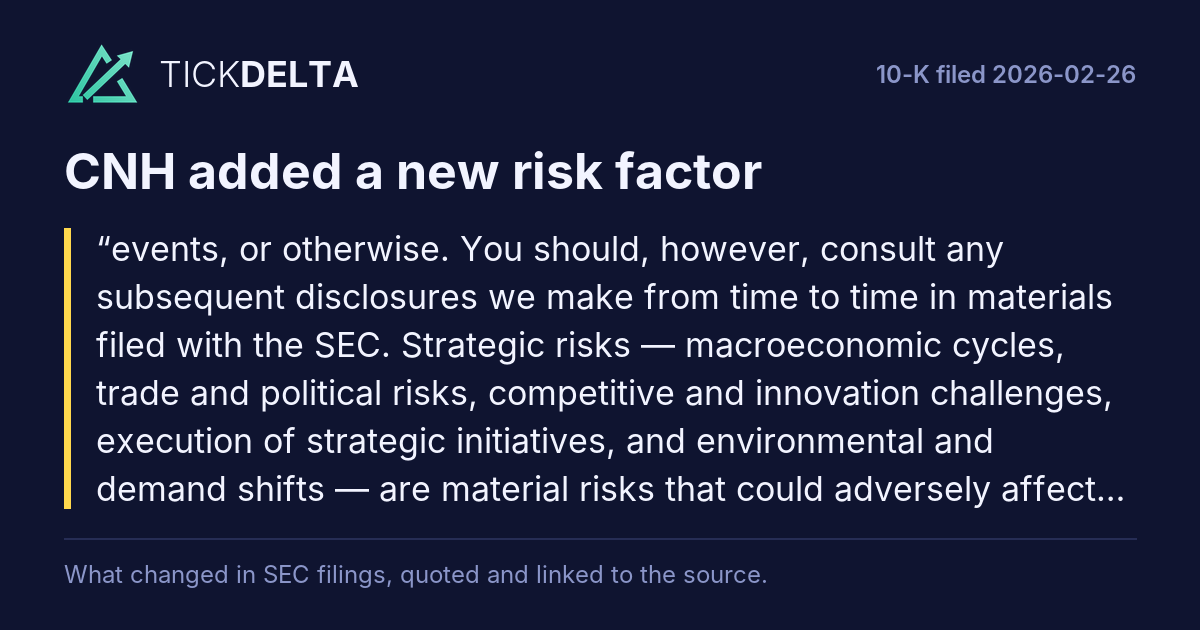
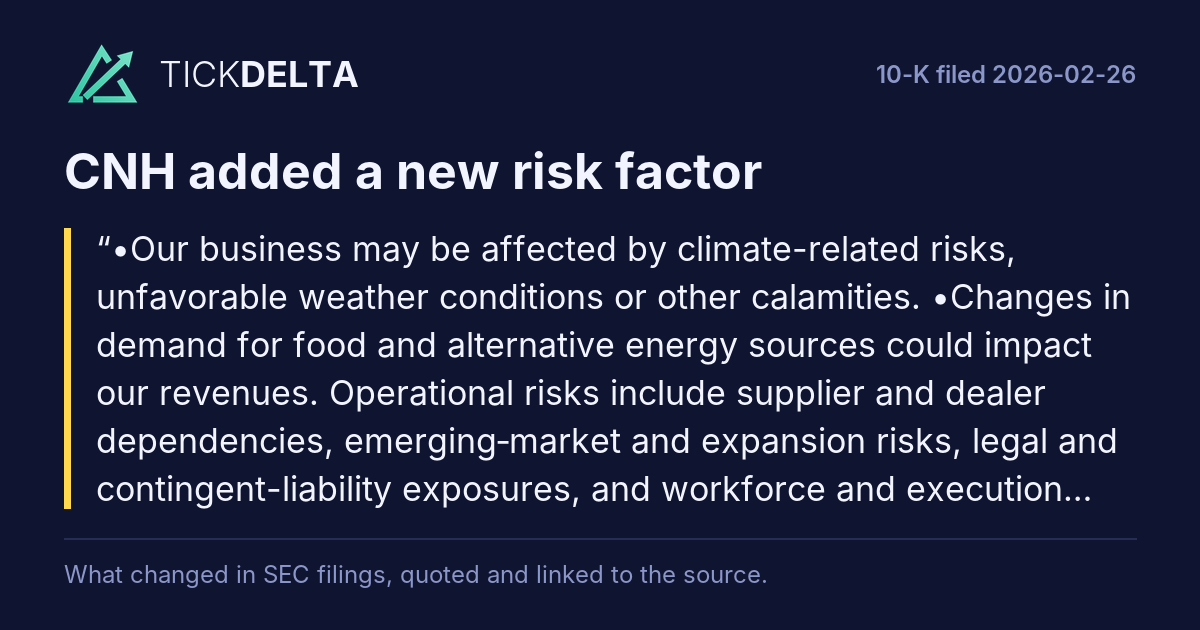
•Our business may be affected by climate-related risks, unfavorable weather conditions or other calamities.
•Changes in demand for food and alternative energy sources could impact our revenues.
Operational risks include supplier and dealer dependencies, emerging‑market and expansion risks, legal and contingent-liability exposures, and workforce and execution challenges that could materially affect our results.
•Our existing operations and expansion plans in emerging markets entail significant risks.
•Dealer equipment sourcing and inventory management decisions could adversely affect our sales.
•Our results of operations may be adversely impacted by various types of claims, lawsuits, and other contingent obligations.
•Our ability to execute our strategy depends upon our ability to attract, develop and retain qualified personnel.
Cybersecurity and digital risks include potential breaches, system failures, vulnerabilities in connected products, and technical or regulatory constraints that could limit the development and deployment of advanced automation, any of which could materially affect operations, data security, and our financial or reputational position.
•Cybersecurity breaches or IT system disruptions could impair operations, compromise data, and result in legal, financial, or reputational harm.
•Our information technology systems may be susceptible to cybersecurity threats, failures, and other disruptions.
•Unauthorized access to, or manipulation of, our connected products could diminish customer confidence and result in potential legal or financial exposure.
•Technical or regulatory limitations may impact our ability to develop and deploy advanced automation, autonomy, and artificial intelligence.
•Disruptions or failures in our technology systems could adversely affect our business.
Compliance risks include evolving regulatory requirements, privacy and financial‑services rule changes, enforcement exposure that could materially affect our financial condition, results and investor confidence.
•We are subject to increasingly stringent and evolving laws that impose significant compliance costs.
•We are subject to extensive laws and regulations, the violation of which could expose CNH to potential liabilities, increased costs and other adverse effects. .
•New regulations or changes in financial services regulations could adversely impact us.
Financial and taxation risks — including financing and covenant constraints, market volatility, Financial Services credit concentration, pension funding, high leverage, tax‑residency and passive foreign investment company ("PFIC") exposure — could materially affect our liquidity, results of operations and cash flows.
•Difficulty in obtaining financing or refinancing existing debt could impact our financial performance.
•We are subject to exchange rate fluctuations, interest rate changes and other market risks.
•Because Financial Services provides financing for a significant portion of our sales worldwide, our operations and financial results could be impacted materially should negative economic conditions affect the financial services industry.
•An increase in delinquencies or repossessions could adversely affect the results of Financial Services.
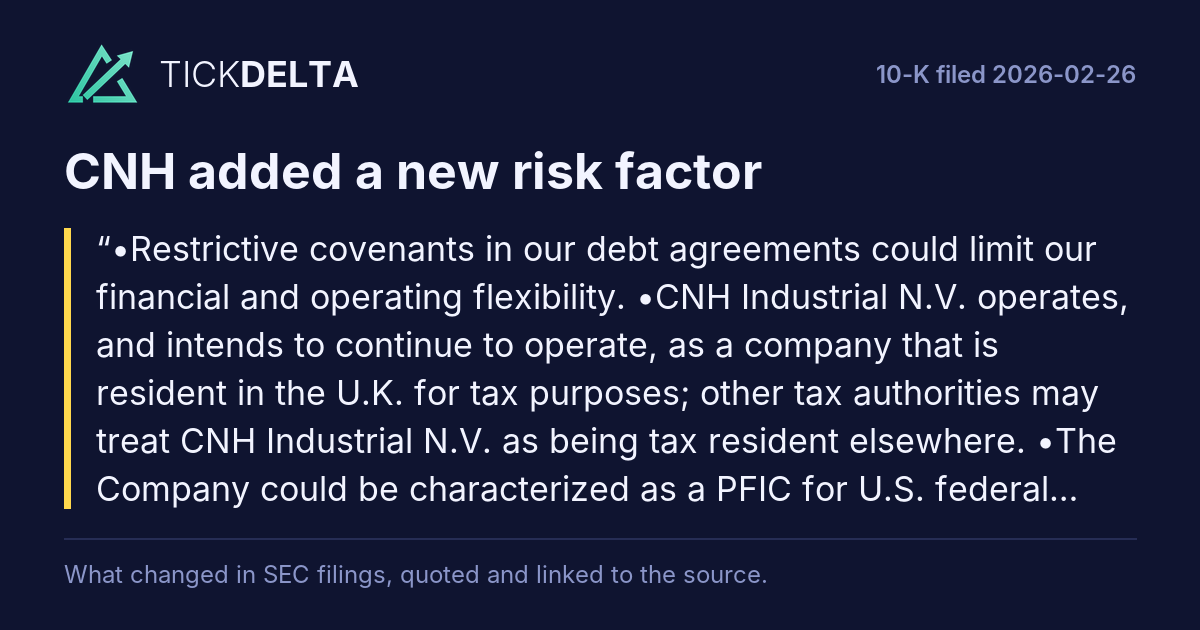
•Restrictive covenants in our debt agreements could limit our financial and operating flexibility.
•CNH Industrial N.V. operates, and intends to continue to operate, as a company that is resident in the U.K. for tax purposes; other tax authorities may treat CNH Industrial N.V. as being tax resident elsewhere.
•The Company could be characterized as a PFIC for U.S. federal income tax purposes
•We may incur additional tax expense or become subject to additional tax exposure.
Risks related to our common shares: The loyalty voting program may reduce share liquidity and market value, entrench existing management, deter potential acquirers and increase governance and investor‑relations risks, any of which could negatively affect the market price of our common shares.
•The loyalty voting program may affect the liquidity of our common shares and reduce our share price.
•The loyalty voting program may prevent or frustrate attempts by our shareholders to change our management and hinder efforts to acquire a controlling interest in us, and the market price of our common shares may be lower as a result
These risks should be considered in light of the actions we have taken to strengthen our business model, including targeted cost‑reduction initiatives, supply‑chain transformation programs such as the Strategic Sourcing Program, our company‑wide quality agenda, and maintaining robust liquidity and funding access. While these initiatives do not eliminate the risks described below, they are intended to enhance our resilience through industry cycles and periods of macroeconomic and trade uncertainty.
Our success largely depends on the vitality of the agricultural industry, which tends to exhibit cyclicality. Negative conditions in the agricultural industry cause weakened demand for our products and services, might limit our access to funding and adversely affect our operating efficiencies. Historically, the agricultural industry has been cyclical and subject
In 2025, unfavorable market conditions resulted in lower sales volumes, lower production, lower manufacturing capacity utilization, higher sales discounts, and a higher provision for credit losses. We expect certain of these conditions to persist in fiscal year 2026. Changes in interest rates and the agricultural market business cycle are driven by factors outside of our control; however, we are calibrating production, inventory levels, and commercial programs to current conditions and will adjust as markets stabilize.
Show the other 6
•changes in, and uncertainty concerning, laws, regulations and policies, and particularly changes and uncertainty that affect, among other things:
International trade policies may impact demand for our products and our competitive position. International trade developments or changes in national laws and policies can affect demand for our products and our competitive position. Government laws and policies on international trade and investment including sanctions, import quotas, capital controls, tariffs or other retaliatory measures imposed in response to tariffs, whether adopted by non-governmental bodies, individual governments or addressed by regional trade blocks, affect the demand for our products, technology and services, impact the competitive position of our products and, in some instances may prevent us from being able to sell products to certain customers or in certain countries. The U.S. government has announced and/or implemented significant new tariffs, including targeted duties on imported steel and aluminum products, as well as baseline tariffs affecting the majority of global imports. These measures have resulted in (and may in the future result in additional) counter tariffs and other retaliatory measures by other countries. Furthermore, restrictions in trade resulting from such measures, as well as the resulting impact on global trade and general economic conditions, has had an adverse effect on our business, results of operations and financial condition; has adversely impacted the availability to us of certain products in certain countries and has disrupted our supply chains, with related impacts to our financial position and results of operations; has impacted the purchasing power and creditworthiness of our customers, resulting in reduced demand in our Industrial Activities segments or losses in our Financial Services segment; and could exacerbate inflation, diminish investment and result in broader negative impacts, including economic instability that may adversely impact demand for our products. In addition, to the extent we are unable to fully recover higher costs resulting from such measures, our margins and profitability could decline. We may be unable to increase prices concurrently with the implementation of new tariffs, which could result in a prolonged period before our prices align with the higher costs incurred from these tariffs. This delay in price adjustment may adversely affect our profit margins and overall financial performance. While there remains significant uncertainty around future policy decisions, we currently expect tariff‑related cost pressures to remain elevated into 2026, particularly in North America, and we continue to adjust sourcing, pricing, and production plans in response.
Competitive activity, or failure by us to respond to actions by our competitors, could adversely affect our results of operations. We operate in highly competitive global and regional markets. Depending on the particular country and product, we compete with other international, regional and local manufacturers and distributors of agricultural and
occurring at optimal times and may cause crop loss through increased disease or mold growth. Temperature affects the rate of growth, crop maturity, crop quality, and yield.
contingency recorded as a reserve and require us to make payments that exceed our reserves, which could have a material adverse effect on our results of operations and/or financial position. For further information see "Note 15: Commitments and Contingencies" to the Consolidated Financial Statements for the year ended December 31, 2025.
Cybersecurity breaches or IT system disruptions could impair operations, compromise data, and result in legal, financial, or reputational harm.
We rely extensively on information technology (“IT”) networks and systems—some internally managed and others operated by third‑party providers—to support and deliver a broad range of products, connected solutions, and business processes. These systems enable key functions across our operations, including product development and connectivity solutions, precision technologies, supply chain management, manufacturing, distribution, invoicing, and the collection of payments from customers and dealers. Our IT systems also support financial reporting, regulatory compliance, and internal controls.
We collect, process, and store confidential and sensitive data, including intellectual property, proprietary business information, and personal data from employees, dealers, suppliers, and customers. In addition, connected platforms and digital ecosystems process substantial volumes of agronomic, operational, and machine‑generated data to support customers and enable product development, including advanced analytics, automation solutions, and machine learning applications.
The secure and continuous operation of these systems, networks, and data environments, including those managed by third‑party cloud providers, is critical to our business operations and strategic objectives.
Our information technology systems may be susceptible to cybersecurity threats, failures, and other disruptions.
Despite our implementation of preventive and detective security controls, our IT networks and those of our partners have been, and may continue to be, targeted by increasingly sophisticated cyber threats, including malware, ransomware, phishing attempts, supply chain compromises, and attempts to breach system security through AI‑enabled attack techniques. These threats also include potential intrusions, data exfiltration, outages, and operational disruptions caused by human error, third‑party failures, system upgrades, natural disasters, or deliberate attacks by cybercriminals or state‑sponsored actors.
Our reliance on third‑party cloud and software‑as‑a‑service providers introduces additional risks because we do not control the underlying infrastructure. Misconfigurations, outages, or security weaknesses at vendors could result in operational disruptions, unauthorized access to data, or compromised system integrity.
Unauthorized access to, or manipulation of, our connected products could diminish customer confidence and result in potential legal or financial exposure. Our products rely on embedded software, electronic control units, connectivity modules, telematics interfaces, and networked communication systems. These technologies expose our equipment to cybersecurity threats, including attempts to gain unauthorized access, manipulate firmware or configuration data, spoof or disrupt in‑vehicle network messages, alter machine performance characteristics, or disable or circumvent emissions‑control or safety‑related systems. A successful compromise could result in unintended machine behavior, loss of availability of critical functions, system disruption, data manipulation, or unauthorized modification of operational, regulatory‑compliance, or safety‑related settings.
While we employ secure‑by‑design engineering practices, cybersecurity testing, and product‑lifecycle controls, residual vulnerabilities may remain and cannot always be fully mitigated prior to product release. Newly discovered vulnerabilities, evolving threat activity, aftermarket tuning devices, or customer or third‑party attempts to increase engine horsepower or defeat emissions‑control systems may require corrective updates, enhanced monitoring, or other measures. Failure to identify, prevent, or remediate such risks could result in regulatory enforcement actions, civil or criminal penalties, warranty or product‑liability claims, customer disputes, or reputational harm.
In addition, reports or perceptions, whether accurate or not, of unauthorized access to our products, systems, or data may create the impression that our products are vulnerable to malicious or unauthorized manipulation. Any actual or perceived vulnerability, unauthorized access, emissions‑system tampering, or loss of data could reduce customer confidence, diminish sales, or result in legal claims, governmental inquiries, liability, or regulatory penalties, any of which could adversely affect our business, results of operations, and financial condition.
Technical or regulatory limitations may impact our ability to develop and deploy advanced automation, autonomy, and artificial intelligence. We continue to expand the use of automation, machine learning, and artificial intelligence across our products and operations. Examples include targeted spraying technologies in our sprayers, collaborative autonomy features, computer‑vision‑driven implement automation, and digital agronomic tools that support customer decision‑making. These advancements depend on complex datasets, integration of emerging technologies, and robust data governance.
However, the development and deployment of these technologies involve inherent risks, such as:
•intellectual property considerations, particularly when leveraging third‑party AI tools;
•evolving privacy, data protection, and AI‑related regulatory frameworks affecting permissible uses of data and automation technologies.
If we fail to advance these technologies at a pace consistent with industry standards or customer expectations—or if competitors deploy more effective or trusted AI‑enabled solutions—our competitive position could be negatively affected.
Disruptions or failures in our technology systems could adversely affect our business. Our dependence on interconnected technology solutions across the enterprise continues to increase. System failures, difficulties in implementing new systems, poor integration, or unexpected outages could result in operational delays, reduced product demand, increased cost to serve customers, or inability to support dealers and end‑users effectively. A significant disruption in any of our core systems or digital platforms could weaken customer confidence and have a material adverse effect on our business, financial condition, and operating results.
Paragraphs in the 10-Q filed Nov 9, 2026 that were not in the one before
New in the latest 10-Q
14 paragraphs in the 10-Q filed Nov 9, 2026 with nothing like them in the 10-Q filed Aug 3, 2026 (at least half the words must differ; new numbers alone do not count). Quoted exactly, grouped by the item heading above them. This is text that changed, not a judgement of how serious it is.
10-Q
Certain prior-period amounts have been reclassified to conform to the current-period presentation. Such reclassifications had no effect on previously reported net income, total assets, total liabilities, shareholders' equity, or cash flows.
Read in the 10-Q
The Company accounts for tariff refunds as gain contingencies and, accordingly, does not recognize such amounts until realization is assured or substantially complete. For refund claims related to tariffs imposed under the International Emergency Economic Powers Act ("IEEPA"), the Company recognizes the benefit upon receipt of the refund following approval by U.S. Customs and Border Protection. Tariff refunds are recorded as a reduction of "Cost of goods sold" or "Inventories, net" as applicable.
Read in the 10-Q
The effective tax rates for the three and nine months ended September 30, 2026 were 89.9 % and 60.9 %, respectively, compared with 2.0 % and 25.4 % for the three and nine months ended September 30, 2025. The increases were primarily driven by a $ 156 million non-cash valuation allowance charge recorded in the third quarter of 2026 against deferred tax assets ("DTAs") in CNH's Financial Services segment in Brazil. The valuation allowance was recorded based on a period of sustained losses in Brazil and other available evidence indicating that sufficient future taxable income may not be generated to realize these DTAs.
Read in the 10-Q
September 30, 2026 December 31, 2025 Gross Accumulated Net Gross Accumulated Net
Read in the 10-Q
Restructuring reserves were $ 11 million and $ 15 million as of September 30, 2026 and December 31, 2025, respectively. The Company incurred restructuring expenses of $ 11 million and $ 39 million during the three and nine months ended September 30, 2026, respectively, and $ 3 million and $ 14 million during the three and nine months ended September 30, 2025. Restructuring expenses primarily related to severance, facility-related costs, and contract termination costs incurred for programs that materially change either the scope of a business undertaken by the Company, or the manner in which that business is conducted.
Read in the 10-Q
Show the other 9
(1) Other Restructuring costs also include contract termination costs related to our dealer network optimization initiatives and other actions undertaken to improve operational efficiency.
Read in the 10-Q
During the third quarter of 2026, Banco CNH Industrial Capital S.A., a subsidiary of CNH, entered into a Mutual Termination Agreement with Iveco Capital Solutions S.p.A., a subsidiary of Iveco Group, to terminate a loss pool guarantee arrangement related to certain retail financing activities in Brazil. Pursuant to the agreement, Iveco Capital Solutions S.p.A. agreed to make a final settlement payment of $ 10.4 million (BRL 53.9 million). As of September 30, 2026, CNH recognized a corresponding financial receivable from Iveco Group. The settlement resulted in $ 7.4 million of income recognized during both the three and nine months ended September 30, 2026.
Read in the 10-Q
On November 9, 2026, the Company entered into a Transaction Agreement with Kobelco Construction Machinery Co., Ltd. pursuant to which the Company has agreed to sell a 70 % interest in its Construction Equipment business.
Read in the 10-Q
Prior to the closing of the transaction, the Company expects to complete an internal reorganization under which the assets, liabilities, and legal entities comprising the Construction Equipment business will be contributed to three wholly owned subsidiaries. Upon completion of the reorganization, the Company expects to sell 70 % of the equity interests in such subsidiaries and Kobelco Construction Machinery Co., Ltd. will operate them in the future.
Read in the 10-Q
Subject to adjustments described below, the Company expects to receive $ 700 million in cash, equal to 70 % of an agreed enterprise value of $ 1 billion. The purchase price will be adjusted for cash, indebtedness, and net working capital as of a specified date prior to closing, reduced by certain transaction-related expenses, and will be subject to customary post-closing adjustments. The amount of the gain that may be recognized upon completion of the transaction cannot be determined at this time.
Read in the 10-Q
The transaction is expected to close by the end of 2027, subject to the satisfaction or waiver of customary closing conditions, including applicable regulatory approvals.
Read in the 10-Q
The increase in income tax expense and effective tax rates was primarily driven by a $156 million non-cash valuation allowance charge recorded in the third quarter of 2026 against DTAs in CNH’s Financial Services segment in Brazil. As of September 30, 2026, the Company had incurred cumulative losses in Brazil over the preceding 36 months, which represented significant objective negative evidence regarding the realizability of these DTAs and limited management’s ability to place significant reliance on projections of future taxable income. Management's assessment of the realizability of DTAs requires significant judgment regarding the timing and amount of future taxable income and is subject to assumptions and uncertainties related to future operating results, economic and market conditions in Brazil, future delinquencies, and interest rate movements. Based on the cumulative loss position and other available evidence, management concluded that it is more likely than not that these DTAs will not be realized through future taxable income and, accordingly, recorded a valuation allowance. The valuation allowance may be reduced or released in future periods if sufficient positive evidence emerges, including sustained profitability or other sources of taxable income.
Read in the 10-Q
The charge did not impact cash taxes payable but increased income tax expense and effective tax rates for the three- and
Read in the 10-Q
Management's assessment of the realizability of DTAs requires significant judgment regarding the timing and amount of future taxable income. During the third quarter of 2026, the Company recorded a $156 million non-cash valuation allowance charge against DTAs in its Financial Services segment in Brazil. As of September 30, 2026, the Company had incurred cumulative losses in Brazil over the preceding 36 months, which represented significant objective negative evidence regarding the realizability of these DTAs. This cumulative loss position limited the Company's ability to place significant reliance on projections of future taxable income and other subjective positive evidence. Accordingly, after considering the cumulative losses and other available evidence, the Company concluded that sufficient future taxable income may not be generated to realize these DTAs and recorded the valuation allowance.
Read in the 10-Q
The 10-Q's risk factors against the 10-K
Item 1A of the 10-Q filed Nov 9, 2026 against Item 1A of the 10-K filed Feb 26, 2026.
A 10-Q repeats only the risks that changed, so a 10-K paragraph that is missing from it is not counted as removed.
Added is a paragraph with nothing like it in the 10-K, Reworded a sentence that is in both with several words changed,
Quiet changes a sentence in both where one to four words changed and one is a hedge or a modal
(cut words struck through, new words highlighted).
Text on the page, not a score; each links to the filing at sec.gov.
What the 10-Q itself says about its risk factors:There have been no material changes to the risk factors disclosed in our Annual Report on Form 10-K ( Part I, Item 1A) for the year ended December 31, 2025. The risks described in those reports, and in the "Safe Harbor Statement" within this report are not the only risks faced by us. Additional risks and uncertainties not currently known, or that are currently judged to be immaterial, may also materially affect our business, financial condition or operating results.
Read in the 10-Q
1 paragraph in the 10-Q's Item 1A, and none of them adds, rewords or quietly edits a paragraph of the 10-K's.
Phrases used for the first time
Two-word phrases in Risk Factors of the 10-K filed Feb 26, 2026 that are in none of the 1 earlier 10-Ks stored, back to Feb 28, 2025
Where each one is used
- connected products: Cybersecurity and digital risks include potential breaches, system failures, vulnerabilities in connected products, and technical or regulatory constraints that could limit the development and deployment of advanced automation, any of which could materially affect operations, data security, and our financial or...
- advanced automation: Cybersecurity and digital risks include potential breaches, system failures, vulnerabilities in connected products, and technical or regulatory constraints that could limit the development and deployment of advanced automation, any of which could materially affect operations, data security, and our financial or...
- reputational harm: •Cybersecurity breaches or IT system disruptions could impair operations, compromise data, and result in legal, financial, or reputational harm.
- cybersecurity threats: •Our information technology systems may be susceptible to cybersecurity threats, failures, and other disruptions.
- higher costs: to a variety of economic and other factors. Sales of agricultural equipment, in turn, are also cyclical and generally reflect the economic health of the agricultural industry. The economic health of the agricultural industry is affected by numerous factors, including changes in general economic conditions farm...
- cycle impact: •Global economic conditions, including the agricultural market business cycle, impact our businesses.
- climate-related risks: •Our business may be affected by climate-related risks, unfavorable weather conditions or other calamities.
- risks unfavorable: •Our business may be affected by climate-related risks, unfavorable weather conditions or other calamities.
Used at least twice, small words left out. Counted, not picked: a phrase can be new because the company renamed something.
What was taken out
11 paragraphs of last year's Risk Factors with nothing like them now. The longest are quoted.
Sources
Item 1A of each 10-K and 10-Q on EDGAR, quoted exactly. Each paragraph links to the filing at sec.gov.
Also
10-K change: what was reworded or cut, section by section.
Work with it
Excel workbook · CSV. Google Sheet that stays up to date: paste =IMPORTDATA("https://tickdelta.com/company/CNH/export.csv") into a cell.