Paragraph 72 · 49% changed
Every version of it
Screener
/
SEC EDGAR
/CIK 0001224608
/10-K filed Feb 24, 2026, compared with Feb 26, 2025
/Numbers from the XBRL of the 10-Ks
NYSE
Financials · Health Insurance
CNO Financial Group, Inc. CNO
The 10-K against last year's
213 changes: 26 added, 18 removed, 165 reworded, 4 quiet changes
10-K Feb 24, 2026 vs Feb 26, 2025
Risk Factors
10.7%
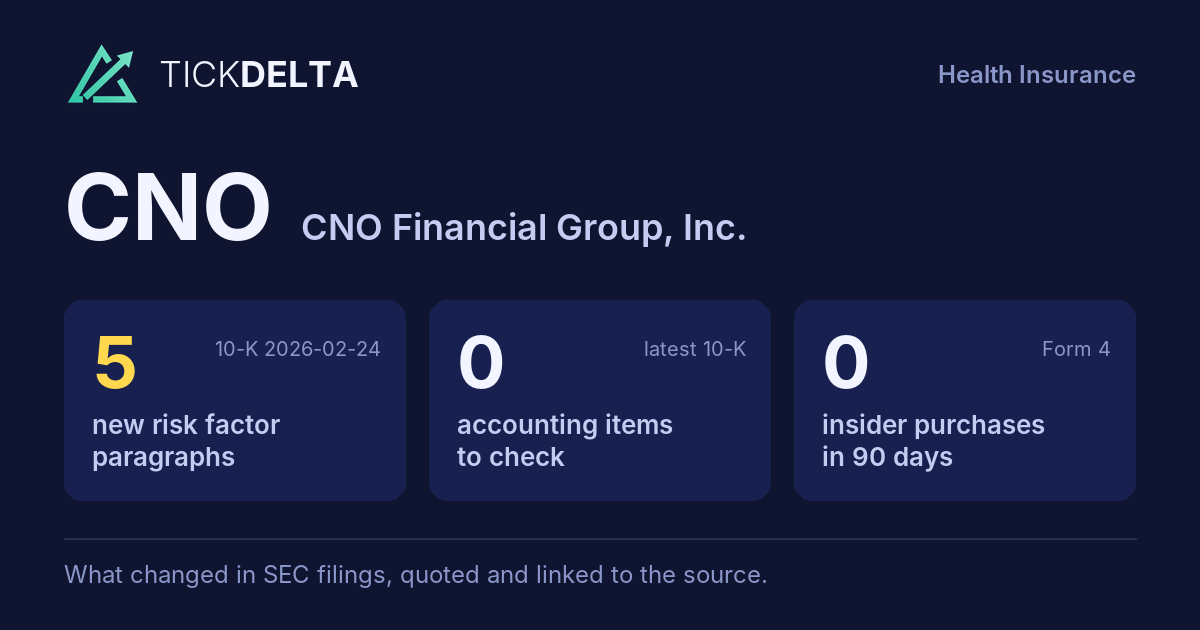
of the text changed · 11,145 words now · 5 new paragraphs, 1 gone
MD&A
20.0%
of the text changed · 19,223 words now · 21 new paragraphs, 17 gone
Legal Proceedings
17.1%
of the text changed · 1,900 words now
Accounting Policies
24.8%
of the text changed · 6,989 words now
10-K 0001224608-26-000017 (Feb 24, 2026) vs 10-K 0001224608-25-000006 (Feb 26, 2025)
Every paragraph, and how much of it changed
One bar per paragraph, in the order of the 10-K. Height and colour show the share of its words not in the closest paragraph a year earlier; the tallest bars are new paragraphs.
Risk Factors
130 paragraphs · 5 new · 42 reworded · 1 gone · 10-K Feb 24, 2026 against Feb 26, 2025
New paragraph
Reworded (5% of its words or more)
Same or nearly
Paragraph 28 · 46% changed
Every version of it
In determining fair value, we generally utilize market transaction data for the same or similar instruments. The degree of management judgment involved in determining fair values is inversely related to the availability of market observable information. Since significant observable market inputs are not available for certain securities, it may be difficult to value them. The fair value of financial assets and financial liabilities may differ from the amount actually received to sell an asset or the amount paid to transfer a liability in an orderly transaction between market participants at the measurement date. Moreover, the use of different valuation assumptions may have a material effect on the fair values
Paragraph 113 · 46% changed
Every version of it
Paragraph 128 · 45% changed
Every version of it
We rely on a combination of contractual rights and copyright, trademark and trade secret laws to establish and protect our intellectual property. Although we use a broad range of measures to protect our intellectual property rights, third parties may infringe or misappropriate our intellectual property. We may have to litigate to enforce and protect our copyrights, trademarks, trade secrets and know-how or to determine their scope, validity or enforceability, which represents a diversion of resources that may be significant in amount and may not prove successful. The loss of intellectual property protection or the inability to secure or enforce the protection of our intellectual property assets could adversely impact our business and its ability to compete effectively.
Paragraph 106 · 44% changed
Every version of it
Paragraph 39 · 34% changed
Every version of it
which our actual claims experience and future expenses are consistent with the assumptions we used in setting our reserves. If our future claims are higher than our assumptions, and our reserves prove to be insufficient to cover our actual losses and expenses, we would be required to increase our liabilities, and this could have a material adverse effect on our results of operations and financial condition.
Paragraph 109 · 30% changed
Every version of it
The use or anticipated use of AI technologies, including generative AI, by us or third parties, may increase the operational risks discussed above, or create new or unanticipated operational risks.
Paragraph 98 · 26% changed
Every version of it
Our investment portfolio may be adversely affected as a result of any delays or failures of borrowers to make payments of principal and interest when due or delays or moratoriums on foreclosures, enforcement actions with respect to delinquent or defaulted mortgages imposed by governmental authorities or the failure of tenants to pay rent or tenants' demands for lease modifications. due. Further, severe market volatility may leave us unable to react to market events in a prudent manner consistent with our historical investment practices. Market dislocations, decreases in observable market
Paragraph 72 · 49% changed
Every version of it
10-K Feb 26, 2025Our insurance business is subject to extensive regulation and supervision in the jurisdictions in which we operate. See "Business of CNO - Governmental Regulation." Our insurance subsidiaries are subject to state insurance laws that establish supervisory agencies. The regulations issued by state insurance agencies can be complex and subject to differing interpretations. If a state insurance regulatory agency determines that one of our insurance subsidiaries is not in compliance with applicable regulations, the subsidiary is subject to various potential administrative remedies including, without limitation, monetary penalties, restrictions on the subsidiary's ability to do business in that state and a return of a portion of policyholder premiums. In addition, regulatory action or investigations could cause us to suffer significant reputational harm, which could have an adverse effect on our business, financial condition and results of operations.
10-K Feb 24, 2026
portion of policyholder premiums. In addition, regulatory action or investigations could cause us to suffer significant reputational harm, which could have an adverse effect on our business, financial condition and results of operations.
Paragraph 28 · 46% changed
Every version of it
10-K Feb 26, 2025
In determining fair value, we generally utilize market transaction data for the same or similar instruments. The degree of management judgment involved in determining fair values is inversely related to the availability of market observable information. Since significant observable market inputs are not available for certain securities, it may be difficult to value them. The fair value of financial assets and financial liabilities may differ from the amount actually received to sell an asset or the amount paid to transfer a liability in an orderly transaction between market participants at the measurement date. Moreover, the use of different valuation assumptions may have a material effect on the fair values
10-K Feb 24, 2026
In determining fair value, we generally utilize market transaction data for the same or similar instruments. The degree of management judgment involved in determining fair values is inversely related to the availability of market
Paragraph 113 · 46% changed
Every version of it
10-K Feb 26, 2025We utilize third-party vendors to provide certain business support services and functions, which exposes us to risks outside our control that may lead to business interruption or compromise. For example, we outsource certain information technology and policy administration operations to third-party service providers (both domestic and international). If we fail to maintain an effective outsourcing strategy or if third-party providers do not perform as contracted, we may experience operational difficulties, increased costs and a loss of business that could have a material adverse effect on our results of operations. In addition, enhanced regulatory and other standards for the oversight of vendors and other service providers could result in higher costs and other potential exposures. In the event that one or more of our third-party service providers becomes unable to continue to provide services, we may suffer financial loss and other negative consequences.
10-K Feb 24, 2026
providers could result in higher costs and other potential exposures. In the event that one or more of our third-party service providers becomes unable to continue to provide services, we may suffer financial loss and other negative consequences.
Paragraph 128 · 45% changed
Every version of it
10-K Feb 26, 2025
We rely on a combination of contractual rights and copyright, trademark and trade secret laws to establish and protect our intellectual property. Although we use a broad range of measures to protect our intellectual property rights, third parties may infringe or misappropriate our intellectual property. We may have to litigate to enforce and protect our copyrights, trademarks, trade secrets and know-how or to determine their scope, validity or enforceability, which represents a diversion of resources that may be significant in amount and may not prove successful. The loss of intellectual property protection or the inability to secure or enforce the protection of our intellectual property assets could adversely impact our business and its ability to compete effectively.
10-K Feb 24, 2026
We rely on a combination of contractual rights and copyright, trademark and trade secret laws to establish and protect our intellectual property. Although we use a broad range of measures to protect our intellectual property rights,
Paragraph 106 · 44% changed
Every version of it
10-K Feb 26, 2025We depend heavily on our telecommunication, information technology and other operational systems and on the integrity and timeliness of data we use to run our businesses and service our customers. These systems may fail to operate properly or become disabled as a result of events or circumstances which may be wholly or partly beyond our control including cyber-attack, denial of service, viruses or other malicious activities, power outages, hardware or software malfunction, defects or degradation, lack of proper maintenance, human error or misuse, and similar events. Further, we face the risk of operational and technology failures by others, including financial intermediaries, vendors and parties that provide services to us. If these parties do not perform as anticipated, we may experience operational difficulties, increased costs and other adverse effects on our business. We have implemented, and we require our vendors to implement, a variety of security measures to protect the confidentiality, availability, and integrity of our information systems and data. However, failure to maintain a reasonable and effective data protection and cybersecurity program, or any compromise of the security, confidentiality, integrity, or availability of our information systems and the sensitive, proprietary, and confidential data, including personal information, on such systems could lead to additional costs and liabilities, as well as damage our reputation or deter people from purchasing our products. We are periodically targeted by cybersecurity threat actors. In the past, we have experienced cybersecurity events resulting in the compromise of personal and confidential information of our customers. While no such cybersecurity event has been material, there can be no assurance that a future breach will not occur or, if any does occur, that it can be promptly detected and sufficiently remediated without materially impacting our business or our operations.
10-K Feb 24, 2026
additional costs and liabilities, as well as damage our reputation or deter people from purchasing our products. We are periodically targeted by cybersecurity threat actors. In the past, we have experienced cybersecurity events resulting in the compromise of personal and confidential information of our customers. While no such cybersecurity event has been material, there can be no assurance that a future breach will not occur or, if any does occur, that it can be promptly detected and sufficiently remediated without materially impacting our business, operations, or reputation.
Paragraph 39 · 34% changed
Every version of it
10-K Feb 26, 2025
expenses, we would be required to increase our liabilities, and this could have a material adverse effect on our results of operations and financial condition.
10-K Feb 24, 2026
which our actual claims experience and future expenses are consistent with the assumptions we used in setting our reserves. If our future claims are higher than our assumptions, and our reserves prove to be insufficient to cover our actual losses and expenses, we would be required to increase our liabilities, and this could have a material adverse effect on our results of operations and financial condition.
Paragraph 109 · 30% changed
Every version of it
10-K Feb 26, 2025
The use or anticipated use of AI technologies, including generative AI, by us or third
10-K Feb 24, 2026
The use or anticipated use of AI technologies, including generative AI, by us or third parties, may increase the operational risks discussed above, or create new or unanticipated operational risks.
Paragraph 98 · 26% changed
Every version of it
10-K Feb 26, 2025
Our investment portfolio may be adversely affected as a result of any delays or failures of borrowers to make payments of principal and interest when due or delays or moratoriums on foreclosures, enforcement actions with respect to delinquent or defaulted mortgages imposed by governmental authorities or the failure of tenants to pay rent or tenants' demands for lease modifications. Further, severe market volatility may leave us unable to react to market events in a prudent manner consistent with our historical investment practices. Market dislocations, decreases in observable market
10-K Feb 24, 2026
Our investment portfolio may be adversely affected as a result of any delays or failures of borrowers to make payments of principal and interest when due. Further, severe market volatility may leave us unable to react to market events in a prudent manner consistent with our historical investment practices.
MD&A
233 paragraphs · 21 new · 96 reworded · 17 gone · 10-K Feb 24, 2026 against Feb 26, 2025
New paragraph
Reworded (5% of its words or more)
Same or nearly
Paragraph 12 · 48% changed
Our fee income segment includes the earnings generated from sales of third-party insurance products (primarily Medicare Advantage), services provided by Optavise to employers through our Worksite division and the operations of our broker-dealer and registered investment advisor. In November 2025, we announced our intention to exit the fee services business within our Worksite Division to sharpen our focus on the core insurance business. As a result, beginning in fourth quarter of 2025, the net results of this business are no longer presented within the fee income segment, but are presented within net loss related to divested business within non-operating income. The resulting fee income metric is the fee income segment's measure of profitability.
Paragraph 109 · 47% changed
Paragraph 134 · 46% changed
Insurance statutes regulate the types of investments that our insurance subsidiaries are permitted to make and limit the amount of funds that may be used for any one type of investment. In addition, we have internal management compliance limits on various exposures and activities which are typically more restrictive than insurance statutes. In light of these statutes and regulations and our capital management strategy, we generally seek to invest in (i) highly rated securities such as United States government and government-agency securities and corporate securities rated investment grade by established nationally recognized rating organizations; (ii) securities of comparable investment quality, if not rated; or (iii) a limited quantity of other investments which offer differentiated return characteristics.
Paragraph 39 · 45% changed
Our non-life NOLs with no expiration date of $832.4 million can be used to offset 35 percent of life insurance company taxable income and 80 percent of non-life company taxable income. Our non-life NOLs with expiration dates can be used to offset 35 percent of life insurance company taxable income and 100 percent of non-life company taxable income until all non-life NOLs are utilized or expire. Our life NOLs with no expiration date of $127.5 million can be used to offset 80% of life company taxable income, subject to certain limitations in the Code. In addition, we expect March 2025, the Company executed a consent agreement with the IRS that provided formal approval for the tax method change for allocating indirect costs (pursuant to recognize approximately $800 the Code) to self-constructed real estate assets. As a result, the Company recharacterized the remaining $797.6 million of non-life NOLs on our 2024 tax return as capitalized indirect costs under the prior accounting method to a result of changes related to the tax accounting NOL with no expiration date.
Paragraph 92 · 45% changed
Paragraph 91 · 43% changed
Margin from Medicare supplement business was $106.1 million in 2025 compared to $113.9 million in 2024 compared to and $116.9 million in 2023 and $151.0 million in 2022. 2023. The Medicare supplement margin adjusted to exclude the impacts of the comprehensive annual actuarial review previously discussed was $115.3 million, $123.3 million, million and $127.5 million in 2025, 2024 and $151.0 million in 2024, 2023 and 2022, 2023, respectively. The adjusted margin as a percentage of insurance policy income was 18 percent, 20 percent, percent and 21 percent in 2025, 2024 and 23 percent 2023, respectively. Insurance policy income was $627.0 million in 2024, 2023 and 2022, respectively. The slight decrease in the adjusted margin in 2024, as 2025 compared to 2023, is primarily due to higher morbidity. $620.5 million in 2024 and $619.9 million in 2023. The decrease in the adjusted margin in 2023 2025, as compared to 2022, 2024, is primarily due to modestly higher claims in 2025 compared to 2024, partially offset by growth in the block. The decrease in the adjusted margin in 2024 compared to 2023, was primarily due to a reduction higher claims in the size of the block and higher morbidity. 2024 compared to 2023. Claim experience will fluctuate from period to period. Insurance policy income was $620.5 million in 2024 compared We are able to $619.9 million in 2023 and $657.8 million in 2022. Over the last several years, we have experienced a shift in the sale of Medicare supplement policies to the sale of Medicare Advantage policies. We receive fee income when Medicare Advantage policies of other providers are sold, which is recorded in our Fee income segment. We continue to invest in both re-rate our Medicare supplement products Supplement business annually. Each year we review experience and Medicare Advantage distribution regulatory requirements to meet arrive at appropriate rate actions. We file rate increase requests with individual states and historically have received approvals generally aligned with our customers' needs and preferences. We launched a new competitive Medicare supplement product in 2022 resulting in sales growth over the past two years. requests.
Paragraph 140 · 39% changed
Paragraph 71 · 38% changed
Insurance product margin was $1,067.6 million, $1,040.0 million, million and $959.0 million in 2025, 2024 and $936.5 2023, respectively. Excluding significant items primarily related to our comprehensive annual actuarial review, the insurance product margin was $1,019.5 million, $1,012.7 million and $925.1 million in 2024, 2023 2025, 2024 and 2022, respectively. Insurance product margin, excluding the impacts summarized in the table above, were $1,012.7 million, $925.1 million and $935.8 million in 2024, 2023 and 2022, 2023, respectively. Fluctuations by product line are discussed in greater detail in the narratives that follow.Total allocated and unallocated expenses are summarized in the table below. Expenses not allocated to product lines include certain significant items listed in the table below. Total allocated and unallocated expenses as adjusted for the significant items are summarized below (dollars in millions): follow.
Paragraph 12 · 48% changed
10-K Feb 26, 2025
Our fee income segment includes the earnings generated from sales of third-party insurance products (primarily Medicare Advantage), services provided by Optavise and the operations of our broker-dealer and registered investment advisor.
10-K Feb 24, 2026
Our fee income segment includes the earnings generated from sales of third-party insurance products (primarily Medicare Advantage), services provided to employers through our Worksite division and the operations of our broker-dealer and registered investment advisor. In November 2025, we announced our intention to exit the fee services business within our Worksite Division to sharpen our focus on the core insurance business. As a result, beginning in fourth quarter of 2025, the net results of this business are no longer presented within the fee income segment, but are presented within net loss related to divested business within non-operating income. The resulting fee income metric is the fee income segment's measure of profitability.
Paragraph 109 · 47% changed
10-K Feb 26, 20252024 2023 2022 Net realized investment gains (losses) from sales, impairments and change in allowance for credit losses $ (72.7) $ (62.7) $ (62.2) Net change in market value of investments recognized in earnings 22.8 (6.3) (73.2) Fair value changes related to agent deferred compensation plan 6.6 (3.5) 48.9 Changes in fair value of embedded derivative liabilities and market risk benefits 24.7 (29.9) 440.2 Other (13.9) (0.3) (3.9) Net non-operating income (loss) before taxes $ (32.5) $ (102.7) $ 349.8
10-K Feb 24, 2026
Net realized investment gains (losses) from disposals, impairments and change in allowance for credit losses $ (69.0) $ (72.7) $ (62.7)
Paragraph 134 · 46% changed
10-K Feb 26, 2025
Insurance statutes regulate the types of investments that our insurance subsidiaries are permitted to make and limit the amount of funds that may be used for any one type of investment. In addition, we have internal management compliance limits on various exposures and activities which are typically more restrictive than insurance statutes. In light of these statutes and regulations and our capital management strategy, we generally seek to invest in (i) highly rated securities such as United States government and government-agency securities and corporate securities rated investment grade by established nationally recognized rating organizations; (ii) securities of comparable investment quality, if not rated; or (iii) a limited quantity of other investments which offer differentiated return characteristics.
10-K Feb 24, 2026
Insurance statutes regulate the types of investments that our insurance subsidiaries are permitted to make and limit the amount of funds that may be used for any one type of investment. In addition, we have internal management
Paragraph 39 · 45% changed
10-K Feb 26, 2025
Our non-life NOLs can be used to offset 35 percent of life insurance company taxable income and 100 percent of non-life company taxable income until all non-life NOLs are utilized or expire. In addition, we expect to recognize approximately $800 million of non-life NOLs on our 2024 tax return as a result of changes related to the tax accounting
10-K Feb 24, 2026
Our non-life NOLs with no expiration date of $832.4 million can be used to offset 35 percent of life insurance company taxable income and 80 percent of non-life company taxable income. Our non-life NOLs with expiration dates can be used to offset 35 percent of life insurance company taxable income and 100 percent of non-life company taxable income until all non-life NOLs are utilized or expire. Our life NOLs with no expiration date of $127.5 million can be used to offset 80% of life company taxable income, subject to certain limitations in the Code. In March 2025, the Company executed a consent agreement with the IRS that provided formal approval for the tax method change for allocating indirect costs (pursuant to the Code) to self-constructed real estate assets. As a result, the Company recharacterized the remaining $797.6 million of capitalized indirect costs under the prior accounting method to a NOL with no expiration date.
Paragraph 92 · 45% changed
10-K Feb 26, 2025Collected premiums on Medicare supplement policies were $625.7 million, $609.4 million and $651.6 million in 2024, 2023 and 2022, respectively. Prior to 2023, decreases were driven by lower sales partially offset by premium rate increases. In recent years, we have experienced a shift in the sale of Medicare supplement policies to the sale of Medicare Advantage policies. We receive fee income when Medicare Advantage policies of other providers are sold, which is recorded in our Fee income segment. We continue to invest in both our Medicare supplement products and Medicare Advantage distribution to ensure we are well-positioned to meet our customers' needs and preferences. We launched a new competitive Medicare supplement product in 2022 resulting in sales growth over the past two years.
10-K Feb 24, 2026
Medicare supplement sales were very strong in the fourth quarter, reflecting a growing shift in consumer preferences from Medicare Advantage to Medicare Supplement, reversing a decade-long trend. Most of these sales were on policies with effective dates in January 2026 and therefore, will be reflected in our 2026 results. We continue to invest in both our Medicare supplement products and Medicare Advantage distribution to meet our customers' needs and preferences. We receive fee income when Medicare Advantage policies of other carriers are sold, which is recorded in our Fee income segment.
Paragraph 91 · 43% changed
10-K Feb 26, 2025
Margin from Medicare supplement business was $113.9 million in 2024 compared to $116.9 million in 2023 and $151.0 million in 2022. The Medicare supplement margin adjusted to exclude the impacts of the annual actuarial review previously discussed was $123.3 million, $127.5 million and $151.0 million in 2024, 2023 and 2022, respectively. The adjusted margin as a percentage of insurance policy income was 20 percent, 21 percent and 23 percent in 2024, 2023 and 2022, respectively. The slight decrease in the adjusted margin in 2024, as compared to 2023, is primarily due to higher morbidity. The decrease in the adjusted margin in 2023 compared to 2022, was primarily due to a reduction in the size of the block and higher morbidity. Claim experience will fluctuate from period to period. Insurance policy income was $620.5 million in 2024 compared to $619.9 million in 2023 and $657.8 million in 2022. Over the last several years, we have experienced a shift in the sale of Medicare supplement policies to the sale of Medicare Advantage policies. We receive fee income when Medicare Advantage policies of other providers are sold, which is recorded in our Fee income segment. We continue to invest in both our Medicare supplement products and Medicare Advantage distribution to meet our customers' needs and preferences. We launched a new competitive Medicare supplement product in 2022 resulting in sales growth over the past two years.
10-K Feb 24, 2026
Margin from Medicare supplement business was $106.1 million in 2025 compared to $113.9 million in 2024 and $116.9 million in 2023. The Medicare supplement margin adjusted to exclude the impacts of the comprehensive annual actuarial review previously discussed was $115.3 million, $123.3 million and $127.5 million in 2025, 2024 and 2023, respectively. The adjusted margin as a percentage of insurance policy income was 18 percent, 20 percent and 21 percent in 2025, 2024 and 2023, respectively. Insurance policy income was $627.0 million in 2025 compared to $620.5 million in 2024 and $619.9 million in 2023. The decrease in the adjusted margin in 2025, as compared to 2024, is primarily due to modestly higher claims in 2025 compared to 2024, partially offset by growth in the block. The decrease in the adjusted margin in 2024 compared to 2023, was primarily due to higher claims in 2024 compared to 2023. Claim experience will fluctuate from period to period. We are able to re-rate our Medicare Supplement business annually. Each year we review experience and regulatory requirements to arrive at appropriate rate actions. We file rate increase requests with individual states and historically have received approvals generally aligned with our requests.
Paragraph 140 · 39% changed
10-K Feb 26, 2025We continually evaluate the creditworthiness of each issuer whose securities we hold. We pay special attention to large investments, investments which have significant risk characteristics and to those securities whose fair values have declined materially for reasons other than changes in general market conditions. We evaluate the realizable value of the investment, the specific condition of the issuer and the issuer's ability to comply with the material terms of the security. We review the historical and recent operational results and financial position of the issuer, information about its industry, information about factors affecting the issuer's performance and other information. 40|86 Advisors employs experienced securities analysts in a broad variety of specialty areas who compile and review such data. During 2024, we recognized net investment losses of $49.9 million, which were comprised of: (i) $75.6 million of net losses from the sales of investments; (ii) $0.4 million of losses related to equity securities, including the change in fair value; (iii) the net increase in fair value of certain other invested assets and fixed maturity investments with embedded derivatives of $24.4 million; (iv) the increase in fair value of embedded derivatives related to a modified coinsurance agreement of $0.4 million; (v) $3.9 million of gains related to the liquidation of VIEs; and (vi) investment write-downs offset by a net decrease in the allowance for credit losses of $2.6 million.
10-K Feb 24, 2026
During 2025, we recognized net investment losses of $54.7 million, which were comprised of: (i) $59.7 million of net losses from the sales of investments; (ii) $1.4 million of gains related to equity securities, including the change in fair value; (iii) the net increase in fair value of certain other invested assets and fixed maturity investments with embedded derivatives of $8.0 million; (iv) the increase in fair value of embedded derivatives related to a modified coinsurance agreement of $1.8 million; and (v) net increase in the allowance for credit losses and investment write-downs of $6.2 million.
Paragraph 71 · 38% changed
10-K Feb 26, 2025
Insurance product margin was $1,040.0 million, $959.0 million and $936.5 million in 2024, 2023 and 2022, respectively. Insurance product margin, excluding the impacts summarized in the table above, were $1,012.7 million, $925.1 million and $935.8 million in 2024, 2023 and 2022, respectively. Fluctuations by product line are discussed in greater detail in the narratives that follow.Total allocated and unallocated expenses are summarized in the table below. Expenses not allocated to product lines include certain significant items listed in the table below. Total allocated and unallocated expenses as adjusted for the significant items are summarized below (dollars in millions):
10-K Feb 24, 2026
Insurance product margin was $1,067.6 million, $1,040.0 million and $959.0 million in 2025, 2024 and 2023, respectively. Excluding significant items primarily related to our comprehensive annual actuarial review, the insurance product margin was $1,019.5 million, $1,012.7 million and $925.1 million in 2025, 2024 and 2023, respectively. Fluctuations by product line are discussed in greater detail in the narratives that follow.
A paragraph is matched with the one last year that shares the most of its words; under half in common makes it new. The paragraphs shown are the 8 reworded the most in each section.
The paragraph that changed most in each section
The redline
Marked against last year's 10-K: cut words struck through, new words highlighted.
MD&A373 words changed in this paragraph; it is 30% similar to last year's version.
Source: Item 7, 10-K 0001224608-26-000017 vs Item 7, 10-K 0001224608-25-000006
Legal Proceedings260 words changed in this paragraph; it is 68% similar to last year's version.
On October 5, 2012, plaintiffs William Jeffrey Burnett and Joe H. Camp commenced an action entitled Burnett v. Conseco Life Ins. Co. against, among others, CNO Financial Group, Inc. and CNO Services, LLC (collectively, the "CNO Entities") in the United States District Court for the Central District of California on behalf of a putative class of former interest-sensitive whole life insurance policyholders who surrendered their policies or let them lapse. Plaintiffs' first amended mended complaint alleges that the CNO Entities are liable under an alter ego theory for Conseco Life Insurance Company's purported breach of the optional premium payment provision (the "Optional Premium Payment") and other provisions of plaintiffs' insurance policies. In January 2018, the case was transferred to the United States District Court for the Southern District of Indiana. On August 17, 2020, the Court denied the CNO Entities' motions to dismiss. On January 13, 2021, the Court granted final approval of a class action settlement between plaintiffs and co-defendant Conseco Life Insurance Company (n/k/a Wilco Life Insurance Company). The case remains pending against the CNO Entities. On March 25, 2022, the Court certified a Rule 23(b)(3) class of under 2,000 policyholders who invoked the policy's Optional Premium Payment prior to October 2008 and who surrendered their policies between October 7, 2008 and September 1, 2011. The Court's certification order acknowledged the existence of individualized issues of causation and damages, which the Court stated could be addressed in individualized proceedings following a class trial on the alter ego allegations and the meaning of the subject insurance policy language. On September 25, 2024, the Court granted in part and denied in part the CNO Entities' Motion for Summary Judgment on the breach of contract claim. On November 12, 2024, the Court granted CNO Entities' Motion to Bifurcate the trials of the breach of contract and alter ego claims. The A three-day jury trial on causation and damages as to the breach of contract claim is scheduled to begin two class representatives commenced on June 16, 2025; 2025, and the jury returned a verdict in favor of the class representatives on June 18, 2025 for approximately $0.2 million collectively. This verdict is notional and contingent and has no preclusive effect on any follow on trials by absent class members in terms of causation and damages. The class representatives' ability to collect any damages from the CNO Entities will depend on the outcome of the bench trial on alter ego liability. The bench trial on alter ego liability was held between August 26 to September 2, 2025, but no ruling has been made yet. The parties prepared post-trial briefing, which was completed at the end of December 2025. Any liability of any kind will depend on the outcome of the alter ego claim is scheduled trial, and in the event the court rules in favor of Plaintiffs on that issue, whether absent class members will participate in follow on trials to begin determine whether they are entitled to damages, and the outcome of those trials. The outcome of all trials will be subject to appeal. Any follow on August 12, 2025. trials and appeals with respect to absent class members may take years to resolve. The CNO Entities continue to vigorously defend the case.
Source: Item 3, via Note 8 – COMMITMENTS AND CONTINGENCIES, 10-K 0001224608-26-000017 vs Item 3, via Note 8 – COMMITMENTS AND CONTINGENCIES, 10-K 0001224608-25-000006
Risk Factors148 words changed in this paragraph; it is 70% similar to last year's version.
Insurance companies historically have been subject to substantial litigation. In addition to the traditional policy claims associated with their businesses, insurance companies like ours face class action suits and derivative suits from policyholders and/or shareholders. We also face significant risks related to regulatory investigations and proceedings. The litigation and regulatory matters we are, have been, or may become, subject to include matters related to the classification of our exclusive agents as independent contractors, sales, marketing and underwriting practices, payment of contingent or other sales commissions, claim payments and procedures, product design, product disclosure, administration, additional premium charges for premiums paid on a periodic basis, calculation of cost of insurance charges, changes to certain non-guaranteed policy features, denial or delay of benefits, charging excessive or impermissible fees on products, procedures related to canceling policies, recommending unsuitable products to customers and policies from legacy business that we acquired or no longer write. Certain of our insurance policies allow or require us to make changes based on experience to certain non-guaranteed elements ("NGEs") such as cost of insurance charges, expense loads, credited interest rates and policyholder bonuses. We intend to may make changes to certain NGEs in the future. In some instances in the past, such action has resulted in litigation and similar litigation may arise in the future. Our exposure (including the potential adverse financial consequences of delays or decisions not to pursue changes to certain NGEs), if any, arising from any such action cannot presently be determined. Our pending legal and regulatory proceedings include matters that are specific to us, as well as matters faced by other insurance companies. State insurance departments have focused and continue to focus on sales, marketing and claims payment practices and product issues in their market conduct examinations. Negotiated settlements of class action and other lawsuits have had a material adverse effect on the business, financial condition and results of operations of CNO and our insurance subsidiaries.
Source: Item 1A, 10-K 0001224608-26-000017 vs Item 1A, 10-K 0001224608-25-000006
Accounting Policies117 words changed in this paragraph; it is 49% similar to last year's version.
In February 2021, we acquired DirectPath, LLC ("DirectPath", now known as Optavise, LLC ("Optavise") subsequent to its name change in April 2022), a leading national provider of year-round, technology-driven employee benefits management services to employers and employees. Optavise 2022). In April 2019, we acquired Web Benefits Design Corporation ("WBD"), which was subsequently merged into Optavise, LLC during 2023. Optavise, LLC provides personalized benefits education, advocacy and transparency, and communications compliance services that help employers reduce healthcare costs and assist employees with making informed benefits decisions. Another company acquired in 2019, Web Benefits Design Corporation ("WBD"), has been operating on an integrated basis with Optavise and was legally merged into Optavise during 2023. Goodwill and other intangible assets of Optavise totaled approximately $69.5 million and $28.1 million, respectively, at December 31, 2024 and are assigned to the Optavise reporting unit. The value of Optavise, LLC goodwill and other intangible assets arising from the acquisitions were $69.5 million and $32.9 million, respectively, at December 31, 2023. The business of Optavise is included reflected in our Fee income segment.
Source: Item 8, Note 2 – SUMMARY OF SIGNIFICANT ACCOUNTING POLICIES, 10-K 0001224608-26-000017 vs Item 8, Note 2 – SUMMARY OF SIGNIFICANT ACCOUNTING POLICIES, 10-K 0001224608-25-000006
Sentences and paragraphs added, removed or reworded
Every change, by type
Sentences and paragraphs of CNO's Risk Factors and MD&A, 10-K Feb 24, 2026 against 10-K Feb 26, 2025. Each links to the text at sec.gov.
Quiet changes are sentences kept from last year with one to four words changed, at least one of them a hedge, a modal or a qualifier (may, could, will, not, significant, material…). A year or date rolling forward is not counted.
The full word list
adverse, adversely, all, although, anticipate, anticipates, any, approximately, believe, believes, can, cannot, certain, could, expect, expects, generally, however, if, intend, intends, largely, likely, many, material, materially, may, might, most, must, never, no, not, possible, primarily, probable, should, significant, significantly, some, substantial, substantially, unlikely, will, would
AddedRisk Factors
The amount and timing of net investment income, capital contributions and distributions from alternative investments, which primarily include limited partnership interests that are typically reported to us one quarter in arrears, can fluctuate significantly due to the performance of the underlying investments or changes in market or economic conditions. Additionally, these investments, as well as our investments in private companies, are less liquid than similar, publicly traded investments and a decline in market liquidity could impact our ability to sell them at their current carrying values.
Read it in 10-K Feb 24, 2026 at sec.gov
AddedRisk Factors
of December 31, 2025. Interest payments on that surplus debenture require prior approval by the Pennsylvania Insurance Department.
Read it in 10-K Feb 24, 2026 at sec.gov
AddedRisk Factors
Our Bermuda based insurance subsidiary is subject to BSCR requirements. These requirements evaluate the adequacy of statutory economic capital and surplus in relation to certain categories of risk, including: fixed income investment risk, equity investment risk, long-term interest rate/liquidity risk, currency risk, concentration risk, certain insurance risks, credit risk, catastrophe risk and operational risk. The requirements are used by the BMA as an early warning tool and failure to maintain statutory economic capital and surplus above specified levels, could result in increased regulatory oversight. We are in process of completing our subsidiary’s capital and solvency return in respect of the year ended December 31, 2025, which includes the BSCR. We believe the BSCR ratios will be in excess of the levels that would subject our Bermuda subsidiary to any regulatory action.
Read it in 10-K Feb 24, 2026 at sec.gov
AddedRisk Factors
margin requirements, and limitations on the ability to close out certain derivatives transactions with certain counterparties upon the bankruptcy of such counterparties. These and other regulations under the Dodd-Frank Act could have a material adverse effect on our business, results of operations, cash flows or financial condition.
Read it in 10-K Feb 24, 2026 at sec.gov
AddedRisk Factors
Our operations are exposed to the risk of major health pandemics, epidemics or outbreaks. The extent to which major health issues impact our business, results of operations or financial condition depends on future developments which
Read it in 10-K Feb 24, 2026 at sec.gov
RemovedRisk Factors
RewordedRisk Factors
(i) a debt to total capitalization ratio (excluding hybrid securities, except to the extent that the aggregate amount outstanding of all such hybrid securities exceeds an amount equal to 15% of total capitalization) of not more than 35.0 percent (such ratio was 30.5 percent at December 31, 2024); and (ii) a minimum consolidated net worth of not less than the sum of $2,674.0 million plus 25.0% of the net equity proceeds received by the Company from the
Read it in 10-K Feb 24, 2026 at sec.gov
RewordedRisk Factors
If interest rates were to return to low levels for an extended period of time, period, we may have need to invest new cash flows or reinvest proceeds from investments that have matured or have been prepaid maturing, prepaid, or sold investments at yields that have the effect of reducing lower yields, which could reduce our net investment income as well as and narrow the spread between interest earned on investments and interest credited to some of our certain products below present current or planned levels.
Read it in 10-K Feb 24, 2026 at sec.gov
Show the other 50
RewordedRisk Factors
Our investment portfolio may be adversely affected as a result of any delays or failures of borrowers to make payments of principal and interest when due or delays or moratoriums on foreclosures, enforcement actions with respect to delinquent or defaulted mortgages imposed by governmental authorities or the failure of tenants to pay rent or tenants' demands for lease modifications. due.
Read it in 10-K Feb 24, 2026 at sec.gov
RewordedRisk Factors
We cannot predict the requirements of the regulations ultimately whether other federal initiatives will be adopted or what impact, if any, such initiatives, if adopted, the effect such regulations will may have on financial markets generally, or on our businesses specifically, the additional costs associated with compliance with such initiatives and related regulations, or any changes to our operations that may be necessary to comply with any new regulations, any of which could have a material adverse effect on our business, results of operations, cash flows or financial condition.
Read it in 10-K Feb 24, 2026 at sec.gov
RewordedRisk Factors
The relative newness of the technology, the speed at which it is being adopted, and the relative lack of laws, regulations or standards expressly and specifically governing its use use, combined with the growing interest by various legislators and regulators to address the development and deployment of AI technologies in a manner which may not be consistent across jurisdictions, increases these risks.
Read it in 10-K Feb 24, 2026 at sec.gov
RewordedRisk Factors
(i) CNO Bermuda Re's statutory economic capital and surplus is less than 150 percent of its ECR at the end of any calendar quarter; or (ii) CNO Bermuda Re's liquid assets are insufficient to meet its contractual obligations to ceding insurers, in each case, unless Bankers Life one or more ceding insurers has provided notice of recapture pursuant to the terms of a modified coinsurance the applicable reinsurance agreement between it and CNO Bermuda Re. Re and such recapture will cause CNO Bermuda Re to meet (i) and (ii) above.
Read it in 10-K Feb 24, 2026 at sec.gov
RewordedRisk Factors
In addition, we have, under an intercompany reinsurance agreement agreements initiated in 2023, 2023 and 2025, ceded approximately $7.6 $8.8 billion of our fixed indexed annuity statutory reserves from Bankers Life and approximately $1.9 billion of our supplemental health statutory reserves from Washington National, respectively, to CNO Bermuda Re as of December 31, 2024. 2025.
Read it in 10-K Feb 24, 2026 at sec.gov
RewordedRisk Factors
Certain of these regulations have imposed additional requirements that may affect both the Company and its derivatives counterparties, including in the areas of reporting, recordkeeping, the mandatory exchange execution and clearing of certain derivatives, position limits with respect to certain derivatives, regulatory initial margin and variation margin requirements, and limitations on the ability to close out certain derivatives transactions with certain counterparties upon the bankruptcy of such counterparties.
Read it in 10-K Feb 24, 2026 at sec.gov
RewordedRisk Factors
However, failure to maintain a reasonable and effective data protection and cybersecurity program, or any compromise of the security, confidentiality, integrity, or availability of our information systems and the sensitive, proprietary, and confidential data, including personal information, on such systems could lead to additional costs and liabilities, as well as damage our reputation or deter people from purchasing our products.
Read it in 10-K Feb 24, 2026 at sec.gov
RewordedRisk Factors
RewordedRisk Factors
The use or anticipated use of AI technologies, including generative AI, by us or third parties, may increase the operational risks discussed above, or create new or unanticipated operational risks.
Read it in 10-K Feb 24, 2026 at sec.gov
RewordedRisk Factors
Many of our competitors are larger companies that have greater capital, capital and technological and marketing resources and have access to capital at a lower cost. resources.
Read it in 10-K Feb 24, 2026 at sec.gov
Quiet changesRisk Factors
Such NOLs will are not be subject to expiration.
Read it in 10-K Feb 24, 2026 at sec.gov
Quiet changesRisk Factors
We intend to may make changes to certain NGEs in the future.
Read it in 10-K Feb 24, 2026 at sec.gov
AddedMD&A
The investment segment involves the management of our capital resources, including investments and the management of corporate debt and liquidity. Our measure of profitability of this segment is the total net investment income not allocated to the insurance products. Investment income not allocated to product lines represents net investment
Read it in 10-K Feb 24, 2026 at sec.gov
AddedMD&A
business and a more meaningful analysis of results of our insurance product lines. The table above reconciles the non-GAAP measure to the corresponding GAAP measure.
Read it in 10-K Feb 24, 2026 at sec.gov
AddedMD&A
In February 2021, we acquired DirectPath, LLC ("DirectPath", now known as Optavise, LLC subsequent to its name change in April 2022). In April 2019, we acquired Web Benefits Design Corporation ("WBD"), which was subsequently merged into Optavise, LLC during 2023. Optavise, LLC provides personalized benefits education, advocacy and transparency, and communications services that help employers reduce healthcare costs and assist employees with making informed benefits decisions. Optavise, LLC goodwill and other intangible assets arising from the acquisitions were reflected in our Fee income segment.
Read it in 10-K Feb 24, 2026 at sec.gov
AddedMD&A
Macroeconomic, industry and market conditions, both current and future expected financial performance, and relevant entity-specific events that occurred during the three months ended September 30, 2025 caused us to consider whether there were any interim indicators of impairment related to the Optavise, LLC business within our fee income segment. Optavise, LLC provides personalized benefits education, advocacy and transparency, and communications services that help employers reduce healthcare costs and assist employees with making informed benefit decisions. As a result of this evaluation, we identified that the valuation of Optavise, LLC would more likely than not be impacted by the recent decline in value of comparable publicly traded companies. This, combined with lower than anticipated revenue in the quarter and trends for future periods led us to conclude that there were indicators of impairment and we accordingly prepared a quantitative assessment. The Company determined the fair value of the reporting unit by using a combination of the present value of expected future cash flows and a market approach based on earnings multiple data from peer companies, using unobservable level 3 inputs.
Read it in 10-K Feb 24, 2026 at sec.gov
AddedMD&A
As a result of the quantitative assessment performed, the Company concluded that goodwill of $69.5 million and other assets, primarily intangible assets, of $27.2 million were fully impaired as of September 30, 2025. We recognized an additional impairment charge of $5.2 million related to other long-lived assets as a result of exiting the fee services side of the Worksite business during the fourth quarter of 2025, as previously announced. The total impairment charge of $101.9 million is included in the accompanying consolidated statement of operations for the year ended December 31, 2025. No material assets remain on Optavise, LLC after the effect of these impairments.
Read it in 10-K Feb 24, 2026 at sec.gov
AddedMD&A
Operating return on equity ("operating ROE") (a non-GAAP measure) is equal to the trailing four quarters of net operating income divided by average shareholders' equity, excluding accumulated other comprehensive loss and net operating loss carryforwards. Our operating ROE, excluding significant items, was 11.4 percent, 11.4 percent, and 8.6 percent for the years ended December 31, 2025, 2024, and 2023, respectively. We continue to target an improvement in run‑rate operating ROE of 200 basis points through 2027, off a 2024 run-rate of approximately 10 percent.
Read it in 10-K Feb 24, 2026 at sec.gov
AddedMD&A
Net fee income decreased $14.8 million in 2025 as compared to 2024 primarily from decreased fee income recognized on Medicare Advantage third-party products, including unfavorable experience adjustments of $4.1 million in 2025 compared to favorable experience adjustments of $2.6 million in 2024. The experience adjustments are largely reflected in the first quarter. In addition, we updated our Medicare Advantage assumptions in the fourth quarter of 2025 to primarily reflect lower persistency, including higher exchanges between carriers, resulting in an unfavorable impact to income of $5.6 million.
Read it in 10-K Feb 24, 2026 at sec.gov
AddedMD&A
Beginning in the fourth quarter of 2025, as a result of exiting the fee services business within our Worksite Division, the net results of this business are no longer reflected within operating income, but are reflected within non-operating income.
Read it in 10-K Feb 24, 2026 at sec.gov
AddedMD&A
2025 2024 2023 Investment income not allocated: Excluding variable components: From general account assets $ 105.0 $ 129.2 $ 108.3 Other investment income 22.5 36.6 9.3 Spread income: FHLB program: Investment income 150.4 161.2 147.4 Interest expense (a) (111.2) (123.2) (104.7) Net spread income on FHLB program 39.2 38.0 42.7 FABN program: Investment income 151.7 96.7 59.0 Expenses (a)(b) (117.6) (64.0) (30.4) Net spread income on FABN program 34.1 32.7 28.6 Interest expense on corporate debt (a) (92.5) (91.8) (62.7) Interest expense on financing arrangements (a) (3.7) (4.7) (2.4) Total excluding variable components 104.6 140.0 123.8 Variable components: Net income from assets supporting deferred compensation plans: Investment income 28.8 27.9 28.7 Expenses (a) (26.7) (24.3) (22.2) Net income from assets supporting deferred compensation plans 2.1 3.6 6.5 Alternative investment income (loss): Total alternative income 64.5 13.6 (1.8) Allocated to product lines (22.9) (28.2) (30.5) Allocated to FABN program (0.7) (0.7) — Excess alternative investment income (loss) 40.9 (15.3) (32.3) Trading account income 5.7 4.9 6.5 Hedge variance related to fixed indexed products (a) 0.8 2.2 (2.5) Impact of annual option forfeitures related to fixed indexed annuity surrenders (a) 14.4 26.0 7.1 Impacts of change in projected cash flows, prepayment and call income and other 0.9 6.5 11.1 Total variable components 64.8 27.9 (3.6) Total investment income not allocated to product lines $ 169.4 $ 167.9 $ 120.2 Reconciliation to net investment income: Total investment income not allocated to product lines $ 169.4 $ 167.9 $ 120.2 Investment income on variable interest entities reported as non-operating income 23.3 33.5 74.8 Add back amounts reported as benefits and expenses 336.5 279.8 217.9 Change in market values of the underlying options supporting fixed indexed products 119.9 255.9 129.0 Amounts allocated to products 1,074.3 1,011.7 957.8 Net investment income $ 1,723.4 $ 1,748.8 $ 1,499.7
Read it in 10-K Feb 24, 2026 at sec.gov
AddedMD&A
(b) Comprised of interest credited and amortization of deferred acquisition costs
Read it in 10-K Feb 24, 2026 at sec.gov
AddedMD&A
Net change in market value of investments recognized in earnings 14.3 22.8 (6.3)
Read it in 10-K Feb 24, 2026 at sec.gov
AddedMD&A
Changes in fair value of embedded derivative liabilities and market risk benefits (64.0) 46.3 (29.9)
Read it in 10-K Feb 24, 2026 at sec.gov
RemovedMD&A
RemovedMD&A
RemovedMD&A
RemovedMD&A
RemovedMD&A
RemovedMD&A
RemovedMD&A
RemovedMD&A
RemovedMD&A
RemovedMD&A
RemovedMD&A
RemovedMD&A
RewordedMD&A
Fixed indexed annuities Insurance policy income $ 27.6 $ 28.0 $ 19.7 $ 14.5 Net investment income 512.2 458.7 410.3 373.8 Insurance policy benefits (6.9) 14.2 (10.1) (20.0) Interest credited (242.3) (205.1) (161.9) (127.5) Amortization and non-deferred commissions (94.6) (80.0) (65.8) (57.4) Margin from fixed indexed annuities $ 196.0 $ 215.8 $ 192.2 $ 183.4 Average net insurance liabilities $ 10,582.5 $ 9,848.9 $ 9,337.3 $ 8,788.6 Margin/average net insurance liabilities 1.85 % 2.19 % 2.06 % 2.09 % Fixed interest annuities Insurance policy income $ 2.1 $ 1.2 $ 1.0 $ 0.8 Net investment income 86.9 84.1 83.6 83.0 Insurance policy benefits 0.7 0.1 (0.5) (1.1) Interest credited (48.5) (46.6) (45.2) (45.7) Amortization and non-deferred commissions (8.4) (7.2) (5.0) (4.6) Margin from fixed interest annuities $ 32.8 $ 31.6 $ 33.9 $ 32.4 Average net insurance liabilities $ 1,591.4 $ 1,578.3 $ 1,612.0 $ 1,700.5 Margin/average net insurance liabilities 2.06 % 2.00 % 2.10 % 1.91 % Other annuities Insurance policy income $ 9.6 $ 6.3 $ 7.7 $ 7.8 Net investment income 22.2 22.2 22.4 23.2 Insurance policy benefits (18.8) 0.9 (18.4) (17.2) Interest credited (2.7) (2.1) (2.3) (2.3) Amortization and non-deferred commissions (0.5) (0.5) (0.4) (0.5) Margin from other annuities $ 9.8 $ 26.8 $ 8.9 $ 11.1 Average net insurance liabilities $ 397.0 $ 422.3 $ 458.8 $ 481.7 Margin/average net insurance liabilities 2.47 % 6.35 % 1.94 % 2.30 % Total annuity margin $ 238.6 $ 274.2 $ 235.0 $ 226.9 Average net insurance liabilities $ 12,570.9 $ 11,849.5 $ 11,408.1 $ 10,970.8 Margin/average net insurance liabilities 1.90 % 2.31 % 2.06 % 2.07 %
Read it in 10-K Feb 24, 2026 at sec.gov
RewordedMD&A
Interest-sensitive life Insurance policy income $ 193.4 $ 187.9 $ 181.1 $ 174.6 Net investment income 55.9 53.2 51.5 51.6 Insurance policy benefits (79.7) (71.8) (65.7) (75.2) Interest credited (53.2) (50.9) (48.7) (48.3) Amortization and non-deferred commissions (22.1) (20.5) (19.5) (23.2) Margin from interest-sensitive life $ 94.3 $ 97.9 $ 98.7 $ 79.5 Average net insurance liabilities $ 1,113.4 $ 1,067.2 $ 1,038.2 $ 1,018.0 Interest margin $ 2.7 $ 2.3 $ 2.8 $ 3.3 Interest margin/average net insurance liabilities 0.24 % 0.22 % 0.27 % 0.32 % Underwriting margin $ 91.6 $ 95.6 $ 95.9 $ 76.2 Underwriting margin/insurance policy income 47 % 51 % 53 % 44 % Traditional life Insurance policy income $ 728.5 716.8 $ 701.4 $ 684.8 Net investment income 95.2 93.9 93.3 90.3 Insurance policy benefits (488.5) (504.2) (504.3) (500.1) Interest credited (0.5) (0.6) (0.6) (0.7) Amortization and non-deferred commissions (88.9) (77.5) (66.3) (54.3) Advertising expense (67.7) (77.3) (92.5) (94.3) Margin from traditional life $ 178.1 $ 151.1 $ 131.0 $ 125.7 Margin/insurance policy income 24 % 21 % 19 % 18 % Margin excluding advertising expense/insurance policy income 32 34 % 32 % 32 % Total life margin $ 272.4 $ 249.0 $ 229.7 $ 205.2
Read it in 10-K Feb 24, 2026 at sec.gov
RewordedMD&A
(iii) an increase in reserves the impact of $100.7 million due to a change in valuation basis recorded directly to surplus (offset by a $93.5 million release of premium deficiency reserves reflected in operating income); the reinsurance transaction with our Bermuda reinsurance subsidiary described below; and (iv) an increase in required capital primarily due to growth of our insurance business and expansion of the FABN program.
Read it in 10-K Feb 24, 2026 at sec.gov
RewordedMD&A
RewordedMD&A
RewordedMD&A
Corporate debt to total capital 42.3 33.6 % 34.0 42.2 % Corporate debt to total capital, excluding accumulated other comprehensive income (loss) (a) 26.2 % 32.1 % 23.1 % Corporate debt to total capital, excluding accumulated other comprehensive income 25.6 % N/A (loss), as adjusted for the expected repayment of the 2025 Notes (a) (b)
Read it in 10-K Feb 24, 2026 at sec.gov
RewordedMD&A
RewordedMD&A
(i) CNO Bermuda Re's statutory economic capital and surplus is less than 150 percent of its ECR enhanced capital requirement at the end of any calendar quarter; or (ii) CNO Bermuda Re's liquid assets are insufficient to meet its contractual obligations to ceding insurers, in each case, unless Bankers Life one or more ceding insurers has provided notice of recapture pursuant to the terms of a modified coinsurance the applicable reinsurance agreement between it and CNO Bermuda Re. Re and such recapture will cause CNO Bermuda Re to meet (i) and (ii).
Read it in 10-K Feb 24, 2026 at sec.gov
RewordedMD&A
(v) the present value of future profits; and (vi) the value of unexpired options credited to insurance liabilities) were $10,582.5 million, $9,848.9 million, million and $9,337.3 million in 2025, 2024 and $8,788.6 million in 2024, 2023 and 2022, respectively, driven by deposits and reinvested returns in excess of withdrawals. 2023, respectively.
Read it in 10-K Feb 24, 2026 at sec.gov
RewordedMD&A
RewordedMD&A
RewordedMD&A
Quiet changesMD&A
Based on our assessment, we have concluded that it is more likely than not that all our net deferred tax assets of $791.4 $711.7 million will be realized through future taxable earnings.
Read it in 10-K Feb 24, 2026 at sec.gov
Quiet changesMD&A
Growth in the block is primarily being partially offset by spread compression driven by increased surrenders of higher spread products.
Read it in 10-K Feb 24, 2026 at sec.gov
Sources
The two latest 10-Ks on EDGAR, section by section. Each change links to the text at sec.gov.
Also
New risk factors: paragraphs with nothing like them last year, quoted in full.
Work with it
Excel workbook · CSV. Google Sheet that stays up to date: paste =IMPORTDATA("https://tickdelta.com/company/CNO/export.csv") into a cell.