CNO Financial Group, Inc. CNO
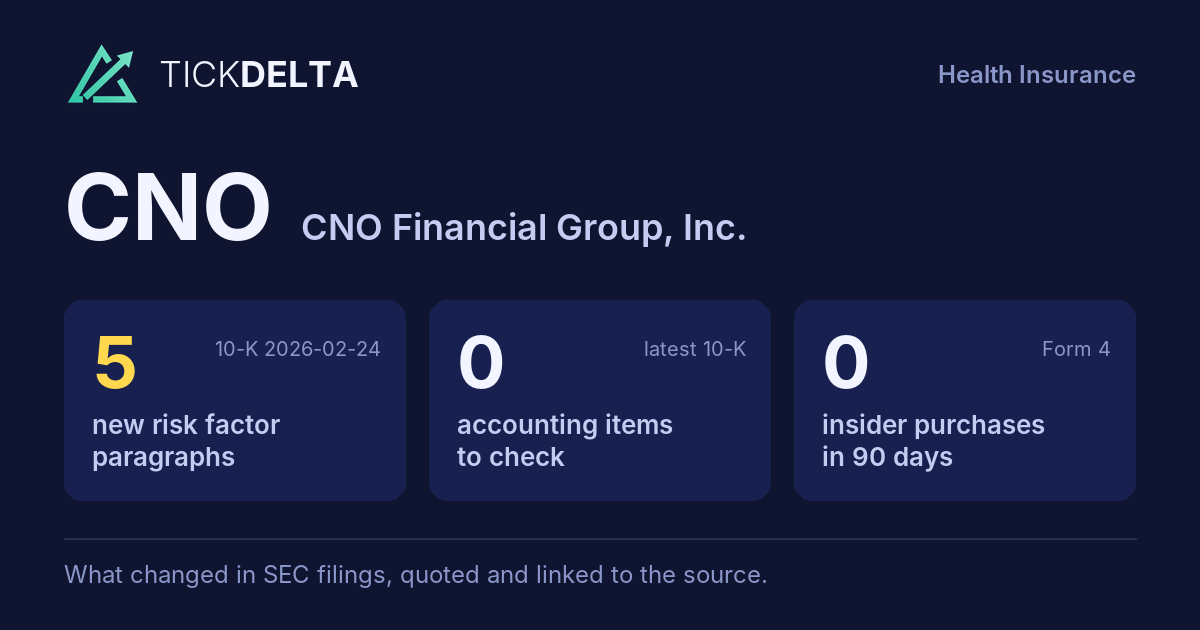
New risk paragraphs, branching off last year
Each branch is a paragraph in Risk Factors with nothing like it in the 10-K filed Feb 26, 2025. A box jumps to the paragraph as filed, below.
Paragraphs with nothing like them in last year's 10-K
5 paragraphs in Risk Factors of the 10-K filed Feb 24, 2026 with nothing like them in the 10-K filed Feb 26, 2025. Quoted exactly. Paragraphs that were only edited are under 10-K change.
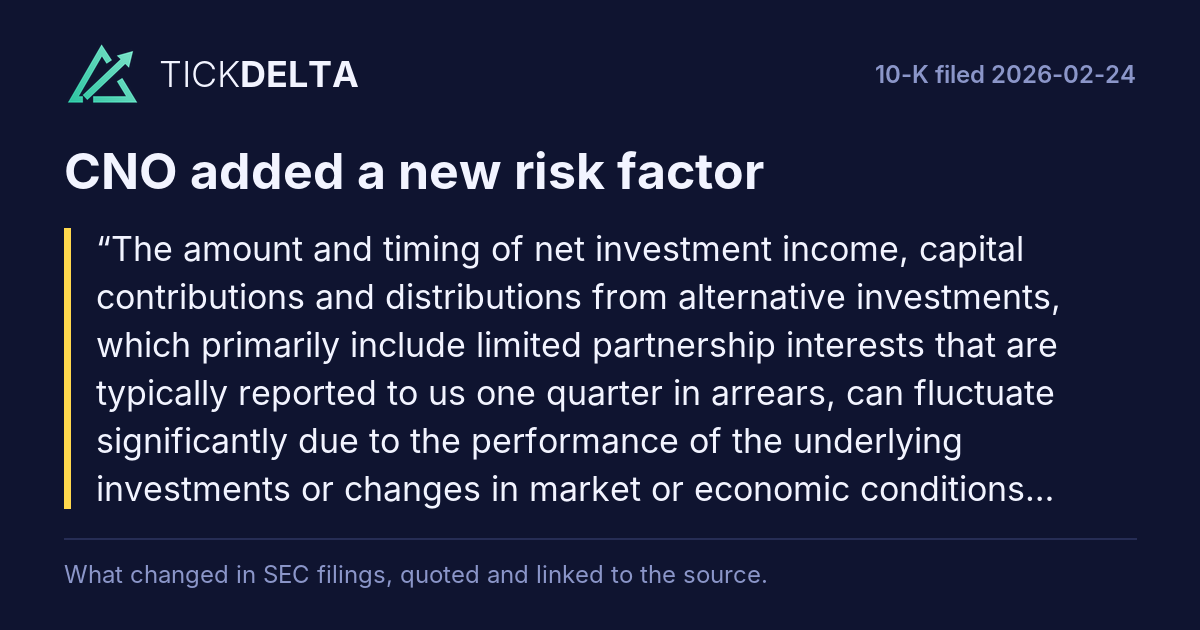
The amount and timing of net investment income, capital contributions and distributions from alternative investments, which primarily include limited partnership interests that are typically reported to us one quarter in arrears, can fluctuate significantly due to the performance of the underlying investments or changes in market or economic conditions. Additionally, these investments, as well as our investments in private companies, are less liquid than similar, publicly traded investments and a decline in market liquidity could impact our ability to sell them at their current carrying values.
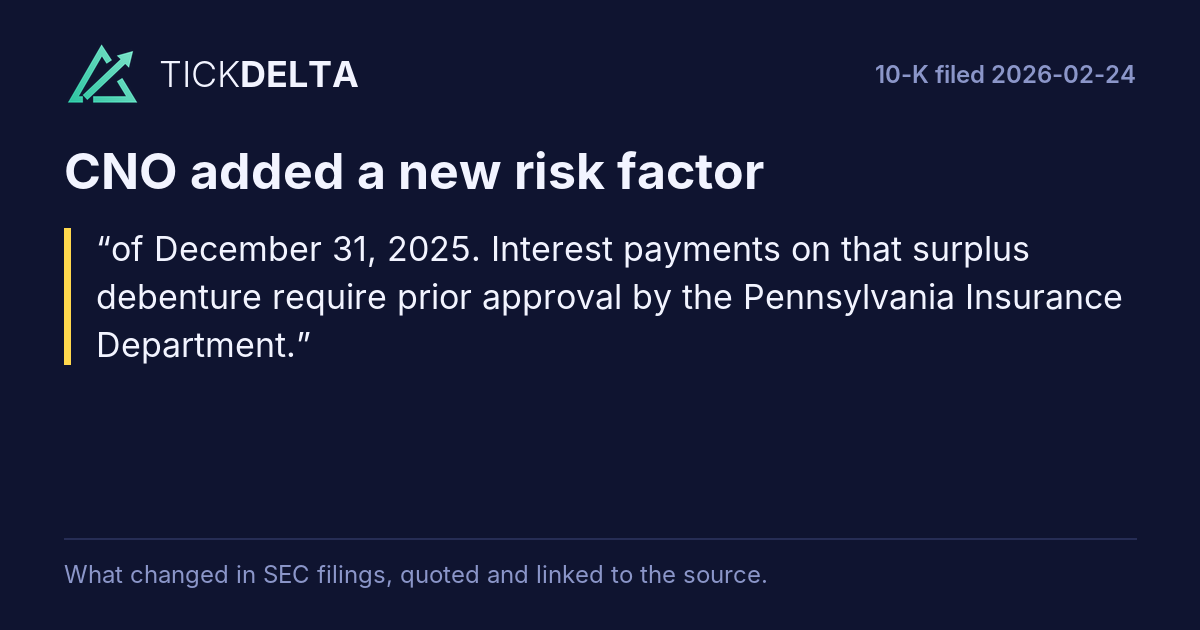
of December 31, 2025. Interest payments on that surplus debenture require prior approval by the Pennsylvania Insurance Department.
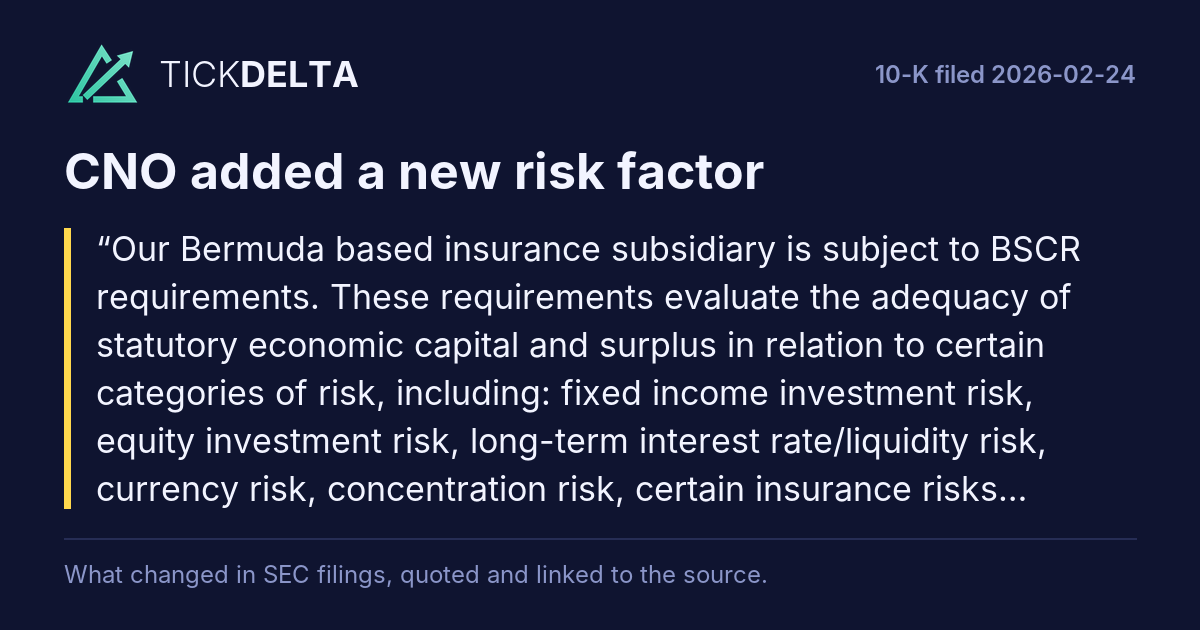
Our Bermuda based insurance subsidiary is subject to BSCR requirements. These requirements evaluate the adequacy of statutory economic capital and surplus in relation to certain categories of risk, including: fixed income investment risk, equity investment risk, long-term interest rate/liquidity risk, currency risk, concentration risk, certain insurance risks, credit risk, catastrophe risk and operational risk. The requirements are used by the BMA as an early warning tool and failure to maintain statutory economic capital and surplus above specified levels, could result in increased regulatory oversight. We are in process of completing our subsidiary’s capital and solvency return in respect of the year ended December 31, 2025, which includes the BSCR. We believe the BSCR ratios will be in excess of the levels that would subject our Bermuda subsidiary to any regulatory action.
margin requirements, and limitations on the ability to close out certain derivatives transactions with certain counterparties upon the bankruptcy of such counterparties. These and other regulations under the Dodd-Frank Act could have a material adverse effect on our business, results of operations, cash flows or financial condition.
Our operations are exposed to the risk of major health pandemics, epidemics or outbreaks. The extent to which major health issues impact our business, results of operations or financial condition depends on future developments which
Paragraphs in the 10-Q filed Nov 5, 2026 that were not in the one before
New in the latest 10-Q
29 paragraphs in the 10-Q filed Nov 5, 2026 with nothing like them in the 10-Q filed Aug 6, 2026 (at least half the words must differ; new numbers alone do not count). Quoted exactly, grouped by the item heading above them. This is text that changed, not a judgement of how serious it is.
Financial statements and notes
In the third quarter of 2026 and 2025, as part of our comprehensive annual actuarial review, we reviewed our actual experience and updated our assumptions for future cash flows. The impact of updating these assumptions is reflected in the "Effect of changes in cash flow assumptions" line items in the tables below.
Read in the 10-Q
In the third quarter of 2026 and 2025, as part of our comprehensive annual actuarial review, we reviewed our nonmarket assumptions used to calculate the MRBs and determined updates were warranted. The impact of updating these assumptions is reflected in the "Effect of changes in future expected policyholder behavior" line items in the table below.
Read in the 10-Q
During the nine months ended September 30, 2026, we generated capital losses primarily from asset sales in anticipation of executing the internal reinsurance transaction on October 1, 2026, portfolio optimization activities and from capital loss allocations from partnership investments. During the third quarter, higher interest rates reduced the level of unrealized capital gains in the insurance companies' available-for-sale fixed maturity securities portfolio that could serve as a source of taxable income to support realization of the resulting capital loss carryforwards. Based on our evaluation of all available positive and negative evidence as of September 30, 2026, management concluded that it is more likely than not that all of the deferred tax assets associated with these capital loss carryforwards will not be realized before expiration. Accordingly, we recorded a valuation allowance of $ 22.1 million against these deferred tax assets during the period.
Read in the 10-Q
We have not recorded a valuation allowance against deferred tax assets associated with unrealized losses on our available-for-sale fixed maturity securities. In evaluating the realizability of these deferred tax assets, we considered our intent and ability to hold the underlying securities until recovery or maturity, available and feasible tax planning strategies that could be implemented, if necessary, to support realization of our deferred tax asset, as well as the expected reversal of the related temporary differences and other available sources of taxable income. Our operating cash flows, capital resources and available sources of liquidity further support our ability to hold securities in an unrealized loss position until recovery or maturity without
Read in the 10-Q
the need to sell such securities to meet near-term liquidity requirements. Based on our evaluation of all available positive and negative evidence, we concluded that it is more likely than not that these deferred tax assets will be realized.
Read in the 10-Q
Show the other 24
Nine months ended September 30, 2026 2025 ──────────────────────────────────────────────────────────────────────────────────────────────────────────── U.S. statutory corporate rate 21.0% 21.0% Non-taxable income and nondeductible benefits, net (2.4) (1.0) State taxes 1.6 2.1 Estimated annual effective tax rate calculated before discrete items 20.2% 22.1% Impact on the estimated annual effective tax rate from discrete items: Valuation allowance for deferred tax assets 5.1 — Goodwill and other asset impairment — 2.9 Estimated annual effective tax rate 25.3% 25.0%
Read in the 10-Q
The Company and its subsidiaries are involved in various legal actions in the normal course of business, in which claims for compensatory and punitive damages are asserted, some for substantial amounts. We recognize an estimated loss from these loss contingencies when we believe it is probable that a loss has been incurred and the amount of the loss can be reasonably
Read in the 10-Q
• Interest Maintenance Reserve ("IMR"). Interpretation 23-01, Net Negative (Disallowed) Interest Maintenance Reserve, the NAIC's interim statutory accounting guidance, was extended from December 31, 2026 through December 31, 2027. The NAIC is continuing to develop a long-term solution for the accounting treatment of negative IMR.
Read in the 10-Q
• RBC Revisions. The NAIC has been assessing the RBC treatment of collateralized loan obligations ("CLOs") and in August 2026 it adopted a proposal which incorporates the American Academy of Actuaries modeled C-1 (asset risk) factors for CLOs, collateralized bond obligations, and collateralized debt obligations into the NAIC’s Life and Fraternal Risk-Based Capital Blanks, Instructions, and Formula, effective for year-end 2026. As a result, the NAIC is considering revisions to the Purposes and Procedures Manual (the "P&P Manual") to clarify that NAIC Designations for CLOs with eligible ratings will continue to be applied through the filing exempt process, while the NAIC’s Structured Securities Group ("SSG") would be permitted to assign NAIC Designations to CLOs that do not qualify for filing exemption based on ratings. The new RBC factors adopted for CLOs in June 2026 will not have a material impact to our RBC.
Read in the 10-Q
• RBC Task Force. In August 2026, the NAIC adopted revisions to the Preamble to the RBC Forecasting and Instructions to align with “Guiding Principles” that were adopted by the Risk-Based Capital Model Governance (EX) Task Force in December 2025 that address the purpose and use of, and standards for maintaining and updating, RBC.
Read in the 10-Q
In August 2026, the NAIC adopted additional revisions to the Life and Fraternal RBC Blanks, Instructions and Formula to modify the RBC charge for collateral loans by creating a “look-through” approach that considers the quality of the underlying collateral rather than the loan itself, effective for year-end 2027 reporting. The adopted methodology requires independent verification of the collateral’s fair value.
Read in the 10-Q
In August 2026, in response to regulator review of disclosure submitted pursuant to AG 55, the NAIC Financial Condition (E) Committee proposed to develop alignment of the life risk-based capital reinsurance credit-risk methodology with the property and casualty risk-based capital approach to account for reinsurers with lower financial strength ratings. These changes are expected to be prioritized for year-end 2027 implementation.
Read in the 10-Q
Comprehensive Annual Actuarial Review: We perform an annual review of our experience and assumptions including, but not limited to, assumptions related to mortality rates, morbidity rates, surrender rates, earned rates, credited rates and expenses. In addition, we also review and update our assumptions on a more frequent basis to the extent current conditions or circumstances warrant changes that could be significant to our operating results. The impacts of these unlocking exercises have had a significant impact on our earnings.
Read in the 10-Q
In the third quarter of 2026, we performed our comprehensive annual actuarial review, resulting in a net favorable impact of $36.0 million to net income, including a net favorable impact of $56.3 million to insurance product margins included in pre-tax operating income. In connection with our comprehensive annual actuarial review, the most significant assumption changes were:
Read in the 10-Q
• Fixed indexed annuities - We increased surrender rates and lengthened the time to assumed election of guaranteed living withdrawal benefit ("GLWB") benefits. We increased GLWB excess withdrawal assumption on policies that have elected the benefit.
Read in the 10-Q
• Medicare supplement - We increased morbidity assumptions and updated rate increase assumptions.
Read in the 10-Q
In addition, the comprehensive annual actuarial review unfavorably impacted pre-tax non-operating income by $11.2 million related to changes in the fair value of embedded derivative liabilities on our fixed indexed annuities.
Read in the 10-Q
In the third quarter of 2025, we performed our comprehensive annual actuarial review, resulting in a net favorable impact of $21.0 million to net income, including a net favorable impact of $41.3 million to insurance product margins included in pre-tax operating income. The primary fixed indexed annuities changes related to higher surrender assumptions for GLWBs. The primary supplemental health changes related to lower persistency assumptions. The primary Medicare supplement changes related to higher morbidity. In addition, the comprehensive annual actuarial review unfavorably impacted pre-tax non-operating income by $14.3 million related to changes in the fair value of embedded derivative liabilities on our fixed indexed annuities.
Read in the 10-Q
The primary changes related to increases in the surrender rate assumptions on GLWBs.
Read in the 10-Q
The estimated annual effective tax rate for the nine months ended September 30, 2026 was 25.3 percent, reflecting a valuation allowance against deferred taxes as discussed in the non-operating income narratives. The operating income effective tax rate was 20.2 percent.
Read in the 10-Q
fee services business within our Worksite Division, the net results of this business have been reflected within non-operating income. The exit of this business was substantially complete as of June 30, 2026.
Read in the 10-Q
benefits will typically increase, but the increase in benefits will be partially offset by investment income earned on the accumulated assets.
Read in the 10-Q
During the third quarter of 2026, we recognized an increase in earnings of $10.0 million for the mark-to-market change in the agent deferred compensation plan liability, which was impacted by changes in the underlying actuarial assumptions used to value the liability. We recognize the mark-to-market change in the estimated value of this liability through earnings as assumptions change.
Read in the 10-Q
During the three months ended September 30, 2025, the Company performed a quantitative impairment assessment of the Optavise reporting unit, driven by macroeconomic conditions, a decline in comparable public company valuations, and lower than anticipated revenue. As a result, the Company determined that goodwill of $69.5 million and other assets, primarily intangible assets, of $27.2 million were fully impaired as of September 30, 2025.
Read in the 10-Q
During the nine months ended September 30, 2026, we generated capital losses primarily from asset sales in anticipation of executing the internal reinsurance transaction on October 1, 2026, portfolio optimization activities and from capital loss allocations from partnership investments. During the third quarter, higher interest rates reduced the level of unrealized capital gains in the insurance companies' available-for-sale fixed maturity securities portfolio that could serve as a source of taxable income to support realization of the resulting capital loss carryforwards. Based on our evaluation of all available positive and negative evidence as of September 30, 2026, management concluded that it is more likely than not that all of the deferred tax assets associated with these capital loss carryforwards will not be realized before expiration. Accordingly, we recorded a valuation allowance of $22.1 million against these deferred tax assets during the period.
Read in the 10-Q
We have not recorded a valuation allowance against deferred tax assets associated with unrealized losses on our available-for-sale fixed maturity securities. In evaluating the realizability of these deferred tax assets, we considered our intent and ability to hold the underlying securities until recovery or maturity, available and feasible tax planning strategies that could
Read in the 10-Q
be implemented, if necessary, to support realization of our deferred tax asset, as well as the expected reversal of the related temporary differences and other available sources of taxable income. Our operating cash flows, capital resources and available sources of liquidity further support our ability to hold securities in an unrealized loss position until recovery or maturity without the need to sell such securities to meet near-term liquidity requirements. Based on our evaluation of all available positive and negative evidence, we concluded that it is more likely than not that these deferred tax assets will be realized.
Read in the 10-Q
CNO's wholly owned Bermuda reinsurance company executed its third transaction, reinsuring approximately $270 million of inforce graded benefit life statutory reserves from Colonial Penn Life Insurance Company ("Colonial Penn"), a CNO subsidiary, effective October 1, 2026.
Read in the 10-Q
perceptions of risk, or to better match certain characteristics of our investment portfolio with the corresponding characteristics of our insurance liabilities. We may also selectively realize gains when appropriate to preserve the tax benefit of capital loss carryforwards that might otherwise expire. These strategic sales do not alter our overall intent and ability to hold securities in an unrealized loss position until recovery or maturity.
Read in the 10-Q
The 10-Q's risk factors against the 10-K
Item 1A of the 10-Q filed Nov 5, 2026 against Item 1A of the 10-K filed Feb 24, 2026.
A 10-Q repeats only the risks that changed, so a 10-K paragraph that is missing from it is not counted as removed.
Added is a paragraph with nothing like it in the 10-K, Reworded a sentence that is in both with several words changed,
Quiet changes a sentence in both where one to four words changed and one is a hedge or a modal
(cut words struck through, new words highlighted).
Text on the page, not a score; each links to the filing at sec.gov.
1 paragraph in the 10-Q's Item 1A, and none of them adds, rewords or quietly edits a paragraph of the 10-K's.
Phrases used for the first time
Two-word phrases in Risk Factors of the 10-K filed Feb 24, 2026 that are in none of the 1 earlier 10-Ks stored, back to Feb 26, 2025
Where each one is used
- reinsurance structures: In addition, we have, under intercompany reinsurance agreements initiated in 2023 and 2025, ceded approximately $8.8 billion of our fixed indexed annuity statutory reserves from Bankers Life and approximately $1.9 billion of our supplemental health statutory reserves from Washington National, respectively, to CNO...
- ceding reinsurers: In addition, we have, under intercompany reinsurance agreements initiated in 2023 and 2025, ceded approximately $8.8 billion of our fixed indexed annuity statutory reserves from Bankers Life and approximately $1.9 billion of our supplemental health statutory reserves from Washington National, respectively, to CNO...
- investment risk: If interest rates were to return to low levels for an extended period, we may need to invest new cash flows or reinvest proceeds from maturing, prepaid, or sold investments at lower yields, which could reduce our net investment income and narrow the spread between interest earned on investments and interest...
Used at least twice, small words left out. Counted, not picked: a phrase can be new because the company renamed something.
What was taken out
1 paragraph of last year's Risk Factors with nothing like them now. The longest are quoted.
Sources
Item 1A of each 10-K and 10-Q on EDGAR, quoted exactly. Each paragraph links to the filing at sec.gov.
Also
10-K change: what was reworded or cut, section by section.
Work with it
Excel workbook · CSV. Google Sheet that stays up to date: paste =IMPORTDATA("https://tickdelta.com/company/CNO/export.csv") into a cell.