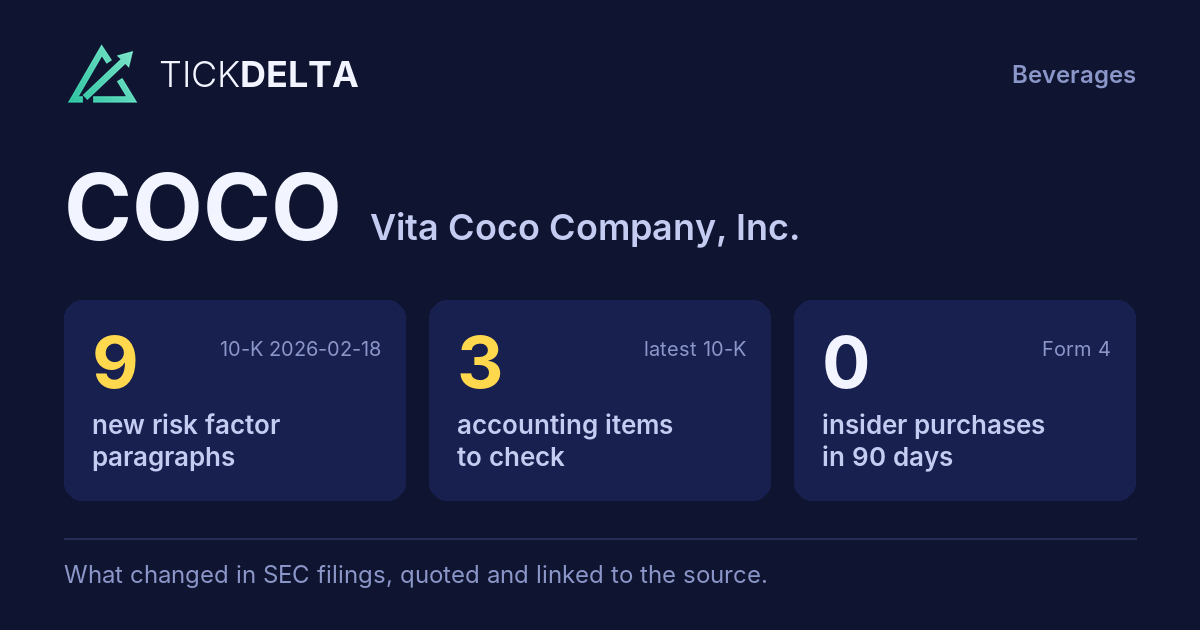
Paragraph 36 · 44% changed
Every version of it
Screener
/
SEC EDGAR
/CIK 0001482981
/10-K filed Feb 18, 2026, compared with Feb 26, 2025
/Numbers from the XBRL of the 10-Ks
Nasdaq
Consumer staples · Beverages
Vita Coco Company, Inc. COCO
The 10-K against last year's
87 changes: 19 added, 6 removed, 57 reworded, 5 quiet changes
10-K Feb 18, 2026 vs Feb 26, 2025
Risk Factors
10.7%
of the text changed · 21,492 words now · 9 new paragraphs, 1 gone
MD&A
21.4%
of the text changed · 7,044 words now · 10 new paragraphs, 5 gone
Legal Proceedings
9.3%
of the text changed · 333 words now
Accounting Policies
22.0%
of the text changed · 4,276 words now
10-K 0001482981-26-000022 (Feb 18, 2026) vs 10-K 0001482981-25-000032 (Feb 26, 2025)
Every paragraph, and how much of it changed
One bar per paragraph, in the order of the 10-K. Height and colour show the share of its words not in the closest paragraph a year earlier; the tallest bars are new paragraphs.
Risk Factors
217 paragraphs · 9 new · 44 reworded · 1 gone · 10-K Feb 18, 2026 against Feb 26, 2025
New paragraph
Reworded (5% of its words or more)
Same or nearly
Paragraph 137 · 44% changed
Every version of it
Paragraph 157 · 43% changed
Every version of it
We may require additional financing to support the growth of our business, to acquire new businesses, for working capital needs or to cover unforeseen costs and expenses. The amount of additional capital we may require, the timing of our capital needs and the availability of financing to fund those needs will depend on a number of factors, including our strategic initiatives and operating plans, the performance of our business, the number, complexity and characteristics of additional products or future manufacturing processes we require to serve new or existing markets, any proposed acquisitions and cost increases related to the integration of acquired products or businesses, any material or significant product recalls, any failure or disruption with our manufacturing and co-packing partners as well as our third party logistics providers, the expansion into new markets, any changes in our regulatory or legislative landscape, particularly with respect to product safety, advertising, product labeling and data privacy, the costs associated with being a public company and the market conditions for debt or equity financing. Additionally, the amount of capital required will depend on our ability to meet our sales goals and otherwise successfully execute our operating plan. We intend to continually monitor and adjust our operating plan as necessary to respond to developments in our business, our markets and the broader economy and it is possible that our business could become more capital intensive. Although we believe various debt and equity financing alternatives will be available to us to support our capital needs, financing arrangements on acceptable terms may not be available to us when needed. Additionally, these alternatives may require significant cash payments for interest and other costs or could be highly dilutive to our existing shareholders. Any such financing alternatives may not provide us with sufficient funds to meet our long-term capital requirements.
Paragraph 130 · 41% changed
Every version of it
Paragraph 23 · 40% changed
Every version of it
Paragraph 82 · 39% changed
Every version of it
Paragraph 125 · 38% changed
Every version of it
Security incidents compromising the confidentiality, integrity and availability of our sensitive information and our systems and those of our third party vendors and business partners could result from cyber-attacks, computer malware, viruses, social engineering (including spear phishing and ransomware attacks), supply chain attacks, efforts by individuals or groups of hackers and sophisticated organizations, including state-sponsored organizations, errors or malfeasance of our personnel, including human error and bad actors, and security vulnerabilities in the software or systems on which we, or our third party vendors or business partners, rely. Cybercrime and hacking techniques are constantly evolving. We and/or our third-party vendors, service providers, and/or business partners may be unable to stop all attempted security breaches, react in a timely manner, or implement adequate preventative measures, particularly given the increasing use of hacking techniques designed to circumvent controls, avoid detection, and remove or obfuscate forensic artifacts. We anticipate that these threats will continue to grow in scope and complexity over time and such incidents may occur in the future, and could result in unauthorized, unlawful, or inappropriate access to, inability to access, disclosure of, or loss of the sensitive, proprietary and confidential information (including personal information) that we collect, receive and process. We employ multiple methods at different layers of our systems designed to defend against intrusion and attack, to protect our systems and to resolve and mitigate the impact of any incidents. Despite our efforts to keep our systems secure and to remedy identified vulnerabilities, future attacks could be successful and could result in substantial liability or business risk. We expect that third parties will continue to attempt to gain unauthorized access to our systems or facilities through various means, including hacking into our systems or facilities, or those of our customers or vendors, or attempting to fraudulently induce our employees, customers, vendors or other users of our systems into disclosing sensitive information, which may in turn be used to access our IT systems. Our cybersecurity programs and efforts to protect our systems and data, and to prevent, detect and respond to data security incidents, may not prevent these threats or provide adequate security. We may experience breaches of our security measures due to human error, malfeasance, system errors or vulnerabilities, or other irregularities including attempts by former, current or future employees to misuse their authorized access and/or gain unauthorized access to our systems. As we rely on a number of our third party vendors and business partners, we are exposed to certain security risks outside of our direct control resulting from our engagements with these parties, and our ability to directly monitor these third-party vendors’ and business partners’ data security is limited. While we take care to vet our vendors and business partners and contract with them to require levels of data security and best practices, and employ a number of security measures designed to prevent, detect, and mitigate potential for harm to our users and our systems from the theft of or misuse of user credentials on our network, these measures may not be effective in every instance. Moreover, we or our third-party vendors or business partners may be more vulnerable to such attacks in remote work environments, which have increased in recent years. Additionally, while we maintain cyber insurance that may help provide coverage for these types of incidents, we cannot ensure that our insurance will be adequate to cover costs and liabilities related to an incident. Previously, we have experienced spoofing and social engineering incidents and since then, we have taken measures, such as third-party forensic consultant reviews, to ensure that no compromises of our systems have occurred and to mitigate risks of future harm. However, the sophistication of cyber attacks continues to increase and there is no guarantee that the steps we have taken will be sufficient to prevent significant disruption and loss.
Paragraph 174 · 38% changed
Every version of it
We have incurred costs related to our implementation of an internal audit and compliance function and expect to incur additional costs to further improve our internal control environment in the future. If we identify future deficiencies in our internal control over financial reporting or if we are unable to comply with the demands that are placed upon us as a public company, including the requirements of Section 404 of the Sarbanes-Oxley Act, in a timely manner, we may be unable to accurately report our financial results, or report them within the timeframes required by the SEC. We also could become subject to sanctions or investigations by the SEC or other regulatory authorities. Further, if we do not maintain adequate financial and management personnel, processes, and controls, we may not be able to manage our business effectively or accurately report our financial performance on a timely basis, adversely affecting our business and the price per share of our common stock.
Paragraph 36 · 44% changed
Every version of it
10-K Feb 26, 2025competitive pressures and changes in consumer preferences by introducing new products, reducing prices or increasing promotional activities, among other things. These large competitors may decide not to compete in coconut water but rather to use their retail relationships and category insights to reduce retailer excitement for the category, impacting our visibility and shelf space.
10-K Feb 18, 2026
to use their retail relationships and category insights to reduce retailer excitement for the category, impacting our visibility and shelf space.
Paragraph 137 · 44% changed
Every version of it
10-K Feb 26, 2025We rely on a variety of marketing techniques and practices to sell our products and to attract new customers and consumers, and we are subject to various current and future data protection laws and obligations that govern marketing and advertising practices. For example, the Controlling the Assault of Non-Solicited Pornography and Marketing Act of 2003, or the CAN-SPAM Act, establishes specific requirements for commercial email messages in the U.S. Governmental authorities, including in the EU and the U.K., continue to evaluate the privacy implications inherent in the use of third-party “cookies” and other methods of online tracking for behavioral advertising and other purposes, such as by regulating the level of consumer notice and consent required before a company can employ cookies or other electronic tracking tools or the use of data gathered with such tools. Laws and regulations regarding the use of these cookies and other current online tracking and advertising practices could increase our costs of operations and limit our ability to acquire new consumers on cost-effective terms, which, in turn, could have an adverse effect on our business, financial condition, results of operations and cash flows. Furthermore, the uncertain and shifting regulatory environment and trust climate may prompt individuals to opt out of our collection of their personal information. Concern regarding our use of the personal information collected on our websites or via our marketing activities could impact sales of product. Additionally, certain new privacy laws require opt-ins rather than opt-outs for certain personal information, which could reduce some of the data we have historically been able to collect. Even the perception that the privacy of personal information is not satisfactorily protected or does not meet regulatory requirements could discourage prospective customers from purchasing our products.
10-K Feb 18, 2026
individuals to opt out of our collection of their personal information. Concern regarding our use of the personal information collected on our websites or via our marketing activities could impact sales of product. Additionally, certain new privacy laws require opt-ins rather than opt-outs for certain personal information, which could reduce some of the data we have historically been able to collect. Even the perception that the privacy of personal information is not satisfactorily protected or does not meet regulatory requirements could discourage prospective customers from purchasing our products.
Paragraph 157 · 43% changed
Every version of it
10-K Feb 26, 2025
We may require additional financing to support the growth of our business, to acquire new businesses, for working capital needs or to cover unforeseen costs and expenses. The amount of additional capital we may require, the timing of our capital needs and the availability of financing to fund those needs will depend on a number of factors, including our strategic initiatives and operating plans, the performance of our business, the number, complexity and characteristics of additional products or future manufacturing processes we require to serve new or existing markets, any proposed acquisitions and cost increases related to the integration of acquired products or businesses, any material or significant product recalls, any failure or disruption with our manufacturing and co-packing partners as well as our third party logistics providers, the expansion into new markets, any changes in our regulatory or legislative landscape, particularly with respect to product safety, advertising, product labeling and data privacy, the costs associated with being a public company and the market conditions for debt or equity financing. Additionally, the amount of capital required will depend on our ability to meet our sales goals and otherwise successfully execute our operating plan. We intend to continually monitor and adjust our operating plan as necessary to respond to developments in our business, our markets and the broader economy and it is possible that our business could become more capital intensive. Although we believe various debt and equity financing alternatives will be available to us to support our capital needs, financing arrangements on acceptable terms may not be available to us when needed. Additionally, these alternatives may require significant cash payments for interest and other costs or could be highly dilutive to our existing shareholders. Any such financing alternatives may not provide us with sufficient funds to meet our long-term capital requirements.
10-K Feb 18, 2026
We may require additional financing to support the growth of our business, to acquire new businesses, for working capital needs or to cover unforeseen costs and expenses. The amount of additional capital we may require, the timing of our capital needs and the availability of financing to fund those needs will depend on a number of factors, including our strategic initiatives and operating plans, the performance of our business, the number, complexity and characteristics of additional products or future manufacturing processes we require to serve new or existing markets, any proposed acquisitions and cost increases related to the integration of acquired products or businesses, any material or
Paragraph 130 · 41% changed
Every version of it
10-K Feb 26, 2025In addition, if any such event resulted in access, disclosure or other loss or unauthorized use of information or data, such as customers’ and suppliers’ information, private information about employees and financial and strategic information about us and our business partners, whether actual or perceived, it could result in legal claims or proceedings, regulatory investigations or actions, and other types of liability under laws that protect the privacy and security of personal information, including federal, state and foreign data protection and privacy laws and regulations, violations of which could result in significant penalties, fines, costs and litigation. The cost of investigating, mitigating and responding to potential security breaches and complying with applicable breach notification obligations to individuals, regulators, partners and others can be significant and the risk of legal claims in the event of a security breach is increasing. For example, certain of the recently enacted state and international comprehensive privacy laws create a private right of action for certain data breaches and for non-compliance. Further, defending a suit, regardless of its merit, could be costly, divert management attention and harm our reputation. The successful assertion of one or more large claims against us that exceed available insurance coverage, or the occurrence of changes in our insurance policies, including premium increases or the imposition of large deductibles or co-insurance requirements, could adversely affect our reputation, business, financial condition, results of operations and cash flows. Any material disruption or slowdown of our systems or those of our third-party vendors or business partners, could have a material adverse effect on our business, financial condition, results of operations and cash flows. Our risks are likely to increase as we continue to expand, grow our customer base, and process, store, and transmit increasing amounts of proprietary and sensitive data. In addition, although we seek to detect and investigate all data security incidents, security breaches and other incidents of unauthorized access to our information technology systems, it can be difficult to detect and determine the scope and impact of data security incidents. Any delay in identifying such breaches or incidents may lead to increased harm and legal exposure of the type described above.
10-K Feb 18, 2026
vendors or business partners, could have a material adverse effect on our business, financial condition, results of operations and cash flows. Our risks are likely to increase as we continue to expand, grow our customer base, and process, store, and transmit increasing amounts of proprietary and sensitive data. In addition, although we seek to detect and investigate all data security incidents, security breaches and other incidents of unauthorized access to our information technology systems, it can be difficult to detect and determine the scope and impact of data security incidents. Any delay in identifying such breaches or incidents may lead to increased harm and legal exposure of the type described above.
Paragraph 23 · 40% changed
Every version of it
10-K Feb 26, 2025In addition to purchasing coconut materials and other ingredients, we negotiate the terms and specifications for the purchase of significant quantities of packaging materials and pallets by our manufacturers and co-packing partners from third parties. The majority of our products are produced and packaged with materials sourced from a single supplier, Tetra Pak. While we believe that we may be able to establish alternative supply relationships for some of these materials, we may be unable to do so in the short term, or at all, at prices or quality levels that are acceptable to us, or in packaging that is acceptable to consumers. Further, any such alternative supplier arrangements may lead to increased costs or delays.
10-K Feb 18, 2026
be unable to do so in the short term, or at all, at prices or quality levels that are acceptable to us, or in packaging that is acceptable to consumers. Further, any such alternative supplier arrangements may lead to increased costs or delays.
Paragraph 82 · 39% changed
Every version of it
10-K Feb 26, 2025For example, in 2024 the political unrest in the Gulf of Aden and Red Sea regions caused ocean freight carriers to reroute away from the Suez Canal, which resulted in longer transit times, increased ocean freight costs and shortages in ocean freight capacity, all of which affected our operations. Recently, there have been discussions about potential tariffs and other import related fees on goods, including those imported from China, Mexico and Canada, and while the specifics are unclear, if tariffs or other import related fees are implemented on goods from these countries, or other countries where the Company does business, they may raise the Company's cost of importation of coconut water and require the Company to adjust its pricing or strategy. An inability to effectively manage these risks associated with our international operations could adversely impact our business and financial results.
10-K Feb 18, 2026
In 2025 the U.S. government implemented tariffs and other import related fees on goods, including coconut water from Asia and Brazil, which were ultimately waived later in 2025. If tariffs or other import related fees are implemented on goods from countries where the Company does business, they may raise the Company's cost of importation of coconut water and require the Company to adjust its pricing or strategy. An inability to effectively manage these risks associated with our international operations could adversely impact our business and financial results. For more information see the risk factor captioned “If we encounter problems or interruptions with our supply chain, our costs may increase and our or our customers’ ability to deliver our products to market could be adversely affected, impacting our business and profitability.”
Paragraph 125 · 38% changed
Every version of it
10-K Feb 26, 2025
Security incidents compromising the confidentiality, integrity and availability of our sensitive information and our systems and those of our third party vendors and business partners could result from cyber-attacks, computer malware, viruses, social engineering (including spear phishing and ransomware attacks), supply chain attacks, efforts by individuals or groups of hackers and sophisticated organizations, including state-sponsored organizations, errors or malfeasance of our personnel, including human error and bad actors, and security vulnerabilities in the software or systems on which we, or our third party vendors or business partners, rely. Cybercrime and hacking techniques are constantly evolving. We and/or our third-party vendors, service providers, and/or business partners may be unable to stop all attempted security breaches, react in a timely manner, or implement adequate preventative measures, particularly given the increasing use of hacking techniques designed to circumvent controls, avoid detection, and remove or obfuscate forensic artifacts. We anticipate that these threats will continue to grow in scope and complexity over time and such incidents may occur in the future, and could result in unauthorized, unlawful, or inappropriate access to, inability to access, disclosure of, or loss of the sensitive, proprietary and confidential information (including personal information) that we collect, receive and process. We employ multiple methods at different layers of our systems designed to defend against intrusion and attack, to protect our systems and to resolve and mitigate the impact of any incidents. Despite our efforts to keep our systems secure and to remedy identified vulnerabilities, future attacks could be successful and could result in substantial liability or business risk. We expect that third parties will continue to attempt to gain unauthorized access to our systems or facilities through various means, including hacking into our systems or facilities, or those of our customers or vendors, or attempting to fraudulently induce our employees, customers, vendors or other users of our systems into disclosing sensitive information, which may in turn be used to access our IT systems. Our cybersecurity programs and efforts to protect our systems and data, and to prevent, detect and respond to data security incidents, may not prevent these threats or provide adequate security. We may experience breaches of our security measures due to human error, malfeasance, system errors or vulnerabilities, or other irregularities including attempts by former, current or future employees to misuse their authorized access and/or gain unauthorized access to our systems. As we rely on a number of our third party vendors and business partners, we are exposed to certain security risks outside of our direct control resulting from our engagements with these parties, and our ability to directly monitor these third-party vendors’ and business partners’ data security is limited. While we take care to vet our vendors and business partners and contract with them to require levels of data security and best practices, and employ a number of security measures designed to prevent, detect, and mitigate potential for harm to our users and our systems from the theft of or misuse of user credentials on our network, these measures may not be effective in every instance. Moreover, we or our third-party vendors or business partners may be more vulnerable to such attacks in remote work environments, which have increased in recent years. Additionally, while we maintain cyber insurance that may help provide coverage for these types of incidents, we cannot ensure that our insurance will be adequate to cover costs and liabilities related to an incident. Previously, we have experienced spoofing and social engineering incidents and since then, we have taken measures, such as third-party forensic consultant reviews, to ensure that no compromises of our systems have occurred and to mitigate risks of future harm. However, the sophistication of cyber attacks continues to increase and there is no guarantee that the steps we have taken will be sufficient to prevent significant disruption and loss.
10-K Feb 18, 2026
Security incidents compromising the confidentiality, integrity and availability of our sensitive information and our systems and those of our third party vendors and business partners could result from cyber-attacks, computer malware, viruses, social engineering (including spear phishing and ransomware attacks), supply chain attacks, efforts by individuals or groups of hackers and sophisticated organizations, including state-sponsored organizations, errors or malfeasance of our personnel, including human error and bad actors, and security vulnerabilities in the software or systems on which we, or our third party vendors or business partners, rely. Cybercrime and hacking techniques are constantly evolving. We and/or our third-party vendors, service providers, and/or business partners may be unable to stop all attempted security breaches, react in a timely manner, or implement adequate preventative measures, particularly given the increasing use of hacking techniques designed to circumvent controls, avoid detection, and remove or obfuscate forensic artifacts. We anticipate that these threats will continue to grow in scope and complexity over time and such incidents may occur in the future, and could result in unauthorized, unlawful, or inappropriate access to, inability to access, disclosure of, or loss of the sensitive, proprietary and confidential information (including personal information) that we collect, receive and process. We employ
Paragraph 174 · 38% changed
Every version of it
10-K Feb 26, 2025
We have incurred costs related to our implementation of an internal audit and compliance function and expect to incur additional costs to further improve our internal control environment in the future. If we identify future deficiencies in our internal control over financial reporting or if we are unable to comply with the demands that are placed upon us as a public company, including the requirements of Section 404 of the Sarbanes-Oxley Act, in a timely manner, we may be unable to accurately report our financial results, or report them within the timeframes required by the SEC. We also could become subject to sanctions or investigations by the SEC or other regulatory authorities. Further, if we do not maintain adequate financial and management personnel, processes, and controls, we may not be able to manage our business effectively or accurately report our financial performance on a timely basis, adversely affecting our business and the price per share of our common stock.
10-K Feb 18, 2026
We have incurred costs related to our implementation of an internal audit and compliance function and expect to incur additional costs to further improve our internal control environment in the future. If we identify future deficiencies in our internal control over financial reporting or if we are unable to comply with the demands that are placed upon us as a
MD&A
102 paragraphs · 10 new · 45 reworded · 5 gone · 10-K Feb 18, 2026 against Feb 26, 2025
New paragraph
Reworded (5% of its words or more)
Same or nearly
Paragraph 41 · 50% changed
Private Label net sales increased by $0.6 decreased $27.2 million, or 3.3%, to $19.3 million for the year ended December 31, 2024, as compared to $18.7 million for the year ended December 31, 2023, which was 30.2%, driven by CE volume growth in EMEA, which was partially offset by CE volume decline in shipments from APAC. of 26.4%, due to lost regions with key retailers.
Paragraph 47 · 45% changed
On a consolidated basis, cost of goods sold increased $4.3 $70.0 million, or 1.4%, 22.1%, driven predominantly by the CE volume increase and the impact of tariffs, in addition to $317.2 million cost increases for the year ended December 31, 2024, from $312.9 million for the year ended December 31, 2023. On a consolidated and segment basis, the increase was primarily driven by elevated transportation costs relating to ocean freight, which was partly offset by lower finished goods costs, partially driven by private label product mix, and domestic logistics. logistics costs.
Paragraph 42 · 45% changed
Net Sales for Other products increased $12.6 million, or 137.3%, driven by CE volume increase of 178.2% as Vita Coco Coconut Water net sales increased by $26.1 million, or 8.2%, to $343.3 million for the year ended December 31, 2024, from $317.2 million for the year ended December 31, 2023. The increase was primarily driven by a combination of increased CE volume growth and benefits from pricing actions. Treats launched nationally.
Paragraph 46 · 43% changed
Paragraph 45 · 42% changed
Private Label net sales increased by $0.6 $6.6 million, or 3.3%, 34.3%, primarily due to $19.3 million for the year ended December 31, 2024, as compared to $18.7 million for the year ended December 31, 2023, which was driven by CE volume growth in EMEA, which was Europe, partially offset by CE volume decline the loss of Private Label coconut oil sales in shipments from APAC. the Asia Pacific region.
Paragraph 73 · 42% changed
During the year ended December 31, 2024, 2025, cash provided by operating activities decreased $64.3 increased $4.3 million as compared to the year ended December 31, 2023. 2024. The decrease in cash provided by operating activities was substantially driven by an increase in inventory purchases to rebuild inventory to improved levels to better support the business, and the timing of certain working capital payments, partly offset by higher cash generation from was driven by the business growth. increase in net income after adjusting for non-cash items and a minor improvement in working capital.
Paragraph 44 · 38% changed
Vita Coco Coconut Water net sales increased by $26.1 $21.6 million, or 8.2%, to $343.3 million for the year ended December 31, 2024, from $317.2 million for the year ended December 31, 2023. The increase was 43.0%, reflecting higher CE volume, primarily driven by a combination of increased CE volume growth in Europe, and benefits from net pricing actions.
Paragraph 48 · 35% changed
On a consolidated basis, gross profit increased by $18.1 $23.8 million, or 10.0%, to $198.8 million for the year ended December 31, 2024, from $180.7 million for the year ended December 31, 2023. This was a result of CE 12.0%, reflecting volume growth, net pricing improvement in Vita Coco Coconut Water, partially offset by tariffs, higher finished good product costs and domestic transportation costs. Gross margin decreased approximately 2.0% percentage points to 36.5% primarily due to increased product cost and the impact of tariffs, partially offset by the benefit of Vita Coco Coconut Water net pricing improvement and favorable product mix due to lower domestic transportation costs, partially offset by elevated transportation costs relating to ocean freight. As a result, gross margin increased approximately 1.9% percentage points to 38.5% for the year ended December 31, 2024, as compared to 36.6% for the year ended December 31, 2023. Private Label volumes.
Paragraph 41 · 50% changed
10-K Feb 26, 2025
Private Label net sales increased by $0.6 million, or 3.3%, to $19.3 million for the year ended December 31, 2024, as compared to $18.7 million for the year ended December 31, 2023, which was driven by CE volume growth in EMEA, which was partially offset by CE volume decline in shipments from APAC.
10-K Feb 18, 2026
Private Label net sales decreased $27.2 million, or 30.2%, driven by CE volume decline of 26.4%, due to lost regions with key retailers.
Paragraph 47 · 45% changed
10-K Feb 26, 2025
On a consolidated basis, cost of goods sold increased $4.3 million, or 1.4%, to $317.2 million for the year ended December 31, 2024, from $312.9 million for the year ended December 31, 2023. On a consolidated and segment basis, the increase was primarily driven by elevated transportation costs relating to ocean freight, which was partly offset by lower finished goods costs, partially driven by private label product mix, and domestic logistics.
10-K Feb 18, 2026
On a consolidated basis, cost of goods sold increased $70.0 million, or 22.1%, driven predominantly by the CE volume increase and the impact of tariffs, in addition to cost increases for finished goods and domestic logistics costs.
Paragraph 42 · 45% changed
10-K Feb 26, 2025
Vita Coco Coconut Water net sales increased by $26.1 million, or 8.2%, to $343.3 million for the year ended December 31, 2024, from $317.2 million for the year ended December 31, 2023. The increase was primarily driven by a combination of increased CE volume growth and benefits from pricing actions.
10-K Feb 18, 2026
Net Sales for Other products increased $12.6 million, or 137.3%, driven by CE volume increase of 178.2% as Vita Coco Treats launched nationally.
Paragraph 46 · 43% changed
10-K Feb 26, 2025Private Label net sales decreased by $13.3 million, or 12.9%, to $89.9 million for the year ended December 31, 2024, from $103.2 million for the year ended December 31, 2023. The decrease in sales was driven by net CE volume declines of 1.9%, as volume declines of private label coconut oil and the associated product price/mix impact more than offset growth of private label coconut water.
10-K Feb 18, 2026
Net Sales for Other products decreased $0.9 million, or 22.7%, to $3.1 million driven primarily by the decrease in sales of Vita Coco coconut oil partially offset by the launch of Vita Coco Treats.
Paragraph 45 · 42% changed
10-K Feb 26, 2025
Private Label net sales increased by $0.6 million, or 3.3%, to $19.3 million for the year ended December 31, 2024, as compared to $18.7 million for the year ended December 31, 2023, which was driven by CE volume growth in EMEA, which was partially offset by CE volume decline in shipments from APAC.
10-K Feb 18, 2026
Private Label net sales increased $6.6 million, or 34.3%, primarily due to CE volume growth in Europe, partially offset by the loss of Private Label coconut oil sales in the Asia Pacific region.
Paragraph 73 · 42% changed
10-K Feb 26, 2025
During the year ended December 31, 2024, cash provided by operating activities decreased $64.3 million as compared to the year ended December 31, 2023. The decrease in cash provided by operating activities was substantially driven by an increase in inventory purchases to rebuild inventory to improved levels to better support the business, and the timing of certain working capital payments, partly offset by higher cash generation from the business growth.
10-K Feb 18, 2026
During the year ended December 31, 2025, cash provided by operating activities increased $4.3 million as compared to the year ended December 31, 2024. The higher cash generation was driven by the increase in net income after adjusting for non-cash items and a minor improvement in working capital.
Paragraph 44 · 38% changed
10-K Feb 26, 2025
Vita Coco Coconut Water net sales increased by $26.1 million, or 8.2%, to $343.3 million for the year ended December 31, 2024, from $317.2 million for the year ended December 31, 2023. The increase was primarily driven by a combination of increased CE volume growth and benefits from pricing actions.
10-K Feb 18, 2026
Vita Coco Coconut Water net sales increased $21.6 million, or 43.0%, reflecting higher CE volume, primarily in Europe, and benefits from net pricing actions.
Paragraph 48 · 35% changed
10-K Feb 26, 2025
On a consolidated basis, gross profit increased by $18.1 million, or 10.0%, to $198.8 million for the year ended December 31, 2024, from $180.7 million for the year ended December 31, 2023. This was a result of CE volume growth, Vita Coco Coconut Water net pricing improvement and lower domestic transportation costs, partially offset by elevated transportation costs relating to ocean freight. As a result, gross margin increased approximately 1.9% percentage points to 38.5% for the year ended December 31, 2024, as compared to 36.6% for the year ended December 31, 2023.
10-K Feb 18, 2026
On a consolidated basis, gross profit increased by $23.8 million, or 12.0%, reflecting volume growth, net pricing improvement in Vita Coco Coconut Water, partially offset by tariffs, higher finished good product costs and domestic transportation costs. Gross margin decreased approximately 2.0% percentage points to 36.5% primarily due to increased product cost and the impact of tariffs, partially offset by the benefit of Vita Coco Coconut Water pricing and favorable product mix due to lower Private Label volumes.
A paragraph is matched with the one last year that shares the most of its words; under half in common makes it new. The paragraphs shown are the 8 reworded the most in each section.
The paragraph that changed most in each section
The redline
Marked against last year's 10-K: cut words struck through, new words highlighted.
Risk Factors435 words changed in this paragraph; it is 48% similar to last year's version.
Security incidents compromising the confidentiality, integrity and availability of our sensitive information and our systems and those of our third party vendors and business partners could result from cyber-attacks, computer malware, viruses, social engineering (including spear phishing and ransomware attacks), supply chain attacks, efforts by individuals or groups of hackers and sophisticated organizations, including state-sponsored organizations, errors or malfeasance of our personnel, including human error and bad actors, and security vulnerabilities in the software or systems on which we, or our third party vendors or business partners, rely. Cybercrime and hacking techniques are constantly evolving. We and/or our third-party vendors, service providers, and/or business partners may be unable to stop all attempted security breaches, react in a timely manner, or implement adequate preventative measures, particularly given the increasing use of hacking techniques designed to circumvent controls, avoid detection, and remove or obfuscate forensic artifacts. We anticipate that these threats will continue to grow in scope and complexity over time and such incidents may occur in the future, and could result in unauthorized, unlawful, or inappropriate access to, inability to access, disclosure of, or loss of the sensitive, proprietary and confidential information (including personal information) that we collect, receive and process. We employ multiple methods at different layers of our systems designed to defend against intrusion and attack, to protect our systems and to resolve and mitigate the impact of any incidents. Despite our efforts to keep our systems secure and to remedy identified vulnerabilities, future attacks could be successful and could result in substantial liability or business risk. We expect that third parties will continue to attempt to gain unauthorized access to our systems or facilities through various means, including hacking into our systems or facilities, or those of our customers or vendors, or attempting to fraudulently induce our employees, customers, vendors or other users of our systems into disclosing sensitive information, which may in turn be used to access our IT systems. Our cybersecurity programs and efforts to protect our systems and data, and to prevent, detect and respond to data security incidents, may not prevent these threats or provide adequate security. We may experience breaches of our security measures due to human error, malfeasance, system errors or vulnerabilities, or other irregularities including attempts by former, current or future employees to misuse their authorized access and/or gain unauthorized access to our systems. As we rely on a number of our third party vendors and business partners, we are exposed to certain security risks outside of our direct control resulting from our engagements with these parties, and our ability to directly monitor these third-party vendors’ and business partners’ data security is limited. While we take care to vet our vendors and business partners and contract with them to require levels of data security and best practices, and employ a number of security measures designed to prevent, detect, and mitigate potential for harm to our users and our systems from the theft of or misuse of user credentials on our network, these measures may not be effective in every instance. Moreover, we or our third-party vendors or business partners may be more vulnerable to such attacks in remote work environments, which have increased in recent years. Additionally, while we maintain cyber insurance that may help provide coverage for these types of incidents, we cannot ensure that our insurance will be adequate to cover costs and liabilities related to an incident. Previously, we have experienced spoofing and social engineering incidents and since then, we have taken measures, such as third-party forensic consultant reviews, to ensure that no compromises of our systems have occurred and to mitigate risks of future harm. However, the sophistication of cyber attacks continues to increase and there is no guarantee that the steps we have taken will be sufficient to prevent significant disruption and loss.
Source: Item 1A, 10-K 0001482981-26-000022 vs Item 1A, 10-K 0001482981-25-000032
MD&A193 words changed in this paragraph; it is 60% similar to last year's version.
Source: Item 7, 10-K 0001482981-26-000022 vs Item 7, 10-K 0001482981-25-000032
Accounting Policies125 words changed in this paragraph; it is 42% similar to last year's version.
developing the estimates and assumptions that are used in the preparation of these consolidated financial statements. Management must apply significant judgment in this process. In addition, other factors may affect estimates, including expected business and operational changes, sensitivity and volatility associated with the assumptions used in developing estimates, and whether historical trends are expected to be representative of future trends. The estimation process may yield a range of reasonable estimates of the ultimate future outcomes, and management must select an amount that falls within that range of reasonable estimates. The most significant estimates in the consolidated financial statements relate to the determination of the value of trade promotions, share-based compensation, assessing long-lived assets for impairment, estimating the net realizable value of inventories, the determination of the current expected credit losses allowance, assessing goodwill for impairment, the determination of the value of trade promotions and losses, assessing the realizability of deferred income taxes. taxes, assessing long-lived assets for impairment, and assessing goodwill for impairment. Actual results could differ from those estimates.
Source: Item 8, Note 2 – SUMMARY OF SIGNIFICANT ACCOUNTING POLICIES, 10-K 0001482981-26-000022 vs Item 8, Note 2 – SUMMARY OF SIGNIFICANT ACCOUNTING POLICIES, 10-K 0001482981-25-000032
Legal Proceedings46 words changed in this paragraph; it is 62% similar to last year's version.
One of the customers acquired less than 5% ownership in the Company upon consummation of the IPO. The same customer also vested in 100,000 was granted 200,000 restricted stock awards during at the period ended time of the IPO, of which 100,000 vested on March 31, 2023 as discussed in Note 10, Stockholders' Equity. and 100,000 vested on March 31, 2024. The customer continues to hold less than 5% ownership monetized its investment in the Company as during the first quarter of December 31, 2024. 2025.
Source: Item 3, via Note 11 – COMMITMENTS AND CONTINGENCIES, 10-K 0001482981-26-000022 vs Item 3, via Note 11 – COMMITMENTS AND CONTINGENCIES, 10-K 0001482981-25-000032
Sentences and paragraphs added, removed or reworded
Every change, by type
Sentences and paragraphs of COCO's Risk Factors and MD&A, 10-K Feb 18, 2026 against 10-K Feb 26, 2025. Each links to the text at sec.gov.
Quiet changes are sentences kept from last year with one to four words changed, at least one of them a hedge, a modal or a qualifier (may, could, will, not, significant, material…). A year or date rolling forward is not counted.
The full word list
adverse, adversely, all, although, anticipate, anticipates, any, approximately, believe, believes, can, cannot, certain, could, expect, expects, generally, however, if, intend, intends, largely, likely, many, material, materially, may, might, most, must, never, no, not, possible, primarily, probable, should, significant, significantly, some, substantial, substantially, unlikely, will, would
AddedRisk Factors
Changes in U.S. trade policy, including the imposition of new and revised tariffs on our principal sourcing countries, have increased our costs and created significant uncertainty, and could continue to materially and adversely affect our business, financial condition, results of operations, and cash flows.
Read it in 10-K Feb 18, 2026 at sec.gov
AddedRisk Factors
The uncertainty surrounding current and future tariffs presents significant challenges to our operations and supply chain. Tariffs, and uncertainty regarding their long-term rates, could disrupt sourcing decisions, production planning, and logistics, including by causing disturbances in ocean shipping capacity and cost. They have also created, and may continue to create, inflationary effects on our input and transportation costs. We are monitoring the evolving tariff landscape and implementing mitigation strategies, including pricing adjustments, modifications to our sourcing strategies, and other cost reduction initiatives. There can be no assurance that these actions will be successful, sufficient, or sustainable, that we will be able to fully or partially offset increased costs through price increases or other measures, or that such measures will not adversely affect demand for our products.
Read it in 10-K Feb 18, 2026 at sec.gov
AddedRisk Factors
Recently, we benefited from a U.S. executive action granting tariff exemptions applicable to coconut water products, which reduced our costs. However, these exemptions may be temporary, subject to change or revocation with limited notice, or may not be renewed on comparable terms, or at all. If the exemptions expire, are scaled back, or otherwise become unavailable, our effective duty rates could increase materially, which could raise our cost of goods sold, compress gross margins, and necessitate price increases or changes to our product, sourcing, or logistics strategies. We may be unable to fully or timely pass increased costs through to customers due to competitive dynamics, retailer negotiations, or consumer price sensitivity, which could adversely affect our volumes, net sales, and profitability.
Read it in 10-K Feb 18, 2026 at sec.gov
AddedRisk Factors
The overall impact of tariffs and related trade actions on our business depends on numerous factors, including the timing, duration, and scope of any tariffs; future changes to tariffs, including rates or enforcement; reciprocal or retaliatory measures by impacted foreign trading partners; inflationary effects on our cost structure; changes in consumer purchasing behavior; and the effectiveness of our responses in managing these challenges. Any continuation, escalation, or expansion of tariffs, retaliatory actions, or other trade restrictions affecting the countries from which we source could increase our costs, reduce margins, constrain supply availability, impair service levels, and otherwise materially and adversely affect our business, financial condition, results of operations, and cash flows.
Read it in 10-K Feb 18, 2026 at sec.gov
AddedRisk Factors
and potentially prevent us from selling or manufacturing our products, which would make it more difficult to compete effectively or to obtain adequate insurance in the future.
Read it in 10-K Feb 18, 2026 at sec.gov
AddedRisk Factors
property, as our efforts to enforce our intellectual property rights may be met with defenses, counterclaims, and countersuits attacking the ownership, scope, validity and enforceability of our intellectual property rights.
Read it in 10-K Feb 18, 2026 at sec.gov
AddedRisk Factors
Our ability to adopt, develop and deploy AI and other new technologies may affect demand for our products and impact our internal operations.
Read it in 10-K Feb 18, 2026 at sec.gov
AddedRisk Factors
Our ability to adopt, develop, and deploy AI and other emerging technologies may affect demand for our products and the efficiency and reliability of our internal operations. We continue to evaluate and plan for implementation of AI tools for functions in our business, such as sales forecasting, demand planning, inventory and supply chain management, marketing analytics, customer service, and information management, and including tools that may process or rely on consumer information. The benefits of these technologies are uncertain, and the costs and risks may be significant. If we do not timely and effectively adopt or integrate these technologies, or if our competitors do so more quickly or successfully, our business, results of operations, financial condition, and prospects could be materially and adversely affected.
Read it in 10-K Feb 18, 2026 at sec.gov
Show the other 46
AddedRisk Factors
Because AI and other emerging technologies are complex and rapidly evolving, we may not be able to fully anticipate or mitigate all associated risks. Implementing appropriate safeguards, controls, monitoring, and human oversight may be costly and time‑consuming and may not prevent all harms. If our AI initiatives do not perform as expected, fail to deliver anticipated efficiencies or insights, produce unreliable or biased results, or give rise to privacy, security, ethical, or legal concerns, our brand and customer trust could be harmed, and our profitability could be negatively impacted, and our competitive position could be weakened. Any of the foregoing could materially and adversely affect our business, results of operations, financial condition, and prospects.
Read it in 10-K Feb 18, 2026 at sec.gov
RemovedRisk Factors
RewordedRisk Factors
The amount of additional capital we may require, the timing of our capital needs and the availability of financing to fund those needs will depend on a number of factors, including our strategic initiatives and operating plans, the performance of our business, the number, complexity and characteristics of additional products or future manufacturing processes we require to serve new or existing markets, any proposed acquisitions and cost increases related to the integration of acquired products or businesses, any material or significant product recalls, any failure or disruption with our manufacturing and co-packing partners as well as our third party logistics providers, the expansion into new markets, any changes in our regulatory or legislative landscape, particularly with respect to product safety, advertising, product labeling and data privacy, the costs associated with being a public company and the market conditions for debt or equity financing.
Read it in 10-K Feb 18, 2026 at sec.gov
RewordedRisk Factors
Although we seek to forecast and plan our product needs sufficiently in advance of anticipated requirements to facilitate reserving production time at our manufacturing and co-packing partners, and arranging for the availability and supply of packaging and ingredient materials, our product takes many weeks to arrive at our warehouses from our manufacturing partners, which reduces our flexibility to react to short term or unexpected consumer demand changes, or changes in transit times, as it can require planning as much as six months in advance to coordinate all materials for production.
Read it in 10-K Feb 18, 2026 at sec.gov
RewordedRisk Factors
Further, by requiring that because Delaware public benefit corporate law requires boards of directors of public benefit corporations consider to balance additional constituencies other than maximizing shareholder value, Delaware and the corporation’s specified public benefit corporation law benefits, it could potentially make it easier for a board to reject a hostile bid, even where the takeover would provide bid that offers the greatest short-term financial yield to investors. investors but is inconsistent with that balancing.
Read it in 10-K Feb 18, 2026 at sec.gov
RewordedRisk Factors
RewordedRisk Factors
If we identify future deficiencies in our internal control over financial reporting or if we are unable to comply with the demands that are placed upon us as a public company, including the requirements of Section 404 of the Sarbanes-Oxley Act, in a timely manner, we may be unable to accurately report our financial results, or report them within the timeframes required by the SEC.
Read it in 10-K Feb 18, 2026 at sec.gov
RewordedRisk Factors
RewordedRisk Factors
While we believe that we may be able to establish alternative supply relationships for some of these materials, we may be unable to do so in the short term, or at all, at prices or quality levels that are acceptable to us, or in packaging that is acceptable to consumers.
Read it in 10-K Feb 18, 2026 at sec.gov
RewordedRisk Factors
Any such litigation could result in the impairment or loss of portions of our intellectual property, as our efforts to enforce our intellectual property rights may be met with defenses, counterclaims, and countersuits attacking the ownership, scope, validity and enforceability of our intellectual property rights.
Read it in 10-K Feb 18, 2026 at sec.gov
RewordedRisk Factors
Any claims or litigation, even if fully indemnified or insured, could damage our reputation and potentially prevent us from selling or manufacturing our products, which would make it more difficult to compete effectively or to obtain adequate insurance in the future.
Read it in 10-K Feb 18, 2026 at sec.gov
RewordedRisk Factors
While we continued the supply relationship for a significant portion of their private label Private Label coconut water needs in 2024 at the customer's request, in 2025, we are expecting in 2025 experienced the loss of further regions that we serviced for this customer in 2024. 2024, resulting in a decline in Private Label volume growth in 2025.
Read it in 10-K Feb 18, 2026 at sec.gov
RewordedRisk Factors
RewordedRisk Factors
Any material disruption or slowdown of our systems or those of our third-party vendors or business partners, could have a material adverse effect on our business, financial condition, results of operations and cash flows.
Read it in 10-K Feb 18, 2026 at sec.gov
Quiet changesRisk Factors
We believe expect that sales of our coconut water will continue to constitute a significant portion of our revenue, income and cash flow for the foreseeable future.
Read it in 10-K Feb 18, 2026 at sec.gov
Quiet changesRisk Factors
If we are unable to manage our supply chain effectively and ensure that our products are available to meet consumer demand, we may not have the ability to pursue our growth strategy, our sales might may decrease, and our business, financial condition, results of operations and cash flows may be materially adversely affected.
Read it in 10-K Feb 18, 2026 at sec.gov
Quiet changesRisk Factors
The success of any future acquisitions will be dependent upon our ability to effectively integrate the acquired products and operations into our business.
Read it in 10-K Feb 18, 2026 at sec.gov
Quiet changesRisk Factors
Based upon our shares of common stock outstanding as of December 31, 2024, 2025, our executive officers, directors and shareholders who own more than 5% of our outstanding share capital, in the aggregate, beneficially own over approximately 30% of our outstanding shares of common stock.
Read it in 10-K Feb 18, 2026 at sec.gov
AddedMD&A
Throughout 2025, we faced evolving tariff pressures, beginning with the implementation of a 10% baseline U.S. tariff and country specific rates. This was followed by reciprocal tariffs announced in August 2025 of approximately 20% for Asian countries from which we source, and incremental tariffs that raised the effective rate to 50% for Brazil. Imports from Mexico and Canada remained exempt under the United States-Mexico-Canada Agreement ("USMCA"). At the end of the third quarter of 2025, we estimated our weighted average tariff rate was 23% based on third quarter sourcing, and continued our attempts to mitigate. On November 14, 2025, the White House announced relief from the reciprocal tariffs for certain agricultural products, which included the tariff codes applicable to coconut water products, which are the bulk of our portfolio, and on November 21, 2025, a waiver on the incremental tariffs on coconut water from Brazil was announced. These November announcements significantly reduced the tariff burden on our importation of our coconut water products post November 21, 2025, although miscellaneous tariffs remain. The various tariff rates resulted in $16 million of tariffs paid in 2025.
Read it in 10-K Feb 18, 2026 at sec.gov
AddedMD&A
Coconut water accounted for 96% of our revenue for the year ended December 31, 2025 and we believe that sales of coconut water will continue to be a significant portion of our business in the foreseeable future. The coconut water
Read it in 10-K Feb 18, 2026 at sec.gov
AddedMD&A
Selling, General & Administrative ("SG&A") expense increased by $15.1 million, or 12.1%, primarily driven by higher personnel-related expenses of $11.0 million, increased marketing spend of $3.0 million, $1.3 million additional charitable contributions, and $1.2 million of overlapping rent expense for the New York office transition. These increases were partially offset by a $2.7 million reduction in sales-related expenses.
Read it in 10-K Feb 18, 2026 at sec.gov
AddedMD&A
Interest income decreased by $0.2 million, to $6.5 million due to the decline in interest rates, partially offset by increased investment balances.
Read it in 10-K Feb 18, 2026 at sec.gov
AddedMD&A
Other income of $0.2 million in the year ended December 31, 2025, resulted from the sale of intellectual property.
Read it in 10-K Feb 18, 2026 at sec.gov
AddedMD&A
The effective tax rate for the year ended December 31, 2025 exceeded the U.S. federal statutory rate of 21% primarily due to state income taxes, and permanently nondeductible compensation costs, partially offset by tax benefits associated with windfall deductions recognized during the year. Other nondeductible expenses and discrete tax items also contributed to the higher effective tax rate.
Read it in 10-K Feb 18, 2026 at sec.gov
AddedMD&A
We account for stock-based compensation in accordance with ASC Topic 718, Compensation—Stock Compensation ("ASC 718") for stock options issued under the 2014 Stock Option and Restricted Stock Plan and the 2021 Stock Incentive Award Plan.
Read it in 10-K Feb 18, 2026 at sec.gov
AddedMD&A
We measure all awards based on their fair value on the date of the grant and recognize compensation expense for those awards over the requisite service period of each stock award grant, which is generally the vesting period of the respective award by using the accelerated attribution method. We apply an estimated forfeiture rate derived from historical employee termination behavior. If the actual forfeitures differ from those estimated by management, adjustment to compensation expense may be required in future periods. Stock awards are equity-classified, as they do not contain a cash settlement option or other features requiring them to be liability-classified.
Read it in 10-K Feb 18, 2026 at sec.gov
AddedMD&A
We issue stock-based awards with service-based and performance-based and market-based vesting conditions. The accounting for performance‑based stock awards requires us to make significant judgments regarding the probability of achieving performance targets and the expected number of shares that will ultimately vest. Certain performance share unit awards allow for the issuance of shares in excess of the target award amount when performance results exceed specified thresholds. We evaluate performance expectations each reporting period and update our estimates based on current forecasts and available information. Changes in these estimates may result in adjustments to stock‑based compensation expense in future periods, which could be material to our results of operations.
Read it in 10-K Feb 18, 2026 at sec.gov
AddedMD&A
impairment for the amount by which the carrying amount exceeds a reporting unit’s fair value. For the years ended December 31, 2025 and 2024, there were no impairments recorded.
Read it in 10-K Feb 18, 2026 at sec.gov
RemovedMD&A
RemovedMD&A
RemovedMD&A
RemovedMD&A
RemovedMD&A
RewordedMD&A
Year Ended December 31, Change 2025 2024 2023 Amount Percentage (in thousands) (in thousands) Unrealized gain/(loss) on derivative instruments $ 4,737 $ (8,176) $ (872) $ (7,304) 12,913 n/m Foreign currency gain/(loss) loss (1,037) (1,571) (251) (1,320) 534 (34.0 Interest income, net 6,548 6,715 (167) (2.5 Other Income $ 191 $ — 191 n/m Interest income 6,715 2,581 4,134 160.2 Interest expense — (31) 31 (100.0 Other Income (Expense), Net $ 10,439 $ (3,032) $ 1,427 $ (4,459) 13,471 n/m
Read it in 10-K Feb 18, 2026 at sec.gov
RewordedMD&A
RewordedMD&A
During the year ended December 31, 2024, we recorded an unrealized loss of $8.2 million for the mark-to-market changes in the fair value on the million, primarily related to outstanding derivative instruments for forward foreign currency exchange contracts, with the largest loss for the year ended December 31, 2024 related to the contracts hedging the Brazilian real, partially offset by gains in on the British Pound, Euro, and Canadian dollar.
Read it in 10-K Feb 18, 2026 at sec.gov
RewordedMD&A
Year Ended December 31, 2025 2024 2023 (in thousands) Net income $ 71,320 $ 55,952 $ 46,629 Depreciation and amortization 1,072 745 660 Interest income income, net (6,548) (6,715) (2,581) Interest expense — 31 Income tax expense 21,651 14,836 11,291 EBITDA 87,495 64,818 56,030 Stock-based compensation (a) 10,843 8,922 9,128 Unrealized (gain)/loss on derivative instruments (b) (4,737) 8,176 872 Foreign currency (gain)/loss (b) 1,037 1,571 251 Secondary offering costs (c) — (324) 1,525 Other adjustments (d) $ 3,603 $ 964 $ 363 Adjusted EBITDA $ 98,241 $ 84,127 $ 68,169
Read it in 10-K Feb 18, 2026 at sec.gov
RewordedMD&A
Operating activities $ 47,174 $ 42,899 $ 107,155 $ (64,256) (60.0)% 4,275 10.0% Investing activities (8,253) (974) (594) (380) 64.0% (7,279) n/m Financing activities (7,534) (8,296) 6,290 (14,586) (231.9)% 762 (9.2)% Effects of exchange rate on changes on cash and cash equivalents 834 (563) 387 (950) (245.5)% 1,397 n/m Net (decrease) increase in cash and cash equivalents $ 32,221 $ 33,066 $ 113,238 $ (80,172) (70.8)% (845) (2.6)%
Read it in 10-K Feb 18, 2026 at sec.gov
RewordedMD&A
The increase in net sales was driven by higher coconut water CE volumes across both the Americas and International segments, including Vita Coco Coconut Water volume growth of 5.8% 21.3% and improved increased Vita Coco Coconut Water pricing due to reduced retailer promotional activity, pricing, partially offset by the transition of private label oil business. reduced Private Label water volume due to lost regions with key retailers.
Read it in 10-K Feb 18, 2026 at sec.gov
RewordedMD&A
These increases were partially offset by a decline in private label volume due to the transition out Private Label sales in certain regions of private label oil at a key customer, and supply constraints impacting private label coconut water. retailers.
Read it in 10-K Feb 18, 2026 at sec.gov
RewordedMD&A
RewordedMD&A
Americas net sales increased by $12.1 $66.4 million, or 2.8%, to $442.3 million for the year ended December 31, 2024, from $430.2 million for the year ended December 31, 2023, 15.0%, primarily driven by CE volume growth of 2.7% 11.2% with additional benefit from branded pricing.
Read it in 10-K Feb 18, 2026 at sec.gov
RewordedMD&A
RewordedMD&A
RewordedMD&A
Quiet changesMD&A
All forward foreign currency exchange contracts were entered into to hedge some of our exposures to the British pound, Canadian dollar, Brazilian real, Malaysian ringgit, Euro, and Thai baht.
Read it in 10-K Feb 18, 2026 at sec.gov
Sources
The two latest 10-Ks on EDGAR, section by section. Each change links to the text at sec.gov.
Also
New risk factors: paragraphs with nothing like them last year, quoted in full.
Work with it
Excel workbook · CSV. Google Sheet that stays up to date: paste =IMPORTDATA("https://tickdelta.com/company/COCO/export.csv") into a cell.