The seller’s earn-out is comprised of the acquisition-date fair value of (1) deferred consideration and (2) contingent consideration payable based on the Gross Profit of the acquired business during the calculation period, which is calendar year 2028. The Seller's earnout is subject to a contractual floor of $ 45,000 and a cap of $ 100,000 and is payable in cash, Company common stock, or a combination thereof, at the Company's discretion. The Company estimated the acquisition-date fair value of the Seller's earnout using a Monte Carlo simulation that incorporated projected Gross Profit, the contractual floor and cap, volatility, and a risk-adjusted discount rate. The Seller's earnout is classified as a liability and will be remeasured to fair value at each reporting date, with changes recognized in earnings.
Read in the 10-Qopen_in_new
The Company has preliminarily allocated the consideration transferred to the assets acquired and liabilities assumed based on their estimated fair values as of the acquisition date. The purchase price allocation remains preliminary as of September 30, 2026. The Company is continuing to evaluate working capital adjustments, contingent consideration, inventory fair values, property and equipment fair values, valuation of identifiable intangible assets, deferred tax impacts, and certain legal and tax matters. Accordingly, the preliminary allocation may change during the measurement period, not to exceed one year from the acquisition date as the Company finalizes its valuations of identifiable acquired intangible assets, inventory, property and equipment, deferred taxes, the working capital adjustment, and contingent consideration. The following table summarizes the preliminary allocation:
Read in the 10-Qopen_in_new
As of July 22, 2026 ──────────────────────────────────────────────────────────────────────────────── Assets Acquired Cash and cash equivalents $ 8,340 Accounts receivable 5,199 Inventory 33,307 Prepaid and other current assets 1,228 Property and equipment 15,996 Identifiable intangible assets 108,100 Other assets 100 Goodwill 102,384 Total assets acquired $ 274,654 Liabilities Assumed Accounts payable $ 8,351 Accrued expenses and other liabilities 3,896 Deferred Tax Liability 24,715 Total liabilities assumed $ 36,962 Net assets acquired $ 237,692
Read in the 10-Qopen_in_new
The preliminary fair values and estimated useful lives of the identifiable intangible assets acquired were as follows:
Read in the 10-Qopen_in_new
Intangible Asset Fair Value Useful Life Private label customer relationships $ 87,000 20 years ────────────────────────────────────────────────────────────────────────────────────── Retail customer relationships 2,700 12 years Private label trade name 7,600 15 years Retail trademarks 10,800 Indefinite Total identifiable intangible assets 108,100
Read in the 10-Qopen_in_new
The preliminary fair values of the Private Label trade name and Retail trademark were estimated using the relief-from-royalty method, while the preliminary fair values of the Private Label customer relationships and retail customer relationships were estimated using the multi-period excess earnings method. In order to determine the useful lives of intangible assets, the Company considered the nature of the underlying assets, historical customer retention and revenue attrition, expected duration of customer relationships, projected periods of economic benefit and related cash flows, the expected ongoing use of the acquired trademarks, and other relevant qualitative factors. The Private Label trade name, Private Label customer relationships, and retail customer relationships are being amortized on a straight-line basis over their estimated useful lives of 15 years, 20 years, and 12 years, respectively, which reflect the periods over which the assets are expected to contribute future cash flows. The Retail trademark was preliminarily determined to have indefinite useful lives based on the Company's expectation of continued use of the brand and the absence of any legal, regulatory, economic, or other factors that would limit the period over which it is expected to generate cash flows.
Read in the 10-Qopen_in_new
Preliminary goodwill of $ 102,384 represents the excess of the preliminary purchase consideration over the estimated fair value of the identifiable net assets acquired. Goodwill is primarily attributable to anticipated synergies from integrating Copra into the Company's existing coconut platform, expected growth opportunities, the assembled workforce, and the strategic benefits associated with vertically integrated manufacturing capabilities in Thailand. Goodwill has been assigned to the Company's Americas reporting unit. The Goodwill recognized in connection with the acquisition is not expected to be deductible for income tax purposes. Goodwill will not be amortized and will be tested for impairment at least annually in accordance with ASC 350, Intangibles - Goodwill and Other.
Read in the 10-Qopen_in_new
During the nine months ended September 30, 2026, the Company incurred acquisition-related costs of $ 3,174, consisting of legal, accounting, advisory, and other professional fees, as well as the premium for a representations and warranties insurance policy. These costs were expensed as incurred and are included in Selling, general and administrative expenses in the condensed consolidated statements of operations, in accordance with ASC 805.
Read in the 10-Qopen_in_new
Inventory includes raw materials, packaging, finished goods, and work-in-process inventories. A new work-in-process category was added during 2026 as a result of the Company's acquisition of Copra and its manufacturing operations in Thailand.
Read in the 10-Qopen_in_new
Changes in the carrying amount of goodwill for the nine months ended September 30, 2026 were as follows:
Read in the 10-Qopen_in_new
The Company's goodwill is allocated to the Americas reporting unit. During the nine months ended September 30, 2026, the Company recognized $ 102,384 of goodwill in connection with its acquisition of Copra. The goodwill acquired represents expected synergies from combining the operations of the Company and Copra, including the expansion of the Company's private label capabilities, the addition of vertically integrated manufacturing capacity in Thailand, and future growth opportunities arising from the acquired business. The purchase price allocation remains preliminary and the amount of goodwill recognized may change during the measurement period as the Company finalizes the fair values of the assets acquired and liabilities assumed. Certain goodwill balances are deductible for income tax purposes; however, the goodwill recognized in connection with the Copra acquisition is not expected to be deductible for income tax purposes. No goodwill impairment charges have been recognized through September 30, 2026 in accordance with ASC Topic 350 - Intangibles, Goodwill & Other.
Read in the 10-Qopen_in_new
In connection with the Copra acquisition, the Company recognized customer relationship, trade name and trademarks intangible assets. The following table summarizes the gross carrying amounts and accumulated amortization of the Company's intangible assets by major class as of September 30, 2026.
Read in the 10-Qopen_in_new
As of September 30, 2026, the estimated future expense for amortizable intangible assets is as follows:
Read in the 10-Qopen_in_new
Net sales Accounts receivable Nine Months Ended September 30, September 30, December 31, 2026 2025 2026 2025 Customer A 23% 20% 26% 9% Customer B 22% 25% 20% 30%
Read in the 10-Qopen_in_new
Contingent Consideration Liability - See Note 3, Business Combination. The fair value of the liability was determined using a probability-weighted analysis based on projected financial performance, the probability of achieving specified earn-out thresholds, and a discount rate. Changes in these assumptions could materially affect the fair value of the liability.
Read in the 10-Qopen_in_new
In connection with the acquisition of Copra, the Company issued shares of its common stock to the former owners of Copra with an aggregate fair value of approximately $ 35,000 as of the acquisition date. The fair value of the shares issued was included as part of the consideration transferred in the business combination. See Note 3, Business Combination, for additional information regarding the acquisition.
Read in the 10-Qopen_in_new
The Company did not grant option awards in the nine months ended September 30, 2026.
Read in the 10-Qopen_in_new
will continue to monitor actual and projected performance relative to the applicable targets and adjust compensation expense, as necessary, over the remaining performance periods.
Read in the 10-Qopen_in_new
For the three months ended September 30, 2026, interest income decreased compared to the prior year period, primarily due to lower interest earned on cash investments as a result of reduced average cash balances following the acquisition of Copra, as well as lower interest rates.
Read in the 10-Qopen_in_new
(c) Acquisition-related costs represent transaction, advisory, legal, accounting, valuation, and other professional fees incurred in connection with the acquisition of Copra.
Read in the 10-Qopen_in_new
In connection with the acquisition of the Copra business on July 22, 2026, we recorded a preliminary purchase price allocation under ASC 805. Accounting for business combinations requires us to make significant estimates and assumptions in determining the fair value of acquired assets and assumed liabilities, including identifiable intangible assets, inventory, property and equipment and contingent consideration. The most significant assumptions used in these valuations include projected revenues and profitability, customer attrition rates, royalty rates, discount rates, including the weighted average cost of capital, and the probability and timing of achieving performance metrics associated with contingent consideration arrangements. The preliminary purchase price allocation remains subject to refinement during the measurement period as additional information becomes available regarding facts and circumstances that existed as of the acquisition date. Changes in these estimates and assumptions could result in adjustments to the value of acquired assets and assumed liabilities, including goodwill, and could affect future depreciation, amortization, and contingent consideration expense.
Read in the 10-Qopen_in_new
Risk Factors
Our business involves a high degree of risk. You should carefully consider the risks and uncertainties described below, together with all of the other information in this Quarterly Report on Form 10-Q. This section contains forward-looking statements. The risks and uncertainties described below are not the only ones we face. Additional risks and uncertainties not presently known to us or that we currently deem immaterial may also become important factors that adversely affect our business. The realization of any of these risks and uncertainties could have a material adverse effect on our reputation, business, financial condition, results of operations, growth and future prospects as well as our ability to accomplish our strategic objectives. In that event, the market price of our common stock could decline and you could lose part or all of your investment.
Read in the 10-Qopen_in_new
Our business is subject to a number of risks and uncertainties, including those risks discussed at length below. You should carefully consider these risks and uncertainties when investing in our common stock. The principal risks and uncertainties affecting our business include the following:
Read in the 10-Qopen_in_new
• a reduction in demand for and sales of our coconut water products or a decrease in consumer demand for coconut water generally;
Read in the 10-Qopen_in_new
• interruptions with our supply chain, including inflation and tariffs, environmental factors or supplier disputes, may result in increased shipping expenses and cost increases for our products, and adverse impacts on our distributor and retail customers’ ability to deliver our products to market;
Read in the 10-Qopen_in_new
• reduced or limited availability of coconuts or other raw materials that meet our quality standards;
Read in the 10-Qopen_in_new
• volatility in the price of materials used to package our products, and our dependence on our existing suppliers for such materials;
Read in the 10-Qopen_in_new
• our dependence on our distributors and retail customers for a significant portion of our sales;
Read in the 10-Qopen_in_new
• strong competition in the food and beverage retail industry presents an ongoing threat to the success of our business;
Read in the 10-Qopen_in_new
• our ability to introduce new products, successfully improve existing products and respond to changes in consumer preferences;
Read in the 10-Qopen_in_new
• pandemics, epidemics, or disease outbreaks may disrupt our business, including, among other things, consumption and trade patterns, and our supply chain and production processes;
Read in the 10-Qopen_in_new
• risks associated with owning and operating manufacturing facilities, including capital expenditure requirements, fixed cost obligations, poor use of capacity, regulatory requirements, and operational challenges;
Read in the 10-Qopen_in_new
• climate change, or measures taken to address climate change, may negatively affect our business and operations;
Read in the 10-Qopen_in_new
• our suppliers' and manufacturing partners' compliance with ethical business practices or applicable laws and regulations;
Read in the 10-Qopen_in_new
• risks associated with the international nature of our business, including foreign exchange volatility;
Read in the 10-Qopen_in_new
• risks associated with sustainability and corporate social responsibility and our status as a public benefit corporation, including any new requirements for public reporting;
Read in the 10-Qopen_in_new
• lawsuits, product recalls or regulatory enforcement actions in connection with real or perceived food safety and food-borne illness incidents, other safety concerns or related to advertising inaccuracies, digital marketing practices, or product mislabeling;
Read in the 10-Qopen_in_new
• our ability to comply with new and existing government regulation and legislative changes, both in the United States ("U.S.") and abroad;
Read in the 10-Qopen_in_new
• our ability to comply with laws and regulations relating to anti-corruption, sanctions, trade, data privacy, data protection, advertising and consumer protection;
Read in the 10-Qopen_in_new
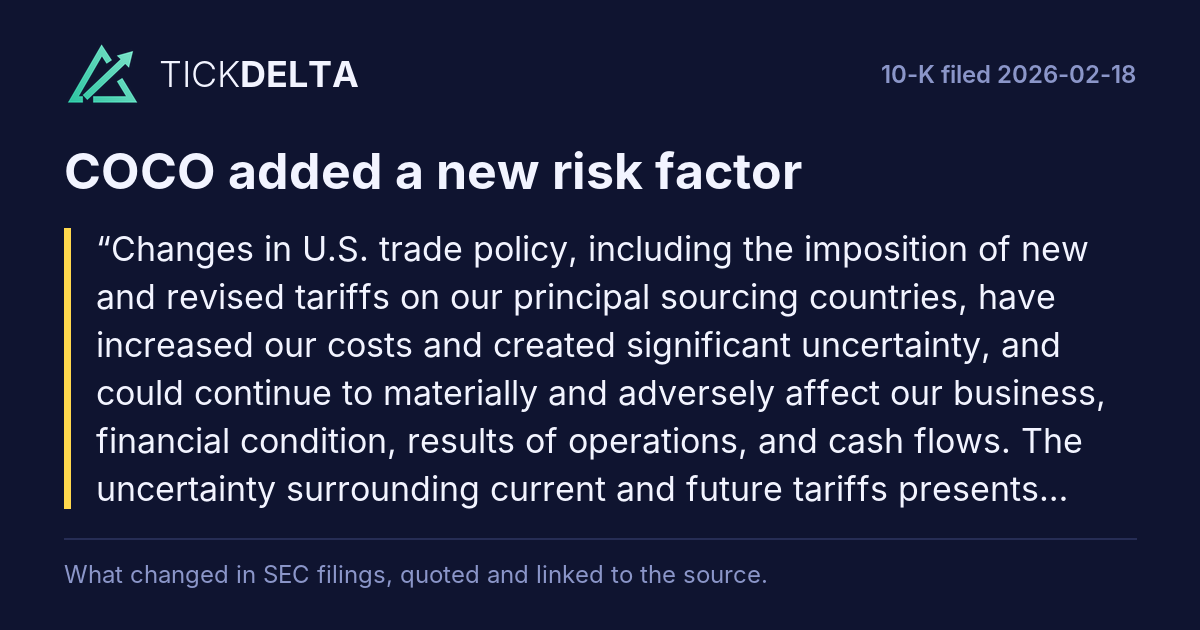
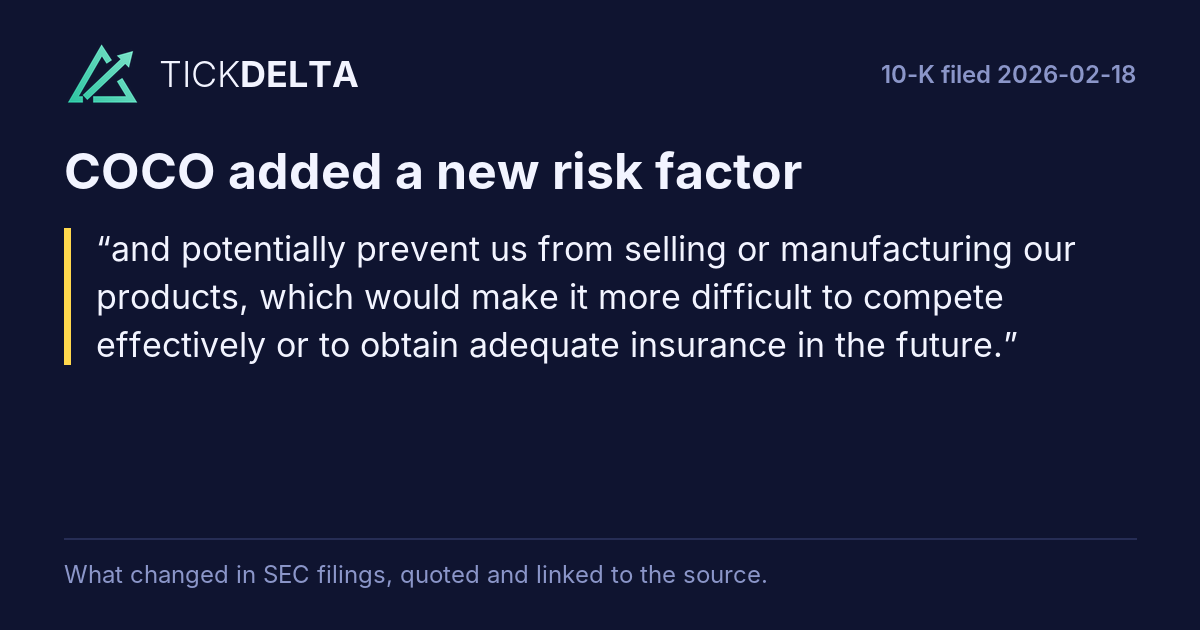
• risks associated with changes in U.S. trade policy, including the imposition of new and revised tariffs on countries which are a principal source of our supply, and uncertainties as they relate to consumer litigation and customer discussions related to tariff refunds;
Read in the 10-Qopen_in_new
• our dependence on information technology systems, and the risk of failure or inadequacy of such systems and cyberattacks;
Read in the 10-Qopen_in_new
• our need for and ability to obtain additional financing to achieve our goals; and
Read in the 10-Qopen_in_new
• our ability to service any indebtedness and comply with the covenants imposed under our existing debt agreements.
Read in the 10-Qopen_in_new
Sales of our coconut water products constitute a significant portion of our revenue, and a reduction in demand for our coconut water products or a decrease in consumer demand for coconut water generally would have an adverse effect on our financial condition.
Read in the 10-Qopen_in_new
Our Vita Coco branded coconut water accounted for 73% and 76% of our revenue for the three and nine months ended September 30, 2026, respectively. We expect that sales of our coconut water will continue to constitute a significant portion of our revenue, income and cash flow for the foreseeable future. Any material negative change to consumer demand for our products or coconut water generally or failure to grow the coconut water category could materially and adversely affect our business, financial condition, results of operations and cash flows. We are also subject to the risk of overly relying upon a few large customers (whether serviced directly or through distributors) in a particular market due to the concentration that exists in retail ownership in our key markets and our significant Private Label business with several large retailers. Our acquisition of Copra could increase this concentration risk because Copra's business is heavily dependent on Private Label sales to a small number of large retail customers, and the loss of, or significant reduction in purchases by, any such customer could adversely affect our revenue and profitability. We cannot be certain that consumer
Read in the 10-Qopen_in_new
and retail customer demand for our other existing and future products will expand to reduce this reliance on coconut water and allow such products to represent a larger percentage of our revenue than they do currently. Accordingly, any factor adversely affecting demand or sales of our coconut water or coconut water generally or a negative decision by a major retailer, could have a material adverse effect on our business, financial condition, results of operations and cash flows. For example, one of our significant customers discontinued the Private Label coconut oil supply relationship in early 2024, and we also experienced an impact in Private Label coconut water net sales in 2025 with this customer due to the loss of some regions that we previously serviced for this customer. However, this customer requested to restart supply in early 2026 for one of those lost regions. We will continue to service their needs if we are asked and it aligns with our long-term margin targets. Generally, the Private Label business is rebid regularly, and adjustments are often made to the regional areas serviced, or a complete transfer of the business to another supplier. These changes can be abrupt and difficult to predict.
Read in the 10-Qopen_in_new
If we encounter problems or interruptions with our supply chain, our costs may increase and our or our customers’ ability to deliver our products to market could be adversely affected, impacting our business and profitability.
Read in the 10-Qopen_in_new
Our supply chain is heavily reliant on third-party partners, and our success is dependent upon our ability to maintain our relationships with existing partners and enter into new arrangements in the future. Any changes to the relationships with our existing partners, including deprioritizing or experiencing delays in our production, or terminating the relationship could adversely affect our business. Furthermore, if we need to find alternative or new manufacturing or co-packing partners, for example, to increase or replace capacity, we would need to spend a significant amount of time and resources to ensure the new partners can meet our standards for quality control and have the necessary capabilities, responsiveness, high-quality service and financial stability, among other things, that align with our values and mission. We may need to assist any such manufacturing or co-packing partners in purchasing and installing packaging and processing capability, which may further delay and increase the financial costs of including them in our supply network and increase the financial risk of those relationships. Although we do not rely on our co-packing partners for the sourcing of raw materials, we face similar risks related to the operations and quality of services provided by such partners. Continued growth in demand could require the addition of new capacity and partners and there is no guarantee that such additions will be as cost competitive as our current suppliers. If we are unable to manage our supply chain effectively and ensure that our products are available to meet consumer demand, we may not have the ability to pursue our growth strategy, our sales may decrease, and our business, financial condition, results of operations and cash flows may be materially adversely affected. The supply risks can be mitigated by planning capacity greater than expected demand, but there is no guarantee that excess capacity will be available to meet any supply disruptions or excess demand.
Read in the 10-Qopen_in_new
Our independent shipping partners transport our products from the country of origin or from our domestic co-packing partners, which are then received by, and subsequently distributed from, our third-party warehousing and fulfillment service providers to our distributors and retail-direct customers by our third-party transportation partners or customer pickup. We depend in large part on the orderly operation of this receiving and distribution process from these third-party partners, which depends, in turn, on timely arrival of products from ports or co-packers, availability of outbound and inbound shipping, real-time tracking information on our products’ location, and effective operations at the warehouses or distribution centers and the ports through which our products flow. In addition, certain of our products require temperature-controlled transportation, warehousing and distribution throughout the supply chain, which involves additional costs, complexity and risk of cold-chain failure compared to our shelf-stable products. Any increase in transportation costs (including increases in fuel costs), increased shipping costs or shipping transit times, increased warehouse costs, issues with overseas shipments or port or supplier-side delays, reductions in the transportation capacity of carriers, labor strikes or shortages in the transportation industry, disruptions to the national and international transportation infrastructure, decreased warehouse availability including due to labor shortages, and unexpected delivery interruptions or delays may increase the cost of, and adversely impact, our logistics, and our ability to provide quality and timely service to our distributors or retail-direct customers. The inability to fulfill or any delays in processing customer or consumer orders from the warehousing or fulfillment centers of our providers, or any quality issues could result in the loss of consumers, retail partners or distributors, or the issuances of penalties, refunds or credits, and may also adversely affect our reputation.
Read in the 10-Qopen_in_new
Additionally, external events beyond our control may affect and cause interruptions or delays in our supply chain. Disruptions in operations due to natural or man-made disasters, inclement weather conditions, accidents, system failures, power outages, political instability, physical or cyber break-ins, server failure, work stoppages, slowdowns or strikes by employees, acts of terrorism, the outbreak of viruses, widespread illness, infectious diseases, contagions and the occurrence of unforeseen epidemics and other unforeseen or catastrophic events could damage the facilities of our supply chain partners or render them inoperable, affect the flow of product to and from these centers, or impact our ability to manage our partners, making it difficult or impossible for us to process customer or consumer orders for an extended period of time. We could also incur significantly higher costs and longer lead times during the time it takes for our supply chain to react and normalize.
Read in the 10-Qopen_in_new
Furthermore, international instability, including volatility in global oil markets, ongoing geopolitical tensions or ongoing trade tensions, including the imposition of tariffs, may affect our supply chain, impacting our costs and our
Read in the 10-Qopen_in_new
capacity to timely supply our products. It is hard to predict where ocean freight rates and capacity will be in the future and what long-term rates could be. Most of our business relies on shipping prepackaged coconut water from sourcing countries to our countries of sale so we are very dependent on shipping container prices and service levels and cost increases in shipping and the imposition of tariffs have materially impacted our financial results in recent years. Due to the price sensitivity of our products, we may not be able to pass such increases on to our customers. Any such disruption or unanticipated event may cause significant interruptions or delays in our business and the reduction or loss of inventory may render us unable to fulfill customer orders in a timely manner, or at all, which could materially adversely affect our business, financial condition, results of operations and cash flows.
Read in the 10-Qopen_in_new
Our cash flows and results of operations may be negatively affected if we are not successful in predicting demand and managing our inventory at appropriate levels for the demand that we experience.
Read in the 10-Qopen_in_new
Efficient inventory planning and management is a key component of our success and profitability. To be successful, we must maintain sufficient inventory levels to meet our customers’ demands without allowing those levels to increase to such an extent that the costs of holding the products unduly impact our financial results or create obsolete inventory, while ensuring we have adequate inventory to fulfill their needs, if their demand changes unexpectedly.
Read in the 10-Qopen_in_new
Maintaining adequate inventory requires significant attention to and monitoring of: market trends, local market demands; performance of our raw material suppliers and manufacturers, our logistics suppliers and distributors; the impact of tariffs and trade restrictions; and the collection of data to enable efficient forecasting and inventory management. Although we seek to forecast and plan our product needs sufficiently in advance of anticipated requirements to facilitate reserving production time at our manufacturing and co-packing partners, and arranging for the availability and supply of packaging and ingredient materials, our product takes many weeks to arrive at our warehouses from our manufacturing partners, which reduces our flexibility to react to short term or unexpected consumer demand changes, or changes in transit times, as it can require planning as much as six months in advance to coordinate all materials for production. As we expand our operations, it may be more difficult to effectively manage our inventory as the complexity increases. In any cases where consumers might not have access to our products, our reputation and brands could be harmed, and consumers may be less likely to recommend our products in the future. If we are not successful in managing our inventory balances, it could have a material adverse effect on our business, financial condition, results of operations and cash flows.
Read in the 10-Qopen_in_new
Our future business, financial condition, results of operations and cash flows may be adversely affected by reduced or limited availability of coconuts and other raw materials for our products.
Read in the 10-Qopen_in_new
Our ability to ensure a continuing supply of high-quality coconuts and other raw materials for our products at competitive prices depends on many factors beyond our control. We rely on a limited number of regional manufacturing partners to source and acquire certain of our raw materials and provide us with finished coconut-based products. Our financial performance depends in large part on their ability to arrange for the purchase of raw materials, including coconuts, coconut water and other natural ingredients, in sufficient quantities.
Read in the 10-Qopen_in_new
The coconuts from which our products are sourced, and the harvesting and transportation of them to our manufacturing partners, are vulnerable to adverse weather conditions and natural disasters, such as floods, droughts, earthquakes, hurricanes, typhoons, pestilence and other shortages and disease, as well as political events and other conditions which can adversely impact quantity and quality, leading to reduced coconut yields and quality, which in turn could reduce the available supply of, or increase the price of, our raw materials. Our manufacturing partners may have general difficulties in obtaining raw materials, particularly coconut derived products, due to our high quality standards. Our current manufacturing partners operate in the Philippines, Sri Lanka, Malaysia, Thailand, Brazil, Vietnam, and Indonesia, and source coconuts from owned trees and networks of many independent small farmers, while some of our co-packers operate in Mexico, the U.S., and the U.K. and source co-packing materials from these regions. In addition, following the Copra acquisition, a portion of our coconut supply used in Copra products is sourced from a single growing region in Thailand and is dependent on a specific coconut varietal, which may be subject to seasonal availability, local price volatility, unpredictable varietal-specific demand changes, and varietal-specific crop risks. Variations in the availability of this coconut variety might impact supply and cost of goods of Copra products and could result in product shortages, increased costs or an inability to meet demand for Copra products.
Read in the 10-Qopen_in_new
While we attempt to mitigate the risk for most of our coconut water products other than Copra by sourcing in multiple geographic areas, the supply of coconuts and other ingredients and materials may be particularly affected by any adverse events in these countries or regions. Any disruption in the ability of our manufacturing partners to source coconuts or other raw materials from their local suppliers to produce our finished goods would result in lower sales volumes and increased costs, and may have a material adverse effect on our business, financial condition, results of operations and cash flows if the necessary supply cannot be replaced in a timely manner or at all.
Read in the 10-Qopen_in_new
In addition, we also compete with other food and beverage companies in the procurement of coconut materials, including coconut water, and other raw materials, and this competition may increase in the future if consumer demand increases for these materials or products containing such materials, and if new or existing competitors increasingly offer products in these market sectors. If supplies of coconut materials and other raw materials, that meet our quality standards are reduced or are in greater demand, this could cause our expenses to increase and we or our manufacturing partners may not be able to obtain sufficient supply to meet our needs on favorable terms, or at all.
Read in the 10-Qopen_in_new
Our manufacturing partners and their ability to source coconut materials and other raw materials may also be affected by any changes among farmers in our sourcing countries as to what they choose to grow and harvest, changes in global economic conditions or climate, and our or their ability to forecast or to commit to our raw materials requirements. Many of these farmers also have alternative income opportunities and the relative financial performance of growing coconuts or other raw materials as compared to other potentially more profitable opportunities could affect their interest in working with us or our manufacturing partners. Any of these factors could impact our ability to supply our products to customers and consumers and may adversely affect our business, financial condition, results of operations and cash flows.
Read in the 10-Qopen_in_new
The success of our financial performance is closely tied to our Americas operating segment.
Read in the 10-Qopen_in_new
Our financial performance is largely dependent on our Americas operating segment, which accounted for approximately 81% of consolidated total net revenue for the nine months ended September 30, 2026. Because the Americas segment is more mature and produces the majority of our operating cash flows, any slowdown or decline in this segment may adversely affect our business, financial condition, results of operations and cash flow. Our International segment may be unable to make up any significant shortfall if our Americas segment, specifically the U.S. market, were to slow or decline, and our business and financial results could be adversely affected.
Read in the 10-Qopen_in_new
We are dependent on our existing suppliers for materials used to package our products, the costs of which may be volatile and may rise significantly.
Read in the 10-Qopen_in_new
In addition to purchasing coconut materials and other ingredients, we negotiate the terms and specifications for the purchase of significant quantities of packaging materials and pallets by our manufacturers and co-packing partners from third parties. The majority of our products are produced and packaged with materials sourced from a single supplier, Tetra Pak. While we believe that we may be able to establish alternative supply relationships for some of these materials, we may be unable to do so in the short term, or at all, at prices or quality levels that are acceptable to us, or in packaging that is acceptable to consumers. Further, any such alternative supplier arrangements may lead to increased costs or delays.
Read in the 10-Qopen_in_new
Volatility or inflation in the costs of our packaging materials and other supplies that we or our manufacturing partners purchase could increase our cost of sales and reduce our profitability. Moreover, we may not be able to implement price increases for our products to cover any increased costs, and any price increases we do implement may result in lower sales volumes or lost relationships. If we are not successful in managing our packaging costs, or if we are unable to increase our prices to cover increased costs or if such price increases reduce our sales volumes, then such increases in costs will adversely affect our business, financial condition, results of operations and cash flows.
Read in the 10-Qopen_in_new
Further, changes in business conditions, pandemics, governmental regulations and other factors beyond our control that we do not presently anticipate could affect our manufacturing and co-packing partners’ ability to receive components from our existing or future suppliers of such materials or the availability of such components generally. New, increasingly stringent, revised or conflicting environmental and sustainability-related laws, regulations and expectations, including related to extended producer responsibility or the use of certain substances in food packaging such as per- and polyfluoroalkyl substances, may increase compliance burdens and costs for us and for our co-packing partners in our global supply chain and in markets imposing such rules. The unavailability of any components for our suppliers could result in production delays and idle manufacturing facilities which may increase our cost of operations and render us unable to fulfill customer orders in a timely manner. In addition, quality issues with packaging materials or packaging processes, could result in the need to replace inventory produced, resulting in increased costs.
Read in the 10-Qopen_in_new
We are dependent on distributor and retail customers for most of our sales, and our failure to maintain these relationships or further develop our sales channels could harm our business, financial condition, results of operations and cash flows.
Read in the 10-Qopen_in_new
We derive a significant portion of our revenue from our network of domestic and international distributors and retail customers (whether serviced directly or through distributors), including club stores, major mass merchandisers, online marketplaces such as Amazon, drug store chains, supermarkets, independent pharmacies, health food stores, and
Read in the 10-Qopen_in_new
other retailers. In addition, our two largest customers accounted for approximately 23% and 22%, respectively, of our total net sales as of September 30, 2026. No other customer or distributor represented more than 10% of our total net sales as of September 30, 2026. Our acquisition of Copra may further increase our customer concentration, as Copra derives a significant portion of its revenue from a small number of major retail customers, certain of which overlap with our existing key accounts.
Read in the 10-Qopen_in_new
A decision by either our largest retail customer or largest distributor, or any other major distributor or retail customer, whether motivated by marketing strategy, competitive conditions, financial difficulties or otherwise, to decrease significantly the quantity or breadth of product purchased from us, or to change their manner of doing business with us and their support of our products, could substantially reduce our revenue and have a material adverse effect on our business, financial condition, results of operations and cash flows. We have previously experienced reductions in significant Private Label business as a result of customer sourcing decisions and changes to their supplier allocations. In addition, following our acquisition of Copra, Inc., we have increased exposure to the Private Label business as Copra derives a significant portion of its revenue from Private Label sales to a limited number of large retail customers. The loss of, reduction in purchases by, or adverse changes in relationships with any such customers could adversely affect our business, financial condition, results of operations and cash flows. Private Label relationships are often subject to changes in retailer purchasing strategies, supplier selection decisions, regional reallocations and pricing pressures, which may result in significant fluctuations in demand and revenue that are difficult to predict. In addition, any store closings or changes in retail strategy by our retail customers, particularly our largest retail customer, could reduce the number of stores or regions carrying our products, or stores may purchase a smaller amount of our products and/or may reduce the retail floor space designated for our products. If any negative change in our relationship with our largest distributor and retail customer or other customers occurs, any other disputes with key customers arise, if we were to lose placement and support of any of our key customers or if any of our key customers consolidate and/or gain greater market power, our business, financial condition, results of operations and cash flows would be materially adversely affected. In addition, we may be similarly adversely impacted if any of our key customers, particularly our largest distributor and retail customer, experience any operational difficulties or generate less traffic.
Read in the 10-Qopen_in_new
Although we aim to enter into long-term agreements with distributors, and historically have renewed, amended or extended them as needed, we cannot guarantee that we will be able to maintain or extend these contractual relationships in the future or that we will be able to do so on attractive terms. If any agreement with a key distributor is terminated or if the performance of such distributor deteriorates, we cannot guarantee that we will be able to find suitable replacement partners on favorable terms, or at all. Distributor contracts also may require that we make payments to terminate or upon non-renewal, and there is no guarantee that the parties will agree on payment terms, or that we will be able to recoup such fees from any replacement distributors. We enter into pricing support and promotional arrangements with our distributors to encourage execution and pricing activity on our brands, and in some cases, offer diversion fees when product is shipped directly to a specific retailer in their geographic market. There is no guarantee that these arrangements will be effective, or that disputes will not arise as to the sharing of the costs of such activity, which could impact our relationship with the distributors or impose additional costs on us.
Read in the 10-Qopen_in_new
We generally do not have long-term contracts or minimum purchase volumes with our retail-direct customers beyond promotional price arrangements, except in cases related to Private Label supply, and the duration of these relationships and terms are subject to change and adjustment based on the performance of the products and our performance as a supplier of these products. For example, pursuant to the terms of the agreement with our largest retail-direct customer, following the initial term, either party is permitted to terminate the agreement without cause with prior notice, and the agreement is non-exclusive and does not impose any minimum purchase or supply requirements. We seek to maintain the relationships with these customers’ Private Label brands and be their supplier of choice, but we cannot guarantee that we will maintain our share of this business, nor that the economic terms we will negotiate with such customers in the future will be favorable to us. The loss of any part of a key customer’s Private Label business may negatively impact that customer’s support of our branded products, and could have a material adverse effect on our business, financial condition, results of operations and cash flows.
Read in the 10-Qopen_in_new
We rely on our retailer partners’ continuing demand for our products whether supplied directly or supported through distributors and their support of our promotional programs. If our retail partners change their pricing and margin expectations, change their business strategies as a result of industry consolidation or otherwise, maintain and seek to grow their own private-label competitive offerings whether supplied by us or other suppliers, reduce the number of brands they carry or amount of shelf space they allocate to our products, or allocate greater shelf space to, or increase their advertising or promotional efforts for, our competitors’ products, our sales could decrease and our business, financial condition, results of operations and cash flows may be materially adversely affected.
Read in the 10-Qopen_in_new
Certain of our distributors or retail-direct customers may from time-to-time experience financial difficulties, including bankruptcy or insolvency. If our customers suffer significant financial or operational difficulty, they may reduce
Read in the 10-Qopen_in_new
their orders from us or stop purchasing from us and/or be unable to timely pay the amounts due to us or at all, which could have a material adverse effect on our ability to collect on receivables, our revenues and our results of operations. It is possible that customers may contest their contractual obligations to us, whether under bankruptcy laws or otherwise. Further, we may have to negotiate significant discounts and/or extended financing terms with these customers in such a situation. If we are unable to collect upon our accounts receivable as they come due in an efficient and timely manner, our business, financial condition, results of operations and cash flows may be materially adversely affected. In addition, product sales are dependent in part on high-quality merchandising and an appealing retail environment to attract consumers, which requires continuing investments by retailers and ongoing support by distributors. Retailers or distributors that experience financial difficulties may fail to make such investments or delay them, resulting in lower sales and orders for our products. Consolidations among our customers would concentrate our credit risk and, if any of these retailers or distributors were to experience a shortage of liquidity or consumer behavior shifts away from their retail model or their service area, it would increase the risk that their outstanding payables to us may not be paid. In addition, increasing market share concentration among one or a few retailers in a particular region increases the risk that if any one of them substantially reduces their purchases of or support for our products, we may be unable to find a sufficient number of other retail outlets for our products to sustain the same level of sales and revenue whether sold directly to retailers or through distributors.
Read in the 10-Qopen_in_new
Competition in the food and beverage retail industry is strong and presents an ongoing threat to the success of our business.
Read in the 10-Qopen_in_new
We operate in a highly competitive market, which includes large multinational companies as well as many smaller entrepreneurial companies seeking to innovate and disrupt the categories in which we compete. As a category, coconut water competes for space with a wide range of beverage offerings. In particular, coconut water competes with functional refreshment, juices, energy drinks, ready to drink teas and coffees and other non-100% coconut water-based beverages, and many of these products are marketed by companies with substantially greater financial resources than ours. We also compete with a number of natural, organic, and functional food and beverage producers. We and these competing brands and products compete for limited retail, and food service customers and consumers. In our market, competition is based on, among other things, brand equity and consumer relationships, consumer needs, product experience (including taste, functionality and texture), nutritional profile and dietary attributes, sustainability of our supply chain (including raw materials), quality and type of ingredients, distribution and product availability, retail and foodservice and e-commerce customer relationships, marketing investment and effectiveness, pricing competitiveness and product packaging.
Read in the 10-Qopen_in_new
Conventional food or beverage companies, which are generally multinational corporations with substantially greater resources and operations than us, may acquire our competitors or launch their own coconut water products or other products that compete with our own. Such competitors may be able to use their resources and scale to respond to competitive pressures and changes in consumer preferences by introducing new products, reducing prices or increasing promotional activities, among other things. These large competitors may decide not to compete in coconut water but rather to use their retail relationships and category insights to reduce retailer excitement for the category, impacting our visibility and shelf space.
Read in the 10-Qopen_in_new
Retailers also market competitive products under their own Private Labels, which are generally sold at lower prices and compete with our products. Retailers source these products from a range of suppliers under competitive bidding relationships and we compete for this business as a Private Label supplier. While we seek to enter into strategic partnerships with retailers to capitalize on Private Label supply opportunities, we cannot guarantee that we will be awarded this Private Label business in future years or that our existing supply relationships may not be downsized or cease. If the quality of competing Private Label or branded products were to be compromised, that could affect the consumer perceptions of coconut water more generally which could impact our business. Additionally, some of our distributor partners carry competing products or in some cases also are brand owners of beverage products that might compete with us, and while we believe our products are worthy of their support, there is no guarantee that their support will continue for all of our brands or at the same levels as today.
Read in the 10-Qopen_in_new
Competitive pressures or other factors could cause us to lose market share and lead to reduced space allocated to our products, which may require us to lower prices, increase marketing and advertising expenditures, or increase the use of discounting or promotional campaigns, each of which could adversely affect our margins and could adversely affect our business, financial condition, results of operations and cash flows. Many of our current and potential competitors in beverages have longer operating histories, greater brand recognition, better access to distribution capabilities, larger fulfillment infrastructures, greater technical capabilities, significantly greater financial, marketing and other resources and maintain deeper customer relationships with key retailers due to their extensive brand portfolios than we do. These factors may allow our competitors to derive greater net sales and profits from their existing customer base, acquire customers at lower costs or respond more quickly than we can to new or emerging technologies and changes in consumer preferences or habits.
Read in the 10-Qopen_in_new
We expect competition in the natural, organic and functional food and beverage industry to continue to increase. The success of the coconut water category in our major markets, increases the likelihood of new competitors entering or expanding their distribution focus. If we fail to compete successfully in this market, our business, financial condition, results of operations and cash flows would be materially and adversely affected.
Read in the 10-Qopen_in_new
If we fail to develop and maintain our brands and Company image, our business could suffer.
Read in the 10-Qopen_in_new
We have developed strong and trusted brands, including our leading Vita Coco brand, that we believe have contributed significantly to the success of our business, and we believe our continued success depends on our ability to maintain and grow the value of Vita Coco and other brands. Maintaining, promoting and positioning our brands and reputation will depend on, among other factors, the success of our product offerings, food safety, quality assurance, marketing and merchandising efforts, the reliability and reputation of our supply chain, our ability to grow and capture share of the coconut water category, and our ability to provide a consistent, high-quality consumer experience. Any negative publicity, regardless of its accuracy, could materially adversely affect our business. For example, as part of the licensing strategy of our brands, we enter into licensing agreements under which we grant our licensing partners certain rights to use our trademarks and other designs. Although our agreements require that the use of our trademarks and designs is subject to our control and approval, any breach of these provisions, or any other action by any of our licensing partners that is harmful to our brands, goodwill and overall image, could have a material adverse impact on our business.
Read in the 10-Qopen_in_new
The growing use of social and digital media by us, our consumers and third parties increases the speed and extent that information or misinformation and opinions can be shared. Negative publicity about us, our brands, our products or our industry on social or digital media could seriously damage our brands and reputation.
Read in the 10-Qopen_in_new
Our Company image and brands are very important to our vision and growth strategies, particularly as a public benefit corporation, a Certified B Corporation, and with the goal of operating consistent with our mission and values. We will need to continue to invest in actions that support our mission and values and adjust our offerings to appeal to a broader audience in the future in order to sustain our business and to achieve growth, and there can be no assurance that we will be able to do so. If we do not maintain the favorable perception of our Company and our brands, our sales and results of operations could be negatively impacted. Our brands and Company image are based on perceptions of subjective qualities, and any incident that erodes the loyalty of our consumers, customers, suppliers or manufacturers, including adverse publicity or a governmental investigation or litigation, could significantly reduce the value of our brands and damage our business, which would have a material adverse effect on our business, financial condition, results of operations and cash flows.
Read in the 10-Qopen_in_new
Failure to introduce new products or successfully improve existing products or adopt new technology or marketing practices effectively, may adversely affect our ability to continue to grow and may cause us to lose market share and sales.
Read in the 10-Qopen_in_new
A key element of our growth strategy depends on our ability to develop and market new products, product extensions and improvements to our existing products that meet our standards for quality and appeal to consumer preferences. In addition, our acquisition of Copra has expanded our product offerings to include non-water coconut formats such as coconut meat, nectar and purée, which are in earlier stages of market development and in which we have limited historical operating experience. The success of our innovation and product development efforts is affected by our ability to anticipate changes in consumer preferences, the technical capability of our innovation staff in developing and testing product prototypes to meet these consumer needs while complying with applicable governmental regulations, the ability to obtain patents and other intellectual property rights and protections for commercializing such innovations and developments, the ability of our supply chain and production systems to provide adequate solutions and capacity for new products, and the success of our management and sales and marketing teams in designing, branding and packaging, introducing and marketing new products. Failure to develop and market new products that appeal to consumers may lead to a decrease in our growth, sales and profitability. There is no guarantee that each innovation we launch will reach our goals and be successful, and many will require iteration and development to have a chance of success. Discontinuing products that have not reached sufficient scale to be viable long term or where consumer demand is decreasing, may result in decreased sales, disappointed customers and unexpected costs. Additionally, the development and introduction of new products requires research, development and marketing expenditures, which we may be unable to recoup if the new products do not gain widespread market acceptance.
Read in the 10-Qopen_in_new
Our competitors also may create or obtain similar formulations first that may hinder our ability to develop new products or enter new categories, which could have a material adverse effect on our growth. If we experience difficulty in partnering with co-packers or manufacturers to produce our new products, it may affect our ability to develop and launch new products and enter new product categories, and scale up supply if successful. Further, if we fail to ensure the
Read in the 10-Qopen_in_new
efficiency and quality of new production processes and products before they launch, we may experience uneven product quality and supply, which could negatively impact consumer acceptance of new products and negatively impact our sales and brand reputation. If we are unsuccessful in meeting our objectives with respect to new or improved products, our business, financial condition, results of operations and cash flow may be adversely affected.
Read in the 10-Qopen_in_new
Consumer preferences for our products are difficult to predict and may change, and, if we are unable to respond quickly to new trends, our business may be adversely affected.
Read in the 10-Qopen_in_new
Our business is primarily focused on developing, manufacturing, marketing and distributing coconut water branded and Private Label products and other “better-for-you” beverages. Consumer demand for our products and interest in our offerings could change based on a number of possible factors, including changes in consumer preferences, dietary habits, refreshment and nutritional habits, concerns regarding the health effects of ingredients, the usage of single use packaging, the impact of our supply chain on our sourcing communities, shifts in preference for various product attributes or consumer confidence, trends within consumer age groups and perceived value and quality for our products relative to alternatives. Consumer trends that we believe favor sales of our products could change based on a number of possible factors. While we continually strive to improve our products through thoughtful, innovative research and development approaches to meet consumer needs, there can be no assurance that our efforts will be successful. If consumer demand for our products decreases, our business, financial condition, results of operations and cash flows may be adversely affected.
Read in the 10-Qopen_in_new
Pandemics, epidemics, or other widespread public health events could disrupt our business and supply chain and production processes, each of which could materially affect our operations, liquidity, financial condition and results of operations.
Read in the 10-Qopen_in_new
Pandemics, epidemics or other widespread public health events, as well as related government measures or other global trade disruptions resulting therefrom, could adversely affect consumer confidence and spending, our customers and the availability and demand for our products. Such events could disrupt the operations of our production facility in Thailand, or those of our manufacturing, co-packing, logistics or other supply chain partners, resulting in product shortages, inventory losses, shipment delays or higher costs. Because our supply chain depends on ocean freight to ship our products from source countries to end-use markets, disruptions to ocean freight and container availability could further impair our ability to meet customer demand. Any of these events could materially adversely affect our business, liquidity, financial condition, results of operations and cash flows.
Read in the 10-Qopen_in_new
As the direct owner and operator of the Thailand facility, we are subject to both U.S. FDA requirements for imported food products and Thai Food and Drug Administration requirements for local manufacturing operations. Compliance with these overlapping regulatory frameworks may increase our costs and operational complexity. We may also have assumed regulatory liability for pre-acquisition compliance issues at the facility, including unresolved regulatory observations or product safety concerns predating our ownership, and any failure to identify or remediate inherited compliance issues could result in enforcement actions, operational disruptions, or reputational harm.
Read in the 10-Qopen_in_new
Climate change, or legal or market measures to address climate change, may negatively affect our business and operations.
Read in the 10-Qopen_in_new
There is growing concern that carbon dioxide and other greenhouse gases in the atmosphere may have an adverse impact on global temperatures, weather patterns and the frequency and severity of extreme weather and natural disasters. If such climate change has a negative effect on agricultural productivity, we may be subject to decreased availability or less favorable pricing for coconut water, oil, cream and other raw materials that are necessary for our current or any future products. Such climate changes may also require us to find manufacturing partners in new geographic areas if the location for best production of coconuts changes, which will require changes to our supply network and investing time and resources with new manufacturing partners, thereby potentially increasing our costs of production. In addition, there is no guarantee that we will be able to maintain the quality and taste of our products as we transition to sourcing coconuts in new geographic areas. Increasing frequency and severity of extreme weather and natural disasters could result in unusual weather patterns, which could affect the supply and demand for our products and lead to negative effects on our business, financial condition, results of operations and cash flow.
Read in the 10-Qopen_in_new
Additionally, the increasing concern over climate change may also result in more federal, state, local and foreign legal requirements to reduce or mitigate the effects of greenhouse gases or to reduce packaging and improve recyclability. If such laws are enacted, we may experience significant increases in our costs of operations and delivery, which in turn may negatively affect our business, financial condition, results of operations and cash flows, and may incur increased liability for the accuracy of any public disclosures.
Read in the 10-Qopen_in_new
Following our acquisition of Copra, we may have greater exposure to climate-related disruptions affecting the Thailand manufacturing facilities and related infrastructure, including flooding, extreme weather events and other natural disasters, which could interrupt production, damage facilities, impair transportation routes, impact coconut yields and raw material quality, or increase operating costs.
Read in the 10-Qopen_in_new
Failure to retain our senior management and key personnel, or to maintain and evolve our culture may adversely affect our operations or our ability to grow successfully.
Read in the 10-Qopen_in_new
Our success is substantially dependent on the continued service of certain members of our senior management and other key employees. These employees have been primarily responsible for determining the strategic direction of our business and for executing our growth strategy and are integral to our brands, culture and the reputation we enjoy with suppliers, manufacturers, distributors, customers and consumers. In particular, we are dependent on our co-founder, Michael Kirban, for leadership, culture, strategy, key customer and supplier relationships and other skills and capabilities. The loss of the services of the co-founder, or any of these executives and key personnel could have a material adverse effect on our business and prospects, as we may not be able to find suitable individuals to replace them on a timely basis, if at all. In addition, any such departure could be viewed in a negative light by investors and analysts, which may cause the price of our common stock to decline. We do not currently carry key-person life insurance for our co-founder or senior executives.
Read in the 10-Qopen_in_new
Additionally, our success depends on our ability to attract, train and retain a diverse workforce who understand and appreciate our culture and can represent our brand effectively and establish credibility with our business partners and consumers. Pressures in the labor market for talent and wage inflation have been increasing and could increase our future costs of hiring or retaining our employees, and thus impact our profitability. If we are unable to hire and retain employees capable of meeting our business needs, and creating the culture and capability that we desire, our business and brand image may be impaired, including not meeting our B Corp expectations nor our public benefit corporation mission.
Read in the 10-Qopen_in_new
If our independent suppliers and manufacturing partners, or the local farmers or other suppliers from which we or our manufacturing partners source the raw materials, do not comply with ethical business practices or with applicable laws and regulations, our reputation, business, and results of operations may be harmed.
Read in the 10-Qopen_in_new
Our reputation and our consumers’ willingness to purchase our products depend in part on the compliance of our suppliers, manufacturers, distributors, and retailer partners, as well as the local farmers or other suppliers from which our
Read in the 10-Qopen_in_new
manufacturing partners source raw materials, with ethical employment practices, such as with respect to child and animal labor, wages and benefits, forced labor, discrimination, safe and healthy working conditions, and with all legal and regulatory requirements relating to the conduct of their businesses. We do not exercise control over our independent suppliers, manufacturers, distributors and retailer partners, nor over the suppliers of our raw materials, and cannot guarantee their compliance with ethical and lawful business practices. If our suppliers, manufacturers, distributors, retailer partners or raw material suppliers fail to comply with applicable laws, regulations, safety codes, employment practices, human rights standards, quality standards, environmental standards, production practices, or other obligations, norms or ethical standards, our reputation and brand image could be harmed, our customers may choose to terminate their relationships with us, and we could be exposed to litigation and additional costs that would harm our business, reputation, and results of operations.
Read in the 10-Qopen_in_new
We are subject to a number of risks related to doing business internationally, any of which could significantly harm our business. These risks include:
Read in the 10-Qopen_in_new
• facing difficulties, such as legal, regulatory, personnel, technological, consumer preference variation, and integration risks, as we operate in countries where we have limited experience or presence, expand our operations into countries in which we have no prior operating history, or directly own and operate foreign facilities, assets and workforces;
Read in the 10-Qopen_in_new
• restrictions on the transfer and repatriation of funds to and from foreign countries, including potentially negative tax consequences;
Read in the 10-Qopen_in_new
• unfavorable changes or proposed changes in U.S. trade policies, including with respect to treaties, tariffs, quotas, trade barriers or other export or import restrictions, including navigating the changing relationships between countries such as the U.S. and China and between the U.K. and the European Union ("EU");
Read in the 10-Qopen_in_new
• unfavorable foreign exchange controls and variation in currency exchange rates;
Read in the 10-Qopen_in_new
• increased exposure to general international market and economic conditions and uncertainty;
Read in the 10-Qopen_in_new
• political, economic, environmental, health-related or social uncertainty and volatility; including risks of expropriation, nationalization or other adverse governmental action affecting foreign-owned assets;
Read in the 10-Qopen_in_new
• the potential for substantial penalties, litigation and reputational risk related to violations of a wide variety of laws, treaties and regulations, including food and beverage regulations, anti-corruption regulations (including, but not limited to, the U.S. Foreign Corrupt Practices Act (“FCPA”), and the U.K. Bribery Act), local tax, land use, property ownership, labor and employment requirements, and data privacy laws and regulations (including the EU’s General Data Protection Regulation);
Read in the 10-Qopen_in_new
• significant differences in regulations across international markets, including new regulations that could impact requirements applicable to our products and the regulatory impacts on a globally integrated supply chain;
Read in the 10-Qopen_in_new
• the varying trademark laws and regulations, or difficulties with international intellectual property protection and problems created by counterfeiting;
Read in the 10-Qopen_in_new
• the bankruptcy or default in payment by our international customers and/or import partners and the potential inability to recoup damages from such defaults, as well as subsequent termination of existing importation agreements;
Read in the 10-Qopen_in_new
• the difficulty and costs of designing and implementing an effective control environment across diverse regions, operations and employee bases;
Read in the 10-Qopen_in_new
• the complexities of monitoring and managing compliance with a broad array of international laws related to data privacy and data protection, as well as cross-border transfers of personal data;
Read in the 10-Qopen_in_new
• the difficulty and costs of maintaining effective data security and meeting different data security regulations;
Read in the 10-Qopen_in_new
If tariffs or other import related fees are implemented on goods from countries where the Company does business, they may raise the Company's cost of importation of coconut water and require the Company to adjust its pricing or strategy. An inability to effectively manage these risks associated with our international operations could adversely impact our business and financial results. For more information see the risk factor captioned “If we encounter problems or interruptions with our supply chain, our costs may increase and our or our customers’ ability to deliver our products to market could be adversely affected, impacting our business and profitability.”
Read in the 10-Qopen_in_new
We are subject to risks related to sustainability and corporate social responsibility.
Read in the 10-Qopen_in_new
Our business faces increasing scrutiny related to environmental, social and governance issues, including sustainable development, product packaging, renewable resources, environmental stewardship, supply chain management, climate change, diversity and inclusion, workplace conduct, human rights, philanthropy and support for local communities. We are a Delaware public benefit corporation which has placed additional requirements on our strategies and decision-making to meet our mission. See “-Risks Related to our Existence as a Public Benefit Corporation.” There has been increasing public focus by investors, customers, environmental activists, the media and governmental and non-governmental organizations on a variety of environmental, social and other sustainability matters. Our efforts to ensure we meet these standards rely on our leadership, contracts, internal and third-party audits and on continued monitoring of potential risks and solutions. We may experience increased costs in order to execute upon our sustainability goals and measure achievement of those goals, which could have an adverse impact on our business and financial condition. Additionally, if we fail to meet applicable standards or expectations with respect to these issues across any of our products and in any of our operations and activities or those of our third-party partners, such as manufacturers and co-packers, our reputation and brand image could be damaged, and our business, financial condition, results of operations and cash flows could be adversely impacted.
Read in the 10-Qopen_in_new
Further, we have developed a strong corporate reputation over the years for our focus on responsible sourcing and support of our supplier communities. We seek to conduct our business in an ethical and socially responsible way, which we regard as essential to maximizing stakeholder value, while enhancing community quality, environmental stewardship and furthering the plant-based movement around the world. We are developing environmental and sustainability initiatives that support our societal programs and are consistent with our purpose, but these initiatives require financial expenditures and employee resources and are not yet fully vetted or implemented. If we are unable to meet our sustainability, and environmental, social and governance goals, this could have a material adverse effect on our reputation and brand and negatively impact our relationship with our employees, customers, consumers and investors. There is no guarantee that our pace of progress on our environmental, social and governance initiatives will meet all parties’ expectations, which in turn could result in harm to our reputation and negatively impact our business, financial condition, results of operations and cash flow. In addition, this emphasis on environmental, social and other sustainability matters has resulted and may result in the adoption of new laws and regulations, including new reporting requirements. If we fail to comply with new laws, regulations or reporting requirements, our reputation and business could be adversely impacted.
Read in the 10-Qopen_in_new
Food safety and food-borne illness incidents or other safety concerns may materially adversely affect our business by exposing us to lawsuits, product recalls or regulatory enforcement actions, increasing our operating costs and reducing demand for our product offerings.
Read in the 10-Qopen_in_new
Selling food and beverages for human consumption involves inherent legal and other risks, and there is increasing governmental scrutiny of and public awareness regarding food safety. Unexpected side effects, illness, injury or death related to allergens, food-borne illnesses or other food safety incidents caused by products we sell or involving our suppliers or manufacturers, could result in the discontinuance of sales of these products or cessation of our relationships with such suppliers and manufacturers, or otherwise result in increased operating costs, lost sales, regulatory enforcement actions or harm to our reputation. Shipment of adulterated or misbranded products, even if inadvertent, can result in criminal or civil liability. Such incidents could also expose us to product liability, negligence or other lawsuits, including consumer class action lawsuits. Any claims brought against us may exceed or be outside the scope of our existing or future insurance policy coverage or limits. Any judgment against us that is more than our policy limits or not covered by our policies would have to be paid from our cash reserves, which would reduce our capital resources. In addition, certain of our products, including the refrigerated and frozen coconut products produced at our facility in Thailand, require end-to-end cold-chain handling and are subject to heightened risks of spoilage, temperature excursion, reduced shelf life and product degradation during production, storage and distribution, any of which could lead to product recalls, food safety incidents, increased waste, and harm to our brands and reputation.
Read in the 10-Qopen_in_new
The occurrence of food-borne illnesses or other food safety incidents could also adversely affect the price and availability of affected ingredients and raw materials, resulting in higher costs, disruptions in supply and a reduction in our sales. Furthermore, any instances of food contamination or regulatory noncompliance, whether or not caused by our actions, could compel us, our manufacturing and co-packing partners, our distributors or our retail customers, depending on the circumstances, to conduct a recall in accordance with FDA regulations and comparable foreign laws and regulations, as well as other regulations and laws in the other jurisdictions in which we operate. Product recalls could result in significant losses due to their associated costs, the destruction of product inventory, lost sales due to the unavailability of the product for a period of time and potential loss of existing distributors, retail customers and shelf space or e-commerce prominence, and a potential negative impact on our ability to attract new customers and consumers, and maintain our current customer and consumer base due to negative consumer experiences or because of an adverse impact on our brands and reputation. The costs of a recall could exceed or be outside the scope of our existing or future insurance policy coverage or limits. While we maintain batch and lot tracking capability to identify potential causes for any discovered problems, there is no guarantee that in the case of a potential recall, we will effectively be able to isolate all product that might be associated with any alleged problem, or that we will be able to quickly and conclusively determine the root cause or narrow the scope of the recall. Our potential inability to effect a recall quickly and effectively, or manage the consumer and retailer communication in a way that mitigates concerns, might create adverse effects on our business and reputation, including large recall and disposal costs and significant loss of revenue.
Read in the 10-Qopen_in_new
We believe our consumers, retailers and distributors rely on us to provide them with high-quality products. Therefore, any real or perceived quality or food safety concerns or failures to comply with applicable food regulations and requirements, whether or not ultimately based on fact and whether or not involving us (such as incidents involving our competitors), could cause negative publicity and reduced confidence in our Company, brands or products, which could in turn harm our reputation and sales, and could materially adversely affect our business, financial condition, results of operations and cash flows. Although we believe we and our manufacturing and co-packing partners on which we rely have rigorous quality control processes in place, there can be no assurance that our products will always comply with the standards set for our products or that our manufacturing and co-packing partners will comply with our product specifications.
Read in the 10-Qopen_in_new
In addition, food and beverage companies have been subject to targeted, large-scale tampering as well as to opportunistic, individual product tampering, and we, like any beverage company, could be a target for product tampering. Forms of tampering could include the introduction of foreign material, chemical contaminants and pathological organisms into consumer products as well as product substitution. The FDA enforces laws and regulations, such as the Food Safety Modernization Act, that require companies like us to analyze, prepare and implement mitigation strategies specifically to address tampering designed to inflict widespread public health harm. If we do not adequately address the possibility, or any actual instance, of product tampering, we could face possible seizure or recall of our products and the imposition of civil or criminal sanctions, which could materially adversely affect our business, financial condition, results of operations and cash flows. Most countries in which we operate have comparable regulations that we endeavor to comply with, but any failure to meet regulators’ or customers’ expectations could impact our business in these markets and have a material adverse effect on our reputation as well as our business, financial condition, results of operations and cash flows.
Read in the 10-Qopen_in_new
Our products and operations are subject to federal, state and foreign government regulation and oversight both in the U.S. and abroad, and our failure to comply with applicable requirements, or to respond to changes in regulations applicable to our business could adversely affect our business, financial condition, results of operations and cash flows.
Read in the 10-Qopen_in_new
The manufacturing, marketing and distribution of food products is highly regulated. We, along with our manufacturing and co-packing partners and our suppliers, are subject to a variety of laws and regulations internationally, which apply to many aspects of our and their businesses, including the sourcing of raw materials, manufacturing, packaging, labeling, distribution, advertising, sale, quality and safety of our products, as well as the health and safety of employees and the protection of the environment.
Read in the 10-Qopen_in_new
Our products and operations and those of our manufacturing and co-packing partners are subject to oversight by multiple U.S. and international regulatory agencies including the USDA, the FDA, the FTC, the EPA, the European Commission and the U.K.’s Food Standards Agency, Health and Safety Executive, Environment Agency, Environmental Health Officers and Trading Standards Officers and the Singapore Food Agency, among others. These agencies regulate, among other things, with respect to our products and operations:
Read in the 10-Qopen_in_new
In the U.S., for example, we are subject to the requirements of the Federal Food, Drug and Cosmetic Act and regulations promulgated thereunder by the FDA. This comprehensive regulatory program governs, among other things, the manufacturing, composition and ingredients, packaging, testing, labeling, marketing, promotion, advertising, storage, distribution and safety of food. The FDA requires that facilities that manufacture food products comply with a range of requirements, including hazard analysis and preventative controls regulations, current good manufacturing practices (“cGMP”), and supplier verification requirements. Certain of our facilities, as well as those of our manufacturing and co-packing partners, are subject to periodic inspection by federal, state and local authorities. We do not control the manufacturing processes of, but rely upon, our third-party manufacturing partners for compliance with cGMPs for the manufacturing of our products that is conducted by our partners. If we or our manufacturing partners cannot successfully manufacture products that conform to our specifications and the strict regulatory requirements of the FDA or other regulatory agencies, we or they may be subject to adverse inspectional findings or enforcement actions, which could materially impact our ability to market our products, could result in our manufacturing or co-packing partners’ inability to continue manufacturing for us or could result in a recall of our product that has already been distributed. In addition, we rely upon these parties to maintain adequate quality control, quality assurance and qualified personnel.
Read in the 10-Qopen_in_new
As a result of the Copra acquisition, we now directly own and operate a food manufacturing facility in Thailand whose products are imported into the United States. This facility is subject to the FDA’s foreign facility inspection authority under the Food Safety Modernization Act (“FSMA”), and any refusal or inability to permit an inspection could result in the suspension of our facility’s registration or the refusal of our products at the U.S. border. The facility has been subject to prior regulatory inspections that resulted in observations requiring remediation, and there can be no assurance that future inspections will not result in similar or more significant findings, including warning letters, import alerts, or automatic detention. We are also subject to FSMA’s Foreign Supplier Verification Program requirements and must maintain a valid biennial FDA registration for the facility. In addition, the facility is independently regulated by the Thai Food and Drug Administration and other Thai regulations, and non-compliance with local requirements could result in fines, operational restrictions, or facility shutdowns, independent of any U.S. regulatory action.
Read in the 10-Qopen_in_new
Furthermore, there are an increasing number of state and local regulations in the U.S. and regulations in international markets related to, among other things, beverage packaging, packaging composition, labeling requirements, container deposits, recycling, or beverage taxes. We anticipate that additional jurisdictions may adopt similar legislation or regulations, requiring us to continuously monitor applicable laws to ensure compliance. Any failure to comply with these
Read in the 10-Qopen_in_new
laws or regulations correctly could result in a temporary halt in distribution of our products and other costs, affecting our business and profitability.
Read in the 10-Qopen_in_new
Failure by us, our suppliers or our manufacturing and co-packing partners to comply with applicable laws and regulations or maintain permits, licenses or registrations relating to our or our suppliers or manufacturing and co-packing partners’ operations could subject us to civil remedies or penalties, including fines, injunctions, recalls or seizures, warning letters, untitled letters, restrictions on the marketing or manufacturing of products, or refusals to permit the import or export of products, as well as potential criminal sanctions, which could result in increased operating costs or loss of revenue, resulting in a material effect on our business, financial condition, results of operations and cash flows. The regulations to which we are subject are complex and continuously changing, and have tended to become more stringent over time. New labeling and food safety laws could restrict our ability to carry on or expand our operations, result in higher than anticipated costs or lower than anticipated sales, and otherwise make it more difficult for us to realize our goals of achieving a more integrated global supply chain due to the differences in regulations around the world.
Read in the 10-Qopen_in_new
We also rely on various independent third-party certifications, such as certifications of our products as “organic,” to differentiate our products and Company from others. Maintaining these certifications requires us and our suppliers and manufacturing partners to comply with applicable requirements, and a failure to do so could result in the loss of certification and adversely affect our market position and business.
Read in the 10-Qopen_in_new
Advertising inaccuracies and product mislabeling may have an adverse effect on our business by exposing us to lawsuits, product recalls or regulatory enforcement actions, increasing our operating costs and reducing demand for our product offerings.
Read in the 10-Qopen_in_new
Certain of our products are advertised with claims as to their origin, ingredients or health, wellness, environmental or other potential benefits, including, by way of example, the use of the terms “natural”, “organic”, “clean”, “non-toxic”, “sustainable”, “no added sugars,” or similar synonyms or implied statements relating to such benefits. Although the FDA and the USDA each have issued statements and adopted policies regarding the appropriate use of the word “natural,” there is no single, universal definition of the term “natural” for various categories we sell, which is true for many other adjectives common in the healthy or sustainable products industry. The resulting uncertainty has led to consumer confusion, distrust and legal challenges.
Read in the 10-Qopen_in_new
In addition, the FDA has consistently enforced its regulations with respect to nutrient content claims, unauthorized health claims (claims that characterize the relationship between a food or food ingredient and a disease or health condition) and other claims that impermissibly suggest therapeutic benefits of certain foods or food components, or that misrepresent or improperly characterize the nutrient content in conventional food products.
Read in the 10-Qopen_in_new
Moreover, the FTC has articulated a robust substantiation standard for health claims on foods and dietary supplements and has pursued investigations and litigation against companies where the FTC has concern that the claims being made are not properly substantiated. Examples of causes of action that may be asserted in a consumer class action lawsuit include fraud, unfair trade practices and breach of state consumer protection statutes. The FTC and/or state attorneys general may bring legal action that seeks removal of a product from the marketplace and impose fines and penalties. Further, consumer class action false advertising litigation relating to terms such as “natural,” “non-toxic,” “non-GMO” and other claims remain a persistent threat in our industry. Even when unmerited, class action claims, action by the FTC or state attorneys general enforcement actions can be expensive to defend and adversely affect our reputation with existing and potential customers and consumers and our corporate and brand image, which could have a material and adverse effect on our business, financial condition, results of operations or cash flows.
Read in the 10-Qopen_in_new
The USDA enforces federal standards for organic production and use of the term “organic” on product labeling. These laws prohibit a company from selling or labeling products as organic unless they are produced and handled in accordance with the applicable federal law. By definition, organic products are not genetically modified or do not include genetically modified (bioengineered) ingredients. We use suppliers and manufacturing partners who can certify that they meet the standards needed for each applicable product or ingredient specification. Our failure, or failure on the part of our suppliers or manufacturing partners to comply with these ingredient and product specifications, to maintain appropriate certifications, or to label organic products in compliance with federal or state laws, may subject us to liability or regulatory enforcement. Consumers may also pursue state law claims as to our labelling practices on this and other matters, challenging our labels as being intentionally mislabeled or misleading or deceptive to consumers. The cost of defending or settling these suits may be material to our business.
Read in the 10-Qopen_in_new
The regulatory environment in which we operate could also change significantly and adversely in the future. New or changing regulations could impact the way consumers view our products, such as potential new labeling regulations or enforcement of a standard of identity for terms used to market our products that would require us to list certain ingredients
Read in the 10-Qopen_in_new
by specific names that could confuse our consumers into thinking we may use different types of ingredients than they originally thought or that the quality of our ingredients is different to what they anticipated.
Read in the 10-Qopen_in_new
Any loss of confidence on the part of consumers in the truthfulness of our labeling, advertising or ingredient claims would be difficult and costly to overcome and may significantly reduce our brand value. In addition, packaging has to be suitable to distributor and retail handling and scanning, and any failures of the packaging to meet these expectations could cause recall or product destruction. Any of these events could adversely affect our brands, increase our costs, and decrease our sales, which could have an adverse effect on our business, financial condition, results of operations and cash flows.
Read in the 10-Qopen_in_new
Federal, state and foreign anti-corruption, sanctions and trade laws create the potential for significant liabilities and penalties and reputational harm.
Read in the 10-Qopen_in_new
As of September 30, 2026, we derived 17% of our net sales from our International segment. In addition, we source all of our coconut water internationally. As such, we are subject to a number of laws and regulations governing payments and contributions to political persons or other third parties, including restrictions imposed by the FCPA, as well as economic sanctions, customs and export control laws, including those administered by the U.S. Department of the Treasury's Office of Foreign Assets Control (“OFAC”), U.S. Customs and Border Protection (“CBP”), the U.S. Department of Commerce and the U.S. Department of State. The FCPA is intended to prohibit bribery of foreign officials-including officials of any government or supranational organization, foreign political parties and officials thereof, and any candidate for foreign political office-to obtain or retain business. It also requires public companies in the U.S. to keep books and records that accurately and fairly reflect those companies’ transactions and maintain internal accounting controls to assure management’s control, authority, and responsibility over a company’s assets. OFAC, CBP, the U.S. Department of Commerce and the U.S. Department of State, among other governmental authorities, administer and enforce various customs and export control laws and regulations, as well as economic and trade sanctions based on U.S. foreign policy and national security goals that target certain countries, regions, governments, businesses and individuals. These laws and regulations relate to a number of aspects of our business, including but not limited to the activities of our suppliers, distributors and other partners.
Read in the 10-Qopen_in_new
Similar laws in non-U.S. jurisdictions, such as EU sanctions or the U.K. Bribery Act, as well as other applicable anti-bribery, anti-corruption, anti-money laundering, sanctions, customs or export control laws, may also impose stricter or more onerous requirements than the FCPA, OFAC, CBP, the U.S. Department of Commerce and the U.S. Department of State, and implementing them may disrupt our business or cause us to incur significantly more costs to comply with those laws. Different laws may also contain conflicting provisions, making compliance with all laws more difficult. If we fail to comply with these laws and regulations, we could be exposed to claims for damages, civil or criminal financial penalties, reputational harm, incarceration of our employees, restrictions on our operations or other liabilities, which could negatively affect our business, operating results and financial condition. In addition, we may be subject to successor liability for FCPA violations or other acts of bribery, or violations of applicable sanctions or other export control laws committed by companies we acquire. The risks of non-compliance with anti-corruption and related laws may be heightened where we directly own and operate foreign subsidiaries with substantial local workforces, as is the case with our Thailand manufacturing operations acquired through Copra, as compared to arrangements in which we engage independent third-party manufacturing partners. Despite our compliance efforts and activities we cannot assure compliance by our employees or representatives for which we may be held responsible. Any determination that we have violated the FCPA or other applicable anti-corruption, sanctions, customs or export control laws could subject us to, among other things, civil and criminal penalties, material fines, profit disgorgement, injunctions on future conduct, securities litigation and a general loss of investor confidence, any one of which could adversely affect our business prospects, financial condition, results of operations or the market value of our common stock.
Read in the 10-Qopen_in_new
U.S. export control laws and economic and trade sanctions prohibit the provision of certain products and services to U.S. embargoed or sanctioned countries, governments and persons. Even though we take precautions to prevent our products from being shipped or provided to embargoed countries and U.S. sanctions targets, they could be shipped, or provided by our distributors, to those countries and targets despite such precautions. The provision of goods in violation of U.S. export controls or sanctions could have negative consequences for our business, including government investigations, penalties and reputational harm. Changes in export and import regulations, economic sanctions and related laws, shifts in the enforcement or scope of existing regulations, changes in the countries, governments or persons targeted by such regulations and the imposition of tariffs may create delays in the introduction and sale of our products in international markets, result in decreased ability to export or sell our products to existing or potential customers with international operations or in some cases, prevent the export or import of our products to certain countries, governments or persons. Actions taken with respect to tariffs or trade relations between the U.S. and other countries, the products subject to such actions, and actions taken by other countries in retaliation may also have an adverse impact on us. The failure to comply with applicable current or future U.S. import, export control, sanctions and anti-corruption laws, including U.S. Customs regulations, could expose us and our employees to substantial civil or criminal penalties, fines and in extreme cases,
Read in the 10-Qopen_in_new
incarceration. In addition, if our distributors fail to obtain appropriate import, export or re-export licenses or authorizations, or otherwise act in accordance with applicable laws, we may be adversely affected through reputational harm and penalties, which could have a material adverse effect on our business, financial condition, results of operations and cash flows.
Read in the 10-Qopen_in_new
Changes in U.S. trade policy, including the imposition of new and revised tariffs on our principal sourcing countries, may increase our costs and create significant uncertainty, and could continue to materially and adversely affect our business, financial condition, results of operations, and cash flows.
Read in the 10-Qopen_in_new
The uncertainty surrounding current and future tariffs presents significant challenges to our operations and supply chain. Tariffs, and uncertainty regarding their long-term rates, could disrupt sourcing decisions, production planning, and logistics, including by causing disturbances in ocean shipping capacity and cost. They have also created, and may continue to create, inflationary effects on our input and transportation costs. We are monitoring the evolving tariff landscape and implementing mitigation strategies, including pricing adjustments, modifications to our sourcing strategies, and other cost reduction initiatives. There can be no assurance that these actions will be successful, sufficient, or sustainable, that we will be able to fully or partially offset increased costs through price increases or other measures, or that such measures will not adversely affect demand for our products.
Read in the 10-Qopen_in_new
Recently, we benefited from a U.S. executive action granting tariff exemptions applicable to coconut water products, which reduced our costs. However, these exemptions may be temporary, subject to change or revocation with limited notice, or may not be renewed on comparable terms, or at all. If the exemptions expire, are scaled back, or otherwise become unavailable, our effective duty rates could increase materially, which could raise our cost of goods sold, compress gross margins, and necessitate price increases or changes to our product, sourcing, or logistics strategies. We may be unable to fully or timely pass increased costs through to customers due to competitive dynamics, retailer negotiations, or consumer price sensitivity, which could adversely affect our volumes, net sales, and profitability.
Read in the 10-Qopen_in_new
The overall impact of tariffs and related trade actions on our business depends on numerous factors, including the timing, duration, and scope of any tariffs; future changes to tariffs, including rates or enforcement; reciprocal or retaliatory measures by impacted foreign trading partners; inflationary effects on our cost structure; changes in consumer purchasing behavior; and the effectiveness of our responses in managing these challenges. Any continuation, escalation, or expansion of tariffs, retaliatory actions, or other trade restrictions affecting the countries from which we source could increase our costs, reduce margins, constrain supply availability, impair service levels, and otherwise materially and adversely affect our business, financial condition, results of operations, and cash flows.
Read in the 10-Qopen_in_new
Litigation or legal proceedings could expose us to significant liabilities and have a negative impact on our reputation or business.
Read in the 10-Qopen_in_new
From time to time, we may be party to various claims and litigation proceedings. We evaluate these claims and litigation proceedings to assess the likelihood of unfavorable outcomes and to estimate, if possible, the amount of potential losses. Based on these assessments and estimates, we may establish reserves, as appropriate. These assessments and estimates are based on the information available to management at the time and involve a significant amount of management judgment. Actual outcomes or losses may differ materially from our assessments and estimates. For example, we are and have been subject to various labelling, trademark infringement and product quality claims in the ordinary course of our business, and may, in the future, face a range of litigation, including employment issues, distributor disputes, shareholder litigation and other contractual matters.
Read in the 10-Qopen_in_new
Even when not merited, the defense of these claims or lawsuits may divert our management’s attention, and we may incur significant expenses in defending these lawsuits. The results of litigation and other legal proceedings are inherently uncertain, and adverse judgments or settlements in some of these legal disputes may result in adverse monetary damages, penalties or injunctive relief against us, which could have a material adverse effect on our financial position, cash flows or results of operations. Any claims or litigation, even if fully indemnified or insured, could damage our reputation
Read in the 10-Qopen_in_new
and potentially prevent us from selling or manufacturing our products, which would make it more difficult to compete effectively or to obtain adequate insurance in the future.
Read in the 10-Qopen_in_new
Furthermore, while we maintain insurance for certain potential liabilities, such insurance does not cover all types and amounts of potential liabilities and is subject to various exclusions as well as caps on amounts recoverable. Even if we believe a claim is covered by insurance, insurers may dispute our entitlement to recovery for a variety of potential reasons, which may affect the timing and, if the insurers prevail, the amount of our recovery.
Read in the 10-Qopen_in_new
We rely heavily on our information technology systems, as well as those of our third-party vendors and business partners, for our business to effectively operate and to safeguard confidential information; any significant failure, inadequacy, interruption or data security incident could adversely affect our business, financial condition, results of operations and cash flows.
Read in the 10-Qopen_in_new
We use information technology systems, infrastructure and data in substantially all aspects of our business operations, and we are critically dependent on the integrity, security and consistent operations of these systems. We collect, process and store sensitive, personally identifiable and confidential information and intellectual property, including customers’ and suppliers’ information, private information about employees and financial and strategic information about us and our business partners and the secure processing, maintenance and transmission of this information is critical to our operations.
Read in the 10-Qopen_in_new
Our systems and those of our third-party vendors, service providers and business partners may be subject to damage or interruption from power outages, telecommunications problems, data corruption, software errors, network failures, acts of war or terrorist attacks, fire, flood, global pandemics and natural disasters, and our existing safety systems, data backup and information technology emergency planning may not be sufficient to prevent data loss or long-term network outages. In addition, costs and potential problems associated with the implementation of new or upgraded systems and technology, or with maintenance of existing systems, could disrupt our business and result in transaction errors, processing inefficiencies and loss of production or sales.
Read in the 10-Qopen_in_new
Our systems and those of our third-party vendors and business partners have experienced, and may continue to be vulnerable to, security incidents, including attacks by hackers (such as ransomware, phishing and other intrusions), computer viruses, social engineering, supply chain attacks, acts of vandalism, misplaced or lost data and human errors. Security incidents could also result from efforts by sophisticated organizations, including state-sponsored actors, or from errors or malfeasance of our personnel. The increase in effectiveness of AI tools may significantly increase the risks of third parties accessing our systems. If unauthorized parties gain access to our networks or databases, or those of our third-party vendors or business partners, they may be able to commit financial fraud or access, publish, delete or modify sensitive information, including personally identifiable information. Employees may also intentionally or inadvertently cause incidents that result in unauthorized release of personally identifiable or confidential information. Because techniques used to circumvent security systems are highly sophisticated, change frequently, and may originate from less regulated areas, we may be unable to address all possible techniques or implement adequate preventive measures for all situations.
Read in the 10-Qopen_in_new
Despite our employment of multiple defensive methods and cybersecurity programs, we and our third-party vendors and business partners may be unable to prevent all security breaches or react in a timely manner, particularly as cybercrime and hacking techniques constantly evolve. Future attacks could be successful and result in substantial liability. We are exposed to security risks outside of our direct control through our third-party vendor relationships, and our ability to monitor their data security is limited. While we maintain cyber insurance, we cannot ensure that it will be adequate to cover all costs and liabilities related to an incident. We have experienced spoofing and social engineering incidents in the past, engaged third-party forensic consultants, and implemented additional mitigation measures; however, there is no guarantee these steps will be sufficient. Our incident response and business continuity plans may not adequately address every type of incident or enable us to restore operations in a timely manner. Remote work environments may further increase vulnerability.
Read in the 10-Qopen_in_new
A failure to effectively incorporate emerging technologies, including artificial intelligence (“AI”), machine learning and automation, could reduce our ability to compete and operate efficiently. We have implemented and continue to expand the use of AI and machine learning in our operations, and while we have adopted an internal AI policy and governance measures, these controls may not prevent all associated risks, including increased governmental monitoring, compliance issues, data privacy risks, bias, discriminatory outputs, intellectual property concerns and potential litigation. Employees, contractors or third-party service providers may use AI tools in ways that result in unauthorized disclosure of confidential information, privacy violations or noncompliance with applicable laws and internal policies. The emergence of
Read in the 10-Qopen_in_new
AI has further increased the speed, sophistication and frequency of cybersecurity threats, including AI-enabled phishing, social engineering and automated intrusion attempts.
Read in the 10-Qopen_in_new
Any data security incident could result in financial losses, costly investigations and litigation, civil or criminal penalties, loss of consumer confidence and negative publicity that could adversely affect our business, reputation, financial condition, results of operations and cash flows. Evolving regulations, including the SEC’s cybersecurity disclosure requirements under Regulation S-K Item 106 and Form 8-K Item 1.05, create additional risks that we may not meet disclosure requirements in a timely manner.
Read in the 10-Qopen_in_new
A security incident resulting in unauthorized access to or loss of sensitive information could give rise to legal claims, regulatory investigations and liability under federal, state and foreign data protection and privacy laws, including recently enacted laws that create a private right of action for certain data breaches. The cost of investigating and responding to breaches and complying with notification obligations can be significant, and defending related litigation could be costly, divert management attention and harm our reputation. Insurance coverage may not be adequate, and changes in our insurance policies could adversely affect our financial condition. Our risks are likely to increase as we continue to expand and process increasing amounts of proprietary and sensitive data, and any delay in identifying breaches may lead to increased harm and legal exposure.
Read in the 10-Qopen_in_new
Changes in laws, regulations, and public perception concerning data privacy, or changes in the patterns of enforcement of existing laws and regulations, could impact our ability to efficiently gather, process, update, and/or provide some or all of the information we currently provide or the ability of our customers and users to use some or all of our products or services, and increase our compliance costs and litigation risks.
Read in the 10-Qopen_in_new
We collect, maintain, and otherwise process personal information and other data relating to our employees and customers. Additionally, we sell products directly to consumers from our website and rely on a variety of marketing techniques, including email and social media marketing, and we are subject to various laws and regulations that govern such selling, marketing and advertising practices. We are subject to numerous state, federal and international laws, rules and regulations that govern the collection, use and protection of personal information.
Read in the 10-Qopen_in_new
In recent years, there has been an increase in attention to and regulation of data protection and data privacy across the globe, including the FTC’s increasingly active approach to enforcing data privacy in the U.S., including through consent orders requiring companies to implement comprehensive data security programs, as well as the enactment of the EU’s General Data Protection Regulation (“GDPR”), which took effect in May 2018, the U.K.’s transposition of GDPR into its domestic laws, which took effect September 2021, the California Privacy Rights Act (“CPRA”), which took effect January 1, 2023 and expands the California Consumer Privacy Act (“CCPA”) of 2020, Virginia’s Consumer Data Protection Act, which also took effect January 1, 2023, and similar comprehensive privacy laws adopted in other states and jurisdictions including Colorado, Connecticut, and Utah. Additionally, Indiana, Montana, Oregon, Tennessee, Texas, Kentucky, Maryland, Minnesota, New Hampshire, New Jersey and Rhode Island have adopted similar laws that took effect in 2025 or will take effect at different dates through 2025 and 2026. As of mid-2026, more than 20 U.S. states have enacted comprehensive consumer privacy laws, creating a patchwork of compliance obligations with varying requirements regarding consumer rights, data processing restrictions and enforcement mechanisms. Additional U.S. states are considering passing similar data laws. On a federal level, the U.S. Congress has introduced several iterations of a federal comprehensive privacy law. If a federal privacy law passed, it would likely supersede the new state privacy laws and establish uniform privacy protections across the country.
Read in the 10-Qopen_in_new
We anticipate that federal, state and international regulators will continue to enact new legislation related to privacy, cybersecurity and the use of personal information within AI technologies. These laws may impose restrictions on our ability to gather and utilize personal information, provide individuals with additional rights around their personal information, and place downstream obligations on our vendors and business partners relating to their use of personal information we provide to them for processing.
Read in the 10-Qopen_in_new
Our actual or alleged failure to comply with applicable privacy or data security laws, regulations, and policies, or to protect personal information, could result in enforcement actions and significant penalties against us, which could result in negative publicity or costs, subject us to claims or other remedies, and have a material adverse effect on our business, financial condition and results of operations. Further, these laws may require us to take on more onerous obligations in our contracts, add new provisions in data processing agreements ("DPAs") related to the processing of personal information, restrict our ability to store, transfer and process personal information or, in some cases, impact our ability to reach current and prospective customers, or to derive insights from data globally. Cross-border data transfers and the use of data transfer mechanisms now involve additional compliance steps. The EU-U.S. Data Privacy Framework, which currently provides a mechanism for lawful transfers of personal data from the EU to certified U.S. organizations, remains subject to legal challenge and the ongoing adequacy assessment by European authorities, and there can be no assurance that this framework
Read in the 10-Qopen_in_new
will remain valid or available on its current terms. In the event any court or regulatory authority blocks personal information transfers to or from a particular jurisdiction on the basis that certain or all such transfer mechanisms are not legally adequate, this could give rise to operational interruption in the performance of services for customers and internal processing of employee information, greater costs to implement alternative data transfer mechanisms that are still permitted, regulatory liabilities, or reputational harm.
Read in the 10-Qopen_in_new
We rely on a variety of marketing techniques and practices to sell our products and to attract new customers and consumers, and we are subject to various current and future data protection laws and obligations that govern marketing and advertising practices. For example, the Controlling the Assault of Non-Solicited Pornography and Marketing Act of 2003, or the CAN-SPAM Act, establishes specific requirements for commercial email messages in the U.S. Governmental authorities, including in the EU and the U.K., continue to evaluate the privacy implications inherent in the use of third-party “cookies” and other methods of online tracking for behavioral advertising and other purposes, such as by regulating the level of consumer notice and consent required before a company can employ cookies or other electronic tracking tools or the use of data gathered with such tools. In addition, major web browsers have adopted or announced privacy-by-default settings that restrict or eliminate third-party cookies, which may limit the effectiveness of our digital marketing efforts and require us to develop alternative approaches to reach consumers. Laws and regulations regarding the use of these cookies and other current online tracking and advertising practices could increase our costs of operations and limit our ability to acquire new consumers on cost-effective terms, which, in turn, could have an adverse effect on our business, financial condition, results of operations and cash flows. Furthermore, the uncertain and shifting regulatory environment and trust climate may prompt individuals to opt out of our collection of their personal information. Concern regarding our use of the personal information collected on our websites or via our marketing activities could impact sales of product. Additionally, certain new privacy laws require opt-ins rather than opt-outs for certain personal information, which could reduce some of the data we have historically been able to collect. Even the perception that the privacy of personal information is not satisfactorily protected or does not meet regulatory requirements could discourage prospective customers from purchasing our products.
Read in the 10-Qopen_in_new
Industry-wide incidents or incidents with respect to our websites, including changes in industry standards, regulations, or laws, could deter people from using the internet or our websites to conduct transactions that involve the transmission of personal information, which could harm our business. We also receive data from third-party vendors (e.g., data brokers). While we have implemented certain contractual measures with such vendors to protect our interests, we are ultimately unable to verify with complete certainty the source of such data, how it was received, and that such information was collected and is being shared with us in compliance with all applicable data privacy laws.
Read in the 10-Qopen_in_new
We may not be able to protect our intellectual property adequately, which may harm the value of our brands.
Read in the 10-Qopen_in_new
We believe that our intellectual property has substantial value and has contributed significantly to the success of our business. Our trademarks are valuable assets that reinforce our brands and differentiate our products. We cannot assure you that we will be able to register and/or enforce our trademarks in all jurisdictions in which we do business, as the registrability of trademarks and the scope of trademark protection varies from jurisdiction to jurisdiction. In addition, third parties may adopt trade names or trademarks that are the same as or similar to ours, especially in jurisdictions in which we have not yet obtained trademark protection, thereby impeding our ability to build brand identity and possibly leading to market confusion. Trademark enforcement may be particularly challenging in certain markets where we source products and where legal frameworks and enforcement mechanisms for intellectual property protection may be less developed. In addition, our trademark applications may be opposed by third parties, our trademarks may otherwise be challenged, and/or the scope of any of our trademark registrations could be narrowed as a result of a challenge, or even canceled entirely. Failure to protect our trademark rights could prevent us in the future from challenging third parties who use names and logos similar to our trademarks, which may in turn cause consumer confusion, negatively affect our brand recognition, or negatively affect consumers’ perception of our brands and products. Over the long term, if we are unable to successfully register our trademarks and trade names and establish name recognition based on our trademarks and trade names, we may not be able to compete effectively and our business may be adversely affected.
Read in the 10-Qopen_in_new
In order to resolve certain trademark disputes, we have entered into coexistence or settlement agreements that permit other parties certain uses of marks similar to ours for certain categories and countries, and restrict the use of our marks in certain categories and countries. There is no guarantee that these coexistence settlement agreements will foreclose future trademark disputes.
Read in the 10-Qopen_in_new
We also rely on proprietary expertise, recipes and formulations and other trade secrets and copyright protection to develop and maintain our competitive position. Obtaining patent protection, if available for any of such proprietary intellectual property, can be time consuming and expensive, and we cannot guarantee that our patent applications would be granted, or if granted, that they would be of sufficient scope to provide meaningful protection. Accordingly, we have in the
Read in the 10-Qopen_in_new
past decided, and may in future decide, to protect our intellectual property rights in our technologies by maintaining them as trade secrets rather than publicly filing for formal intellectual property registrations such as patents and copyrights.
Read in the 10-Qopen_in_new
Our confidentiality agreements with our employees and certain of our consultants, contract employees, suppliers and independent contractors, including some of our manufacturers who use our formulations to manufacture our products, generally require that all information made known to them be kept strictly confidential.
Read in the 10-Qopen_in_new
Nevertheless, trade secrets are difficult to protect. Although we attempt to protect our trade secrets, our confidentiality agreements may not effectively prevent disclosure of our proprietary information and may not provide an adequate remedy in the event of unauthorized disclosure of such information. In addition, others may independently develop similar recipes or formulations to those that we have maintained as trade secrets, in which case we would not be able to assert trade secret rights against such parties. Further, some of our formulations have been developed by or with our suppliers (manufacturing, co-packing, ingredient and packaging partners). As a result, we may not be able to prevent others from developing or using similar formulations.
Read in the 10-Qopen_in_new
We cannot assure you that the steps we have taken to protect our intellectual property rights are adequate, that our intellectual property rights can be successfully defended and asserted in the future or that third parties will not infringe upon or misappropriate any such rights. We may be required to spend significant resources in order to monitor and protect our intellectual property rights. Litigation may be necessary in the future to enforce our intellectual property rights, including to protect our trademarks and trade secrets. We cannot assure you that we will have adequate resources to enforce our intellectual property rights, as such enforcement and potential litigation can be costly, time-consuming, and distracting to the Company’s operations. Any such litigation could result in the impairment or loss of portions of our intellectual property, as our efforts to enforce our intellectual property rights may be met with defenses, counterclaims, and countersuits attacking the ownership, scope, validity and enforceability of our intellectual property rights.
Read in the 10-Qopen_in_new
We also face the risk of claims that we have infringed third parties’ intellectual property rights. If a third party asserts a claim that our offerings infringe, misappropriate or violate their rights, resulting litigation could be expensive and could divert management attention and resources away from our core business operations. Any claims of trademark or intellectual property infringement, even those without merit, could:
Read in the 10-Qopen_in_new
• cause us to cease making, licensing or using products that incorporate the challenged intellectual property, which in turn could harm relationships with customers and distributors and might result in damages;
Read in the 10-Qopen_in_new
• require us to redesign, reengineer, or rebrand our products or packaging, if feasible, and might result in large inventory write-offs of unsaleable or unusable materials; and
Read in the 10-Qopen_in_new
• require us to enter into royalty or licensing agreements in order to obtain the right to use a third party’s intellectual property which might affect our margins and ability to compete.
Read in the 10-Qopen_in_new
Any royalty or licensing agreements, if required, may not be available to us on acceptable terms or at all. A successful claim of infringement against us could result in our being required to pay significant damages, enter into costly license or royalty agreements, or stop the sale of certain products, any of which could have a negative impact on our operating profits, our customer relations and harm our future prospects.
Read in the 10-Qopen_in_new
In addition, the introduction of AI technologies into our business activities could expose our business to intellectual property risks. The intellectual property ownership and license rights, including copyright, surrounding AI technologies has not been fully addressed by laws or regulations, and the use or adoption of third-party AI technologies into our business operations, products and services may result in exposure to claims of copyright infringement or other intellectual property misappropriation, as well as potential liability to customers. Additionally, the use of generative AI tools by our employees, contractors or business partners could inadvertently incorporate third-party copyrighted content into our work product or result in the disclosure of our proprietary information, trade secrets or confidential data to AI platform providers.
Read in the 10-Qopen_in_new
Our ability to adopt, develop and deploy AI and other new technologies may affect demand for our products and impact our internal operations.
Read in the 10-Qopen_in_new
Our ability to adopt, develop, and deploy AI and other emerging technologies may affect demand for our products and the efficiency and reliability of our internal operations. We continue to evaluate and plan for implementation of AI tools for functions in our business, such as sales forecasting, demand planning, inventory and supply chain management, marketing analytics, customer service, and information management, and including tools that may process or rely on consumer information. The benefits of these technologies are uncertain, and the costs and risks may be significant. If we do not timely and effectively adopt or integrate these technologies, or if our competitors do so more quickly or successfully, our business, results of operations, financial condition, and prospects could be materially and adversely affected. The use of AI technologies by our customers, distributors, suppliers and other service providers could adversely affect our business relationships if we are unable to adapt to or interact with the resulting changes in logistical or business processes.
Read in the 10-Qopen_in_new
Because AI and other emerging technologies are complex and rapidly evolving, we may not be able to fully anticipate or mitigate all associated risks. Implementing appropriate safeguards, controls, monitoring, and human oversight may be costly and time‑consuming and may not prevent all harms. If our AI initiatives do not perform as expected, fail to deliver anticipated efficiencies or insights, produce unreliable or biased results, or give rise to privacy, security, ethical, or legal concerns, our brand and customer trust could be harmed, and our profitability could be negatively impacted and our competitive position could be weakened. The legal framework governing AI is rapidly evolving across international, federal and state jurisdictions, and new or expanded regulations may impose restrictions relating to risk assessments, documentation, human oversight and transparency that could increase our compliance costs or limit our use of certain AI capabilities. In addition, the EU’s Artificial Intelligence Act, which has begun to take effect on a phased basis, may apply to certain of our operations or those of our business partners in the EU, and a growing number of U.S. states have introduced or enacted AI-specific legislation, creating a fragmented compliance landscape. Furthermore, the SEC has indicated increased scrutiny of public-company statements regarding AI capabilities and use, and any overstatement of the benefits or deployment of AI in our public disclosures could expose us to claims of “AI-washing” and related regulatory or litigation risk. Any of the foregoing could materially and adversely affect our business, results of operations, financial condition, and prospects.
Read in the 10-Qopen_in_new
We may require additional financing to achieve our goals, which may not be available when needed or may be costly and dilutive.
Read in the 10-Qopen_in_new
We may require additional financing to support the growth of our business, to acquire new businesses, for working capital needs or to cover unforeseen costs and expenses. The amount of additional capital we may require, the timing of our capital needs and the availability of financing to fund those needs will depend on a number of factors, including our strategic initiatives and operating plans, the performance of our business, required inventory investment, the performance and capital needs of the Copra manufacturing facility in Thailand, the number, complexity and characteristics of additional products or future manufacturing processes we require to serve new or existing markets, any proposed acquisitions and cost increases related to the integration of acquired products or businesses, any material or significant product recalls, any failure or disruption with our manufacturing and co-packing partners as well as our third-party logistics providers, the expansion into new markets, any changes in our regulatory or legislative landscape, particularly with respect to product safety, advertising, product labeling and data privacy, the costs associated with being a public company and the market conditions for debt or equity financing. Additionally, the amount of capital required will depend on our ability to meet our sales goals and otherwise successfully execute our operating plan. We intend to continually monitor and adjust our operating plan as necessary to respond to developments in our business, our markets and the broader economy and it is possible that our business could become more capital intensive. Although we believe various debt and equity financing alternatives will be available to us to support our capital needs, financing arrangements on acceptable terms may not be available to us when needed. Additionally, these alternatives may require significant cash payments for interest and other costs or could be highly dilutive to our existing shareholders. Any such financing alternatives may not provide us with sufficient funds to meet our long-term capital requirements.
Read in the 10-Qopen_in_new
We may be unable to generate sufficient cash flow to satisfy our future debt service obligations, which would adversely affect our financial condition and results of operations.
Read in the 10-Qopen_in_new
Our credit facility with Wells Fargo Bank, National Association (the “Credit Facility”), matures in February 2030 and consists of a revolving line of credit that provides for committed borrowings of $60 million. As of September 30, 2026, we have no outstanding debt under our Credit Facility. Our ability to make principal and interest payments on and to refinance any indebtedness we incur in the future will depend on our ability to generate cash in the future. This, to a certain extent, is subject to general economic, financial, competitive, legislative, regulatory, and other factors that are beyond our control. If our business does not generate sufficient cash flow from operations, in the amounts projected or at all, or if future borrowings are not available to us in amounts sufficient to fund our other liquidity needs including working capital needs or acquisition needs, our financial condition and results of operations may be adversely affected. If we cannot generate sufficient cash flow from operations to make scheduled principal amortization and interest payments on our future
Read in the 10-Qopen_in_new
debt obligations, we may need to refinance all or a portion of our indebtedness on or before maturity, sell assets, delay vendor payments and capital expenditures, or seek additional equity investments. If we are unable to refinance any of our indebtedness on commercially reasonable terms or at all or to effect any other action relating to our indebtedness on satisfactory terms or at all, our business may be harmed.
Read in the 10-Qopen_in_new
The agreements governing our current and future indebtedness may contain restrictive covenants and our failure to comply with any of these covenants could put us in default, which would have an adverse effect on our business and prospects.
Read in the 10-Qopen_in_new
Our Credit Facility imposes certain terms and restrictive covenants of these borrowings and the terms of any future indebtedness will likely impose similar restrictions. The Credit Facility contains, and agreements governing any future indebtedness may contain, a number of covenants which put some limits on our ability to, among other things:
Read in the 10-Qopen_in_new
The Credit Facility also requires us to maintain a specified total leverage ratio, fixed charge coverage ratio and asset coverage ratio and our ability to meet these financial ratios may be affected by events beyond our control, and we may not satisfy such a test. A breach of the covenants in the Credit Facility or any agreements governing future debt obligations could result in a default under such agreements. By reason of cross-acceleration or cross-default provisions, other indebtedness may then become immediately due and payable. Our assets or cash flows may not be sufficient to fully repay borrowings under our outstanding debt instruments if accelerated upon an event of default. If amounts owed are accelerated because of a default and we are unable to pay such amounts, our lenders may have the right to assume control of substantially all of the assets securing the indebtedness.
Read in the 10-Qopen_in_new
Any changes to interest rates could affect the value of any investments and interest income thereof, or could significantly change the cost of any borrowing.
Read in the 10-Qopen_in_new
Borrowings under the Credit Facility accrue interest at variable rates and expose us to interest rate risk. Interest rates may fluctuate in the future. As a result, interest rates under the agreement or other variable rate debt obligations could be higher or lower than current levels. If interest rates increase, our debt service obligations on any future variable rate indebtedness could be significant.
Read in the 10-Qopen_in_new
We generally operate with a small target cash balance, and when that level is exceeded, we invest any excess in interest generating investments with generally short maturities consistent with our projected cash business needs. Any change in interest rates could affect the income from our cash equivalent balance and such investments, and might impact the market value of such holdings.
Read in the 10-Qopen_in_new
Concentration of ownership of our shares among our existing executive officers, directors and principal shareholders may prevent new investors from influencing significant corporate decisions.
Read in the 10-Qopen_in_new
Based upon our shares of common stock outstanding as of September 30, 2026, our executive officers, directors and shareholders who own more than 5% of our outstanding share capital, in the aggregate, beneficially own a significant percentage of our outstanding shares of common stock. These shareholders, acting together, are able to significantly
Read in the 10-Qopen_in_new
influence all matters requiring shareholder approval, including the election and removal of directors and approval of any merger, consolidation or sale of all or substantially all of our assets.
Read in the 10-Qopen_in_new
In addition, certain of our shareholders have entered into a shareholders’ agreement to support each other’s director nominees. For so long as such agreement remains, the remaining shareholders may be prevented from having an influence on the Board.
Read in the 10-Qopen_in_new
Some of these persons or entities may have interests different than yours. For example, because many of these shareholders purchased their shares at prices substantially below the current market price and have held their shares for a long period, they may be more interested in selling our Company to an acquirer than other investors, or they may want us to pursue strategies that deviate from the interests of other shareholders.
Read in the 10-Qopen_in_new
Furthermore, sales of a substantial number of shares of our common stock into the public market, particularly sales by our directors, executive officers and principal stockholders, or the perception that these sales might occur, could cause the market price of our common stock to decline.
Read in the 10-Qopen_in_new
As a public reporting company, we are subject to SEC and Nasdaq requirements regarding our internal control over financial reporting. Deficiencies in those controls could adversely affect our business and the market price of our common stock.
Read in the 10-Qopen_in_new
As a public company, we are required to document and test our internal control over financial reporting pursuant to Section 404 of the Sarbanes-Oxley Act. Section 404(a) of the Sarbanes-Oxley Act (“Section 404(a)”) requires that management assess and report annually on the effectiveness of those controls and identify any material weaknesses, and our independent registered public accounting firm is required to provide an attestation report. Maintaining compliance requires ongoing expense and management attention. If we are unable to certify the effectiveness of our controls, our independent registered public accounting firm cannot provide the required attestation, or we fail to remediate a significant deficiency or material weakness, we could face regulatory scrutiny, loss of public confidence, reputational harm and a decline in the price of our common stock. See "Controls and Procedures" in Part II, Item 9A, for management’s annual report on internal control over financial reporting as of December 31, 2025.
Read in the 10-Qopen_in_new
We continue to invest in our internal audit and compliance function and expect to incur additional costs to maintain and improve our internal control environment. If future deficiencies arise or if we cannot comply with Section 404 and other public-company reporting requirements in a timely manner, we may be unable to report accurate financial results within SEC deadlines and could become subject to SEC sanctions or investigations. Inadequate financial and management personnel, processes or controls could also impair our ability to manage our business or report our financial performance on a timely basis. As we grow and expand internationally, including through acquisitions such as Copra, the complexity of our internal control environment will increase, and we will need to invest additional resources to maintain the effectiveness of our internal controls.
Read in the 10-Qopen_in_new
We do not intend to pay dividends for the foreseeable future. Consequently, any gains from an investment in our common stock will likely depend on whether the price of our common stock increases.
Read in the 10-Qopen_in_new
We currently intend to retain any future earnings to finance the operation and expansion of our business and we do not expect to declare or pay any dividends in the foreseeable future. Moreover, the terms of our existing arrangements of indebtedness restrict our ability to pay dividends under certain circumstances, and any additional debt we may incur in the future may include similar restrictions. In addition, Delaware law may impose requirements that may restrict our ability to pay dividends to holders of our common stock. As a result, stockholders must rely on sales of their common stock after price appreciation, which may never occur, as the only way to realize any future gains on their investment.
Read in the 10-Qopen_in_new
Delaware law and provisions in our amended and restated certificate of incorporation and amended and restated bylaws could make a merger, tender offer or proxy contest more difficult, limit attempts by our stockholders to replace or remove our current management and depress the market price of our common stock.
Read in the 10-Qopen_in_new
Provisions in our amended and restated certificate of incorporation and our amended and restated bylaws may discourage, delay or prevent a merger, acquisition or other change in control of us or tender offer that stockholders may consider favorable, including transactions in which stockholders might otherwise receive a premium for their shares. These provisions could also limit the price that investors might be willing to pay in the future for shares of our common stock, thereby depressing the market price of our common stock. In addition, these provisions may frustrate or prevent any attempts by our stockholders to replace or remove our current management by making it more difficult for stockholders to replace members of the Board. Because the Board is responsible for appointing the members of our management team,
Read in the 10-Qopen_in_new
these provisions could in turn affect any attempt by our stockholders to replace current members of our management team. Among others, these provisions include that:
Read in the 10-Qopen_in_new
• the forum for certain litigation against us is restricted to Delaware or the federal courts, as applicable;
Read in the 10-Qopen_in_new
• the Board has the exclusive right to expand the size of the Board and to elect directors to fill a vacancy created by the expansion of the Board or the resignation, death or removal of a director, which prevents stockholders from being able to fill vacancies on the Board;
Read in the 10-Qopen_in_new
• the Board is divided into three classes, Class I, Class II and Class III, with each class serving staggered three-year terms, which may delay the ability of stockholders to change the membership of a majority of the Board;
Read in the 10-Qopen_in_new
• our stockholders may not act by written consent, which forces stockholder action to be taken at an annual or special meeting of our stockholders;
Read in the 10-Qopen_in_new
• a special meeting of stockholders may be called only by the chair of the Board, a chief executive officer, or the Board, which may delay the ability of our stockholders to force consideration of a proposal or to take action, including the removal of directors;
Read in the 10-Qopen_in_new
• our amended and restated certificate of incorporation prohibits cumulative voting in the election of directors, which limits the ability of minority stockholders to elect director candidates;
Read in the 10-Qopen_in_new
• the required approval of the holders of at least two-thirds of the shares entitled to vote at an election of directors to adopt, amend or repeal our amended and restated bylaws or repeal the provisions of our amended and restated certificate of incorporation regarding the election and removal of directors;
Read in the 10-Qopen_in_new
• stockholders must provide advance notice and additional disclosures in order to nominate individuals for election to the Board or to propose matters that can be acted upon at a stockholders’ meeting, which may discourage or deter a potential acquiror from conducting a solicitation of proxies to elect the acquiror’s own slate of directors or otherwise attempting to obtain control of our Company; and
Read in the 10-Qopen_in_new
• the Board is authorized to issue shares of preferred stock and to determine the terms of those shares, including preferences and voting rights, without stockholder approval, which could be used to significantly dilute the ownership of a hostile acquirer.
Read in the 10-Qopen_in_new
Moreover, we have opted out of Section 203 of the General Corporation Law of the State of Delaware, which we refer to as the DGCL, but our amended and restated certificate of incorporation will provide that engaging in any of a broad range of business combinations with any “interested” stockholder (generally defined as any stockholder with 15% or more of our voting stock) for a period of three years following the date on which the stockholder became an “interested” stockholder is prohibited unless certain requirements are met, provided, however, that, under our amended and restated certificate of incorporation, Verlinvest Beverages SA and any of its affiliates will not be deemed to be interested stockholders regardless of the percentage of our outstanding voting stock owned by them, and accordingly will not be subject to such restrictions.
Read in the 10-Qopen_in_new
We may issue additional capital stock in connection with financings, acquisitions, investments, our equity incentive plans, or otherwise, which will dilute other stockholders.
Read in the 10-Qopen_in_new
It is possible in the future that we may issue additional capital stock that will result in dilution to all other stockholders. We may also raise capital through equity financings in the future. As part of our business strategy, we may acquire or make investments in companies and issue equity securities as consideration for any such acquisition or investment, including issuances in connection with any acquisition-related earnout provision. Any such issuances of additional capital stock may cause stockholders to experience significant dilution of their ownership interests and the per share value of our common stock to decline.
Read in the 10-Qopen_in_new
Our amended and restated certificate of incorporation provides that the Court of Chancery of the State of Delaware is the sole and exclusive forum for certain stockholder litigation matters and the federal district courts of the United States are the exclusive forum for the resolution of any complaint asserting a cause of action arising under the Securities Act, which could limit our stockholders’ ability to obtain a favorable judicial forum for disputes with us or our directors, officers, employees or stockholders.
Read in the 10-Qopen_in_new
Our amended and restated certificate of incorporation provides that, subject to limited exceptions, the following actions must be exclusively brought in the Court of Chancery of the State of Delaware or, if such court does not have subject matter jurisdiction thereof, the federal district court of the State of Delaware:
Read in the 10-Qopen_in_new
• any action asserting a claim of breach of a fiduciary duty owed by any current or former director, officer, other employee or stockholder of the Company to the Company or the Company’s stockholders;
Read in the 10-Qopen_in_new
• any action asserting a claim arising pursuant to any provision of the Delaware General Corporation Law, our amended and restated certificate of incorporation or our amended and restated bylaws (as either may be amended or restated) or as to which the Delaware General Corporation Law confers exclusive jurisdiction on the Court of Chancery of the State of Delaware; or
Read in the 10-Qopen_in_new
• any action asserting a claim governed by the internal affairs doctrine of the law of the State of Delaware.
Read in the 10-Qopen_in_new
Additionally, our amended and restated certificate of incorporation provides that the federal district courts of the United States are the exclusive forum for the resolution of any complaint asserting a cause or causes of action arising under the Securities Act, including all causes of action asserted against a defendant to such complaint. The choice of forum provisions do not apply to claims or causes of action brought to enforce a duty or liability created by the Exchange Act or any other claim for which the federal courts have exclusive jurisdiction, as Section 27 of the Exchange Act creates exclusive federal jurisdiction over all claims brought to enforce any duty or liability created by the Exchange Act or the rules and regulations thereunder. Accordingly, actions by our stockholders to enforce any duty or liability created by the Exchange Act or the rules and regulations thereunder must be brought in federal court. We note that there is uncertainty as to whether a court would enforce the choice of forum provision with respect to claims under the federal securities laws, and that investors cannot waive compliance with the federal securities laws and the rules and regulations thereunder.
Read in the 10-Qopen_in_new
The choice of forum provisions may limit a stockholder’s ability to bring a claim in a judicial forum that it finds favorable for disputes with us or our directors, officers or other employees, which may discourage such lawsuits against us and our directors, officers, and other employees, although our stockholders will not be deemed to have waived our compliance with federal securities laws and the rules and regulations thereunder. Alternatively, if a court were to find the choice of forum provision contained in our amended and restated certificate of incorporation to be inapplicable or unenforceable in an action, we may incur additional costs associated with resolving such action in other jurisdictions, which could harm our business, financial condition and results of operations. Any person or entity purchasing or otherwise acquiring or holding any interest in shares of our capital stock shall be deemed to have notice of and consented to the forum provisions in our amended and restated certificate of incorporation.
Read in the 10-Qopen_in_new
Changes in tax laws or in their implementation may adversely affect our business and financial condition.
Read in the 10-Qopen_in_new
There could be significant changes in tax laws and regulations that could result in additional federal income taxes being imposed on us or changes to taxes in other jurisdictions. Any adverse developments in these laws or regulations, including legislative changes, judicial holdings or administrative interpretations, could have a material and adverse effect on our business, financial condition, results of operations and cash flows. Changes in tax rates or exposure to additional tax liabilities or assessments could affect our profitability, and audits by tax authorities could result in additional tax payments.
Read in the 10-Qopen_in_new
Continued or renewed inflationary pressures could increase our costs, reduce consumer demand for our products, and adversely affect our business, financial condition, results of operations and cash flows.
Read in the 10-Qopen_in_new
Inflation has the potential to adversely affect our business, results of operations, financial condition and cash flows by increasing our overall cost structure, including the costs of coconuts and other raw materials, packaging, ocean freight, warehousing, labor and energy, particularly if we are unable to achieve commensurate increases in the prices we charge our customers. Our products are price-sensitive, and during periods of high inflation consumers may reduce consumption or trade down to lower-priced alternatives. Even if we increase prices, there may be a timing lag between cost increases and price adjustments, and price increases may reduce sales volumes, weaken relationships with distributors or retailers or otherwise reduce demand. Inflationary pressures may be exacerbated by geopolitical instability, including the ongoing geopolitical conflicts, tariff uncertainty and supply-chain constraints, any of which could adversely affect our business, financial condition, results of operations and cash flows.
Read in the 10-Qopen_in_new
If our estimates or judgments relating to our critical accounting policies are based on assumptions that change or prove to be incorrect, our results of operations could fall below the expectations of our investors and securities analysts, resulting in a decline in the trading price of our common stock.
Read in the 10-Qopen_in_new
We operate as a Delaware public benefit corporation, and we cannot provide any assurance that we will achieve our public benefit purpose.
Read in the 10-Qopen_in_new
As a public benefit corporation, we are required to produce a public benefit or benefits and to operate in a responsible and sustainable manner, balancing our stockholders’ pecuniary interests, the best interests of those materially affected by our conduct, and the public benefit or benefits identified by our amended and restated certificate of incorporation. There is no assurance that we will achieve our public benefit purpose or that the expected positive impact from being a public benefit corporation will be realized, which could have a material adverse effect on our reputation, which in turn may have a material adverse effect on our business, financial condition, results of operations and cash flows.
Read in the 10-Qopen_in_new
As a public benefit corporation, we are required to publicly disclose a report at least biennially on our overall public benefit performance and on our assessment of our success in achieving our specific public benefit purpose. If we are unable to provide the report, if we are unable to provide the report in a timely manner, or if the report is not viewed
Read in the 10-Qopen_in_new
favorably by parties doing business with us or regulators or others reviewing our credentials, our reputation and status as a public benefit corporation may be harmed and we could be subject to derivative litigation.
Read in the 10-Qopen_in_new
As a Delaware public benefit corporation, our focus on a specific public benefit purpose and producing a positive effect for society may negatively impact our financial performance or increase legal risk.
Read in the 10-Qopen_in_new
Unlike traditional corporations, which have a fiduciary duty to focus exclusively on maximizing stockholder value, our directors have a fiduciary duty to consider not only the stockholders’ interests, but also the Company’s specific public benefit and the interests of other stakeholders affected by our actions. Therefore, we may take actions that we believe will be in the best interests of those stakeholders materially affected by our specific benefit purpose, even if those actions do not maximize our financial results. While we intend for this public benefit designation and obligation to provide an overall net benefit to us, our stockholders and our customers, it could instead cause us to make decisions and take actions without seeking to maximize the income generated from our business. Our pursuit of longer-term or non-pecuniary benefits related to this public benefit designation may not materialize within the timeframe we expect or at all, yet may have an immediate negative effect on any amounts available for distribution to our stockholders. Accordingly, being a public benefit corporation may have a material adverse effect on our business, results of operations, financial condition and cash flows, which in turn could cause our stock price to decline.
Read in the 10-Qopen_in_new
As a public benefit corporation, we may be less attractive as a takeover target than a traditional company would be, and, therefore, your ability to realize your investment through a sale may be limited. Under Delaware law, a public benefit corporation cannot merge or consolidate with another entity if, as a result of such merger or consolidation, the surviving entity’s charter “does not contain the identical provisions identifying the public benefit or public benefits,” unless the transaction receives approval from a majority of the outstanding shares entitled to vote thereon. Additionally, public benefit corporations may also not be attractive targets for activists or hedge funds because new directors must balance stockholders’ pecuniary interests, the best interests of those materially affected by the corporation’s conduct, and the specific public benefit(s) identified in the charter. Stockholders meeting the statutory ownership thresholds can enforce this balancing duty through derivative suits. Further, because Delaware public benefit corporate law requires boards of directors of public benefit corporations to balance additional constituencies and the corporation’s specified public benefits, it could potentially make it easier for a board to reject a hostile bid that offers the greatest short-term financial yield to investors but is inconsistent with that balancing. Additionally, being a public benefit corporation may result in a different assessment of potential acquisitions than a traditional corporation and may limit the suitable pool of such targets.
Read in the 10-Qopen_in_new
Stockholders of a Delaware public benefit corporation (if they, individually or collectively, own at least 2% of the Company’s outstanding shares or, upon our listing, the lesser of such percentage or shares of at least $2 million in market value) are entitled to file a derivative lawsuit claiming the directors failed to balance stockholder and public benefit interests. This potential liability does not exist for traditional corporations. Therefore, we may be subject to the possibility of increased derivative litigation, which would require the attention of our management, and, as a result, may adversely impact our management’s ability to effectively execute our strategy. Additionally, any such derivative litigation may be costly, which may have an adverse impact on our financial condition and results of operations.
Read in the 10-Qopen_in_new
Our directors have a fiduciary duty to consider not only our stockholders’ interests, but also our specific public benefit and the interests of other stakeholders affected by our actions. If a conflict between such interests arises, there is no guarantee that such a conflict would be resolved in favor of our stockholders.
Read in the 10-Qopen_in_new
While directors of a traditional corporation are required to make decisions that they believe to be in the best interests of their stockholders, directors of a public benefit corporation have a fiduciary duty to consider not only the stockholders’ interests, but also how its stakeholders are affected by the company’s actions. Under Delaware law, directors are shielded from liability for breach of these obligations if they make informed and disinterested decisions that serve a rational purpose. Thus, unlike traditional corporations which must focus exclusively on stockholder value, our directors are not merely permitted, but obligated, to consider our specific public benefit and the interests of other stakeholders. In the event of a conflict between the interests of our stockholders and the interests of our specific public benefit or our other stakeholders, our directors must only make informed and disinterested decisions that serve a rational purpose; thus, there is no guarantee such a conflict would be resolved in favor of our stockholders. While we believe our public benefit designation and obligation will benefit our stockholders, in balancing these interests, the Board may take actions that do not maximize stockholder value. Any benefits to stockholders resulting from our public benefit purposes may not materialize within the timeframe we expect or at all and may have negative effects. For example:
Read in the 10-Qopen_in_new
• we may choose to revise our policies in ways that we believe will be beneficial to our stakeholders, including suppliers, employees and local communities, even though the changes may be costly;
Read in the 10-Qopen_in_new
• we may take actions that exceed regulatory requirements, even though these actions may be more costly than other alternatives;
Read in the 10-Qopen_in_new
• we may be influenced to pursue programs and services to further our commitment to the communities we serve even though there is no immediate return to our stockholders; or
Read in the 10-Qopen_in_new
• in responding to a possible proposal to acquire the Company, the Board has a fiduciary duty to consider the interests of our other stakeholders, including suppliers, employees and local communities, whose interests may be different from the interests of our stockholders.
Read in the 10-Qopen_in_new
We may be unable or slow to realize the benefits we expect from actions taken to benefit our stakeholders, which could have a material adverse effect on our business, financial condition, results of operations, and cash flows, which in turn could cause our stock price to decline.
Read in the 10-Qopen_in_new
Other information
In accordance with the disclosure requirements set forth in Item 408(a) of Regulation S-K, the following table discloses any officer (as defined in Rule 16a-1(f) under the Exchange Act), director, or entity controlled by such officer or director who adopted or terminated a contract, instruction, or written plan for the sale of securities of the Company intended to satisfy the affirmative defense of Rule 10b5-1(c) during the quarterly period ended September 30, 2026:
Read in the 10-Qopen_in_new
Name Title Action Taken Date of Action Duration of Trading Arrangement Aggregate Number of Securities to be Sold Michael Kirban Chairman of the Board Adoption July 26, 2026 November 2, 2026 to July 15, 2027 Up to 136,500 shares of common stock Corey Baker Chief Financial Officer Adoption July 28, 2026 October 28, 2026 to March 1, 2027 Up to 24,000 shares of common stock Martin Roper(1)(2) Chief Executive Officer and Director Adoption August 12, 2026 January 4, 2027 to August 5, 2027 Up to 75,000 shares of common stock Martin Roper (1) Chief Executive Officer and Director Adoption August 12, 2026 November 12, 2026 to August 13, 2027 Up to 100,000 shares of common stock C.G. Roper Exempt Family Trust(1) A trust controlled by Martin Roper (Chief Executive Officer and Director) Adoption August 12, 2026 November 12, 2026 to August 13, 2027 Up to 100,000 shares of common stock P.S. Roper Exempt Family Trust(1) A trust controlled by Martin Roper (Chief Executive Officer and Director) Adoption August 12, 2026 November 12, 2026 to August 13, 2027 Up to 100,000 shares of common stock T.L. Roper Exempt Family Trust(1) A trust controlled by Martin Roper (Chief Executive Officer and Director) Adoption August 12, 2026 November 12, 2026 to August 13, 2027 Up to 100,000 shares of common stock Kenneth Sadowsky Revocable Trust A trust controlled by Kenneth Sadowsky (Director) Adoption August 17, 2026 November 18, 2026 to November 30, 2027 Up to 60,700 shares of common stock ──────────────────────────────────────────────────────────────────────────────────────────────────────────────────────────────────────────────────────────────────────────────────────────────────────────────────────────────────────────────────────
Read in the 10-Qopen_in_new
(1) On August 12, 2026, Mr. Roper, on behalf of himself and with respect to accounts held by the C.G. Roper Exempt Family Trust, P.S. Roper Exempt Family Trust, and T.L. Roper Exempt Family Trust, adopted a Rule 10b5-1 trading arrangement consisting of separate trading instructions administered by two separate brokers. The trading instructions are intended to constitute a single trading arrangement within the meaning of Rule 10b5-1(c)(1)(ii)(D)(1) and are divided among accounts and brokers solely for administrative and recordkeeping purposes.
Read in the 10-Qopen_in_new
(2) On August 4, 2026, Mr. Roper adopted a Rule 10b5-1 trading arrangement with Fidelity providing for the sale of up to 75,000 shares of common stock, which was terminated on August 12, 2026 in connection with the adoption of the single trading arrangement described in footnote (1). No trades were made under the August 4, 2026 Rule 10b5-1 trading arrangement.
Read in the 10-Qopen_in_new
Other than as disclosed above, no other officer, director or entity controlled by such officer or director adopted, modified or terminated a contract, instruction or written plan for the purchase or sale of securities of the Company intended to satisfy the affirmative defense of Rule 10b5-1(c) or a non-Rule 10b5-1 trading arrangement.
Read in the 10-Qopen_in_new