Paragraph 68 · 45% changed
Every version of it
Screener
/
SEC EDGAR
/CIK 0000317540
/10-K filed Feb 18, 2026, compared with Feb 20, 2025
/Numbers from the XBRL of the 10-Ks
Nasdaq
Consumer staples · Soft Drinks
Coca-Cola Consolidated, Inc. COKE
The 10-K against last year's
95 changes: 18 added, 14 removed, 62 reworded, 1 quiet changes
10-K Feb 18, 2026 vs Feb 20, 2025
Risk Factors
11.4%
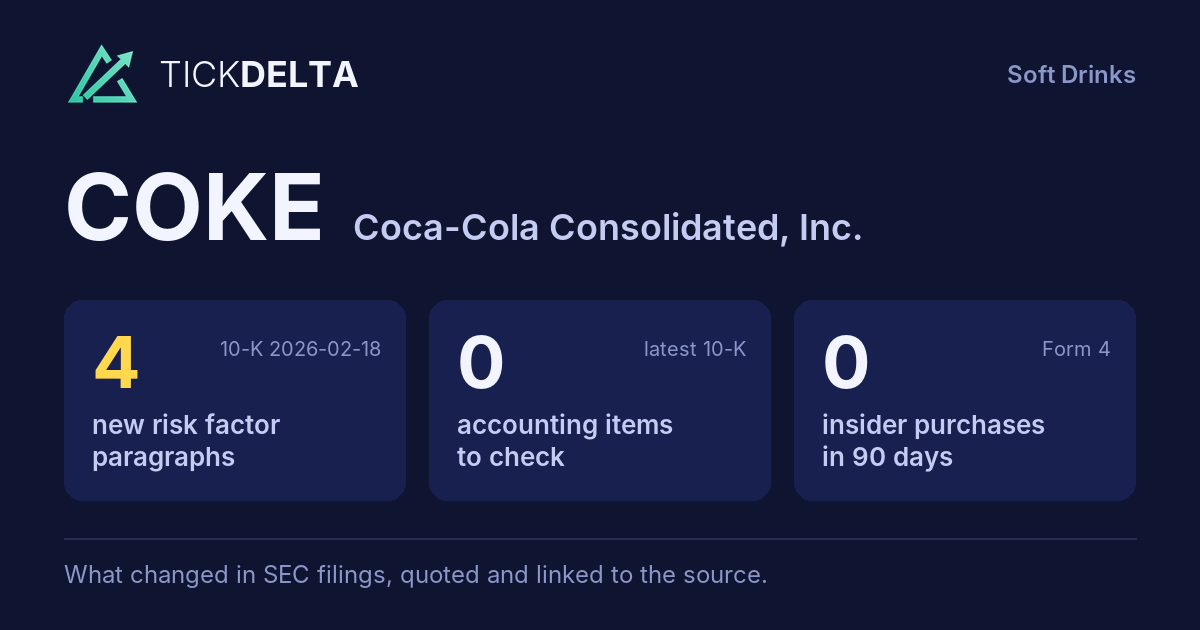
of the text changed · 7,150 words now · 4 new paragraphs, 1 gone
MD&A
27.5%
of the text changed · 10,337 words now · 14 new paragraphs, 13 gone
Legal Proceedings
3.5%
of the text changed · 548 words now
Accounting Policies
10.6%
of the text changed · 5,500 words now
10-K 0001628280-26-009057 (Feb 18, 2026) vs 10-K 0000317540-25-000025 (Feb 20, 2025)
Every paragraph, and how much of it changed
One bar per paragraph, in the order of the 10-K. Height and colour show the share of its words not in the closest paragraph a year earlier; the tallest bars are new paragraphs.
Risk Factors
83 paragraphs · 4 new · 28 reworded · 1 gone · 10-K Feb 18, 2026 against Feb 20, 2025
New paragraph
Reworded (5% of its words or more)
Same or nearly
Paragraph 81 · 36% changed
Every version of it
Natural disasters, changing weather patterns and unfavorable weather weather, or the increased frequency of any such events due to climate change, and public expectations around combatting climate change or legislative or regulatory responses to such change could negatively impact the Company’s business, financial condition and future results of operations or profitability. operations.
Paragraph 18 · 34% changed
Every version of it
Legislation has been proposed in Congress and by certain state and local governments which would prohibit the sale of soft drink products in non-refillable bottles and cans or require a mandatory deposit as a means of encouraging the return of such containers, each in an attempt to reduce solid waste and litter. Similarly, the Company is aware of proposed legislation legislation, including in the Company’s territory, that would impose fees or taxes on various types of containers that are used in its business, implement new recycling regulations and the reduction of single-use plastics and place the onus on plastic suppliers to identify recycling solutions. The Company is not currently impacted by the policies in such proposed legislation, but it is possible that similar or more restrictive legal requirements may be proposed or enacted within its distribution territories in the future which could adversely impact bottle/can sales. Additionally, legislative priorities for increased recycled content in packaging could adversely impact our margins due to increased demand for such materials. It is also possible that the Company could be a named party in a lawsuit related to the environmental impact of plastics or littering. Any such lawsuit could subject us to liability or damage the reputation of the Company, which could adversely affect the Company’s profitability.
Paragraph 57 · 33% changed
Every version of it
Paragraph 29 · 26% changed
Every version of it
The Company is also a member of the NPSG, which is composed of The Coca‑Cola Company, the Company and certain other Coca‑Cola bottlers who are regional producing bottlers in The Coca‑Cola Company’s national product supply system. Subject to the terms and conditions of the NPSG Agreement, the Company is required to comply with certain key decisions made by the NPSG Board, which include decisions regarding strategic infrastructure investment and divestment planning, optimal national product supply sourcing and new product or packaging infrastructure planning. Although the Company has a representative on the NPSG Board, the Company cannot exercise sole decision-making authority relating to the decisions of the NPSG Board, and the interests of other members of the NPSG Board may diverge from those of the Company. Any such divergence could have a material adverse effect on the operating and financial results of the Company.
Paragraph 83 · 22% changed
Every version of it
Paragraph 19 · 22% changed
Every version of it
Paragraph 56 · 20% changed
Every version of it
The Company purchases all of the plastic bottles used in its manufacturing plants from Southeastern Container and Western Container, two manufacturing cooperatives the Company co-owns with several other Coca‑Cola bottlers, and all of its aluminum cans from two domestic suppliers. The inability of these suppliers to meet the Company’s requirements for containers could result in the Company not being able to fulfill customer orders and production demand until alternative sources of supply are located. The Company attempts to mitigate these risks by working closely with key suppliers and by purchasing business interruption insurance where appropriate. Failure of the plastic bottle or aluminum can suppliers to meet the Company’s purchase requirements could negatively impact inventory levels, customer confidence and results of operations, including sales levels and profitability.
Paragraph 68 · 45% changed
Every version of it
10-K Feb 20, 2025The Company’s future growth and performance depend on its ability to attract, hire, train, develop, motivate and retain a highly skilled, diverse and properly credentialed workforce, including front-line employees. The Company’s ability to meet its labor needs while controlling labor costs is subject to many external factors, including competition for and availability of qualified personnel in a given market, unemployment levels within those markets, prevailing wage rates, minimum wage laws, health and other insurance costs and changes in employment and labor laws or other workplace regulations. The Company’s labor costs could be impacted by new or revised labor laws, rules or regulations or healthcare laws that are adopted or implemented. Any unplanned turnover or unsuccessful implementation of the Company’s succession plans could deplete the Company’s institutional knowledge base and erode its competitive advantage or result in increased costs due to increased competition for employees, higher employee turnover or increased employee benefit costs. Any of the foregoing could adversely affect the Company’s reputation, business, financial condition or results of operations.
10-K Feb 18, 2026
unsuccessful implementation of the Company’s succession plans could deplete the Company’s institutional knowledge base and erode its competitive advantage or result in increased costs due to increased competition for employees, higher employee turnover or increased employee benefit costs. Any of the foregoing could adversely affect the Company’s reputation, business, financial condition or results of operations.
Paragraph 81 · 36% changed
Every version of it
10-K Feb 20, 2025
Natural disasters, changing weather patterns and unfavorable weather could negatively impact the Company’s business, financial condition and future results of operations or profitability.
10-K Feb 18, 2026
Natural disasters, changing weather patterns and unfavorable weather, or the increased frequency of any such events due to climate change, and public expectations around combatting climate change or legislative or regulatory responses to such change could negatively impact the Company’s business, financial condition and future results of operations.
Paragraph 18 · 34% changed
Every version of it
10-K Feb 20, 2025
Legislation has been proposed in Congress and by certain state and local governments which would prohibit the sale of soft drink products in non-refillable bottles and cans or require a mandatory deposit as a means of encouraging the return of such containers, each in an attempt to reduce solid waste and litter. Similarly, the Company is aware of proposed legislation that would impose fees or taxes on various types of containers that are used in its business, implement new recycling regulations and the reduction of single-use plastics and place the onus on plastic suppliers to identify recycling solutions. The Company is not currently impacted by the policies in such proposed legislation, but it is possible that similar or more restrictive legal requirements may be proposed or enacted within its distribution territories in the future which could adversely impact bottle/can sales. Additionally, legislative priorities for increased recycled content in packaging could adversely impact our margins due to increased demand for such materials. It is also possible that the Company could be a named party in a lawsuit related to the environmental impact of plastics or littering. Any such lawsuit could subject us to liability or damage the reputation of the Company, which could adversely affect the Company’s profitability.
10-K Feb 18, 2026
Legislation has been proposed in Congress and by certain state and local governments which would prohibit the sale of soft drink products in non-refillable bottles and cans or require a mandatory deposit as a means of encouraging the return of such containers, each in an attempt to reduce solid waste and litter. Similarly, the Company is aware of proposed legislation, including in the Company’s territory, that would impose fees or taxes on various types of containers that are used in its business, implement new
Paragraph 57 · 33% changed
Every version of it
10-K Feb 20, 2025The Company purchases all of the plastic bottles used in its manufacturing plants from Southeastern Container and Western Container, two manufacturing cooperatives the Company co-owns with several other Coca‑Cola bottlers, and all of its aluminum cans from two domestic suppliers. The inability of these suppliers to meet the Company’s requirements for containers could result in the Company not being able to fulfill customer orders and production demand until alternative sources of supply are located. The Company attempts to mitigate these risks by working closely with key suppliers and by purchasing business interruption insurance where appropriate. Failure of the plastic bottle or aluminum can suppliers to meet the Company’s purchase requirements could negatively impact inventory levels, customer confidence and results of operations, including sales levels and profitability.
10-K Feb 18, 2026
to mitigate these risks by working closely with key suppliers and by purchasing business interruption insurance where appropriate. Failure of the plastic bottle or aluminum can suppliers to meet the Company’s purchase requirements could negatively impact inventory levels, customer confidence and results of operations, including sales levels and profitability.
Paragraph 29 · 26% changed
Every version of it
10-K Feb 20, 2025
The Company is also a member of the NPSG, which is composed of The Coca‑Cola Company, the Company and certain other Coca‑Cola bottlers who are regional producing bottlers in The Coca‑Cola Company’s national product supply system. Subject to the terms and conditions of the NPSG Agreement, the Company is required to comply with certain key decisions made by the NPSG Board, which include decisions regarding strategic infrastructure investment and divestment planning, optimal national product supply
10-K Feb 18, 2026
The Company is also a member of the NPSG, which is composed of The Coca‑Cola Company, the Company and certain other Coca‑Cola bottlers who are regional producing bottlers in The Coca‑Cola Company’s national product supply system. Subject to the terms and conditions of the NPSG Agreement, the Company is required to comply with certain key decisions made by the NPSG Board, which include decisions regarding strategic infrastructure investment and divestment planning, optimal national product supply sourcing and new product or packaging infrastructure planning. Although the Company has a representative on the NPSG Board, the Company cannot exercise sole decision-making authority relating to the decisions of the NPSG Board, and the interests of other members of the NPSG Board may diverge from those of the Company. Any such divergence could have a material adverse effect on the operating and financial results of the Company.
Paragraph 83 · 22% changed
Every version of it
10-K Feb 20, 2025There is concern that a gradual increase in global average temperatures due to increased concentration of carbon dioxide and other greenhouse gases in the atmosphere could cause significant changes in weather patterns and an increase in the frequency or duration of extreme weather and climate events. These changes could adversely impact some of the Company’s facilities, the availability and cost of key raw materials used by the Company in production or the demand for the Company’s products. Public expectations for reductions in greenhouse gas emissions could result in increased energy, transportation and raw material costs and may require the Company to make additional investments in facilities and equipment. In addition, federal, state or local governmental authorities may propose legislative and regulatory initiatives in response to concerns over climate change, which could directly or indirectly adversely affect the Company’s business, require additional investments or increase the cost of raw materials, fuel, ingredients and water. As a result, the effects of climate change could have a long-term adverse impact on the Company’s business and results of operations.
10-K Feb 18, 2026
Furthermore, public expectations for reductions in greenhouse gas emissions to combat climate change could result in increased energy, transportation and raw material costs and may require the Company to make additional investments in facilities and equipment. In addition, federal, state or local governmental authorities may propose legislative and regulatory initiatives in response to concerns over climate change, which could directly or indirectly adversely affect the Company’s business, require additional investments or increase the cost of raw materials, fuel, ingredients and water. As a result, the effects of climate change could have a long-term adverse impact on the Company’s business and results of operations
Paragraph 19 · 22% changed
Every version of it
10-K Feb 20, 2025Legislation has been proposed in Congress and by certain state and local governments which would prohibit the sale of soft drink products in non-refillable bottles and cans or require a mandatory deposit as a means of encouraging the return of such containers, each in an attempt to reduce solid waste and litter. Similarly, the Company is aware of proposed legislation that would impose fees or taxes on various types of containers that are used in its business, implement new recycling regulations and the reduction of single-use plastics and place the onus on plastic suppliers to identify recycling solutions. The Company is not currently impacted by the policies in such proposed legislation, but it is possible that similar or more restrictive legal requirements may be proposed or enacted within its distribution territories in the future which could adversely impact bottle/can sales. Additionally, legislative priorities for increased recycled content in packaging could adversely impact our margins due to increased demand for such materials. It is also possible that the Company could be a named party in a lawsuit related to the environmental impact of plastics or littering. Any such lawsuit could subject us to liability or damage the reputation of the Company, which could adversely affect the Company’s profitability.
10-K Feb 18, 2026
recycling regulations and the reduction of single-use plastics and place the onus on plastic suppliers to identify recycling solutions. The Company is not currently impacted by the policies in such legislation, but it is possible that similar or more restrictive legal requirements may be proposed or enacted within its distribution territories in the future which could adversely impact bottle/can sales. Additionally, legislative priorities for increased recycled content in packaging could adversely impact our margins due to increased demand for such materials. It is also possible that the Company could be a named party in a lawsuit related to the environmental impact of plastics or littering. Any such lawsuit could subject us to liability or damage the reputation of the Company, which could adversely affect the Company’s profitability.
Paragraph 56 · 20% changed
Every version of it
10-K Feb 20, 2025
The Company purchases all of the plastic bottles used in its manufacturing plants from Southeastern Container and Western Container, two manufacturing cooperatives the Company co-owns with several other Coca‑Cola bottlers, and all of its aluminum cans from two domestic suppliers. The inability of these suppliers to meet the Company’s requirements for containers could result in the Company not being able to fulfill customer orders and production demand until alternative sources of supply are located. The Company attempts to mitigate these risks by working closely with key suppliers and by purchasing business interruption insurance where appropriate. Failure of the plastic bottle or aluminum can suppliers to meet the Company’s purchase requirements could negatively impact inventory levels, customer confidence and results of operations, including sales levels and profitability.
10-K Feb 18, 2026
The Company purchases all of the plastic bottles used in its manufacturing plants from Southeastern Container and Western Container, two manufacturing cooperatives the Company co-owns with several other Coca‑Cola bottlers, and all of its aluminum cans from two domestic suppliers. The inability of these suppliers to meet the Company’s requirements for containers could result in the Company not being able to fulfill customer orders and production demand until alternative sources of supply are located. The Company attempts
MD&A
139 paragraphs · 14 new · 58 reworded · 13 gone · 10-K Feb 18, 2026 against Feb 20, 2025
New paragraph
Reworded (5% of its words or more)
Same or nearly
Paragraph 69 · 50% changed
(1)The 2025 Senior Bonds were issued at 99.975% of par. As of December 31, 2024, the The 2025 Senior Bonds, net Bonds were fully repaid during the fourth quarter of debt issuance costs and unamortized discount, were classified as current portion of debt in the consolidated balance sheets. 2025.
Paragraph 17 · 49% changed
Paragraph 131 · 48% changed
The Company sponsors a postretirement healthcare plan for employees meeting specified qualifying criteria. Several statistical and other factors, which attempt to anticipate future events, are used in calculating the net periodic postretirement benefit cost and the postretirement benefit obligation for this plan. These factors include assumptions about the discount rate and the expected growth rate for the cost of healthcare benefits. In addition, the Company uses subjective factors such as withdrawal and mortality rates to estimate the projected liability under this plan. The actuarial assumptions used by the Company may differ materially from actual results due to changing market and economic conditions, higher or lower withdrawal rates or longer or shorter life spans of participants. The Company does not prefund its postretirement benefits and has the right to modify or terminate certain of these benefits in the future.
Paragraph 44 · 46% changed
Paragraph 59 · 45% changed
Paragraph 127 · 44% changed
Paragraph 7 · 42% changed
Gross profit in 2024 2025 increased $154.5 $119.2 million, or 5.9%, 4.3%, while gross margin increased 80 decreased 20 basis points to 39.9%. 39.7%. Aluminum costs, including the impact of elevated import tariffs, adversely affected our gross margin in 2025, particularly in the back half of the year. The improvement reduction in gross profit resulted primarily from higher prices for our products and a continued moderation of costs on certain commodities. Compared to 2023, gross margin also benefited resulted from the increased mix of Sparkling beverages, a shift in sales toward our Still portfolio, which generally carry higher have lower gross margins than Still products. compared to Sparkling beverages.
Paragraph 25 · 41% changed
Paragraph 69 · 50% changed
10-K Feb 20, 2025
(1)The 2025 Senior Bonds were issued at 99.975% of par. As of December 31, 2024, the 2025 Senior Bonds, net of debt issuance costs and unamortized discount, were classified as current portion of debt in the consolidated balance sheets.
10-K Feb 18, 2026
(1)The 2025 Senior Bonds were issued at 99.975% of par. The 2025 Senior Bonds were fully repaid during the fourth quarter of 2025.
Paragraph 17 · 49% changed
10-K Feb 20, 2025As a result of not physically delivering the product, the sales volume delivered using these alternative methods of distribution is not reflected in our volume metrics. However, because we have the exclusive distribution rights for nonalcoholic beverages within our franchise territory, we receive fees from our brand partners for the delivery of qualified product in our territory. These fees are reported in net sales. Changes in the delivery of our products to our customers impacted our reported volume and net sales in 2024 as compared to 2023 as we accelerated the transition of bottle/can sales volume to alternative methods of distribution. Less than 10% of the bottle/can volume sold in our franchise territory in 2024 was delivered using these alternative methods of distribution. We expect to continue to use alternative methods of distribution to deliver bottle/can products in future years and, where beneficial, to seek out additional opportunities to shift to alternative methods of distribution.
10-K Feb 18, 2026
In instances of bottle/can delivery, we have shifted certain products for certain customers and channels of business to ARTM. These ARTM include third-party distributors, the manufacturer of the product or the customer’s supply chain infrastructure. These bottle/can arrangements generally come with favorable commercial terms for the Company, and, because we have the exclusive distribution rights for nonalcoholic beverages within our franchise territories, we receive fees from our brand partners for the delivery of qualified product in our territories. These fees are reported in net sales but not our reported volume metrics.
Paragraph 131 · 48% changed
10-K Feb 20, 2025
The Company sponsors a postretirement healthcare plan for employees meeting specified qualifying criteria. Several statistical and other factors, which attempt to anticipate future events, are used in calculating the net periodic postretirement benefit cost and the postretirement benefit obligation for this plan. These factors include assumptions about the discount rate and the expected growth rate for the cost of healthcare benefits. In addition, the Company uses subjective factors such as withdrawal and mortality rates to estimate the projected liability under this plan. The actuarial assumptions used by the Company may differ materially from actual results due to changing market and economic conditions, higher or lower withdrawal rates or longer or shorter life spans of participants. The Company does not prefund its postretirement benefits and has the right to modify or terminate certain of these benefits in the future.
10-K Feb 18, 2026
The Company sponsors a postretirement healthcare plan for employees meeting specified qualifying criteria. Several statistical and other factors, which attempt to anticipate future events, are used in calculating the net periodic postretirement benefit cost and the
Paragraph 44 · 46% changed
10-K Feb 20, 2025The Company has three operating segments, each identified by its unique products and services. Nonalcoholic Beverages represents the vast majority of the Company’s consolidated net sales and income from operations. The additional two operating segments, which include Data Ventures, Inc. and the Red Classic subsidiaries, do not meet the quantitative thresholds for separate reporting, either individually or in the aggregate, and, therefore, have been combined into “All Other.” The accounting policies of the Nonalcoholic Beverages segment are the same as those described in the summary of significant accounting policies.
10-K Feb 18, 2026
Previously, the Company had three operating segments, Nonalcoholic Beverages and two additional operating segments, which included Data Ventures, Inc. and the Red Classic subsidiaries. Since the two additional operating segments did not meet the quantitative thresholds for separate reporting, either individually or in the aggregate, they were combined into “All Other.” As of December 31, 2025, the Data Ventures, Inc. operating segment was liquidated, dissolved and merged into the Nonalcoholic Beverages operating segment. For reporting purposes, all periods presented have been retroactively adjusted to reflect the liquidation and dissolution of the Data Ventures, Inc. operating segment within the “All Other” bucket and the merger of the Data Ventures, Inc. operating segment with the Nonalcoholic Beverages operating segment.
Paragraph 59 · 45% changed
10-K Feb 20, 2025•An increase in cash and cash equivalents of $500.6 million, primarily as a result of bond proceeds received of $1.20 billion and strong operating performance, partially offset by share repurchases and related fee payments totaling $625.7 million, as further discussed below.
10-K Feb 18, 2026
•A decrease in cash and cash equivalents of $853.9 million and a decrease in short-term investments of $301.2 million, primarily as a result of share repurchases and related fee payments totaling $2.61 billion, which were funded through cash on hand, liquidation of short-term investments and additional borrowings, as further discussed below. The Company also used cash to repay $350 million of senior bonds and to invest in capital expenditures totaling approximately $312 million. These decreases to cash were partially offset by the Company’s strong operating performance during 2025.
Paragraph 127 · 44% changed
10-K Feb 20, 2025Shipping and handling costs included in SD&A expenses were approximately $806 million in 2024 and approximately $780 million in 2023.
10-K Feb 18, 2026
Pension costs for the Bargaining Plan were $3.2 million in 2025 and $3.7 million in 2024.
Paragraph 7 · 42% changed
10-K Feb 20, 2025
Gross profit in 2024 increased $154.5 million, or 5.9%, while gross margin increased 80 basis points to 39.9%. The improvement in gross profit resulted primarily from higher prices for our products and a continued moderation of costs on certain commodities. Compared to 2023, gross margin also benefited from the increased mix of Sparkling beverages, which generally carry higher gross margins than Still products.
10-K Feb 18, 2026
Gross profit in 2025 increased $119.2 million, or 4.3%, while gross margin decreased 20 basis points to 39.7%. Aluminum costs, including the impact of elevated import tariffs, adversely affected our gross margin in 2025, particularly in the back half of the year. The reduction in gross margin also resulted from a shift in sales toward our Still portfolio, which generally have lower gross margins compared to Sparkling beverages.
Paragraph 25 · 41% changed
10-K Feb 20, 2025A standard physical case is a volume metric used to standardize differing package configurations in order to measure delivered cases on an equivalent basis. As the Company evaluates its volume metrics, it reassesses the way in which physical case volume is measured, which may lead to differences from previously presented results in order to conform with current period standard volume measurement techniques, as used by management. Additionally, as the Company introduces new products, it reassesses the category assigned to its products at the SKU level, therefore categorization could differ from previously presented results in order to conform with current period categorization. Any differences are not material.
10-K Feb 18, 2026
assigned to its products at the SKU level, therefore categorization could differ from previously presented results in order to conform with current period categorization. Any differences are not material.
A paragraph is matched with the one last year that shares the most of its words; under half in common makes it new. The paragraphs shown are the 8 reworded the most in each section.
The paragraph that changed most in each section
The redline
Marked against last year's 10-K: cut words struck through, new words highlighted.
MD&A325 words changed in this paragraph; it is 67% similar to last year's version.
Certain statements made in this report, or in other public filings, press releases, or other written or oral communications made by the Company, which are not historical facts, are forward-looking statements subject to the safe harbor provisions of the Private Securities Litigation Reform Act of 1995. These forward-looking statements involve risks and uncertainties which we expect will or may occur in the future and may impact our business, financial condition and results of operations. The words “anticipate,” “believe,” “expect,” “intend,” “project,” “may,” “will,” “should,” “could” and similar expressions are intended to identify those forward-looking statements. These forward-looking statements reflect the Company’s best judgment based on current information, and, although we base these statements on circumstances that we believe to be reasonable when made, there can be no assurance that future events will not affect the accuracy of such forward-looking information. As such, the forward-looking statements are not guarantees of future performance, and actual results may vary materially from the projected results and expectations discussed in this report. Factors that might cause the Company’s actual results to differ materially from those anticipated in forward-looking statements include, but are not limited to: increased costs (including due to inflation or uncertainty around tariffs) or disruption, unavailability or shortages of raw materials, fuel and other supplies; the reliance on purchased finished products from external sources; changes in public and consumer perception and preferences, including concerns related to product safety and sustainability, artificial ingredients, brand reputation and obesity; changes in government regulations related to nonalcoholic beverages, including regulations related to obesity, public health, artificial ingredients, recycling, sustainability, product safety and benefit programs, including SNAP; decreases from historic levels of marketing funding support provided to us by The Coca‑Cola Company and other beverage companies; material changes in the performance requirements for marketing funding support or our inability to meet such requirements; decreases from historic levels of advertising, marketing and product innovation spending by The Coca‑Cola Company and other beverage companies, or advertising campaigns that are negatively perceived by the public; any failure of the several Coca‑Cola system governance entities of which we are a participant to function efficiently or in our best interest and any failure or delay of ours to receive anticipated benefits from these governance entities; provisions in our beverage distribution and manufacturing agreements with The Coca‑Cola Company that could delay or prevent a change in control of us or a sale of our Coca‑Cola distribution or manufacturing businesses; the concentration of our capital stock ownership; our inability to meet requirements under our beverage distribution and manufacturing agreements; changes in the inputs used to calculate our acquisition related contingent consideration liability; technology failures or cyberattacks on our information technology systems or our effective response to technology failures or cyberattacks on our third-party service providers’, business partners’, customers’, suppliers’ or other third parties’ information technology systems; unfavorable changes in the general economy; changes in trade policies, including the imposition of, or increase in, tariffs on imported goods; the concentration risks among our customers and suppliers; lower than expected net pricing of our products resulting from continued and increased customer and competitor consolidations and marketplace competition; the effect of changes in our level of debt, borrowing costs and credit ratings on our access to capital and credit markets, operating flexibility and ability to obtain additional financing to fund future needs; the failure to attract, train and retain qualified employees while controlling labor costs and other labor issues; the failure to maintain productive relationships with our employees covered by collective bargaining agreements, including failing to renegotiate collective bargaining agreements; changes in accounting standards; our use of estimates and assumptions; changes in tax laws, disagreements with tax authorities or additional tax liabilities; changes in legal contingencies; natural disasters, changing weather patterns and unfavorable weather; climate change or legislative or regulatory responses to such change; and the risks discussed in “Item 1A. Risk Factors” of this report and elsewhere herein.
Source: Item 7, 10-K 0001628280-26-009057 vs Item 7, 10-K 0000317540-25-000025
Risk Factors135 words changed in this paragraph; it is 54% similar to last year's version.
Legislation has been proposed in Congress and by certain state and local governments which would prohibit the sale of soft drink products in non-refillable bottles and cans or require a mandatory deposit as a means of encouraging the return of such containers, each in an attempt to reduce solid waste and litter. Similarly, the Company is aware of proposed legislation legislation, including in the Company’s territory, that would impose fees or taxes on various types of containers that are used in its business, implement new recycling regulations and the reduction of single-use plastics and place the onus on plastic suppliers to identify recycling solutions. The Company is not currently impacted by the policies in such proposed legislation, but it is possible that similar or more restrictive legal requirements may be proposed or enacted within its distribution territories in the future which could adversely impact bottle/can sales. Additionally, legislative priorities for increased recycled content in packaging could adversely impact our margins due to increased demand for such materials. It is also possible that the Company could be a named party in a lawsuit related to the environmental impact of plastics or littering. Any such lawsuit could subject us to liability or damage the reputation of the Company, which could adversely affect the Company’s profitability.
Source: Item 1A, 10-K 0001628280-26-009057 vs Item 1A, 10-K 0000317540-25-000025
Accounting Policies70 words changed in this paragraph; it is 72% similar to last year's version.
The Company’s Board of Directors has declared, and the Company has paid, dividends on the Common Stock and the Class B Common Stock and each class of common stock has participated equally in all dividends declared by the Board of Directors and paid by the Company since 1994. During 2024, dividends of $3.50 Dividends paid per share were declared and dividends of $20.00 per share were paid on both the Common Stock and the Class B Common Stock. During 2023, dividends of $18.00 per share Stock were declared and dividends of $5.00 per share were paid on both the Common Stock and the Class B Common Stock. During 2022, dividends of $4.50 per share were declared and dividends of $1.00 per share were paid on both the Common Stock in 2025, $2.00 per share in 2024 and the Class B Common Stock. $0.50 per share in 2023. Total cash dividends paid were $86.7 million in 2025, $185.6 million in 2024, 2024 and $46.9 million in 2023 and $9.4 million in 2022. 2023.
Source: Item 8, Note 1 – Description of Business and Summary of Critical Accounting Policies, 10-K 0001628280-26-009057 vs Item 8, Note 1 – Description of Business and Summary of Critical Accounting Policies, 10-K 0000317540-25-000025
Legal Proceedings21 words changed in this paragraph; it is 93% similar to last year's version.
The Company guarantees a portion of SAC’s debt, which matures in 2028, based on the ratio of SAC’s total liabilities to SAC’s shareholders’ equity as of December 31 of each year. As of December 31, 2025 and December 31, 2024, the ratio of SAC’s total liabilities to SAC’s shareholders’ equity was such that the Company was not required to guarantee any of SAC’s debt. As of December 31, 2023, the amount of the Company’s guarantee of SAC’s debt was $9.5 million. In the event SAC fails to fulfill its commitments under the related debt, the Company would be responsible for payment to the lenders up to the level of the guarantee. The Company does not anticipate SAC will fail to fulfill its commitments related to the debt. The Company further believes SAC has sufficient assets, including production equipment, facilities and working capital, and the ability to adjust the selling prices of its products to adequately mitigate the risk of material loss relating to the Company’s guarantee.
Source: Item 3, via Note 21 – Commitments and Contingencies, 10-K 0001628280-26-009057 vs Item 3, via Note 21 – Commitments and Contingencies, 10-K 0000317540-25-000025
Sentences and paragraphs added, removed or reworded
Every change, by type
Sentences and paragraphs of COKE's Risk Factors and MD&A, 10-K Feb 18, 2026 against 10-K Feb 20, 2025. Each links to the text at sec.gov.
Quiet changes are sentences kept from last year with one to four words changed, at least one of them a hedge, a modal or a qualifier (may, could, will, not, significant, material…). A year or date rolling forward is not counted.
The full word list
adverse, adversely, all, although, anticipate, anticipates, any, approximately, believe, believes, can, cannot, certain, could, expect, expects, generally, however, if, intend, intends, largely, likely, many, material, materially, may, might, most, must, never, no, not, possible, primarily, probable, should, significant, significantly, some, substantial, substantially, unlikely, will, would
AddedRisk Factors
The Company is a member of CONA and party to an amended and restated master services agreement with CONA, pursuant to which the Company is an authorized user of the CONA System, a uniform information technology system developed to promote operational
Read it in 10-K Feb 18, 2026 at sec.gov
AddedRisk Factors
delinquencies and bankruptcies, which would increase the risk of collectability of certain accounts. Each of these factors could adversely affect the Company’s overall business, financial condition and results of operations.
Read it in 10-K Feb 18, 2026 at sec.gov
AddedRisk Factors
In 2025, the U.S. implemented a variety of additional tariffs on goods from multiple nations and trading blocks and has been subject to reciprocal tariffs and other retaliatory actions in response. These additional tariffs, and the uncertainty around additional tariffs due to current legal and administrative actions, have increased costs and volatility in commodity markets, in particular with respect to the price of aluminum. The Company may execute future price increases in an effort to offset these increased commodity costs, but there can be no assurance that such efforts will fully offset the increased commodity costs or that customer demand will not be adversely affected.
Read it in 10-K Feb 18, 2026 at sec.gov
AddedRisk Factors
amounts is reasonably possible as a result of these claims, the Company faces risk of an adverse effect on its results of operations, financial position or cash flows, depending on the outcome of the legal proceedings.
Read it in 10-K Feb 18, 2026 at sec.gov
RemovedRisk Factors
RewordedRisk Factors
Natural disasters, changing weather patterns and unfavorable weather weather, or the increased frequency of any such events due to climate change, and public expectations around combatting climate change or legislative or regulatory responses to such change could negatively impact the Company’s business, financial condition and future results of operations or profitability. operations.
Read it in 10-K Feb 18, 2026 at sec.gov
RewordedRisk Factors
Similarly, the Company is aware of proposed legislation legislation, including in the Company’s territory, that would impose fees or taxes on various types of containers that are used in its business, implement new recycling regulations and the reduction of single-use plastics and place the onus on plastic suppliers to identify recycling solutions.
Read it in 10-K Feb 18, 2026 at sec.gov
RewordedRisk Factors
Adverse economic conditions could also increase the likelihood of customer delinquencies and bankruptcies, which would increase the risk of collectability of certain accounts.
Read it in 10-K Feb 18, 2026 at sec.gov
Show the other 44
RewordedRisk Factors
Engagements by of the Company’s Company or The Coca‑Cola Company or their respective executives in social and public policy debates may occasionally be the subject of criticism from advocacy groups that have differing points of view and could result in adverse media and consumer reaction, including product boycotts.
Read it in 10-K Feb 18, 2026 at sec.gov
RewordedRisk Factors
Changes in government regulations related to nonalcoholic beverages, including regulations related to obesity, public health, artificial ingredients, recycling, sustainability sustainability, product safety and product safety, benefit programs, including SNAP, could reduce demand for the Company’s products and reduce profitability.
Read it in 10-K Feb 18, 2026 at sec.gov
RewordedRisk Factors
Raw material costs, including the costs for plastic bottles, aluminum cans, PET resin, carbon dioxide and high-fructose corn syrup, are subject to significant price volatility, which may be worsened by periods of increased demand, supply constraints constraints, high inflation or high inflation. uncertainty around tariffs.
Read it in 10-K Feb 18, 2026 at sec.gov
RewordedRisk Factors
Subject to the terms and conditions of the NPSG Agreement, the Company is required to comply with certain key decisions made by the NPSG Board, which include decisions regarding strategic infrastructure investment and divestment planning, optimal national product supply sourcing and new product or packaging infrastructure planning.
Read it in 10-K Feb 18, 2026 at sec.gov
RewordedRisk Factors
International or domestic geopolitical or other events, including pandemics, armed conflict or the imposition of tariffs and/or quotas by the U.S. government on any of these raw materials, have adversely impacted and could in the future adversely impact the supply and cost of these raw materials to the Company or render them unavailable at commercially favorable terms or at all.
Read it in 10-K Feb 18, 2026 at sec.gov
RewordedRisk Factors
The inability to implement upgrades, updates or installations in a timely manner, to train employees effectively in the use of new or updated technology or to obtain the anticipated benefits of the Company’s technology could adversely impact the Company’s business, financial condition, condition or results of operations or profitability. operations.
Read it in 10-K Feb 18, 2026 at sec.gov
RewordedRisk Factors
AddedMD&A
Net sales increased 4.8% to $7.23 billion in 2025, with standard physical case volume up 0.3% when compared to the prior year. The growth in net sales was primarily the result of annual pricing actions executed during the first quarter of 2025. For 2025, Sparkling and Still net sales increased 3.5% and 6.1%, respectively. The increase in Sparkling category net sales was driven primarily by sales of multi-pack, take-home packages sold within our large store, club and value channels. The increase in Still category net sales was driven primarily by the solid performance across our Still portfolio sold within large retail and convenience stores.
Read it in 10-K Feb 18, 2026 at sec.gov
AddedMD&A
Fiscal year 2025 had one fewer selling day compared to fiscal year 2024, which negatively impacted the annual volume comparison by approximately 0.3%, as further discussed in the “Comparable and Adjusted Results (Non-GAAP)” section. For fiscal year 2025, Sparkling volume was flat while Still volume increased 1.0%. The steady Sparkling volume performance was driven by growth within zero-sugar and flavor offerings, offset by slower sales of Coca-Cola Original Taste during 2025. Within the Still portfolio, Monster, Powerade, BODYARMOR, Topo Chico and Core Power all achieved volume growth during the year, reflecting strength across our entire portfolio of brands and driving growth in net sales in 2025.
Read it in 10-K Feb 18, 2026 at sec.gov
AddedMD&A
During 2025, approximately two-thirds of our post-mix gallons and less than 10% of our bottle/can volume were delivered through ARTM.
Read it in 10-K Feb 18, 2026 at sec.gov
AddedMD&A
•An increase in other accrued liabilities of $60.6 million, primarily as a result of accrued excise taxes on share repurchases of $28.0 million, an increase in the current portion of the liability related to the acquisition related contingent consideration and an increase in accrued insurance costs.
Read it in 10-K Feb 18, 2026 at sec.gov
AddedMD&A
On November 7, 2025, the Company entered into the Repurchase Agreement with the Seller, an indirect wholly owned subsidiary of The Coca-Cola Company, The Coca‑Cola Company and J. Frank Harrison, III, Chairman of the Board of Directors and Chief Executive Officer of the Company, pursuant to which the Company agreed to purchase and the Seller agreed to sell all of the Seller’s shares of Common Stock for a cash payment in the aggregate amount of approximately $2.4 billion. The closing of the Repurchase also occurred on November 7, 2025. The Company funded the purchase price for the Repurchase with cash on hand and a term loan obtained under a certain bridge loan agreement (the “Bridge Facility”), as further discussed below.
Read it in 10-K Feb 18, 2026 at sec.gov
AddedMD&A
Upon completion of the Repurchase, the 18,835,460 shares of Common Stock repurchased from the Seller were retired and recorded as a reduction to Common Stock at par value, with the excess of carrying value over par value recorded as a deduction from retained (deficit) earnings. As a result, the Company is in a deficit position as of December 31, 2025. This deficit position does not impact the Company’s ability to pay dividends.
Read it in 10-K Feb 18, 2026 at sec.gov
AddedMD&A
In the third quarter of 2025, the Company retired 31,488,535 shares of Common Stock and 6,281,140 shares of Class B Common Stock included in treasury stock. The retired treasury stock had a carrying value of $162.6 million. The retirement of treasury stock was recorded as a reduction to Common Stock and Class B Common Stock at par value, with the excess of carrying value over par value recorded as a deduction from retained (deficit) earnings.
Read it in 10-K Feb 18, 2026 at sec.gov
AddedMD&A
On March 4, 2025, the Company announced that its Board of Directors had approved a 10-for-1 forward stock split (the “Stock Split”) of Common Stock and Class B Common Stock. The Stock Split was effected through an amendment to the Company’s Restated Certificate of Incorporation (the “Amendment”). The Amendment also effected a proportionate increase in the number of authorized shares of Common Stock and Class B Common Stock. The Amendment obtained stockholder approval at the Company’s 2025 Annual Meeting of Stockholders, which took place on May 13, 2025. Each stockholder of record as of the close of business on May 16, 2025 received nine additional shares for each share of Common Stock or Class B Common Stock held as of such date reflected in the stockholder’s account on May 23, 2025. Trading began on a split-adjusted basis on May 27, 2025. The par value per share of Common Stock and Class B Common Stock remains unchanged.
Read it in 10-K Feb 18, 2026 at sec.gov
AddedMD&A
The Company entered into the Bridge Facility, dated as of November 7, 2025, providing for a 364-day senior unsecured bridge term loan facility in an aggregate principal amount of $1.20 billion to fund the Repurchase. Also on November 7, 2025, the Company borrowed $1.20 billion under the Bridge Facility, the full amount available under the Bridge Facility.
Read it in 10-K Feb 18, 2026 at sec.gov
AddedMD&A
On December 8, 2025, the Company entered into a term loan agreement, providing for (i) the Three-Year Term Loan Facility, a senior unsecured term loan facility in the aggregate principal amount of up to $900 million, maturing on December 8, 2028, and (ii) the Five-Year Term Loan Facility, a senior unsecured term loan facility in the aggregate principal amount of up to $450 million, maturing on December 6, 2030 (collectively, the “Term Loan Facilities”). Also on December 8, 2025, the Company borrowed $1.35 billion under the Term Loan Facilities, the full amount available under the Term Loan Facilities. In conjunction with the borrowings under the Term Loan Facilities, the Company modified and extinguished the Bridge Facility discussed above, fully repaying the $1.20 billion outstanding under the Bridge Facility through a net cash settlement with the lender.
Read it in 10-K Feb 18, 2026 at sec.gov
AddedMD&A
Subsequent to the end of 2025, on February 9, 2026, the Company repaid $150 million of the $450 million aggregate principal balance outstanding under the Five-Year Term Loan Facility using cash on hand.
Read it in 10-K Feb 18, 2026 at sec.gov
AddedMD&A
Credit Rating Rating Outlook Moody’s Baa1 Stable Standard & Poor’s BBB+ Negative
Read it in 10-K Feb 18, 2026 at sec.gov
RemovedMD&A
RemovedMD&A
RemovedMD&A
RemovedMD&A
RemovedMD&A
RemovedMD&A
RemovedMD&A
RemovedMD&A
RemovedMD&A
RemovedMD&A
RemovedMD&A
RemovedMD&A
RewordedMD&A
Factors that might cause the Company’s actual results to differ materially from those anticipated in forward-looking statements include, but are not limited to: increased costs (including due to inflation or uncertainty around tariffs) or disruption, unavailability or shortages of raw materials, fuel and other supplies; the reliance on purchased finished products from external sources; changes in public and consumer perception and preferences, including concerns related to product safety and sustainability, artificial ingredients, brand reputation and obesity; changes in government regulations related to nonalcoholic beverages, including regulations related to obesity, public health, artificial ingredients, recycling, sustainability, product safety and benefit programs, including SNAP; decreases from historic levels of marketing funding support provided to us by The Coca‑Cola Company and other beverage companies; material changes in the performance requirements for marketing funding support or our inability to meet such requirements; decreases from historic levels of advertising, marketing and product innovation spending by The Coca‑Cola Company and other beverage companies, or advertising campaigns that are negatively perceived by the public; any failure of the several Coca‑Cola system governance entities of which we are a participant to function efficiently or in our best interest and any failure or delay of ours to receive anticipated benefits from these governance entities; provisions in our beverage distribution and manufacturing agreements with The Coca‑Cola Company that could delay or prevent a change in control of us or a sale of our Coca‑Cola distribution or manufacturing businesses; the concentration of our capital stock ownership; our inability to meet requirements under our beverage distribution and manufacturing agreements; changes in the inputs used to calculate our acquisition related contingent consideration liability; technology failures or cyberattacks on our information technology systems or our effective response to technology failures or cyberattacks on our third-party service providers’, business partners’, customers’, suppliers’ or other third parties’ information technology systems; unfavorable changes in the general economy; changes in trade policies, including the imposition of, or increase in, tariffs on imported goods; the concentration risks among our customers and suppliers; lower than expected net pricing of our products resulting from continued and increased customer and competitor consolidations and marketplace competition; the effect of changes in our level of debt, borrowing costs and credit ratings on our access to capital and credit markets, operating flexibility and ability to obtain additional financing to fund future needs; the failure to attract, train and retain qualified employees while controlling labor costs and other labor issues; the failure to maintain productive relationships with our employees covered by collective bargaining agreements, including failing to renegotiate collective bargaining agreements; changes in accounting standards; our use of estimates and assumptions; changes in tax laws, disagreements with tax authorities or additional tax liabilities; changes in legal contingencies; natural disasters, changing weather patterns and unfavorable weather; climate change or legislative or regulatory responses to such change; and the risks discussed in “Item 1A.
Read it in 10-K Feb 18, 2026 at sec.gov
RewordedMD&A
(in thousands, except per share data) Gross SD&A Income from Income before Net Basic net income profit expenses operations taxes income per share Fiscal Year 2024 2025 Reported results (GAAP) $ 2,753,179 2,872,362 $ 1,832,829 1,921,706 $ 920,350 950,656 $ 856,654 772,918 $ 633,125 570,582 $ 70.10 6.82 Fair value adjustment of acquisition related contingent consideration(1) — — — 59,166 44,493 4.92 131,901 99,190 1.18 Fair value adjustments for commodity derivative instruments(2) 728 (547) 1,275 1,275 959 0.11 (2,183) (455) (1,728) (1,728) (1,299) (0.02) Total reconciling items 728 (547) 1,275 60,441 45,452 5.03 (2,183) (455) (1,728) 130,173 97,891 1.16 Adjusted results (non-GAAP) $ 2,753,907 2,870,179 $ 1,832,282 1,921,251 $ 921,625 948,928 $ 917,095 903,091 $ 678,577 668,473 $ 75.13 7.98
Read it in 10-K Feb 18, 2026 at sec.gov
RewordedMD&A
Payments related to share repurchases $ 2,606,031 $ 625,654 $ Repayment of bridge loan upon extinguishment 800,000 — Purchases of short-term investments 390,111 446,309 Repayment of senior bonds 350,000 — Additions to property, plant and equipment 312,315 371,015 282,304 Cash dividends paid 86,673 185,635 46,868 Payments of acquisition related contingent consideration 68,884 64,312 28,208 Investment in equity method investees 19,600 15,720 13,741 Debt issuance fees 3,396 15,512 340 Payments on financing lease obligations 1,809 2,488 2,303 Total cash uses $ 4,638,819 $ 1,726,645 $ 373,764 Net (decrease) increase in cash and cash equivalents during period $ (853,906) $ 500,555 $ 437,621
Read it in 10-K Feb 18, 2026 at sec.gov
RewordedMD&A
RewordedMD&A
The additional two operating segments, segment, which include Data Ventures, Inc. and includes the Red Classic subsidiaries, do does not meet the quantitative thresholds threshold for separate reporting, either individually or in the aggregate, reporting and, therefore, have has been combined into reported as “All Other. Other.”
Read it in 10-K Feb 18, 2026 at sec.gov
RewordedMD&A
Proceeds from bond issuance bridge loan $ 1,200,000 $ — Proceeds from term loan facility upon modification 950,000 — Net cash provided by operating activities(1) 931,904 876,357 810,690 Proceeds from the disposal of short-term investments 696,415 150,274 — Proceeds from the sale of property, plant and equipment 6,594 569 695 Proceeds from bond issuance — 1,200,000 Total cash sources $ 3,784,913 $ 2,227,200 $ 811,385 Cash Uses:
Read it in 10-K Feb 18, 2026 at sec.gov
RewordedMD&A
The additional two operating segments do segment, which includes the Red Classic subsidiaries, does not meet the quantitative thresholds threshold for separate reporting, either individually or in the aggregate, reporting and, therefore, have has been combined into reported as “All Other.”
Read it in 10-K Feb 18, 2026 at sec.gov
RewordedMD&A
RewordedMD&A
The increase decrease in cash used in investing activities was also partially a result of higher fewer additions to property, plant and equipment, which were $312.3 million during 2025 and $371.0 million during 2024 and $282.3 million during 2023. 2024.
Read it in 10-K Feb 18, 2026 at sec.gov
RewordedMD&A
The Company’s income tax expense increased $74.4 decreased $21.2 million, or 49.9%, 9.5%, to $202.3 million in 2025, as compared to $223.5 million in 2024, as compared to $149.1 million in 2023. 2024.
Read it in 10-K Feb 18, 2026 at sec.gov
RewordedMD&A
Net sales increased $245.9 $328.3 million, or 3.7%, 4.8%, to $7.23 billion in 2025, as compared to $6.90 billion in 2024, as compared to $6.65 billion in 2023. 2024.
Read it in 10-K Feb 18, 2026 at sec.gov
RewordedMD&A
Cost of sales increased $91.4 $209.2 million, or 2.3%, 5.0%, to $4.36 billion in 2025, as compared to $4.15 billion in 2024, as compared to $4.06 billion in 2023. 2024.
Read it in 10-K Feb 18, 2026 at sec.gov
Quiet changesMD&A
We are focused on execution at every step in our supply chain, including raw material and finished product procurement, manufacturing conversion, transportation, warehousing and distribution, to ensure in-store execution can occur.
Read it in 10-K Feb 18, 2026 at sec.gov
Sources
The two latest 10-Ks on EDGAR, section by section. Each change links to the text at sec.gov.
Also
New risk factors: paragraphs with nothing like them last year, quoted in full.
Work with it
Excel workbook · CSV. Google Sheet that stays up to date: paste =IMPORTDATA("https://tickdelta.com/company/COKE/export.csv") into a cell.