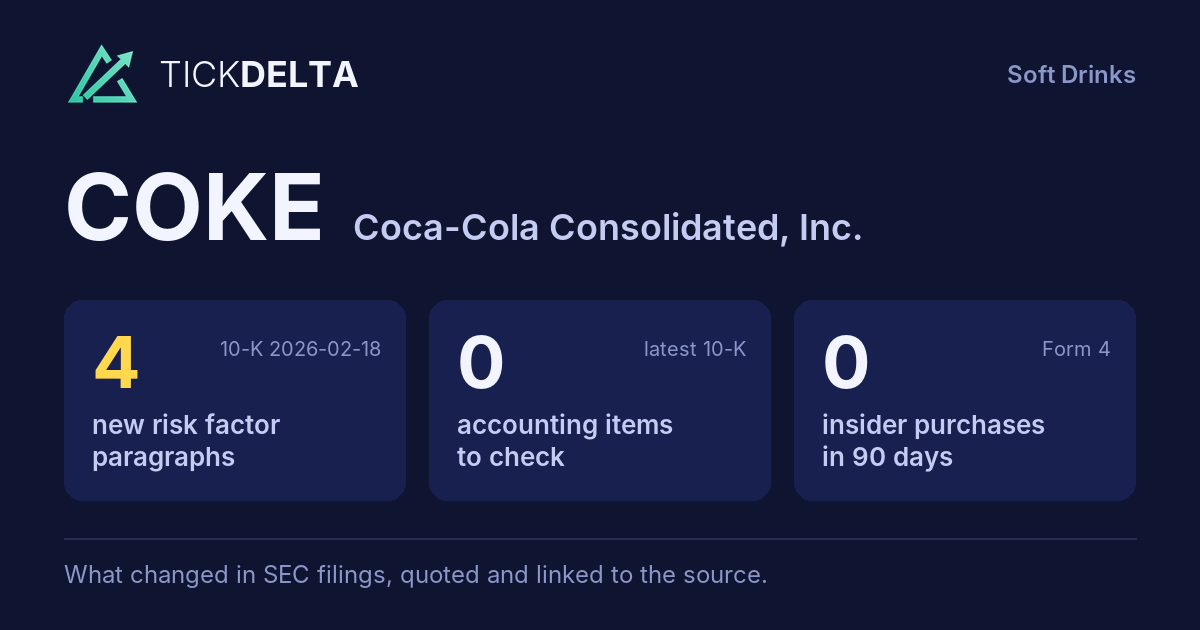
Screener / SEC EDGAR /CIK 0000317540 /10-K filed Feb 18, 2026, compared with Feb 20, 2025 /Numbers from the XBRL of the 10-Ks
Nasdaq Consumer staples · Soft Drinks

Coca-Cola Consolidated, Inc. COKE

Compare with peers Embed
SEC comment letters, last 20 years

2 reviews of COKE's filings by SEC staff

UPLOAD and CORRESP
Reviews 2 latest letter Nov 24, 2014
Questions asked 8 each answered in the company's own letter
No closing letter 0 reviews without a letter saying the staff completed it

When the SEC's staff reviews a filing, it writes to the company with numbered questions, and the company answers each one in a letter. SEC publishes the exchange once the review is over, at least 20 business days later. A question is not an accusation; most reviews end with the company adding detail to its next filing.

How the reviews went

Every review on EDGAR, from the first staff letter to the letter that closes it

  1. 1. Staff letters 3 UPLOAD
  2. 2. Questions in them 8 numbered comments
  3. 3. Company replies 3 CORRESP
  4. 4. Reviews closed 2 of 2 closing letter

Half the closed reviews took 55 days or less from the first letter to the closing letter.

Form 10-K for the Fiscal Year Ended December 29, 2013

2014-11-24 to 2014-12-22 · 2 questions · 1 letter from the SEC, 1 from the company
Review closed 2014-12-22
Results discussion (MD&A)Segments
Results of Operations, page 40 · 2013 Compared to 2012, page 40
SEC asked (1)
We note the decline in bottle/can volume in your sparkling beverages (including energy drinks) in 2013 as disclosed on page 41. It appears that your total bottle/can volume decreased for the year despite an 8% increase in still beverages. Please revise future filings to discuss the material trends and reasons for significant changes in volume sold for your sparkling beverages as compared to your still beverages.
Rest of the question

In this regard, it is unclear whether and why the “cooler and wetter than normal weather in most of the Company’s territories during the first and second quarters of 2013” had a different impact on sparkling and still beverages. Please provide draft disclosure.

COKE answered
The underlying trends of still beverages and sparkling beverages are different. However, the total volume of the Company’s products is linked. Still beverages are in a growth cycle, driven by changes in consumer preferences. Consequently, volume in sparkling beverages, which are in a mature state, is growing at a slower pace than still beverages.
Rest of the answer

As a result of the linkage between sparkling and still beverages and their respective growth trajectories, both sparkling and still beverages were negatively impacted by cooler and wetter than normal weather in the first and second quarters of 2013.

United States

Securities and Exchange Commission

December 9, 2014

Page

In future filings, the Company will provide further disclosure to describe the differences in growth trajectories of sparkling and still beverages similar to the following:

“Although the total bottle/can volume decreased by 0.9%, primarily due to a volume decrease in sparkling beverages, significant growth in volume of still beverages helped to offset the decrease. The growth trajectories, and driving factors, of sparkling and still beverages are different. Sparkling beverages are in a mature state and have a lower growth trajectory, while still beverages have a higher growth trajectory primarily driven by changing customer preferences. Although volume of sparkling beverages declined and volume of still beverages increased, the volume of both was negatively impacted by cooler and wetter than normal weather in most of the Company’s territories during the first and second quarters of 2013. The Company believes volume would have been higher in both sparkling and still beverages had it not been for the cooler and wetter than normal weather.”

Financial Statements

Note 1. Significant Accounting Policies,

Read in the reply
In its next report

First report after the company's reply of Dec 9, 2014: 10-K filed Mar 13, 2015 ↗, against the 10-K filed Mar 14, 2014 ↗.

Tickdelta does not hold the text of both reports, so they are not compared here.
Financial Statements · Note 1. Significant Accounting Policies, page 66
SEC asked (2)
Please disclose in future filings the factors used in determining you had one reportable segment, including whether operating segments have been aggregated. Refer to ASC 280-10-50-21. Please provide us your proposed disclosures.
COKE answered
The Company evaluates segment reporting in accordance with ASC 280 each reporting period, which includes evaluating the information used by the Chief Operating Decision Maker (“CODM”) to review performance and allocate resources. As a result of the evaluation performed as of December 29, 2013, the Company concluded it has one reportable segment. Two operating segments are aggregated into the one reportable segment.
Rest of the answer

The franchised nonalcoholic beverages operating segment alone represents approximately 97%, 95%, and 99% of the Company’s consolidated revenues, operating income, and total assets, respectively. The internally-developed nonalcoholic beverages operating segment has been aggregated with the franchised nonalcoholic beverages operating segment due to its similar economic characteristics, as described in ASC 280-10-50-11. The operating segments also share similarities in products, production processes, types of customers, methods used to distribute products and nature of the regulatory environment.

In future filings, the Company will provide further disclosure on its conclusions regarding segments similar to the following (using 2013 figures for illustrative purposes), assuming the same facts and circumstances exist:

“The Company evaluates segment reporting in accordance with ASC 280, Segment

Reporting (“ASC 280”) each reporting period, including evaluating the reporting package reviewed by the Chief Operating Decision Maker (“CODM”). As a result of the evaluation performed, the Company concluded that there is one reportable segment. ASC 280 defines operating segments as components of an enterprise about which separate financial information is available that is evaluated regularly by the CODM in deciding how to allocate resources and in assessing performance.

The franchised nonalcoholic beverages operating segment alone represents approximately 97%, 95%, and 99% of the Company’s consolidated revenues, operating income, and total assets, respectively, as of or for the year ended December 29, 2013. This operating segment has been aggregated with the internally-developed nonalcoholic beverages operating segment due to similar economic characteristics as well as the similarity of products, production processes, types of customers, methods used to distribute products and nature of the regulatory environment.”

The Company supplementally advises the staff that it does not present separate segment disclosure information to reconcile its reportable segment to its consolidated results as such reconciling amounts are inconsequential.

Supplementally, we also note that the Company is going through a publicly announced transformation, which includes integrating acquisitions closed in Q2 2014 and Q4 2014. Additionally, the Company has publicly announced the signing of letters of intent for the acquisition of additional franchise territories. This business transformation could lead to changes in how the Company manages its business in the future, including potential related changes in the internal reporting used by the CODM. The process is ongoing and no changes have been made to the operating segment structure to date. The

Company will continue to evaluate segment reporting in accordance with ASC 280 at each reporting period and make changes, if applicable, if such operational and reporting changes occur.

The Company acknowledges that:

• it is responsible for the adequacy and accuracy of the disclosure in the filing;

staff comments or changes to disclosure in response to staff comments do not foreclose the Commission from taking any action with respect to the filing; and it may not assert staff comments as a defense in any proceeding initiated by the Commission or any person under the federal securities laws of the United States.

Read in the reply
In its next report

First report after the company's reply of Dec 9, 2014: 10-K filed Mar 13, 2015 ↗, against the 10-K filed Mar 14, 2014 ↗.

Tickdelta does not hold the text of both reports, so they are not compared here.

Also in this review: closing letter, 2014-12-22
Form 10-K

2010-07-06 to 2010-08-30 · 6 questions · 2 letters from the SEC, 2 from the company
Review closed 2010-08-30
Executive pay
Form 10-K, filed March 18, 2010 · Exhibits and Financial Schedules, page 106
SEC asked (1)
We note that exhibits 10.1 and 10.25 do not have some or all of the schedules, attachments, or exhibits as listed in the exhibit itself. Please file with your next periodic report each exhibit in its entirety as required by Item 601(b)(10) of Regulation S-K or advise.
Rest of the question

Also, with respect to exhibits 10.25 and 10.26, it appears you do not provide the “relevant Amended Agreement,” “Appendix” or other executed agreements that contain the actual performance measures applicable to named executive officers. Please file such agreements or advise.

COKE answered
Exhibit 10.1/Credit Agreement

Exhibit 10.1 to the Company’s Form 10-K for the fiscal year ended January 3, 2010 (the “2010 Form

10-K”) is the U.S. $200,000,000 Amended and Restated Credit Agreement, dated as of March 8, 2007

(the “Credit Agreement”), by and among the Company, the banks named therein and Citibank, N.A., as administrative agent. The Company originally filed the Credit Agreement as an exhibit to the

Company’s Form 8-K filed on March 14, 2007.
Rest of the answer

The Company will file the Credit Agreement as an exhibit to its Quarterly Report on Form 10-Q for the quarterly period ended July 4, 2010 that it expects to file in early August and, when it does so, will include all of the schedules, attachments and exhibits to the Credit Agreement.

Exhibit 10.25/Annual Bonus Plan

Exhibit 10.25 to the 2010 Form 10-K is the Company’s Annual Bonus Plan. The Company originally filed the Annual Bonus Plan as Appendix B to its Proxy Statement for its 2007 Annual Meeting of

Stockholders (the “2007 Proxy Statement”) at which the Annual Bonus Plan was submitted to and approved by the Company’s stockholders. The Annual Bonus Plan was described in the 2007 Proxy

Statement and has been described in all of the Company’s proxy statements filed since then.

Cash awards have been made for each of 2007, 2008, 2009 and 2010 in the manner contemplated by the

Annual Bonus Plan and using the performance measures and factors set forth on Annex A thereto (a copy of which Annex A is attached to the form of Annual Bonus Plan attached as Appendix B to the

2007 Proxy Statement that is incorporated by reference into the 2010 Form 10-K). These cash awards and the performance measures and factors are specifically identified, quantified and described in the Company’s annual proxy statement for each year as part of the Company’s discussion of its compensation for the prior year.

The Company does not enter into individual award agreements with executive officers or other employees who receive awards under the Annual Bonus Plan. Instead, in the first quarter of each year at a regularly scheduled meeting, the Company’s Compensation Committee establishes the specific performance measures and factors for awards for that particular year. We do not believe this action taken by the Compensation Committee at a meeting constitutes an amendment to the Annual

Bonus Plan or creates a contract or agreement with the participants in the Annual Bonus Plan.

Instead, the Compensation Committee is simply taking action in the manner contemplated by the

Annual Bonus Plan. The amount of the awards and related performance measures and factors are then individually communicated to participants in the Annual Bonus Plan. In light of these particular facts and circumstances, the Company does not believe that there are any further schedules, attachments, exhibits or agreements that it is required to file as an exhibit with respect to the

Annual Bonus Plan. The Company notes that its disclosure of awards under the Annual Bonus Plan is consistent with the Staff’s guidance in Compliance Disclosure Interpretations 117.09, 117.10 and

117.11 to Form 8-K.

Exhibit 10.26/Long-Term Performance Plan

Exhibit 10.26 to the 2010 Form 10-K is the Company’s Long-Term Performance Plan. The Company originally filed the Long-Term Performance Plan as Appendix C to its Proxy Statement for its 2007

Annual Meeting of Stockholders at which the Long-Term Performance Plan was submitted to and approved by the Company’s stockholders. The Long-Term Performance Plan was described in the 2007

Proxy Statement and has been described in all of the Company’s proxy statements filed since then.

The Company made awards in the first quarter of 2008, 2009 and 2010 under the Long-Term Performance

Plan for the three-year periods beginning with each such year. These awards were made in the manner contemplated by the Long-Term Performance Plan and using the performance goals set forth therein. The amounts of these awards and the performance goals are specifically identified, quantified and described in the Company’s annual proxy statement for each year as part of the

Company’s discussion of its compensation for the prior year.

After the amounts of the awards and the related performance goals were established in the first quarter of each year, the Company presented individual participants with a Long-Term Performance

Plan Bonus Award Agreement (the “Award Agreement”) that is in the form of a certificate. While the

Company notes that the form of the Award Agreement is consistent with the previously disclosed terms of the Long-Term Performance Plan, the Company will file the form of the Award Agreement as an exhibit to its Quarterly Report on Form 10-Q for the quarterly period ended July 4, 2010 that it expects to file in early August. The Company does not believe it is necessary to file individual

Award Agreements as exhibits to its filings in light of the Instruction to Paragraph (b)(10) of

Item 601 of Regulation S-K which provides that “registrants need only file copies of the various compensatory plans and need not file each individual director’s or executive officer’s personal agreement under the plans unless there are particular provisions in such personal agreements whose disclosure in an exhibit is necessary to an investor’s understanding of that individual’s compensation under the plan.” The Company notes that the Award Agreements are all identical other than with respect to each individual’s award amount and that it is not necessary to file Award

Agreements for each executive officer. Finally, the Company notes that this treatment of awards under the Long-Term Performance Plan will be consistent with the Staff’s guidance in Compliance

Disclosure Interpretations 117.09, 117.10 and 117.11 to Form 8-K.

Read in the reply
In its next report

First report after the company's reply of Aug 2, 2010: 10-Q filed Aug 13, 2010 ↗, against the 10-Q filed May 13, 2010 ↗.

Tickdelta does not hold the text of both reports, so they are not compared here.

Other
SEC asked (2)
We note the Form 8-K filed April 7, 2010 and the legal opinion and other exhibits relating to an April 2, 2010 prospectus for 7% notes due 2019. It is unclear whether you filed a supplemental indenture in connection with this offering. Please advise. With respect to the foregoing, please consider Compliance Disclosure Interpretation 201.04 to the Trust Indenture Act for helpful guidance.
COKE answered
The Company issued $110,000,000 aggregate principal amount of 7.00% senior notes due

2019 (the “senior notes”) pursuant to a Registration Statement on Form S-3 (Registration No.

333-155635) that was filed with the Commission on November 24, 2008 and declared effective on

December 18, 2008. In connection with the issuance of the senior notes, the Company filed a preliminary prospectus on April 2, 2009 and a final prospectus on April 3, 2009.
Rest of the answer

In addition, the

Company filed a Form 8-K on April 7, 2009 in which it reported its entering into the underwriting agreement related to the senior notes as well as certain other information related to the senior note offering. The Company filed the underwriting agreement, the form of senior note and the

Exhibit 5 legal opinion as exhibits to the Form 8-K dated April 7, 2009.

The senior notes were issued under an indenture originally dated as of July 20, 1994 between the

Company and NationsBank of Georgia, National Association, as trustee, as such indenture was supplemented and restated in its entirety by the supplemental indenture dated March 3, 1995, as amended and supplemented (the “Supplemental Indenture”), between the Company and The Bank of New

York Mellon Trust Company, N.A., as successor trustee. This Supplemental Indenture had previously been filed as an exhibit to the Company’s Annual Report on Form 10-K for the fiscal year ended

December 29, 2002. The Registration Statement on Form S-3 (Registration No. 333-155635) under which the senior notes were offered and sold included as exhibits both the Supplemental Indenture and the Statement of Eligibility on Form T-1 for The Bank of New York Mellon Trust Company, N.A., the successor trustee under the Supplemental Indenture.

Pursuant to the terms of the Supplemental Indenture, the Company prepared and executed a global note in connection with the closing of the senior note offering, the form of which was filed as

Exhibit 4.1 to the Company’s Form 8-K dated April 7, 2009. While the Company did deliver various closing certificates and orders to the successor trustee under the Supplemental Indenture, the

Company was not required to nor did it enter into a further supplemental indenture in connection with the issuance of the senior notes. Instead, the Company issued the senior notes in the manner contemplated by the Supplemental Indenture by simply executing a senior note dated April 7, 2009 in the original principal amount of $110,000,000. The Company advises the Staff that certain terms related to the senior notes (e.g., the Company’s optional redemption right and the Company’s obligation to make an offer to repurchase the senior notes upon certain change of control triggering events) were established, as contemplated by Section 301 of the Supplemental Indenture, pursuant to a board resolution and officers’ certificate delivered to the trustee and set forth in the actual senior note rather than in a supplemental indenture.

The Company believes the approach it followed in connection with the senior notes offering is consistent with that outlined by the Staff in Compliance Disclosure Interpretation 201.04 to the

Trust Indenture Act.

Read in the reply
DEF 14A, filed March 30, 2010 · Risk Analysis of Compensation Plans, page 39
SEC asked (3)
We note the statement on page 39 that you reviewed your compensation policies and practices and “concluded that any risks arising from [the] policies and practices are not reasonably likely to have a material adverse effect on Coke Consolidated.” Please describe for us the process you undertook to reach the conclusion that disclosure is not necessary under Item 402(s) of Regulation S-K.
COKE answered
As described in the “Compensation Discussion and Analysis” section of the Company’s most recent proxy statement, the Company’s Compensation Committee and its senior management have designed the Company’s compensation programs to achieve a number of goals, including the following:

•

Motivating the Company’s executive officers to achieve the Company’s annual and long-term strategic goals;

Appropriately taking into account risk and reward in the context of the Company’s business environment and long-range business plans;

Being affordable and appropriately aligned with stockholder interests;
Rest of the answer

and

Achieving a reasonable balance across types and purposes of compensation, particularly with respect to fixed compensation objectives, short-term and long-term based performance-based objectives and retention and retirement objectives.

In light of these goals, the Company’s Compensation Committee and its senior management have routinely considered risk as they have designed the various elements of the Company’s compensation programs. During the first quarter of 2010, members of the Company’s senior management along with human resources personnel considered the Company’s compensation policies and practices for all employees and confirmed their conclusion that the risks arising from these policies and practices are not reasonably likely to have a material adverse effect on the Company.

The Company notes the following factors with respect to the determination that the risks arising from its compensation policies and practices are not reasonably likely to have a material adverse effect on the Company:

The Company believes that its compensation programs are reasonably balanced across types of compensation and the various objectives they are designed to reward.

While the Company does not engage in compensation benchmarking, it does retain

Hewitt Associates to conduct comparative studies of the Company’s executive compensation relative to peer companies.

The Company’s Annual Bonus Plan and its Long-Term Performance Plan provide for payouts based on the achievement of key financial goals under the Company’s long-range strategic plan and provide for increased payout as financial performance increases and less or no payout as financial performance decreases.

Awards under these plans do not provide for payouts based on individual transactions that could transfer liability to the Company beyond the award date. In addition, the performance units awarded to the Company’s Chief Executive Officer vest based upon the Company’s achieving the specified corporate performance goals under the

Annual Bonus Plan.

The specific corporate performance goals for the Company’s Annual Bonus Plan and its

Long-Term Performance Plan are initially developed by the Company’s Chief Financial

Officer, Chief Accounting Officer and Treasurer using financial models that assist them in determining the appropriate award criteria. These proposed models are reviewed with and approved by other executive officers of the Company before being presented to, reviewed with and approved by the Compensation Committee.

Performance goals are based on corporate and individual performance and are not based on other goals that may create increased risk such as the performance of individual business units or the accomplishment of particular tasks where the income and risk from the task extend over a significantly longer period of time.

Read in the reply
In its next report

First report after the company's reply of Aug 2, 2010: 10-Q filed Aug 13, 2010 ↗, against the 10-Q filed May 13, 2010 ↗.

Tickdelta does not hold the text of both reports, so they are not compared here.

Related Person Transactions, page 41
SEC asked (4)
We note the statement that prices are “generally set by The Coca-Cola Company.” With a view to clarifying disclosure in future filings, please advise us of the mechanics for determining the price and other material terms of the concentrates, syrups and marketing programs.
COKE answered
The Company’s business consists primarily of the production, marketing and distribution of nonalcoholic beverage products of The Coca-Cola Company, which is the sole owner of the secret formulas for the concentrates or syrups used to make these products. Accordingly, the Company engages in various transactions with The Coca-Cola Company, including transactions relating to its purchase of concentrates and syrups from The Coca-Cola Company and its marketing funding arrangements with The Coca-Cola Company.

Purchase of Concentrates and Syrups

The Company has entered into various agreements with
Rest of the answer

The Coca-Cola Company that entitle the Company to produce, market and distribute in its exclusive territory The Coca-Cola Company’s nonalcoholic beverages in bottles, cans and five gallon pressurized pre-mix containers. These agreements with

The Coca-Cola Company generally require the Company to purchase concentrates and syrups at prices, on terms of payment, and on other terms and conditions of supply as determined from time to time by

The Coca-Cola Company in its sole discretion. The Company has entered into additional agreements with The Coca-Cola Company generally providing that The Coca-Cola

Company will sell syrups and concentrates to the Company at prices no greater than those charged to other bottlers party to agreements substantially similar to those between the Company and The Coca-Cola Company.

In addition, the Company entered into an agreement with The Coca-Cola Company to test an incidence-based pricing model for 2008 for all sparkling beverages for which the Company purchases concentrate from The Coca-Cola Company. Under this model, the concentrate price The Coca-Cola

Company charges is impacted by a number of factors, including the Company’s pricing of finished products, the channels in which the finished products are sold and package mix. For 2009 and 2010, the Company has continued to purchase concentrate under this incidence-based pricing model and did not purchase concentrates at standard concentrate prices as was the practice in prior years.

Marketing Funding Arrangements

The Company’s agreements with The Coca-Cola Company generally require the Company to use all approved means and spend such funds on advertising and other forms of marketing as may be reasonably required to satisfy demand for The Coca-Cola Company’s beverage products in its territories. The Company is required to meet annually with The Coca-Cola Company to present its marketing, management, and advertising plans for the upcoming year, including financial plans showing that the Company has the consolidated financial capacity to perform its duties and obligations to The Coca-Cola Company.

The Company relies extensively on advertising and sales promotion in the marketing of its products.

The Coca-Cola Company and other beverage companies that supply concentrates, syrups and finished products to the Company have historically made substantial marketing and advertising expenditures to promote sales in the local territories served by the Company. The Company also benefits from national advertising programs conducted by The Coca-Cola Company and other beverage companies.

Certain of the marketing expenditures by The Coca-Cola Company and other beverage companies are made pursuant to annual arrangements.

While The Coca-Cola Company has provided the Company with marketing funding support in the past, the Company’s bottling agreements generally do not obligate The Coca-Cola Company to do so. The

Company has however entered into agreements with The Coca-Cola Company generally providing that The

Coca-Cola Company will offer marketing funding to the Company in a manner consistent with its dealing with comparable bottlers.

Future Proxy Statement Disclosure

The Company will provide additional disclosure in its proxy statement in the future with respect to its purchase of concentrates and syrups from The Coca-Cola Company and its marketing funding arrangements with The Coca-Cola Company. In particular, the future disclosure with respect to the purchase of concentrates and syrups will discuss the following items:

The Company’s agreements with The Coca-Cola Company generally require it to purchase concentrates and syrups at prices, on terms of payment, and on other terms and conditions of supply as determined from time to time by The

Coca-Cola Company in its sole discretion;

The Company has entered into additional agreements with The Coca-Cola Company generally providing that The Coca-Cola Company will sell syrups and concentrates to the

Company at prices no greater than those charged to other bottlers party to agreements substantially similar to those between the Company and The Coca-Cola Company; and

The Company’s and The Coca-Cola Company’s incidence-based pricing model is utilized for Company purchases of sparkling beverage concentrate from The Coca-Cola Company.

In addition, the future disclosures with respect to the Company’s marketing funding arrangements with The Coca-Cola Company will discuss the following items:

While The Coca-Cola Company has provided the Company with marketing funding support in the past, the Company’s bottling agreements generally do not obligate The Coca-Cola

Company to do so; and generally providing that The Coca-Cola Company will offer marketing funding to the

Company in a manner consistent with its dealing with comparable bottlers.

* * * *

The Company acknowledges that:

it is responsible for the adequacy and accuracy of the disclosure in the filing;

comments from the Staff of the Commission or changes to disclosure in response to

Staff comments do not foreclose the Commission from taking any action with respect to the filing; and it may not assert Staff comments as a defense in any proceeding initiated by the

Commission or any person under the federal securities laws of the United States.

Read in the reply
In its next report

First report after the company's reply of Aug 2, 2010: 10-Q filed Aug 13, 2010 ↗, against the 10-Q filed May 13, 2010 ↗.

Tickdelta does not hold the text of both reports, so they are not compared here.

Form 10-K, filed March 18, 2010 · Other
SEC asked (1)
We note your response to prior comment two indicating that board resolutions and officers’ certificates delivered to the trustee were used instead of supplemental indentures. Please file the relevant officer certificates and board resolutions with your next periodic report as an exhibit pursuant to Item 601(a)(4) of Regulation S-K.
COKE answered
The Company advises the Staff that the following exhibits related to its

$110,000,000 aggregate principal amount of 7.00% Senior Notes Due 2019 were included as exhibits to its

4115

Coca-Cola Plaza, Charlotte, North Carolina 28211

Quarterly Report on Form 10-Q for the quarterly period ended July 4, 2010 that was filed with the

Commission on August 13, 2010.

4.2 Officers’

Certificate pursuant to Sections 102 and 301 of the Indenture, dated as of July 20, 1994, as supplemented and restated by the Supplemental Indenture dated as of March 3, 1995, between the Company and The Bank of New
Rest of the answer

York Mellon Trust Company, N.A., as successor trustee, relating to the establishment of the Company’s $110,000,000 aggregate principal amount of 7.00%

Senior Notes Due 2019.

4.3 Resolutions adopted by certain committees of the board of directors of the Company related to the establishment of the Company’s $110,000,000 aggregate principal amount of 7.00% Senior Notes

Due 2019.

The Company advises the Staff this certificate and these resolutions are the only relevant officer certificates and board resolutions related to the establishment of its $110,000,000 aggregate principal amount of 7.00% Senior Notes Due 2019.

Read in the reply
DEF 14A, filed March 30, 2010 · Related Person Transactions, page 41
SEC asked (2)
We note your response to prior comment four in our letter dated July 6, 2010. You refer to agreements “generally providing that The Coca-Cola Company will sell syrups and concentrates to the Company at prices no greater than those charged to other bottlers” and to agreements “generally providing that The Coca-Cola Company will offer marketing funding to the Company in a manner consistent with its dealing with
Rest of the question

comparable bottlers.” Please confirm that any material agreements relating to these or other matters between you and The Coca-Cola Company have been filed pursuant to Item 601(b)(10) of Regulation S-K.

COKE answered
The Company considers the materiality of its agreements with The Coca-Cola

Company on a case-by-case basis, and has filed many of these agreements as exhibits to its periodic reports pursuant to Item 601(b)(10) of Regulation S-K. The Company also includes a general description of its agreements with The Coca-Cola Company, as well as important terms of those agreements, in its Annual Reports on

Form 10-K.
Rest of the answer

In light of the Staff’s Comments and with a view to providing enhanced disclosure to its investors, the Company will undertake to file certain additional agreements that it has with The Coca-Cola Company as exhibits to its next

Quarterly Report on Form 10-Q. These exhibits will include agreements with The Coca-Cola Company that provide that The Coca-Cola Company will (1) sell syrups and concentrates to the Company at prices no greater than those charged to other bottlers and (2) offer marketing funding to the Company in a manner consistent with The Coca-Cola Company’s dealings with comparable bottlers. Due to proprietary and confidential information contained in some of these agreements, portions of the agreements may be redacted and filed separately with the Commission in connection with a request for confidential treatment.

* * * *

The Company acknowledges that:

• it is responsible for the adequacy and accuracy of the disclosure in the filing;

comments from the Staff of the Commission or changes to disclosure in response to Staff comments do not foreclose the Commission from taking any action with respect to the filing; and it may not assert Staff comments as a defense in any proceeding initiated by the Commission or any person under the federal securities laws of the United States.

Read in the reply
In its next report

First report after the company's reply of Aug 23, 2010: 10-Q filed Nov 12, 2010 ↗, against the 10-Q filed May 13, 2010 ↗.

Tickdelta does not hold the text of both reports, so they are not compared here.

Also in this review: request for more time, Jul 9, 2010, closing letter, 2010-08-30

Letters without questions

Other letters

UPLOAD and CORRESP
1 other letter: notices that a filing will not be reviewed, requests to declare a registration effective, and the like
  • Nov 17, 2006 · SEC: review completed · Coca-Cola Bottling Co. Consolidated · Form 10-K for Fiscal Year Ended January 1, 2006...

From the SEC's correspondence on EDGAR: staff letters (form UPLOAD) and company letters (form CORRESP), 10 letters filed since 2006-11-21. Questions and answers are matched by their numbers; topics come from words in each question. The reports are compared word for word (same form, before the first SEC letter against the first report after the company's reply). No AI.

Sources

The SEC's correspondence on EDGAR: staff letters (form UPLOAD) and company letters (form CORRESP), matched question by question. No AI.

Also

Filings: the letters in the filing list.

Work with it

Excel workbook · CSV. Google Sheet that stays up to date: paste =IMPORTDATA("https://tickdelta.com/company/COKE/export.csv") into a cell.

Next in Owners and insiders:Insider trades
Esc

Type a ticker such as AAPL, a name, an investor such as Buffett, or a topic such as tariffs. ↑ ↓ to move, Enter to open.