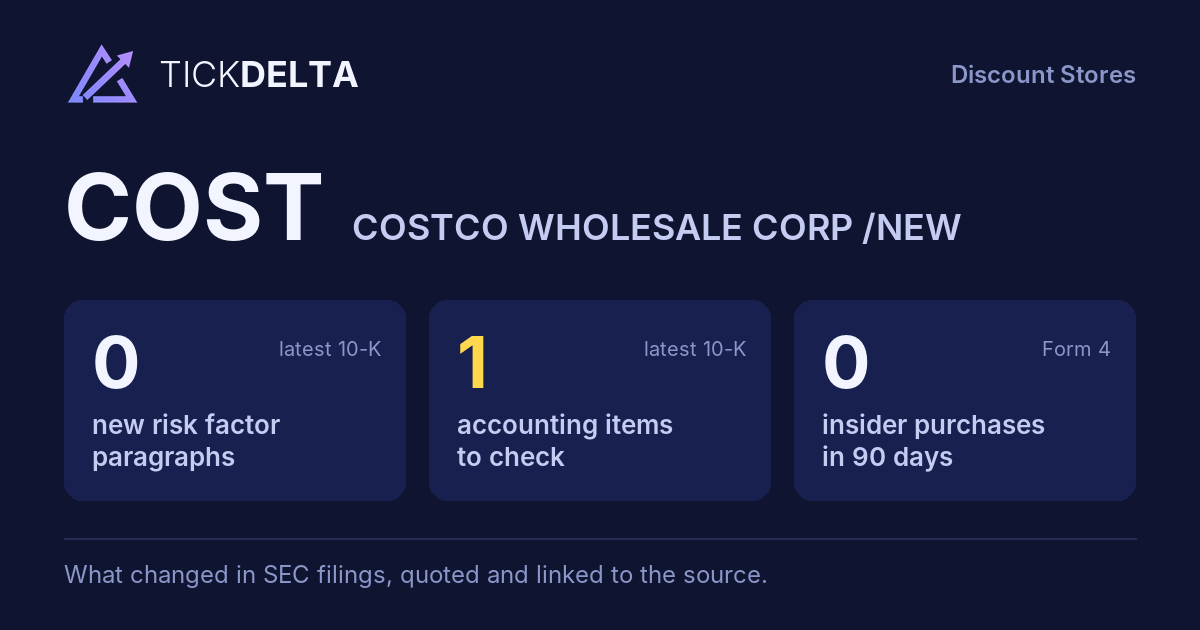
RemovedRisk Factors
COSTCostco
Costco Wholesale Corporation and its subsidiaries (Costco or the Company) began operations in 1983, in Seattle, Washington. 10-K, Item 1
- Employees
- 355,000
- Headquarters
- Issaquah, WA
- CEO
- Roland Michael Vachris
- Next results
- around Dec 10, 2026
10-K 0000909832-26-000093 (2026-10-07) vs 10-K 0000909832-25-000101 (2025-10-08)
| Section | Compared text | Words now | Changed |
|---|---|---|---|
| Risk Factors | Item 1A | 6,375 | 14.9% |
| MD&A | Item 7 | 4,095 | 20.1% |
| Legal Proceedings | Item 3, via Note 10 – Commitments and Contingencies | 1,644 | 46.6% |
| Accounting Policies | Item 8, Note 1 – Summary of Significant Accounting Policies | 4,925 | 7.9% |
The redline: what was cut and what was added
In each section, the paragraph that changed most, marked against last year's 10-K:
cut words struck through, new words highlighted and underlined.
Risk Factors 178 words changed in this paragraph; it is 70% similar to last year's version.
Increased security threats and more sophisticated cyber misconduct pose a risk to our systems, networks, products and services. We rely upon IT systems and networks, some of which are managed by or belong to third parties, including suppliers, partners, vendors, and service providers. Additionally, we collect, store store, and process sensitive information relating to our business, members, employees, and other third parties. Operating these IT systems and networks and processing and maintaining this data in a secure manner, manner are critical to our business operations and strategy. Remote work has also expanded possible attack surfaces. Attempts to gain unauthorized access to systems, networks networks, and data, both ours and third parties with whom we work, are increasing in frequency and sophistication, and in some cases, these attempts are successful. Cybersecurity attacks may range from random attempts to coordinated and targeted attacks, including sophisticated computer crimes and advanced persistent threats. Phishing attacks have emerged as are particularly prominent, including as vectors for ransomware attacks, which have increased in breadth and frequency. While we train our employees as part of our security efforts, that training cannot be completely effective. The rapid evolution of AI has automated and accelerated the scale of cybersecurity threats, potentially reducing the time for us to detect and mitigate potential information security incidents. If our security infrastructure fails to keep pace with these evolving threats, it could lead to more frequent or sophisticated compromises of our systems, networks, or data, adversely affecting our operations and member confidence. These threats pose a risk to the security of our systems and networks and the confidentiality, integrity, and availability of our data. Our IT systems and networks, or those managed by third parties such as cloud providers or suppliers that otherwise host or have access to confidential information, periodically have vulnerabilities, which may go unnoticed for a period of time. Our logging capabilities, or the logging capabilities of third parties, are also not always complete or sufficiently detailed, affecting our ability to fully investigate and understand the scope of security events. While our cybersecurity and compliance efforts seek to mitigate such risks, there can be no guarantee that the actions and controls we and our third-party service providers have implemented and are implementing, will be sufficient to protect our systems, information or other property.
Source: Item 1A, 10-K 0000909832-26-000093 vs Item 1A, 10-K 0000909832-25-000101
MD&A 151 words changed in this paragraph; it is 40% similar to last year's version.
Gross margin percentage increased 20 decreased three basis points. Excluding the impact of gasoline price deflation inflation on net sales, gross margin percentage was 11.03%, 11.22%, an increase of 11 10 basis points. This increase was positively impacted by 19 basis points in our warehouse ancillary and other businesses, primarily gasoline and pharmacy, offset by an 11 basis point decrease in core merchandise categories, primarily due to fresh foods and our co-branded credit card program. Gross margin percentage was negatively impacted by seven basis points due to a LIFO charge in 2025 for higher merchandise costs and one basis point categories. The majority of the increase in warehouse ancillary and other businesses. Changes businesses and the decrease in foreign currencies relative core merchandise categories was due to the U.S. dollar change in sales mix as warehouse ancillary and other businesses sales grew at a faster rate than core merchandise categories. Core merchandise categories were also negatively impacted by our co-branded credit card program as a result of reward costs associated with higher gasoline sales. IEEPA tariff refunds, net of investment in price reductions for members, positively impacted gross margin by approximately $224, attributable to our Other International and Canadian operations. three basis points.
Source: Item 7, 10-K 0000909832-26-000093 vs Item 7, 10-K 0000909832-25-000101
Legal Proceedings 126 words changed in this paragraph; it is 35% similar to last year's version.
In November 2023, a former employee filed a class action against the Company alleging claims under California law for failure to pay minimum wage, failure to pay overtime, failure to provide meal and rest breaks, failure to provide accurate wage statements, failure to reimburse expenses, failure to pay wages when due, and failure to pay sick pay. Martin Reyes v. Costco Wholesale Corporation, Sacramento County Superior Court (No. 23cv011351), removed to federal court, No. 2:24-cv-00300 (E.D. Cal.). A second amended complaint was filed, which the Company has moved to dismiss. In January 2024, the same plaintiff filed a related Private Attorneys General Act (PAGA) representative action, seeking civil penalties and asserting the same alleged underlying Labor Code violations and an additional suitable seating claim. In May 2024, the plaintiff filed an amended PAGA complaint; the Company has denied the material allegations of the complaint and filed a motion to stay the action. The motion was granted on December 18, 2024.
Source: Item 3, via Note 10 – Commitments and Contingencies, 10-K 0000909832-26-000093 vs Item 3, via Note 10 – Commitments and Contingencies, 10-K 0000909832-25-000101
Accounting Policies 61 words changed in this paragraph; it is 69% similar to last year's version.
The Company accounts for income taxes using the asset and liability method. Deferred tax assets and liabilities are recognized for the future tax consequences attributed to differences between the financial statement carrying amounts of existing assets and liabilities and their tax bases, credits and loss carry-forwards. Deferred tax assets and liabilities are measured using tax rates expected to apply to taxable income in the years in which those temporary differences and carry-forwards are expected to be recovered or settled. The effect on deferred tax assets and liabilities of a change in tax rates is recognized in income in the period that includes the enactment date. A valuation allowance is established when necessary to reduce deferred tax assets to amounts that are more likely than not expected to be realized.
Source: Item 8, Note 1 – Summary of Significant Accounting Policies, 10-K 0000909832-26-000093 vs Item 8, Note 1 – Summary of Significant Accounting Policies, 10-K 0000909832-25-000101
Every change, by type
Sentences and paragraphs of COST's Risk Factors and MD&A, 10-K 2026-10-07 against 10-K 2025-10-08. Each links to the text at sec.gov.
Quiet changes are sentences kept from last year with one to four words changed, at least one of them a hedge, a modal or a qualifier
(may, could, will, not, significant, material…). A year or date rolling forward is not counted.
The full word list
adverse, adversely, all, although, anticipate, anticipates, any, approximately, believe, believes, can, cannot, certain, could, expect, expects, generally, however, if, intend, intends, largely, likely, many, material, materially, may, might, most, must, never, no, not, possible, primarily, probable, should, significant, significantly, some, substantial, substantially, unlikely, will, would
RemovedRisk Factors
RemovedRisk Factors
RemovedRisk Factors
RewordedRisk Factors
Such events could result in physical damage to our properties or inventory, additional heating, cooling, and refrigeration costs, limitations on store operating hours, less frequent visits by members to physical locations, the temporary closure of warehouses, depots, manufacturing manufacturing, or home office facilities, the temporary lack of an adequate work force, disruptions to our IT systems, the temporary or long-term disruption in the supply of products from some local or overseas suppliers, the temporary disruption in the transport of goods to or from overseas, delays in the delivery of goods to our warehouses or depots, delays in online merchandise delivery, the temporary reduction in the availability of products in our warehouses, and long-term disruption or threats to the habitability of key markets in which we operate.
RewordedRisk Factors
Some competitors have greater financial resources and technology capabilities, including the faster adoption of artificial intelligence, better access to merchandise, AI technologies, and greater market penetration than we do.
RewordedRisk Factors
These factors include political and economic conditions, regulatory constraints, currency regulations, policy changes, and other matters in any of the countries or regions in which where we operate, now or in the future.
RewordedRisk Factors
RewordedRisk Factors
Our failure to maintain membership growth, loyalty loyalty, brand recognition, and brand recognition our culture could adversely affect our results of operations.
RewordedRisk Factors
We must attract, train train, and retain a large and growing number of qualified employees, while controlling related labor costs costs, preserving our culture, and maintaining our core values.
RewordedRisk Factors
Our suppliers (and those they depend upon for materials and services) are subject to risks, including labor disputes, union organizing activities, human and rights violations, animal rights welfare violations, financial liquidity, climate change, natural disasters, extreme weather conditions, environmental degradation, public health emergencies, supply constraints constraints, and general economic and political conditions and other risks similar to those we face that could limit their ability to timely provide us with acceptable merchandise.
RewordedRisk Factors
We are subject to risks associated with the legislative, judicial, accounting, regulatory, political and economic factors specific to the countries or regions in which places where we operate, which could adversely affect our business, financial condition and results of operations.
RewordedRisk Factors
Damage to our brands brands, reputation, or reputation culture may negatively impact comparable sales, diminish member trust, and reduce renewal rates and, accordingly, net sales and membership fee revenue, negatively impacting our results of operations.
RewordedRisk Factors
Suppliers may be unable to timely supply provide us with quality merchandise at competitive prices or may fail to adhere to our high standards, resulting in adverse effects on our business, merchandise inventories, sales, and profit margins. profits.
RewordedRisk Factors
Furthermore, international, federal, state state, and local regulatory authorities, private organizations and individuals may challenge our approach to ESG issues, including allegations that we failed in our efforts, should not have undertaken such efforts efforts, or that we improperly engaged other entities in our approach to ESG issues.
Quiet changesRisk Factors
Additionally, trade-related actions in various countries have adversely affected the costs of some of our merchandise.
AddedMD&A
Beginning in February 2025, the United States imposed tariffs under the International Emergency Economic Powers Act (IEEPA) on certain goods, materials, and products imported into the United States. We paid the government approximately $500 in IEEPA tariffs. In February 2026, the U.S. Supreme Court ruled that the IEEPA tariffs were unlawful. Following this ruling, the government launched a program to administer IEEPA refunds.
AddedMD&A
We applied the gain contingency model, in accordance with Accounting Standards Codification (ASC) 450-30, “Gain Contingencies,” recognizing recoveries in our consolidated statements of operations only as they were realized. During 2026, we began filing for refunds and received $184, made up of $174 in refunds, recorded as a reduction to merchandise costs, and $10 recorded as interest income. A portion of these refunds was invested in reducing prices for members. Subsequent to 2026, we received $155 in additional refunds and we intend to continue to invest the majority of the refunds in increased value for the member. For a small percentage of transactions where corrections are required, refunds may be delayed as the government continues to implement the IEEPA refund process.
AddedMD&A
2026 2025 2024 Net Sales $ 297,247 $ 269,912 $ 249,625 Increases in net sales: U.S. 10 % 9 % 4 % Canada 10 % 6 % 6 % Other International 12 % 8 % 9 % Total Company 10 % 8 % 5 % Increases in comparable sales(1): U.S. 8 % 6 % 4 % Canada 8 % 5 % 7 % Other International 10 % 5 % 8 % Total Company 8 % 6 % 5 % Increases in comparable sales excluding the impact of changes in foreign-currency and gasoline prices(1): U.S. 7 % 7 % 5 % Canada 7 % 8 % 8 % Other International 6 % 8 % 8 % Total Company 7 % 8 % 6 %
AddedMD&A
Digitally-enabled comparable sales increased 21% during 2026, both as reported and excluding the impact of changes in foreign currencies.
RemovedMD&A
RewordedMD&A
Short-term borrowings outstanding under were immaterial at the bank credit facilities, which are end of 2025 and were included in other current liabilities on the consolidated balance sheets, were immaterial at the end of 2025 and 2024. sheets.
RewordedMD&A
RewordedMD&A
Comparable sales is defined as net sales from warehouses open operating for more than one year, including remodels, relocations relocations, and expansions, and sales related to e-commerce sites operating for more than one year. expansions.
RewordedMD&A
RewordedMD&A
During 2025 2026 and 2024, 2025, we repurchased 891,000 and 943,000 and 1,004,000 shares of common stock, at an average price per share of $957.66 $950.90 and $695.29, $957.66, totaling approximately $903 $847 and $698. $903.
RewordedMD&A
The decrease increase in interest income in 2025 2026 was due to lower interest rates, higher cash balances, partially offset by higher cash balances. lower interest rates.
RewordedMD&A
RewordedMD&A
Membership fee revenue increased 10% 11% in 2025, 2026, driven by new member sign-ups and sign-ups, membership fee increases. increases, and upgrades to Executive memberships.
RewordedMD&A
Cash and cash equivalents and short-term investments were $21,301 and $15,284 and $11,144 at August 30, 2026, and August 31, 2025, and September 1, 2024. 2025.
RewordedMD&A
Cash flow used in financing activities primarily related to the payment of dividends, repayments of long-term debt and short-term borrowings, repurchases of common stock, repayments of short-term borrowings and long-term debt, and withholding taxes on stock-based awards.
RewordedMD&A
At August 31, 2025, 30, 2026, we had borrowing capacity under these facilities of $1,220. $2,118, compared to $1,220 at the end of 2025.
RewordedMD&A
Comparable sales were positively impacted by increases of 5% in average ticket and 3% in shopping frequency and approximately 1% in average ticket. frequency.
Quiet changesMD&A
Our worldwide renewal rate is adversely impacted by membership growth in newer certain international markets and a higher penetration of memberships sold online, including through digital membership promotions, which renew at a slightly lower rate on average.
Work on COST in a spreadsheet:
Excel workbook (a sheet per section, ten years by column, charts, links to the filings) ·
CSV.
For a Google Sheet that stays up to date, paste =IMPORTDATA("https://tickdelta.com/company/COST/export.csv") into a cell.