tickdelta
Sign in

Tickdelta is free for now. Sign up and get Pro free

← Screener

COSTCostco

Consumer staples · Discount Stores · Nasdaq

Costco Wholesale Corporation and its subsidiaries (Costco or the Company) began operations in 1983, in Seattle, Washington. 10-K, Item 1

Employees
355,000
Headquarters
Issaquah, WA
CEO
Roland Michael Vachris
Next results
around Dec 10, 2026
Compare with peers → Embed

When the SEC's staff reviews a filing, it writes to the company with numbered questions, and the company answers each one in a letter. SEC publishes the exchange once the review is over, at least 20 business days later. Below: what the staff asked COST, and the company's answer to each question, quoted from the letters. A question is not an accusation; most reviews end with the company adding detail to its next filing.

Form 10-K

2026-03-04 to 2026-03-26 · 2 questions · 1 letter from the SEC, 1 from the company
Review closed 2026-03-26
Results discussion (MD&A)Liquidity and cashSegments
Liquidity and Capital Resources · Cash Flows from Operating Activities, page 29
SEC asked (1)
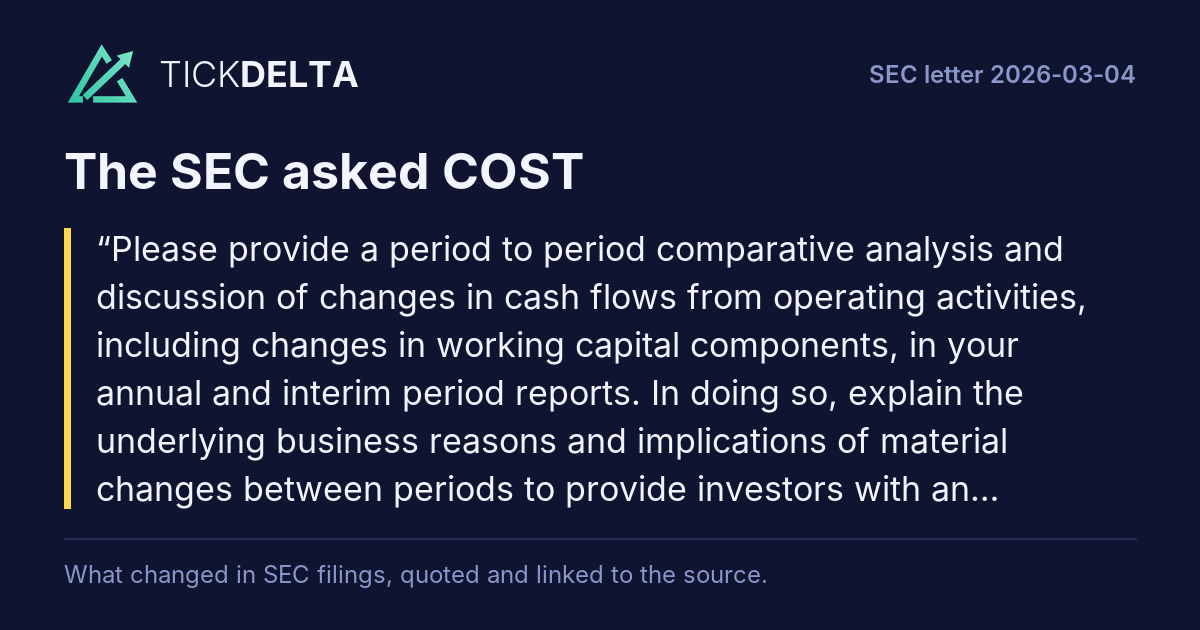
Please provide a period to period comparative analysis and discussion of changes in cash flows from operating activities, including changes in working capital components, in your annual and interim period reports. In doing so, explain the underlying business reasons and implications of material changes between periods to provide investors with an understanding of variability and potential trends in cash flows.
Rest of the question

Ensure your discussion and analysis is not merely a recitation of changes evident from the consolidated statements of cash flows. Refer to Item 303(a) and (b) of Regulation S-K and SEC Release No. 33-8350.

COST answered
We respectfully acknowledge the Staff’s comments and will expand our disclosures to include a comparative analysis and discussion of changes in cash flows from operating activities in future filings. The following is an example of the future disclosure:

Cash Flows from Operating Activities

Our cash flow provided by operations is primarily from net sales and membership fees.
Rest of the answer

Cash flow used in operations generally consists of payments to merchandise suppliers, warehouse operating costs, including wages and employee benefits, utilities, credit and debit card processing fees, and operating leases. Cash used in operations also includes payments for income taxes. Changes in our net investment in merchandise inventories (the difference between merchandise inventories and accounts payable) is impacted by several factors, including inventory levels and turnover, payment terms with suppliers, and early payments to obtain discounts. Net cash provided by operating activities totaled $13,335 in 2025, compared to $11,339 in 2024. The increase was primarily due to higher cash flow provided from operating income, as well as reduced net investment in merchandise inventories. The latter was a result of faster inventory turns and improved payment terms with suppliers.

Read in the reply ↗
In its next report

First report after the company's reply of 2026-03-23: 10-Q filed 2026-06-03 ↗, against the 10-Q filed 2025-12-17 ↗.

Cash Flows from Operating Activities: 10 paragraphs changed; the 3 closest in words to the question are below.

Reworded

The preparation of our consolidated financial statements in accordance with U.S. GAAP requires that we make estimates and judgments. We base these on historical experience and on assumptions that we believe to be reasonable. Our critical accounting policies are discussed in Part II, Item 7, “Management’s Discussion and Analysis of Financial Condition and Results of Operations” section of our Annual Report on Form 10-K, for the fiscal year ended August 31, 2025. There have been no material changes to the critical accounting estimates previously disclosed in that Report.

27 words cut, 0 added sec.gov ↗
Reworded

On January 19, 2023, the Board of Directors authorized a share repurchase program in the amount of $4,000, which expires in January 2027. During the first quarter thirty-six weeks of 2026 and 2025, we repurchased 225,000 638,000 and 230,000 658,000 shares of common stock, at an average price per share of $932.02 $945.46 and $899.23, $946.64, totaling approximately $210 $603 and $206. $623. These amounts may differ from the accompanying condensed consolidated statements of cash flows due to changes in unsettled repurchases at the end of a quarter. Purchases are made from time to time, as conditions warrant, in potentially including the open market or in market, block purchases, purchases and pursuant to plans under SEC Rule 10b5-1. Repurchased shares are retired, in accordance with the Washington Business Corporation Act. The remaining amount available to be purchased under our approved plan was $1,752 $1,359 at the end of the first third quarter.

14 words cut, 15 added sec.gov ↗
Reworded

Net cash provided by operating activities totaled $4,688 in the first quarter of 2026, compared to $3,260 in the first quarter of 2025. Our cash flow provided by operations is primarily from net sales and membership fees. Cash flow used in operations generally consists of payments to suppliers, warehouse operating costs, including wages and employee benefits, utilities, credit and debit card processing fees, and operating leases. Cash used in operations also includes payments for income taxes. Changes in our net investment in merchandise inventories (the difference between merchandise inventories and accounts payable) is impacted by several factors, including inventory levels and turnover, payment terms with suppliers, and early payments to obtain discounts. Net cash provided by operating activities totaled $11,133 in the first thirty-six weeks of 2026, compared to $9,468 in the first thirty-six weeks of 2025. The increase was primarily due to higher cash flow provided from operating income, as well as reduced net investment in merchandise inventories. The latter was a result of faster inventory turns and improved payment terms with suppliers.

23 words cut, 62 added sec.gov ↗

Paragraphs where only numbers, dates or period words changed are not shown. Cut words struck through, new words highlighted and underlined.

Notes to Consolidated Financial Statements · Note 11 - Segment Reporting, page 62
SEC asked (2)
You disclose the CODM utilizes operating income in evaluating performance and allocating resources but not how the measure is used for these purposes. Refer to ASC 280-10-50-29(f) and ASC 280-10-55-47(bb). Please revise as appropriate.
Rest of the question

In closing, we remind you that the company and its management are responsible for the accuracy and adequacy of their disclosures, notwithstanding any review, comments, action or absence of action by the staff.

COST answered
We will revise our disclosure in our future filings to include how the CODM utilizes operating income as described below:

The CODM uses the metrics outlined in the table below, along with internal management reports, to evaluate performance, monitor actual results versus budget and prior year results, and make strategic and operational resource allocation decisions. Read in the reply ↗
In its next report

First report after the company's reply of 2026-03-23: 10-Q filed 2026-06-03 ↗, against the 10-Q filed 2025-12-17 ↗.

The part of the filing the question names could not be found in both reports. Read them on sec.gov.
Also in this review: closing letter, 2026-03-26
Form 10-K

2025-03-19 to 2025-05-20 · 6 questions · 2 letters from the SEC, 2 from the company
Review closed 2025-05-20
RevenueResults discussion (MD&A)
After reviewing your response to this letter, we may have additional comments. Business · Membership, page 6
SEC asked (1)
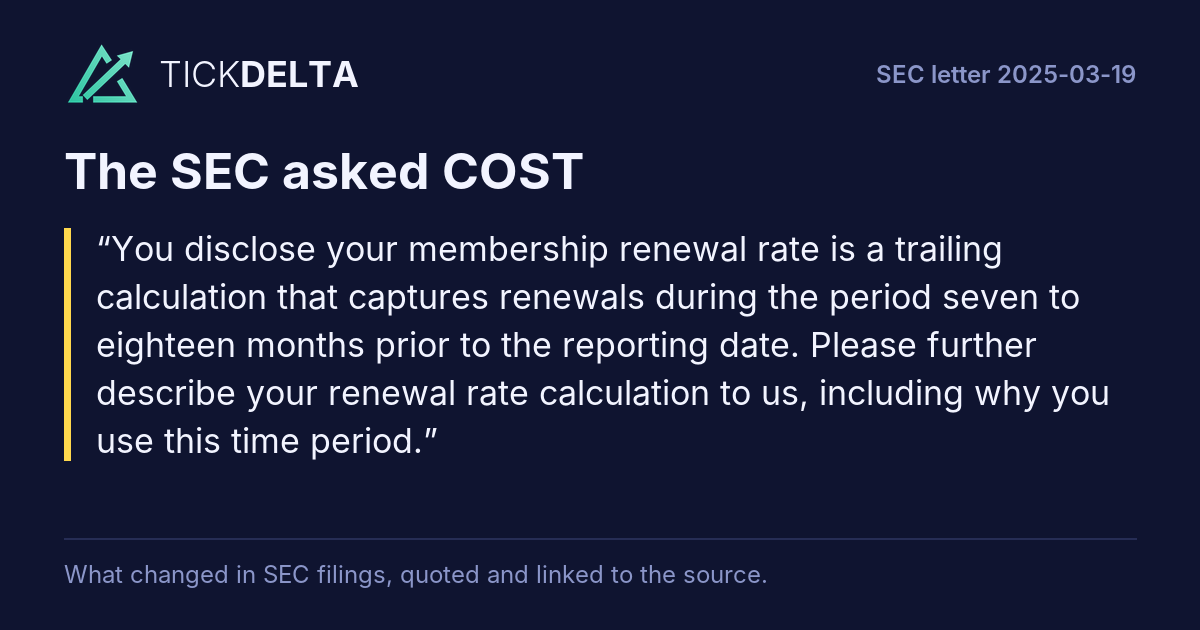
You disclose your membership renewal rate is a trailing calculation that captures renewals during the period seven to eighteen months prior to the reporting date. Please further describe your renewal rate calculation to us, including why you use this time period.
COST answered
We received a Comment Letter dated January 22, 2014, concerning our Form 10-K for the fiscal year ended September 1, 2013, filed October 16, 2013, with a similar question regarding our membership renewal rate calculation. The following response is consistent with the response to that letter (dated February 4th, 2014), as to which the staff had no follow up.
Rest of the answer

Our subsequent disclosures for the past decade have been consistent, and renewal patterns were comparable during that period.

Historical data show that most members renew prior to expiration; the vast majority of those who renew late do so within six months of expiration. As such, measuring renewals only at

Confidential Treatment Requested by Costco Wholesale Corporation

C-001

[*] - Information omitted and provided under separate cover to the Staff pursuant to Rule 83 (17 C.F.R. § 200.83) the point of expiration would not provide investors an accurate picture of our renewal activity. Memberships that have an expiration date in the six months prior to the end of our reporting period are excluded from this calculation, regardless of whether or not they have been renewed.

For example, our renewal rate calculation as of September 1, 2024, included all memberships that had expired between March 2023 and February 2024. These represented the base (i.e., denominator) of memberships used to evaluate the renewal rate. Using that same membership base, to the extent the membership has been renewed as of the most recent month-end prior to the reporting date, it is included in the renewal count used as the numerator. This calculation yields the reported renewal rate.

Read in the reply ↗
After reviewing your response to this letter, we may have additional comments. Business · Membership, page 6
SEC asked (2)
Please revise to clarify whether the membership figures in the table are as of a point in time or for a period of time.
COST answered
The membership figures in the table are as of a point in time, at the end of years 2024, 2023, and 2022. We will conform our future disclosures accordingly. Read in the reply ↗
After reviewing your response to this letter, we may have additional comments. Business · Membership, page 6
SEC asked (3)
You state membership counts include active memberships as well as memberships that have not renewed within the 12 months prior to the reporting date. Please tell us your basis for including memberships that have not renewed within the 12 months prior to the reporting date.
COST answered
As noted above, a substantial number of our members renew after expiration and renewal timing can be impacted by seasonal trends, membership promotions and concentrations of new warehouse openings in a given period. Internal reports to management utilize the methodology reflected in our public filings regarding a membership count that includes members that have not renewed within the twelve months prior to the reporting date (to capture a full annual cycle).
Rest of the answer

In our Forms 10-K since 2020 we have advised investors that the membership counts include those that have not renewed within the twelve months prior to the reporting date.

Read in the reply ↗
Management's Discussion and Analysis of Financial Conditions and Results of Operations · Results of Operations, page 25
SEC asked (4)
Please revise to quantify factors to which changes are attributed. For example, you state the increase in net sales was attributable to an increase in comparable sales and the opening of new warehouses, partially offset by one less week of sales. As another example, you cite wage increases as impacting SG&A expenses. Please also revise to quantify impacts of changes in price and volume on revenue.
Rest of the question

Refer to Item 303(b)(2) of Regulation S-K.

COST answered
Our 2024 Form 10-K disclosed the factors contributing to the increase in net sales as an increase in comparable sales and sales at new warehouses opened in 2023 and 2024, partially offset by the impact of one less week of sales. These drivers show the impact of changes in volume on revenue. Within the comparable sales discussion of MD&A, we also disclose that shopping frequency was the significant driver of comparable sales growth.
Rest of the answer

In future filings, we will further quantify the drivers that we believe are material factors within our MD&A (acknowledging the examples you cite above for net sales and wage increases).

For the period covered by the Form 10-K we concluded that the impact of changes in prices was immaterial, except for changes in the price of gasoline, which we disclosed, along with the change in the volume of gasoline gallons sold.

Presented below for illustrative purposes is an excerpt from MD&A marked to show an example of the quantitative descriptions we intend to provide in our future filings (additions to existing language are in brackets):

Net Sales

Net sales increased $11,915 or 5% during 2024. The improvement was attributable to an increase in comparable sales [of $12,141 or 5%] and sales at new warehouses opened in 2023 and 2024 [of $4,252 or 2%], partially offset by the impact of one less week of sales in 2024 [estimated to be approximately 2%].

Read in the reply ↗
In its next report

First report after the company's reply of 2025-04-21: 10-Q filed 2025-06-05 ↗, against the 10-Q filed 2025-03-13 ↗.

Tickdelta does not hold the text of both reports, so they are not compared here.

Note 1 - Summary of Significant Accounting Policies · Revenue Recognition, page 46
SEC asked (5)
We note your disclosure that you derive a portion of your revenue from Citibank, including a royalty on purchases made on the co-branded card outside of Costco. Please tell us the amounts of revenue you recognized from Citibank, including such royalties, in each of the last three fiscal years and latest interim period. Please also tell us the nature and extent of any direct costs associated with this revenue.
Rest of the question

Finally, please tell us how you categorize this revenue in your table of disaggregated revenue in Note 11 on page 62.

COST answered
(dollars in millions):

Under our Citibank, N.A. Co-Branded Credit Card Agreement, Citibank remitted to Costco revenues that totaled [*] in 2024, 2023 and 2022 and [*] during the first half of 2025.

Direct costs associated with the agreement consisted of funds the Company contributed to cover a portion of the rebate that cardholders receive. These amounts totaled [*] in 2024, 2023 and 2022 and [*] during the first half of 2025 and are reflected within revenue in

C-003 accordance with revenue-recognition guidance.
Rest of the answer

These amounts include adjustments to the estimated breakage associated with the redemption of the rebate that cardholders earn, as disclosed in Note 1 to our financial statements. [*]

Revenues related to the agreement are disclosed within the Warehouse Ancillary and Other Businesses line in the Disaggregated Revenue table in Note 11, similar to where we categorize other revenues that are not directly associated with our core merchandise categories or that have an immaterial impact on net sales.

Read in the reply ↗
In its next report

First report after the company's reply of 2025-04-21: 10-Q filed 2025-06-05 ↗, against the 10-Q filed 2025-03-13 ↗.

Tickdelta does not hold the text of both reports, so they are not compared here.

Business · Memberships, page 5
SEC asked
We note your response to prior comment 1 and 3. Please clarify your disclosure so users have better understanding of your rational behind the methodology of your renewal rate calculation and active memberships.
COST answered
We will revise our disclosures in our next Annual Report on Form 10-K to clarify the rationale behind the methodology of our renewal rate calculation and active memberships. Read in the reply ↗

Also in this review: request for more time, 2025-03-21, request for more time, 2025-04-15, closing letter, 2025-05-20

Form 10-K for the Fiscal Year Ended August 29, 2021

2022-04-18 to 2022-04-28 · 1 question · 1 letter from the SEC, 1 from the company
Review closed 2022-04-28
Results discussion (MD&A)
Results of Operations · Net Sales, page 25
SEC asked
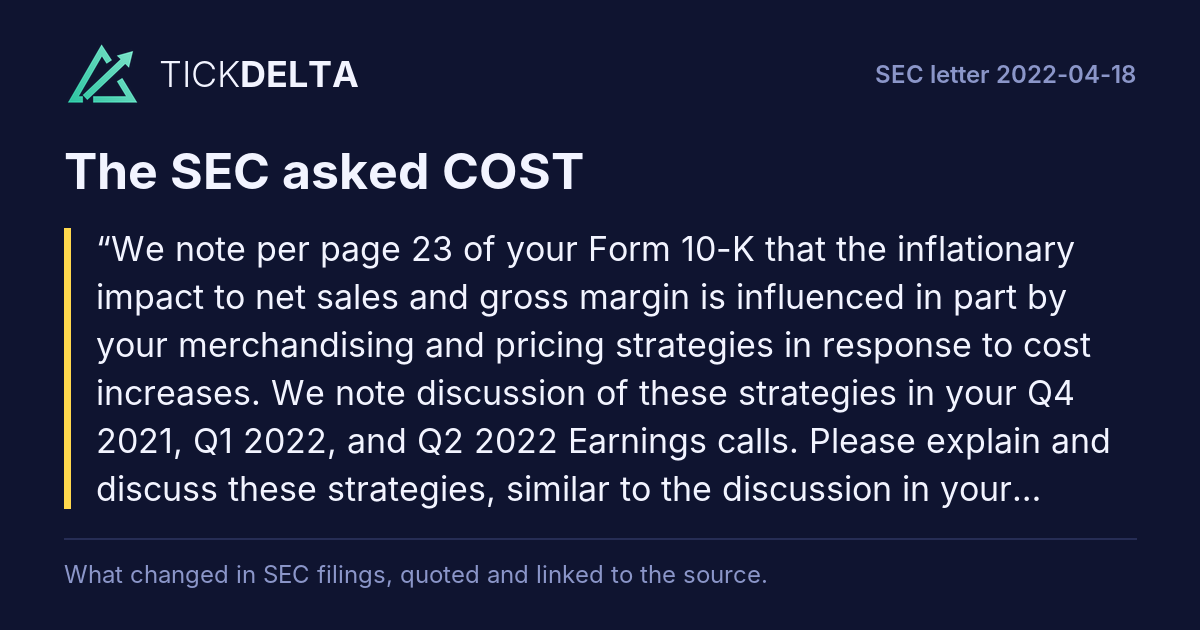
We note per page 23 of your Form 10-K that the inflationary impact to net sales and gross margin is influenced in part by your merchandising and pricing strategies in response to cost increases. We note discussion of these strategies in your Q4 2021, Q1 2022, and Q2 2022 Earnings calls.
Rest of the question

Please explain and discuss these strategies, similar to the discussion in your earnings calls, as deemed appropriate, in future filings. Refer to Item 303(b) or Regulation S-K.

COST answered
We will revise our future disclosure to explain and discuss our merchandising and pricing strategies in response to cost increases. Read in the reply ↗
In its next report

First report after the company's reply of 2022-04-22: 10-Q filed 2022-06-02 ↗, against the 10-Q filed 2022-03-10 ↗.

Tickdelta does not hold the text of both reports, so they are not compared here.

Also in this review: closing letter, 2022-04-28

From the SEC's correspondence on EDGAR: staff letters (form UPLOAD) and company letters (form CORRESP), 13 letters filed since 2022-04-18. Questions and answers are matched by their numbers; topics come from words in each question. The reports are compared word for word (same form, before the first SEC letter against the first report after the company's reply). No AI.

Work on COST in a spreadsheet: Excel workbook (a sheet per section, ten years by column, charts, links to the filings) · CSV. For a Google Sheet that stays up to date, paste =IMPORTDATA("https://tickdelta.com/company/COST/export.csv") into a cell.