Rest of the answer
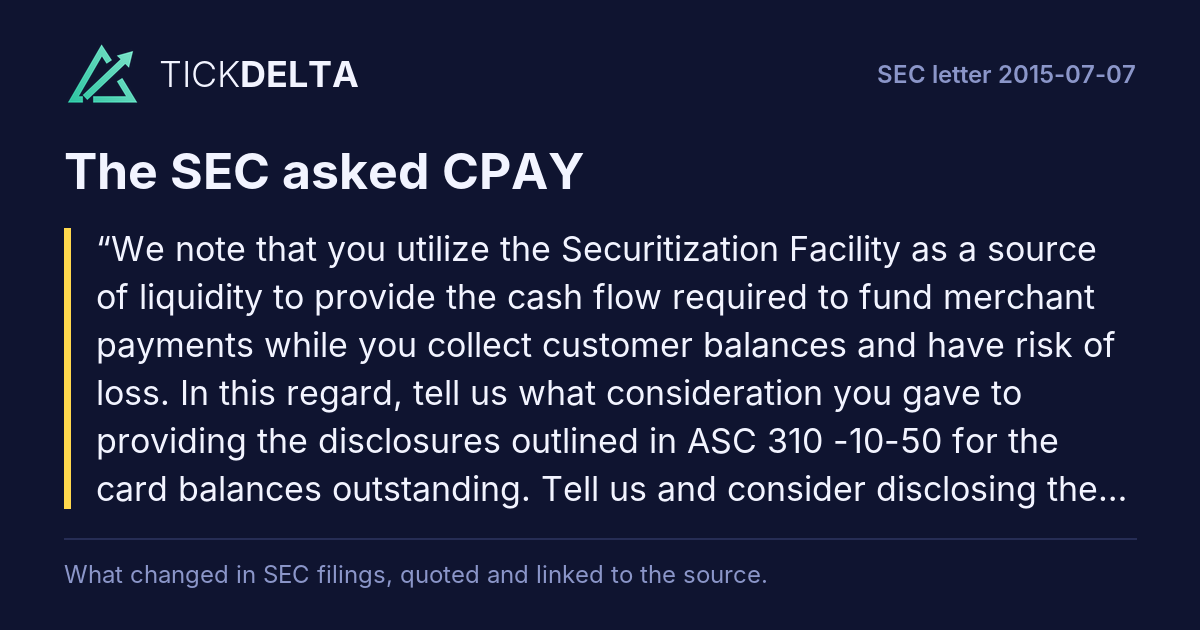
We utilize our Securitization Facility much like a revolver, in that we tend to sell eligible receivables on an as needed basis, to fund the timing difference between funding the merchants and collecting from our customers. The domestic receivables in question relate primarily to our fuel based charge card products.
Monthly, we review our accounts receivable balances, securitized and non-securitized, and provide for probable doubtful accounts based primarily on the aging of those balances.
The Company’s residual interest in the accounts receivables related to the Securitization Facility fair value approximates carrying value due to the short-term nature of those receivables.
In accordance with the guidance in ASC 310-10, paragraphs 50-1A, 50-2 and 50-4A, we have disclosed our significant accounting policies related to trade accounts receivable within our “critical accounting policies” in footnote 2 within our 2014 Form 10-K. These footnote disclosures are included under the following subheadings revenue recognition and presentation, credit risk and reserve for losses on receivables, and accounts receivable.
We will expand our disclosures related to the recognition of finance charge income in future filings, under the subheading revenue recognition and presentation, to include the following, “the Company recognizes revenue from late fees and finance charges, in jurisdictions where permitted under local regulations, primarily in the US and
Canada. Such fees are recognized net of a provision for estimated uncollectible amounts, at the time the fees and finance charges are assessed and services are provided. The Company ceases billing and accruing for late fees and finance charges approximately 30-40 days after the customer’s balance becomes delinquent.” While our systems do not track outstanding late fees and finance charges separately from the related customer accounts, we estimate that total outstanding late fees and finance charges, net of the provision for uncollectible amounts, represents approximately 1% of consolidated accounts receivable at December 31, 2014 and are not material for separate disclosure.
We will expand our critical accounting policy and related footnote disclosures, under the subheading credit risk and reserve for losses on receivables, in future filings to include the following, “Accounts receivable are deemed uncollectible once they age past 90 days and are deemed uncollectible from the customer. The Company also provides an allowance for receivables aged less than 90 days that it expects will be uncollectible based on historical collections experience and would include accounts that have filed for bankruptcy. At December 31, 2014, approximately 98.2% of outstanding accounts receivable were current.”
We consider all of our trade receivables as one portfolio of receivables made up of smaller balances of accounts, and therefore we have concluded that there is no further disclosure requirement for the Company in order to comply with the provisions of ASC 310-10-50-3.
In accordance with the provisions of ASC 310-10-50-5 and 860-30-50-1A, we have provided the carrying amount of trade accounts receivables that serve as collateral, on the face of the balance sheet and in the related Securitization Facility disclosures.
Furthermore, as a point of clarification and as disclosed in our Form 10-K, we issue our customers “charge cards” (rather than a “credit card”) in order to facilitate the purchase of specific goods and services. According to the Federal Register 12 CFR
Section 226, a “charge card” is a product where no periodic rate is used to compute a finance charge, outstanding balances cannot be carried over from one billing cycle to the next, and the balance is payable in full when a periodic statement is received. Our agreements with our customers do not allow a balance to carry from billing cycle to the next as would be common with a credit card with revolving credit terms. There is no “credit card” element to these receivables.
We have considered whether our charge card trade accounts receivables qualify for certain of the disclosure exceptions set forth in ASC 310-10-50-5B. We have concluded that our charge cards differ from credit cards and that the related trade accounts receivables have a contractual maturity of less than one year.
We also considered the guidance in 310-10, paragraphs50-5A through 50-8, we believe that our charge card trade accounts receivable meets the disclosure exceptions set forth in paragraph 50-5B and 50-7B. In completing that analysis, we have concluded that our charge cards differ from credit cards and that our related charge card trade accounts receivables have a contractual maturity of approximately 14 days of the billing date and arise from the sale of services. As such, we believe that charge card trade accounts receivable meets the exception for the disclosures set forth in 310-10, paragraphs 50-6 through 50-7A. We will clarify in future filings that “accounts receivable collateralized within our Securitization Facility relate to trade receivables” as well as our conclusions that “these accounts receivable relate to charge card activity”.
In addition, we have considered the following sections within ASC 310-10-50:
Paragraphs 50-9 through 50-10, “Accounting Policies for Off-Balance-Sheet Credit Exposures”- We do not have any off-balance-sheet credit exposures and thus concluded that the disclosures related to this section of guidance were not applicable.
Paragraph 50-11, “Foreclosed and Repossessed Assets” - We do not have any foreclosed and repossessed assets and thus concluded that the disclosures related to this section of guidance were not applicable.
Paragraphs 50-11A through 50-14, “Allowance for Credit Losses Related to Financing Receivables” – As previously stated, we consider all of our trade receivables as one portfolio of receivables made up of smaller balances of accounts that we evaluate for impairment. We will provide the enhanced disclosures related to our policies for credit risk and reserve for losses on receivables in addition to the disclosures currently provided previously in our 2014 Form 10-K, which we believe collectively meet the requirements of the guidance.
Paragraphs 50-14A through 50-20 and 50-35, “Impaired Loans” and “Loans in Process of Foreclosure”- We do not issue loans nor have any impaired loans and thus concluded that the disclosures related to this section of guidance were not applicable.
Paragraphs 50-21 through 50-24, “Loss Contingencies”- We do not have any circumstances in which no accrual was made for a loss contingencies related to accounts receivable at December 31, 2014 and
March 31, 2015, and thus, concluded that the disclosures related to this section of guidance were not applicable.
Paragraph 50-25, “Risk and Uncertainties”- We do not issue loans nor have any loan products and thus concluded that the disclosures related to this section of guidance were not applicable.
Paragraph 50-26, “Fair Value Disclosures” – We have disclosed within footnote 2 to our 2014 Form 10-K that “the residual interest’s fair value (in securitized accounts receivable) approximates carrying value due its short-term nature.” Furthermore within footnote 3 to our 2014 Form 10-K, we disclose, “The carrying value of the Company’s cash, accounts receivable, securitized accounts receivable and related facility…approximate their respective fair values due to the short-term maturities of the instruments.” As such, we believe we meet the requirements of this disclosure guidance. We noted upon reading our disclosure that there was an administrative error in the above sentence within footnote 3, where the words ‘fair value’ were inadvertently replaced with ‘carrying value’. We will correct this in future filings to read as transcribed above.
Paragraphs 50-27 through 50-30, “Credit Quality Information”- As this guidance states that it does apply to the financing receivables listed in paragraph 310-10-50-7B, which includes trade accounts receivable, we have concluded that the disclosures related to this section of guidance are not applicable.
Paragraphs 50-31 through 50-34, “Modifications”- We do not have any troubled debt restructurings and thus concluded that the disclosures related to this section of guidance were not applicable.