Screener / SEC EDGAR /CIK 0001530721 /10-K filed May 27, 2026, compared with May 28, 2025 /Numbers from the XBRL of the 10-Ks
NYSE Consumer discretionary · Leather Goods

Capri Holdings Ltd CPRI

Compare with peers Embed
SEC comment letters, last 20 years

6 reviews of CPRI's filings by SEC staff

UPLOAD and CORRESP
Reviews 6 latest letter Feb 5, 2025
Questions asked 23 each answered in the company's own letter
No closing letter 1 reviews without a letter saying the staff completed it

When the SEC's staff reviews a filing, it writes to the company with numbered questions, and the company answers each one in a letter. SEC publishes the exchange once the review is over, at least 20 business days later. A question is not an accusation; most reviews end with the company adding detail to its next filing.

How the reviews went

Every review on EDGAR, from the first staff letter to the letter that closes it

  1. 1. Staff letters 8 UPLOAD
  2. 2. Questions in them 23 numbered comments
  3. 3. Company replies 8 CORRESP
  4. 4. Reviews closed 5 of 6 closing letter

Half the closed reviews took 15 days or less from the first letter to the closing letter.

Form 10-K for the Fiscal Year Ended March 30, 2024

2025-02-05 to 2025-02-18 · 4 questions · 1 letter from the SEC, 1 from the company
Review closed 2025-02-18
Non-GAAP measuresSegmentsResults discussion (MD&A)RevenueCritical estimatesReserves and insuranceLiquidity and cash
SEC asked (2)
We note that your disclosure on page 54 presents income from operations for each segment and includes a subtotal that is titled “total income from operations.” We further note that the amount presented on page 54 is not consistent with the income from operations line item on the consolidated statements of operations and comprehensive (loss) income.
Rest of the question

Please note that the presentation of the total segment profit or loss measure outside of the ASC 280 required footnote disclosure, would be considered a Non-GAAP financial measure and if presented in MD&A should include the applicable non-GAAP disclosures required by Item 10(e) of Regulation S-K. Please revise accordingly. These changes should also be applied to your disclosure in your earnings release filed on Form 8-K.

CPRI answered
The Company will revise its future filings (including earnings releases filed on Form 8-K) to include applicable non-GAAP disclosures required by Item 10(e) of Regulation S-K, including a reconciliation between “total income from operations” by segment and the “total (loss) income from operations” line item on the consolidated statements of operations and comprehensive (loss) income.
Read in the reply
In its next report

First report after the company's reply of Feb 13, 2025: 10-K filed May 28, 2025 ↗, against the 10-K filed May 29, 2024 ↗.

Tickdelta does not hold the text of both reports, so they are not compared here.
Notes to the Audited Financial Statements · Note 4. Revenue Recognition, page 87
SEC asked (3)
We note that your disclosure of your revenue recognition policies includes separate discussion of retail versus wholesale revenue. We also note that you disclose that you have three primary channels of distribution: retail, wholesale and licensing and your critical accounting estimates section of MD&A discloses that you have separate reserves for wholesale and retail sales returns.
Rest of the question

We further note that your disaggregated revenue disclosures include revenue by geographic location within each segment and also by product category (as disclosed in Note 20). Please explain to us how you considered the guidance in ASC 606-10-50-5, and ASC 606-10-55-89 through 55-91 in determining whether or not to further disclose disaggregation of revenue by amounts such as wholesale versus retail.

CPRI answered
In determining the appropriate categories of disaggregation to present in accordance with ASC 606-10-50-5, the Company has assessed the nature, amount, timing and uncertainty of revenue and cash flows affected by the economic factors impacting revenue recognized. Based on this analysis, the Company has concluded that revenue recognized by brand and by geography, regardless of channel of distribution, are consistent as the product is all luxury fashion goods, the product ultimately reaches the same end consumer and the type of contracts are short term with revenue being recognized on the
Rest of the answer

transfer of goods to the customer at a point-in-time.

The Company has also assessed its primary channels of distribution for disaggregation based on potential differences between its critical accounting estimates and has concluded that the majority of these estimates apply to both channels and the Company does not believe that these estimates create a different risk profile. In particular, the Company notes the only differing estimate relates to wholesale allowances which was approximately $29 million as of the end of Fiscal 2024. While the Company acknowledges this estimate is unique to the wholesale channel, we do not believe this is significant resulting in a different overall risk profile or requiring separate revenue disclosures.

Further, presentation of revenue by brand and geography best depicts the uncertainty of such revenue and cash flows as each geography has similar economic environments (or economic factors impacting revenue) and customers are typically unique to each region (i.e. customers are not present across multiple regions).

Although individual products within our product line may differ by category (i.e. apparel, accessories, footwear, etc.), and are disclosed to satisfy the requirements of ASC 280-10-50-40, revenue by category metrics are not regularly reviewed by the Company’s chief operating decision maker (CODM).

Lastly, the Company has assessed the factors listed in ASC 606-10-55-90, including the examples listed in ASC 606-120-55-91, and determined that disaggregation by brand and geography is consistent with the disclosures included within the Company’s earnings releases and the regular internal reporting provided to, and reviewed by, the Company’s CODM. The CODM regularly reviews disaggregated data and financial results predominantly by brand and by region.

Read in the reply
In its next report

First report after the company's reply of Feb 13, 2025: 10-K filed May 28, 2025 ↗, against the 10-K filed May 29, 2024 ↗.

Tickdelta does not hold the text of both reports, so they are not compared here.

Exhibit 99.1 Earnings Release, page 1
SEC asked (4)
We note that in the bullet points at the top of your second quarter earnings release, you disclose adjusted operating margin and adjusted earnings per share without prominent disclosure of the most comparable GAAP amounts.
Rest of the question

Please note that Item 10(e)(1)(i)(A) of Regulation S-K requires that when you present a non-GAAP measure, you must present the most directly comparable GAAP measure with equal or greater prominence. Please revise accordingly. We also note that it does not appear that you have presented a reconciliation of adjusted operating margin to its most comparable GAAP measure within the earnings release which is required by Item 10(e)(1)(i)(B) of Regulation S-K. See additional guidance in Question 102.10(a) of the SEC Staff’s Compliance and Disclosure Interpretations on Non-GAAP Financial Measures. Please revise future filings accordingly.

CPRI answered
The Company will revise its future filings to present the most directly comparable GAAP measure with equal or greater prominence where it presents a non-GAAP measure. In future filings, the Company will also include a reconciliation of all non-GAAP measures to the most comparable GAAP measure as required by Item 10(e)(1)(i)(B) of Regulation S-K.
Read in the reply
In its next report

First report after the company's reply of Feb 13, 2025: 10-K filed May 28, 2025 ↗, against the 10-K filed May 29, 2024 ↗.

Tickdelta does not hold the text of both reports, so they are not compared here.

Exhibit 99.1 Earnings Release, page 1
SEC asked (5)
We note your disclosure of free cash flow on the second page of your earnings release. Please revise future filings to identify this measure as non-GAAP and include the disclosures required by Item 10(e) of Regulation S-K.
CPRI answered
The Company will revise its future filings that include free cash flow to identify this measure as a non-GAAP measure and include the disclosures required by Item 10(e) of Regulation S-K.

*****

The Company understands that it and its management are responsible for the accuracy and adequacy of its disclosures, notwithstanding any review, comments, action or absence of action by the Staff.
Read in the reply
In its next report

First report after the company's reply of Feb 13, 2025: 10-K filed May 28, 2025 ↗, against the 10-K filed May 29, 2024 ↗.

Tickdelta does not hold the text of both reports, so they are not compared here.

Also in this review: closing letter, 2025-02-18
Form 10-K for the Fiscal Year Ended April 1, 2017

2017-08-30 to 2017-09-13 · 1 question · 1 letter from the SEC, 1 from the company
Review closed 2017-09-13
Income taxes
Comparison of Fiscal 2017 with Fiscal 2016 · Provision for Income Taxes, page 39
SEC asked
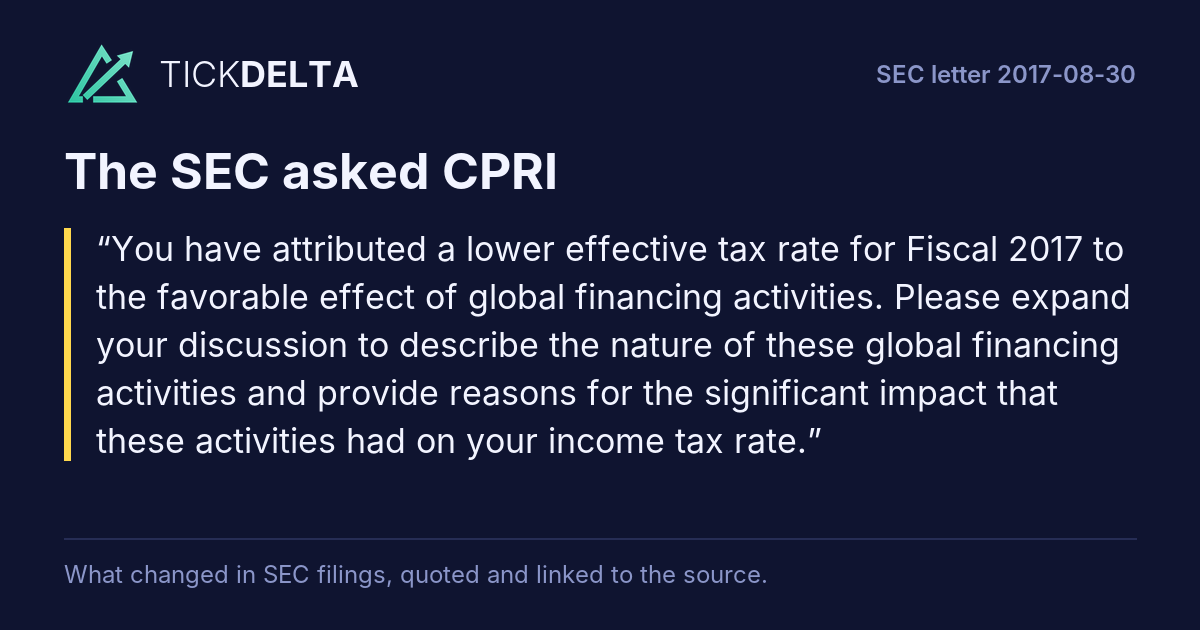
You have attributed a lower effective tax rate for Fiscal 2017 to the favorable effect of global financing activities. Please expand your discussion to describe the nature of these global financing activities and provide reasons for the significant impact that these activities had on your income tax rate.
CPRI answered
The Company will expand its disclosure in Management’s Discussion and Analysis of Financial Condition and Results of Operations in future filings to provide additional information regarding the nature of its global financing activities and their effect on its effective tax rate. An example of such disclosure is set forth below, which has been marked to present changes from the Company’s disclosure included in its Form 10-K for the fiscal year ended April 1, 2017:

“We recognized $137.1 million of income tax expense during Fiscal 2017, compared with $334.6 million for Fiscal 2016.
Rest of the answer

Our effective tax rate for Fiscal 2017 was 19.9%, compared to 28.5% for Fiscal 2016. The decrease in our effective tax rate was primarily due to the favorable effect of global financing activities, as well as the increase in taxable income in certain of our non-U.S. subsidiaries (predominantly European operations) during Fiscal 2017, which are subject to lower statutory income tax rates. The global financing activities are related to our previously disclosed 2014 move of our principal executive office from Hong Kong to the United Kingdom ("U.K.") and decision to become a U.K. tax resident. In connection with this decision, we funded our international growth strategy through intercompany debt financing arrangements between our U.S., U.K. and Switzerland subsidiaries in December 2015. Accordingly, due to the difference in the statutory income tax rates between these jurisdictions, we realized a reduction in our effective tax rate. The impact on our effective tax rate was higher in Fiscal 2017 than in Fiscal 2016 because the debt financing arrangements were initiated near the end of Fiscal 2016. Due to our substantial international growth and expansion over the past several years and our Company being a U.K. tax resident, we believe that it is most appropriate to reconcile our effective tax rate to the U.K. statutory tax rate."

*****

The Company understands that it and its management are responsible for the accuracy and adequacy of its disclosures, notwithstanding any review, comments, action or absence of action by the Staff.

Read in the reply
In its next report

First report after the company's reply of Sep 8, 2017: 10-Q filed Nov 8, 2017 ↗, against the 10-Q filed Aug 9, 2017 ↗.

Tickdelta does not hold the text of both reports, so they are not compared here.

Also in this review: closing letter, 2017-09-13

Form 10-K

2015-09-21 to 2015-10-06 · 2 questions · 1 letter from the SEC, 1 from the company
Review closed 2015-10-06
Results discussion (MD&A)
Results of Operations, page 31
SEC asked (1)
We note the statement on page 32 that non-comparable store sales growth “was primarily attributable to operating 121 additional stores since March 29, 2014 and sales from our ecommerce site.” In future filings where you attribute material changes to multiple reasons, please quantify the approximate proportion attributed to each reason.
Rest of the question

Please provide draft disclosure and confirm that future filings will address year-over-year changes in e-commerce sales to the extent they are material to you.

CPRI answered
The Company confirms that when there are multiple reasons for a material change to its sales it will disclose the proportion attributable to each such material change in its future filings. Such disclosure is set forth below, which has been marked to present changes from the Company’s disclosure included in its Form 10-K for the fiscal year ended March 28, 2015:

“Approximately 85% of this sales growth was primarily attributable to operating 121 additional stores since March 29, 2014 and approximately 15% was attributable to sales from our e-commerce site.”
Read in the reply
In its next report

First report after the company's reply of Sep 24, 2015: 10-Q filed Nov 5, 2015 ↗, against the 10-Q filed Aug 6, 2015 ↗.

Tickdelta does not hold the text of both reports, so they are not compared here.

Results of Operations, page 31
SEC asked (2)
We note the statement on page 28 that you purchased an aircraft for $16.5 million from a related party. However, we note the Aircraft Time Sharing Agreements filed as Exhibits 10.19 and 10.20, which appear to cover the personal use of the aircraft, state that the registrant is the “lessee” of the aircraft.
Rest of the question

Please clarify in future filings the material terms of the arrangement between you and the related party from whom you acquired possession, command and control of the aircraft. In addition, please clarify the material terms associated with the personal use of the aircraft. Please provide draft disclosure.

CPRI answered
As stated on page 28 of the Proxy Statement, on October 24, 2014, the Company purchased an aircraft for $16.5 million from Lawrence S. Stroll, our former director who resigned from the Board on September 10, 2014. This disclosure reflects all of the material terms of the arrangement between the Company and the related party from whom we acquired possession, command and control of the aircraft.
Rest of the answer

As separate and distinct related party transactions, a subsidiary of the Company, who leases the Company-owned aircraft from the Company pursuant to an intercompany lease agreement, entered into Aircraft Time Sharing Agreements with each of John D. Idol, our Chairman and Chief Executive Officer, and Michael Kors, our Honorary Chairman and Chief Creative Officer, on November 24, 2014 and December 12, 2014, respectively, relating to each such executive’s personal use of the Company-owned aircraft previously purchased in October 2014. Pursuant to these Aircraft Time Sharing Agreements, each of Messrs. Kors and Idol are required to reimburse the Company’s U.S. subsidiary for the incremental costs of using the Company-owned aircraft for personal purposes. For the fiscal year ended March 28, 2015, there were no amounts payable by either Michael Kors or John Idol to us for personal use of the aircraft. In future filings, the Company will include the following additional related party disclosure either in its Form 10-K or by incorporating by reference such disclosure from its Definitive Proxy Statement filed not later than 120 days after the end of the fiscal year covered by the Form 10-K:

“We entered into Aircraft Time Sharing Agreements with each of John D. Idol, our Chairman and Chief Executive Officer, and Michael Kors, our Honorary Chairman and Chief Creative Officer, on November 24, 2014 and December 12, 2014, respectively, relating to each such executive’s personal use of the Company-owned aircraft. Pursuant to these Aircraft Time Sharing Agreements, each of Messrs. Kors and Idol are required to reimburse us for the incremental costs of using the Company-owned aircraft for personal purposes. For the fiscal year ended March 28, 2015, there were no amounts payable by either Michael Kors or John Idol to us for personal use of the aircraft.”

The Company hereby acknowledges that:

• the Company is responsible for the adequacy and accuracy of the disclosure in the filing;

Staff comments or changes to disclosure in response to staff comments do not foreclose the Commission from taking any action with respect to the filing; and the Company may not assert Staff comments as a defense in any proceeding initiated by the Commission or any person under the federal securities laws of the United States.

Read in the reply
In its next report

First report after the company's reply of Sep 24, 2015: 10-Q filed Nov 5, 2015 ↗, against the 10-Q filed Aug 6, 2015 ↗.

Tickdelta does not hold the text of both reports, so they are not compared here.

Also in this review: closing letter, 2015-10-06

Form 10-K for the Fiscal Year Ended March 29, 2014

2014-09-09 to 2014-09-26 · 5 questions · 1 letter from the SEC, 0 from the company
Review closed 2014-09-26
RevenueInventory
SEC letter of Sep 9, 2014 ↗ no reply letter on EDGAR
General
SEC asked (1)
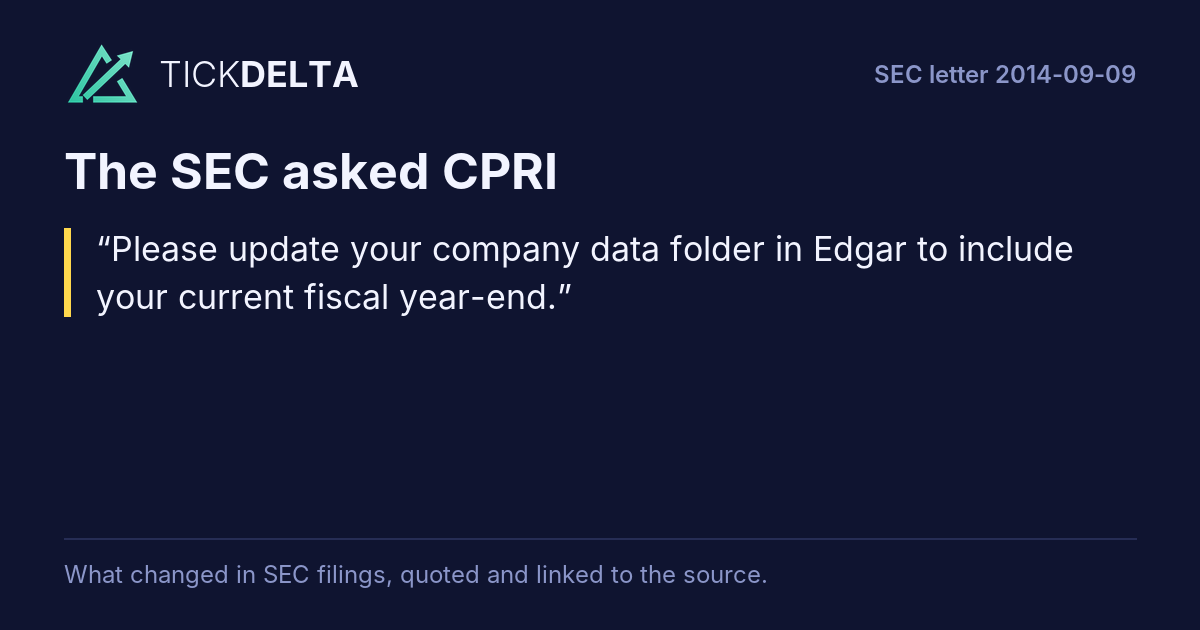
Please update your company data folder in Edgar to include your current fiscal year-end.
CPRI answered

No reply letter found.

General
SEC asked (2)
We note your October 3, 2013 response to our comment letter dated September 25, 2013 in which you confirmed that the company would provide the disclosure required by Item 201(d) of Regulation S-K in future filings. It appears that you have not provided the disclosure required by Item 201(d) of Regulation S-K. Please confirm that you will provide such disclosure in future filings.
Rest of the question

Please provide draft disclosure in your response.

CPRI answered

No reply letter found.

Business, page 4
SEC asked (3)
Please confirm that in future filings you will disclose for each of the last three fiscal years the amount or percentage of total revenue contributed by any class of similar products (e.g., accessories, footwear or apparel) which accounted for 10% or more of consolidated revenue in any of the last three fiscal years. Please provide draft disclosure in your response.
Rest of the question

Alternatively, advise us why you believe such information is not material to an understanding of your business as a whole. Refer to Item 101(c)(1)(i) of Regulation S-K.

CPRI answered

No reply letter found.

Business, page 4
SEC asked (4)
We note your disclosure that your largest wholesale customer, a large and nationally recognized U.S. department store, accounted for 14.4% of your total revenue for the 2014 fiscal year and 14.0% of your total revenue for the 2013 fiscal year. Please confirm that in future filings you will disclose the name of this wholesale customer pursuant to Item 101(c)(1)(vii) of Regulation S-K.
Rest of the question

Please provide draft disclosure in your response. Alternatively, please advise us why the loss of this wholesale customer would not have a material adverse effect on the registrant and its subsidiaries.

CPRI answered

No reply letter found.

Note 3. Summary of Significant Accounting Policies, page 56 · Inventories, page 57
SEC asked (5)
We note you changed the method you utilize to value your inventory from the firstin firstout method to the weighted average cost method. Please provide the disclosures required by FASB ASC 250-10-50 and a preferability letter from your auditor as required by Item 601 (B)(18) of Regulation S-K.
CPRI answered

No reply letter found.

In its next report

First report after the SEC's letter of Sep 9, 2014: 10-Q filed Nov 6, 2014 ↗, against the 10-Q filed Aug 7, 2014 ↗.

Tickdelta does not hold the text of both reports, so they are not compared here.

Also in this review: closing letter, 2014-09-26

Form 10-K for the Fiscal Year Ended March 30, 2013

2013-09-25 to 2014-09-17 · 8 questions · 3 letters from the SEC, 4 from the company
Review closed 2013-12-17
Results discussion (MD&A)
Market for Registrant’s Common Equity, Related Stockholder Matters and Issuer Purchases of · Equity Securities, page 19
SEC asked (1)
Please confirm in future filings that you will provide the disclosure required by Item 201(d) of Regulation S-K or advise.
CPRI answered
The Company acknowledges the Staff’s request for additional disclosure in its definition of gross profit and will revise the disclosure in future fillings as set forth below (revisions underlined):

Gross profit is total revenue (net sales plus licensing revenue) less cost of goods sold. As a result of retail store operating and occupancy costs being excluded from our cost of goods, our gross profit may not be comparable to that of other entities that have chosen to include some or all of those expenses as a component of their gross profit.

With respect to the Staff’s comment concerning the
Rest of the answer

disclosure of depreciation and amortization, please see the Company’s response to Comment 2 below.

Read in the reply
In its next report

First report after the company's reply of Oct 22, 2013: 10-Q filed Nov 7, 2013 ↗, against the 10-Q filed Aug 8, 2013 ↗.

Tickdelta does not hold the text of both reports, so they are not compared here.

Management’s Discussion and Analysis, page 22 · Certain Relationships and Related Person Transactions, page 26
SEC asked (2)
The disclosure on page 27 addressing your Far East Licensing Agreements indicates that you “waived the royalty on all net sales of licensed products” for the periods prior to April 1, 2013. Please advise us of the dollar amount of royalties waived.
Rest of the question

In addition, confirm that you will provide the disclosure requested by Item 404(a)(4) of Regulation S- K regarding the dollar value of each related party’s interest in the Far East Licensing Agreements in future filings, and provide us with draft disclosure based on the yearended March 30, 2013.

CPRI answered
In response to the Staff’s request that the Company explain how its presentation of cost of goods sold complies with the guidance set forth in SAB Topic 11.B, the Company respectfully advises the Staff that, since the Company’s products are sourced from third party manufacturers, the only costs that are directly or indirectly related to bringing the Company’s products to their existing location and condition are those described in the revised definition of Cost of goods sold.
Rest of the answer

Consistent with those filers who are not manufacturers, the Company did not include depreciation and amortization in cost of goods sold because they were not directly or indirectly related to bringing the products to their existing location and condition and therefore the Company does not believe that SAB Topic 11.B is applicable in this context.

Read in the reply
In its next report

First report after the company's reply of Oct 22, 2013: 10-Q filed Nov 7, 2013 ↗, against the 10-Q filed Aug 8, 2013 ↗.

Tickdelta does not hold the text of both reports, so they are not compared here.

General Definitions for operating results, page 28
SEC asked (3)
We note that you record your warehousing and distribution costs, rent for your distribution centers, store payroll, and store occupancy costs in sales, general and administrative expenses as opposed to cost of goods sold.
Rest of the question

Please disclose that your gross profit may not be comparable to those of other entities, since some entities may include all or some component of these costs in cost of goods sold and others like you exclude them from gross profit.

CPRI answered
For the fiscal year ended March 30, 2013, Sportswear Holdings Limited, Michael Kors and John D. Idol owned 63.4%, 14.3% and 8.1%, respectively, of the ordinary shares of Michael Kors Far East Holdings Limited. Based solely on the related party’s ownership interest in Far East Holdings and the royalties waived under the Far East Licensing Agreements in the amount of $343,813 in fiscal 2013, the dollar value of Sportswear Holdings Limited’s, Mr. Kors’ and Mr. Idol’s interest in the Far East License Agreements was $217,977, $49,165 and $27,849, respectively.
Rest of the answer

In response to the Staff’s comment, the Company will include the following disclosure in future filings (revisions underlined):

For the fiscal year ended March 30, 2013, Sportswear Holdings Limited, Michael Kors and John D. Idol owned 63.4%, 14.3% and 8.1%, respectively, of the ordinary shares of Michael Kors Far East Holdings Limited (“Far East Holdings”). We have entered into agreements (the “Far East Licensing Agreements”) with certain subsidiaries of Far East Holdings (the “Licensees”) pursuant to which the Licensees have certain exclusive rights within China, Hong Kong, Macau and Taiwan, and rights of first refusal to expand to other territories across Asia, to import, sell, advertise and promote apparel, footwear and accessories, excluding eyewear, watches and fragrance and personal care products, and to own and operate free-standing retail stores bearing our “Michael Kors,” “MICHAEL Michael Kors” and “KORS Michael Kors” trademarks. The Far East Licensing Agreements expire on March 31, 2041, and we may terminate them at certain intervals if certain minimum sale benchmarks are not met. Pursuant to the Far East Licensing Agreements, we waived the royalty on all net sales of licensed products by the Licensees prior to April 1, 2013. The royalty waived on net sales of licensed products for fiscal 2013 was $343,813. Based solely on Sportswear Holding Limited’s ownership interest in Far East Holdings and the royalties due under the Far East Licensing Agreements, the dollar value of its interest as of the end of fiscal 2013 in the Far East License Agreements was $217,977.

The Company has omitted from this disclosure the dollar value of each of Messrs. Kors’ and Idol’s interest in the Far East Licensing Agreements for fiscal 2013 since such dollar value was less than $120,000 for each of them. The Company will disclose the dollar value of each of Michael Kors’ and John Idol’s interest in the Far East Licensing Agreements in future filings where such disclosure is required.

Read in the reply
In its next report

First report after the company's reply of Oct 22, 2013: 10-Q filed Nov 7, 2013 ↗, against the 10-Q filed Aug 8, 2013 ↗.

Tickdelta does not hold the text of both reports, so they are not compared here.

Property and Equipment, page 51
SEC asked (4)
You disclose on page 21 of MD&A the number of retail stores operating at March 31, 2013 was 304, an increase of 67 stores from 237 stores operated at March 31, 2012. We further note in the Q1 2014 earnings conference call you state you are on track to open a significant number of new stores in fiscal 2014 including another 50 stores in North America and another 7 stores in Japan.
Rest of the question

In consideration of these activities please provide us with your policy for the accounting of start-up or store pre-opening costs with details sufficient to understand the types of costs that you consider to be start-up costs under FASB ASC Section 720-15. Please confirm you will include disclosure of this policy in future filings.

CPRI answered

No numbered answer found in the reply. Read the reply ↗

In its next report

First report after the company's reply of Oct 22, 2013: 10-Q filed Nov 7, 2013 ↗, against the 10-Q filed Aug 8, 2013 ↗.

Tickdelta does not hold the text of both reports, so they are not compared here.

Management’s Discussion and Analysis of Financial Condition and Results of Operations, page · General Definitions for operating results, page 27
SEC asked (1)
We note your response to prior comment 3 from our letter dated September 25, 2013 and see that you have provided proposed disclosure indicating that certain costs are not included in costs of goods sold and that your costs of goods sold may not be comparable to that of other entities. However, your proposed disclosure does not state that your gross profit may not be comparable to those of other entities.
Rest of the question

Please revise your proposed disclosure accordingly. In addition, your revised disclose should also indicate that depreciation and amortization are not included in cost of goods sold or gross profit.

CPRI answered
The Company acknowledges the Staff’s request for additional disclosure regarding clarification over the exclusion of depreciation and amortization expense from cost of goods sold. Accordingly, the Company is revising its accounting policy disclosures, in both MD&A and the financial statement footnotes, and will include the revised policy in future fillings as set forth below (revisions underlined):

MD&A- Critical Accounting Policies:

Long-lived Assets

All long-lived assets are recorded at cost less accumulated amortization or depreciation.
Rest of the answer

For the purposes of impairment testing we group our long-lived assets according to their lowest level of use, such as aggregating and capitalizing all construction costs related to a retail store into leasehold improvements and those related to our wholesale business into shop-in-shops. Our leasehold improvements are typically amortized over the life of the store lease, and our shop-in-shops are amortized over a three year period. All amortization and depreciation expense is included as a component of total operating expenses as the underlying long-lived assets are not directly or indirectly related to bringing our products to their existing location and condition.

Notes- Summary of Significant Accounting Policies:

Property and Equipment

Property and equipment is stated at cost less accumulated depreciation and amortization (carrying value). Depreciation is provided on a straight-line basis over the expected remaining useful lives of the related assets. Equipment, furniture and fixtures, and computer hardware and software are depreciated over five years. Leasehold improvements are amortized using the straight-line method over the shorter of the estimated remaining useful lives of the related assets or remaining lease term. The Company includes all amortization and depreciation expense as a component of total operating expenses, as the underlying long-lived assets are not directly or indirectly related to bringing the Company’s products to their existing location and condition.

* * * *

In addition, the Company intends to revise its related party disclosure as set forth in its Schedule 14A filed with the SEC on June 18, 2013 under the heading “Certain Relationships and Related Party Transactions” relating to the Far East Licensing Agreements in response to additional correspondence between the Company and the Staff. A draft of such disclosure is set forth below (revisions underlined):

Michael Kors Far East Holdings Limited

For the fiscal year ended March 30, 2013, Sportswear Holdings Limited, Michael Kors and John D. Idol owned 63.4%, 14.3% and 8.1%, respectively, of the ordinary shares of Michael Kors Far East Holdings Limited (“Far East Holdings”). We have entered into agreements (the “Far East Licensing Agreements”) with certain subsidiaries of Far East Holdings (the “Licensees”) pursuant to which the Licensees have certain exclusive rights within China, Hong Kong, Macau and Taiwan, and rights of first refusal to expand to other territories across Asia, to import, sell, advertise and promote apparel, footwear and accessories, excluding eyewear, watches and fragrance and personal care products, and to own and operate free-standing retail stores bearing our “Michael Kors,” “MICHAEL Michael Kors” and “KORS Michael Kors” trademarks. The Far East Licensing Agreements expire on March 31, 2041, and we may terminate them at certain intervals if certain minimum sale benchmarks are not met. Pursuant to the Far East Licensing Agreements, we waived the royalty on all net sales of licensed products by the Licensees prior to April 1, 2013. Under the Far East Licensing Agreements, net sales of licensed products for fiscal 2013 totaled approximately $8.2 million. In fiscal 2013, the royalty waived on net sales of licensed products was $343,813.

Read in the reply
In its next report

First report after the company's reply of Nov 25, 2013: 10-Q filed Feb 6, 2014 ↗, against the 10-Q filed Aug 8, 2013 ↗.

Tickdelta does not hold the text of both reports, so they are not compared here.

Consolidated Statements of Operations and Comprehensive Income, page 46
SEC asked (2)
We note cost of sales in your statement of operations exclude charges for depreciation and amortization. Please tell us how your presentation of cost of goods sold complies with the guidance in SAB Topic 11.B or provide revised disclosure to be included in future filings.
CPRI answered

No numbered answer found in the reply. Read the reply ↗

In its next report

First report after the company's reply of Nov 25, 2013: 10-Q filed Feb 6, 2014 ↗, against the 10-Q filed Aug 8, 2013 ↗.

Tickdelta does not hold the text of both reports, so they are not compared here.

Schedule 14A filed June 18, 2013 · Certain Relationships and Related Person Transactions, page 26
SEC asked (3)
We note your response to comment 2 of our letter dated September 25, 2013 and the draft language disclosing each related party’s ownership interest in Michael Kors Far East Holdings Limited. Please also provide the disclosure required by Item 404(a)(4) of Regulation S-K regarding the dollar value of each related party’s interest in the Far East Licensing Agreements, as previously requested.
Rest of the question

Please provide us with draft disclosure for inclusion in future filings.

CPRI answered

No numbered answer found in the reply. Read the reply ↗

In its next report

First report after the company's reply of Nov 25, 2013: 10-Q filed Feb 6, 2014 ↗, against the 10-Q filed Aug 8, 2013 ↗.

Tickdelta does not hold the text of both reports, so they are not compared here.

Form 10-K for the Fiscal Year Ended March 31, 2013 · Statement of Operations, page 46
SEC asked
We note your response to comment 2 in our letter dated October 11, 2013 and understand that you do not include depreciation and amortization in cost of goods sold because these costs are not directly or indirectly related to bringing your products to their existing location and condition.
Rest of the question

Please confirm that you will expand your financial statement footnote disclosure in future filings to clarify why depreciation and amortization is not included in your cost of goods sold. Please provide a draft of your proposed disclosure in your response.

CPRI answered
The Company has updated its company data folder in Edgar to include its current fiscal year-end.
Read in the reply
In its next report

First report after the company's reply of Sep 17, 2014: 10-Q filed Nov 6, 2014 ↗, against the 10-Q filed Aug 8, 2013 ↗.

Tickdelta does not hold the text of both reports, so they are not compared here.

Also in this review: company letter, Oct 3, 2013, closing letter, 2013-12-17

Form F-1

2011-12-09 to 2011-12-09 · 3 questions · 1 letter from the SEC, 1 from the company
No closing letter
Form F-1, filed December 2, 2011 · General
SEC asked (1)
We remind you that the outstanding comments regarding your application for confidential treatment must be cleared prior to your request for effectiveness.
CPRI answered
The Company understands that the outstanding comments regarding its application for confidential treatment must be cleared prior to its request for effectiveness.
Read in the reply
Summary Historical Consolidated Financial and Other Data, page 8
SEC asked (2)
Please label “weighted average ordinary shares outstanding” and the “net income per ordinary share” with footnote (4) as it appears that these values give effect to the Share Split and the conversion of all outstanding preference shares into ordinary shares immediately prior to the completion of this offering. Consolidated Financial Statements Notes to Consolidated Financial Statements 1.
Rest of the question

Business and Basis of Presentation, page F-7

CPRI answered
The Registration Statement has been revised in response to the Staff’s comment. Please see pages 9 and 31 of the Changed Pages.

Consolidated Financial Statements

Notes to Consolidated Financial

Statements

1. Business and Basis of Presentation, page F-7
Read in the reply
Summary Historical Consolidated Financial and Other Data, page 8
SEC asked (3)
It appears that your disclosure here which states that the 3.8 to 1 share split occurred on November 30, 2011 is inconsistent with the disclosure presented on page 7 which states the share split occurred on December 1, 2011. Please clarify or revise.
CPRI answered
The Registration Statement has been revised in response to the Staff’s comment. Please see page 7 of the Changed Pages.
Read in the reply

Letters without questions

Other letters

UPLOAD and CORRESP
2 other letters: notices that a filing will not be reviewed, requests to declare a registration effective, and the like

From the SEC's correspondence on EDGAR: staff letters (form UPLOAD) and company letters (form CORRESP), 23 letters filed since 2011-12-09. Questions and answers are matched by their numbers; topics come from words in each question. The reports are compared word for word (same form, before the first SEC letter against the first report after the company's reply). No AI.

Sources

The SEC's correspondence on EDGAR: staff letters (form UPLOAD) and company letters (form CORRESP), matched question by question. No AI.

Also

Filings: the letters in the filing list.

Work with it

Excel workbook · CSV. Google Sheet that stays up to date: paste =IMPORTDATA("https://tickdelta.com/company/CPRI/export.csv") into a cell.

Next in Owners and insiders:Insider trades
Esc

Type a ticker such as AAPL, a name, an investor such as Buffett, or a topic such as tariffs. ↑ ↓ to move, Enter to open.