Screener / SEC EDGAR /CIK 0001609253 /10-K filed Mar 2, 2026, compared with Mar 3, 2025 /Numbers from the XBRL of the 10-Ks
NYSE Energy · Oil & Gas Production

California Resources Corp CRC

Compare with peers Embed
SEC comment letters, last 20 years

3 reviews of CRC's filings by SEC staff

UPLOAD and CORRESP
Reviews 3 latest letter Mar 11, 2020
Questions asked 9 each answered in the company's own letter
No closing letter 1 reviews without a letter saying the staff completed it

When the SEC's staff reviews a filing, it writes to the company with numbered questions, and the company answers each one in a letter. SEC publishes the exchange once the review is over, at least 20 business days later. A question is not an accusation; most reviews end with the company adding detail to its next filing.

How the reviews went

Every review on EDGAR, from the first staff letter to the letter that closes it

  1. 1. Staff letters 4 UPLOAD
  2. 2. Questions in them 9 numbered comments
  3. 3. Company replies 4 CORRESP
  4. 4. Reviews closed 2 of 3 closing letter

Half the closed reviews took 90 days or less from the first letter to the closing letter.

Form S-3

2020-03-11 to 2020-03-27 · 4 questions · 2 letters from the SEC, 2 from the company
No closing letter
Risk factorsLegal and contingenciesDerivatives and hedging
Description of Capital Stock · Forum Selection, page 11
SEC asked (1)
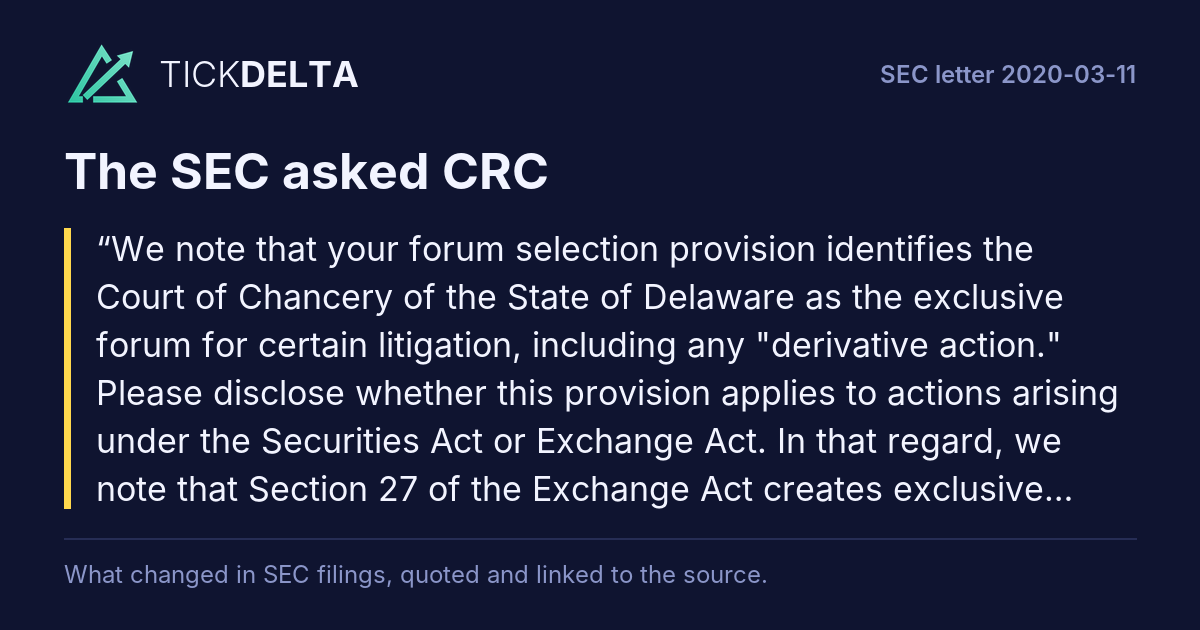
We note that your forum selection provision identifies the Court of Chancery of the State of Delaware as the exclusive forum for certain litigation, including any "derivative action." Please disclose whether this provision applies to actions arising under the Securities Act or Exchange Act.
Rest of the question

In that regard, we note that Section 27 of the Exchange Act creates exclusive federal jurisdiction over all suits brought to enforce any duty or liability created by the Exchange Act or the rules and regulations thereunder, and Section 22 of the Securities Act creates concurrent jurisdiction for federal and state courts over all suits brought to enforce any duty or liability created by the Securities Act or the rules and regulations thereunder. If the provision applies to Securities Act claims, please also revise your prospectus to add related risk factor disclosure, and to state that investors cannot waive compliance with the federal securities laws and the rules and regulations thereunder.

CRC answered
The Company acknowledges the Staff’s comment and has revised its disclosure on page 6 of Amendment No. 1 to include the following language under “Forum Selection”:

“This forum selection provision would not apply to claims brought to enforce a duty or liability created by the Securities Act, Exchange Act or any other claim for which the federal courts have exclusive jurisdiction.”
Read in the reply
General
SEC asked (2)
We note that you incorporate by reference your Form 10-K for the fiscal year ended December 31, 2019 and that such report incorporates by reference information from your definitive proxy statement, which has not yet been filed.
Rest of the question

Prior to requesting acceleration of the effectiveness of this registration statement, please either amend the Form 10-K to include information required by Part III of Form 10-K or file the definitive proxy statement. Please refer to Compliance and Disclosure Interpretations, Securities Act Forms Question 123.01 for guidance.

CRC answered
The Company acknowledges the Staff’s comment and hereby informs the Staff that the Company has filed its definitive proxy statement on March 24, 2020.
Read in the reply
Description of Capital Stock · Forum Selection, page 6
SEC asked (1)
We note that your forum selection provision identifies the Court of Chancery of the State of Delaware as the exclusive forum for certain litigation, including any "derivative action." Please disclose whether this provision applies to actions arising under the Securities Act or Exchange Act.
Rest of the question

In that regard, we note that Section 27 of the Exchange Act creates exclusive federal jurisdiction over all suits brought to enforce any duty or liability created by the Exchange Act or the rules and regulations thereunder, and Section 22 of the Securities Act creates concurrent jurisdiction for federal and state courts over all suits brought to enforce any duty or liability created by the Securities Act or the rules and regulations thereunder. If the provision applies to Securities Act claims, please also revise your prospectus to add related risk factor disclosure, and to state that investors cannot waive compliance with the federal securities laws and the rules and regulations thereunder.

CRC answered
The Company acknowledges the Staff’s comment and has revised its disclosure on page 6 of Amendment No. 2 to include the following language under “Forum Selection”:

“This forum selection provision would not apply to claims brought to enforce a duty or liability created by the Securities Act, Exchange Act or any other claim for which the federal courts have exclusive jurisdiction.”
Read in the reply
General
SEC asked (2)
We note that you incorporate by reference your Form 10-K for the fiscal year ended December 31, 2019 and that such report incorporates by reference information from your definitive proxy statement, which has not yet been filed.
Rest of the question

Prior to requesting acceleration of the effectiveness of this registration statement, please either amend the Form 10-K to include information required by Part III of Form 10-K or file the definitive proxy statement. Please refer to Compliance and Disclosure Interpretations, Securities Act Forms Question 123.01 for guidance.

CRC answered
The Company acknowledges the Staff’s comment and hereby informs the Staff that the Company has filed its definitive proxy statement on March 24, 2020.
Read in the reply

Form 10-K

2018-11-09 to 2019-02-07 · 3 questions · 1 letter from the SEC, 1 from the company
Review closed 2019-02-07
Liquidity and cashReserves and insuranceAcquisitions
Our Reserves · Proved Undeveloped Reserves, page 32
SEC asked (1)
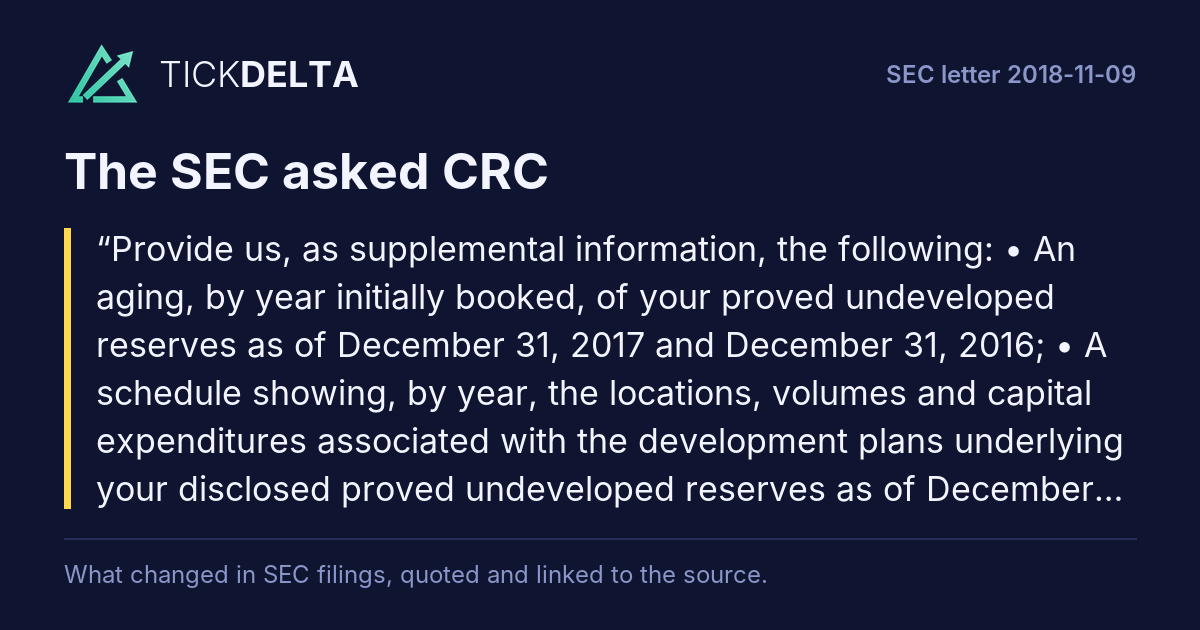
Provide us, as supplemental information, the following: • An aging, by year initially booked, of your proved undeveloped reserves as of December 31, 2017 and December 31, 2016; • A schedule showing, by year, the locations, volumes and capital expenditures associated with the development plans underlying your disclosed proved undeveloped reserves as of December 31, 2017 and December 31, 2016; and, • A schedule which
Rest of the question

reconciles, as of December 31, 2017 and December 31, 2016, total planned capital expenditures associated with converting your proved undeveloped reserves to total future development costs per the standardized measure of discounted future net cash flows appearing on page 119 of your filing.

CRC answered
We provided the requested information above in the Supplemental Letter sent directly to the Staff of the Commission.
Read in the reply
In its next report

First report after the company's reply of Nov 27, 2018: 10-K filed Feb 27, 2019 ↗, against the 10-K filed Feb 27, 2018 ↗.

Tickdelta does not hold the text of both reports, so they are not compared here.

Note 6 - Joint Ventures · Non-controlling Interests, page 12
SEC asked (2)
Tell us and disclose in more detail how you determined that the Class A common interests and Class B preferred interests held by ECR Corporate Holdings L.P. should be classified as redeemable non-controlling interest in mezzanine equity on your balance sheet. In addition, include the redemption amount on the balance sheet, as outlined in the disclosure requirements in Rule 5-02(27) of Regulation S-X.
Rest of the question

As part of your response, please cite relevant authoritative accounting guidance which supports the basis for your conclusions and the measurement of the carrying value of the non-controlling interests.

CRC answered
California Resources Elk Hills, LLC (CREH), a subsidiary of CRC, and ECR Corporate Holdings L.P. (ECR), an independent third party to CRC, entered into a midstream joint venture known as Elk Hills Power, LLC (the JV) on February 7, 2018 (Effective Date). CREH holds 50,000 Class A common units and 95,250 Class C common units.
Rest of the answer

ECR holds 50,000 Class A common units, all of the 750,000 Class B preferred units and 4,750 Class C common units.

The JV is party to a Commercial Agreement with CREH in which the JV provides electricity generation and gas processing services, the payments for which include fixed and variable components. The variable components are based on market factors (including, for example, greenhouse gas allowance index prices and gas prices) as well as volumes. The JV generates additional revenue from sources other than the Commercial Agreement, including a power purchase agreement with a regulated utility, as well as a contract with California ISO for electricity sold to the wholesale market. CREH controls and consolidates the JV.

The Class B preferred units held by ECR earn a preferred return on $750 million of invested capital. Cash flows generated by the JV are first distributed to the Class B holder to the extent available for the preferred return, and the remaining cash flows are distributed pro rata to the Class C holders. CRC, through CREH, has the option to cause the JV to repurchase all of ECR’s Class A common and Class B preferred units at any time prior to August 7, 2025 (the 7 ½-year anniversary date). If CREH elects this option, the Class B preferred units would be repurchased for the $750 million of invested capital, plus any previously accrued but unpaid preferred distributions and a make-whole amount. The Class A common units carry a premium that is determined based on when a redemption occurs, if at all.

ECR, as the Class B holder, has the right to cause an exit transaction (as described below) upon the occurrence of the following events:

a)

CRC does not cause the JV to repurchase ECR’s Class A common and Class B preferred units in full by the end of the 7 ½ -year period, b)

CREH defaults on payments owed to the JV under the Commercial Agreement, with rights to cure, along with a failure to make a preferred distribution within 60 days of when otherwise due, c)

CRC defaults on its bank debt which causes such debt to be declared due and payable, d)

CRC or any of its subsidiaries file for bankruptcy, e)

CREH procures power or gas processing services within a certain geographic area from a party other than the JV during the term of the Commercial Agreement, or f)

Certain other breaches of performance obligations of CRC or CREH under the JV agreements.

The exit transaction may include a sale, lease or other disposition of all or substantially all of the JV assets, or a market transaction such as an initial public offering, consolidation, merger or sale of all or any portion of the units. This exit transaction is designed to allow ECR holders to monetize their investment through the sale of the underlying assets of the JV or through a direct sale of their Class A and B units.

The Class B preferred units held by ECR can also cause a redemption transaction upon the occurrence of certain contingent events as follows:

A CRC change in control event as defined in CRC’s 2014 Revolving Credit Facility. If such event were to occur, then the outstanding Class B holder could elect to cause the JV to redeem its Class B preferred units at the liquidation preference of $750 million x 101%, or

A CREH change in control event which is defined as either a sale of at least 40% of the subsidiary assets to any person other than CRC and its affiliates or a transaction that causes either a more than 50% change in its ownership or the ability to designate a majority of CREHs’ Board of Directors. In such case, the Class B holder could elect to cause the JV to redeem its preferred units at the liquidation preference plus a make-whole amount.

Accordingly, the Class A common and B preferred units held by ECR are not mandatorily redeemable at a date certain or upon an event that is certain to occur. Given that the Class A and B units are not mandatorily redeemable, they do not meet the definition of a liability under ASC 480-10. Therefore, we considered whether the Class A and B units should be reported as a component of permanent equity.

Pursuant to the guidance under ASC 480-10-S99-3A, we reported the Class A and Class B units within temporary equity (at a mezzanine level). Paragraph 2 of ASC 480-10-S99-3A provides that a non-controlling interest should be classified outside of permanent equity (our analysis reflected in italics) when it is redeemable:

at a fixed or determinable price on a fixed or determinable date

Analysis – While the Class A and B units are not redeemable at a fixed or determinable date, they would be redeemable at a fixed and determinable price on the date the redemption provision is exercised.

at the option of the holder, or

Analysis – The Class B Holder can, at its option, force an effective redemption through an exit transaction that could include the sale of all or substantially all of the JV assets. Following an exit transaction, no Class A or B units would remain outstanding.

upon the occurrence of an event that is not solely within the control of the issuer.

Analysis – The occurrence of a CRC change in control event is outside the control of CRC, and a CREH change in control event is outside the control of the JV.

Since the Class B units, and with it the Class A units, are both effectively redeemable through liquidation at the option of the holder (exit transaction) and redeemable upon the occurrence of an event that is not solely within the control of CRC or any of its related parties, the Class A and B units are classified as temporary equity and reported at a mezzanine level between liabilities and permanent equity.

Regarding the redemption amount on the balance sheet, Rule 5-02(27) of Regulation S-X states in part that if there is more than one issue, then the details may be aggregated on the face of the balance sheet and details concerning each issue, the carrying amount and redemption amount may be presented in a separate note. In Note 6 Joint Ventures on page 12 of Form 10-Q, we have included a non-controlling interest table as well as a narrative describing each issue as well as the optional redemption provisions and rights held by the Class B holder described above.

ASC 805-20-30 states that for non-controlling interests, the initial amount presented in mezzanine equity should be the initial carrying amount, which is acquisition date fair value. We valued each of the units at issuance date based on the fair value method. The acquisition date fair value of ECR’s units were as follows (in millions):

Units

Fair Value

Class A Common

$27

Class B Preferred

$687

Class C Common

$36

Total

$750

The subsequent measurement of a non-controlling interest first considers the non-controlling interest accounting in ASC 810-10 (i.e., the initial carrying amount, increased or decreased for the non-controlling interest's share of other comprehensive income or loss less distributions) and then the redeemable equity guidance in ASC 480-10-S99-3A.

An entity only applies the redeemable equity guidance in ASC 480-10-S99-3A paragraph 14 if the non-controlling interest is either (1) currently redeemable or (2) probable of becoming redeemable (for example, when the redemption depends solely on the passage of time). At this time, ECR’s Class B preferred units, and with it ECR’s Class A common units, are neither. We do not currently have the intent to exercise our option to cause a repurchase of ECR’s Class A and Class B units by the JV. Further, an exit transaction is not available at this time and is contingent upon events or actions which have not occurred.

When a redemption becomes probable, we will recognize changes in the value of the non-controlling interest and adjust the carrying amount to equal the greater of (i) the redemption value at the end of each reporting period (assuming the end of the reporting period to be the redemption date) or (ii) the cumulative amount that would result from applying the measurement guidance in ASC 810.

Read in the reply
In its next report

First report after the company's reply of Nov 27, 2018: 10-K filed Feb 27, 2019 ↗, against the 10-K filed Feb 27, 2018 ↗.

Tickdelta does not hold the text of both reports, so they are not compared here.

Note 7 - Acquisitions and Divestitures · Acquisitions, page 13
SEC asked (3)
With respect to the Elk Hills transaction, please provide disclosures, as applicable, in accordance with FASB ASC 805-10-50-2(h).
CRC answered
We acknowledge the Staff’s comment and respectfully advise the Staff that we ran the significant subsidiary tests under Regulation S-X 1-02(w). The results of all of these tests were comfortably below the required thresholds, and we determined that the Elk Hills transaction was not significant. Additionally, in accordance with FASB ASC 805-10-50-2(h), we compared key financial statement line items (including revenue, production costs and general and administrative expenses) and non-financial statement items (including production volumes) from the Elk Hills transaction to our consolidated
Rest of the answer

results since the acquisition date and for the comparative periods presented in the financial statements. In each case, the transaction constituted less than 10% of our consolidated results for all periods presented. Therefore, we concluded that the Elk Hills transaction was not material to our condensed consolidated financial statements taken as a whole. We did not believe that the omission of these disclosures were qualitatively or quantitatively misleading to a financial statement reader and, therefore, did not include the disclosures in our Form 10-Q.

Read in the reply
In its next report

First report after the company's reply of Nov 27, 2018: 10-K filed Feb 27, 2019 ↗, against the 10-K filed Feb 27, 2018 ↗.

Tickdelta does not hold the text of both reports, so they are not compared here.

Also in this review: closing letter, 2019-02-07

Form 10-K

2017-12-12 to 2018-01-04 · 2 questions · 1 letter from the SEC, 1 from the company
Review closed 2018-01-04
Reserves and insuranceResults discussion (MD&A)Acquisitions
Properties, page 27 · Proved Undeveloped Reserves, page 35
SEC asked (1)
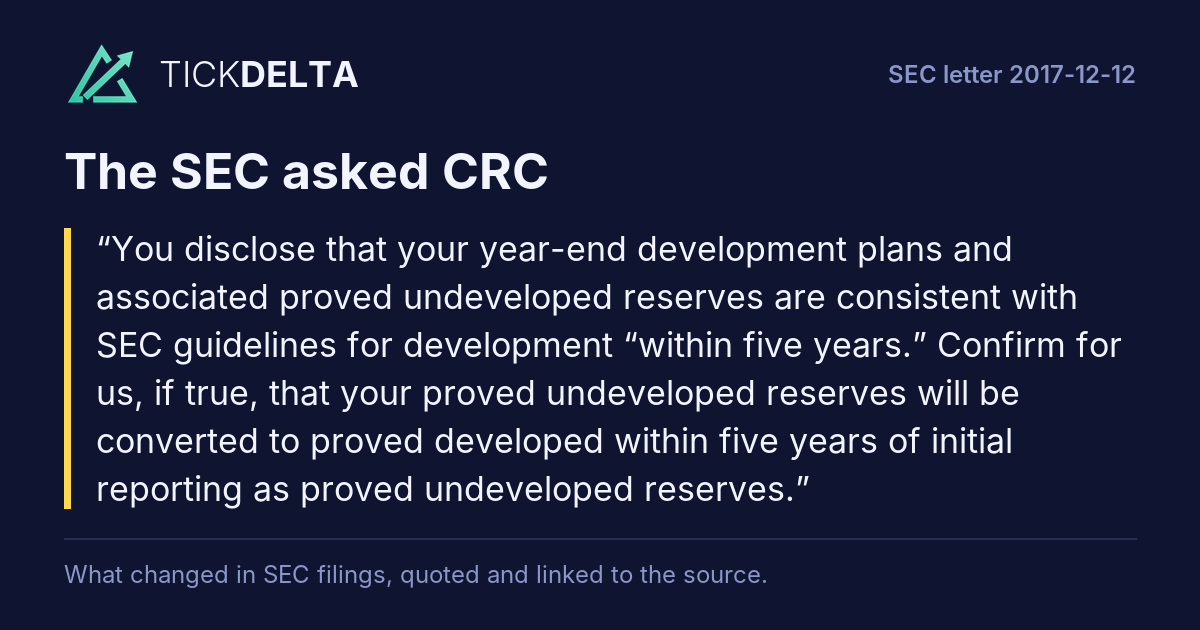
You disclose that your year-end development plans and associated proved undeveloped reserves are consistent with SEC guidelines for development “within five years.” Confirm for us, if true, that your proved undeveloped reserves will be converted to proved developed within five years of initial reporting as proved undeveloped reserves.
CRC answered
We acknowledge the Staff’s comment and confirm to the Staff that at the time of our 10-K filing on February 24, 2017, our development plan contemplated that all of our proved undeveloped reserves will be converted to proved developed within five years of initial reporting as proved undeveloped reserves.
Read in the reply
In its next report

First report after the company's reply of Dec 20, 2017: 10-K filed Feb 27, 2018 ↗, against the 10-K filed Feb 24, 2017 ↗.

Tickdelta does not hold the text of both reports, so they are not compared here.

Supplemental Oil and Gas Information (Unaudited), page 116 · Proved Developed and Undeveloped Reserves
SEC asked (2)
Expand the disclosure relating to the changes in net proved reserves for each of the periods presented to provide an appropriate narrative explanation for the significant changes relating to each line item entry within your reconciliation, such as revisions of previous estimates, improved recovery, extensions and discoveries, acquisitions and divestitures.
Rest of the question

Your explanation should address the change for the line item by separately identifying and quantifying each factor that contributed to a significant change so that the change in net reserves between periods is fully explained. To the extent that two or more factors contribute to a significant change, indicate the net amount attributable to each factor accompanied by a narrative explanation. Your disclosure of revisions in the previous estimates of reserves in particular should identify such factors as changes caused by commodity prices, well performance, unsuccessful and/or uneconomic proved undeveloped locations or the removal of proved undeveloped locations due to changes in a previously adopted development plan. Refer to FASB ASC 932-235-50-5.

CRC answered
We acknowledge the Staff's comment and respectfully advise the Staff that the following narrative explanation for the significant changes relating to each line item within our reconciliation to the changes in net proved reserves was included in Item 2 Properties – Our Reserves and Production Information on pages 33 to 34 in our Form 10-K.

“Improved Recovery

In 2016, we added proved reserves of 3 MMBoe from improved recovery through proven IOR and EOR methods.
Rest of the answer

The improved recovery additions in 2016 were associated with the continued development of steamflood and waterflood properties in the San Joaquin basin. The types of conventional IOR and EOR development methods we use can be applied through existing wells, though additional drilling is frequently required to fully optimize the development configuration.

Extensions and Discoveries

In 2016, we added 20 MMBoe of proved reserves from extensions and discoveries, which generally result from exploration, exploitation and development programs. The extensions and discovery additions were associated with the continued successful but limited drilling primarily in the San Joaquin, Los Angeles, and Ventura basins.

Revisions of Previous Estimates

Revisions related to performance - Performance related revisions can include upward or downward changes to previous proved reserves estimates due to the evaluation or interpretation of geologic, production decline or operating performance data. In 2016, our positive performance related revisions of 13 MMBoe resulted primarily from better than expected reservoir performance and comprehensive field development planning. These positive revisions primarily came from the San Joaquin and Ventura basins.

Revisions related to price changes - Product price changes affect proved reserves we record. For example, higher prices generally increase the economically recoverable reserves in all of our operations, because the extra margin extends their expected lives and renders more projects economic. Partially offsetting this effect, higher prices decrease our share of proved cost recovery reserves under arrangements similar to production-sharing contracts at our Long Beach operations because less oil is required to recover costs. Conversely, when prices drop, we experience the opposite effects. Total net negative price revisions in 2016 were 60 MMBoe. The price revisions incorporated the positive effect of lower operating costs also caused by the lower commodity price environment.

During the course of 2016 we experienced further price declines compared to 2015, resulting in the average SEC price for Brent oil decreasing from $55.57 per barrel for 2015 to $42.90 for 2016. As a result, we experienced negative price related revisions to our proved reserves at December 31, 2016 of 60 MMBoe. Generally, lower prices adversely impact the quantity of our reserves as those reserves may no longer meet the economic producibility criteria under the rules or may be removed due to a lower amount of capital available to develop these projects within the SEC-mandated five-year limit. However, our production-sharing contracts in Long Beach tend to partially offset these effects because our share of production and reserves from these contracts increases as prices decline. Further, during the course of the year we implemented significant cost reduction and efficiency steps, which reduced our production costs by approximately 16% and drilling costs by approximately 23%. These cost reductions, as well as other efficiency efforts, offset a portion of the price-related loss of reserves quantities as some of the barrels that would have become uneconomic in later years remain economic, a portion of the proved undeveloped reserves that would otherwise be removed from the reserves quantities become economic and we expect to drill more wells with the same amount of capital.”

We believe that a reader of our financial statements would benefit from an explanation for these changes in the front section of our Form 10-K where we also present the proved reserves additions table. However, we acknowledge that FASB ASC 932-235-50-5 requires us to also present this narrative in the Supplemental Oil and Gas Information section of the Form 10-K. Therefore, in future filings, we will provide cross references in the Supplemental Oil and Gas Information section to our narrative discussion in Item 2 Properties – Our Reserves and Production Information.

Read in the reply
In its next report

First report after the company's reply of Dec 20, 2017: 10-K filed Feb 27, 2018 ↗, against the 10-K filed Feb 24, 2017 ↗.

Tickdelta does not hold the text of both reports, so they are not compared here.

Also in this review: closing letter, 2018-01-04

Letters without questions

Other letters

UPLOAD and CORRESP
2 other letters: notices that a filing will not be reviewed, requests to declare a registration effective, and the like

From the SEC's correspondence on EDGAR: staff letters (form UPLOAD) and company letters (form CORRESP), 12 letters filed since 2017-12-12. Questions and answers are matched by their numbers; topics come from words in each question. The reports are compared word for word (same form, before the first SEC letter against the first report after the company's reply). No AI.

Sources

The SEC's correspondence on EDGAR: staff letters (form UPLOAD) and company letters (form CORRESP), matched question by question. No AI.

Also

Filings: the letters in the filing list.

Work with it

Excel workbook · CSV. Google Sheet that stays up to date: paste =IMPORTDATA("https://tickdelta.com/company/CRC/export.csv") into a cell.

Next in Owners and insiders:Insider trades
Esc

Type a ticker such as AAPL, a name, an investor such as Buffett, or a topic such as tariffs. ↑ ↓ to move, Enter to open.