Paragraph 206 · 50% changed
Every version of it
Screener
/
SEC EDGAR
/CIK 0001807794
/10-K filed Jun 15, 2026, compared with Jul 2, 2025
/Numbers from the XBRL of the 10-Ks
Nasdaq
Technology · Semiconductors
Credo Technology Group Holding Ltd CRDO
The 10-K against last year's
146 changes: 30 added, 44 removed, 70 reworded, 2 quiet changes
10-K Jun 15, 2026 vs Jul 2, 2025
Risk Factors
19.0%
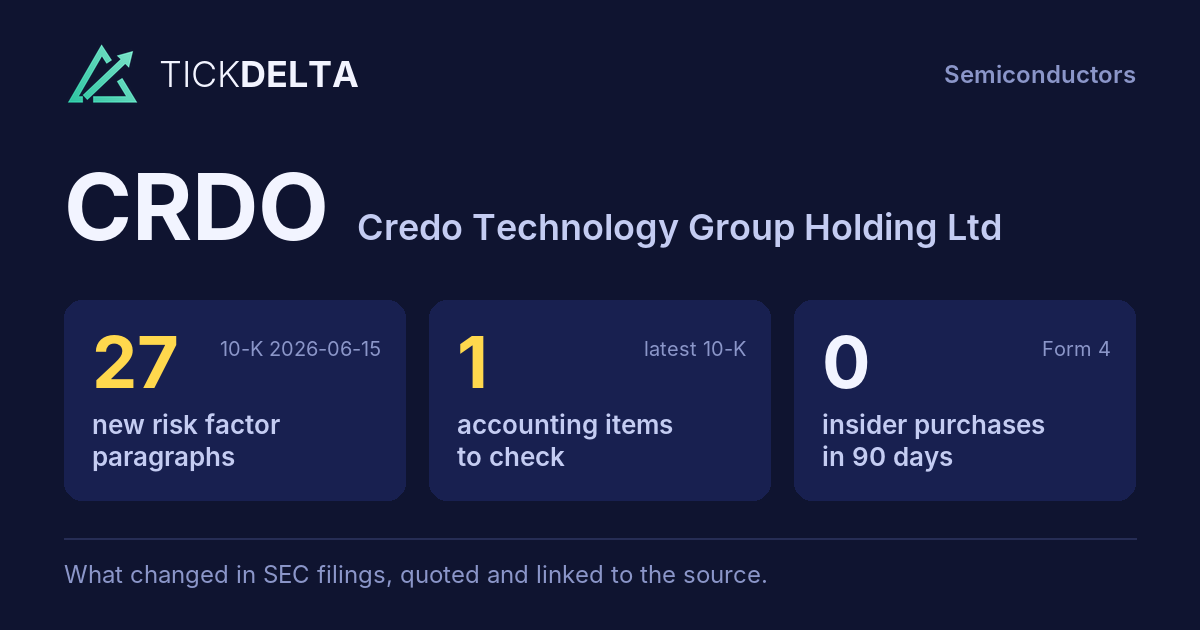
of the text changed · 25,933 words now · 27 new paragraphs, 29 gone
MD&A
29.4%
of the text changed · 3,862 words now · 3 new paragraphs, 15 gone
Legal Proceedings
23.8%
of the text changed · 681 words now
Accounting Policies
25.4%
of the text changed · 3,173 words now
10-K 0001628280-26-043303 (Jun 15, 2026) vs 10-K 0001628280-25-033813 (Jul 2, 2025)
Every paragraph, and how much of it changed
One bar per paragraph, in the order of the 10-K. Height and colour show the share of its words not in the closest paragraph a year earlier; the tallest bars are new paragraphs.
Risk Factors
307 paragraphs · 27 new · 82 reworded · 29 gone · 10-K Jun 15, 2026 against Jul 2, 2025
New paragraph
Reworded (5% of its words or more)
Same or nearly
Paragraph 22 · 50% changed
Every version of it
Paragraph 161 · 50% changed
Every version of it
In addition, there can be no assurance that the laws or administrative practices relating to taxation (including the current position as to income and withholding taxes), foreign exchange, export controls, economic sanctions or otherwise in the jurisdictions where we have operations will not change. Changes in tax laws in some jurisdictions may also have a retroactive effect and we may be found to have paid less tax than required in such regions. Compliance with diverse legal requirements is costly, time consuming and requires significant resources. Violations of one or more of these regulations in the conduct of our business could result in significant fines, criminal sanctions against us or our officers, prohibitions on doing business and damage to our reputation. Violations of these regulations in connection with the performance of our obligations to our customers also could result in liability for significant monetary damages, fines or criminal prosecution, unfavorable publicity and other reputational damage and allegations by our customers that we have not performed our contractual obligations. Due to the varying degrees of development of the legal systems of the countries in which we operate, local laws might be insufficient to protect our rights.
Paragraph 282 · 49% changed
Every version of it
We have pursued, and may not receive timely payments from our customers, in the future pursue, mergers, acquisitions, investments in other companies and dispositions, which could adversely affect our business, financial condition and results of operations.
Paragraph 167 · 49% changed
Every version of it
Paragraph 173 · 46% changed
Every version of it
The Outbound Investment Rule captures restricts investment by U.S. and U.S.-controlled persons in certain entities that are not based linked to China, including companies located in China or Chinese-owned if certain deriving more than 50% of various financial thresholds are met. metrics from covered activities in China. Certain of our subsidiaries that are organized and conduct substantial operations in China engage in certain covered activities under the Outbound Investment Rule. Given While, based on our most recent audited financial statements, we do not believe that the breadth of Company as a whole triggers the notification requirement as applicable within 50% test, the semiconductor industry, we Company will likely be subject to increased regulatory burden to engage in certain investments in China. Such a mechanism China, including capital investments in the Company’s own subsidiaries to the extent they relate to covered activities. This could negatively impact affect our ability to realize value from certain existing and future investments, including by limiting our investments and to raise capital expenditures from U.S. sources that might be directed to covered activities in our Chinese subsidiaries. Moreover, China. Additionally, it is anticipated that the Outbound Investment Rule ostensibly applies will be revised in 2027 and thereafter, and it is possible that future changes to “indirect” investments by U.S. persons in entities that are persons of the Outbound Investment Rule could have a country of concern, which currently inhibits negative impact on our ability to raise capital through equity financings with U.S. investors as China-linked business. Accordingly, the outbound investment reporting requirements and prohibitions could adversely affect our Chinese subsidiaries meet the applicable business, financial thresholds to be a covered foreign person. condition, and operating results.
Paragraph 231 · 45% changed
Every version of it
While we take steps to monitor the use of all open-source software in our products, processes and technology and try to ensure that no open-source software is used in such a way as to require us to disclose the source code to the related product, processes or technology when we do not wish to do so, such use could inadvertently occur. Additionally, if a third party software provider has incorporated certain types of open-source software into software we license from such third party for our products, processes or technology, we could, under certain circumstances, be required to disclose the source code to our products, processes or technology. This could harm our intellectual property position and have a material adverse effect on our business, results of operations and financial condition.
Paragraph 40 · 44% changed
Every version of it
Industry consolidation may lead to increased competition. Our competitors may also establish cooperative relationships among themselves or with third parties third-parties or may acquire companies that provide similar products to ours. As a result, new competitors or alliances may emerge that could capture significant market share. There has been a trend toward industry consolidation in our markets for several years. We expect this trend to continue as companies attempt to improve the leverage of growing research and development costs, strengthen or hold their market positions in an evolving industry or are unable to continue operations. Companies that are strategic alliance partners in some areas of our business may acquire or form alliances with our competitors, thereby reducing their business with us. Industry consolidation may result in stronger competitors that are better able to compete as sole-source vendors for customers.
Paragraph 206 · 50% changed
Every version of it
10-K Jul 2, 2025Our success depends in part upon our ability to obtain and maintain patent and other intellectual property protection with respect to our products and the technology we develop. To accomplish this, we rely on a combination of intellectual property rights, including patents, copyrights and trademarks in the United States and in selected foreign countries where we believe filing for such protection is appropriate. We also rely on trade secret laws, as well as confidentiality and non-disclosure and other contractual protections, to protect our proprietary know-how.
10-K Jun 15, 2026
We also rely on trade secret laws, as well as confidentiality and non-disclosure and other contractual protections, to protect our proprietary know-how.
Paragraph 22 · 50% changed
Every version of it
10-K Jul 2, 2025Our product sales are primarily generated on the basis of purchase orders with our customers rather than long-term purchase commitments. However, we place orders with our suppliers based on forecasts of customer demand and, in some instances, may establish buffer inventories to accommodate anticipated demand, which may not materialize. Due to our lengthy product development cycle, it is critical for us to anticipate changes in demand for our various product features and the applications they serve to allow sufficient time for product development and design. We have limited visibility into future customer demand and the product mix that our customers will require, which could adversely affect our revenue forecasts and operating margins. Moreover, because some of our target markets are relatively new, many of our customers have difficulty accurately forecasting their product requirements and estimating the timing of their new product introductions, which ultimately affects their demand for our products. Our failure to accurately forecast demand can lead to product shortages that can impede production by our customers and harm our customer relationships. Conversely, our failure to forecast declining demand or shifts in product mix can result in excess or obsolete inventory. In addition, the rapid pace of innovation in our industry could also render significant portions of our inventory obsolete. Excess or obsolete inventory levels could result in unexpected expenses or increases in our reserves that could adversely affect our business, financial condition and results of operations. In contrast, if we were to underestimate customer demand or if sufficient manufacturing capacity were unavailable, we could forego revenue opportunities, potentially lose market share and damage our customer relationships. In addition, any significant future cancellations or deferrals of product orders or the return of previously sold products due to manufacturing defects could materially and adversely impact our profit margins, increase our write-offs due to product obsolescence and restrict our ability to fund our operations.
10-K Jun 15, 2026
condition and results of operations. In contrast, if we were to underestimate customer demand or if sufficient manufacturing capacity were unavailable, we could forego revenue opportunities, potentially lose market share and damage our customer relationships. In addition, any significant future cancellations or deferrals of product orders or the return of previously sold products due to manufacturing defects could materially and adversely impact our profit margins, increase our write-offs due to product obsolescence and restrict our ability to fund our operations.
Paragraph 161 · 50% changed
Every version of it
10-K Jul 2, 2025
In addition, there can be no assurance that the laws or administrative practices relating to taxation (including the current position as to income and withholding taxes), foreign exchange, export controls, economic sanctions or otherwise in the jurisdictions where we have operations will not change. Changes in tax laws in some jurisdictions may also have a retroactive effect and we may be found to have paid less tax than required in such regions. Compliance with diverse legal requirements is costly, time consuming and requires significant resources. Violations of one or more of these regulations in the conduct of our business could result in significant fines, criminal sanctions against us or our officers, prohibitions on doing business and damage to our reputation. Violations of these regulations in connection with the performance of our obligations to our customers also could result in liability for significant monetary damages, fines or criminal prosecution, unfavorable publicity and other reputational damage and allegations by our customers that we have not performed our contractual obligations. Due to the varying degrees of development of the legal systems of the countries in which we operate, local laws might be insufficient to protect our rights.
10-K Jun 15, 2026
In addition, there can be no assurance that the laws or administrative practices relating to taxation (including the current position as to income and withholding taxes), foreign exchange, export controls, economic sanctions or otherwise in the jurisdictions where we have operations will not change. Changes
Paragraph 282 · 49% changed
Every version of it
10-K Jul 2, 2025
We may not receive timely payments from our customers, which could adversely affect our business, financial condition and results of operations.
10-K Jun 15, 2026
We have pursued, and may in the future pursue, mergers, acquisitions, investments in other companies and dispositions, which could adversely affect our results of operations.
Paragraph 167 · 49% changed
Every version of it
10-K Jul 2, 2025sale of our products to decrease. Any of the foregoing could harm our business, financial condition and results of operations.
10-K Jun 15, 2026
use of our products or solutions or limitation on our ability to export or sell our products and solutions would likely adversely affect our business, financial condition and results of operations.
Paragraph 173 · 46% changed
Every version of it
10-K Jul 2, 2025
The Outbound Investment Rule captures entities that are not based in China or Chinese-owned if certain financial thresholds are met. Certain of our subsidiaries that are organized and conduct substantial operations in China engage in certain covered activities under the Outbound Investment Rule. Given the breadth of the notification requirement as applicable within the semiconductor industry, we will likely be subject to increased regulatory burden to engage in certain investments in China. Such a mechanism could negatively impact our ability to realize value from certain existing and future investments, including by limiting our capital expenditures in our Chinese subsidiaries. Moreover, the Outbound Investment Rule ostensibly applies to “indirect” investments by U.S. persons in entities that are persons of a country of concern, which currently inhibits our ability to raise capital through equity financings with U.S. investors as our Chinese subsidiaries meet the applicable financial thresholds to be a covered foreign person.
10-K Jun 15, 2026
The Outbound Investment Rule restricts investment by U.S. and U.S.-controlled persons in certain entities linked to China, including companies located in China or deriving more than 50% of various financial metrics from covered activities in China. Certain of our subsidiaries that are organized and conduct substantial operations in China engage in certain covered activities under the Outbound Investment Rule. While, based on our most recent audited financial statements, we do not believe that the Company as a whole triggers the 50% test, the Company will likely be subject to increased regulatory burden to engage in certain investments in China, including capital investments in the Company’s own subsidiaries to the extent they relate to covered activities. This could negatively affect our ability to realize value from certain existing and future investments and to raise capital from U.S. sources that might be directed to covered activities in China. Additionally, it is anticipated that the Outbound Investment Rule will be revised in 2027 and thereafter, and it is possible that future changes to the Outbound Investment Rule could have a negative impact on our China-linked business. Accordingly, the outbound investment reporting requirements and prohibitions could adversely affect our business, financial condition, and operating results.
Paragraph 231 · 45% changed
Every version of it
10-K Jul 2, 2025
While we take steps to monitor the use of all open-source software in our products, processes and technology and try to ensure that no open-source software is used in such a way as to require us to disclose the source code to the related product, processes or technology when we do not wish to do so, such use could inadvertently occur. Additionally, if a third party software provider has incorporated certain types of open-source software into software we license from such third party for our products, processes or technology, we could, under certain circumstances, be required to disclose the source code to our products, processes or technology. This could harm our intellectual property position and have a material adverse effect on our business, results of operations and financial condition.
10-K Jun 15, 2026
While we take steps to monitor the use of all open-source software in our products, processes and technology and try to ensure that no open-source software is used in such a way as to require us to
Paragraph 40 · 44% changed
Every version of it
10-K Jul 2, 2025
Industry consolidation may lead to increased competition. Our competitors may also establish cooperative relationships among themselves or with third parties or may acquire companies that provide similar products to ours. As a result, new competitors or alliances may emerge that could capture significant market share. There has been a trend toward industry consolidation in our markets for several years. We expect this trend to continue as companies attempt to improve the leverage of growing research and development costs, strengthen or hold their market positions in an evolving industry or are unable to continue operations. Companies that are strategic alliance partners in some areas of our business may acquire or form alliances with our competitors, thereby reducing their business with us. Industry consolidation may result in stronger competitors that are better able to compete as sole-source vendors for customers.
10-K Jun 15, 2026
Industry consolidation may lead to increased competition. Our competitors may also establish cooperative relationships among themselves or with third-parties or may acquire companies that provide similar products to ours. As a result, new competitors or alliances may emerge that could capture significant market share.
MD&A
55 paragraphs · 3 new · 36 reworded · 15 gone · 10-K Jun 15, 2026 against Jul 2, 2025
New paragraph
Reworded (5% of its words or more)
Same or nearly
Paragraph 6 · 48% changed
Paragraph 7 · 48% changed
The multibillion-dollar data infrastructure market that we serve is driven largely by hyperscale data centers (hyperscalers), (hyperscalers) and emerging NeoClouds building AI/Machine Learning (ML) Infrastructure as well as general compute, AI/ML infrastructure, multi-service operators (MSOs) compute and mobile network operators (MNOs). data centers. The demands for increased bandwidth, better reliability and improved power efficiency have grown as AI model sizes have increased from billions to trillions of parameters and cost efficiency and heightened security have simultaneously and dramatically the workload has expanded as work, education and entertainment have rapidly digitized across myriad endpoint users. from training to inference.
Paragraph 39 · 42% changed
Provision for income taxes in fiscal 2025 decreased 2026 increased by $2.9 $0.5 million compared to the same period in fiscal 2024. 2025. The decrease increase was primarily due driven by higher pre-tax income generated in tax-paying jurisdictions during the current year relative to the tax expense related to the establishment of a full valuation allowance in the U.S. same period in fiscal 2024. 2025.
Paragraph 5 · 42% changed
Paragraph 40 · 42% changed
Our activities consist primarily of selling our products, licensing our IP, providing IP customization services and conducting research and development of our products and technology. products. As of May 2, 2026 and May 3, 2025 and April 27, 2024, 2025, we had cash and cash equivalents of $1.2 billion and $236.3 million and $66.9 million, respectively, and working capital of $1.8 billion and $605.8 million and $485.6 million, respectively. Our principal use of cash is to fund our operations and invest in research and development to support our growth. See also Note 7 to our consolidated financial statements included in this Annual Report on Form 10-K for a further discussion of our cash requirements under non-cancelable purchase obligations.
Paragraph 41 · 36% changed
Paragraph 30 · 34% changed
Paragraph 53 · 34% changed
We value our inventory, which includes raw materials, assembly and test, and other manufacturing costs, at the lower of cost and net realizable value. Cost is computed using standard cost, which approximates actual cost, on a first-in, first-out basis. Net realizable value is the estimated selling price of our products in the ordinary course of business, less reasonably predictable costs of completion, disposal and transportation. We regularly review inventory quantities on hand and non-cancellable purchase commitments and record write-downs for excess and obsolete inventory based primarily on the shipment history and our estimated forecast of product demand. These factors are impacted by market and economic conditions, technology changes, new product introductions and changes in strategic direction. If the future demand for our products is less favorable than our forecasts, the value of the inventories may be required to be reduced, which could result in additional expense to us and affect our results of operations. We do not believe there is a reasonable likelihood that there will be a material change in the future estimates or assumptions that we use to calculate our inventory reserve. However, if estimates regarding customer demand are inaccurate or changes in technology affect demand for certain products in an unforeseen manner, we may be exposed to losses or gains that could be material.
Paragraph 6 · 48% changed
10-K Jul 2, 2025Data generation has increased dramatically over the past ten years, creating new and complicated challenges in both circuit and system design. Our proprietary SerDes and DSP technologies enable us to achieve similar performance to leading competitors’ products but at a lower cost and more highly available legacy node (n-1 advantage). Beyond power and performance, Credo continues to innovate to address customers’ system level requirements. We partner with Microsoft on our HiWire Switch AEC and open-source implementation that helps realize Microsoft’s vision for a highly reliable network-managed dual-Top-of-Rack (ToR) architecture (a network architecture design in which computing equipment located within the same or an adjacent rack are, for redundancy, connected to two in-rack network switches, which are, in turn, connected to aggregation switches via fiber optic cables), overcome complex and slow legacy enterprise approaches, simplify deployment and improve connection reliability in the data center.
10-K Jun 15, 2026
Artificial Intelligence (AI) has bred a new generation of data centers over the past 5 years that depend much more heavily on high speed, reliable communications for Front End, Scale Out, Scale Up and emerging Scale In Networks. Our proprietary SerDes and DSP technologies enable us to achieve similar performance to leading competitors’ products but at a lower cost and more highly available legacy node (n-1 advantage). Beyond power and performance, Credo continues to innovate to address customers’ system level requirements. We partnered with Oracle to develop our ZeroFlap Optics that helps address the reliability issues known as Link Flap which plague commodity options in AI data centers enabling faster AI cluster turn on and time to first revenue.
Paragraph 7 · 48% changed
10-K Jul 2, 2025
The multibillion-dollar data infrastructure market that we serve is driven largely by hyperscale data centers (hyperscalers), as well as general compute, AI/ML infrastructure, multi-service operators (MSOs) and mobile network operators (MNOs). The demands for increased bandwidth, improved power and cost efficiency and heightened security have simultaneously and dramatically expanded as work, education and entertainment have rapidly digitized across myriad endpoint users.
10-K Jun 15, 2026
The multibillion-dollar data infrastructure market that we serve is driven largely by hyperscale data centers (hyperscalers) and emerging NeoClouds building AI/Machine Learning (ML) Infrastructure as well as general compute and data centers. The demands for increased bandwidth, better reliability and improved power efficiency have grown as AI model sizes have increased from billions to trillions of parameters and the workload has expanded from training to inference.
Paragraph 39 · 42% changed
10-K Jul 2, 2025
Provision for income taxes in fiscal 2025 decreased by $2.9 million compared to the same period in fiscal 2024. The decrease was primarily due to the tax expense related to the establishment of a full valuation allowance in the U.S. in fiscal 2024.
10-K Jun 15, 2026
Provision for income taxes in fiscal 2026 increased by $0.5 million compared to the same period in fiscal 2025. The increase was primarily driven by higher pre-tax income generated in tax-paying jurisdictions during the current year relative to the same period in fiscal 2025.
Paragraph 5 · 42% changed
10-K Jul 2, 2025At Credo, our mission is to redefine high-speed connectivity by delivering breakthrough solutions that enable the next generation of AI-driven applications. We are committed to enabling faster, more reliable, more energy-efficient, and scalable solutions that support the ever-expanding demands of AI, cloud computing and hyperscale networks. Our connectivity solutions are optimized for optical and electrical Ethernet and PCIe applications, including the 100G (or Gigabits per second), 200G, 400G, 800G and emerging 1.6T (or Terabits per second) ethernet markets and the 32G PCIe5 and upcoming 64G PCIe6 markets. Our products are based on our Serializer/Deserializer (SerDes) and Digital Signal Processor (DSP) technologies. Our product families include integrated circuits (ICs), Active Electrical Cables (AECs) and SerDes Chiplets. Our intellectual property (IP) solutions consist primarily of SerDes IP licensing.
10-K Jun 15, 2026
Our connectivity solutions are optimized for optical and electrical Ethernet, PCIe and emerging UALink, ESUN and SUE applications, ranging in speeds from 32G (or Gigabits per second per lane) to 200G. Our products are based on our own optimized Serializer/Deserializer (SerDes) and DSP technologies. Our product families include integrated circuits (ICs), Active Electrical Cables (AECs) and SerDes Chiplets. Our intellectual property (IP) solutions consist primarily of SerDes IP licensing.
Paragraph 40 · 42% changed
10-K Jul 2, 2025
Our activities consist primarily of selling our products, licensing our IP, providing IP customization services and conducting research and development of our products and technology. As of May 3, 2025 and April 27, 2024, we had cash and cash equivalents of $236.3 million and $66.9 million, respectively, and working capital of $605.8 million and $485.6 million, respectively. Our principal use of cash is to fund our operations and invest in research and development to support our growth. See also Note 7 to our consolidated financial statements included in this Annual Report on Form 10-K for a further discussion of our cash requirements under non-cancelable purchase obligations.
10-K Jun 15, 2026
Our activities consist primarily of selling our products. As of May 2, 2026 and May 3, 2025, we had cash and cash equivalents of $1.2 billion and $236.3 million, respectively, and working capital of $1.8 billion and $605.8 million, respectively. Our principal use of cash is to fund our operations and invest in
Paragraph 41 · 36% changed
10-K Jul 2, 2025Our activities consist primarily of selling our products, licensing our IP, providing IP customization services and conducting research and development of our products and technology. As of May 3, 2025 and April 27, 2024, we had cash and cash equivalents of $236.3 million and $66.9 million, respectively, and working capital of $605.8 million and $485.6 million, respectively. Our principal use of cash is to fund our operations and invest in research and development to support our growth. See also Note 7 to our consolidated financial statements included in this Annual Report on Form 10-K for a further discussion of our cash requirements under non-cancelable purchase obligations.
10-K Jun 15, 2026
research and development and acquisitions of complementary businesses or technologies to support our growth. See also Note 9 to our consolidated financial statements included in this Annual Report on Form 10-K for a further discussion of our cash requirements under non-cancelable purchase obligations.
Paragraph 30 · 34% changed
10-K Jul 2, 2025The increase in product sales revenue was primarily due to a significant increase in volume unit shipments for AEC products which contributed over 95% of the increase in product sales revenue.
10-K Jun 15, 2026
Revenue for fiscal 2026 increased by $898.3 million as compared to fiscal 2025 primarily due to significant increase in volume unit shipments for AEC products. The sales increase was primarily driven by the ramp-up of our AEC solutions at our hyperscale data center customers during fiscal 2026 which contributed over 99% of the increase in revenue.
Paragraph 53 · 34% changed
10-K Jul 2, 2025
We value our inventory, which includes raw materials, assembly and test, and other manufacturing costs, at the lower of cost and net realizable value. Cost is computed using standard cost, which approximates actual cost, on a first-in, first-out basis. Net realizable value is the estimated selling price of our products in the ordinary course of business, less reasonably predictable costs of completion, disposal and transportation. We regularly review inventory quantities on hand and non-cancellable purchase commitments and record write-downs for excess and obsolete inventory based primarily on the shipment history and our estimated forecast of product demand. These factors are impacted by market and economic conditions, technology changes, new product introductions and changes in strategic direction. If the future demand for our products is less favorable than our forecasts, the value of the inventories may be required to be reduced, which could result in additional expense to us and affect our results of operations. We do not believe there is a reasonable likelihood that there will be a material change in the future estimates or assumptions that we use to calculate our inventory reserve. However, if estimates regarding customer demand are inaccurate or changes in technology affect demand for certain products in an unforeseen manner, we may be exposed to losses or gains that could be material.
10-K Jun 15, 2026
We value our inventory, which includes raw materials, assembly and test, and other manufacturing costs, at the lower of cost and net realizable value. Cost is computed using standard cost, which approximates actual cost, on a first-in, first-out basis. Net realizable value is the estimated selling price of our products in the ordinary course of business, less reasonably predictable costs of completion, disposal and transportation. We regularly review inventory quantities on hand and non-cancellable purchase commitments and record write-downs for excess and obsolete inventory based primarily on the shipment
A paragraph is matched with the one last year that shares the most of its words; under half in common makes it new. The paragraphs shown are the 8 reworded the most in each section.
The paragraph that changed most in each section
The redline
Marked against last year's 10-K: cut words struck through, new words highlighted.
Risk Factors298 words changed in this paragraph; it is 32% similar to last year's version.
Furthermore, privacy, data protection and cybersecurity are subject to frequently changing and complex laws and regulations, which sometimes conflict among the various jurisdictions and countries in which we provide services. We are subject to a variety of local, state, national and international laws and regulations that apply to the collection, use, retention, protection, disclosure, transfer and other processing of personal information in the different jurisdictions in which we operate. Privacy, data protection and cybersecurity laws and regulations, including the European Union’s General Data Protection Regulation and the California Consumer Privacy Act of 2018, as amended by the California Privacy Rights Act of 2020 (CPRA) (collectively, CCPA), pose increasingly complex compliance challenges, which may increase compliance costs, and any failure to comply with privacy, data protection or cybersecurity laws and regulations could result in significant penalties. Compliance with U.S. and international privacy, data protection and cybersecurity laws and regulations could cause us to incur substantial costs or require us to change our business practices and compliance procedures in a manner adverse to our business. Any inability or perceived inability to adequately address privacy, data protection or cybersecurity concerns, even if unfounded, or to successfully negotiate privacy, data protection or cybersecurity contractual terms with customers, or to comply with applicable laws and regulations relating to privacy, data protection or cybersecurity, could result in additional cost and liability to us, harm our reputation and brand, and could negatively impact our business, financial condition and results of operations. Furthermore, the PRC regulatory authorities have promulgated the Personal Information Protection Law of the PRC and the PRC Data Security Law, to ensure cybersecurity, data and personal information protection. The PRC Data Security Law is a comprehensive data security legislation in mainland China and aims to regulate a wide range of issues in relation to the collection, storage, processing, use, provision, transaction and publication of any kind of data. There is significant uncertainty in how PRC regulators will interpret and enforce these cybersecurity and data privacy laws, but they contain provisions that allow substantial government oversight and include fines for failure to obtain required approval from or complete required filing procedures with China’s cyber and data protection regulators for certain cross-border personal data-related data transfers.
Source: Item 1A, 10-K 0001628280-26-043303 vs Item 1A, 10-K 0001628280-25-033813
MD&A150 words changed in this paragraph; it is 43% similar to last year's version.
Source: Item 7, 10-K 0001628280-26-043303 vs Item 7, 10-K 0001628280-25-033813
Accounting Policies94 words changed in this paragraph; it is 41% similar to last year's version.
Source: Item 8, Note 2 – Significant Accounting Policies, 10-K 0001628280-26-043303 vs Item 8, Note 2 – Significant Accounting Policies, 10-K 0001628280-25-033813
Legal Proceedings94 words changed in this paragraph; it is 67% similar to last year's version.
The Company has a three manufacturing supply capacity reservation agreement agreements with an assembly subcontractor subcontractors as of May 3, 2025. 2, 2026. Under this these arrangement, the Company has paid refundable deposits to the supplier in exchange for reserved manufacturing production capacity over the remaining term of the agreement, agreements, which approximates range from two to five years. In addition, the Company committed to certain purchase levels that were in line with the capacity reserved. If the Company does not meet the purchase level commitment, the agreement requires the Company to pay a fee equal to the difference between the actual purchase and the purchase commitment, up to the value of refundable deposits made. The Company currently estimates that it has made purchase level commitments of at least $13.2 million for the fiscal year 2026 through fiscal year 2028 under the capacity reservation agreement. Such purchase commitments are included in the preceding table. In addition, the Company had refundable deposits of $8.1 million as of May 3, 2025, of which $2.2 million was recorded in other current assets and $5.9 million was recorded in other non-current assets on the consolidated balance sheets.
Source: Item 3, via Note 9 – Commitments and Contingencies, 10-K 0001628280-26-043303 vs Item 3, via Note 7 – Commitments and Contingencies, 10-K 0001628280-25-033813
Sentences and paragraphs added, removed or reworded
Every change, by type
Sentences and paragraphs of CRDO's Risk Factors and MD&A, 10-K Jun 15, 2026 against 10-K Jul 2, 2025. Each links to the text at sec.gov.
Quiet changes are sentences kept from last year with one to four words changed, at least one of them a hedge, a modal or a qualifier (may, could, will, not, significant, material…). A year or date rolling forward is not counted.
The full word list
adverse, adversely, all, although, anticipate, anticipates, any, approximately, believe, believes, can, cannot, certain, could, expect, expects, generally, however, if, intend, intends, largely, likely, many, material, materially, may, might, most, must, never, no, not, possible, primarily, probable, should, significant, significantly, some, substantial, substantially, unlikely, will, would
AddedRisk Factors
In addition to the above risks related to economic conditions, the U.S. has implemented a series of tariffs targeting various nations and industries. These announcements have triggered global reactions, affecting markets, slowing global economic growth, and heightening concerns about broader financial instability. Tariffs and escalations of trade tensions between the U.S. and its trading partners, especially China, and the decoupling of global economies could result in a global economic slowdown and long-term changes to global trade.
Read it in 10-K Jun 15, 2026 at sec.gov
AddedRisk Factors
Changes in global trade policies, including tariffs, sanctions and trade barriers may adversely affect our business, financial condition, results of operations and prospects.
Read it in 10-K Jun 15, 2026 at sec.gov
AddedRisk Factors
Substantial new tariffs and other restrictive trade policies have created a dynamic and unpredictable trade landscape, which may adversely impact our business. Laws and regulations regarding tariffs and trade policies are continuously and rapidly evolving, and the scope and interpretation of the laws and regulations that are or may be applicable to us are often uncertain and may be conflicting. As a result, these laws and regulations may be interpreted and applied in a manner inconsistent with our practices or policies and we could face fines, lawsuits, regulatory investigations, and other claims and penalties, and we could be required to fundamentally change our practices, which could adversely affect our business and operating results. Complying with such laws and regulations may be time-consuming and require additional resources, and could therefore adversely affect our business and results of operations.
Read it in 10-K Jun 15, 2026 at sec.gov
AddedRisk Factors
Current or future tariffs or other restrictive trade measures may significantly raise the costs of raw materials, components or finished goods, which may adversely impact both our product offerings and our operational expenses. Such cost increases may reduce our margins and require us to increase prices, which could harm our competitive position, reduce customer demand and damage customer relationships. Our manufacturers, suppliers and distribution channels are also affected by the current trade environment, and we may experience supply chain disruptions as a result of increased costs and uncertainty.
Read it in 10-K Jun 15, 2026 at sec.gov
AddedRisk Factors
We operate an outsourced manufacturing business model. As a result, we rely on third-party foundry wafer fabrication and assembly and test capacity. We currently outsource all of our IC manufacturing to
Read it in 10-K Jun 15, 2026 at sec.gov
AddedRisk Factors
result in reduced sales and profits, contract penalties or terminations and damage to our customer relationships.
Read it in 10-K Jun 15, 2026 at sec.gov
AddedRisk Factors
Changes in environmental laws or regulations, as well as sustainability initiatives, could impose substantial costs and may adversely affect our business.
Read it in 10-K Jun 15, 2026 at sec.gov
AddedRisk Factors
Our product or manufacturing standards could be impacted by new or revised environmental rules and regulations or other social initiatives. For example, a significant portion of our revenue comes from international sales. Environmental laws or regulations in those countries or in the countries of our end customers may increase our cost of doing business and adversely affect our business and results of operations.
Read it in 10-K Jun 15, 2026 at sec.gov
Show the other 57
AddedRisk Factors
We are affected by various taxes imposed in different jurisdictions, including direct and indirect taxes imposed on our global activities. For example, the Organization for Economic Cooperation and Development (OECD) has been working on a Base Erosion and Profit Shifting Project, and since 2015 has been issuing guidelines and proposals with respect to various aspects of the existing framework under which our tax obligations are determined in countries in which we do business. Many countries have implemented legislation and other guidance to align their international rules with the OECD’s legal framework, including enacting a minimum tax rate of at least 15% as part of the OECD’s “Pillar Two” initiative. We expect we may be subject to legislation based on the OECD’s 15% global minimum tax regime in our fiscal year 2028.
Read it in 10-K Jun 15, 2026 at sec.gov
AddedRisk Factors
customers may be vulnerable to damage, disruptions or shutdowns due to errors, negligence or malfeasance by employees, contractors, or others who have access to these systems.
Read it in 10-K Jun 15, 2026 at sec.gov
AddedRisk Factors
Further, many market analysts and other stakeholders have voiced growing concern that the technology sector, including AI, is currently in a stock market “bubble” characterized by extreme valuations and unsustainable stock price growth over the past few years. If these views prove to be correct, or if the public begins to perceive such concerns as valid, it could result in a market correction or downturn, which could materially and adversely affect us, including by limiting or preventing us from raising capital and by diminishing our customer base and market for our products
Read it in 10-K Jun 15, 2026 at sec.gov
AddedRisk Factors
We are subject to the cyclical nature of the semiconductor industry which is undergoing significant change due to artificial intelligence.
Read it in 10-K Jun 15, 2026 at sec.gov
RemovedRisk Factors
RemovedRisk Factors
RemovedRisk Factors
RemovedRisk Factors
RemovedRisk Factors
RemovedRisk Factors
RemovedRisk Factors
RemovedRisk Factors
RemovedRisk Factors
RemovedRisk Factors
RemovedRisk Factors
RemovedRisk Factors
RewordedRisk Factors
Any of these factors, alone or in combination with others, could lead to an increase harm our business, financial condition, and results of operations and result in pricing pressure, more variability in our operating results, a loss of market share and could harm our business, financial condition and results of operations. an increase in pricing pressure.
Read it in 10-K Jun 15, 2026 at sec.gov
RewordedRisk Factors
RewordedRisk Factors
If we are unable to comply, or are unable to cause our suppliers to comply, with such policies or provisions or meet the requirements of our customers and our investors, it could harm our reputation, such customers may stop purchasing products from us, which would harm our revenue and results of operations, or such investors may sell their shares, which could cause the trading price of our ordinary shares to decline.
Read it in 10-K Jun 15, 2026 at sec.gov
RewordedRisk Factors
RewordedRisk Factors
Adverse publicity about regulatory or legal action against us could damage our reputation and brand image, undermine our customers’ confidence and reduce long-term demand for our products, even if the regulatory or legal action is unfounded or not material to our operations.
Read it in 10-K Jun 15, 2026 at sec.gov
RewordedRisk Factors
Failure to comply with these reporting obligations may subject a United States shareholder to significant monetary penalties and may prevent the statute of limitations with respect to such shareholder’s U.S. federal income tax return for the year for which reporting was due from starting.
Read it in 10-K Jun 15, 2026 at sec.gov
RewordedRisk Factors
The complexity of our products could result in undetected defects; we may be subject to warranty claims and product liability, which could result in a decrease in customers and revenue, unexpected expenses and loss of market share, and our product liability insurance may not adequately cover our costs arising from product defects or otherwise.
Read it in 10-K Jun 15, 2026 at sec.gov
RewordedRisk Factors
While we take steps to monitor the use of all open-source software in our products, processes and technology and try to ensure that no open-source software is used in such a way as to require us to disclose the source code to the related product, processes or technology when we do not wish to do so, such use could inadvertently occur.
Read it in 10-K Jun 15, 2026 at sec.gov
RewordedRisk Factors
Many of our competitors are substantially larger, have greater financial, technical, marketing, distribution, customer support, government support support, and other resources, resources; are more established than we are are; and have significantly better brand recognition and broader product offerings, and may be able to bundle their products to gain market share. offerings.
Read it in 10-K Jun 15, 2026 at sec.gov
RewordedRisk Factors
These components, supplies, and commodities have from time to time become restricted and restricted, or general market factors and conditions (such as inflation or supply chain constraints) have in the past and may in the future affect the pricing of such components, supplies and commodities. commodities (such as inflation or supply chain constraints).
Read it in 10-K Jun 15, 2026 at sec.gov
RewordedRisk Factors
RewordedRisk Factors
In addition, our information technology systems and those of our vendors, suppliers, and customers may be vulnerable to damage, disruptions or shutdowns due to errors, negligence or malfeasance by employees, contractors, or others.
Read it in 10-K Jun 15, 2026 at sec.gov
Quiet changesRisk Factors
Quiet changesRisk Factors
If audits result in payments or assessments, our future results may include unfavorable adjustments to our tax liabilities, and we could be adversely affected.
Read it in 10-K Jun 15, 2026 at sec.gov
AddedMD&A
At Credo, our mission is to transform connectivity at scale through fast, reliable and energy-efficient system solutions. The Company’s highspeed copper and optical interconnect products deliver industry-leading power and performance at up to 1.6T to meet the ever-expanding data infrastructure demands of AI. The Company’s product portfolio includes ZeroFlap (ZF) Active Electrical Cables (AECs) and ZF optical transceivers, OmniConnect memory solutions and a suite of retimers and Digital Signal Processors (DSPs) for optical and copper Ethernet and PCIe, all leveraging the PILOT diagnostic and analytics software platform. Our innovations enable our customers to connect the systems that connect the world.
Read it in 10-K Jun 15, 2026 at sec.gov
AddedMD&A
We are a product-focused business with a strong foundation in IP, pioneering comprehensive connectivity solutions that deliver bandwidth, scalability and end-to-end signal integrity for next-generation platforms.
Read it in 10-K Jun 15, 2026 at sec.gov
AddedMD&A
Our revenues primarily consist of shipments of our AEC and ICs products. Our customers are primarily hyperscalers, NeoClouds and other cloud infrastructure providers. Our revenue is driven by various trends in these markets.
Read it in 10-K Jun 15, 2026 at sec.gov
RemovedMD&A
RemovedMD&A
RemovedMD&A
RemovedMD&A
RemovedMD&A
RemovedMD&A
RemovedMD&A
RemovedMD&A
RemovedMD&A
RemovedMD&A
RemovedMD&A
RemovedMD&A
RewordedMD&A
Net cash used in provided by financing activities of $7.7 $717.6 million for fiscal 2025 2026 was primarily attributable to $9.3 million tax withheld related to RSU settlement and $6.3 $736.3 million in payments for long-term technology license obligations, offset by $7.8 proceeds from the ATM Offering and $7.1 million in proceeds from exercises of employee share options and the issuance of shares under our employee share purchase plan. plan, offset by $19.2 million tax withheld related to RSU settlement and $6.6 million in payments for long-term technology license obligations.
Read it in 10-K Jun 15, 2026 at sec.gov
RewordedMD&A
Net cash used in investing activities of $249.5 $112.0 million for fiscal 2024 2025 was attributable to maturities of investment in certificates of deposit of $406.8 million, partially offset by purchases of property and equipment of $15.7 $36.1 million and investment in certificates of deposit of $403.6 million, partially offset by maturities of investment in certificates of deposits of $169.8 $258.7 million.
Read it in 10-K Jun 15, 2026 at sec.gov
RewordedMD&A
Research and development 33.4% 49.5% 20.9% 33.6% Selling, general and administrative 13.8% 22.6% 31.2% Impairment charges 0.3% 0.4% Total operating expenses 34.7% 56.3% 81.1% Operating income (loss) 33.3% 8.5% (19.2)% Other income (expense), income, net 2.3% 4.1% 7.4% Income (loss) before income taxes 35.6% 12.6% (11.8)% Provision (benefit) for income taxes 0.2% 0.7% 2.9% Net income (loss) 35.4% 11.9% (14.7)%
Read it in 10-K Jun 15, 2026 at sec.gov
RewordedMD&A
Estimates are used for, but not limited to, to write-down for excess and obsolete inventories, variable consideration from revenue contracts, determination of the fair value of share awards, and the realization of tax assets and estimates of tax reserves. inventories.
Read it in 10-K Jun 15, 2026 at sec.gov
RewordedMD&A
The increase was due primarily to a $20.6 $60.9 million increase in share-based compensation expense driven by increased amortization expense from new equity awards granted to employees, a $13.3 an $18.8 million increase in personnel costs primarily as a result of new hires for product development, a $10.0 $35.4 million increase in design activities and higher engineering activities relating to testing and laboratory supplies for new product development development, a $5.1 million increase in acquisition and integration related costs relating to the business acquisitions and a $3.6 $4.0 million increase in depreciation expense driven by increased computer equipment and software and laboratory equipment utilized in research and development activities.
Read it in 10-K Jun 15, 2026 at sec.gov
RewordedMD&A
The multibillion-dollar data infrastructure market that we serve is driven largely by hyperscale data centers (hyperscalers), (hyperscalers) and emerging NeoClouds building AI/Machine Learning (ML) Infrastructure as well as general compute, AI/ML infrastructure, multi-service operators (MSOs) compute and mobile network operators (MNOs). data centers.
Read it in 10-K Jun 15, 2026 at sec.gov
RewordedMD&A
As of May 2, 2026 and May 3, 2025 and April 27, 2024, 2025, we had cash and cash equivalents of $1.2 billion and $236.3 million and $66.9 million, respectively, and working capital of $1.8 billion and $605.8 million and $485.6 million, respectively.
Read it in 10-K Jun 15, 2026 at sec.gov
RewordedMD&A
Gross margin increased by 2.9 3.2 percentage points in fiscal 2025 2026 primarily driven by our product sales business gaining the improved economies of scale from the improvements in our operating leverage. revenue.
Read it in 10-K Jun 15, 2026 at sec.gov
RewordedMD&A
In the event that we need to borrow funds or issue additional equity, we cannot be assured that any such additional financing will be available on terms acceptable to us, if at all.
Read it in 10-K Jun 15, 2026 at sec.gov
RewordedMD&A
The cash inflows from operating activities for fiscal 2025 2026 were primarily due to net income of $52.2 $472.3 million adjusted for the following non-cash items: share-based compensation expense of $77.4 $182.6 million, depreciation and amortization of $21.9 $34.6 million, write-down for excess and obsolete inventory of $15.1 million and other non-cash items of $22.0 $1.9 million.
Read it in 10-K Jun 15, 2026 at sec.gov
RewordedMD&A
Year Ended May 2, 2026 May 3, 2025 April 27, 2024 (in thousands) Net cash provided by operating activities $ 65,083 $32,737 464,292 $65,083 Net cash provided by (used in) investing activities $ 111,990 $(249,485) (253,528) $111,990 Net cash provided by (used in) financing activities $ (7,728) $175,276 717,629 $(7,728)
Read it in 10-K Jun 15, 2026 at sec.gov
RewordedMD&A
Geographically, 58% and 15% and 31% of our total revenue in fiscal 2026 and 2025 and 2024 was generated from customers in North America, and 42% and 85% and 69% of our total revenue in fiscal 2026 and 2025 and 2024 was generated from customers in the rest of the world, primarily in Asia.
Read it in 10-K Jun 15, 2026 at sec.gov
Sources
The two latest 10-Ks on EDGAR, section by section. Each change links to the text at sec.gov.
Also
New risk factors: paragraphs with nothing like them last year, quoted in full.
Work with it
Excel workbook · CSV. Google Sheet that stays up to date: paste =IMPORTDATA("https://tickdelta.com/company/CRDO/export.csv") into a cell.