Screener / SEC EDGAR /CIK 0000023194 /10-K filed Feb 19, 2026, compared with Feb 21, 2025 /Numbers from the XBRL of the 10-Ks
NYSE Energy · Oil & Gas Production

Comstock Resources Inc CRK

Compare with peers Embed
SEC comment letters, last 20 years

4 reviews of CRK's filings by SEC staff

UPLOAD and CORRESP
Reviews 4 latest letter Sep 18, 2020
Questions asked 36 each answered in the company's own letter
No closing letter 2 reviews without a letter saying the staff completed it

When the SEC's staff reviews a filing, it writes to the company with numbered questions, and the company answers each one in a letter. SEC publishes the exchange once the review is over, at least 20 business days later. A question is not an accusation; most reviews end with the company adding detail to its next filing.

How the reviews went

Every review on EDGAR, from the first staff letter to the letter that closes it

  1. 1. Staff letters 5 UPLOAD
  2. 2. Questions in them 36 numbered comments
  3. 3. Company replies 5 CORRESP
  4. 4. Reviews closed 2 of 4 closing letter

Half the closed reviews took 41 days or less from the first letter to the closing letter.

Form 10-K

2020-09-18 to 2020-10-29 · 18 questions · 2 letters from the SEC, 2 from the company
Review closed 2020-10-29
Reserves and insuranceRevenueNon-GAAP measuresResults discussion (MD&A)
Business and Properties · Primary Operating Areas, page 9
SEC asked (1)
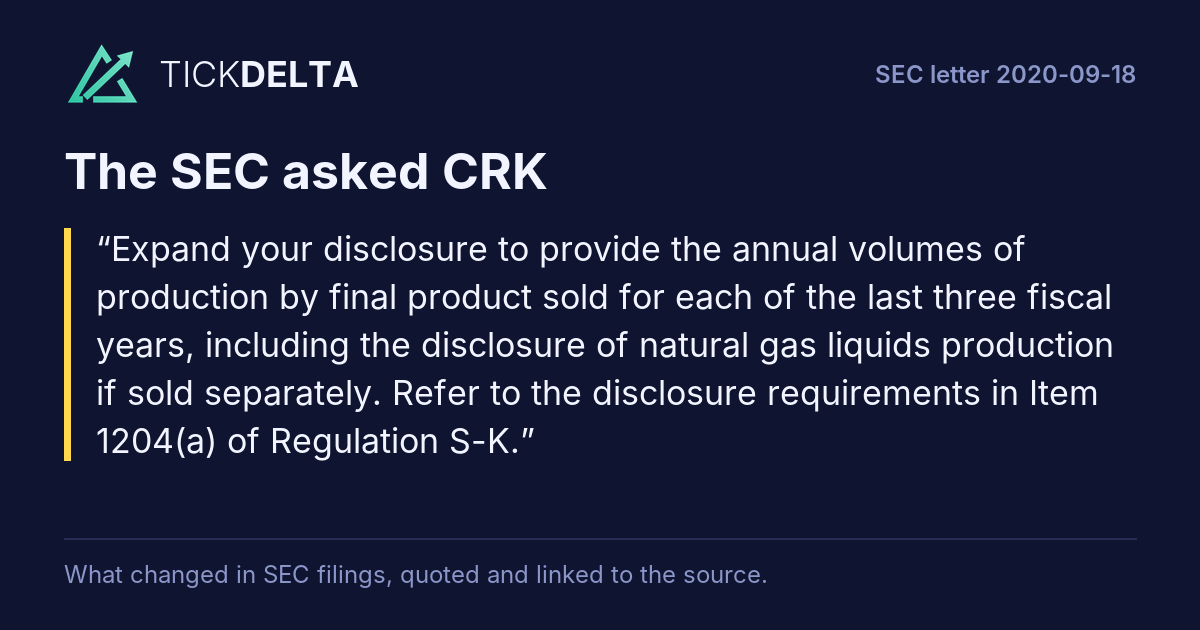
Expand your disclosure to provide the annual volumes of production by final product sold for each of the last three fiscal years, including the disclosure of natural gas liquids production if sold separately. Refer to the disclosure requirements in Item 1204(a) of Regulation S-K.
CRK answered
The Company reports production and revenues related to its oil and gas production activities on the two-stream method which is commonly used in our industry. Accordingly, natural gas liquids (“NGL”) production is included in natural gas production and revenues. In 2019, total NGL production was 497.2

MBbls, which was sold for $5.8 million. This amounts to 0.9% of total natural gas sales. Most of our wells do not produce any NGLs so the level of NGL volumes is not significant.
Rest of the answer

Footnote 1 to the table of proved reserves and production on page

1 discusses how we convert NGL volumes to Mcf.

September 29, 2020

Page

The Company presented fourth quarter 2019 production activity for our primary operating areas due to the significance of the Covey Park acquisition completed in the third quarter of 2019 as we felt that would be more meaningful to investors. Fourth quarter 2019 was the first full quarter that included the acquisition. We disclosed full year average daily production by major operating area for 2019 on an annual basis on page 10 of our annual report. The Company proposes to include annual volumes by product and operating area in a tabular format within its future filings as follows:

Predecessor

Successor

Year Ended

December 31, 2017

Period from

January 1, 2018 through

August 13, 2018

August 14, 2018

December 31, 2018

December 31, 2019

Natural Gas (MMcf):

Haynesville/Bossier Shale

71,550

52,021

39,413

275,832

Bakken Shale

—

3,855

6,106

Other

1,971

3,219

1,763

10,896

Oil (MBbls):

1,364

2,465

898

287

214

Total (MMcfe):

Read in the reply
In its next report

First report after the company's reply of Sep 29, 2020: 10-Q filed Nov 5, 2020 ↗, against the 10-Q filed Aug 7, 2020 ↗.

Tickdelta does not hold the text of both reports, so they are not compared here.
Oil and Natural Gas Reserves, page 11
SEC asked (2)
The third party reserves audit reports filed as Exhibits 99.1 and 99.2, respectively, disclose natural gas liquids reserves; however, such reserves are not disclosed in the filing on Form 10-K as of December 31, 2019. Tell us the reason(s) for this apparent inconsistency in the disclosure of your proved reserves.
CRK answered
As discussed in the Company’s response to comment 1 above, Comstock includes NGL production as part of its natural gas production. Footnote 1 to the table of proved reserves and production on page 1 states that natural gas volumes include NGLs.
Read in the reply
In its next report

First report after the company's reply of Sep 29, 2020: 10-Q filed Nov 5, 2020 ↗, against the 10-Q filed Aug 7, 2020 ↗.

Tickdelta does not hold the text of both reports, so they are not compared here.

Oil and Natural Gas Reserves, page 11
SEC asked (3)
The tabular presentation provided on page 11 relating to the proved reserves as of December 31, 2019 indicates that the present worth discounted at 10% (“PV 10 Value”) for your proved developed non-producing reserves is positive. However, both third party reserves audit reports filed as Exhibits 99.1 and 99.2, respectively, disclose that the present worth at 10% relating to such reserves is negative.
Rest of the question

Tell us the reason(s) for this apparent inconsistency in the disclosure of information relating to your proved reserves.

CRK answered
The Company reported proved developed shut-in reserves and behind pipe reserves as proved developed non-producing reserves in the table on page 11. Proved developed shut-in reserves represent wells that were formerly producing but are no longer producing due to mechanical issues. Behind pipe reserves represent reserves expected to be recovered from zones in existing wells, which will require additional completion work or future re-completion prior to start of production.

See table below for a reconciliation of proved developed non-producing reserves between the table on page 11 and the
Rest of the answer

revised Exhibit 99.1 and Exhibit 99.2.

Reserve table on

Revised

Exhibit

99.1

99.2

Total

Difference

(in thousands)

Proved developed non-producing reserve PV 10

Value

$

10,677

10,796

(119

Read in the reply
In its next report

First report after the company's reply of Sep 29, 2020: 10-Q filed Nov 5, 2020 ↗, against the 10-Q filed Aug 7, 2020 ↗.

Tickdelta does not hold the text of both reports, so they are not compared here.

Oil and Natural Gas Reserves, page 11
SEC asked (4)
The third party reserves audit report filed as Exhibit 99.2 indicates that you have included estimates of proved undeveloped reserves for certain locations that generate positive future net revenue but have negative present worth discounted at 10 percent. Tell us if the referenced locations were part of the development plan adopted by your management at December 31, 2019.
Rest of the question

Refer to Rule 4-10(a)(31)(ii) of Regulation S-X.

CRK answered

No numbered answer found in the reply. Read the reply ↗

In its next report

First report after the company's reply of Sep 29, 2020: 10-Q filed Nov 5, 2020 ↗, against the 10-Q filed Aug 7, 2020 ↗.

Tickdelta does not hold the text of both reports, so they are not compared here.

Oil and Natural Gas Reserves, page 11
SEC asked (5)
If you have adopted a plan to drill proved undeveloped locations with negative present worth discounted at 10 percent, disclose the marginal nature of these wells and the economic risk that they pose in your filing. Refer to FASB ASC 932-235-50-10 and your response dated January 19, 2012 to comment 3 in the letter dated December 28, 2011.
CRK answered
s 4 and 5: The referenced proved undeveloped reserves, which have a negative present worth, are comprised of 40.2 net locations with total reserves of 246.1 Bcfe (4.5% of total proved reserves), future net revenues of $79.0 million and a PV10 Value of $(22.6) million. The referenced locations were part of the Company’s development plan at December 31, 2019 and are scheduled to be drilled and completed within five years with the expectation that they will generate adequate returns when they are completed or are being drilled to meet certain drilling obligations in order to retain leasehold
Rest of the answer

interest or to properly manage reservoir performance. The inclusion of these reserves in our proved reserves were not significant to our total proved reserves. The Company proposes the following disclosure in future filings with regard to such reserves:

“Our estimates of oil and natural gas reserves include 246.1 Bcfe as of

December 31, 2019 related to undrilled wells that have positive undiscounted future cash flows but which, based upon natural gas prices that we use to prepare reserve estimates in accordance with SEC guidelines, have a rate of return that is less than the 10% discount rate used in the Standardized Measure. We anticipate drilling such wells based on our expectation of future oil and natural gas prices as well as the need to meet certain drilling obligations in order to retain leasehold interests and to properly manage reservoir performance. To the extent that oil or natural gas prices are substantially weaker than our expectations, we may not recover our investment in drilling these wells from future cash flows.”

Read in the reply
In its next report

First report after the company's reply of Sep 29, 2020: 10-Q filed Nov 5, 2020 ↗, against the 10-Q filed Aug 7, 2020 ↗.

Tickdelta does not hold the text of both reports, so they are not compared here.

Oil and Natural Gas Reserves, page 11
SEC asked (6)
Revise the tabular disclosure provided on page 12 relating to the average production cost per unit of production for each of the last three fiscal years to exclude the costs relating to severance and ad valorem taxes and transportation costs. Refer to Item 1204(b)(2) of
CRK answered
The Company proposes to include average production cost per unit of production in a tabular format within its future filings as follows:

Average Production Costs ($ per Mcfe):
Read in the reply
In its next report

First report after the company's reply of Sep 29, 2020: 10-Q filed Nov 5, 2020 ↗, against the 10-Q filed Aug 7, 2020 ↗.

Tickdelta does not hold the text of both reports, so they are not compared here.

Oil and Natural Gas Reserves, page 11
SEC asked (7)
The tabular reconciliation of the changes that occurred in proved undeveloped reserves provided on page 13 indicates that no new reserves were added from extensions and discoveries for the fiscal year ended December 31, 2019.
Rest of the question

This disclosure appears to be inconsistent with the level of drilling activity that occurred during the year and the disclosure relating to the change in total proved reserves for new reserves added from extension and discoveries. Tell us the reason(s) for this apparent inconsistency in the disclosure of information relating to your proved undeveloped reserves. Exhibits and Financial Statement Schedules (b) Exhibits

CRK answered
During the fiscal year ended December 31, 2019, Comstock completed the acquisition of Covey

Park Energy, which added a large number of proved undeveloped drilling locations. According to Rule 4-10(a)(31) of Regulation S-X, “undrilled locations can be classified as having undeveloped reserves only if a development plan has been adopted indicating that they are scheduled to be drilled within five years, unless specific circumstances, justify a longer time.” Given the magnitude of additional proved undeveloped locations added with the acquisition, the Company elected not to include any new
Rest of the answer

proved undeveloped locations on its properties owned before the acquisition in order to align the future development of proved undeveloped locations within the five year limitation. Accordingly, there were no proved undeveloped locations added during fiscal year 2019 through extensions and discoveries.

Exhibits and Financial Statement Schedules

(b) Exhibits

Read in the reply
In its next report

First report after the company's reply of Sep 29, 2020: 10-Q filed Nov 5, 2020 ↗, against the 10-Q filed Aug 7, 2020 ↗.

Tickdelta does not hold the text of both reports, so they are not compared here.

Exhibit 99.1, page 66
SEC asked (8)
Expand the disclosure in Exhibit 99.1 to provide the qualifications of the technical person(s) of the independent petroleum engineering firm primarily responsible for overseeing the firm’s audit of the Company’s proved reserves. Alternatively, expand the disclosure in the filing on Form 10-K to provide this disclosure. Refer to the disclosure requirements pursuant to Item 1202(a)(7) of Regulation S-K.
CRK answered
The Company proposes filing a revised Exhibit 99.1 that provides the qualifications of the technical person(s) of the independent petroleum engineering firm primarily responsible for overseeing the firm’s audit of Comstock’s proved reserves. See attachment to this correspondence of what the Company proposes filing as a revised Exhibit 99.1. The Company points out that Exhibit 99.1 only covers 6.1% of our proved reserves.
Read in the reply
In its next report

First report after the company's reply of Sep 29, 2020: 10-Q filed Nov 5, 2020 ↗, against the 10-Q filed Aug 7, 2020 ↗.

Tickdelta does not hold the text of both reports, so they are not compared here.

Exhibit 99.1, page 66
SEC asked (9)
The disclosure in Exhibit 99.1 does not appear to address all of the requirements of the report pursuant to Item 1202(a)(8) of Regulation S-K. Obtain and file a revised reserves report to address the following points: • The reserves report should state the purpose for which the report was prepared, e.g. for inclusion as an exhibit in a filing made with the U.S. Securities and Exchange Commission.
Rest of the question

See Item 1202(a)(8)(i) of Regulation S-K. • The reserves report should specify the initial benchmark and the average realized prices after adjustments for location and quality differentials, by product type, including natural gas liquids, for the reserves included in the report. See Item 1202(a)(8)(v) of Regulation S-K.

CRK answered
The Company proposes filing a revised Exhibit 99.1 to state the purpose for which the report was prepared and to specify the initial benchmark and the average realized prices after adjustments for location and quality differentials, by product type for the reserves included in the report. See attachment to this correspondence of what the Company proposes filing as a revised Exhibit 99.1.
Read in the reply
In its next report

First report after the company's reply of Sep 29, 2020: 10-Q filed Nov 5, 2020 ↗, against the 10-Q filed Aug 7, 2020 ↗.

Tickdelta does not hold the text of both reports, so they are not compared here.

Exhibit 99.1, page 66
SEC asked (10)
The reserves report refers to additional supplemental information, e.g. various summaries including Schedule No. 1 through Schedule No. 5 and an Appendix: SEC Petroleum Reserve Definitions that are not included with the report. Obtain and file a revised report to include the referenced supplemental information. Alternatively, remove these references if you do not intend to include this supplemental information.
CRK answered
The Company proposes filing a revised Exhibit 99.1 with the above-mentioned references removed from the report. See attachment to this correspondence of what the Company proposes filing as a revised Exhibit 99.1.
Read in the reply
In its next report

First report after the company's reply of Sep 29, 2020: 10-Q filed Nov 5, 2020 ↗, against the 10-Q filed Aug 7, 2020 ↗.

Tickdelta does not hold the text of both reports, so they are not compared here.

Exhibit 99.1, page 66
SEC asked (11)
The tabular summary of the estimated remaining net reserves and future net revenue provided on page 1 indicates that the proved developed non-producing reserves have negative future net revenue, both undiscounted and discounted at 10%. Tell us why these reserves meet the requirements to be classified as proved reserves at December 31, 2019.
Rest of the question

Refer to the definitions of economically producible, proved reserves, and reserves in Rules 4-10(a)(10), (a)(22) and (a)(26) of Regulation S-X, respectively.

CRK answered
As discussed in the Company’s response to comment 3, proved developed non-producing reserves represent shut-in wells that were formerly producing but are no longer producing due to mechanical issues.

The proved undeveloped non-producing reserves referenced in the table represent a reserve quantity of 1.0 Bcfe, which is 0.0018% of the Company’s total proved reserves.
Rest of the answer

These cases are marginally uneconomic using first-day-of-the month average pricing for the previous 12 months (“SEC pricing”) and therefore do not meet the definitions of economically producible, proved reserves and reserves according to Rule 4-10 of Regulation S-X. However, the Company also considers the impact of forward market pricing, drilling obligations and reservoir performance in its evaluation of whether or not to keep marginally uneconomic reserves using SEC pricing.

Read in the reply
In its next report

First report after the company's reply of Sep 29, 2020: 10-Q filed Nov 5, 2020 ↗, against the 10-Q filed Aug 7, 2020 ↗.

Tickdelta does not hold the text of both reports, so they are not compared here.

Notes to Consolidated Financial Statements · Note 14 Oil and Gas Reserves Information (Unaudited), page F-36
SEC asked (12)
Expand your disclosure of the changes in the net quantities of total proved reserves for each of the periods presented to include an appropriate narrative explanation of the significant changes related to each line item other than production.
Rest of the question

To the extent that two or more separate and unrelated factors are combined to arrive at the line item figure, your disclosure should separately identify and quantify each individual factor that contributed to a significant change so that the change in net reserves between periods is fully explained. In particular, disclosure relating to the revisions in previous estimates of reserves should identify such underlying factors as changes caused by commodity prices, well performance, improved recovery, uneconomic proved undeveloped locations or changes resulting from the removal of proved undeveloped locations due to changes in a previously adopted development plan. Refer to FASB ASC 932-235-50-5 and Instruction 1 to Item 302(b) of Regulation S-K.

CRK answered
The Company provided an explanation of the significant increase in acquisitions of minerals in place during 2019 on page F-36. The Company proposes in future filings to expand its disclosure of significant changes in net quantities of total proved reserves with an appropriate narrative explanation of significant changes related to each line item and disclosure related to revisions in previous estimates as follows:

“Revisions of previous estimates.
Rest of the answer

Revisions of previous estimates for 2017, 2018 and 2019 were comprised of 14.6 Bcfe, 41.0 Bcfe and 266.6 Bcfe, respectively, of upward revisions that were primarily attributable to higher production performance from Haynesville Shale wells as compared to expected performance from proved undeveloped locations included in proved reserves in the previous year. Revisions of previous estimates associated with changes in oil and gas prices were 26.5 Bcfe of upward price revisions in 2017, zero price related revisions in 2018 and 231.5 Bcfe of negative price revisions in 2019.

Extensions and discoveries. Extensions and discoveries for 2017, 2018 and 2019 were primarily comprised of proved reserve additions attributable to the Company’s successful drilling program in the Haynesville/Bossier Shale.

Acquisitions of minerals in place.

The significant increase in acquisitions of minerals in place during 2019 is primarily related to the Covey Park Acquisition.”

Read in the reply
In its next report

First report after the company's reply of Sep 29, 2020: 10-Q filed Nov 5, 2020 ↗, against the 10-Q filed Aug 7, 2020 ↗.

Tickdelta does not hold the text of both reports, so they are not compared here.

Notes to Consolidated Financial Statements · Note 14 Oil and Gas Reserves Information (Unaudited), page F-36
SEC asked (13)
The figures relating to the changes that occurred in your total proved reserves due to extensions and discoveries appear to be inconsistent with the corresponding figures relating to such changes that occurred in your proved undeveloped reserves for each of the last three fiscal years presented.
Rest of the question

Expand the discussion of the changes in your total proved reserves attributed to extensions and discoveries to explain the reason(s) for this difference. Refer to FASB ASC 932-235-50-5.

CRK answered
The reserve additions related to extensions and discoveries on page F-36 relate to total proved reserves (both developed and undeveloped) while the reserves table on page 13 relates to total proved undeveloped reserves only. The inconsistency between the tables is due to wells successfully drilled and completed that were not classified as proved undeveloped reserves in the prior year.
Rest of the answer

The Company’s drilling program typically includes certain locations that were not carried as proved undeveloped.

As noted in the Company’s response to comment 12, Comstock proposes in future filings to expand its disclosure of the changes in net quantities of total proved reserves, including an appropriate narrative explanation of significant changes related to each line item and disclosure related to revisions of previous estimates. See the Company’s response to comment 12 for an example of the proposed disclosure language.

Read in the reply
In its next report

First report after the company's reply of Sep 29, 2020: 10-Q filed Nov 5, 2020 ↗, against the 10-Q filed Aug 7, 2020 ↗.

Tickdelta does not hold the text of both reports, so they are not compared here.

Notes to Consolidated Financial Statements · Note 14 Oil and Gas Reserves Information (Unaudited), page F-36
SEC asked (14)
Tell us if the costs associated with the abandonment of your proved undeveloped locations, have been included as part of the future development costs used in the calculation of the standardized measure as of December 31, 2019. If such costs have been omitted, explain to us your basis for excluding these costs from your calculation of the standardized measure.
CRK answered
The costs associated with the abandonment of our proved undeveloped locations have not been included as part of the future development costs used in our calculation of standardized measure due to their immateriality. Due to the long economic lives of the Company’s wells, the standardized measure of abandonment costs associated with the Company’s proved undeveloped locations amount to $23.1 million of undiscounted cost and $174 thousand of discounted cost.
Rest of the answer

The Company proposes to include abandonment costs as part of the future development costs associated with our proved undeveloped locations in the calculation of the standardized measure in future filings despite the immateriality.

Read in the reply
In its next report

First report after the company's reply of Sep 29, 2020: 10-Q filed Nov 5, 2020 ↗, against the 10-Q filed Aug 7, 2020 ↗.

Tickdelta does not hold the text of both reports, so they are not compared here.

Exhibit 99.1 · Financial Results for the Three and Six Months Ended June 30, 2020, page 1
SEC asked (15)
We note your presentation of the non-GAAP measure adjusted net income available to common stockholders. Revise to present a tabular reconciliation of adjusted net income available to common stockholders to net income. Additionally, revise to disclose the reasons why you believe your presentation of this non-GAAP measure provides useful information to investors.
Rest of the question

Lastly, revise to disclose the purposes for which management uses this non-GAAP measure. Please refer to Regulation G and Item 10(e)(1)(i) of

CRK answered
The Company believes it provided a quantitative reconciliation of material items that comprised the difference between net income available to common stockholders and adjusted net income available to common stockholders in accordance with Regulation G and Item

10(e)(1)(i) of Regulation S-K. Although Comstock believes it provided the appropriate information in the reconciliation of its non-GAAP measure, the Company proposes to include in future filings a tabular reconciliation of adjusted net income available to common stockholders to net income available to common stockholders and the
Rest of the answer

reasons why we believe our presentation of this non-GAAP measure provides useful information to investors and the purposes for which the Company’s management uses this non-GAAP measure as follows:

Three Months

Ended June 30,

Six Months

Net loss available to common stockholders

(60,002

(30,046

Unrealized loss on derivative financial instruments

65,585

49,102

Interest amortization on Senior Notes valuation

5,425

10,680

Loss on early extinguishment of debt

861

Non-cash preferred stock accretion

2,917

5,417

Impairment of unevaluated oil and gas properties

Adjusted provision for income taxes

(13,043

(8,048

Adjusted net income available to common stockholders

1,743

27,993

Diluted shares outstanding

208,904

198,910

Adjusted net income available to common stockholders per share

0.01

0.14

“The Company presents adjusted net income available to common stockholders because of its acceptance by investors and by Comstock management as an indicator of the Company’s profitability excluding non-cash unrealized gains and losses on derivative financial instruments and other unusual items.”

Read in the reply
In its next report

First report after the company's reply of Sep 29, 2020: 10-Q filed Nov 5, 2020 ↗, against the 10-Q filed Aug 7, 2020 ↗.

Tickdelta does not hold the text of both reports, so they are not compared here.

Exhibit 99.1 · Financial Results for the Three and Six Months Ended June 30, 2020, page 1
SEC asked (16)
We note certain line items in your tabular reconciliation of net income to EBITDAX that are not traditionally included to arrive at the non-GAAP measure EBITDAX. Tell us whether you considered labeling this measure adjusted EBITDAX.
CRK answered
The Company did not consider labeling EBITDAX as adjusted EBITDAX in its tabular reconciliation of net income to EBITDAX. The

Company has historically included non-cash items in its calculation of EBITDAX that are non-traditional to the definition of EBITDAX and has noted from its review of other peers in the energy industry that they also include non-traditional items in their calculation of EBITDAX without labeling it adjusted EBITDAX. The Company proposes in future filings to change the label of this measure to adjusted EBITDAX.
Read in the reply
In its next report

First report after the company's reply of Sep 29, 2020: 10-Q filed Nov 5, 2020 ↗, against the 10-Q filed Aug 7, 2020 ↗.

Tickdelta does not hold the text of both reports, so they are not compared here.

Business and Properties · Oil and Natural Gas Reserves, page 11
SEC asked (1)
Your response to prior comments 3 and 11 acknowledges that the disclosed proved developed non-producing reserves for certain shut-in wells at December 31, 2019 did not meet the definitions of economically producible, proved reserves or reserves according to Rule 4-10(a)(10), (a)(22) and (a)(26), respectively. The intent to develop these uneconomic quantities in and of itself does not justify recognition of reserves.
Rest of the question

Remove any quantities in filings made with the U.S. Securities and Exchange Commission that do not meet all of the requirements to be classified as reserves.

CRK answered
The Company acknowledges that the disclosed proved developed non-producing reserves included certain shut-in wells at December 31, 2019 that did not meet the definition of economically producible, proved reserves. The Company proposes in future filings to exclude any reserve quantities related to wells that do not meet all of the requirements to be classified as proved reserves under the Commission’s rules.
Read in the reply
In its next report

First report after the company's reply of Oct 28, 2020: 10-Q filed Nov 5, 2020 ↗, against the 10-Q filed Aug 7, 2020 ↗.

Tickdelta does not hold the text of both reports, so they are not compared here.

Notes to Consolidated Financial Statements · Note 14 Oil and Gas Reserves Information (Unaudited), page F-36
SEC asked (2)
Your response to prior comment 12 indicates that will expand your disclosure in future filings to include an appropriate narrative explanation of significant changes related to each line item in the reconciliation other than production for each of the periods presented.
Rest of the question

Please confirm that your expanded disclosure relating to the changes from extensions and discoveries will additionally include the narrative explanation provided in your response to prior comment 13.

CRK answered
The Company confirms that in future filings it will include a narrative explanation relating to the changes from extensions and discoveries, if significant, as provided in our response to prior comment 13.
Read in the reply
In its next report

First report after the company's reply of Oct 28, 2020: 10-Q filed Nov 5, 2020 ↗, against the 10-Q filed Aug 7, 2020 ↗.

Tickdelta does not hold the text of both reports, so they are not compared here.

Also in this review: closing letter, 2020-10-29
Schedule TO-I

2018-07-23 to 2018-07-25 · 6 questions · 1 letter from the SEC, 1 from the company
No closing letter
Offer to Purchase and Consent Solicitation · Incorporation of Documents by Reference, page v
SEC asked (1)
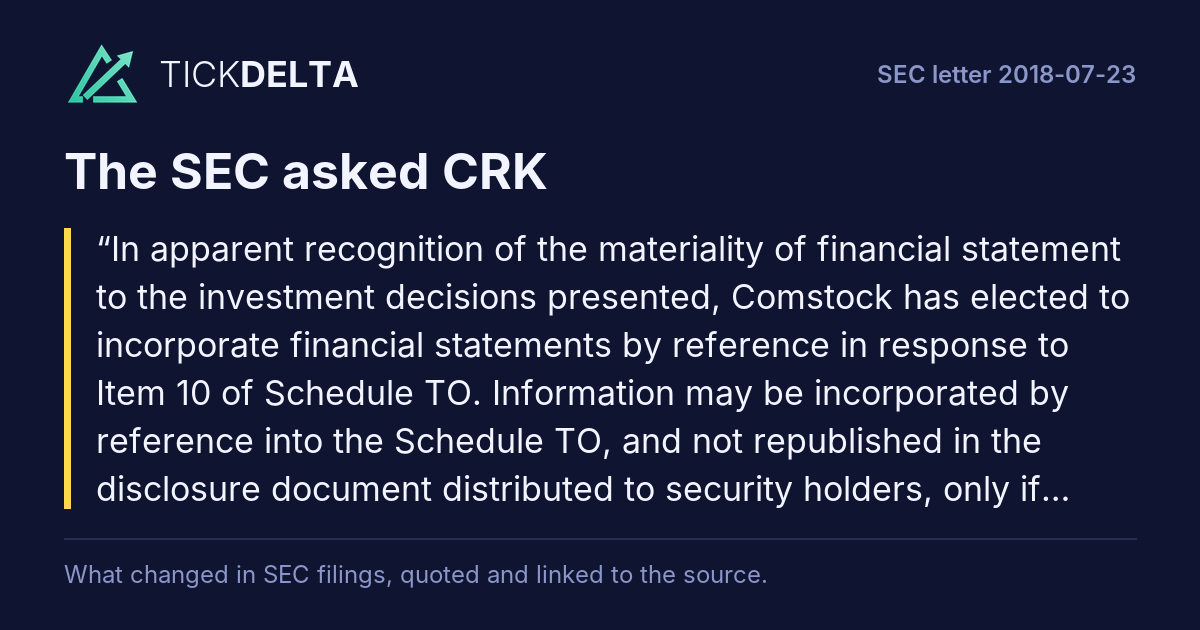
In apparent recognition of the materiality of financial statement to the investment decisions presented, Comstock has elected to incorporate financial statements by reference in response to Item 10 of Schedule TO. Information may be incorporated by reference into the Schedule TO, and not republished in the disclosure document distributed to security holders, only if such information is included as an exhibit.
Rest of the question

See General Instruction F. The reference to “a copy” in that instruction is only intended to mean the substantive content of information so incorporated as distinguished from the controlling requirement to identify the information so incorporated as an entry on the exhibit list. Accordingly, please revise the exhibit list.

CRK answered
Item 10 has been revised to delete the sentence “The information set forth in the documents referred to under the heading “Incorporation of Documents by Reference” in the Offer to Purchase is incorporated herein by reference.” The exhibit index has been revised to list the sections of the Company’s 10-K and 10-Q that contain its financial statements.
Read in the reply
Offer to Purchase and Consent Solicitation · Incorporation of Documents by Reference, page v
SEC asked (2)
To the extent that the financial information required by Item 1010(a) of Regulation M-A continues to be incorporated by reference into the Schedule TO, it must be summarized in accordance with Item 1010(c) of Regulation M-A. See General Instruction 6 to Item 10 of Schedule TO.
Rest of the question

Unless the financial statements required by Item 10 of Schedule TO and corresponding Item 1010(a) of Regulation M-A will be printed and delivered to security holders being invited to tender, or Comstock affirmatively states within Item 10 of Schedule TO as well as this section that the disclosure required by these provisions is immaterial, please amend the Offer to Purchase to disclose the information required by Item 1010(c), including the ratio of earnings to fixed charges disclosed in the Schedule TO. See Interpretation I.H.7 in the July 2001 public guidance accessible via the following link: http://www.sec.gov/interps/telephone/phonesupplement3.htm

CRK answered
Item 10 has been revised to disclose the information required by Item 1010(c) of Regulation M-A. Pursuant to Interpretation I.H.7 in the July 2001 public guidance, the information required by Item 1010(c) of Regulation M-A has been added to the Offer to Purchase.
Read in the reply
The Tender Offer and the Consent Solicitation, page 8
SEC asked (3)
Disclosure indicates that “Subject to applicable law, the Tender Offer for a series of Notes is being made independently of the Tender Offer for the other series of Notes….” Please advise us more specifically as to the “applicable law” being referred to in the quoted clause.
CRK answered
The disclosure on the cover and pages 1, 3, 8 and 19 of the Offer to Purchase has been revised to delete the references to “applicable law”.
Read in the reply
Proposed Amendments, page 10
SEC asked (4)
We note the following disclosure on page 13: “We intend to execute the applicable Supplemental Indentures effecting the Proposed Amendments on the Settlement Date if we have received the Requisite Consents with respect to the applicable series of Notes.
Rest of the question

Each of the Supplemental Indentures will become effective upon execution by us, the Guarantors and the applicable Trustee, but will provide that the Proposed Amendments will not become operative unless we purchase in the Tender Offer more than a majority of the outstanding principal amount of the applicable series of Notes….” Given that other disclosure in the offer document indicates that tenders must be paired with consents, it does not appear to be correct that you would receive the Requisite Consents and execute the applicable Supplemental Indentures but then not purchase a majority of the outstanding principal amount of the applicable series of Notes. Please clarify the disclosure here and throughout the offer document, as well as throughout the Consent and Letter of Transmittal, as this seemingly inconsistent disclosure appears in a number of places.

CRK answered
The disclosure on the cover and pages 2, 3, and 13 of the Offer to Purchase and the cover and pages 6 and 9 of the Consent and Letter of Transmittal has been revised to state that “If we have received the Requisite Consents and the Tender Offer Conditions have been met, we will execute the Supplemental Indentures on the Settlement Date.
Rest of the answer

For the avoidance of doubt, the Proposed Amendments will not become operative until we purchase in the Tender Offer more than a majority of the outstanding principal amount of the applicable series of Notes, excluding any Notes held by Affiliates (or, in the case of the Collateral Release, at least two-thirds of the outstanding principal amount of the applicable series of Notes, excluding any Notes held by Affiliates).”

Read in the reply
Conditions to Consummation of the Tender Offer, page 19
SEC asked (5)
The offer document discloses that “Our decision as to whether or not a condition was satisfied will be final and binding, and you will have no right to disagree with our conclusion.” Similarly themed disclosure appears elsewhere in the offer document, e.g., in the sections titled, “Procedures for Tendering Notes and Delivering Consents” and “Withdrawal of Tenders; Revocation of Consents,” as well as in the Consent
Rest of the question

and Letter of Transmittal. Please revise all such references to remove the implication that security holders may not challenge these determinations in a court of competent jurisdiction.

CRK answered
The disclosure on pages 19 and 23 of the Offer to Purchase and on pages 7 and 9 of the Consent and Letter of Transmittal has been revised to state that “Holders may challenge our determinations in a court of competent jurisdiction. Only a court of competent jurisdiction can make a determination that will be final and binding upon the parties.”
Read in the reply
Consent and Letter of Transmittal
SEC asked (6)
The disclosure on page 4 states that the Tender Offer and Consent Solicitation “are not being made to (nor will tenders of Notes be accepted from or on behalf of) holders in any jurisdiction in which the making or acceptance of the Tender Offer or the Consent Solicitation would not be in compliance with the laws of such jurisdiction.” Similar disclosure also appears in the offer document on pages ii and 33.
Rest of the question

Please provide your analysis as to how limiting participation in this manner is consistent with Rule 13e-4(f)(8)(i). If the Company is attempting to rely on Rule 13e-4(f)(9)(ii), please note that Rule 13e4(f)(9)(ii) is restricted to state law. For guidance, refer to Exchange Act Release 34-58597, Section II.G.1 (September 19, 2008).

CRK answered
The disclosure on pages ii and 33 of the Offer to Purchase and on page 4 of the Consent and Letter of Transmittal has been revised to delete such language limiting participation.
Read in the reply

Schedule 14A

2018-06-13 to 2018-06-29 · 3 questions · 1 letter from the SEC, 1 from the company
Review closed 2018-06-29
Revenue
Audited Financial Statements of the Bakken Shale Properties, page A-1
SEC asked (1)
We note that you have presented audited statements of assets acquired and liabilities assumed and statements of revenues and direct operating expenses for the oil and natural gas properties to be contributed by the Jones Partnerships (i.e., Arkoma Drilling, LP and Williston Drilling, LP) in exchange for shares of your common stock.
Rest of the question

As the disclosure in your proxy indicates that the Jones Partnerships is the accounting acquirer in the proposed transaction, describe your basis for presenting abbreviated financial statements rather than full audited financial statements. Refer to Item 14 of Schedule 14A and Item 17 of Form S-4.

CRK answered

No numbered answer found in the reply. Read the reply ↗

Audited Financial Statements of the Bakken Shale Properties, page A-1
SEC asked (2)
Provide us a comprehensive analysis supporting your conclusion that the Jones Partnerships is the accounting acquirer in the proposed transaction, including your consideration of each factor outlined in FASB ASC paragraphs 805-10-55-11 through 805-10-55-14.
CRK answered
We believe our responses to the Staff’s comments numbers 1 and 2 are interrelated; as such, we have combined our responses to comment numbers 1 and 2 in the response to comment number 2.

We acknowledge that the proxy, specifically the Introduction and Basis of

Presentation to the Unaudited Pro Forma Combined Financial Statements, describes the Jones Partnerships as the accounting acquirer in the transaction.
Rest of the answer

As clarification, this reference was intended to convey that Comstock will undergo a change in control as a result of the issuance of 88.6 million shares to the Jones Partnerships in exchange for the Bakken Shale Properties (which prior to the transaction are held by the Jones Partnerships). We did not intend to imply that a business combination has occurred at the Comstock reporting entity nor that the transaction would be accounted for as a reverse merger. The description of the accounting by Comstock is discussed below. Further, we will clarify the disclosures provided in the footnotes to the pro forma financial statements to be included in an amendment to the proxy.

Securities and Exchange Commission

Page

Background and Accounting for the Transaction

We entered into a Contribution Agreement (the “Contribution Agreement”) on May 9, 2018 with Arkoma Drilling, L.P. and Williston

Drilling, L.P. (collectively, the “Jones Partnerships”) under which the Jones Partnerships will contribute to Comstock interests in certain oil and gas properties located in the Williston Basin in North Dakota and Montana (the “Bakken

Shale Properties”) in exchange for approximately 88.6 million shares of Comstock common stock, which following the issuance will represent approximately 84.6% of the Company’s total outstanding shares (the “Jones

Contribution”). The Jones Partnerships are wholly owned by Jerry Jones and his children (collectively referred to herein as, the “Jones Group”).

As described in our response to the Staff’s comment number 3 below, the Bakken Shale Properties do not meet the definition of a business in ASC 805-10-55-5A; therefore the acquisition of the Bakken Shale Properties will not be accounted for as a business combination. Comstock will recognize the Bakken Shale Properties at the date of the acquisition with no change in reporting entity or retrospective accounting. In addition, the transaction will result in the Jones Group obtaining a controlling financial interest in Comstock. Therefore, since the Bakken Shale Properties will be controlled by the Jones Group both before and after the transaction, we have concluded that Comstock should recognize the Bakken Shale Properties as a common control transaction at the basis held by the Jones Group consistent with the guidance in ASC 805-50-30-5.

Finally, we will elect to apply push-down accounting on the acquisition date to the assets and liabilities of Comstock pursuant to the guidance in ASC 805-50-25-4. As a result, we will reflect a new basis of accounting for the assets and liabilities of Comstock following the guidance in ASC 805. This will result in a “black line” presentation, such that the historical Comstock financial statements will continue to be presented for periods prior to the transaction, and the combined Bakken Shale Properties

(at their historical cost) and legacy Comstock (at the new basis) will be presented prospectively.

Availability of Financial Information

As the Bakken Shale Properties do not meet the definition of a business under U.S. GAAP, and will be accounted for prospectively from the date of acquisition, we considered the appropriateness of presenting abbreviated financial statements rather than full audited financial statements. We considered the applicability and relevance of the staff’s guidance in FRM 2065.11 and previously submitted a preclearance letter to the Division’s Office of the Chief Accountant dated May 17, 2018 on this issue. Our considerations included the following regarding the availability and usefulness to investors of full audited financial statements of the Bakken Shale Properties:

•

The Bakken Shale Properties do not represent a separate entity, subsidiary or division of the Jones Partnerships. Stand-alone financial statements relating to the Bakken Shale Properties have never previously been prepared, and the Jones Partnerships informed us that it would be impracticable to prepare complete audited carve out financial statements in accordance with Item 14 of Schedule 14A and Item 17 of Form S-4.

Further, the Jones Partnerships advise that distinct and separate accounts necessary to prepare full financial statements for the Bakken Shale Properties have never been maintained because they have never operated these assets separately from the rest of the Jones Partnerships.

The Jones family businesses cannot objectively allocate certain corporate overhead expenses to the Bakken Shale Properties. Any allocation would be subjective and would not be relevant to investors given the differences between the Jones Partnerships’ legal structure and Comstock’s corporate structure which will remain intact after the transaction.

Working capital accounts, including cash relating to the Bakken Shale Properties, have been maintained only in the aggregate at the family business level and it is not practicable to separately identify those amounts attributable to the Bakken Shale Properties or the Jones Partnerships. In addition, there is no debt attributable to the Jones Partnerships or directly attributable to the Bakken Shale Properties.

Alternatives to Audited Financial Statements

While we note that FRM 2065.11 permits the use of abbreviated financial statements in transactions similar to the Jones Transactions to satisfy

Rule 3-05 of Regulation S-X, it does not provide the same automatic relief for such financial statements in proxy statements. However, we believe that if the use of such financial statements is deemed sufficient for shareholders to understand the impact of the Jones Contribution upon consummation, it should be equally useful for purposes of making a voting decision on a transaction.

While the Company does not believe that it is practicable to prepare full audited financial statements for the Bakken Shale Properties, if it were practicable, we believe the cost of preparing and auditing such information would exceed the benefit that our shareholders would derive from the incremental information provided in a set of full financial statements as compared to the abbreviated financial statements.

Having assessed the adequacy of the available financial information with respect to the Bakken Shale

Properties, and after considering the separate guidance in FRM 2065.11 with respect to abbreviated financial statements, we believe that presentation of the abbreviated financial information set forth below relating to the Bakken Shale Properties is appropriate for investors in satisfaction of the requirements of Item 14 of Schedule 14A and Item 17 of Form S-4.

Attached as Exhibit 1 to this letter are revised pro forma financial statements, including the notes thereto, that we propose to attach as a revised Annex B to the proxy statement. We have also attached a marked copy to show the changes.

Read in the reply
Audited Financial Statements of the Bakken Shale Properties, page A-1
SEC asked (3)
Tell us whether the oil and natural gas properties to be contributed by the Jones Partnerships meet the definition of a business pursuant to FASB ASC paragraphs 805-1055-3A through 805-10-55-9. Include sufficient detail describing the nature of these properties as part of the analysis in your response.
CRK answered
The Company performed an assessment as to whether the Bakken Shale Properties represent a business under the guidance contained in Accounting Standards Codification (“ASC”) Topic 805 (Business Combinations), and Accounting Standards Update

(“ASU”) No. 2017-01 – Business Combinations (Topic 805): Clarifying the Definition of a Business (“ASU 2017-01”).
Rest of the answer

The Company adopted ASU 2017-01 on January 1, 2018.

Specifically, ASC 805-10-55-3A states that: “A business is an integrated set of activities and assets that is capable of being conducted and managed for the purpose of providing a return in the form of dividends, lower costs, or other economic benefits directly to investors or other owners, members, or participants. To be considered a business, an integrated set must meet the requirements in paragraphs 805-10-55-4 through 55-6 and 805-10-55-8 through 55-9”.

Further guidance is provided in ASC 805-10-55-5A, which states: “If substantially all of the fair value of the gross assets acquired is concentrated in a single identifiable asset or group of similar identifiable assets, the set is not considered a business. (Emphasis added for effect). Gross assets acquired should exclude cash and cash equivalents, deferred tax assets, and goodwill resulting from the effects of deferred tax liabilities. However, the gross assets acquired should include any consideration transferred (plus the fair value of any noncontrolling interest and previously held interest, if any) in excess of the fair value of net identifiable assets acquired.”

As noted above, the Bakken Shale Properties are made up of numerous individual wells, all of which are proved oil and gas properties located in the Williston Basin in North Dakota and Montana. Accordingly, the Company analyzed whether the individual properties qualify as a group of similar assets, as discussed further below.

ASC

805-10-55-5C states that: A group of similar assets includes multiple assets identified in accordance with paragraph 805-10-55-5B. When evaluating whether assets are similar, an entity should consider the nature of each single identifiable asset and the risks associated with managing and creating outputs from the assets (that is, the risk characteristics). However, the following should not be considered similar assets:

a.

A tangible asset and an intangible asset b.

Identifiable intangible assets in different major intangible asset classes (for example, customer-related intangibles, trademarks, and in-process research and development) c.

A financial asset and a nonfinancial asset d.

Different major classes of financial assets (for example, accounts receivable and marketable securities) e.

Different major classes of tangible assets (for example, inventory, manufacturing equipment, and automobiles) f.

Identifiable assets within the same major asset class that have significantly different risk characteristics.

The Bakken Shale Properties are comprised exclusively of undivided working interests in oil and gas wells, principally located in North Dakota and Montana, all of which are located in the Bakken Shale formation within the Williston Basin. All of the oil and gas reserves associated with the Bakken Shale Properties are classified as proved reserves, most of which are proved developed

(approximately 90% of the total proved reserves, and 94% of the estimated fair value). Although a portion of the proved reserves are undeveloped, those reserves are considered to be proved undeveloped as the probability of drilling successful wells is extremely high.

Comstock will be acquiring non-operated working interests in the Bakken Shale

Properties ranging from 0.1% to 57% with an average 15.6% working interest. All oil and gas production is marketed by the well operators. Comstock will not assume any personnel from the Jones Partnerships as part of the Jones Contribution, but rather will absorb the management of the Bakken Shale Properties into its existing organization with minimal changes to its current staffing.

The risks associated with development of the Bakken Shale formation are not significant based on recent history and experience in developing horizontal wells in this location. The reservoir is well delineated and there is no more than an insignificant risk of drilling an unsuccessful well. All production is typically sold at the wellhead or lease and infrastructure exists for transporting the production to its ultimate markets in Cushing, Oklahoma and the U.S. Gulf Coast. Neither the Jones Partnerships nor Comstock take responsibility for, and do not participate in, the development of any infrastructure such as pipelines and other transportation methods.

We believe that the undivided interests in the Bakken Shale reserves have similar risk characteristics.

Further, all of these assets would be classified for balance sheet purposes as proved oil and gas properties, a long-term asset. Accordingly, we have concluded that the Bakken Shale Properties do not meet the definition of a business for accounting purposes because substantially all of the fair value of the gross assets acquired is concentrated in a group of similar identifiable assets (proved oil and gas properties) that satisfy the criteria as defined in ASC 805-10-55-5A and ASC 805-10-55-5C of being concentrated in a single identifiable asset or group of similar identifiable assets.

Read in the reply

Also in this review: closing letter, 2018-06-29

Form S-4

2016-08-11 to 2016-08-15 · 9 questions · 1 letter from the SEC, 1 from the company
No closing letter
Legal and contingencies
General
SEC asked (1)
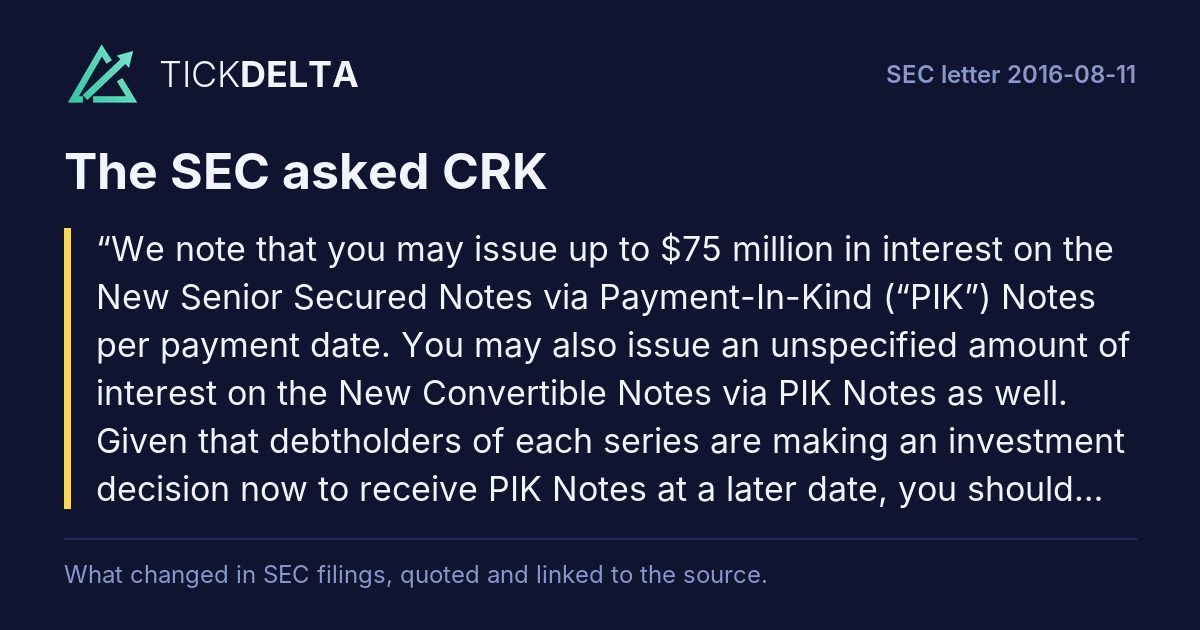
We note that you may issue up to $75 million in interest on the New Senior Secured Notes via Payment-In-Kind (“PIK”) Notes per payment date. You may also issue an unspecified amount of interest on the New Convertible Notes via PIK Notes as well.
Rest of the question

Given that debtholders of each series are making an investment decision now to receive PIK Notes at a later date, you should register a sufficient number of PIK Notes and common stock representing a bona fide estimate of the amounts of such securities you will ultimately be issuing. Please advise or revise.

CRK answered
The Company acknowledges the Staff’s comment and respectfully submits that the registration fee table contained in the Registration

Statement contemplated the registration of (i) $75 million of New Senior Secured Notes that may be issued as PIK Notes, (ii) the Company’s good faith estimate of the amount of New Convertible Notes that may be issued as PIK Notes through the respective maturity dates of the New Convertible Notes and (iii) an indeterminate amount of shares of common stock issuable upon conversion of the New Convertible Notes (including New Convertible Notes issued as PIK Notes).
Rest of the answer

Amendment No. 1 contains a revised fee table with respect to (a) additional warrants to be issued in exchange for Old Senior Secured Notes tendered in the exchange offer (and the common stock issuable upon the exercise thereof), as described on page 1 of Supplement No. 1, and (b) the revised maximum amount of New Senior Secured Notes issuable as PIK Notes, as described on page 1 of Supplement No. 1.

Read in the reply
Cautionary Note Regarding Forward-Looking Statements, page iv
SEC asked (2)
The safe harbor for forward-looking statements provided in the Private Securities Litigation Reform Act of 1995 does not apply to statements made in connection with a tender offer. See Section 27A(b)(2)(C) of the Securities Act and Section 21E(b)(2)(C) of the Exchange Act.
Rest of the question

Therefore, please delete the reference to the safe harbor or state explicitly that the safe harbor protections it provides do not apply to statements made in connection with the offer.

CRK answered
The

Company acknowledges the Staff’s comment and has addressed the inapplicability of the safe harbor to the statements made in connection with the offer on page 2 of Supplement No. 1.
Read in the reply
The New Convertible Notes, page 15
SEC asked (3)
Regarding the PIK provision, you indicate that “[f]or each series of New Convertible Notes, interest will be payable by issuing additional notes in an amount equal to the applicable amount of interest for the interest period (rounded down to the nearest whole dollar).” Since you do not cite any limitation on such payment, as you do for the New Senior Secured Notes, this suggests that you intend to make the interest
Rest of the question

payments only via PIK Notes. Please clarify your disclosure.

CRK answered
The Company acknowledges the Staff’s comment and has included a clarification on page 1 of Supplement No. 1.
Read in the reply
Exhibit 5.1
SEC asked (4)
The assumption on page 2 that “all persons who signed such documents on behalf of a business entity were duly authorized to do so” appears overly broad. With regard to the company and any co-registrant guarantors, counsel may instead receive and rely upon applicable officers’ certificates. Please obtain a revised opinion which does not include those parties within the scope of the assumption.
Rest of the question

Please see Section II.B.3.a of Staff Legal Bulletin No. 19 (CF) (October 14, 2011) (“SLB 19”) for guidance.

CRK answered
The Company acknowledges the Staff’s comment and has filed a revised opinion as Exhibit 5.1 to Amendment No. 1 modifying the cited assumption.
Read in the reply
Exhibit 5.1
SEC asked (5)
We note your reliance on the opinion of Woodburn and Wedge with respect to certain matters. See our comments below regarding Exhibit 5.2. Those issues may limit your ability to rely on that opinion.
CRK answered
Company acknowledges the Staff’s comment and has filed a revised opinion from Woodburn and Wedge, as further described below, as Exhibit 5.2 to Amendment No. 1, addressing the reliance comment.
Read in the reply
Exhibit 5.1
SEC asked (6)
Assumptions “vi” and “viii” listed at the top of page 3 appear to be overly broad or to assume readily ascertainable or otherwise material facts. While it may be appropriate to assume that specific factual events may take place after effectiveness in granting the legal opinion, counsel should not assume that the registrant has taken all corporate actions necessary to authorize the issuance of the securities or
Rest of the question

assume legal conclusions. See SLB 19.II.B.3.a.

CRK answered
The Company acknowledges the Staff’s comment and has filed a revised opinion as Exhibit 5.1 to Amendment No. 1 deleting the cited assumptions.
Read in the reply
Exhibit 5.2
SEC asked (7)
The assumption on page 2 that “all persons who signed such documents on behalf of a those parties within the scope of the assumption. Please see Section II.B.3.a of SLB 19 for guidance.
CRK answered
The Company acknowledges the Staff’s comment and has filed a revised opinion as Exhibit 5.2 to Amendment No. 1 modifying the cited
Read in the reply
Exhibit 5.2
SEC asked (8)
Assumption “vi” at the top of page 3 appears to assume certain conclusions of law that are necessary findings for the opinion given. Please revise your opinion to remove such assumptions. See Section II.B.3.a of SLB 19.
CRK answered
The Company acknowledges the Staff’s comment and has filed a revised opinion as Exhibit 5.2 to Amendment No. 1 deleting the cited
Read in the reply
Exhibit 5.2
SEC asked (9)
Assumptions “vi” and “viii” listed on pages 3 and 4 appear to be overly broad or to assume readily ascertainable, or otherwise material facts. While it may be appropriate to necessary to authorize the issuance of the securities or assume legal conclusions. Please see Section II.B.3.a of SLB 19 for guidance.
CRK answered
The Company acknowledges the Staff’s comment and has filed a revised opinion as Exhibit 5.2 to Amendment No. 1 deleting the cited

In addition, the Company hereby acknowledges that:

• should the Commission or the staff, acting pursuant to delegated authority, declare the filing effective, it does not foreclose the Commission from taking any action with respect to the filing;

the action of the Commission or the staff, acting pursuant to delegated authority, in declaring the filing effective, does not relieve the Company from its full responsibility for the adequacy and accuracy of the
Rest of the answer

disclosure in the filing; and the Company may not assert staff comments and the declaration of effectiveness as a defense in any proceeding initiated by the Commission or any person under the federal securities laws of the United States.

Read in the reply

Letters without questions

Other letters

UPLOAD and CORRESP
21 other letters: notices that a filing will not be reviewed, requests to declare a registration effective, and the like

From the SEC's correspondence on EDGAR: staff letters (form UPLOAD) and company letters (form CORRESP), 33 letters filed since 2016-08-11. Questions and answers are matched by their numbers; topics come from words in each question. The reports are compared word for word (same form, before the first SEC letter against the first report after the company's reply). No AI.

Sources

The SEC's correspondence on EDGAR: staff letters (form UPLOAD) and company letters (form CORRESP), matched question by question. No AI.

Also

Filings: the letters in the filing list.

Work with it

Excel workbook · CSV. Google Sheet that stays up to date: paste =IMPORTDATA("https://tickdelta.com/company/CRK/export.csv") into a cell.

Next in Owners and insiders:Insider trades
Esc

Type a ticker such as AAPL, a name, an investor such as Buffett, or a topic such as tariffs. ↑ ↓ to move, Enter to open.