Comstock Resources Inc CRK
New risk paragraphs, branching off last year
Each branch is a paragraph in Risk Factors with nothing like it in the 10-K filed Feb 21, 2025. A box jumps to the paragraph as filed, below.
Paragraphs with nothing like them in last year's 10-K
7 paragraphs in Risk Factors of the 10-K filed Feb 19, 2026 with nothing like them in the 10-K filed Feb 21, 2025. Quoted exactly. Paragraphs that were only edited are under 10-K change.
•tariffs and trade restrictions that may be imposed by the United States or other countries on natural resources, including natural gas;
Some of our undeveloped leasehold acreage is subject to leases that will expire unless production is established on units containing the acreage. Failure to administer lease acquisitions, lease contracting, lease maintenance and timely lease payments could lead to loss of leased land.
A large portion of our undeveloped leasehold acreage is subject to leases with primary terms that expire prior to 2028 unless we establish and maintain production on units containing these leases during their terms or we renew them before their expiration. The cost to renew such leases could increase significantly and we may not be able to renew such leases on economically beneficial terms or at all. If our leases expire or we are unable to renew such leases, we will lose our right to develop such leasehold acreage and our exploration and development activities could materially differ from our current expectations, which could adversely affect our business.
The unavailability or high cost of drilling rigs, completion equipment, supplies, qualified personnel and oilfield services could adversely affect our ability to execute our exploration and development plans on a timely basis and within our budget.
When drilling and completion activity in the United States or a particular operating area increases, associated costs also increase, including costs associated with drilling rigs, completion equipment, drill pipe, casing and other tubular goods, sand and other proppants, personnel and other related services. If these costs increase, we may not be able to obtain necessary equipment, supplies and services or obtain them at economically beneficial terms. Such increases in cost could result in delays in our drilling or completion activities, which could limit our ability to establish and replace reserves, or should we choose to incur higher costs, could negatively impact our business.
If any of these events were to materialize, either to the Company or a third party upon which we rely, they could lead to, without limitation, any of the following:
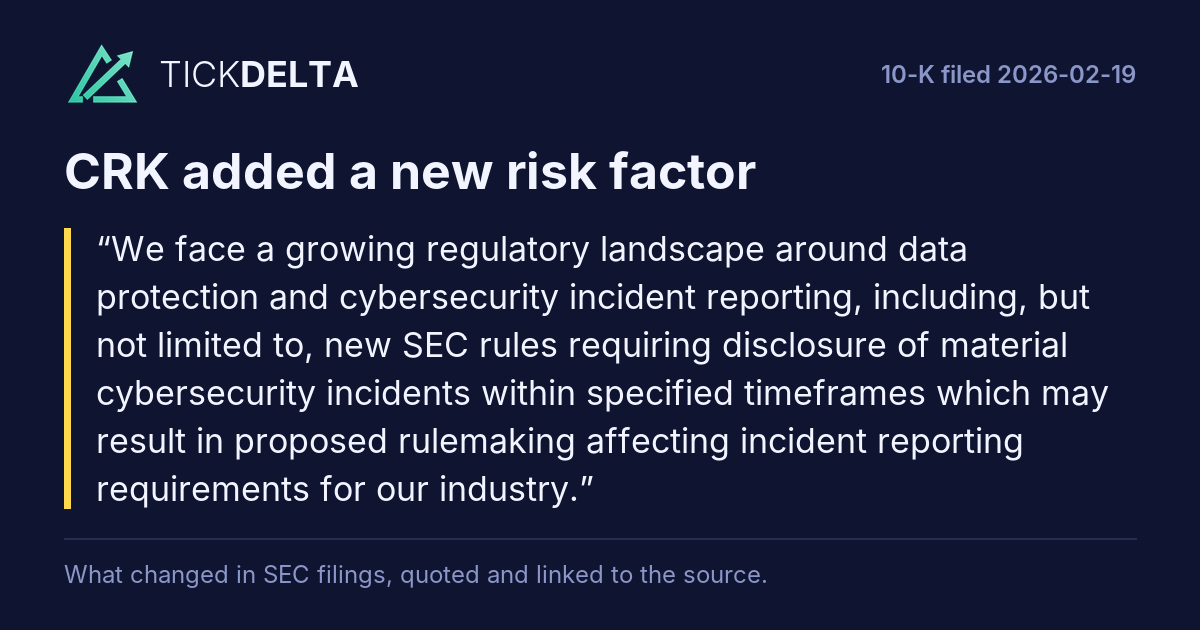
We face a growing regulatory landscape around data protection and cybersecurity incident reporting, including, but not limited to, new SEC rules requiring disclosure of material cybersecurity incidents within specified timeframes which may result in proposed rulemaking affecting incident reporting requirements for our industry.
Paragraphs in the 10-Q filed Nov 5, 2026 that were not in the one before
New in the latest 10-Q
12 paragraphs in the 10-Q filed Nov 5, 2026 with nothing like them in the 10-Q filed Jul 30, 2026 (at least half the words must differ; new numbers alone do not count). Quoted exactly, grouped by the item heading above them. This is text that changed, not a judgement of how serious it is.
Financial statements and notes
September 30, September 30, Gain (loss) on Derivatives Recognized in Earnings 2026 2025 2026 2025 (In thousands) ─────────────────────────────────────────────────────────────────────────────────────────────────────────────────────────────────────────── Natural gas price derivatives $ 74,529 $142,822 $121,290 $48,330 $ 74,529 $142,822 $121,290 $48,330 Stock-Based Compensation Comstock accounts for employee stock-based compensation under the fair value method. Compensation cost is measured at the grant date based on the fair value of the award and is recognized over the award vesting period and included in general and administrative expenses for awards of restricted stock and performance stock units ("PSUs") to the Company's employees and directors. The Company recognized $7.5 million and $5.6 million of stock-based compensation expense within general and administrative expenses related to awards of restricted stock and PSUs to its employees and directors during the three months ended September 30, 2026 and 2025, respectively, and $23.3 million and $15.6 million during the nine months ended September 30, 2026 and 2025, respectively. In January 2026, the Company granted 894,373 shares of restricted stock to its directors and employees, which were valued at $22.47 per share. In June 2026, the Company granted an additional 44,610 shares of restricted stock to its directors, which were valued at $13.45 per share. As of September 30, 2026, Comstock had 1,845,388 shares of unvested restricted stock outstanding at a weighted average grant date fair value of $17.71 per share. Total unrecognized compensation cost related to unvested restricted stock grants of $23.2 million as of September 30, 2026 is expected to be recognized over a period of 1.9 years. In January 2026, the Company granted 596,623 PSUs to its executive officers, which were valued at $27.85 per unit. As of September 30, 2026, Comstock had 1,831,896 PSUs outstanding with a weighted average grant date fair value of $23.43 per unit. The number of shares of common stock to be issued related to the PSUs is based on the Company's stock price performance as compared to its peers which could result in the issuance of anywhere from zero to 3,663,792 shares of common stock. Total unrecognized compensation cost related to these grants of $24.3 million as of September 30, 2026 is expected to be recognized over a period of 1.8 years. Segment Reporting The Company presently operates in one business segment, the exploration and production of North American natural gas and oil, primarily in the Haynesville and Bossier shale. The measure of segment profit or loss used by the chief operating decision maker ("CODM") is consolidated net income, which is provided in the accompanying consolidated statements of operations. The significant segment expenses regularly provided to the CODM are operating expenses and certain significant non-operating items, such as gains or losses from derivative financial instruments, interest expense and income tax expense. These items are also detailed in the accompanying consolidated statements of operations. Revenue Recognition Comstock produces natural gas and oil and reports revenues separately for each of these two primary products in its statements of operations. Revenues are recognized upon the transfer of produced volumes to the Company's customers, who take control of the volumes and receive all the benefits of ownership upon delivery at designated sales points. Gas services revenues represent sales of natural gas purchased for resale from unaffiliated third parties and fees received for gathering and treating services provided by PGS to third parties. Revenues are recognized upon completion of the gathering and treating of contracted natural gas volumes and delivery of purchased natural gas volumes to the Company's customers. Profits and losses earned from the gathering and treating of natural gas produced by the Company's natural gas wells are eliminated in consolidation. Revenues and expenses associated with natural gas purchased for resale are presented on a gross basis in the Company's consolidated statements of operations as the Company acts as the principal in the transaction by assuming the risks and rewards from ownership of the natural gas volumes purchased and the responsibility to deliver the natural gas volumes to their sales point.
Read in the 10-Q
The Company holds or has held certain financial assets and liabilities that are required to be measured at fair value. These include cash and cash equivalents held in bank accounts and derivative financial instruments. Fair value is defined as the price that would be received to sell an asset or paid to transfer a liability (an exit price) in the principal or most advantageous market for the asset or liability in an orderly transaction between market participants on the measurement date. A three-level hierarchy is followed for disclosure to show the extent and level of judgment used to estimate fair value measurements:
Read in the 10-Q
Level 1 - Inputs used to measure fair value are unadjusted quoted prices that are available in active markets for the identical assets or liabilities as of the reporting date.
Read in the 10-Q
Level 2 - Inputs used to measure fair value, other than quoted prices included in Level 1, are either directly or indirectly observable as of the reporting date through correlation with market data, including quoted prices for similar assets and liabilities in active markets and quoted prices in markets that are not active. Level 2 also includes assets and liabilities that are valued using models or other pricing methodologies that do not require significant judgment since the input assumptions used in the models, such as interest rates and volatility factors, are corroborated by readily observable data from actively quoted markets for substantially the full term of the financial instrument.
Read in the 10-Q
Level 3 - Inputs used to measure fair value are unobservable inputs that are supported by little or no market activity and reflect the use of significant management judgment. These values are generally determined using pricing models for which the assumptions utilize management's estimates of market participant assumptions.
Read in the 10-Q
Show the other 7
On August 31, 2026, Comstock entered into a farmout and development agreement with one of the partnerships owned by its majority stockholder. Under the terms of the agreement, the partnership will fund the drilling and completion costs of 85% of 18 of the Company's Western Haynesville wells and 80% of nine Legacy Haynesville wells (collectively, the "subject wells") being drilled and completed by Comstock over the next twelve months, which is expected to cost approximately $450 million. After a 15% return on the partnership's investment is achieved, 50% of the interest in the subject wells will revert back to Comstock. The agreement also stipulates that the Company will receive 100% of the net revenues after operating expenses attributable to the subject wells until the Company recovers all development and lease operating expense costs incurred on the subject wells. After the Company's costs are recovered, the partnership will receive 100% of the net proceeds until the 15% return is achieved. The Company has incurred approximately $180 million in development costs on the subject wells and expects to recover its costs by the end of 2027.
Read in the 10-Q
In connection with the operation of the wells and the farmout and development agreement, the Company had a $51.5 million and $3.6 million receivable from the partnerships at September 30, 2026 and December 31, 2025, respectively.
Read in the 10-Q
(5) SUBSEQUENT EVENTS On November 4, 2026, the Company entered into a definitive purchase and sale agreement with the State Oil Company of the Azerbaijan Republic ("SOCAR") to sell a non-operated working interest in 15% of Comstock's interest in its Western Haynesville upstream assets, 15% of the Company's interest in PGS and a non-operated working interest in 20% of the Company's interest in all of its other upstream assets for an aggregate cash purchase price of $1.65 billion, subject to customary purchase price adjustments. SOCAR's interest in the Western Haynesville upstream assets will reduce to 7.5% after five years and after SOCAR has achieved a 15% return on investment in those assets. The effective date of the transaction is July 1, 2026 and is expected to close by the end of 2026, subject to customary closing conditions, including any required government approvals. The Company expects to recognize a gain on the sale between $150 million and $250 million upon closing. On November 4, 2026, Comstock amended its $1.5 billion upstream bank credit facility to extend the maturity date to November 15, 2028 and to further extend maturity date to November 15, 2031 upon the closing of the SOCAR transaction and the repayment of debt using the proceeds from the SOCAR transaction. Aggregate commitments under the new bank credit facility will continue to be $1.5 billion while borrowings will be subject to a borrowing base initially set at $1.6 billion.
Read in the 10-Q
On November 4, 2026, we entered into a definitive purchase and sale agreement with SOCAR to sell a non-operated working interest in 15% of our interest in our Western Haynesville upstream assets, 15% of our interest in PGS and a non-operated working interest in 20% of our interest in all of our other upstream assets for an aggregate cash purchase price of $1.65 billion, subject to customary purchase price adjustments. SOCAR's interest in the Western Haynesville upstream assets will reduce to 7.5% after five years and after SOCAR has achieved a 15% return on investment in those assets. The effective date of the transaction is July 1, 2026 and is expected to close by the end of 2026, subject to customary closing conditions, including any required government approvals. We plan to utilize the proceeds from this divestiture to pay off the balance on our bank credit facility and retire a portion of our 6.75% Senior Notes due in 2029.
Read in the 10-Q
Other information
On November 4, 2026, we entered into a definitive purchase and sale agreement with SOCAR to sell a non-operated working interest in 15% of our interest in our Western Haynesville upstream assets, 15% of our interest in PGS and a non-operated working interest in 20% of our interest in all of our other upstream assets for an aggregate cash purchase price of $1.65 billion, subject to customary purchase price adjustments. SOCAR's interest in the Western Haynesville upstream assets will reduce to 7.5% after five years and after SOCAR has achieved a 15% return on investment in those assets. The effective date of the transaction is July 1, 2026 and is expected to close by the end of 2026, subject to customary closing conditions, including any required government approvals. We expect to recognize a gain on the sale between $150 million and $250 million upon closing.
Read in the 10-Q
On November 4, 2026, we amended our $1.5 billion upstream bank credit facility to extend the maturity date to November 15, 2028 and to further extend maturity date to November 15, 2031 upon the closing of the SOCAR transaction and the repayment of debt using the proceeds from the SOCAR transaction. Aggregate commitments under the new bank credit facility will continue to be $1.5 billion while borrowings will be subject to a borrowing base initially set at $1.6 billion.
Read in the 10-Q
Item 6
10.2* Purchase and Sale Agreement by and among Comstock Resources, Inc., as Seller Parent, Comstock Oil & Gas, LLC, Comstock Oil & Gas - Louisiana, LLC and Comstock Gas Services, LLC, as Sellers and The State Oil Company of the Azerbaijan Republic as Purchaser Parent dated November 4, 2026.
Read in the 10-Q
The 10-Q's risk factors against the 10-K
Item 1A of the 10-Q filed Nov 5, 2026 against Item 1A of the 10-K filed Feb 19, 2026.
A 10-Q repeats only the risks that changed, so a 10-K paragraph that is missing from it is not counted as removed.
Added is a paragraph with nothing like it in the 10-K, Reworded a sentence that is in both with several words changed,
Quiet changes a sentence in both where one to four words changed and one is a hedge or a modal
(cut words struck through, new words highlighted).
Text on the page, not a score; each links to the filing at sec.gov.
What the 10-Q itself says about its risk factors:We are subject to various risks and uncertainties in the course of our business. For a discussion of such risks and uncertainties, please see "Item 1A. Risk Factors" in the Annual Report. There have been no material changes to the Risk Factors we have disclosed in the Annual Report.
Read in the 10-Q
1 paragraph in the 10-Q's Item 1A, and none of them adds, rewords or quietly edits a paragraph of the 10-K's.
Phrases used for the first time
Two-word phrases in Risk Factors of the 10-K filed Feb 19, 2026 that are in none of the 1 earlier 10-Ks stored, back to Feb 21, 2025
Where each one is used
- leasehold acreage: Some of our undeveloped leasehold acreage is subject to leases that will expire unless production is established on units containing the acreage. Failure to administer lease acquisitions, lease contracting, lease maintenance and timely lease payments could lead to loss of leased land.
- united states: •tariffs and trade restrictions that may be imposed by the United States or other countries on natural resources, including natural gas;
- whether natural: A prospect is a property in which we own an interest, or have operating rights to, and that has what our geoscientists believe, based on available seismic and geological information, to be an indication of potential oil or natural gas. Our prospects are in various stages of evaluation, ranging from a prospect that...
- undeveloped leasehold: Some of our undeveloped leasehold acreage is subject to leases that will expire unless production is established on units containing the acreage. Failure to administer lease acquisitions, lease contracting, lease maintenance and timely lease payments could lead to loss of leased land.
- units containing: Some of our undeveloped leasehold acreage is subject to leases that will expire unless production is established on units containing the acreage. Failure to administer lease acquisitions, lease contracting, lease maintenance and timely lease payments could lead to loss of leased land.
- economically beneficial: A large portion of our undeveloped leasehold acreage is subject to leases with primary terms that expire prior to 2028 unless we establish and maintain production on units containing these leases during their terms or we renew them before their expiration. The cost to renew such leases could increase significantly...
- beneficial terms: A large portion of our undeveloped leasehold acreage is subject to leases with primary terms that expire prior to 2028 unless we establish and maintain production on units containing these leases during their terms or we renew them before their expiration. The cost to renew such leases could increase significantly...
- drilling rigs: The unavailability or high cost of drilling rigs, completion equipment, supplies, qualified personnel and oilfield services could adversely affect our ability to execute our exploration and development plans on a timely basis and within our budget.
Used at least twice, small words left out. Counted, not picked: a phrase can be new because the company renamed something.
What was taken out
1 paragraph of last year's Risk Factors with nothing like them now. The longest are quoted.
Sources
Item 1A of each 10-K and 10-Q on EDGAR, quoted exactly. Each paragraph links to the filing at sec.gov.
Also
10-K change: what was reworded or cut, section by section.
Work with it
Excel workbook · CSV. Google Sheet that stays up to date: paste =IMPORTDATA("https://tickdelta.com/company/CRK/export.csv") into a cell.