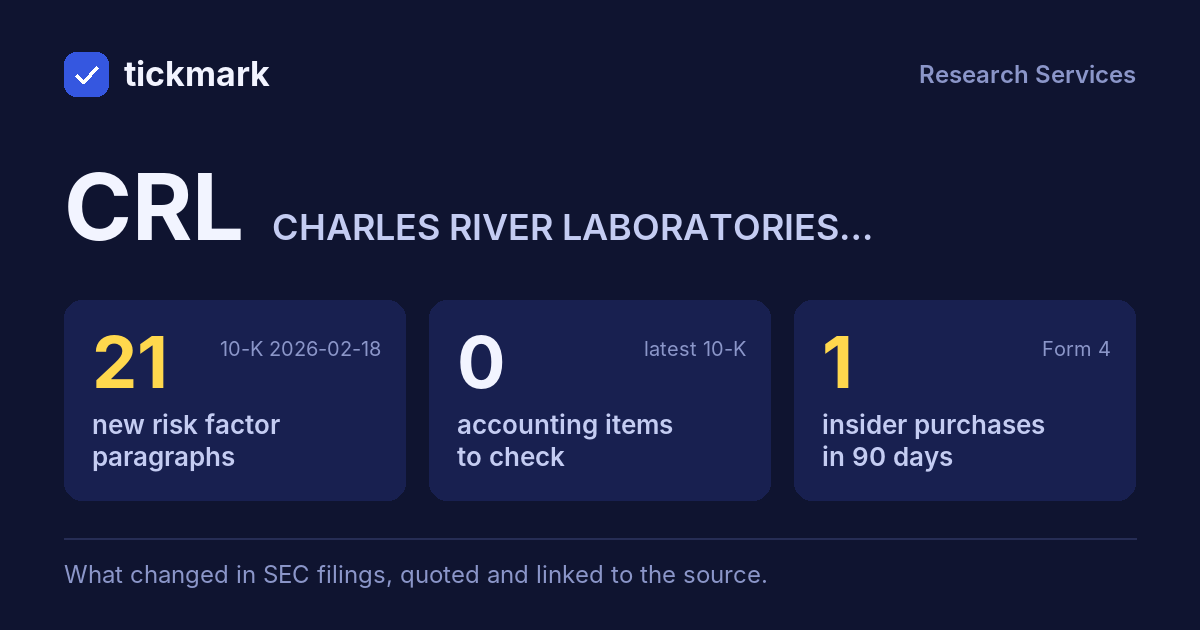
21 paragraphs in Risk Factors of the 10-K filed Feb 18, 2026
with nothing like them in the 10-K filed Feb 19, 2025. Quoted exactly.
Paragraphs that were only edited are under 10-K change.
Compared with the Risk Factors in the latest 10-K of the other 59 Health care companies:
a paragraph with at least half its words the same at another company is called similar, and the companies are listed under it.
A paragraph most of them have is marked boilerplate. No line means no other company has one like it.
This counts text; it does not say how serious a risk is.
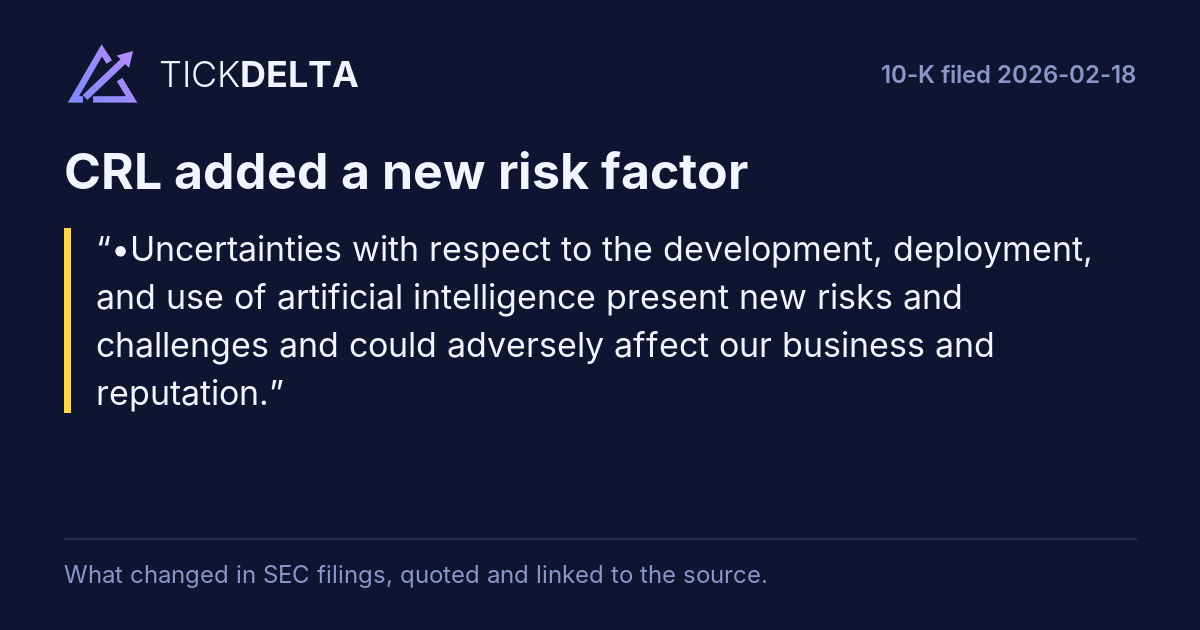
•Uncertainties with respect to the development, deployment, and use of artificial intelligence present new risks and challenges and could adversely affect our business and reputation.
Similar paragraph at 4 of 59 other Health care companies:
BIIB,
CI,
DHR,
ILMN
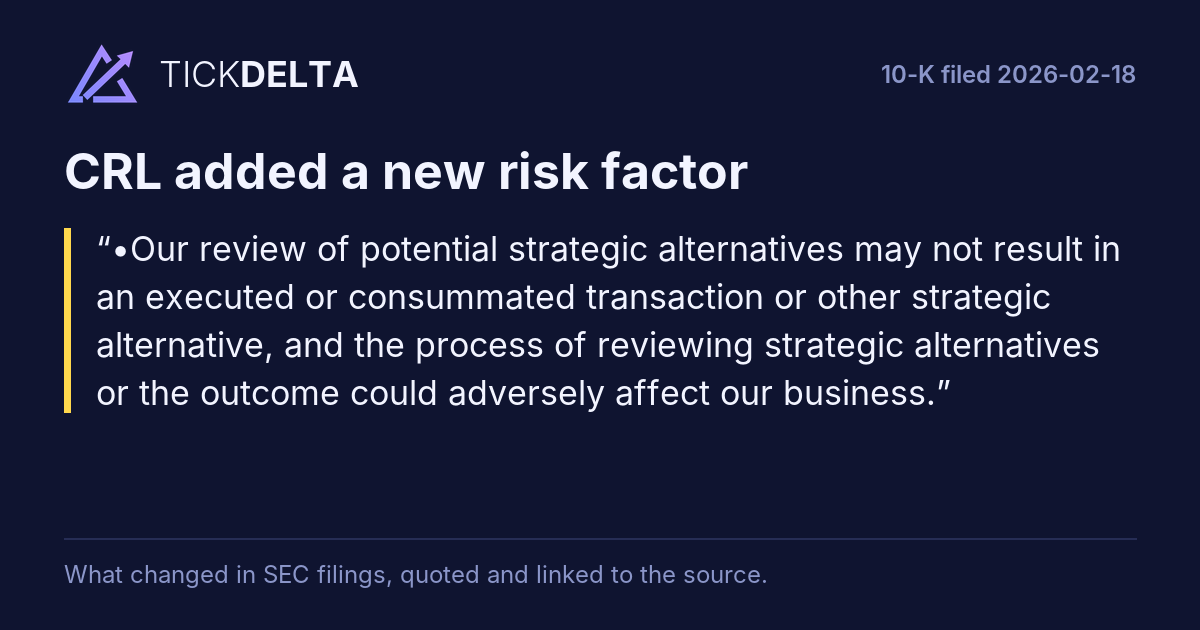
•Our review of potential strategic alternatives may not result in an executed or consummated transaction or other strategic alternative, and the process of reviewing strategic alternatives or the outcome could adversely affect our business.
Read in the 10-K ↗
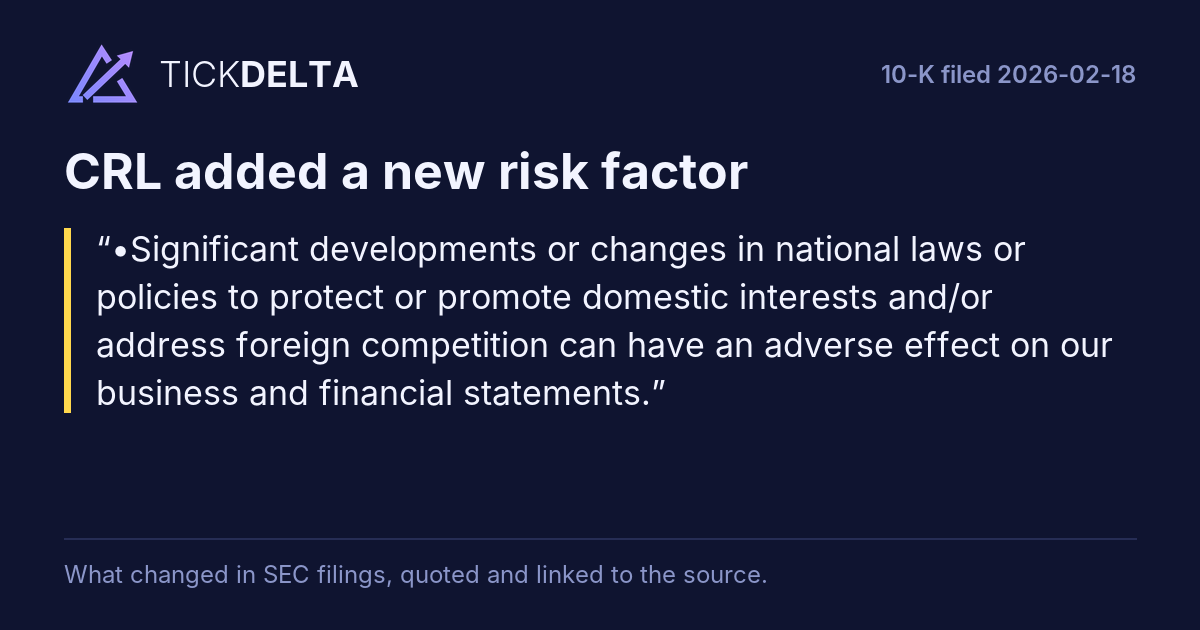
•Significant developments or changes in national laws or policies to protect or promote domestic interests and/or address foreign competition can have an adverse effect on our business and financial statements.
Similar paragraph at 2 of 59 other Health care companies:
DHR,
TECH
We leverage software and hardware solutions from technology and services providers, including software-as-a-service and public cloud infrastructure, who have been subject to cybersecurity incidents in the past and may have incidents or breaches in the future. As of the date of this filing, to our knowledge, no prior cybersecurity incident or breach at a third party has had a material impact on our business. However, future incidents or breaches could cause us to suffer significant harm.
Read in the 10-K ↗
Uncertainties with respect to the development, deployment, and use of artificial intelligence present new risks and challenges and could adversely affect our business and reputation.
Similar paragraph at 4 of 59 other Health care companies:
BIIB,
CI,
DHR,
ILMNWe, along with many businesses in the biopharmaceutical industry, are adopting and exploring the use of artificial intelligence (AI) in our business, and as an emerging and rapidly evolving technology, our use of AI introduces potential opportunities but also presents risks that could adversely affect our operations, information security and reputation. For example, algorithms may be flawed; data sets may be insufficient, of poor quality, or contain biased information; and inappropriate or controversial data practices by data scientists, engineers, and end-users could impair results. If the analyses that artificial intelligence-based applications assist in producing are deficient or inaccurate, we could be subjected to competitive harm, potential legal liability and brand or reputational harm. Use of AI-based software may also lead to cybersecurity risks or the release of confidential proprietary information, including personal data, which may impact our ability to realize the benefit of our intellectual property or violate our internal policies, data protection laws or contractual requirements. The use of AI-based software may also result in unauthorized access of personal data or the intellectual property of third parties. The legal and regulatory landscape regarding the use of AI is rapidly evolving, including in the areas of intellectual property, cybersecurity, and privacy and data protection. Compliance may impose operational costs and limit our ability to use AI-based software, and failure to comply may result in potential government actions, litigation, fines, penalties or adverse publicity.
Similar paragraph at 2 of 59 other Health care companies:
BIIB,
VTRS
manner. We may not be successful in managing these or any other significant risks that we encounter in divesting a business, site or product line or service offering and, as a result, we may not achieve some or all of the expected benefits of the divestitures.
Read in the 10-K ↗
•changes in trade relationships, including new tariffs, trade protection measures, import or export licensing requirements, trade embargoes and sanctions, and other trade barriers;
Read in the 10-K ↗
Our review of potential strategic alternatives may not result in an executed or consummated transaction or other strategic alternative, and the process of reviewing strategic alternatives or the outcome could adversely affect our business.
On May 6, 2025, in connection with a Cooperation Agreement entered into with a large shareholder of the Company, we agreed, among other things, to have the Strategic Planning and Capital Allocation Committee of our Board of Directors oversee and direct a comprehensive strategic review and evaluation of the Company’s business and prospects, including an examination of various alternatives to enhance long-term stockholder value. On November 5, 2025, the Company announced that, as part of our Board of Directors’ comprehensive strategic review of our business and growth prospects, we will focus on strategic initiatives to strengthen our leading scientific portfolio within our core markets through strategic acquisitions, partnerships, and internal investments; divest certain non-core assets; maximize our financial performance, including by implementing additional initiatives aimed at driving greater operating efficiency, which are expected to generate incremental net cost savings; and maintain a disciplined approach to capital deployment through regularly evaluating the optimal balance between strategic acquisitions, stock repurchases, debt repayment, and other uses of capital. There is no assurance that the process will result in the approval or completion of any specific transaction or outcome. Further, there is no guarantee that any transaction resulting from the strategic review will ultimately benefit our stockholders.
The process of reviewing potential strategic and operational alternatives is time consuming and costly and may divert management’s attention. It may also be disruptive to our business operations and long-term planning, which may cause concern to our current or potential investors, customers, employees, strategic partners, vendors and other stakeholders and may have a material impact on our operating results or result in increased volatility in our stock price.
Any potential transaction or other strategic alternative, including, without limitation the acquisitions of the assets of K.F. (Cambodia) Ltd. and Pathoquest SAS, would be dependent on a number of factors that may be beyond our control, including, among other things, market conditions, industry trends, regulatory approvals, and the availability of financing for a potential transaction on favorable terms. There can be no assurance that any potential transaction or other strategic alternative will be successfully implemented, achieve the intended benefits or provide greater value to our stockholders than that reflected in the current price of our common stock. Until the review process is concluded, perceived uncertainties related to our future may result in the loss of potential business opportunities, volatility in the market price of our common stock and difficulty attracting and retaining qualified talent and business partners.
Read in the 10-K ↗
4 more
The EU GDPR also imposes specific restrictions on the transfer of personal data to countries outside of the EU and EEA, including the use of appropriate safeguards to enable such transfers, such as Standard Contractual Clauses (SCCs) and the EU-
Read in the 10-K ↗
Significant developments or changes in national laws or policies to protect or promote domestic interests and/or address foreign competition can have an adverse effect on our business and financial statements.
Similar paragraph at 2 of 59 other Health care companies:
DHR,
TECHSignificant developments or changes in national laws or policies to protect or promote domestic interests and/or address foreign competition, including laws and policies in areas such as trade, manufacturing, government purchasing, healthcare, intellectual property, regulatory enforcement and investment/development, can adversely affect our business and financial statements. The U.S. has experienced a rapid increase in new government regulations, including tariffs and proposed tariffs on imports from a wide range of markets and geographies, including some in which we operate. These tariffs/proposed tariffs have prompted retaliatory tariffs by a number of countries and a cycle of retaliatory tariffs by both the U.S. and other countries. We continue to monitor the global tariff environment and potential trade conflicts, sanctions and impediments that could impact our business. As of the date of this report a number of tariffs remain in effect, including significant tariffs between the U.S. and countries from which we obtain significant supply, such as Vietnam, Mauritius, Cambodia, and China. Collectively, this may adversely impact our operating margin and results of operations, for example, our costs and expenses related to our business activities and those of our customers and suppliers; demand for our products and our competitive positioning; the availability to us of certain products in certain countries; and our supply chain operations. Though the risks identified above in certain cases have already adversely impacted part of our business, the full impact of these tariffs and other actions on the Company and on our business partners remains highly uncertain and subject to rapid change.
Similar paragraph at 1 of 59 other Health care companies:
DHR
During the fourth quarter 2025, we performed the quantitative goodwill impairment test for our reporting units and upon completion, it was determined that the fair value of the Biologics Solutions reporting unit did not exceed its carrying value, resulting in a goodwill impairment charge of $165.0 million. This was primarily attributable to a decline in its operating performance, resulting in a reduction to the long-range financial plan of the reporting unit, and evolving market information in the fourth quarter of 2025. The fair value of the Biologics Solutions reporting unit tested for impairment during 2025 was determined based on a discounted cash flow model (an income approach), and sales and earnings multiples based on the guideline public company method, and other market information (a market approach). The discounted cash flow model used to
determine the fair value of the Biologics Solutions reporting unit reflected significant assumptions related to future revenue, a long term growth rate, operating income margins, and a discount rate based on a weighted-average cost of capital. Significant assumptions used in the market approach included earnings multiples, sales multiples, and other market information about the value of certain asset groups within the reporting unit. The Biologics Solutions reporting unit fair value measurement is classified as Level 3 in the fair value hierarchy because they involve significant unobservable inputs. We will continue to closely monitor future performance and any potential impacts on the value of the reporting unit. If the estimated future cash flows decrease below our current expectations, specifically as a result of lower revenue growth rates or operating income margins, or due to an increase of the weighted-average cost of capital, the fair value may further decrease resulting in an incremental material goodwill impairment.
Excluding the impairment charge associated with the Biologics Solutions reporting unit, our 2025 annual impairment test indicated that goodwill was not impaired for any other reporting units.
Read in the 10-K ↗
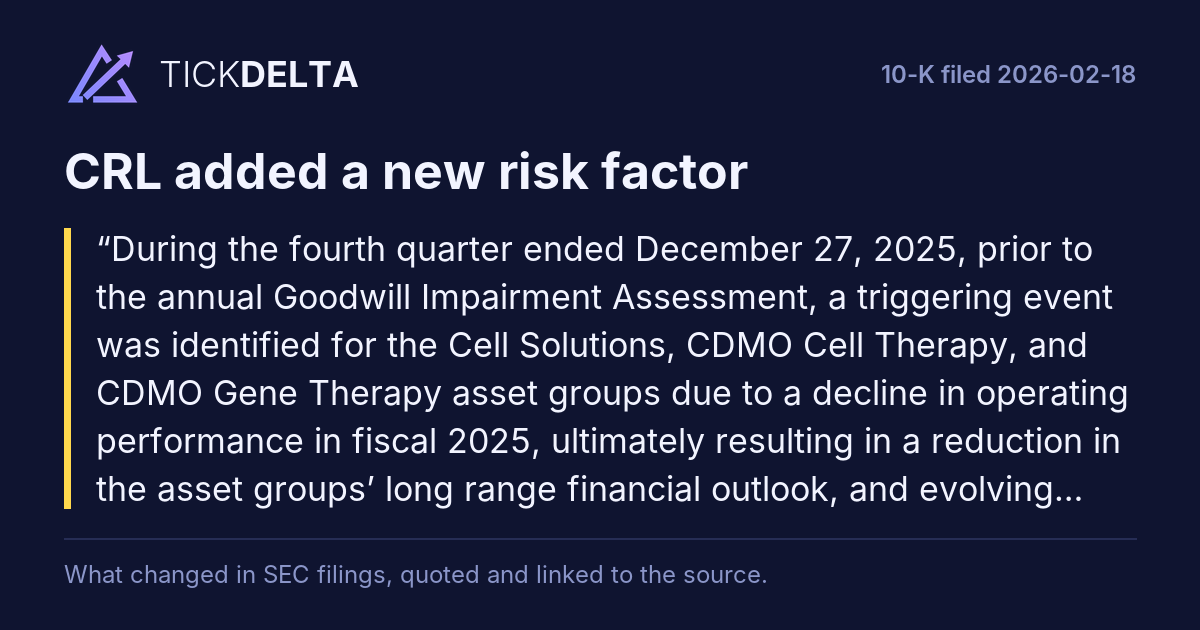
During the fourth quarter ended December 27, 2025, prior to the annual Goodwill Impairment Assessment, a triggering event was identified for the Cell Solutions, CDMO Cell Therapy, and CDMO Gene Therapy asset groups due to a decline in operating performance in fiscal 2025, ultimately resulting in a reduction in the asset groups’ long range financial outlook, and evolving market information about these asset groups identified in the fourth quarter of 2025. Cell Solutions is presented within the RMS reportable segment, while CDMO Cell Therapy and CDMO Gene Therapy are presented within the Manufacturing reportable segment. In response, we conducted a recoverability test for each asset group, based on an estimate of undiscounted future cash flows for various recoverability scenarios, to determine if the asset groups were impaired. Upon completion of the recoverability test, it was determined that the probability-weighted undiscounted cash flows of the CDMO Cell Therapy asset group exceeded its carrying value. The Cell Solutions and CDMO Gene Therapy asset groups probability-weighted undiscounted cash flows did not exceed their carrying value, resulting in an intangible asset impairment charge of approximately $211.0 million and impairment charges of approximately $8.0 million within Property, plant, and equipment, net and Operating lease right-of-use assets.
During the fourth quarter ended December 28, 2024, a triggering event was identified for the CDMO Cell Therapy asset group within the Biologics Solutions business, part of the Manufacturing reportable segment, as there was a loss of key customers, resulting in a significant reduction in cash flows. We concluded there were no impairments for the asset group related to this triggering event, however the remaining useful life of the intangible asset within the asset group was reduced to less than 1 year.
For additional information regarding this topic, please see Note 10. Goodwill and Intangible Assets, included in the notes to our consolidated financial statements included elsewhere in this Form 10-K.
Similar paragraph at 4 of 59 other Health care companies:
BAX,
CI,
GILD,
JNJ
New in the latest 10-Q
5 paragraphs in the 10-Q filed Nov 4, 2026 with nothing like
them in the 10-Q filed Aug 5, 2026 (at least half the words must differ; new numbers alone do not count).
Quoted exactly, grouped by the item heading above them. This is text that changed, not a judgement of how serious it is.
Financial statements and notes
In September 2026, the Company announced “Create the Future,” a multi-year restructuring program intended to modernize operations, improve client experience, and enhance profitability through AI and automation, simplification and digitization, and enterprise optimization. Create the Future builds upon actions already underway, including process improvements, procurement synergies, global business service expansion, workforce optimization, and real estate footprint rationalization.
Read in the 10-Q ↗
We continuously assess opportunities to drive greater efficiencies through process improvements, cost-savings initiatives, and restructuring actions. During the third quarter of fiscal 2026, we announced our Create the Future program, which formalizes and expands the Company’s ongoing transformation and efficiency initiatives under a unified operating framework. Create the Future builds upon actions already underway, including process improvements, procurement synergies, global business service expansion, workforce optimization, and real estate footprint rationalization, while introducing additional initiatives focused on AI-enabled automation, simplification and digitization, and enterprise optimization.
Read in the 10-Q ↗
Through the ongoing actions, the Company expects to achieve approximately $300 million of cumulative annualized cost savings by the end of 2026, with more than $175 million realized through fiscal 2025. In addition, the Create the Future program is expected to generate incremental cost savings in excess of $300 million between 2027 and 2030. Workforce-related actions have primarily resulted in severance and transition costs, while facility optimization activities have resulted in asset impairment charges, accelerated depreciation, and other site-related costs. Restructuring charges were $19.2 million and $73.8 million during the three and nine months ended September 26, 2026, respectively, compared with $99.8 million and $107.0 million in fiscal 2025 and 2024, respectively. For further details of these costs, see Note 15 - Restructuring and Asset Impairments in Part I, Item 1.
Read in the 10-Q ↗
benefit resulting from the reversal of an unrecognized tax benefit reserve following the enactment of tax legislation and completion of certain tax requirements in a foreign jurisdiction.
Read in the 10-Q ↗
Payment of contingent consideration and deferred consideration for acquisitions (111,394) (21,822)
Read in the 10-Q ↗
The 10-Q's risk factors against the 10-K
Item 1A of the 10-Q filed Nov 4, 2026 against Item 1A of the 10-K filed Feb 18, 2026.
A 10-Q repeats only the risks that changed, so a 10-K paragraph that is missing from it is not counted as removed.
Added is a paragraph with nothing like it in the 10-K, Reworded a sentence that is in both with several words changed,
Quiet changes a sentence in both where one to four words changed and one is a hedge or a modal
(cut words struck through, new words highlighted and underlined).
Text on the page, not a score; each links to the filing at sec.gov.
Added10-Q 2026-11-04 vs 10-K 2026-02-18
In addition to the other information set forth in this report, you should carefully consider the factors discussed in Part I, “Item 1A. Risk Factors” in our 2025 Form 10-K and in Part II, “Item 1A. Risk Factors” in our Quarterly Report on Form 10-Q for the quarter ended March 28, 2026 (Q1 10-Q) which could materially affect our business, financial condition, and/or future results. The risks described in our 2025 Form 10-K and in our Q1 10-Q are not the only risks we face. Additional risks and uncertainties not currently known to us or that we currently deem to be immaterial also may materially adversely affect our business, financial condition, and/or operating results. Except for the risk factor disclosed in Part II, Item 1A of the Q1 10-Q, which is hereby incorporated by reference into this Part II, Item 1A of this Form 10-Q, there have been no material changes to the Company’s risk factors since the 2025 Form 10-K.
Read it in the 10-Q at sec.gov ↗