Added10-Q Nov 5, 2026 vs 10-K May 22, 2026
• we are prevented from accessing information necessary to conduct our business;
Each branch is a paragraph in Risk Factors with nothing like it in the 10-K filed May 23, 2025. A box jumps to the paragraph as filed, below.
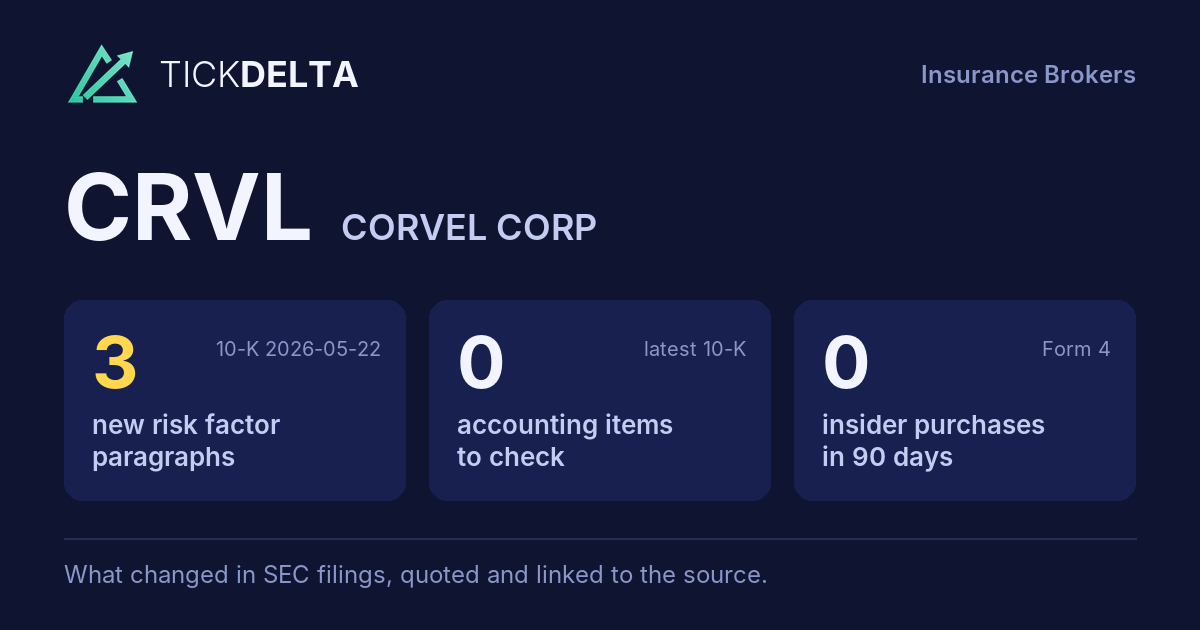
3 paragraphs in Risk Factors of the 10-K filed May 22, 2026 with nothing like them in the 10-K filed May 23, 2025. Quoted exactly. Paragraphs that were only edited are under 10-K change.
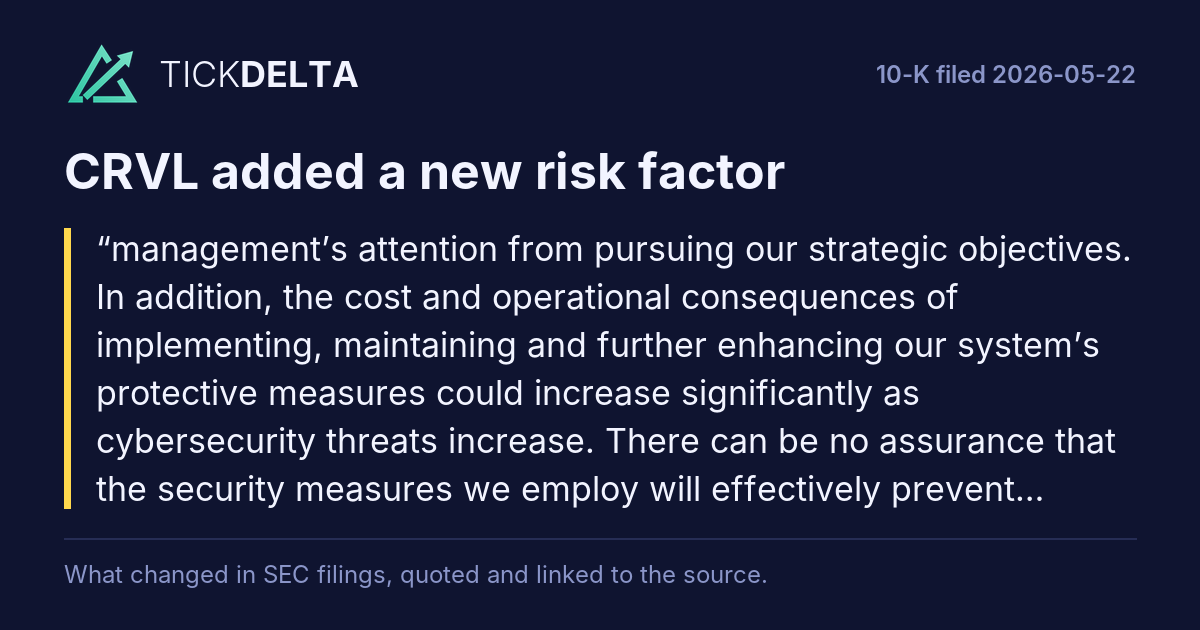
management’s attention from pursuing our strategic objectives. In addition, the cost and operational consequences of implementing, maintaining and further enhancing our system’s protective measures could increase significantly as cybersecurity threats increase. There can be no assurance that the security measures we employ will effectively prevent cybersecurity incidents or otherwise prevent malicious actors from obtaining access to our systems and information.
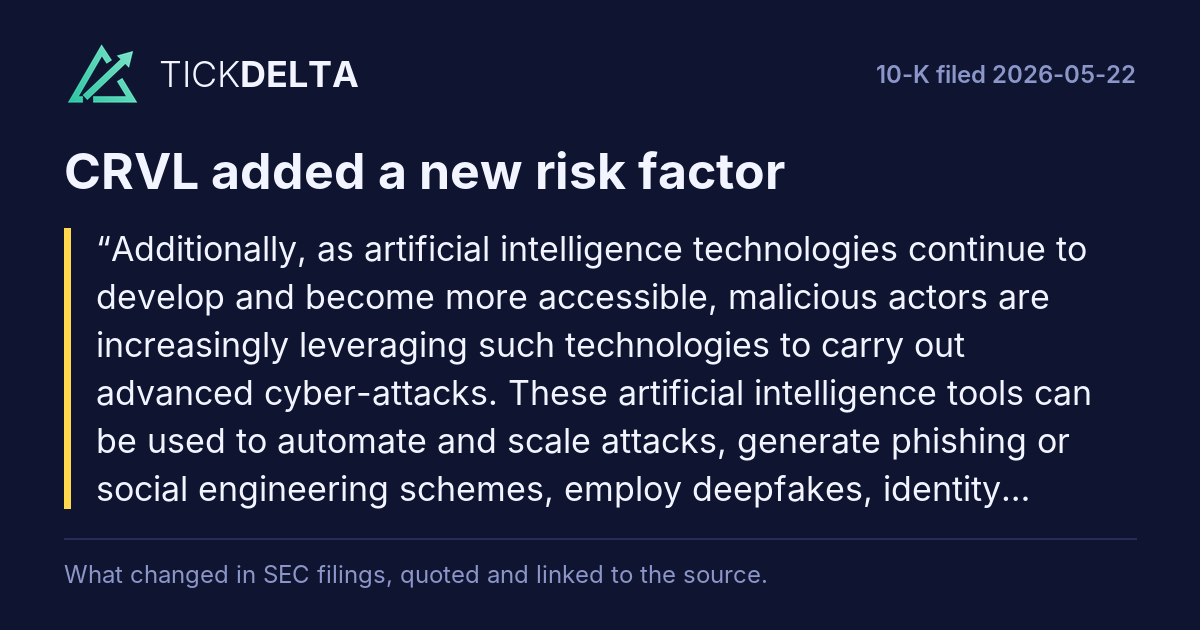
Additionally, as artificial intelligence technologies continue to develop and become more accessible, malicious actors are increasingly leveraging such technologies to carry out advanced cyber-attacks. These artificial intelligence tools can be used to automate and scale attacks, generate phishing or social engineering schemes, employ deepfakes, identity system vulnerabilities, or evade transitional detection methods. Consequently, the use of artificial intelligence by malicious actors may result in an increase in the frequency, speed, and severity of cybersecurity threats targeting our systems, networks, and employees.
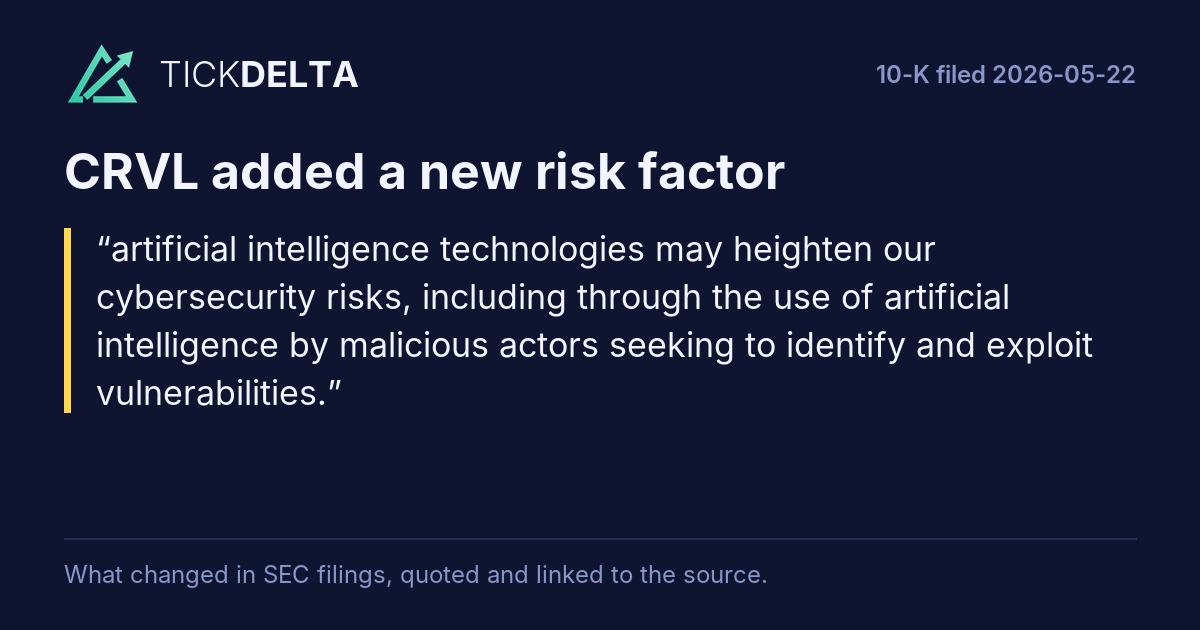
artificial intelligence technologies may heighten our cybersecurity risks, including through the use of artificial intelligence by malicious actors seeking to identify and exploit vulnerabilities.
New in the latest 10-Q
4 paragraphs in the 10-Q filed Nov 5, 2026 with nothing like them in the 10-Q filed Aug 6, 2026 (at least half the words must differ; new numbers alone do not count). Quoted exactly, grouped by the item heading above them. This is text that changed, not a judgement of how serious it is.
Six months ended September 30, 2026 compared to six months ended September 30, 2025
Read in the 10-Q
Six months ended September 30, 2026 compared to six months ended September 30, 2025
Read in the 10-Q
Six months ended September 30, 2026 compared to six months ended September 30, 2025
Read in the 10-Q
CORVEL CORPORATION Dated: November 5, 2026 By: /s/ Sarah A. Scott Sarah A. Scott
Read in the 10-Q
Item 1A of the 10-Q filed Nov 5, 2026 against Item 1A of the 10-K filed May 22, 2026.
A 10-Q repeats only the risks that changed, so a 10-K paragraph that is missing from it is not counted as removed.
Added is a paragraph with nothing like it in the 10-K, Reworded a sentence that is in both with several words changed,
Quiet changes a sentence in both where one to four words changed and one is a hedge or a modal
(cut words struck through, new words highlighted).
Text on the page, not a score; each links to the filing at sec.gov.
What the 10-Q itself says about its risk factors:A restated description of the risk factors associated with our business is set forth below. This description includes any and all changes (whether or not material) to, and supersedes, the description of the risk factors associated with our business previously disclosed in Part I, Item 1A of our Annual Report.
Read in the 10-Q
Two-word phrases in Risk Factors of the 10-K filed May 22, 2026 that are in none of the 1 earlier 10-Ks stored, back to May 23, 2025
Used at least twice, small words left out. Counted, not picked: a phrase can be new because the company renamed something.
Item 1A of each 10-K and 10-Q on EDGAR, quoted exactly. Each paragraph links to the filing at sec.gov.
10-K change: what was reworded or cut, section by section.
Excel workbook · CSV. Google Sheet that stays up to date: paste =IMPORTDATA("https://tickdelta.com/company/CRVL/export.csv") into a cell.