Screener / SEC EDGAR /CIK 0000790051 /10-K filed Feb 13, 2026, compared with Feb 14, 2025 /Numbers from the XBRL of the 10-Ks
NYSE Materials · Fabricated Rubber Products

Carlisle Companies Inc CSL

Compare with peers Embed
SEC comment letters, last 20 years

4 reviews of CSL's filings by SEC staff

UPLOAD and CORRESP
Reviews 4 latest letter May 15, 2023
Questions asked 11 each answered in the company's own letter
No closing letter 0 reviews without a letter saying the staff completed it

When the SEC's staff reviews a filing, it writes to the company with numbered questions, and the company answers each one in a letter. SEC publishes the exchange once the review is over, at least 20 business days later. A question is not an accusation; most reviews end with the company adding detail to its next filing.

How the reviews went

Every review on EDGAR, from the first staff letter to the letter that closes it

  1. 1. Staff letters 5 UPLOAD
  2. 2. Questions in them 11 numbered comments
  3. 3. Company replies 5 CORRESP
  4. 4. Reviews closed 4 of 4 closing letter

Half the closed reviews took 36 days or less from the first letter to the closing letter.

Form 10-K

2023-05-15 to 2023-06-09 · 4 questions · 1 letter from the SEC, 1 from the company
Review closed 2023-06-09
RevenueResults discussion (MD&A)SegmentsAcquisitionsLiquidity and cashCritical estimatesInventoryLegal and contingencies
Management's Discussion and Analysis of Financial Condition and Results of Operations · Consolidated Results of Operations, page 20
SEC asked (1)
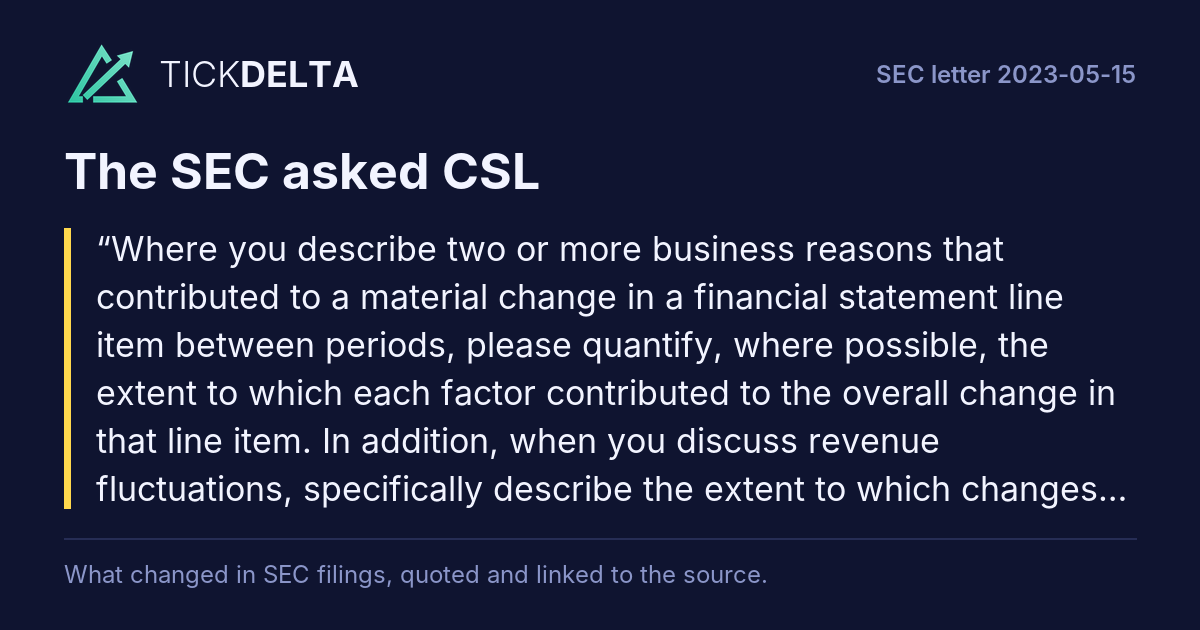
Where you describe two or more business reasons that contributed to a material change in a financial statement line item between periods, please quantify, where possible, the extent to which each factor contributed to the overall change in that line item.
Rest of the question

In addition, when you discuss revenue fluctuations, specifically describe the extent to which changes are attributable to changes in prices or to changes in the volume or amount of goods or services being sold or to the introduction of new products or services. Please apply this comment to both your consolidated and segment results of operations. As an example, your disclosures on page 20 attribute the increase in revenues to positive pricing across all segments, contributions from an acquisition, and higher sales volumes, partially offset by unfavorable foreign currency impacts. See Item 303 of Regulation S-K, including Item 303(b)(2), and SEC Release No. 33-8350.

CSL answered
We confirm that in future filings when we describe two or more business reasons that contributed to a material change in a financial statement line item between periods, we will quantify, where possible, the extent to which each factor contributed to the overall change in that line item.

With respect to specifically describing the extent to which material changes in revenue from period to period are attributable to changes in prices or to changes in the volume or amount of goods or services being sold or to the introduction of new products or services, our revenues are impacted by factors in
Rest of the answer

addition to price and volume. Across our businesses, we offer many products that are sold at varying prices to different customers in different regions. In some cases, unit measures and directly corresponding price changes may be calculable; in other cases the same products may be sold in different units at different prices. Ongoing new product launches and product discontinuances contribute to product mix changes that impact specific price/volume calculations. In some cases, changes in unit volumes may have a pricing component as a result of promotions or from groups of products sold at a combined price or discount from prices of the products sold separately. Accordingly, while we estimate pricing /volume changes at a high level for internal management purposes, it would be prohibitively burdensome to calculate such changes with sufficient detail to accurately include this data in our public disclosures.

Read in the reply
In its next report

First report after the company's reply of Jun 8, 2023: 10-Q filed Jul 27, 2023 ↗, against the 10-Q filed Apr 28, 2023 ↗.

Tickdelta does not hold the text of both reports, so they are not compared here.
Liquidity and Capital Resources · Sources and Uses of Cash and Cash Equivalents, page 26
SEC asked (2)
Please provide a more informative discussion and analysis of cash flows from operating activities, including changes in working capital components, for the periods presented. In doing so, explain the underlying reasons and implications of material changes between periods to provide investors with an understanding of trends and variability in cash flows.
Rest of the question

Also ensure that your disclosures are not merely a recitation of changes evident from the financial statements. Please refer to Item 303(a) of Regulation S-K and SEC Release No. 33-8350.

CSL answered
In future filings, beginning with the Company's Form 10-Q for the period ended June 30, 2023, the Company will revise the following paragraphs within its disclosure of Liquidity and Capital Resources, included in Part I, Item 2. Management's Discussion and Analysis of Financial Condition and Results of Operations, in a manner similar to the following:

Operating Activities

We generated operating cash flows totaling $1,000.9 million for 2022 (including working capital uses of $222.0 million), compared with $421.7 million for 2021 (including working capital uses of $275.2 million).
Rest of the answer

Higher operating cash flows of $579.2 million in 2022 primarily reflected higher net income of $502.3 million reflecting improved operating results, and a reduction in working capital uses of $53.2 million related to collection of accounts receivable of $181.0 million reflecting increased revenues, partially offset by a reduction in accounts payable of $145.9 million reflecting reduced purchases to manage inventory balances as we return to normal seasonal buying patterns.

Read in the reply
In its next report

First report after the company's reply of Jun 8, 2023: 10-Q filed Jul 27, 2023 ↗, against the 10-Q filed Apr 28, 2023 ↗.

Tickdelta does not hold the text of both reports, so they are not compared here.

Critical Accounting Estimates · Revenue Recognition, page 31
SEC asked (3)
Within the last bullet of this section, you disclose that critical judgments and estimates related to revenue recognition for certain customer contracts includes the measurement of revenue "using the key inputs of expected gross margin and inventory in our possession." Please tell us and revise your disclosures to clarify what this bullet is intending to convey.
Rest of the question

To the extent this disclosure pertains to accounting for performance obligation satisfied over time, ensure you provide the disclosures required by ASC 606-10-50-18.

CSL answered
In future filings, beginning with the Company's Form 10-K for the period ended December 31, 2023, the Company will revise the following paragraphs within its disclosure of Critical Accounting Estimates - Revenue Recognition, included in Part II, Item 7. Management's Discussion and Analysis of Financial Condition and Results of Operations, in a manner similar to the following:

Revenue Recognition

Revenue is recognized when obligations under the terms of a contract with a customer are satisfied; generally, this occurs with the transfer of control of our products or services.
Rest of the answer

Revenue is measured as the amount of total consideration expected to be received in exchange for transferring goods or providing services. Total expected consideration, in certain cases, is estimated at each reporting period, including interim periods, and is subject to change with variability dependent on future events, such as customer behavior related to future purchase volumes, returns, early payment discounts and other customer allowances. Estimates for rights of return, discounts and rebates to customers, and other adjustments for variable consideration are provided for at the time of sale as a deduction to revenue, based on an analysis of historical experience and actual sales data. Changes in these estimates are reflected as an adjustment to revenue in the period identified. Sales, value added and other taxes collected concurrently with revenue-producing activities are excluded from revenue.

We receive payment at the inception of the contract for separately priced extended service warranties, and revenue is deferred and recognized on a straight-line basis over the life of the contracts. The term of these warranties ranges from five to 40 years. The weighted average life of the contracts as of December 31, 2022, is approximately 20 years.

Additionally, critical judgments and estimates related to revenue recognition relative to certain customer contracts in our CIT and CFT segments, in which they are contract manufacturers or where they have entered into an agreement to provide both services (engineering and design) and products resulting from those services, include the following:

•Determination of whether revenue is earned at a "point-in-time" or "over time": Where contracts provide for the manufacture of highly customized products with no alternative use and provide CIT or CFT the right to payment for work performed to date, including a normal margin for that effort, we have concluded those contracts require the recognition of revenue over time.

•For performance obligations satisfied over time, revenue is determined using the input method as we believe that best depicts the transfer of control to the customer, as the customer controls the inventory as it is produced. Measurement of revenue uses the key inputs of inventory in our possession and expected gross margin. We believe inventory reflects an appropriate measure of cost incurred to date, relative to total costs, to which we apply an expected gross margin to determine revenues. We utilize an estimate of expected gross margin based on historical margin patterns and management’s experience, which may vary based on the customers and end markets being evaluated. There are multiple unique customer contracts at CIT or CFT. Accordingly, the estimate of expected margin is done for each customer discretely. We review the margins for these categories as contracts, customers and product profiles change over time so that the margin expectations reflect the best available data for each category.

Additionally, in future filings, beginning with the Company's Form 10-Q for the period ended June 30, 2023, the Company will revise its disclosure of of Note 6--Revenue Recognition, included in Part I, Item 1. Financial Statements, for the underlined items above, as applicable.

Read in the reply
In its next report

First report after the company's reply of Jun 8, 2023: 10-Q filed Jul 27, 2023 ↗, against the 10-Q filed Apr 28, 2023 ↗.

Tickdelta does not hold the text of both reports, so they are not compared here.

Note 17 - Commitments and Contingencies · Litigation, page 74
SEC asked (4)
Please address the following comments related to your asbestos-related claims: • We note your disclosure that you "may recognize expenses for indemnity and defense costs in particular periods if and when it becomes probable that such costs will not be covered by insurance." As this disclosures suggests that you may not record litigation expense if covered by insurance, please clarify for us whether or not you
Rest of the question

separately account for and record litigation accruals and insurance recoveries on a gross basis. • Tell us where on the balance sheet you classify litigation-related insurance receivables and contingency accruals. If presented on a net basis, tell us how the balances meet the right of setoff criteria specified in ASC 210-20-45-1.

CSL answered
The Company recognizes a liability and corresponding expense for asbestos-related indemnity claims when they are considered probable and estimable. These liabilities are reflected within the Company's balance sheet as "accrued and other current liabilities" and "other long-term liabilities," as applicable depending on the expected future payment date.

Separately, the Company recognizes insurance receivables and corresponding income for asbestos-related coverage claims when recovery is considered probable and the amount is determinable, not to exceed the amount of the covered loss.
Rest of the answer

These assets are reflected within the Company's balance sheet as "other current assets" and "other long-term assets," as applicable depending on the expected future receipt of payment.

As disclosed in the Company's Form 10-K for the year ended December 31, 2022, the Company's policy is to expense legal defense costs related to such matters as incurred. Additionally, the Company records an insurance receivable for defense costs when recovery is considered probable and the amount is determinable, not to exceed the amount of the covered loss. Balances related to defense costs and insurance recoveries are reflected as "accrued and other current liabilities" and "other current assets," respectively, on the Company's balance sheet.

In future filings, beginning with the Company's Form 10-Q for the period ended June 30, 2023, the Company will revise the following paragraphs within its disclosure of Note 15--Commitments and Contingencies, included in Part I, Item 1. Financial Statements, in a manner similar to the following:

Litigation

Over the years, the Company has been named as a defendant, along with numerous other defendants, in lawsuits in various courts in which plaintiffs have alleged injury due to exposure to asbestos-containing friction products produced and sold predominantly by the Company’s discontinued Motion Control business between the late-1940s and the mid-1980s. The Company has been subject to liabilities for indemnity and defense costs associated with these lawsuits.

The Company has recorded a liability for estimated indemnity costs associated with pending and future asbestos claims. As of December 31, 2022, the Company believes that its accrual for these costs is not material to the Company's financial position, results of operations or operating cash flows.

The Company recognizes expenses for defense costs associated with asbestos claims during the periods in which they are incurred. Refer to Note 1 for the Company’s accounting policy related to litigation defense costs.

The Company currently maintains insurance coverage with respect to asbestos-related claims and associated defense costs. The Company records the insurance coverage as a receivable in an amount it reasonably estimates is probable of recovery for pending and future asbestos-related indemnity claims. Since the Company’s insurance coverage contains various exclusions, limits of coverage and self-insured retentions and may be subject to insurance coverage disputes, the Company may incur expenses for indemnity and defense costs and income from insurance recoveries in different periods, as such recoveries are recorded only if and when it becomes probable that such costs will be covered by insurance.

Read in the reply
In its next report

First report after the company's reply of Jun 8, 2023: 10-Q filed Jul 27, 2023 ↗, against the 10-Q filed Apr 28, 2023 ↗.

Tickdelta does not hold the text of both reports, so they are not compared here.

Also in this review: request for more time, May 26, 2023, closing letter, 2023-06-09
Form 10-K

2020-05-15 to 2020-05-21 · 1 question · 1 letter from the SEC, 1 from the company
Review closed 2020-05-21
Goodwill and impairment
Notes to Condensed Consolidated Financial Statements (Unaudited) · Goodwill and Other Intangible Assets, net, page 15
SEC asked
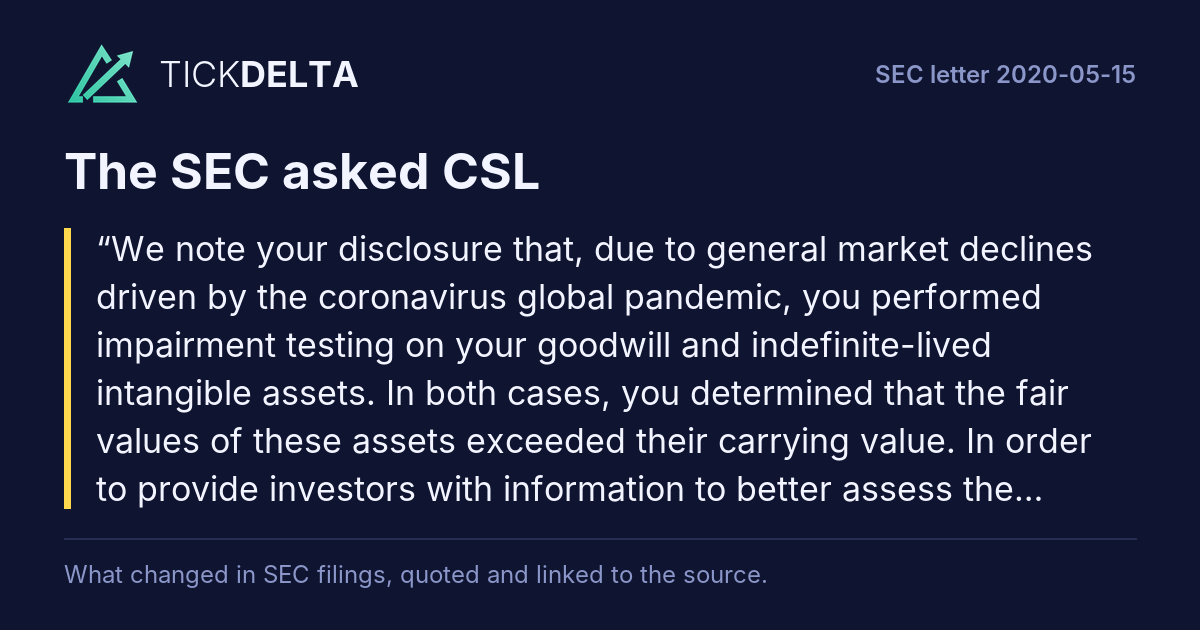
We note your disclosure that, due to general market declines driven by the coronavirus global pandemic, you performed impairment testing on your goodwill and indefinite-lived intangible assets. In both cases, you determined that the fair values of these assets exceeded their carrying value.
Rest of the question

In order to provide investors with information to better assess the probability of future goodwill impairment charges, please disclose, if accurate, that the estimated fair values of the intangible assets you quantitatively tested for impairment substantially exceeded their carrying values. For any asset whose estimated fair value did not substantially exceed its carrying value, please disclose the percentage by which fair value exceeded carrying value at the date of the most recent test.

CSL answered
In future filings, beginning with the Company’s Form 10-Q for the period ending June 30, 2020, the Company will revise the following paragraphs within its disclosure of Critical Accounting Estimates – Subsequent Measurement of Goodwill and Subsequent Measurement of Indefinite-Lived Intangible Assets, included in Part I, Item 2.
Rest of the answer

Management’s Discussion and Analysis of Financial Condition and Results of Operations, in a manner similar to the following:,

Subsequent Measurement of Goodwill

In the first quarter of 2020, changes in facts and circumstances and general market declines from COVID-19 resulted in reduced expectations of future operating results. We considered these circumstances and the potential long-term impact on cash flows associated with our reporting units and determined that an indicator of possible impairment existed within our CFT and CBF reporting units. Accordingly, we tested our goodwill for impairment as of March 31, 2020. Those reporting units were tested for impairment using the quantitative approach described above, resulting in fair value that exceeded the carrying amount for each of the reporting units by approximately 10 percent. The carrying amount of goodwill for the CFT and CBF reporting units was $185.6 million and $96.4 million, respectively.

Subsequent Measurement of Indefinite-Lived Intangible Assets

Based on the output of the analysis, we determined that the fair values of both the CFT and CBF indefinite-lived trade names substantially exceeded their carrying amounts. Accordingly, no impairment charges were required as of March 31, 2020. The carrying amount of indefinite-lived trade names for CFT and CBF were $129.1 million and $42.0 million, respectively.

Additionally, we will update these proposed disclosures if another required impairment test is performed in the second quarter of 2020, or other future periods.

Read in the reply
In its next report

First report after the company's reply of May 21, 2020: 10-Q filed Jul 23, 2020 ↗, against the 10-Q filed Apr 23, 2020 ↗.

Tickdelta does not hold the text of both reports, so they are not compared here.

Also in this review: closing letter, 2020-05-21

Form 10-K for the year ended December 31, 2017

2018-06-19 to 2018-07-25 · 2 questions · 1 letter from the SEC, 1 from the company
Review closed 2018-07-25
Results discussion (MD&A)AcquisitionsControls
Management's Discussion and Analysis, page 14 · Acquisitions, page 16
SEC asked (1)
We note the divestiture of CFS was announced on February 1, 2018, was completed on March 20, 2018 and was accounted for as a discontinued operation as of March 31, 2018. Please tell us how you determined it was not appropriate to classify the CFS assets and liabilities as held for sale in accordance with ASC 205-20-45-1E.
CSL answered
At December 31, 2017, the CFS assets and liabilities were not classified as held for sale, as all of the criteria in ASC 205-20-45-1E were not met. Specifically, the criterion in ASC 205-20-45-1E(a), "management, having the authority to approve the action, commits to a plan to sell the entity to be sold," and ASC-205-20-45-1E(d), "the sale of the entity to be sold is probable, and transfer of the entity to be sold is expected to qualify for recognition as a completed sale, within one year," were not met as this transaction to sell CFS required the approval of the Board of Directors.
Rest of the answer

The Board of Directors approved the Company to enter into a definitive agreement to sell CFS on January 30, 2018, therefore the Company had not committed to a plan to sell, nor was the sale probable within one year, prior to that date.

Read in the reply
In its next report

First report after the company's reply of Jul 18, 2018: 10-Q filed Jul 26, 2018 ↗, against the 10-Q filed Apr 27, 2018 ↗.

Tickdelta does not hold the text of both reports, so they are not compared here.

Form 10-Q for the period ended March 31, 2018 · Controls and Procedures, page 34
SEC asked (2)
We note your statement "With the exception of the adoption of the new accounting standard and integration activities described above, there were no changes in the Company’s internal control over financial reporting that have materially affected, or are reasonably likely to materially affect, the Company’s internal control over financial reporting." Please revise your disclosure to make an unqualified statement that,
Rest of the question

if true, there were no changes in your internal control over financial reporting during the last fiscal quarter that has materially affected, or are reasonably likely to materially affect, your internal control over financial reporting.

CSL answered
In future filings, beginning with the Company’s Form 10-Q for the period ending June 30, 2018, the Company will revise its disclosure for Controls and Procedures in a manner similar to the following:

During the first and second quarters of 2018, there have been no changes in the Company’s internal control over financial reporting that have materially affected, or are reasonably likely to materially affect, the Company’s internal control over financial reporting.
Read in the reply
In its next report

First report after the company's reply of Jul 18, 2018: 10-Q filed Jul 26, 2018 ↗, against the 10-Q filed Apr 27, 2018 ↗.

Tickdelta does not hold the text of both reports, so they are not compared here.

Also in this review: closing letter, 2018-07-25

Form 10-K

2017-06-09 to 2017-08-03 · 4 questions · 2 letters from the SEC, 2 from the company
Review closed 2017-08-03
Results discussion (MD&A)Goodwill and impairmentCritical estimatesIncome taxesNon-GAAP measuresSegments
Management’s Discussion and Analysis, page 15 · Results of Operations, page 18
SEC asked (1)
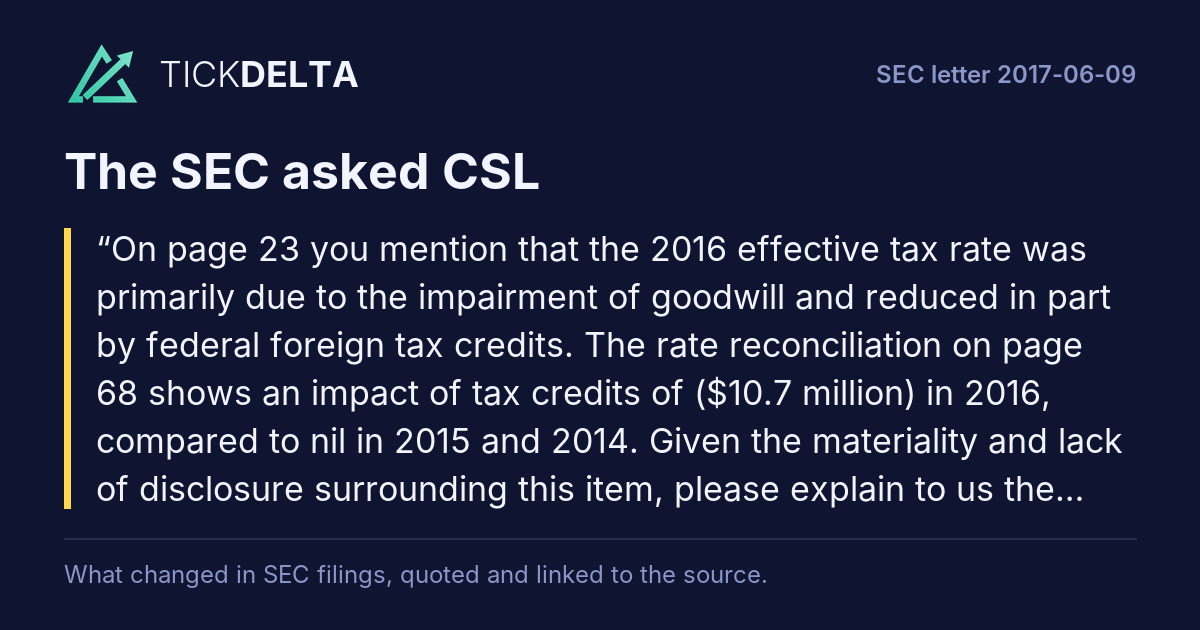
On page 23 you mention that the 2016 effective tax rate was primarily due to the impairment of goodwill and reduced in part by federal foreign tax credits. The rate reconciliation on page 68 shows an impact of tax credits of ($10.7 million) in 2016, compared to nil in 2015 and 2014.
Rest of the question

Given the materiality and lack of disclosure surrounding this item, please explain to us the transaction(s) generating the credits and/or the nature thereof, the jurisdiction and expiration dates of the most significant credits and why there is no impact in 2015 and 2014. Revise your disclosures in MD&A accordingly to the extent material.

CSL answered
In the fourth quarter of 2016, Carlisle made a distribution from a foreign subsidiary to the United States ("US"), which resulted in a taxable dividend and US Federal foreign tax credits for a net tax benefit of approximately $9 million. In addition to US Federal foreign tax credits, Carlisle also realized US research and development and other credits that would otherwise not be material enough to separate in the tax rate reconciliation within Footnote 6 in the Notes to the Financial Statements in the Form 10-K for the year ended December 31, 2016.
Rest of the answer

The Company made no similar distributions in 2015 or 2014. At the end of 2016, there were approximately $6.6 million of US Federal foreign tax credit carryovers, which have an expiration date of 2026.

In future filings, beginning with the Company’s Form 10-K for the year ending December 31, 2017, the Company will revise its previous discussion in Results of Operations related to income taxes as follows:

The 2016 effective income tax rate of 38.9% differs from the U.S. Federal tax rate of 35% primarily due to the impairment of goodwill, reduced by foreign earnings taxed at lower rates, the deduction for U.S. manufacturing activities, US Federal foreign tax credits, and the recognition of certain state tax attributes. The US Federal foreign tax credits arose in the fourth quarter of 2016 resulting from a non-cash distribution of capital from a foreign subsidiary generating a net tax benefit of approximately $9 million. At the end of 2016, there were approximately $6.6 million of Federal foreign tax credit carryovers, which have an expiration date of 2026.

Read in the reply
In its next report

First report after the company's reply of Jun 23, 2017: 10-Q filed Jul 26, 2017 ↗, against the 10-Q filed Apr 28, 2017 ↗.

Tickdelta does not hold the text of both reports, so they are not compared here.

Management’s Discussion and Analysis, page 26 · Business Performance, page 26
SEC asked (2)
We note your tabular presentation of EBIT and EBIT margin preceding Income from continuing operations, as well as in the Summary of Consolidated Financial Results on page 17 of your December 31, 2016 Form 10-K. Please provide a discussion comparing Income from continuing operations from the respective prior year period more prominently than your discussion of EBIT and EBIT margin.
Rest of the question

Refer to Item 10(e)(1)(i)(A) of Regulation S-K and Question 102.10 of the Non-GAAP C&DI available at www.sec.gov.

CSL answered
In future filings, beginning with the Company’s Form 10-Q for the period ending June 30, 2017, the Company will revise its disclosure for Income from continuing operations within Management's Discussion and Analysis in a manner similar to the following:

Business Performance

(in millions, except per share amounts)

Three Months Ended

March 31,

2017

2016

Change

Net Sales

$

857.3

794.0

8.0

%

Income from continuing operations

61.5

68.5

(10.2

)%

Diluted EPS from continuing operations

0.94

1.05

(10.5

EBIT

96.7

110.6

(12.6

EBIT Margin

11.3

13.9

(260

) bps

Net cash
Rest of the answer

provided by operating activities

31.9

109.0

(70.7

Net sales increased in the first quarter of 2017 primarily due to higher net sales volume at Construction Materials related to the strength of the domestic roofing business as well as contribution from acquisitions, primarily San Jamar, in the FoodService Products segment. These increases were partially offset by lower sales volume at Interconnect Technologies, due to customer in-sourcing initiatives as well as greater than anticipated shift in the quarter from standard in-flight entertainment and connectivity ("IFEC") products towards the new satellite connectivity platforms.

The decrease in Income from continuing operations, EBIT and EBIT margin in the first quarter of 2017 was primarily due to unfavorable operating performance at Interconnect Technologies as well as approximately $5.2 million of charges for the previously announced facility rationalization and plant restructuring projects and $3.9 million of acquired inventory costs. Partially offsetting the year-over-year decline was higher net sales volume in the Construction Materials segment and savings from COS. In addition, decline in Income from continuing operations was partially offset by lower tax expense.

Read in the reply
In its next report

First report after the company's reply of Jun 23, 2017: 10-Q filed Jul 26, 2017 ↗, against the 10-Q filed Apr 28, 2017 ↗.

Tickdelta does not hold the text of both reports, so they are not compared here.

Critical Accounting Estimates, page 35
SEC asked (3)
We note your CBF segment increase of sales of 1.7% was the first increase experienced since the third quarter of fiscal 2014 and segment EBIT continued to experience decreases. Please tell us how management considered the need for disclosure regarding potential additional impairments to CBF as you have done in previous periodic reports.
Rest of the question

Disclosure regarding any known trends or uncertainties is required by Item 303 of Regulation S-K.

CSL answered
In preparing the disclosures in our first quarter 2017 Form 10-Q, Management considered the disclosures made in the 2016 Form 10-K related to the CBF goodwill and indefinite-lived intangible asset impairment charges and concluded that highlighting the critical assumptions related to these impairments within Critical Accounting Estimates in the first quarter 2017 Form 10-Q as the most appropriate means to further highlight the risk for potential additional impairments.

In future filings, beginning with the Company’s Form 10-Q for the period ending June 30, 2017, the Company will revise its
Rest of the answer

disclosure regarding potential future impairments to CBF in Critical Accounting Estimates in a manner similar to the following:

Indefinite-Lived Intangible Assets

During 2016, we recognized a pre-tax impairment charge of $11.5 million related to our Wellman trade name, primarily reflecting a decline in estimated future revenue related to this trade name. We continue to closely monitor actual results versus expectations as well as whether to what extent any significant changes in current events or conditions result in corresponding changes to our expectations about future estimated revenues. In the first quarter of 2017, we did not identify any additional events that required us to perform an impairment test related to the Wellman trade name. If our adjusted expectations of recovery, both in size and timing, in CBF’s end markets do not materialize, or the weighted average cost of capital increases (based on increases in interest rates, market rates of return, and market volatility), the Company may be required to record additional impairment charges.

Goodwill

In the first quarter of 2017, we adopted ASU 2017-04, Simplifying the Test for Goodwill Impairment (see Note 2 to the Consolidated Financial Statements in Item 1). This ASU eliminated step 2 of the goodwill impairment test described in Critical Accounting Estimates in our 2016 10-K. While the elimination of step 2 will reduce the cost and complexity of performing goodwill impairment tests, it could result in different amounts being recognized in future periods versus the single-step test, as we will no longer be required to perform a hypothetical purchase price allocation to measure the goodwill impairment. This hypothetical purchase price allocation required the reporting unit’s underlying net assets be measured at fair value with differences from their carrying values either increasing or decreasing the hypothetical amount of goodwill and therefore increasing or decreasing any potential goodwill impairment loss.

We estimate the fair value of our reporting units primarily based on the income approach utilizing the discounted cash flow method. We also utilize fair value estimates derived from the market approach utilizing the public company market multiple method to validate the results of the discounted cash flow method, which require us to make assumptions about the applicability of those multiples to our reporting units. The discounted cash flow method requires us to estimate future cash flows and discount those amounts to present value. The key assumptions that drive fair value include:

•

Industry weighted-average cost of capital (“WACC”): We utilize a WACC relative to each reporting unit’s industry as the discount rate for estimated future cash flows. The WACC is intended to represent a rate of return that would be expected by a market place participant.

Revenue growth rates: We utilize a revenue growth rate based on historical growth patterns, industry analysis and management’s experience, which vary based on the reporting unit being evaluated.

EBIT margins: We utilize historical and expected EBIT margins, which vary based on the projections of each reporting unit being evaluated.

The methods and key assumptions utilized to determine the fair value of our reporting units will not change as a result of adopting this ASU.

During 2016, we recognized a goodwill impairment charge of $130.0 million related to our CBF reporting unit, primarily reflecting continued declines in sales related to overall market conditions and lower expectations of recovery in CBF’s various end markets. We continue to closely monitor actual results versus expectations as well as whether and to what extent any significant changes in current events or conditions result in corresponding changes to our expectations about future estimated cash flows as well as the weighted average cost of capital. If our adjusted expectations of recovery, both in size and timing in CBF’s end markets do not materialize, or the WACC increases (based on increases in interest rates, market rates of return, and market volatility), we may be required to record additional intangible asset and goodwill impairment charges, which may be material. At December 31, 2016, goodwill allocated to the CBF reporting unit totaled $96.4 million and the carrying value of the CBF reporting unit exceeded its fair value by 5 percent. In the first quarter of 2017, we did not identify any additional events that required us to perform an impairment test related to goodwill of the CBF reporting unit.

While we believe our conclusions regarding the estimates of fair value of our CBF reporting unit, and the Wellman trade name is appropriate, these estimates are subject to uncertainty and by nature include judgments and estimates regarding various factors including the rate and extent of growth in the markets that our reporting units serve, the realization of future sales price increases, fluctuations in exchange rates, fluctuations in price and availability of key raw materials, future operating efficiencies, and discount rates.

Read in the reply
In its next report

First report after the company's reply of Jun 23, 2017: 10-Q filed Jul 26, 2017 ↗, against the 10-Q filed Apr 28, 2017 ↗.

Tickdelta does not hold the text of both reports, so they are not compared here.

Form 10-Q for the period ended March 31, 2017 · Critical Accounting Estimates, page 35
SEC asked
We have read your response to comment 3 in our letter dated June 9, 2017. Within your proposed revised disclosure you have stated “At December 31, 2016, goodwill allocated to the CBF reporting unit totaled $96.4 million and the carrying value of the CBF reporting unit exceeded its fair value by 5 percent.” Please tell us how you determined at October 1 and December 31, 2016 that “there were no significant changes
Rest of the question

and therefore no indicators of impairment at such dates” and further impairment was not necessary at December 31, 2016. In light of this 5% disparity between carrying value and fair value at December 31, 2016, please tell us how you determined no impairment test was required and if no test was performed, how you determined that the carrying value exceeded fair value by 5%. Further tell us how you determined that no impairment test or charge was necessary under ASU 2017-04 at March 31, 2017 considering the 5% disparity between the carrying value and fair value of the reporting unit and your statement in your response that you did not identify any additional events that required you to perform an impairment test of CBF at March 31, 2017.

CSL answered
In reviewing the Staff's comment, Management realized that there was a typographical error in our response to comment 3 within the letter dated June 9, 2017.

The correct response should have indicated: "At December 31, 2016, goodwill allocated to the CBF reporting unit totaled $96.4 million and the fair value of the CBF reporting unit exceeded its carrying value by 5 percent."
Read in the reply
In its next report

First report after the company's reply of Jul 21, 2017: 10-Q filed Jul 26, 2017 ↗, against the 10-Q filed Apr 28, 2017 ↗.

Tickdelta does not hold the text of both reports, so they are not compared here.

Also in this review: closing letter, 2017-08-03

From the SEC's correspondence on EDGAR: staff letters (form UPLOAD) and company letters (form CORRESP), 15 letters filed since 2017-06-09. Questions and answers are matched by their numbers; topics come from words in each question. The reports are compared word for word (same form, before the first SEC letter against the first report after the company's reply). No AI.

Sources

The SEC's correspondence on EDGAR: staff letters (form UPLOAD) and company letters (form CORRESP), matched question by question. No AI.

Also

Filings: the letters in the filing list.

Work with it

Excel workbook · CSV. Google Sheet that stays up to date: paste =IMPORTDATA("https://tickdelta.com/company/CSL/export.csv") into a cell.

Next in Owners and insiders:Insider trades
Esc

Type a ticker such as AAPL, a name, an investor such as Buffett, or a topic such as tariffs. ↑ ↓ to move, Enter to open.