Carlisle Companies Inc CSL
New risk paragraphs, branching off last year
Each branch is a paragraph in Risk Factors with nothing like it in the 10-K filed Feb 14, 2025. A box jumps to the paragraph as filed, below.
Paragraphs with nothing like them in last year's 10-K
10 paragraphs in Risk Factors of the 10-K filed Feb 13, 2026 with nothing like them in the 10-K filed Feb 14, 2025. Quoted exactly. Paragraphs that were only edited are under 10-K change.
A key pillar of the Company’s Vision 2030 strategic plan is building scale with synergistic acquisitions. When companies become available for purchase, the process is often highly competitive, which tends to result in relatively high valuations for the target company. There can be no assurance that the Company will be able to continue to identify, negotiate and finance suitable acquisitions at values the Company considers reasonable.
The Company could be adversely affected by any significant damage to, or prolonged disruption of, our manufacturing facilities.
The Company has made substantial investments in manufacturing facilities, and many products are produced at a limited number of locations. These facilities could be materially damaged or operations at these facilities could be materially disrupted by natural disasters, such as floods, tornados, hurricanes, fires and earthquakes, as well as governmental or administrative actions, regulatory issues, civil unrest, industrial accidents, unavailability or excessively high cost of raw materials, mechanical equipment failure, human error, cybersecurity breaches, widespread health emergencies, theft, sabotage or other reasons. We could incur uninsured losses and liabilities arising from such events, including damage to our reputation, or suffer material losses in operational capacity, which could have a material adverse impact on our business, financial condition, results of operations or cash flows.
The development and introduction of new products, or the failure to do so, could have a material adverse effect on our business, financial condition, results of operations or cash flows.
A key pillar of the Company’s Vision 2030 strategic plan is driving growth through continued investment in new product innovation. Our likelihood of success in investing in new products must be considered in light of the expenses, difficulties and delays frequently encountered in connection with the early phases of new product development, including the difficulties involved in obtaining permits and regulatory approvals, planning and constructing new manufacturing facilities, and establishing, maintaining or expanding customer relationships. While
we strive to introduce new products, our efforts to develop and market new products may be unsuccessful or unprofitable, which could adversely affect our business, financial condition, results of operations or cash flows.
and its long history of industrial activities at certain of its current or former facilities, as well as those acquired, could potentially result in material environmental liabilities or asset retirement obligations.
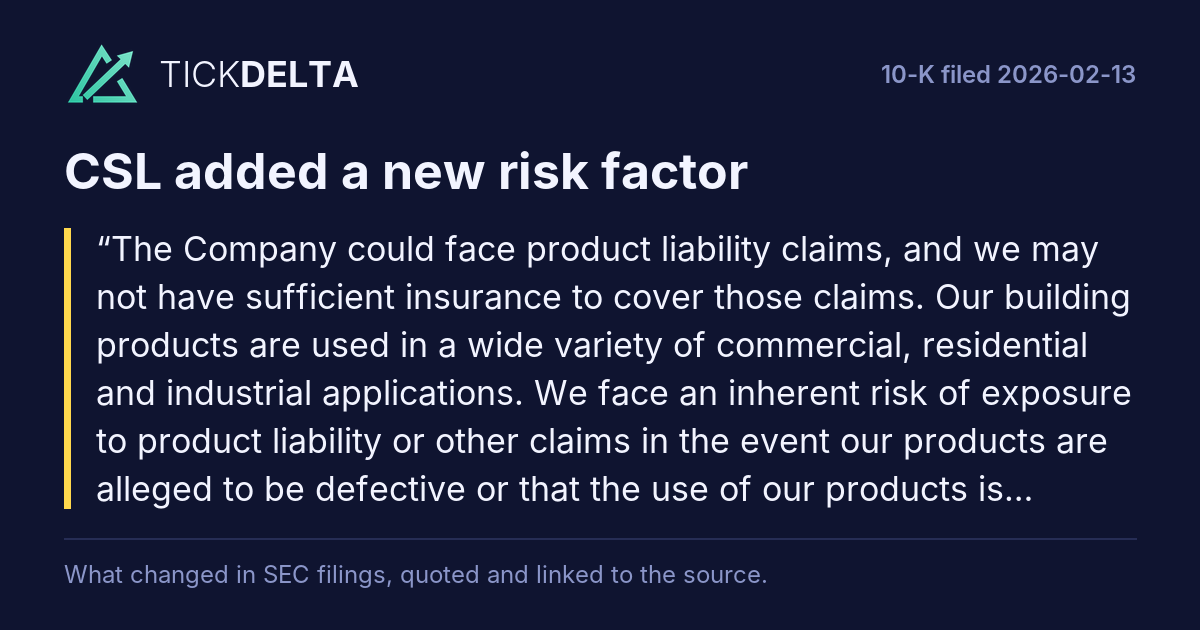
The Company could face product liability claims, and we may not have sufficient insurance to cover those claims.
Our building products are used in a wide variety of commercial, residential and industrial applications. We face an inherent risk of exposure to product liability or other claims in the event our products are alleged to be defective or that the use of our products is alleged to have resulted in harm to others or their property. If product liability lawsuits against us are successful, it could have an adverse impact on our financial condition and results of operations. Moreover, any such lawsuits, whether or not successful, could result in adverse publicity to us, which could harm our reputation and cause our sales to decline. We maintain insurance coverage to protect us against product liability
claims, but that coverage may not be adequate to cover all claims that may arise, or we may not be able to maintain adequate insurance coverage in the future at an acceptable cost. Any liability not covered by insurance or that exceeds our established reserves could materially and adversely impact our business, financial condition and results of operations.
Paragraphs in the 10-Q filed Oct 29, 2026 that were not in the one before
New in the latest 10-Q
10 paragraphs in the 10-Q filed Oct 29, 2026 with nothing like them in the 10-Q filed Jul 30, 2026 (at least half the words must differ; new numbers alone do not count). Quoted exactly, grouped by the item heading above them. This is text that changed, not a judgement of how serious it is.
Financial statements and notes
September 30, (in millions) 2026 2025 ──────────────────────────────────────────────────────────────────────────────────────────────────────────────────────────────────────────────────────── Operating activities: Net income $ 591.0 $ 613.3 Reconciliation of net income to net cash provided by (used in) operating activities: Depreciation 57.0 55.3 Amortization 89.7 91.2 Stock-based compensation 27.3 27.3 Deferred taxes (25.5) (2.3) Other operating activities, net 30.4 33.1 Changes in assets and liabilities, excluding effects of acquisitions: Receivables (292.1) (184.6) Inventories (85.1) (0.3) Accounts payable 147.1 29.1 Other assets and liabilities (28.6) 53.7 Net cash provided by (used in) operating activities 511.2 715.8 Investing activities: Acquisitions, net of cash acquired — (108.1) Capital expenditures (106.8) (91.3) Other investing activities, net 0.6 — Net cash provided by (used in) investing activities (106.2) (199.4) Financing activities: Proceeds from notes — 987.8 Repurchases of common stock (850.0) (1,000.0) Dividends paid (139.6) (135.3) Proceeds from exercise of stock options 47.5 14.8 Withholding tax paid related to stock-based compensation (11.9) (13.5) Other financing activities, net (16.1) (19.2) Net cash provided by (used in) financing activities (970.1) (165.4) Effect of foreign currency exchange rate changes on cash and cash equivalents (0.3) 0.5 Change in cash and cash equivalents (565.4) 351.5 Cash and cash equivalents at beginning of period 1,112.1 753.5 Cash and cash equivalents at end of period $ 546.7 $ 1,105.0
Read in the 10-Q
Carlisle recorded third quarter diluted earnings per share from continuing operations of $5.22, up 5% year-over-year, on 9% revenue growth to $1.5 billion. Both CCM and CWT again grew faster than their underlying markets, reflecting our Vision 2030 strategic initiatives, the strength of our resilient business model, and the Carlisle Experience we deliver to contractors, distributors, and building owners. Even as petroleum-derived input and freight costs rose sharply, our teams grew volume, built price realization, and delivered solid results.
Read in the 10-Q
CCM grew revenue 8%, driven by strong volume from our strategic initiatives, including growing traction in data centers, together with solid re-roofing demand and price realization. Re-roofing has grown steadily since we launched Vision 2030, supported by an aging building stock and the non-discretionary nature of roof replacement. CCM operating income was $281 million and adjusted EBITDA increased 1% to $306 million, driven by higher volumes, Carlisle Operating System productivity gains, and disciplined cost management. At CWT, share gains more than offset continued softness in new construction. CWT operating income increased 31% to $39 million, and adjusted EBITDA grew 13% with 60 basis points of margin expansion, reflecting our investments in automation, manufacturing consolidation, and in-house expanded polystyrene resin capacity. We also continued to advance our innovation pipeline, with nine of the twelve new products planned for this year now in the market.
Read in the 10-Q
Revenues increased 9% in the third quarter of 2026. Higher volumes at both CCM and CWT contributed approximately 6%, and realization of price increases and freight surcharges implemented in the second and third quarters to offset input cost inflation contributed approximately 3%.
Read in the 10-Q
Revenues increased 5% in the first nine months of 2026. Higher volumes at both CCM and CWT contributed approximately 3%, realization of price increases and freight surcharges implemented in the second and third quarters to offset input cost inflation contributed approximately 1%, and revenues from acquisitions contributed less than 1%.
Read in the 10-Q
Show the other 5
CCM’s revenue increased 8% in the third quarter of 2026. Higher volumes from continued execution of strategic initiatives and solid re-roofing demand contributed approximately 5%, and realization of price increases and freight surcharges implemented in the second and third quarters to offset input cost inflation contributed approximately 3%.
Read in the 10-Q
CCM’s revenue increased 4% in the first nine months of 2026. Higher volumes from continued execution of strategic initiatives and solid re-roofing demand contributed approximately 3%, and realization of price increases and freight surcharges implemented in the second and third quarters to offset input cost inflation contributed approximately 1%.
Read in the 10-Q
CWT’s revenue increased 9% in the third quarter of 2026. Higher volumes from share gains and weather conditions that drove demand for roof coatings contributed approximately 7%, and realization of price increases implemented in the second and third quarters to offset input cost inflation contributed approximately 2%.
Read in the 10-Q
CWT’s operating margin and adjusted EBITDA margin increased in the third quarter, driven by the benefits of operating leverage on higher volumes, which were supported by our investments in automation, manufacturing footprint consolidation, and in-house expanded polystyrene resin capacity, combined with building price realization. This more than offset elevated input and freight costs resulting from higher oil prices. Margins for the first nine months of 2026 were relatively flat as higher volumes were offset by elevated input and freight costs.
Read in the 10-Q
• increases in raw material, energy, and freight costs that cannot be recovered in product pricing;
Read in the 10-Q
The 10-Q's risk factors against the 10-K
Item 1A of the 10-Q filed Oct 29, 2026 against Item 1A of the 10-K filed Feb 13, 2026.
A 10-Q repeats only the risks that changed, so a 10-K paragraph that is missing from it is not counted as removed.
Added is a paragraph with nothing like it in the 10-K, Reworded a sentence that is in both with several words changed,
Quiet changes a sentence in both where one to four words changed and one is a hedge or a modal
(cut words struck through, new words highlighted).
Text on the page, not a score; each links to the filing at sec.gov.
What the 10-Q itself says about its risk factors:There have been no material changes in the Company's risk factors disclosed in "PART I - Item 1A. Risk Factors" in our 2025 Annual Report on Form 10-K.
Read in the 10-Q
1 paragraph in the 10-Q's Item 1A, and none of them adds, rewords or quietly edits a paragraph of the 10-K's.
Phrases used for the first time
Two-word phrases in Risk Factors of the 10-K filed Feb 13, 2026 that are in none of the 1 earlier 10-Ks stored, back to Feb 14, 2025
Where each one is used
- new products: The development and introduction of new products, or the failure to do so, could have a material adverse effect on our business, financial condition, results of operations or cash flows.
- product liability: The Company could face product liability claims, and we may not have sufficient insurance to cover those claims.
- key pillar: A key pillar of the Company’s Vision 2030 strategic plan is building scale with synergistic acquisitions. When companies become available for purchase, the process is often highly competitive, which tends to result in relatively high valuations for the target company. There can be no assurance that the Company will...
- company’s vision: A key pillar of the Company’s Vision 2030 strategic plan is building scale with synergistic acquisitions. When companies become available for purchase, the process is often highly competitive, which tends to result in relatively high valuations for the target company. There can be no assurance that the Company will...
- vision strategic: A key pillar of the Company’s Vision 2030 strategic plan is building scale with synergistic acquisitions. When companies become available for purchase, the process is often highly competitive, which tends to result in relatively high valuations for the target company. There can be no assurance that the Company will...
- strategic plan: A key pillar of the Company’s Vision 2030 strategic plan is building scale with synergistic acquisitions. When companies become available for purchase, the process is often highly competitive, which tends to result in relatively high valuations for the target company. There can be no assurance that the Company will...
- building products: The Company's CCM segment operates in several niche markets in which a large portion of the segment’s revenues are attributable to a few large customers. These markets have experienced recent consolidation among distributors of roofing materials and complementary building products. A significant reduction in...
- new product: The development and introduction of new products, or the failure to do so, could have a material adverse effect on our business, financial condition, results of operations or cash flows.
Used at least twice, small words left out. Counted, not picked: a phrase can be new because the company renamed something.
What was taken out
5 paragraphs of last year's Risk Factors with nothing like them now. The longest are quoted.
Sources
Item 1A of each 10-K and 10-Q on EDGAR, quoted exactly. Each paragraph links to the filing at sec.gov.
Also
10-K change: what was reworded or cut, section by section.
Work with it
Excel workbook · CSV. Google Sheet that stays up to date: paste =IMPORTDATA("https://tickdelta.com/company/CSL/export.csv") into a cell.