Form 10-K for the Fiscal Year Ended May 31, 2021
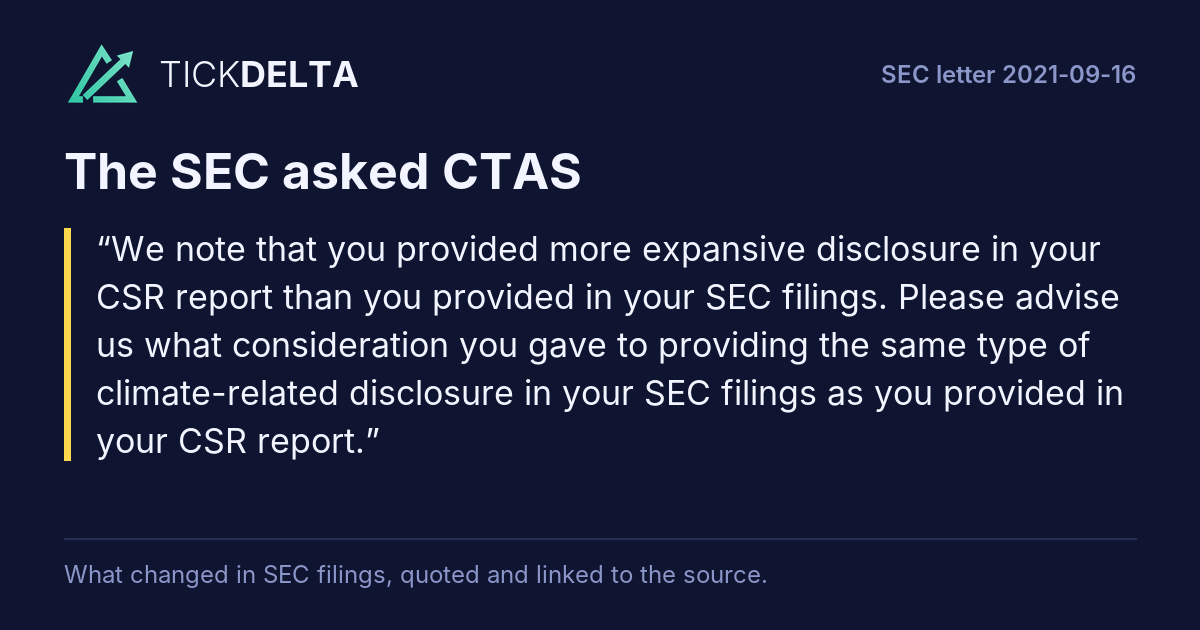
We note that you provided more expansive disclosure in your CSR report than you provided in your SEC filings. Please advise us what consideration you gave to providing the same type of climate-related disclosure in your SEC filings as you provided in your CSR report.
In response to the Staff’s comment, the Company respectfully advises the Staff that the Company’s Environmental, Social and
Governance Report (“ESG Report”) is designed to provide selected information regarding the Company’s ESG performance to a broad audience that includes investors, employee-partners, customers, communities, suppliers and other interested parties.Read in the reply ↗Rest of the answer
As a result, the ESG Report may include detailed information, such as information regarding the Company’s efforts to reduce energy use and greenhouse gas (“GHG”) emissions, that is beyond the scope of the information that is required to be disclosed pursuant to applicable
SEC rules and/or regulations. When considering whether to include climate-related disclosure in its SEC filings, including the type of climate-related disclosure provided in the ESG Report, the Company takes into account applicable SEC rules and regulations, including
Item 101, Item 103, Item 105 and Item 303 of Regulation S-K, as well as the SEC’s Compliance and Disclosure Interpretations, available guidance from the Staff (including the SEC’s 2010 Commission Guidance Regarding Disclosure Related to Climate Change) and applicable standards of materiality. The Company also considers that, while certain climate-related information may be of interest to readers of the ESG Report, such information may not be material to investors in the context of an SEC filing, while SEC filings may otherwise include separate climate-related disclosure required pursuant to Regulation S-K and other applicable SEC rules, regulations and guidance. The Company respectfully advises the Staff that it will, in response to the Staff’s comment, and historical practice, continue to evaluate its climate-related disclosure in SEC filings in light of applicable SEC rules, regulations and guidance and applicable standards of materiality.
First report after the company's reply of 2021-09-28: 10-Q filed 2021-10-07 ↗, against the 10-Q filed 2021-04-06 ↗.
Tickdelta does not hold the text of both reports, so they are not compared here.
In your CSR report, you state that you are committed to lowering the total amount of energy that you consume in your operations and reducing your greenhouse gas emissions. Please revise your disclosure to identify any material past and/or future capital expenditures for climate-related projects related to these initiatives. If material, please quantify these expenditures.
In response to the Staff’s comment, the Company respectfully advises the Staff that the Company considers applicable SEC disclosure rules, regulations and guidance, including Item 101, Item 105 and Item 303 of Regulation S-K, when preparing its SEC filings and, as applicable and to the extent material, evaluates disclosure regarding capital expenditures for environmental compliance.Read in the reply ↗Rest of the answer
For example, in the Form 10-K, the Company disclosed that “[w]hile environmental compliance is not a material component of our costs, Cintas makes capital expenditures and associated operating costs, primarily for water treatment and waste removal, on a regular basis in order to comply with environmental laws and regulations, to promote employee safety and to carry out its environmental sustainability principles.”
In the Form 10-K, the Company also provided quantitative disclosure regarding environmental spending related to water treatment and waste removal, as well as capital expenditures to limit or monitor hazardous substances. As of the filing of the Form 10-K, however, the Company had not identified any material capital expenditures related to the Company’s efforts to lower its energy use and GHG emissions. The Company respectfully advises the Staff that it will, in response to the Staff’s comment, and historical practice, continue to evaluate its climate-related disclosure in SEC filings, including disclosure regarding material capital expenditures for these initiatives, in light of applicable SEC rules, regulations and guidance and applicable standards of materiality.
First report after the company's reply of 2021-09-28: 10-Q filed 2021-10-07 ↗, against the 10-Q filed 2021-04-06 ↗.
Tickdelta does not hold the text of both reports, so they are not compared here.
To the extent material, discuss the indirect consequences of climate-related regulation or business trends, such as the following: • decreased demand for goods or services that produce significant greenhouse gas emissions or are related to carbon-based energy sources; • increased demand for goods or services that result in lower emissions than competing products; • increased competition to develop innovative newRest of the question
services that result in lower emissions; and • any anticipated reputational risks resulting from operations or products that produce material greenhouse gas emissions.
In response to the Staff’s comment, the Company respectfully advises the Staff that the Company considers applicable SEC disclosure rules, regulations, and guidance, including Item 101, Item 105 and Item 303 of Regulation S-K, when preparing its SEC filings and, as applicable and to the extent material, evaluates disclosure regarding indirect consequences of climate-related regulation or business trends. As of the filing of the Form 10-K, however, the Company had not identified any material indirect consequences of climate-related regulation or business trends.Read in the reply ↗Rest of the answer
The Company respectfully advises the Staff that it will, in response to the Staff’s comment, and historical practice, continue to evaluate its climate-related disclosure in SEC filings, including disclosure regarding the indirect consequences of climate-related regulation or business trends, in light of applicable SEC rules, regulations and guidance and applicable standards of materiality.
First report after the company's reply of 2021-09-28: 10-Q filed 2021-10-07 ↗, against the 10-Q filed 2021-04-06 ↗.
Tickdelta does not hold the text of both reports, so they are not compared here.
If material, discuss the significant physical effects of climate change on your operations and results. This disclosure may include the following: • quantification of material weather-related damages to your property or operations; • potential for indirect weather-related impacts that have affected or may affect your major customers or suppliers; and • any weather-related impacts on the cost or availability ofRest of the question
insurance.
In response to the Staff’s comment, the Company respectfully advises the Staff that the Company considers applicable SEC disclosure rules, regulations, and guidance, including Item 101, Item 105 and Item 303 of Regulation S-K, when preparing its SEC filings and, as applicable and to the extent material, evaluates disclosure regarding any significant physical effects of climate change on its operations and results.Read in the reply ↗Rest of the answer
As of the filing of the Form 10-K, however, the Company had not identified any significant physical effects of climate change on its operations and results that were material to the Company. The Company respectfully advises the Staff that it will, in response to the Staff’s comment, and historical practice, continue to evaluate its climate-related disclosure in SEC filings, including disclosure regarding the significant physical effects of climate change on its operations and results, in light of applicable SEC rules, regulations and guidance and applicable standards of materiality.
First report after the company's reply of 2021-09-28: 10-Q filed 2021-10-07 ↗, against the 10-Q filed 2021-04-06 ↗.
Tickdelta does not hold the text of both reports, so they are not compared here.
Disclose the material effects of transition risks related to climate change that may affect your business, financial condition, and results of operations, such as policy and regulatory changes that could impose operational and compliance burdens, market trends that may alter business opportunities, credit risks, or technological changes.
In response to the Staff’s comment, the Company respectfully advises the Staff that the Company considers applicable SEC disclosure rules, regulations, and guidance, including Item 101, Item 105 and Item 303 of Regulation S-K, when preparing its SEC filings and, as applicable and to the extent material, evaluates disclosure regarding the material effects of transition risks related to climate change.
As of the filing of the Form 10-K, however, the Company had not identified any effects of transition risks related to climate change that were material to the Company.Read in the reply ↗Rest of the answer
The Company respectfully advises the Staff that it will, in response to the Staff’s comment, and historical practice, continue to evaluate its climate-related disclosure in SEC filings, including disclosure regarding the material effects of transition risks related to climate change, in light of applicable SEC rules, regulations and guidance and applicable standards
First report after the company's reply of 2021-09-28: 10-Q filed 2021-10-07 ↗, against the 10-Q filed 2021-04-06 ↗.
Tickdelta does not hold the text of both reports, so they are not compared here.
Your response to prior comment 3, which states that you have not identified any material indirect consequences of climate-related regulation or business trends, appears to be conclusory without providing sufficient detail. Please provide us with additional support for your conclusion, including with regard to the individual items noted in our prior comment.
As background for the Staff, the Company respectfully advises the Staff that the Company provides certain products and services that generally enhance its customers’ image and help keep customers’ facilities and employees clean and safe. These products and services include uniforms through rental and sales programs, mats, mops, restroom supplies, first aid and safety products, fire extinguishers and testing and safety training. None of these products produce significant greenhouse gas emissions.Read in the reply ↗Rest of the answer
The Company generally provides these products to customers via approximately 11,000 local delivery routes. These local delivery routes are run by Company employees on Company-owned trucks. These trucks do create greenhouse gas (“GHG”) emissions in compliance with current regulatory emissions requirements.
Many of the Company’s products, such as uniforms, mats, mops and other rentable products, are laundered in Company-owned laundry facilities. The laundering process uses water and energy to run the washers, dryers and other processing equipment.
In response to the Staff’s comment, the Company respectfully advises the Staff that, at the time of the filing of the Form 10-K and to date, aside from the general economic effects of the COVID-19 pandemic on its customers, the Company did not experience and has not experienced any significant decreased demand for products or services, whether such products or services might produce significant GHG emissions or are related to carbon-based energy sources, or significant demand for products or services that might result in lower emissions than competing products or services. The
Company did not identify and has not identified any significant changes in competition due to innovative new services that result in lower emissions. While the Company has had inquiries from customers and investors about its fleet and laundry processes with regards to GHG emissions and other carbon-based energy impacts, the Company did not identify and has not identified any material reputational risks resulting from these inquiries.
In response to prior comment 4, you indicate that you have not identified any significant physical effects of climate change on your operations and results that are material. Your response appears to be conclusory in nature, but does not address the specific elements of our prior comment.Rest of the question
Please tell us about the physical effects of climate change considered in your response, address the factors from our prior comment, and provide an analysis of materiality.
As background for the
Staff, the Company respectfully advises the Staff that the Company has a diverse geographic presence within the United States and Canada.
The Company operates within 473 facilities throughout the United States and Canada, and the Company had no concentration of its consolidated fiscal 2021 revenue exceeding nine percent in any one state within the United States and had less than six percent of its consolidated fiscal 2021 revenue derived in Canada.Read in the reply ↗Rest of the answer
Additionally, the Company did not have any one particular customer that accounted for more than one percent of its consolidated fiscal 2021 revenue.
In response to the Staff’s comment, the Company respectfully advises the Staff that, as a result of the Company’s geographic and customer revenue diversity, local and regional climate change and weather-related disasters, such as tornadoes, hurricanes, fires or snow storms, have not materially adversely impacted the Company’s financial performance. While these types of disasters have certainly occurred in the United States in the last several years, they have not materially adversely impacted the Company’s financial performance or caused any material damages to the Company’s property or operations. For example, during the Company’s third quarter of fiscal 2021, winter and ice storms occurred in Texas. Although these storms did create challenges, the Company was able to transfer processing volumes within its surrounding plants and continue to visit most customers in a timely manner. As a result, these storms did not have a significant impact on the Company’s third fiscal quarter of 2021 financial performance as evidenced in the
Company’s Quarter Report on Form 10-Q for the quarterly period ended February 28, 2021.
With respect to the potential for indirect weather-related impacts that have affected or may affect the Company’s suppliers, the Company respectfully advises the Staff that it did disclose in “Item 1A. Risk Factors” of the Form 10-K in the risk factor entitled “Unexpected events could negatively impact our operations and adversely affect our consolidated results of operations” that unexpected events, such as severe weather conditions and natural disasters such as hurricanes or tornadoes, could result in supply disruptions that could adversely affect the Company’s consolidated results of operations. At the time of the filing of the Form 10-K and to date, the Company did not view and has not viewed the potential for indirect weather-related impacts that have affected or may affect the Company’s customers given the Company’s geographic and customer revenue diversity.
Lastly, the Company respectfully advises that Staff that at the time of the filing of the Form 10-K, it did not and has not identified any material weather-related impacts on the cost or availability of insurance.
Your response to prior comment 5 states that you have not identified any effects of transition risks related to climate change that are material to the company. Please describe the transition risks you have identified and explain how you concluded their effects were not material.
In response to the
Staff’s comment, the Company respectfully advises the Staff that the Company did disclose in “Item 1A. Risk Factors” of the Form 10-K” certain transition risks that could potentially, materially and adversely affect its business and financial performance.
These risks included:
· “An inability to open new, cost effective operating facilities may adversely affect our expansion efforts.” Within this risk factor, the Company indicates, ”Our ability to open new operating facilities depends on our ability to identify attractive locations…and obtain adequate utility and waterRead in the reply ↗Rest of the answer
sources and comply with environmental regulations, zoning laws and other similar factors.”
· “Unexpected events could negatively impact our operations and adversely affect our consolidated results of operations.” Within this risk factor, the Company indicates, “Unexpected events, including fires or explosions at facilities, severe weather conditions, natural disaster such as hurricanes and tornadoes…could adversely affect our consolidated results of operations.”
· “Changes in the fuel and energy industry could adversely affect our consolidated financial condition and consolidated results of operations.” Within this risk factor, the Company indicates, “The price of fuel and energy needed to run our vehicles and equipment is unpredictable and fluctuates based on events outside our control, including…environmental concerns…”
· “Failure to comply with federal and state regulations to which we are subject could result in penalties or costs that could adversely affect our consolidated results of operations.” Within this risk factor, the Company indicates, “Our business is subject to complex and stringent state and federal regulations, including…transportation and other laws and regulations.” The Company further indicates, “We have incurred, and will continue to incur, capital and operating expenditures and other costs in the ordinary course of our business in complying with USDOT regulations, the OSHA Act and other laws and regulations to which we are subject. Changes in laws or regulations that may be enacted by the current U.S. presidential administration and Congress, may alter the landscape in which we do business and may affect our costs of doing business. The impact of new laws and regulations cannot be predicted. Compliance with new laws and regulations may increase our operating costs or require significant capital expenditures.”
· “Compliance with environmental laws and regulations could result in significant costs that adversely affect our consolidated results of operations.” Within this risk factor, the Company indicates, “Our operating locations are subject to environmental laws and regulations relating to the protection of the environment and health and safety matters, including those governing discharges of pollutants to the air and water, the management and disposal of hazardous substances and wastes and the clean-up of contaminated sites. The operation of our businesses entails risks under environmental laws and regulations. We could incur significant costs…under these laws and regulations.” The Company further indicates, “In addition, potentially significant expenditures could be required to comply with environmental laws and regulations, including requirements that may be adopted or imposed in the future.”
While the Company disclosed in the Form
10-K that certain transition risks could potentially, materially and adversely affect its business and financial performance, at the time of the filing of the Form 10-K and to date, the Company did not identify and has not identified any specific and quantifiable material effects of transition risks related to climate change. As disclosed in the Form 10-K, the Company is subject to complex and stringent state and federal regulations. The Company works hard to understand these existing laws and regulations, and the operational impact of those are incorporated into its current financial performance. Predicting future policy and regulatory changes in connection with climate change, and the specific details of those changes, is very difficult and challenging.
As the Company assesses its future within the constructs of climate change, though, it has identified potential transition risks associated with its fleet and with its laundry operations. The risk associated with the Company’s fleet relates to the possible transition to alternative fuel as opposed to gasoline or diesel. The Company has researched alternative fuel vehicles, but none had been identified at the time of the filings of the Form 10-K or has been identified to date that could perform in the necessary manner to complete the Company’s service routes. The Company recognizes that it will need to purchase and/or replace trucks within its fleet from time to time as the Company grows and as trucks exhaust their useful lives. Recognizing that no alternative vehicle solution exists today that can meet the Company’s performance requirements, the Company cannot predict if the future costs of trucks will change materially, although the Company does not view this a material risk.
The potential risks associated with the Company’s laundry operations relate to the future availability of water and possible transition to alternative fuel used to operate its laundry equipment as opposed to natural gas or electricity. The Company continuously searches for more efficient processes, uses of water and alternative fuels in order to improve its operational performance and to reduce its carbon intensity. At the time of the filing of the Form 10-K and to date, however, the Company was not and is not aware of any requirement to transition away from water usage, natural gas and electricity, was not and is not aware of any existing laws or regulations that would materially increase the costs of operating its laundry facilities, and was not and is not aware of any alternatives or technological changes to its current operating procedures that could result in material transition effects on its laundry operations. Lastly, the Company did not identify and has not identified any credit transition risks related to climate change.
Also in this review: closing letter, 2022-01-14