Form 10-K for the Fiscal Year Ended December 31, 2021
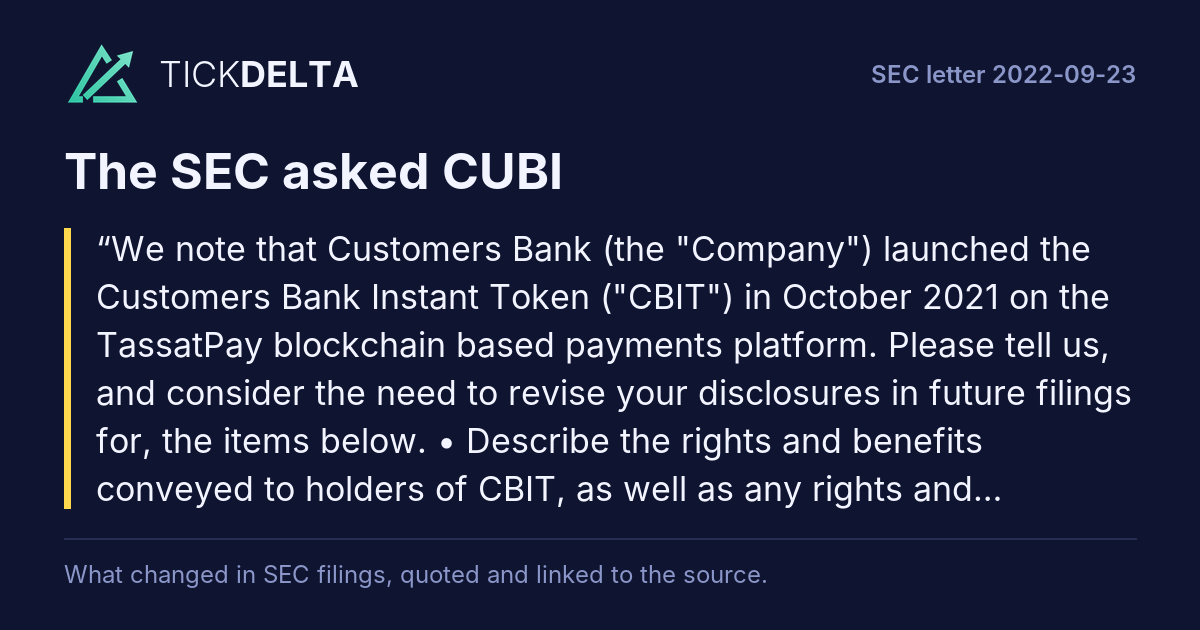
We note that Customers Bank (the "Company") launched the Customers Bank Instant Token ("CBIT") in October 2021 on the TassatPay blockchain based payments platform. Please tell us, and consider the need to revise your disclosures in future filings for, the items below. • Describe the rights and benefits conveyed to holders of CBIT, as well as any rights and obligations the Company has towards those holders.Rest of the question
For example, tell us whether holders of CBIT receive any yield or interest on their tokens. • Explain the roles and responsibilities of the Company and of TassatPay under the arrangement. For example, describe how CBIT is held, who controls the asset, who is responsible for safeguarding the assets, and who holds cryptographic or private key information. • Describe the terms of any fee arrangements between the Company and TassatPay or the Company and users associated with the issuance, payment, holding, or redemption of CBIT. • Where applicable, tell us how the fee arrangements and any other revenue related to CBIT are reflected in your financial statements and how you account for them, and quantify any amounts, as appropriate.
On behalf of Customers Bancorp, Inc. (the “Company,” “we,” “us,” or “our”), set forth below are our responses to the comments of the Staff of the Securities and Exchange Commission regarding the above-referenced filings set forth in the Staff’s letter dated September 23, 2022. For your convenience, we have repeated the comments set forth in the Staff’s letter and followed each comment with our response. We note that Customers Bank (the “Company”) launched the Customers Bank Instant Token (“CBIT”) in October 2021 on the TassatPay blockchain based payments platform. Please tell us, and consider the need to revise your disclosures in future filings for, the items below.One letter for all the questions, without numbered answers. Read the replyRest of the letter
•Describe the rights and benefits conveyed to holders of CBIT, as well as any rights and obligations the Company has towards those holders. For example, tell us whether holders of CBIT receive any yield or interest on their tokens. •Explain the roles and responsibilities of the Company and of TassatPay under the arrangement. For example, describe how CBIT is held, who controls the asset, who is responsible for safeguarding the assets, and who holds cryptographic or private key information. •Describe the terms of any fee arrangements between the Company and TassatPay or the Company and users associated with the issuance, payment, holding, or redemption of CBIT. •Where applicable, tell us how the fee arrangements and any other revenue related to CBIT are reflected in your financial statements and how you account for them, and quantify any amounts, as appropriate. The primary business purpose for the CBIT payment platform is to provide a closed-system for real-time intrabank commercial transactions and is not intended to be a trading platform for tokens/digital assets. There are no scenarios in which the transaction or redemption value of one CBIT token would not be equal to one U.S. Dollar. Each CBIT token is minted with precisely one U.S. Dollar equivalent, and those dollars are held in an FDIC insured omnibus deposit account (“Omnibus Deposit Account”) at the Company until the CBIT token is burned. The number of CBIT tokens outstanding in the CBIT platform is always equal to the U.S. Dollars held in the Omnibus Deposit Account at the Company and is reported as a deposit liability in the consolidated balance sheets. CBIT tokens may only be created by, transferred to and redeemed by our commercial customers on the CBIT instant payments platform by maintaining U.S. dollars in deposit accounts (“DDAs”) at Customers Bank. A commercial customer mints CBIT tokens by first opening a DDA at Customers Bank, funding that DDA with U.S. Dollars, and connecting that DDA to its CBIT wallet. The customer has an ownership interest titled in its name in the U.S. Dollars deposited in the Omnibus Deposit Account in the amount equivalent to the amount of CBIT tokens in the customer’s CBIT wallet. When a commercial customer transfers CBIT tokens to another commercial customer, the total value in the Omnibus Deposit Account remains the same, but the transferring customer’s ownership interest in the U.S. Dollars held in the Omnibus Deposit Account will now be transferred in the receiver’s name equivalent to the value of the transferred CBIT tokens. Each CBIT token is a deposit token and a digital representation of the value of one U.S. Dollar that has no legal tender status and no monetary value. Only U.S. Dollars, and no other currency, can be transferred to a commercial customer’s CBIT wallet. As discussed above, the U.S. Dollar equivalent of these CBIT tokens in the customers’ CBIT wallets are held in one Omnibus Deposit Account which is reported as part of the Company’s total deposit liability in its consolidated balance sheets while the cash received from these deposits can be used by the Company in its business operations without any restrictions. Therefore, as an example, a CBIT token as a deposit token is different from a stablecoin which is a bearer asset that pegs its value to a traditional asset, such as a fiat money. The U.S. Dollar equivalent held in the customer’s name in the Omnibus Deposit Account together with any other deposits held in the customer’s name at the Company are FDIC insured up to $250,000. Our customers do not receive any yield or interest on their CBIT tokens since these are only utilized to facilitate real-time payment transactions between our commercial customers. Our commercial customers’ CBIT related DDAs earn interest if held in interest-bearing DDAs. If a customer’s DDA is overdrawn, the Company may transfer or redeem CBIT tokens from the customer’s CBIT wallet to cover the overdraft in the DDA. The Company may freeze or suspend a customer’s CBIT wallet due to fraud or misuse of the account. We may also freeze or seize the funds from a customer’s DDA in the event of legal action or process against the customer. In addition, if the customer is an actual or suspected victim of fraud identified through the Company’s monitoring program or when the customer notifies us, procedures are in place to investigate, resolve and mitigate the impact of fraud, which may include freezing funds in the customer’s DDA or CBIT wallet, locking the DDA or CBIT wallet or suspending or terminating access by an authorized user. If an authorized user engages in unauthorized activities and the customer reports that to us immediately, we will suspend the user’s login credentials. The Company may also correct or reverse a fraudulent or unauthorized transaction. If the services provided by the CBIT platform becomes permanently unavailable, all CBIT tokens in the customer’s CBIT wallet will be automatically redeemed to U.S. Dollars in the customer’s DDA. If the customer notifies us through our claim process of a processing error caused by us or our third-party providers within 30 days of the processing error, we will use commercially reasonable efforts to correct the processing error in accordance with our procedures applicable to the service. The Company is responsible for creating the profiles of the customer’s authorized users in the CBIT platform, based on information provided by the customer to us. The Company grants the customer a non-exclusive, non-transferable, revocable, limited right to access and use the services as set forth in our agreement with the customer. Tassat maintains the CBIT platform and all its functionalities, including the blockchain where the transactions in the CBIT platform are recorded. Tassat’s access is limited to performing updates to the CBIT platform. The Company maintains the customers’ DDAs connected to their CBIT wallets on the CBIT platform and the Omnibus Deposit Account where the U.S. Dollar to back the minted CBIT token is held. The customers can access their CBIT wallets using their individual passwords and are further subject to multi-factor authentication. The Company pays fees to Tassat for maintaining the CBIT platform and for the use of the CBIT platform by our customers. The fees incurred by the Company are recorded in Technology, communication and bank operations within non-interest expense on our consolidated statements of income. We currently do not charge our customers fees to join the CBIT platform or make any transactions using CBIT tokens. In future filings, the Company will include disclosure substantially in the form below to clarify the primary business purpose of CBIT and the related accounting and financial reporting impacts. The primary business purpose for the CBIT instant payment platform is to provide a closed-system for real-time intrabank commercial transactions and is not intended to be a trading platform for tokens or digital assets. There are no scenarios in which the transaction or redemption value of one CBIT token would not be equal to one U.S. Dollar. Each CBIT token is minted with precisely one U.S. Dollar equivalent, and those dollars are held in a non-interest bearing omnibus deposit account until the CBIT token is burned or redeemed. The number of CBIT tokens outstanding in the CBIT platform is always equal to the U.S. Dollars held in the omnibus deposit account at the Company and is reported as a deposit liability in the consolidated balance sheet. In addition to the comment above, please address the items below. •Tell us, in detail, the transactional process for minting, issuing, making payments, redeeming / burning, and converting CBIT back to dollar form. In addition, clarify what happens to the dollars in a client’s deposit account when they are exchanged into CBIT. •As it relates to the above activities, tell us how each of these activities are reflected in your financial statements. For example, specify any assets or liabilities that you recognize relating to CBIT (e.g., deposits, digital assets, segregated cash, etc.) and how you account for each of them. Include references to specific accounting guidance you relied upon to support your conclusions. •Clarify for us whether there would be any scenarios in which the transaction or redemption value of one CBIT would not be one U.S. dollar. If so, provide additional detail including how pricing or value of CBIT would be determined and / or maintained. The transaction process flow and related accounting and financial statement presentation for CBIT are described below. A commercial customer opens a deposit account (i.e., DDA) at Customers Bank and funds that DDA with U.S. Dollars using traditional methods such as transfer or wire. In the CBIT platform, the Company creates a CBIT wallet for this customer and connects the CBIT wallet to this DDA. To mint CBIT tokens, a customer performs a “deposit” function in the CBIT platform. The customer indicates the amount of U.S. Dollars to deposit in the CBIT wallet, which cannot exceed the U.S. Dollar amount the customer has in the corresponding DDA. When this action is taken, the U.S. Dollars are removed from the customer’s DDA, so that balance is reduced by the precise amount the customer wants to fund in the CBIT wallet and transferred to the Omnibus Deposit Account that is created specifically for CBIT tokens in circulation on the CBIT platform. For example, if a customer deposits $100 into the CBIT wallet from its DDA with a beginning balance of $1,000, the customer has $900 in its DDA after the deposit. The Omnibus Account holds all U.S. Dollars for minted CBIT tokens. In this example, if the Omnibus Account had no balance prior to this deposit, it now holds $100. The customer’s CBIT wallet is funded with the CBIT tokens the customer deposits (i.e., 100 CBIT tokens). The Company records a customer’s deposit in the DDA as a deposit liability on the balance sheet in accordance with ASC 942-405-25-3. The funds transferred to the Omnibus Deposit Account equal to the deposit made by a customer in its CBIT wallet represent the Company’s deposit liability to that customer. In the above example, the Company would reflect a deposit liability of $1,000 on its balance sheet (i.e., $900 in the customer’s DDA and $100 in the Omnibus Deposit Account held in the customer’s name). To make a payment to a receiver in CBIT tokens, both the sender and the receiver of the payment must be set up with CBIT wallets on the CBIT platform. The sender must be connected to the receiver or know the CBIT wallet address where to send the payment. In the CBIT platform, the sender takes this action using the “send” function. In this function the user indicates the CBIT token amount to be sent, and the receiver. The amount to be sent cannot exceed the amount in the sender’s CBIT wallet. When the transaction is submitted, the CBIT token is removed from the sender’s CBIT wallet and is transferred to the receiver’s CBIT wallet. The total amount of U.S. Dollars in the Omnibus Account does not change, as the same amount of CBIT tokens is in circulation through this transaction, although the ownership interest in the U.S. Dollars held in the Omnibus Deposit Account is now titled in the receiver’s name. Similarly, the Company’s total deposit liability balance on its balance sheet does not change upon payment on the CBIT platform. To burn or redeem CBIT tokens, the customer performs the “redeem” function in the CBIT platform. The customer indicates the amount of CBIT tokens to be redeemed, which cannot exceed the CBIT tokens the customer has in its CBIT wallet. When this action is taken, the CBIT token is removed from the customer’s CBIT wallet. For example, if a customer redeems 100 CBIT tokens from a CBIT wallet with 500 CBIT tokens, 400 CBIT tokens remain in its CBIT wallet. The U.S. Dollar equivalent is removed from the Omnibus Deposit Account ($100 in this example) and transferred to the customer’s DDA (i.e., $100 is added to the customer’s DDA). The Company’s total deposit liability balance on its balance sheet does not change upon burning or redeeming CBIT tokens. There are no scenarios in which the transaction or redemption value of one CBIT token would not be equal to one U.S. Dollar. As described above, each CBIT token is minted with precisely one U.S. Dollar equivalent, and those dollars are held in the Omnibus Account until the CBIT token is burned or redeemed. The number of CBIT tokens outstanding in the CBIT platform is always equal to the U.S. Dollars held in the Omnibus Deposit Account at the Company. We note that you held $1.9 billion of deposits from customers participating in CBIT as of December 31, 2021, and that this amount increased to $2.1 billion as of June 30, 2022. Please address the items below. •Clarify if this means that there are also 1.9 billion and 2.1 billion tokens outstanding as of December 31, 2021 and June 30, 2022, respectively. If not, then tell us how many tokens are outstanding at the end of each period. •Tell us how you classify cash received as deposits for CBIT participants and describe any restrictions related to your usage of these deposits. Include in your response a discussion of how you currently use such deposits, including reference to any asset liability management or liquidity considerations. •We note that the Company's balance of cash and equivalents is below that of your CBIT-related deposits. Explain what would occur if clients made withdrawals in excess of those balances at one time. In addition, tell us the extent to which such deposits are insured by the FDIC or another entity. •Please explain where the deposit dollars are held (e.g., in Company checking accounts, an omnibus wallet on TassatPay, or some other arrangement). These figures represent total deposits in U.S. Dollars held in non-interest bearing or interest-bearing DDAs at the Company by customers who have joined the CBIT platform as of the respective dates. These customers are primarily in the digital asset industry. These figures do not represent the balances in the Omnibus Deposit Account, or the outstanding CBIT tokens in the CBIT wallets of the customers, as of the respective dates. The Omnibus Deposit Account is a non-interest bearing demand deposit account at the Company. On most days, it is expected that customers will burn or redeem their CBIT tokens for U.S. Dollars in their DDAs after concluding their transaction activity on the CBIT platform. There were no balances held in the Omnibus Account in customers’ name as of June 30, 2022 and December 31, 2021. We will clarify in our future filings the balances held in CBIT-related DDA accounts and those held in the Omnibus Deposit Account as of the balance sheet dates presented. The funds deposited in non-interest bearing and interest-bearing deposit accounts at the Company by commercial customers participating in the CBIT platform are subject to the same terms and conditions that are applicable to any commercial deposit accounts at the Company, including the customers’ withdrawal, as governed by our cash management master services agreement with the commercial customers. The U.S. Dollar equivalent held in the customer’s name in the Omnibus Deposit Account, if any, together with any other deposits held in the customer’s name in the DDAs at the Company are FDIC insured up to $250,000. The Company invests the deposits received from our customers, including deposits associated with the CBIT platform, in interest earning assets subject to prudent risk management practices and policies. There are no restrictions on the use of cash raised by the deposits that can be used on the CBIT platform, or any other deposits, liabilities or equity raised by the Company other than for the policies and procedures that the Company has adopted and observes to manage the various risk exposures of the Company’s portfolio of interest earning assets. Pursuant to the Company’s Liquidity Risk Policy and Contingent Funding Plan, the Company maintains significant sources of liquidity that could be accessed in the event of withdrawals in excess of cash on hand. Specifically, as of June 30, 2022, the Company’s stock of unpledged investment securities amounted to approximately $3.6 billion and the total available balance of committed liquidity between the Federal Home Loan Bank of Pittsburgh and the Federal Reserve Bank of Philadelphia amounted to approximately $3.2 billion. Together with our cash balance, these sources of liquidity amounted to approximately $7 billion, which is equivalent to over 41% of the Company’s total deposits as of June 30, 2022. We note that installment loans constituted about 15% of loans and leases receivable and 25% of total nonaccrual loans as of June 30, 2022, as well as a significant portion of provision for credit losses and charge offs for the three and six months ended June 30, 2022. We also note your disclosure on page 72 that such loans largely consist of personal, student loan refinancing, and home improvement loans. Please provide us with a table showing additional granularity regarding the balances and changes for different types of installment loans for the periods presented, as well as a discussion of period over period changes and drivers within this category, including reference to items such as weighted average interest rates or fees, as applicable. In future filings, to the extent that installment loans comprise a material portion of key metrics or measures, please enhance your disclosures to provide (here or within MD&A, as appropriate) this same level of granularity, so that investors can get a better sense of trends within this loan category. The composition of the Company’s consumer installment loans as of the periods presented is presented below. (dollars in thousands) June 30, 2022 December 31, 2021 Change % Change Personal loans $ 1,613,628 $ 1,392,862 $ 220,766 15.8 % Medical loans 135,741 177,649 $ (41,908) (23.6) % Home improvement loans 85,459 102,640 (17,181) (16.7) % Student loans 66,242 71,324 (5,082) (7.1) % Total installment loans $ 1,901,070 $ 1,744,475 156,595 9.0 % Per the above table, $1.6 billion, or 84.9%, of our consumer installment loan portfolio consists of unsecured, fully-amortizing fixed rate loans with terms ranging from 3 years to 7 years as of June 30, 2022. The remaining $287.4 million, or 15.1%, of the consumer installment portfolio consists of medical, home improvement and student loans. Our medical loans are unsecured, fixed rate loans with terms ranging from 5 years to 20 years. Our home improvement loans may be secured by liens on the property and related fixtures by filing UCC-1 financing statements under certain circumstances but generally are unsecured, fixed rate loans with terms ranging from 5 years to 20 years. Our student loans are private or refinancing loans with fixed rates and terms ranging from 5 years to 20 years. Our personal loan portfolio increased $220.8 million, or 15.8%, to $1.6 billion at June 30, 2022 from $1.4 billion at December 31, 2021 due to net growth in originations and $76.0 million of loan pool purchases. Our medical loan portfolio decreased $41.9 million, or 23.6%, to $135.7 million at June 30, 2022 from $177.6 million at December 31, 2021. Our home improvement loan portfolio decreased $17.2 million, or 16.7%, to $85.5 million at June 30, 2022 from $102.6 million at December 31, 2021. Our student loan portfolio decreased $5.1 million, or 7.1%, to $66.2 million at June 30, 2022 from $71.3 million at December 31, 2021. The decreases in our medical, home improvement and student loan portfolios primarily reflect pay downs. We have maintained the size of our medical and student loan portfolios relatively constant by occasionally purchasing pools of medical loans and periodically originating student loans to offset pay downs. Because we have not actively increased originations or acquired significant amounts of medical, home improvement or student loans, net of pay downs, these lending activities have consistently represented an immaterial portion of our consumer installment loan portfolio. We also currently have an immaterial portfolio of credit card accounts included in the personal loan category, which had less than $1 million in outstanding balance as of June 30, 2022 and December 31, 2021. Given the immaterial amounts of these loans, combined with our stated strategy of not growing our consumer installment portfolio, we do not believe that separately disclosing the amounts and related key metrics or measures of other installment loans consisting of medical, home improvement and student loans and credit cards from personal loans provide additional insights into our consumer installment loan portfolio. As reported on our Current Report on Form 8-K filed on October 3, 2022, the Company sold $500 million of personal loans to a vehicle managed by a global asset manager on September 30, 2022. With this sale, together with pay downs, we expect that our consumer installment loan portfolio will represent a significantly smaller portion of our total loans and leases receivable in future periods. The composition of our nonaccrual consumer installment loans are summarized below as of the dates indicated. Personal loans $ 4,108 $ 2,273 $ 1,835 80.7 % Home improvement loans 121 204 (83) (40.7) % Total installment loans $ 5,965 $ 3,783 2,182 57.7 % The unsecured personal loans that are in nonaccrual status represented a significant portion (68.9% at June 30, 2022 and 60.1% at December 31, 2021) of the total nonaccrual loans in our consumer installment loan portfolio for the periods presented. The composition of net charge-offs in our consumer installment loan portfolio are summarized below for the periods indicated. Three Months Ended June 30, QTD Six Months Ended June 30, YTD (dollars in thousands) 2022 2021 Change % Change 2022 2021 Change % Change Personal loans $ 10,443 $ 6,029 $ 4,414 73.2 % $ 16,725 $ 15,095 $ 1,630 10.8 % Medical loans 673 689 $ (16) (2.3) % 1,496 2,091 (595) (28.5) % Home improvement loans 578 342 236 69.0 % 702 663 39 5.9 % Total installment loans $ 11,932 $ 7,060 4,872 69.0 % $ 19,684 $ 17,915 1,769 9.9 % The Company charges off consumer loans after 120 days of delinquency or sooner when cash flows are determined to be insufficient for repayment. Although our legal rights and remedies against borrowers may differ somewhat for medical, home improvement and student loans as compared to unsecured personal loans, our historical experience of charge-offs and recoveries on these portfolios have not differed significantly from our unsecured personal loans. Moreover, the net charge-offs for unsecured personal loans represented a significant portion (approximately 85%) of the net charge-offs in our consumer installment loan portfolio for the periods presented. Based on the above, the Company will present the outstanding balance of the consumer installment loan portfolio into two categories: personal and other installment loans in the notes to the financial statements and the MD&A in future filings. We believe that other metrics associated with medical, home improvement and student loans within the other installment loans category, such as nonaccrual status and net charge-offs separate from the personal installment loan category do not provide additional meaningful insights into our consumer installment loan portfolio. The Company will provide material components of the other installment loans category and related significant trends in the MD&A in our future filings, consistent with the above tables, if our medical, home improvement, student loan or credit card portfolio becomes material in future periods. Please tell us, and revise your future filings to disclose, the Company's consideration of and accounting adoption of Staff Accounting Bulletin No. 121 (“SAB 121”), including quantification of the impact upon adoption, as well as any applicable disclosures required by SAB 121. As part of your response, provide us with your accounting analysis explaining the Company's conclusions regarding applicability and adoption, including but not limited to discussion of any scoping considerations; whether you or an agent acting on your behalf has a safeguarding obligation or not; and who is responsible in the event of a theft or breach of CBIT. SAB 121 was released on March 31, 2022 and required adoption no later than the second quarter 2022 Form 10-Q, with retrospective application as of January 1, 2022. The Company reviewed SAB 121, multiple interpretive guides released by the Big 4 Accounting Firms, the AICPA Practice Aid: Accounting for and Auditing of Digital Assets and multiple joint letters from Securities Industry and Financial Markets Association (“SIFMA”) and the American Bankers Association (“ABA”) to the SEC pertaining to SAB 121 to gain an understanding of the scope and accounting implications of SAB 121. As part of the SAB 121 adoption process, the Company reviewed its existing product offerings and services, including CBIT, to assess the applicability of SAB 121, by first evaluating whether the product offerings or services relate to “crypto-assets”. SAB 121 defined a “crypto-asset” as a digital asset that is issued and/or transferred using distributed ledger or blockchain technology using cryptographic techniques. The CBIT token is a deposit token and a digital representation of the value of one U.S. Dollar that has no legal tender status and no monetary value. Further, the CBIT token cannot be pledged or obligated as collateral by the customer to any third party, and the customer is not authorized to provide any third party any legal claim to the CBIT tokens in the customer’s CBIT wallet. CBIT tokens are transferred using a private permissioned blockchain technology platform. Based upon this evaluation, the Company concluded that the CBIT tokens in the customers’ CBIT wallet represent a “crypto-asset” as broadly defined under SAB 121. The customers also have the sole access and control over the CBIT tokens held in their CBIT wallets from minting, and making payments until redemption or burning the tokens subject to the Company’s administrative rights in the event of a fraudulent or unauthorized transaction as described in our response in Comment 1. As provided in our response to Comment 1, the U.S. Dollar equivalent of these CBIT tokens in the customers’ CBIT wallets are held in one Omnibus Deposit Account which is reported as part of the Company’s total deposit liability while the cash received from these deposits are reported as part of cash and cash equivalents in the Company’s consolidated balance sheet. In addition, as stated in our response to Comment 3, there were no balances held in the Omnibus Deposit Account or CBIT tokens outstanding at June 30, 2022 and December 31, 2021. The Company has also concluded that none of its other products met the definition of a crypto asset nor any of its existing services involve a crypto-asset. The Company next evaluated whether the product and services related to CBIT included an obligation to safeguard the customers’ CBIT tokens. SAB 121 provides that the obligations associated with crypto assets safeguarding arrangements involve unique risk and uncertainties not present in arrangements to safeguard assets that are not crypto-assets, including technology, legal and regulatory risks and uncertainties. We evaluated the CBIT product to identify any unique risks and uncertainties as provided under SAB 121. The Company considers native crypto-assets such as Bitcoin and Ether, which are typically traded on a public permissionless blockchain, to represent a significantly different technology risks pattern when compared to CBIT. The CBIT tokens and platform are used to provide real time intrabank commercial transactions and are not intended to be a trading platform for tokens/digital assets. The payment platform is on a private permissioned blockchain and CBIT tokens may only be redeemed by our existing commercial customers through their existing DDAs. All payment transfers and blockchain interaction occur within Tassat’s secured real time payment platform. In the event of a fraudulent or unauthorized transaction, Tassat may reverse the fraudulent or unauthorized transaction upon written instructions from the Company. To gain access to the CBIT platform, the Company’s commercial customer must have a valid funded DDA and complete a CBIT setup form to establish a CBIT wallet. In addition, controls are in place to ensure that only authorized users can process the minting, payment and redemption transactions in the CBIT platform. The DDA is funded using traditional methods such as through a fund or wire transfer. The Company does not receive any additional cash or financial assets for the minting of CBIT tokens. The CBIT tokens are solely used to facilitate the real time intrabank commercial transactions and may not be redeemed outside of the Company. The Company does not consider the CBIT arrangement as a custodial relationship since the sole and only purpose of the CBIT tokens is to facilitate real time intrabank transactions between its commercial customers. The CBIT platform does not take deposits or hold funds at any time and as such the deposit liability remains on the Company’s consolidated balance sheets. Based on this analysis, we have not identified any unique technological risk with CBIT that is not already mitigated by the practices, processes and controls that we have put in place for our other existing products and services, as a regulated banking institution, to protect the Company and its customers against theft, loss, and unauthorized transactions. The Company, as a regulated banking institution, is subject to a comprehensive regulatory risk management framework that distinguishes banking organizations from nonbank entities, to protect its clients and promote safety and soundness. The Company is also subject to regulation that requires appropriate capital levels are maintained. Regulatory oversight is conducted through a comprehensive and frequent examination process. CBIT was presented and discussed with the Company’s banking regulators providing them the product overview as well as the related key risks and related mitigants. As part of the CBIT wallet set-up process, customers receive a copy of the CBIT service agreement, which details the services provided that are not custodial in nature and the assumptions of risks. The agreement specifically encourages the customer to implement dual user control accounts to mitigate instances of fraud. In the event of fraud, the Company has standard procedures in place to investigate, resolve, and mitigate the impact of fraud, including freezing funds, in the customer’s DDA or CBIT wallet, or suspending or terminating access by an authorized user. For cash to inaccurately leave the Company due to a breach of security, both the CBIT wallet and associated DDA would need to be compromised. The risk of a compromised deposit account due to a security breach is already an existing risk that is mitigated by the Company’s existing practices, processes and controls as a regulated banking institution. In regards to bankruptcy, the U.S. Dollar equivalent held in the customer’s name in the Omnibus Deposit Account together with any other deposits held in the customer’s name at the Company are FDIC insured up to $250,000. Based on the terms and conditions of the CBIT product combined with the transactional process for minting, transferring payments through the CBIT platform, and burning or redeeming as described above, the Company has determined that no unique risks or uncertainties exist with CBIT that we have not already identified in our existing products and services. These existing risks are mitigated through our existing practices, processes and controls as a regulated banking institution. The primary business purpose for the CBIT platform is to provide a closed-system for intrabank commercial transactions and is not intended to be a trading platform for tokens or digital assets. The CBIT tokens are solely used to facilitate these real time intrabank commercial transactions. Accordingly, the Company concluded that recognizing a safeguarding obligation and corresponding safeguarding asset under SAB 121 is not appropriate. The U.S. Dollar equivalent of these CBIT tokens in the customers’ CBIT wallets are held in one Omnibus Deposit Account reported as part of the Company’s total deposit liability in its consolidated balance sheets. There were no balances held in the Omnibus Deposit Account or CBIT tokens outstanding at June 30, 2022 and December 31, 2021. The Company has also put a sustainable process in place to assess the applicability of SAB 121 on future product offerings and services, such as crypto-based lending, or changes to the existing CBIT product. In future filings, we will include a discussion in the notes to the Company’s consolidated financial statements that the adoption of SAB 121 had no impact to our consolidated financial statements. We will update our future filings if the Company’s obligations with respect to the existing CBIT product materially change, or if the Company enters into new material transactions, such as crypto-based lending, that will become subject to SAB 121. We note your reference to "investments in digital transformation." Please tell us how you are defining digital transformation and what it means in this context, including what type of investments you have made for the periods presented, quantification of related costs, and how (if at all) business operations have been impacted or changed as a result. To the extent that this is part of a broader strategy, also revise future disclosures to provide context and specificity for your planned and executed “digital transformation” activity and costs. Our reference to “investments in digital transformation” within the Management Discussion and Analysis of the Results of Operations for the three and six month periods ended June 30, 2022 was made in the context of various expenditures incurred by the Company in deploying and integrating technology (such as software licenses, implementation and usage and service fees paid to third party vendors) in our lending and deposit products and banking services that we provide to our customers, as well as the technology deployed in our back office to support these products and services. For example, we are developing a proprietary product suite that will drive differentiated primary commercial banking relationships, franchise value from stable multi-product customer integrations, and a low-to-no cost deposit franchise of payments and reporting integrated operating accounts. We are committed to revolutionize banking through a cloud-based offering of 24/7 API-enabled fully integrated Treasury, Payments and BaaS offerings through our Specialty Lending and Digital Assets banking groups. API-enabled Digital Solutions include, among others, Customer Facing API Library, API-Enabled Wires and ACH, Digital Onboarding, and API-Enabled FX (Foreign Currency). These initiatives and related expenditures are consistent with our rebranding and strategic goal of becoming a fintech-forward financial institution with a national reach as described in our 2021 Form 10-K, Part I, Item 1. Business. Below is a summary of expenditures incurred by us for technology, communication and other infrastructure needed for our current operations, as well as for the aforementioned initiatives for the periods presented. Technology, communication and bank operations $ 22,738 $ 19,618 $ 3,120 15.9 % $ 46,806 $ 39,606 $ 7,200 18.2 % Included within the technology, communication and bank operations above are expenses of $15.9 million and $14.3 million to BM Technologies, Inc. under the deposit servicing agreement for the three months ended June 30, 2022 and 2021, respectively. The Company incurred expenses of $33.7 million and $27.9 million to BM Technologies, Inc. under the deposit servicing agreement during the six months ended June 30, 2022 and 2021, respectively. The remaining balances of $6.8 million and $5.3 million for the three months ended June 30, 2022 and 2021, respectively, and $13.1 million and $11.7 million for the six months ended June 30, 2022 and 2021, respectively, represent our spending on technology, communication and other infrastructure utilized by the Company in its current operations, as well as spending on software licenses and fees paid for software as a service, such as our CBIT instant payment platform, to provide more efficient lending and deposit products and banking services to our customers and related back office support. The Company will revise future disclosures within the Management Discussion and Analysis of the Results of Operations to provide the nature and amount of costs incurred to deploy technology in our products and services, particularly for software licenses and fees paid for software as a service. We note that Commercial and industrial loans, including specialty lending, grew from $3.4 billion at December 31, 2021 to $5.7 billion at June 30, 2022. Please provide us with a table and accompanying narrative showing specific balances and trends for material components of this category, such as significant specialty lending activities, and explaining main growth drivers. Additionally, to the extent that such significant shifts occur in future periods, enhance your disclosures in future periods to provide similar granularity regarding what sectors or loan types are driving the overall category trends, as well as any other key details, such as weighted average interest rates, related income, or fees for such components, as applicable. The composition of our commercial and industrial loans and leases, including specialty lending as of the periods presented is presented below. The Company will provide material components of the commercial and industrial loans and leases, including specialty lending, and related significant trends in the MD&A, consistent with below, in our future filings. Commercial and industrial loans and leases: Specialty lending loans and leases $ 4,599,640 $ 2,403,991 $ 2,195,649 91.3 % Other commercial and industrial loans 1,138,030 1,020,792 117,238 11.5 % Total commercial and industrial loans and leases $ 5,737,670 $ 3,424,783 2,312,887 67.5 % Specialty lending includes our lender finance, fund finance, technology and venture capital banking and financial institutions group verticals that provide multiple financing solutions to private equity, venture capital and private debt fund customers. Other verticals within specialty lending includes our equipment finance group, real estate specialty finance and healthcare. As disclosed in our 2021 Form 10-K, we added three new verticals in the second half of 2021 within our Specialty Banking business which included fund finance, technology and venture capital banking and financial institutions group. The originations in these new verticals, together with the growth in our existing lender finance vertical, comprised approximately $1.5 billion of the $2.2 billion increase in loans outstanding to $4.6 billion at June 30, 2022 compared to $2.4 billion at December 31, 2021. Our lender finance vertical provides variable rate loans secured by diverse collateral pools to private debt funds. Our fund finance vertical provides variable rate loans secured by collateral pools and limited partnership commitments from institutional investors in private equity funds. Our technology and venture capital banking provides loans to businesses with mission critical software products, recurring software revenues and funded by well-known venture capital firms. Other commercial and industrial primarily includes our commercial and industrial loans to our customers primarily in the Mid-Atlantic region, mortgage companies and the SBA 7(a) loans. Our other commercial and industrial loans increased $117.2 million, or 11.5%, to $1.1 billion at June 30, 2022 from $1.0 billion at December 31, 2021. The following tables summarize the dollar amount of changes in interest income for the components of commercial and industrial loans and leases for the three and six months ended June 30, 2022 and 2021. Information is provided for each component within commercial and industrial loans and leases with respect to (i) changes attributable to volume (i.e., changes in average balances multiplied by the prior-period average rate) and (ii) changes attributable to rate (i.e., changes in average rate multiplied by prior-period average balances). For purposes of this table, changes attributable to both rate and volume which cannot be segregated have been allocated proportionately to the change due to volume and the change due to rate. Three Months Ended June 30, Three Months Ended June 30, Specialty lending loans and leases $ 4,068,175 $ 39,160 3.86 % $ 1,505,007 $ 13,220 3.52 % $ 1,393 $ 24,548 $ 25,941 Other commercial and industrial loans 1,509,655 14,706 3.91 % 1,373,038 12,566 3.67 % 849 1,290 2,139 Six Months Ended June 30, Six Months Ended June 30, Specialty lending loans and leases $ 3,403,277 $ 62,551 3.71 % $ 1,473,337 $ 27,266 3.73 % $ (147) $ 35,432 $ 35,285 Other commercial and industrial loans 1,451,857 27,974 3.89 % 1,389,931 26,371 3.83 % 417 1,186 1,603 The Company will provide the dollar amount of changes in interest income for the material components of the commercial and industrial loans and leases, including specialty lending, and related significant trends in the MD&A, consistent with the above, in our future filings.
First report after the company's reply of Oct 28, 2022: 10-Q filed Nov 8, 2022 ↗, against the 10-Q filed Aug 8, 2022 ↗.
Tickdelta does not hold the text of both reports, so they are not compared here.
In addition to the comment above, please address the items below. • Tell us, in detail, the transactional process for minting, issuing, making payments, redeeming / burning, and converting CBIT back to dollar form. In addition, clarify what happens to the dollars in a client’s deposit account when they are exchanged into CBIT.Rest of the question
• As it relates to the above activities, tell us how each of these activities are reflected in your financial statements. For example, specify any assets or liabilities that you recognize relating to CBIT (e.g., deposits, digital assets, segregated cash, etc.) and how you account for each of them. Include references to specific accounting guidance you relied upon to support your conclusions. • Clarify for us whether there would be any scenarios in which the transaction or redemption value of one CBIT would not be one U.S. dollar. If so, provide additional detail including how pricing or value of CBIT would be determined and / or maintained.
See the reply above.
First report after the company's reply of Oct 28, 2022: 10-Q filed Nov 8, 2022 ↗, against the 10-Q filed Aug 8, 2022 ↗.
Tickdelta does not hold the text of both reports, so they are not compared here.
We note that you held $1.9 billion of deposits from customers participating in CBIT as of December 31, 2021, and that this amount increased to $2.1 billion as of June 30, 2022. Please address the items below. • Clarify if this means that there are also 1.9 billion and 2.1 billion tokens outstanding as of December 31, 2021 and June 30, 2022, respectively.Rest of the question
If not, then tell us how many tokens are outstanding at the end of each period. • Tell us how you classify cash received as deposits for CBIT participants and describe any restrictions related to your usage of these deposits. Include in your response a discussion of how you currently use such deposits, including reference to any asset liability management or liquidity considerations. • We note that the Company's balance of cash and equivalents is below that of your CBIT-related deposits. Explain what would occur if clients made withdrawals in excess of those balances at one time. In addition, tell us the extent to which such deposits are insured by the FDIC or another entity. • Please explain where the deposit dollars are held (e.g., in Company checking accounts, an omnibus wallet on TassatPay, or some other arrangement). Notes to Consolidated Unaudited Financial Statements Note 8 - Loans and Leases Receivable and Allowance for Credit Losses on Loans and Leases,
See the reply above.
First report after the company's reply of Oct 28, 2022: 10-Q filed Nov 8, 2022 ↗, against the 10-Q filed Aug 8, 2022 ↗.
Tickdelta does not hold the text of both reports, so they are not compared here.
We note that installment loans constituted about 15% of loans and leases receivable and 25% of total nonaccrual loans as of June 30, 2022, as well as a significant portion of provision for credit losses and charge offs for the three and six months ended June 30, 2022. We also note your disclosure on page 72 that such loans largely consist of personal, student loan refinancing, and home improvement loans.Rest of the question
Please provide us with a table showing additional granularity regarding the balances and changes for different types of installment loans for the periods presented, as well as a discussion of period over period changes and drivers within this category, including reference to items such as weighted average interest rates or fees, as applicable. In future filings, to the extent that installment loans comprise a material portion of key metrics or measures, please enhance your disclosures to provide (here or within MD&A, as appropriate) this same level of granularity, so that investors can get a better sense of trends within this loan category.
See the reply above.
First report after the company's reply of Oct 28, 2022: 10-Q filed Nov 8, 2022 ↗, against the 10-Q filed Aug 8, 2022 ↗.
Tickdelta does not hold the text of both reports, so they are not compared here.
Please tell us, and revise your future filings to disclose, the Company's consideration of and accounting adoption of Staff Accounting Bulletin No. 121 ("SAB 121"), including quantification of the impact upon adoption, as well as any applicable disclosures required by SAB 121.Rest of the question
As part of your response, provide us with your accounting analysis explaining the Company's conclusions regarding applicability and adoption, including but not limited to discussion of any scoping considerations; whether you or an agent acting on your behalf has a safeguarding obligation or not; and who is responsible in the event of a theft or breach of CBIT.
See the reply above.
First report after the company's reply of Oct 28, 2022: 10-Q filed Nov 8, 2022 ↗, against the 10-Q filed Aug 8, 2022 ↗.
Tickdelta does not hold the text of both reports, so they are not compared here.
We note your reference to "investments in digital transformation." Please tell us how you are defining digital transformation and what it means in this context, including what type of investments you have made for the periods presented, quantification of related costs, and how (if at all) business operations have been impacted or changed as a result.Rest of the question
To the extent that this is part of a broader strategy, also revise future disclosures to provide context and specificity for your planned and executed “digital transformation” activity and costs.
See the reply above.
First report after the company's reply of Oct 28, 2022: 10-Q filed Nov 8, 2022 ↗, against the 10-Q filed Aug 8, 2022 ↗.
Tickdelta does not hold the text of both reports, so they are not compared here.
We note that Commercial and industrial loans, including specialty lending, grew from $3.4 billion at December 31, 2021 to $5.7 billion at June 30, 2022. Please provide us with a table and accompanying narrative showing specific balances and trends for material components of this category, such as significant specialty lending activities, and explaining main growth drivers.Rest of the question
Additionally, to the extent that such significant shifts occur in future periods, enhance your disclosures in future periods to provide similar granularity regarding what sectors or loan types are driving the overall category trends, as well as any other key details, such as weighted average interest rates, related income, or fees for such components, as applicable.
See the reply above.
First report after the company's reply of Oct 28, 2022: 10-Q filed Nov 8, 2022 ↗, against the 10-Q filed Aug 8, 2022 ↗.
Tickdelta does not hold the text of both reports, so they are not compared here.
We note your response to prior comment 1. Please address the following: • You state that CBIT tokens may only be created by, transferred to and redeemed by your commercial customers on the CBIT instant payments platform.Rest of the question
If true, please confirm that CBIT tokens may not be transferred to an external party and explain how you prevent such transfer; • Tell us if CBIT tokens have any value or possible use outside of the CBIT payment platform; • Tell us whether CBIT tokens can be minted or burned in any way other than by connecting a DDA to a CBIT wallet and making intrabank transactions; • Tell us how you maintain access to, or control over, CBIT tokens in a customer's CBIT wallet to make transfers, redeem or freeze tokens under the circumstances you enumerate; • You state that the primary business purpose for the CBIT payment platform is to provide a closed-system for real-time intrabank commercial transactions and is not intended to be a trading platform for tokens/digital assets. Please tell us if you have any plans to expand the CBIT platform, if so, what those plans are, and whether the CBIT platform could be used as a a trading platform for tokens/digital assets. General
On behalf of Customers Bancorp, Inc. (the “Company,” “we,” “us,” or “our”), set forth below are our responses to the comments of the Staff of the Securities and Exchange Commission regarding the above-referenced filings set forth in the Staff’s letter dated February 22, 2023. For your convenience, we have repeated the comments set forth in the Staff’s letter and followed each comment with our response. We note your response to prior comment 1. Please address the following: •You state that CBIT tokens may only be created by, transferred to and redeemed by your commercial customers on the CBIT instant payments platform.One letter for all the questions, without numbered answers. Read the replyRest of the letter
If true, please confirm that CBIT tokens may not be transferred to an external party and explain how you prevent such transfer; •Tell us if CBIT tokens have any value or possible use outside of the CBIT payment platform; •Tell us whether CBIT tokens can be minted or burned in any way other than by connecting a DDA to a CBIT wallet and making intrabank transactions; •Tell us how you maintain access to, or control over, CBIT tokens in a customer's CBIT wallet to make transfers, redeem or freeze tokens under the circumstances you enumerate; •You state that the primary business purpose for the CBIT payment platform is to provide a closed-system for real-time intrabank commercial transactions and is not intended to be a trading platform for tokens/digital assets. Please tell us if you have any plans to expand the CBIT platform, if so, what those plans are, and whether the CBIT platform could be used as a a trading platform for tokens/digital assets. •We are confirming that CBIT tokens may not be transferred to an external party. The CBIT instance of the Tassatpay platform is a closed loop environment, whereby a customer can only send a CBIT token to another customer of Customers Bank on the CBIT instant payments platform with an active CBIT wallet. The platform environment only permits the transfer of CBIT tokens to other customers that are on CBIT platform – customers that have a DDA with Customers Bank and that have been manually onboarded to CBIT platform, and that have an active CBIT wallet address. If a customer tries to send funds to a wallet outside the CBIT environment, the transaction will fail. •We are confirming that the CBIT tokens have no value or possible use outside of our CBIT payment platform. CBIT tokens cannot be transferred outside the CBIT payment platform. •There are no other ways to mint or burn CBIT tokens other than by connecting a Customers Bank DDA to a CBIT wallet and processing intrabank commercial transactions. CBIT tokens cannot be minted or burned in any other way than by connecting a customer’s DDA to that customer’s CBIT wallet. To mint CBIT tokens, the customer initiates a “deposit” function, which mints the CBIT tokens and the U.S.Dollar equivalent on 1:1 basis is transferred from the customer’s DDA to the omnibus deposit account at Customers Bank. To burn CBIT tokens, the customer initiates a “redeem” transaction, which burns the CBIT tokens and the U.S. Dollar equivalent on 1:1 basis is transferred from the omnibus deposit account to that customer’s DDA. •We have administrator access to the platform, where we can see all platform activity in real time. As an administrator, we do not have the ability to transfer tokens from one CBIT customer to another CBIT customer; nor do we have the ability to mint CBIT tokens on behalf of a customer. However, we have the ability to take the following actions on a firm, wallet or user: ◦Firm: Lock (no one from the firm can log in) or freeze (users can log in but cannot transact) ◦Wallet: Lock (no one from that wallet can log in) ◦User: Freeze (user can log in but cannot transact) Additionally, if a customer has CBIT tokens in its wallet and we need to remove those funds from the CBIT environment, as administrators, we have the ability to force a redemption of the funds in the wallet, which burns the CBIT and transfers the U.S. Dollars into the customer’s associated DDA. •We have no plans to expand the CBIT platform at this point in time. We note you state that the primary business purpose for the CBIT payment platform is to provide a closed-system for real-time intrabank commercial transactions and that the customers who have joined the CBIT platform are primarily in the digital asset industry. We further note that the Tassat platform promotes digital asset exchanges among its use cases. Please describe the functions the Tassat platform performs in facilitating exchanges of digital assets, discuss whether any of these digital assets are or may be securities under the federal securities laws and consider whether specific risk factor disclosure is appropriate in future filings. In its recently filed Form 10-K, the Company has included disclosures that the CBIT tokens used in connection with the CBIT instant payments platform are not securities for purposes of applicable securities laws, and intends to include similar disclosures, to the extent relevant, in future filings. As the Company uses components of the Tassat platform that are unrelated to facilitating exchanges of digital assets, the Company does not believe that a discussion of the Tassat platform that extends beyond the Company’s use of that platform is material to an investor’s understanding of the Company’s business. In addition, the Company is not in a position to make a determination as to whether the digital assets that may be traded across components of the Tassat platform that the Company does not use for its CBIT business are or are not securities and does not believe that any speculation by the Company as to the status of those assets would provide any meaningful disclosure to the Company’s shareholders.
First report after the company's reply of Mar 22, 2023: 10-Q filed May 9, 2023 ↗, against the 10-Q filed Aug 8, 2022 ↗.
Tickdelta does not hold the text of both reports, so they are not compared here.
We note you state that the primary business purpose for the CBIT payment platform is to provide a closed-system for real-time intrabank commercial transactions and that the customers who have joined the CBIT platform are primarily in the digital asset industry. We further note that the Tassat platform promotes digital asset exchanges among its use cases.Rest of the question
Please describe the functions the Tassat platform performs in facilitating exchanges of digital assets, discuss whether any of these digital assets are or may be securities under the federal securities laws and consider whether specific risk factor disclosure is appropriate in future filings.
See the reply above.
First report after the company's reply of Mar 22, 2023: 10-Q filed May 9, 2023 ↗, against the 10-Q filed Aug 8, 2022 ↗.
Tickdelta does not hold the text of both reports, so they are not compared here.
Also in this review: request for more time, Oct 11, 2022, request for more time, Mar 8, 2023, closing letter, 2023-04-21