Paragraphs with nothing like them in last year's 10-K
Quoted exactly
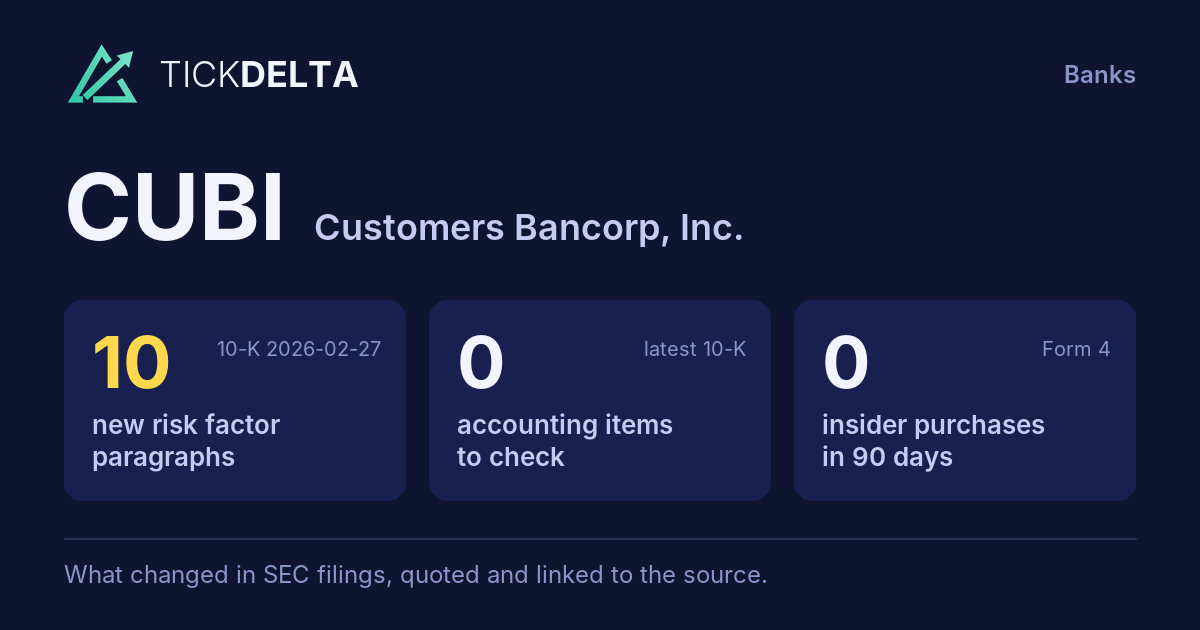
10 paragraphs in Risk Factors of the 10-K filed Feb 27, 2026
with nothing like them in the 10-K filed Feb 28, 2025. Quoted exactly.
Paragraphs that were only edited are under 10-K change.
In July 2025, President Trump signed into law the GENIUS Act, which establishes a regulatory framework for “payment stablecoins” and their issuers. Consumers and businesses may view payment stablecoins as a substitute for traditional bank deposits, resulting in deposit withdrawals. Depending on consumer and business interest in payment stablecoins, and the characteristics and utility of payment stablecoins, the passage of the GENIUS Act could result in increased competition with respect to our deposit products. However, the GENIUS Act requires the U.S. Treasury Department and federal and state regulators to issue regulations on numerous topics to interpret and implement the statute, so the effect of the GENIUS Act will depend on what those regulations provide.
The ongoing military conflict between Russia and Ukraine, ongoing conflicts in the Middle East, uncertainty as to tariff policies and the threat of retaliatory tariffs and other restrictions on international trade have created and are expected to continue to create additional uncertainty for the U.S. and global economy and potential for market disruption. After the 2022 – 2023 period in which the Federal Reserve raised interest rates significantly to lower inflation, the subsequently lowered interest rates in response, in large part, to reductions in the inflation rate, only to then reduce its reductions or maintain existing interest rates in response to subsequent increases in inflation and concerns about unemployment. It is uncertain whether the Federal Reserve will maintain current rates or pursue one or more decreases in interest rates in 2026 or future periods. These factors, and other factors, such as real estate values, state and local municipal budget deficits, government spending and the U.S. national debt may, directly and indirectly, adversely affect the U.S. economy and our financial condition and results of operations.
In addition, on or about June 17, 2025, the Company’s Board of Directors received a letter demanding it to investigate and pursue causes of action, purportedly on behalf of the Company, against certain current and former directors and/or officers of the Company based on alleged deficiencies in the Company’s disclosures concerning anti-money laundering and bank secrecy compliance (the “Demand Letter”). In response to the Demand Letter, on July 23, 2025, the Board approved the formation of a Special Litigation Committee comprised entirely of independent directors to investigate the allegations raised.
We may need to raise additional capital in the future and such capital may not be available when needed or at all.
We are required by regulatory agencies to maintain adequate levels of capital. We may need to raise additional capital in the future to meet regulatory or other internal requirements. As a publicly traded company, a likely source of additional funds is the capital markets, accomplished generally through the issuance of equity, both common and preferred stock, and the issuance of debt. Our ability to raise additional capital, if needed, will depend on, among other things, conditions in the capital markets at that time, which are outside of our control, and our financial performance.
We cannot provide any assurance that access to such capital will be available to us on acceptable terms or at all. Any occurrence that may limit our access to the capital markets, such as a decline in the confidence of debt purchasers or counterparties participating in the capital markets, may materially and adversely affect our capital costs and our ability to raise capital and, in turn, our liquidity. If we need to raise capital in the future, we may have to do so when many other financial institutions are also seeking to raise capital and would then have to compete with those institutions for investors. The inability to raise additional capital on acceptable terms when needed could have a materially adverse effect on our business, financial condition or results of operations.
We are subject to capital adequacy standards, and a failure to meet these standards could adversely affect our financial condition.
Customers Bancorp and the Bank are each subject to capital adequacy and liquidity rules and other regulatory requirements specifying the minimum amounts and types of capital that must be maintained. From time to time, the regulators implement changes to these regulatory capital adequacy and liquidity guidelines. If we fail to meet these minimum capital and liquidity guidelines and other regulatory requirements, we may be restricted in the types of activities we may conduct and may be prohibited from taking certain capital actions, such as making payments on certain capital instruments, paying executive bonuses or dividends, and repurchasing or redeeming capital securities.
On July 4, 2025, the OBBBA was signed into law and made significant changes to the U.S. federal income tax code, including permanently extending many provisions of the Tax Act and introducing new temporary deductions and credits. Specific provisions of the OBBBA that may impact Customers include the restoration of 100% bonus depreciation and changes to research and development expensing rules. The provisions of the OBBBA do not have a material impact on Customers' effective tax rate.
Certain provisions of the OBBBA are temporary and subject to expiration or future modification. Further legislation could result in material changes to tax rates or tax deductions that could negatively affect Customers. We are unable to predict the likelihood or impact of any such future changes in tax law.
Paragraphs in the 10-Q filed Nov 6, 2026 that were not in the one before
New in the latest 10-Q
4 paragraphs in the 10-Q filed Nov 6, 2026 with nothing like
them in the 10-Q filed Aug 7, 2026 (at least half the words must differ; new numbers alone do not count).
Quoted exactly, grouped by the item heading above them. This is text that changed, not a judgement of how serious it is.
10-Q
On September 5, 2025, Customers Bancorp sold 2,189,781 shares of its common stock held as treasury stock in an underwritten public offering at a price of $ 68.50 per share. Customers Bancorp granted the underwriters a 30-day option to purchase up to an additional 328,467 shares of its common stock in the offering at the public offering price, less underwriting discounts and commissions, which option was exercised in full. The net proceeds after deducting underwriting discounts and commissions and offering expenses were $ 163.5 million. The sales proceeds received in excess of the carrying value of the treasury stock of $ 84.8 million is included in additional paid-in capital in the consolidated statements of changes in shareholders’ equity for the three and nine months ended September 30, 2025.
Read in the 10-Qopen_in_new
To determine the ACL as of September 30, 2026, Customers utilized its baseline forecast to generate its modeled expected losses and considered other alternative economic forecast scenarios to qualitatively adjust the modeled ACL by loan portfolio in order to reflect management’s reasonable expectations of current and future economic conditions. The baseline forecast at September 2026 assumed slight improvements in certain macroeconomic variables while others remained flat from the second quarter 2026 forecasts of macroeconomic conditions used by Customers.
Read in the 10-Qopen_in_new
Customers’ effective tax rate was 21.7% for the nine months ended September 30, 2026 compared to 21.7% for the nine months ended September 30, 2025. The effective tax rate was relatively consistent between periods, as the benefit of a lower estimated annual effective tax rate was offset by a smaller impact of favorable discrete items relative to pre-tax income. Favorable discrete items in 2026 primarily consisted of excess tax benefits on vested stock awards and the net discount realized on the purchase of energy tax credits.
Read in the 10-Qopen_in_new
The $4.7 million increase in other non-interest expense for the nine months ended September 30, 2026 compared to the nine months ended September 30, 2025 primarily resulted from increases in deposit costs of $8.1 million mainly for deposits referred from other financial institutions, $3.4 million in business development expenses and $1.2 million in insurance expenses related to self-insured health plan. These increases were partially offset by a decrease of $8.2 million in provision for unfunded lending-related commitments. Refer to “NOTE 13 - FINANCIAL INSTRUMENTS WITH OFF-BALANCE SHEET RISK” to Customers’ unaudited consolidated financial statements for additional information on a benefit to provision for unfunded lending-related commitments.
Read in the 10-Qopen_in_new
The 10-Q's risk factors against the 10-K
Item 1A of the 10-Q filed Nov 6, 2026 against Item 1A of the 10-K filed Feb 27, 2026.
A 10-Q repeats only the risks that changed, so a 10-K paragraph that is missing from it is not counted as removed.
Added is a paragraph with nothing like it in the 10-K, Reworded a sentence that is in both with several words changed,
Quiet changes a sentence in both where one to four words changed and one is a hedge or a modal
(cut words struck through, new words highlighted).
Text on the page, not a score; each links to the filing at sec.gov.
Added10-Q Nov 6, 2026 vs 10-K Feb 27, 2026
In addition to the other information set forth in this Quarterly Report, you should carefully consider the factors discussed in “Risk Factors” included within the 2025 Form 10-K. There are no material changes from the risk factors included within the 2025 Form 10-K. The risks described within the 2025 Form 10-K are not the only risks facing us. Additional risks and uncertainties not currently known to us or that we currently believe to be immaterial also may materially adversely affect our business, financial condition and/or operating results. Refer to “Item 2 - Management’s Discussion and Analysis of Financial Condition and Results of Operations - Cautionary Note Regarding Forward-Looking Statements.”
Read it in the 10-Q at sec.govopen_in_new
Phrases used for the first time
Two-word phrases in Risk Factors of the 10-K filed Feb 27, 2026 that are in none of the 1 earlier 10-Ks stored, back to Feb 28, 2025
party service ×6genius act ×4payment stablecoins ×4digital asset ×3capital adequacy ×3sale loans ×2receivable installment ×2loans currently ×2historically low ×2low interest ×2asset industry ×2identify recruit ×2deposit products ×2regulatory burden ×2asset sensitive ×2service provider ×2
Where each one is used
- party service: ◦Risks associated with our dependency on our information technology and telecommunications systems and third-party service providers including exposures to systems failures, interruptions or breaches of security;
- genius act: In July 2025, President Trump signed into law the GENIUS Act, which establishes a regulatory framework for “payment stablecoins” and their issuers. Consumers and businesses may view payment stablecoins as a substitute for traditional bank deposits, resulting in deposit withdrawals. Depending on consumer and...
- payment stablecoins: In July 2025, President Trump signed into law the GENIUS Act, which establishes a regulatory framework for “payment stablecoins” and their issuers. Consumers and businesses may view payment stablecoins as a substitute for traditional bank deposits, resulting in deposit withdrawals. Depending on consumer and...
- digital asset: Our loan and deposit portfolios consist primarily of commercial and industrial loans, including specialized lending activities, multifamily lending, commercial real estate loans, and mortgage finance loans, and related deposits, which contain material concentrations in certain business lines or product types....
- capital adequacy: We are subject to capital adequacy standards, and a failure to meet these standards could adversely affect our financial condition.
- sale loans: As of December 31, 2025, Customers had $1.4 billion in consumer loans outstanding, or 8.5% of the total loan and lease portfolio, which includes loans held for sale, loans receivable, mortgage finance, at fair value, and loans receivable, installment, at fair value, compared to $1.4 billion, or 9.9% of the total...
- receivable installment: As of December 31, 2025, Customers had $1.4 billion in consumer loans outstanding, or 8.5% of the total loan and lease portfolio, which includes loans held for sale, loans receivable, mortgage finance, at fair value, and loans receivable, installment, at fair value, compared to $1.4 billion, or 9.9% of the total...
- loans currently: Commercial real estate mortgage loans generally involve a greater degree of credit risk than residential real estate mortgage loans because they typically have larger balances and are more affected by adverse conditions in the economy. Because payments on loans secured by commercial real estate often depend upon...
The 10-K at sec.govopen_in_new
Used at least twice, small words left out. Counted, not picked: a phrase can be new because the company renamed something.
On January 4, 2021, we completed the divestiture of BMT through the merger of BMT with MFAC. In connection with the closing of the divestiture, MFAC changed its name to “BM Technologies, Inc.” Our agreement with MFAC relating to the merger of BMT and MFAC provided that the shares issuable by MFAC in connection with the merger would be issued directly to Customers Bancorp shareholders rather than being issued to and held by us. In connection with the divestiture, we have entered into various agreements with BM Technologies, including a transition services agreement, software license...
In the 10-K filed Feb 28, 2025open_in_new
In addition, the U.S. economy contracted into a recession in the first half of 2020, primarily driven by the COVID-19 pandemic. The U.S. government and the Federal Reserve responded to the pandemic with unprecedented measures. The U.S. economy has since strengthened despite the spread of COVID-19 variants, with higher inflation and housing values beginning in 2021. Also, the ongoing global supply chain issues and the military conflict between Russia and Ukraine contributed to higher inflation in 2022. In response, the Federal Reserve began normalizing monetary policy with its decision in...
In the 10-K filed Feb 28, 2025open_in_new
Our Series E and Series F Preferred Stock rank equally. Although we do not currently have outstanding preferred stock that ranks senior to the Series E and Series F Preferred Stock, the Series E and Series F Preferred Stock may rank junior to other preferred stock we may issue in the future that by its terms is expressly senior in rights and preferences to the Series E and Series F Preferred Stock, although the affirmative vote or consent of the holders of at least two-thirds of all outstanding shares of the affected class of preferred stock is required to issue any shares of stock ranking...
In the 10-K filed Feb 28, 2025open_in_new
Our Series E and Series F Preferred Stock are perpetual equity securities, meaning that they have no maturity date or mandatory redemption date, and the shares are not redeemable at the option of the holders thereof. During the year ended December 31, 2021, we redeemed all of the outstanding shares of Series C and Series D Preferred Stock. However, any determination we make at any time to propose a redemption of the Series E and Series F Preferred Stock will depend upon a number of factors, including our evaluation of our capital position, the composition of our shareholders’ equity and...
In the 10-K filed Feb 28, 2025open_in_new
Sources
Item 1A of each 10-K and 10-Q on EDGAR, quoted exactly. Each paragraph links to the filing at sec.gov.
Also
10-K change: what was reworded or cut, section by section.
Work with it
Excel workbook · CSV. Google Sheet that stays up to date: paste =IMPORTDATA("https://tickdelta.com/company/CUBI/export.csv") into a cell.