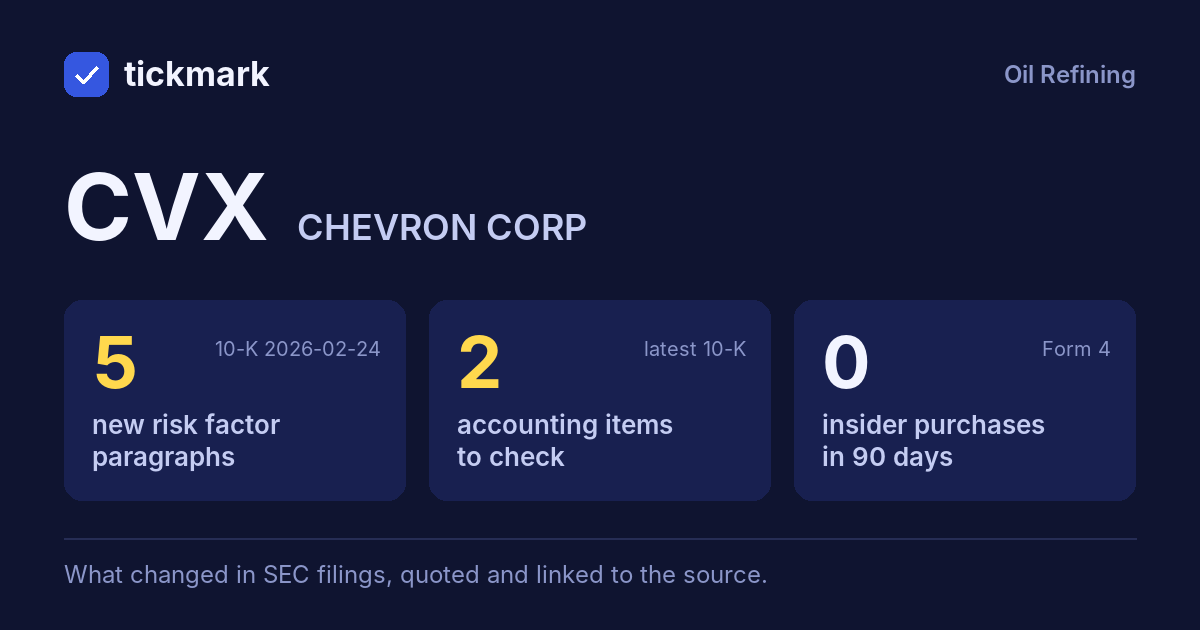
10-K 0000093410-26-000078 (2026-02-24) vs 10-K 0000093410-25-000009 (2025-02-21)
| Section | Compared text | Words now | Changed |
|---|
| Risk Factors | Item 1A | 4,919 |
19.2% |
| MD&A | Item 7 | 16,942 |
24.5% |
| Legal Proceedings | Item 3 | 442 |
33.1% |
| Accounting Policies | Item 8, Note 1 – Summary of Significant Accounting Policies | 2,631 |
8.3% |
The redline: what was cut and what was added
In each section, the paragraph that changed most, marked against last year's 10-K:
cut words struck through, new words highlighted and underlined.
MD&A 584 words changed in this paragraph; it is 34% similar to last year's version.
Report of Independent Registered Public Accounting Firm To the Board of Directors and Stockholders of Chevron Corporation Opinions on the Financial Statements and Internal Control over Financial Reporting We have audited the accompanying consolidated balance sheet of Chevron Corporation and its subsidiaries (the “Company”) as of December 31, 2024 and 2023, and the related consolidated statements of income, of comprehensive income, of equity and of cash flows for each of the three years in the period ended December 31, 2024, including the related notes and financial statement schedule listed in the index appearing under Item 15(a)(2) (collectively referred to as the “consolidated financial statements”). We also have audited the Company's internal control over financial reporting as of December 31, 2024, based on criteria established in Internal Control - Integrated Framework (2013) issued by the Committee of Sponsoring Organizations of the Treadway Commission (COSO). In our opinion, the consolidated financial statements referred to above present fairly, in all material respects, the financial position of the Company as of December 31, 2024 and 2023, and the results of its operations and its cash flows for each of the three years in the period ended December 31, 2024 in conformity with accounting principles generally accepted in the United States of America. Also in our opinion, the Company maintained, in all material respects, effective internal control over financial reporting as of December 31, 2024, based on criteria established in Internal Control - Integrated Framework (2013) issued by the COSO. Basis for Opinions The Company's management is responsible for these consolidated financial statements, for maintaining effective internal control over financial reporting, and for its assessment of the effectiveness of internal control over financial reporting, included in the accompanying Management’s Report on Internal Control Over Financial Reporting. Our responsibility is to express opinions on the Company’s consolidated financial statements and on the Company's internal control over financial reporting based on our audits. We are a public accounting firm registered with the Public Company Accounting Oversight Board (United States) (PCAOB) and are required to be independent with respect to the Company in accordance with the U.S. federal securities laws and the applicable rules and regulations of the Securities and Exchange Commission and the PCAOB. We conducted our audits in accordance with the standards of the PCAOB. Those standards require that we plan and perform the audits to obtain reasonable assurance about whether the consolidated financial statements are free of material misstatement, whether due to error or fraud, and whether effective internal control over financial reporting was maintained in all material respects. Our audits of the consolidated financial statements included performing procedures to assess the risks of material misstatement of the consolidated financial statements, whether due to error or fraud, and performing procedures that respond to those risks. Such procedures included examining, on a test basis, evidence regarding the amounts and disclosures in the consolidated financial statements. Our audits also included evaluating the accounting principles used and significant estimates made by management, as well as evaluating the overall presentation of the consolidated financial statements. Our audit of internal control over financial reporting included obtaining an understanding of internal control over financial reporting, assessing the risk that a material weakness exists, and testing and evaluating the design and operating effectiveness of internal control based on the assessed risk. Our audits also included performing such other procedures as we considered necessary in the circumstances. We believe that our audits provide a reasonable basis for our opinions. Definition and Limitations of Internal Control over Financial Reporting A company’s internal control over financial reporting is a process designed to provide reasonable assurance regarding the reliability of financial reporting and the preparation of financial statements for external purposes in accordance with generally accepted accounting principles. A company’s internal control over financial reporting includes those policies and procedures that (i) pertain to the maintenance of records that, in reasonable detail, accurately and fairly reflect the transactions and dispositions of the assets of the company; (ii) provide reasonable assurance that transactions are recorded as necessary to permit preparation of financial statements in accordance with generally accepted accounting principles, and that receipts and expenditures of the company are being made only in accordance with authorizations of management and directors of the company; and (iii) provide reasonable assurance regarding prevention or timely detection of unauthorized acquisition, use, or disposition of the company’s assets that could have a material effect on the financial statements.
Source: Item 7, 10-K 0000093410-26-000078 vs Item 7, 10-K 0000093410-25-000009
Risk Factors 147 words changed in this paragraph; it is 74% similar to last year's version.
Our existing processes and controls may not align with evolving voluntary and mandatory standards for identifying, measuring, and reporting ESG metrics. Our interpretation of reporting standards may differ from those of others, and such standards may change over time, including through non-public processes, any of which could result in significant revisions to our goals or reported progress in achieving such goals. For example, Chevron’s methane intensity target is calculated based on Compendium of Greenhouse Gas Emissions Methodologies for the Oil and Natural Gas Industry (2021), which requires use of local regulatory reporting methodologies where applicable. The U.S. EPA has adopted notable changes to reporting methodologies in its Greenhouse Gas Reporting Program (40 C.F.R. Part 98.230), which are applicable to Chevron’s U.S. operations. We expect these adopted changes may increase our reported emissions in future years, and therefore, increase our reported methane intensity. In addition, Chevron participates, along with other companies, institutes, universities, trade associations and other organizations, in various initiatives, campaigns, and other projects that express various ambitions, aspirations and goals related to climate change, emissions and energy transition. Chevron’s individual ambitions, future performance or policies may differ from the ambitions of such organizations or the individual ambitions of other participants in these various initiatives, campaigns, and other projects, and Chevron may unilaterally change its individual ambitions. Achievement of or efforts to achieve ambitions such as the foregoing and future internal climate-related initiatives has, and may continue to, increase costs, and, in addition, may require purchase of carbon credits, or limit or impact the company’s business plans, operations and financial results, potentially resulting in reduction to the economic end-of-life of certain assets, impairing the associated net book value, among other material adverse impacts. Our failure or perceived failure to pursue or fulfill such ambitions within the timelines we announce, or at all, or to satisfy various reporting standards and regulations could have a negative impact on the company’s reputation, investor sentiment, ratings outcomes for evaluating the company’s approach to ESG matters, stock price, and cost of capital and expose us to government enforcement actions and private litigation, among other material adverse impacts.
Source: Item 1A, 10-K 0000093410-26-000078 vs Item 1A, 10-K 0000093410-25-000009
Accounting Policies 31 words changed in this paragraph; it is 83% similar to last year's version.
Where leases are used in joint ventures, the company recognizes 100 percent of the right-of-use assets and lease liabilities when the company is the sole signatory for the lease (in most cases, where the company is the operator of a joint venture). Lease costs reflect only the costs associated with the operator’s working interest share. The lease term includes the committed lease term identified in the contract, taking into account renewal and termination options that management is reasonably certain to exercise. The company uses its incremental borrowing rate as a proxy for the discount rate based on the term of the lease unless the implicit rate is available.
Source: Item 8, Note 1 – Summary of Significant Accounting Policies, 10-K 0000093410-26-000078 vs Item 8, Note 1 – Summary of Significant Accounting Policies, 10-K 0000093410-25-000009
Legal Proceedings 5 words changed in this paragraph; it is 96% similar to last year's version.
On As previously disclosed, on May 26, 2023, Chevron’s refinery in El Segundo, California notified the U.S. EPA that it had inadvertently overstated the number of biofuel credits generated by co-processing in 2022 in violation of the Renewable Fuel Standard program. The parties began negotiating a resolution of the violation in October 2024. Resolution of the violation may will result in the payment of a civil penalty of $1.0 million or more.
Source: Item 3, 10-K 0000093410-26-000078 vs Item 3, 10-K 0000093410-25-000009
Every change, by type
Sentences and paragraphs of CVX's Risk Factors and MD&A, 10-K 2026-02-24 against 10-K 2025-02-21.
Each links to the text at sec.gov.
Quiet changes are sentences kept from last year with one to four words changed, at least one of them a hedge, a modal or a qualifier
(may, could, will, not, significant, material…). A year or date rolling forward is not counted.
The full word list
adverse, adversely, all, although, anticipate, anticipates, any, approximately, believe, believes, can, cannot, certain, could, expect, expects, generally, however, if, intend, intends, largely, likely, many, material, materially, may, might, most, must, never, no, not, possible, primarily, probable, should, significant, significantly, some, substantial, substantially, unlikely, will, would
AddedRisk Factors
As a global energy company, Chevron is subject to a variety of risks. The following disclosures reflect our beliefs and opinions as to factors that could materially and adversely affect us in the future. References to past events are provided by way of example only and are not intended to be a complete listing or a representation as to whether or not such factors have occurred in the past or their likelihood of occurring in the future.
Read it in 10-K 2026-02-24 at sec.gov ↗
AddedRisk Factors
Chevron is incorporating artificial intelligence technologies into its processes and these technologies may present business, compliance, and reputational risks The company is increasingly utilizing artificial intelligence (“AI”) technologies in certain of its processes, information systems and various operations, and expects that AI will assume a more critical role in its operations over time. The use of AI technologies introduces certain risks to the company, including potential dependency on biased or incorrect AI outputs, new or enhanced regulatory requirements, litigation, privacy risks, cybersecurity risks, reputational harm, liability or other adverse consequences, any of which could adversely affect its business, financial condition and results of operations. Additionally, other unforeseen risks stemming from either the company’s or third-party service providers’ use and development of AI tools and technologies, or the company’s inability to adopt such technologies at the same pace as its competitors, may arise in the future that could adversely affect its business and results of operations.
Read it in 10-K 2026-02-24 at sec.gov ↗
AddedRisk Factors
One of our subsidiaries acts as the general partner of a publicly traded limited partnership, Hess Midstream LP, which may involve a potential legal liability One of our subsidiaries acts as the general partner of Hess Midstream, a publicly traded limited partnership. Our control of the general partner of Hess Midstream may increase the possibility that we could be subject to claims of breach of duties owed to Hess Midstream, including claims of conflict of interest. Any liability resulting from such claims could have an adverse impact on our future business, financial condition, results of operations and cash flows.
Read it in 10-K 2026-02-24 at sec.gov ↗
AddedRisk Factors
legal challenges, including the actual laws and regulations enacted, the variables and trade-offs that inevitably occur in connection with such processes, and market conditions, including the responses of consumers to such changes.
Read it in 10-K 2026-02-24 at sec.gov ↗
AddedRisk Factors
emissions and emission reductions and removals; (7) customers’ and consumers’ preferences and use of the company’s products or substitute products; and (8) actions taken by the company’s competitors.
Read it in 10-K 2026-02-24 at sec.gov ↗
RemovedRisk Factors
As a global energy company, Chevron is subject to a variety of risks that could materially impact the company’s results of operations and financial condition.
Read it in 10-K 2025-02-21 at sec.gov ↗
RemovedRisk Factors
Chevron may not complete the acquisition of Hess Corporation within the time frame the company anticipates or at all, which could have adverse effects on Chevron The completion of the acquisition of Hess Corporation (Hess) is subject to a number of conditions, including approval of any Guyanese governmental body, agency or authority that asserts its approval is required in connection with the transaction, which makes the completion and timing of the completion of the merger uncertain.
Read it in 10-K 2025-02-21 at sec.gov ↗
RemovedRisk Factors
Hess Guyana Exploration Limited (HGEL), a wholly owned subsidiary of Hess, is currently in arbitration with respect to the right of first refusal (Stabroek ROFR) contained in an operating agreement among HGEL, affiliates of Exxon Mobil Corporation (Exxon), and China National Offshore Oil Corporation (CNOOC) regarding the Stabroek Block offshore Guyana. The arbitration merits hearing about the applicability of the Stabroek ROFR to the merger has been scheduled for May 2025, with a decision expected in approximately the following three months. If the arbitration does not result in a confirmation that the Stabroek ROFR is inapplicable to the merger, and if Chevron, Hess, Exxon and/or CNOOC do not otherwise agree upon an acceptable resolution, then there would be a failure of a closing condition under the merger agreement, in which case the merger would not close.
Read it in 10-K 2025-02-21 at sec.gov ↗
RemovedRisk Factors
On December 7, 2023, Chevron and Hess each received a request for additional information and documentary materials (Second Request) from the Federal Trade Commission (FTC). Following the FTC review of the transaction, on September 30, 2024, the FTC announced that a majority of the Commission voted to accept a consent agreement among the FTC,
Read it in 10-K 2025-02-21 at sec.gov ↗
RemovedRisk Factors
Chevron and Hess, resolving the concerns the FTC identified during its review of the transaction. Chevron and Hess have taken and will continue to take appropriate steps to maintain our ability under the Hart-Scott-Rodino Act of 1976, as amended, to close the merger following satisfactory resolution of the ongoing arbitration proceedings regarding preemptive rights in the Stabroek Block joint operating agreement. Additionally, if any Guyanese governmental body, agency or authority of competent jurisdiction asserts that its approval is required as a result of the consequences of the merger in Guyana on Hess’ assets in Guyana (which has not occurred as of the filing date of this report), approval of such governmental body, agency or authority will become a condition to each party’s obligation to complete the merger.
Read it in 10-K 2025-02-21 at sec.gov ↗
RemovedRisk Factors
The failure to satisfy all of the required conditions could delay the completion of the acquisition for a significant period of time or prevent it from occurring at all. A failure to complete the acquisition would mean that we will not realize the anticipated benefits of the transaction. In addition, the terms and conditions of the required regulatory authorizations and consents for the acquisition that are granted, if any, may impose requirements, limitations or costs or place restrictions on the conduct of the company’s business after the transaction or materially delay the completion of the acquisition. A delay in completing the acquisition could cause the company to realize some or all of the benefits later than we otherwise expect to realize them if the acquisition is successfully completed within the anticipated timeframe, which could result in additional transaction costs or in other negative effects associated with uncertainty about completion of the acquisition.
Read it in 10-K 2025-02-21 at sec.gov ↗
RemovedRisk Factors
designed to stop or impede the development or production of oil and gas, such as those related to the use of hydraulic fracturing or bans on drilling, or any law or regulation that impacts the demand for our products, could adversely affect the company’s current or anticipated future operations and profitability.
Read it in 10-K 2025-02-21 at sec.gov ↗
RewordedRisk Factors
Acquisitions The acquisition of Hess may cause Chevron’s financial results to differ from the company’s expectations or the expectations of the investment community, the company may not achieve the anticipated benefits of the acquisition, and the acquisition may disrupt the company’s current plans or operations The success of the pending acquisition of Hess Hess, which closed in July 2025, will depend, in part, on Chevron’s ability to successfully integrate the business of Hess and realize the anticipated benefits, including synergies. the anticipated run-rate cost synergies, estimated five-year production and free cash flow growth rates, and anticipated higher returns to shareholders over the long-term.
Read it in 10-K 2026-02-24 at sec.gov ↗
RewordedRisk Factors
Further, the ultimate impact of GHG emissions and climate change-related agreements, legislation, regulation, and government actions on the company’s financial performance is highly uncertain because the company is unable to predict with certainty, for a multitude of individual jurisdictions, the outcome of political decision-making processes and legal challenges, including the actual laws and regulations enacted, the variables and trade-offs that inevitably occur in connection with such processes, and market conditions, including the responses of consumers to such changes.
Read it in 10-K 2026-02-24 at sec.gov ↗
RewordedRisk Factors
Difficulties in integrating Hess may result in the failure Failure to realize anticipated synergies in the expected timeframes, in timeframe, operational challenges, and in the diversion of management’s attention from ongoing business concerns, as well as in and unforeseen expenses associated with the acquisition, which acquisition may have an adverse impact on the company’s our financial results.
Read it in 10-K 2026-02-24 at sec.gov ↗
RewordedRisk Factors
Chevron regularly evaluates its ambitions and expects to change or eliminate The company has changed and/or eliminated some of these aspirations, targets, and other ambitions and may continue to do so in the future for various reasons, including market conditions; its strategy or portfolio; and financial, operational, policy, reputational, legal and other factors.
Read it in 10-K 2026-02-24 at sec.gov ↗
RewordedRisk Factors
The company’s operations are therefore subject to disruption from natural or human causes beyond its control, including risks from hurricanes, severe storms, floods, heat waves, and other forms of severe weather; wildfires; ambient temperature increases; sea level rise; war or other military conflicts such as the conflict between Russia and Ukraine and in the Middle East and the military conflict between Russia and Ukraine; East; accidents; civil unrest; political events; events such as current geopolitical tensions in Venezuela; fires; earthquakes; system failures; cyber threats; terrorist acts; and epidemic or pandemic diseases, some of which may be impacted by climate change and any of which could result in suspension of operations or harm to people or the natural environment.
Read it in 10-K 2026-02-24 at sec.gov ↗
RewordedRisk Factors
In a number of locations, including the European Union, governments have proposed or imposed restrictions on direct and indirect obligations with respect to the company’s operations, activities, trade, currency exchange controls, burdensome taxes, and public disclosure requirements disclosures, as well as currency exchange controls that might harm the company’s competitiveness, return on investments, or relations with other governments or third parties.
Read it in 10-K 2026-02-24 at sec.gov ↗
RewordedRisk Factors
Our ability to achieve any ambition, including with respect those related to GHG emissions or climate-related initiatives, including such as those outlined in the Management’s Discussion and Analysis of Financial Condition and Results of Operations, on pages 35 36 through 37, and any as well as efforts concerning new businesses, is subject to numerous risks and contingencies, many of which are outside of Chevron’s control. control and persist.
Read it in 10-K 2026-02-24 at sec.gov ↗
RewordedRisk Factors
The cyber risk landscape changes over time due to a variety of internal and external factors, including during organizational changes, relocating work to international geographies, or other corporate transactions; political tensions; war or other military conflicts; or civil unrest.
Read it in 10-K 2026-02-24 at sec.gov ↗
RewordedRisk Factors
In addition, to the extent that societal pressures or political or other factors are involved, it It is also possible that such liability could be imposed without regard to the company’s causation of or contribution to the asserted damage, or to other mitigating factors.
Read it in 10-K 2026-02-24 at sec.gov ↗
RewordedRisk Factors
For example, increasing trends in attention to ESG matters, including climate change, has have resulted and may result in the future in shifting demand for our hydrocarbon products, and have resulted in additional litigation and governmental investigations, or and/or threats thereof, against the company.
Read it in 10-K 2026-02-24 at sec.gov ↗
RewordedRisk Factors
Extended periods of low prices or demand for crude oil, natural gas, and natural gas liquids have had, and in the future can have have, a material adverse impact on the company’s results of operations, financial condition and liquidity.
Read it in 10-K 2026-02-24 at sec.gov ↗
RewordedRisk Factors
EPA) Greenhouse Gas Reporting Program, (5) evolving regulatory requirements affecting ESG standards or disclosures;
Read it in 10-K 2026-02-24 at sec.gov ↗
AddedMD&A
programs to continue to increase, these costs currently do not have a material impact on the company’s financial condition or results of operations.
Read it in 10-K 2026-02-24 at sec.gov ↗
AddedMD&A
See page 46 for the company’s U.S. and international average realizations for each of the past three years.
Read it in 10-K 2026-02-24 at sec.gov ↗
AddedMD&A
Angola Achieved first oil from the South N’dola platform, leveraging existing infrastructure.
Read it in 10-K 2026-02-24 at sec.gov ↗
AddedMD&A
Argentina Exercised option to participate in the Vaca Muerta Sur Pipeline Project to export crude from the Vaca Muerta shale to a new export terminal.
Read it in 10-K 2026-02-24 at sec.gov ↗
AddedMD&A
Australia Reached final investment decision (FID) on the Gorgon backfill development to connect the Geryon and Eurytion fields to existing infrastructure, enabling long-term supply of domestic gas in Western Australia and LNG in Asia.
Read it in 10-K 2026-02-24 at sec.gov ↗
AddedMD&A
Guyana Achieved first oil at Yellowtail, the fourth development in the offshore Stabroek Block, and reached FID on the Hammerhead project, the seventh development.
Read it in 10-K 2026-02-24 at sec.gov ↗
AddedMD&A
Malaysia/Thailand JDA Completed the sale of the company’s interest in the Malaysia-Thailand Joint Development Area.
Read it in 10-K 2026-02-24 at sec.gov ↗
AddedMD&A
Nigeria Discovered hydrocarbons in two exploration and appraisal wells in the Delta South-AA in Petroleum Mining Lease 46 and the Awodi-07 in Petroleum Prospecting License 263 in shallow offshore water.
Read it in 10-K 2026-02-24 at sec.gov ↗
AddedMD&A
Peru Secured three offshore exploration blocks (Blocks Z-61, Z-62, and Z-63) in the Trujillo Basin.
Read it in 10-K 2026-02-24 at sec.gov ↗
AddedMD&A
Republic of Congo Completed the sale of the company’s interest in the Republic of Congo.
Read it in 10-K 2026-02-24 at sec.gov ↗
AddedMD&A
United States Completed the acquisition of Hess, creating a combined company with a premier upstream portfolio and achieving the initial run-rate synergy target of $1 billion.
Read it in 10-K 2026-02-24 at sec.gov ↗
AddedMD&A
United States Started and ramped up production at the Anchor, Ballymore, Stampede, and Whale fields in the deepwater Gulf of America.
Read it in 10-K 2026-02-24 at sec.gov ↗
RemovedMD&A
Some governments, companies, communities and other stakeholders are supporting efforts to address climate change. International initiatives and national, regional and state legislation and regulations that aim to directly or indirectly reduce GHG emissions are in various stages of design, adoption and implementation. These policies and programs, some of which support the global net zero emissions ambitions of the Paris Agreement, can change the amount of energy consumed, the rate of energy-demand growth, the energy mix and the relative economics of one fuel versus another. Implementation of jurisdiction-specific policies and programs can be dependent on, and can affect the pace of, technological advancements; the granting of necessary permits by governing authorities; the availability and acceptability of cost-effective, verifiable carbon credits; the availability of suppliers that can meet our sustainability-related standards; evolving regulatory or other requirements affecting ESG standards or disclosures and evolving standards and regulations for tracking, reporting, marketing and advertising relating to emissions and emission reductions and removals.
Read it in 10-K 2025-02-21 at sec.gov ↗
RemovedMD&A
Some of these policies and programs include renewable and low carbon fuel standards, such as the Renewable Fuel Standard program in the U.S. and California’s Low Carbon Fuel Standard; programs that price GHG emissions, including
Read it in 10-K 2025-02-21 at sec.gov ↗
RemovedMD&A
2050 Net Zero Upstream Aspiration Chevron aspires to achieve net zero for upstream production Scope 1 and 2 GHG emissions on an equity basis by 2050. The company believes accomplishing this aspiration depends on, among other things, sufficient and substantial advances in technology, including the continuing progress of commercially viable technologies and low- or non-carbon-based energy sources; enabling policies and other actions by governing authorities, including those regarding subsidies, tax and other incentives as well as the granting of necessary permits; successful negotiations for carbon capture and storage and nature-based solutions with customers, suppliers, partners and governments; market conditions; and the availability and acceptability of cost-effective, verifiable carbon credits.
Read it in 10-K 2025-02-21 at sec.gov ↗
RemovedMD&A
Planned Lower-Carbon Capital Spend through 2028 In 2021, the company guided to capital spend of approximately $10 billion through 2028 to advance its lower carbon ambitions, which includes approximately $2 billion to lower the carbon intensity of its oil and gas operations, and approximately $8 billion for lower carbon investments including in renewable fuels, hydrogen and carbon capture and offsets. Beyond 2028, the company anticipates capital spending will be necessary to progress the company’s 2050 upstream production Scope 1 and 2 net zero aspiration and building of its lower carbon business lines.
Read it in 10-K 2025-02-21 at sec.gov ↗
RemovedMD&A
Since 2021, the company has spent $7.7 billion in lower carbon investments, including $2.9 billion associated with the acquisition of REG in 2022.
Read it in 10-K 2025-02-21 at sec.gov ↗
RemovedMD&A
In December 2021, the Organization for Economic Co-operation and Development (OECD) issued model rules for a new 15 percent global minimum tax (Pillar Two), and various jurisdictions in which the company operates enacted or are in the process of enacting Pillar Two legislation. Certain aspects of the tax under the Pillar Two framework became effective in 2024 in some jurisdictions and will be effective in 2025 (or later) in others. Pillar Two did not have a material impact on the company’s results of operations in 2024. Although we do not currently expect that Pillar Two will have a material impact on our future results of operations, we are continuing to evaluate the impact of pending legislative adoption by individual countries.
Read it in 10-K 2025-02-21 at sec.gov ↗
RemovedMD&A
Refer to the Cautionary Statement Relevant to Forward-Looking Information on page 2 and to Item 1A. Risk Factors for a discussion of some of the inherent risks that could materially impact the company’s results of operations or financial condition.
Read it in 10-K 2025-02-21 at sec.gov ↗
RemovedMD&A
In December 2024, the company sold its 20 percent non-operated interest in the Athabasca Oil Sands Project and 70 percent operated interest in the Duvernay shale in Alberta, Canada, to Canadian Natural Resources Limited for $6.5 billion before taxes, and expects to make tax payments totaling $1.5 billion in first quarter 2025. In 2024, these assets produced 86 thousand barrels of oil-equivalent per day and generated over $2.2 billion of sales and approximately $590 million of operational net income. As part of the sale, the buyer assumed decommissioning obligations for the transferred assets.
Read it in 10-K 2025-02-21 at sec.gov ↗
RemovedMD&A
In April 2024, Tengizchevroil LLP (TCO) achieved start-up of the Wellhead Pressure Management Project (WPMP) and at year-end 2024, all four pressure boost facility compressors are online and all metering stations have been converted to low pressure. In January 2025, TCO started oil production at its Future Growth Project, which is expected to contribute to higher free cash flow.
Read it in 10-K 2025-02-21 at sec.gov ↗
RemovedMD&A
Chevron operates and holds interests in the Bibiyana, Jalalabad and Moulavi Bazar fields in Bangladesh. Recent political unrest in the country has not impacted the company’s operations to date; however, the future impacts, if any, on the company’s results of operations and financial condition remain uncertain.
Read it in 10-K 2025-02-21 at sec.gov ↗
RemovedMD&A
Crude prices in 2024 were influenced by geopolitical conflict and OPEC+ supply restraint, which was offset by factors such as non-OPEC supply growth and slowing demand growth.
Read it in 10-K 2025-02-21 at sec.gov ↗
RemovedMD&A
In contrast to price movements in the global market for crude oil, prices for natural gas are also impacted by regional supply and demand and infrastructure conditions in local markets. In the United States, lower Henry Hub prices were driven by high storage levels, strong production, and delayed starts to liquefied natural gas (LNG) export projects.
Read it in 10-K 2025-02-21 at sec.gov ↗
RewordedMD&A
Accumulated depreciation, depletion and amortization 215,226 198,134 192,462 Properties, plant and equipment, net 219,729 147,799 153,619 Deferred charges and other assets 16,236 14,854 13,734 Goodwill 4,568 4,578 4,722 Assets held for sale 25 481 675 Total Assets $ 324,012 $ 256,938 $ 261,632 Liabilities and Equity Short-term debt $ 977 $ 4,406 $ 529 Accounts payable 19,280 22,079 20,423 Accrued liabilities 10,763 8,486 7,655 Federal and other taxes on income 844 1,872 1,863 Other taxes payable 1,523 1,715 1,788 Total Current Liabilities 33,387 38,558 32,258 Long-term debt1 39,781 20,135 20,307 Deferred credits and other noncurrent obligations 24,543 22,094 24,226 Noncurrent deferred income taxes 30,014 19,137 18,830 Noncurrent employee benefit plans 4,111 3,857 4,082 Total Liabilities2 $ 131,836 $ 103,781 $ 99,703 Preferred stock (authorized 100,000,000 shares; $1.00 par value; none issued) — — Common stock (authorized 6,000,000,000 shares; $0.75 par value; 2,442,676,580 shares 1,832 1,832 issued at December 31, 2024 2025 and 2023) 2024) Capital in excess of par value 33,886 21,671 21,365 Retained earnings 205,365 205,852 200,025 Accumulated other comprehensive losses (2,464) (2,760) (2,960) Deferred compensation and benefit plan trust (240) (240) Treasury stock, at cost (2024 (2025 - 448,260,458 shares; 2024 - 673,664,306 shares; 2023 - 577,028,776 shares) (51,929) (74,037) (59,065) Total Chevron Corporation Stockholders’ Equity 186,450 152,318 160,957 Noncontrolling interests (includes redeemable noncontrolling interest of $0 and $166 at December 31, 2024 and 2023) 5,726 839 972 Total Equity 192,176 153,157 161,929 Total Liabilities and Equity $ 324,012 $ 256,938 $ 261,632 1 Includes finance lease liabilities of $659 and $546 and $574 at December 31, 2024 2025 and 2023, 2024, respectively. 2 Refer to Note 24 Other Contingencies and Commitments.
Read it in 10-K 2026-02-24 at sec.gov ↗
RewordedMD&A
The principal considerations for our determination that performing procedures relating to the impact valuation of proved developed crude oil and natural gas reserves on upstream property, plant, and equipment, net properties acquired in the acquisition of Hess is a critical audit matter are (i) the significant judgment by management, including the use of management’s specialists, when developing the fair value estimates of proved developed crude oil and natural gas reserves, which in turn led to (ii) a high degree of auditor judgment, subjectivity, and effort in performing procedures and evaluating audit evidence obtained related to the data, methods, and assumptions used by management and its specialists in developing the estimates of proved developed crude oil and natural gas reserves. properties acquired;
Read it in 10-K 2026-02-24 at sec.gov ↗
RewordedMD&A
Year ended December 31 2025 2024 2023 2022 Operating Activities Net Income (Loss) $ 12,485 $ 17,749 $ 21,411 $ 35,608 Adjustments Depreciation, depletion and amortization 20,132 17,282 17,326 16,319 Dry hole expense 325 429 436 486 Distributions more (less) than income from equity affiliates 2,282 (366) (885) (4,730) Net before-tax gains on asset retirements and sales (462) (1,685) (138) (550) Net foreign currency effects 585 (629) 578 (412) Deferred income tax provision 986 1,240 298 2,124 Net decrease (increase) in operating working capital (1,008) 1,211 (3,185) 2,125 Decrease (increase) in long-term receivables (132) 114 150 153 Net decrease (increase) in other deferred charges (508) (1,225) (300) (212) Cash contributions to employee pension plans (588) (844) (1,120) (1,322) Other (158) (1,784) 1,038 13 Net Cash Provided by Operating Activities 33,939 31,492 35,609 49,602 Investing Activities Acquisition of businesses, net of cash received 1,056 — 55 (2,862) Acquisition of Hess Corporation common stock (2,225) — — Capital expenditures (17,347) (16,448) (15,829) (11,974) Proceeds and deposits related to asset sales and returns of investment 1,826 7,704 669 2,635 Net maturities of (investments in) time deposits 1 (4) — — Net sales (purchases) of marketable securities — 45 175 117 Net repayment (borrowing) of loans by equity affiliates 778 (233) (302) (24) Net Cash Used for Investing Activities (15,911) (8,936) (15,232) (12,108) Financing Activities Net borrowings (repayments) of short-term obligations (1,061) 4,868 135 263 Proceeds from issuances of long-term debt 11,402 478 150 — Repayments of long-term debt and other financing obligations (4,475) (1,778) (4,340) (8,742) Cash dividends - common stock (12,751) (11,801) (11,336) (10,968) Net contributions from (distributions to) noncontrolling interests (323) (195) (40) (114) Net sales (purchases) of treasury shares (11,855) (15,044) (14,678) (5,417) Net Cash Provided by (Used for) Financing Activities (19,063) (23,472) (30,109) (24,978) Effect of Exchange Rate Changes on Cash, Cash Equivalents and Restricted Cash 58 (97) (114) (190) Net Change in Cash, Cash Equivalents and Restricted Cash (977) (1,013) (9,846) 12,326 Cash, Cash Equivalents and Restricted Cash at January 1 8,262 9,275 19,121 6,795 Cash, Cash Equivalents and Restricted Cash at December 31 $ 7,285 $ 8,262 $ 9,275 $ 19,121 See accompanying Notes to the Consolidated Financial Statements.
Read it in 10-K 2026-02-24 at sec.gov ↗
RewordedMD&A
Upstream Net Crude Oil and Natural Gas Liquids (NGLs) Production MBD 1,341 1,152 997 888 Net Natural Gas Production3 MMCFD 3,099 2,684 2,112 1,758 Net Oil-Equivalent Production MBOED 1,858 1,599 1,349 1,181 Sales of Natural Gas4 MMCFD 5,717 5,172 4,637 4,354 Sales of Natural Gas Liquids MBD 536 490 354 276 Revenues from Net Production Crude $/BBL $ 62.22 $ 73.47 $ 75.04 $ 92.41 NGLs $/BBL $ 18.80 $ 19.88 $ 20.04 $ 33.80 Liquids (weighted average of Crude and NGLs) $/BBL $ 48.13 $ 56.24 $ 59.19 $ 76.71 Natural Gas $/MCF $ 2.05 $ 1.04 $ 1.67 $ 5.55 International Upstream Net Crude Oil and NGLs Production5 MBD 962 823 833 831 Net Natural Gas Production3 MMCFD 5,416 5,494 5,632 5,919 Net Oil-Equivalent Production5 MBOED 1,865 1,739 1,771 1,818 Sales of Natural Gas MMCFD 5,535 5,678 6,025 5,786 Sales of Natural Gas Liquids MBD 126 132 94 107 Revenues from Liftings Crude $/BBL $ 63.25 $ 73.72 $ 74.29 $ 93.73 NGLs $/BBL $ 21.19 $ 26.49 $ 24.01 $ 37.56 Liquids (weighted average of Crude and NGLs) $/BBL $ 61.58 $ 71.38 $ 71.70 $ 90.71 71.7 Natural Gas $/MCF $ 7.04 $ 7.32 $ 7.69 $ 9.75 Worldwide Upstream Net Oil-Equivalent Production5 United States MBOED 1,858 1,599 1,349 1,181 International MBOED 1,865 1,739 1,771 1,818 Total MBOED 3,723 3,338 3,120 2,999 U.S.
Read it in 10-K 2026-02-24 at sec.gov ↗
RewordedMD&A
The procedures performed also included evaluation (ii) testing the completeness and accuracy of the methods and assumptions used by the specialists, tests of data used by the specialists specialists; and an evaluation of (iii) evaluating the specialists’ findings related to estimated future production volumes by comparing the estimate to relevant historical and current period information, as applicable. findings. /s/ PricewaterhouseCoopers LLP San Francisco, California February 21, 2025 24, 2026 We have served as the Company’s auditor since 1935.
Read it in 10-K 2026-02-24 at sec.gov ↗
RewordedMD&A
The Impact of Proved Developed Crude Oil and Natural Gas Reserves on Upstream Property, Plant, and Equipment, Net As described in Notes 1 and 18 to the consolidated financial statements, the Company’s upstream property, plant and equipment, net balance was $129.1 $200.8 billion as of December 31, 2024, 2025, and the related depreciation, depletion and amortization expense was $15.5 $18.4 billion for the year ended December 31, 2024. 2025, the majority of which related to proved developed crude oil and natural gas reserves.
Read it in 10-K 2026-02-24 at sec.gov ↗
RewordedMD&A
Year ended December 31 2025 2024 2023 2022 Net Income (Loss) $ 12,485 $ 17,749 $ 21,411 $ 35,608 Currency translation adjustment Unrealized net change arising during period 60 (67) 11 (41) Unrealized holding gain (loss) on securities Net gain (loss) arising during period 15 (8) 1 (1) Derivatives Net derivatives gain (loss) on hedge transactions — (50) (11) 65 Reclassification to net income 27 25 33 (80) Income tax benefit (cost) on derivatives transactions (5) 6 (5) 3 Total 22 (19) 17 (12) Defined benefit plans Actuarial gain (loss) Amortization to net income of net actuarial loss and settlements 335 247 244 599 Actuarial gain (loss) arising during period (180) 228 (550) 1,050 Prior service credits (cost) Amortization to net income of net prior service costs and curtailments (10) (10) (13) (19) Prior service (costs) credits arising during period 59 (48) (29) (96) Defined benefit plans sponsored by equity affiliates - benefit (cost) 16 (19) 6 100 Income tax benefit (cost) on defined benefit plans (21) (104) 151 (489) Total 199 294 (191) 1,145 Other Comprehensive Gain (Loss), Net of Tax 296 200 (162) 1,091 Comprehensive Income (Loss) 12,781 17,949 21,249 36,699 Comprehensive loss (income) attributable to noncontrolling interests (186) (88) (42) (143) Comprehensive Income (Loss) Attributable to Chevron Corporation $ 12,595 $ 17,861 $ 21,207 $ 36,556 See accompanying Notes to the Consolidated Financial Statements.
Read it in 10-K 2026-02-24 at sec.gov ↗
RewordedMD&A
The decrease in income before taxes for the company was primarily the result of lower downstream margins, higher upstream depreciation, depletion and amortization, lower upstream realizations, unfavorable foreign exchange impacts, and higher operating expenses, in part due to severance charges, costs, partially offset by the absence of charges from decommissioning obligations for previously divested assets, higher upstream sales volumes and favorable foreign exchange impacts. higher downstream margins.
Read it in 10-K 2026-02-24 at sec.gov ↗
RewordedMD&A
Production The company’s worldwide net oil-equivalent production in 2024 2025 was 3.3 3.7 million barrels per day, 7 12 percent higher than in 2023 2024 primarily due to the full-year acquisition of legacy PDC Energy, Inc. Hess and growth in TCO, the Permian Basin and the Gulf of America, which were partly offset by the impacts of asset sales.
Read it in 10-K 2026-02-24 at sec.gov ↗
RewordedMD&A
International downstream earnings decreased increased by $1.0 billion $451 million, primarily due to lower higher margins on refined product sales of $880 $440 million and the absence of prior year impairments of $190 million. $185 million, partly offset by foreign currency effects, which had an unfavorable impact on earnings of $174 million between periods.
Read it in 10-K 2026-02-24 at sec.gov ↗
RewordedMD&A
The increase decrease of $1.5 $2.2 billion in international income tax expense between year-over-year periods, from $6.4 billion in 2023 to $7.9 billion in 2024, 2024 to $5.7 billion in 2025, was primarily driven by the decrease in income before tax, along with the absence of tax impacts of the asset sales in Canada, partially offset by the decrease in income before tax. Canada.
Read it in 10-K 2026-02-24 at sec.gov ↗
RewordedMD&A
EPA) Standards Some of Performance for New, Reconstructed, these policies and Modified Sources programs include renewable and Emissions Guidelines for Existing Sources; low carbon fuel standards; programs that price GHG emissions; performance standards; and measures that provide various incentives for lower carbon activities, including carbon capture and storage and the production of hydrogen and sustainable aviation fuel, such as the U.S. fuel.
Read it in 10-K 2026-02-24 at sec.gov ↗