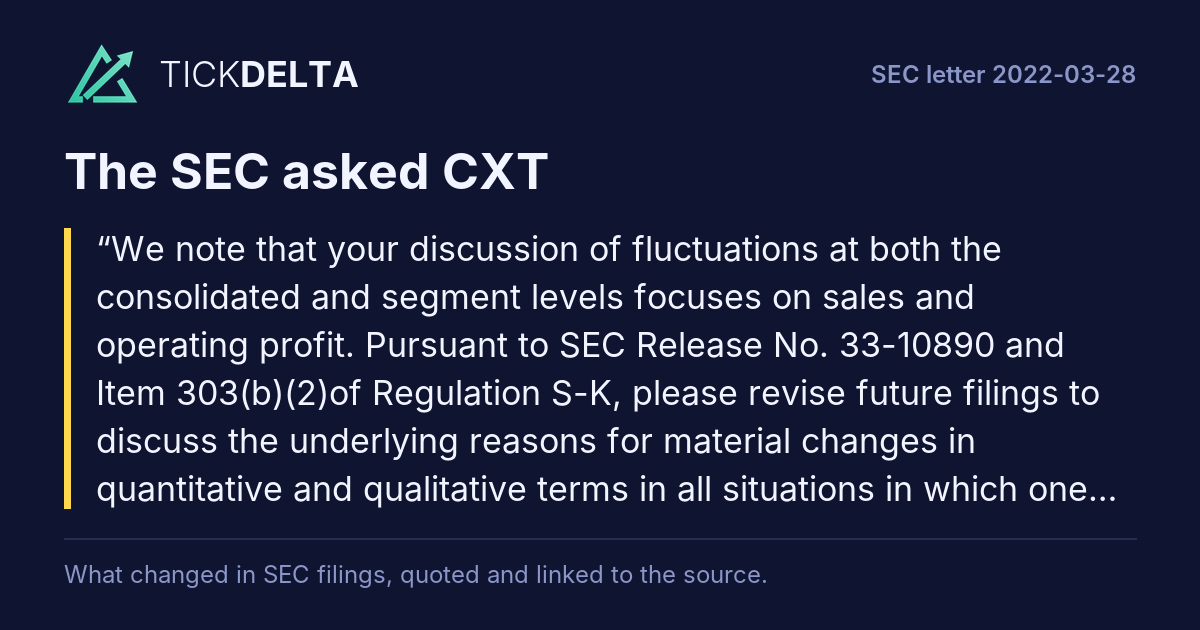
The Company respectfully acknowledges the Staff’s comment and provides the below example of disclosure to be included in future filings. There were no material changes or contracts that would significantly affect any of our critical accounting estimates. Specifically, delivery on the military contract described in the January 22, 2022, Earnings
Call does not begin until 2026, therefore this item does not impact any of our critical accounting estimates in 2021.
Rest of the answer
We will continue to evaluate any reasonably likely changes that could impact our critical accounting estimates and provide disclosure as needed.
APPLICATION OF CRITICAL ACCOUNTING POLICIES
Our consolidated financial statements are prepared in accordance with accounting principles generally accepted in the United States. Our significant accounting policies are more fully described in Item 8 under Note 1, “Nature of Operations and Significant Accounting Policies” in the Notes to Consolidated Financial Statements. Certain accounting policies require us to make estimates and assumptions that affect the reported amounts of assets and liabilities at the date of the financial statements and the reported amounts of revenue and expense during the reporting period. On an ongoing basis, we evaluate our estimates and assumptions, and the effects of revisions are reflected in the financial statements in the period in which they are determined to be necessary. The accounting policies described below are those that most frequently require us to make estimates and judgments and, therefore, are critical to understanding our results of operations. We have discussed the development and selection of these accounting estimates and the related disclosures with the Audit Committee of our Board of Directors.
Revenue Recognition
We primarily generate revenue through the manufacture and sale of engineered industrial products. Each product within a contract generally represents a separate performance obligation, as we do not provide a significant service of integrating or installing the products, the products do not customize each other, and the products can function independently of each other. Control of products generally transfers to the customer at a point in time, as the customer does not control the products as they are manufactured. We exercise judgment and consider the timing of right to payment, transfer of risk and rewards, transfer of title, transfer of physical possession, and customer acceptance when determining when control transfers to the customer. As a result, revenue from the sale of products is generally recognized at a point in time—either upon shipment or delivery—based on the specific shipping terms in the contract.
When products are customized or products are sold directly to the U.S.
government or indirectly to the U.S. government through subcontracts, revenue is recognized over time because control is transferred continuously to customers, as the contract progresses. We exercise judgment to determine whether the products have an alternative use to us. When an alternative use does not exist for these products and we are entitled to payment for performance completed to date which includes a reasonable profit margin, revenue is recognized over time. When a contract with the
U.S. government or subcontract for the U.S. government contains clauses indicating that the U.S. government owns any work-in-progress as the contracted product is being built, revenue is recognized over time. The measure of progress applied by us is the cost-to-cost method as this provides the most faithful depiction of the pattern of transfer of control. Under this method, we measure progress by comparing costs incurred to date to the total estimated costs to provide the performance obligation. This method effectively reflects our progress toward completion, as this methodology includes any work-in-process amounts as part of the measure of progress. Costs incurred represent work performed, which corresponds with, and thereby depicts, the transfer of control to the customer. Total revenue recognized and cost estimates are updated monthly.
These estimates are subject to uncertainties and require judgment. Estimates of contract costs include labor hours and rates, and material costs. These estimates consider historical performance, the complexity of the work to be performed, the estimated time to complete the project, and other economic factors such as inflation and market rates. We update our estimates on a periodic basis and any revisions to such estimates are recorded in earnings in the period in which they are determined. Provisions for estimated losses, if any, on uncompleted long-term contracts, are made in the period in which such losses are determined. We do not believe that any discrete event or adjustment to an individual contract within the aggregate changes in contract estimates for
2021, 2020 or 2019 was material to the consolidated statements of income for such annual periods.
Income Taxes
We are subject to income taxes in the U.S. and numerous international jurisdictions. As a matter of course, federal, state, and international tax authorities regularly audit us. From time to time, these audits result in proposed assessments.
The evaluation of our uncertain tax positions involves significant judgment in the interpretation and application of U.S. GAAP, domestic and international tax laws, and the allocation of taxing rights among countries. We adjust our liability for unrecognized tax benefits in the period in which we determine the issue is effectively settled with the tax authorities, the statute of limitations expires for the return containing the tax position, or when more information becomes available. Although we believe our reserves are reasonable, and historically they have been adequate, resolution of these uncertainties in a manner inconsistent with our expectations could have a material impact on our financial condition and operating results.
Deferred tax assets and liabilities reflect temporary differences between the amount of assets and liabilities for financial and tax reporting purposes as well as carryforwards of operating losses and tax credits. We adjust deferred tax balances, as appropriate, to reflect changes in tax rates expected to be in effect when the temporary differences reverse. Changes in tax laws or accounting standards and methods may also affect our deferred taxes in future periods.
We record a valuation allowance to reduce our deferred tax assets to the amount that is more likely than not to be realized. We must make estimates of future taxable income, considering feasible tax planning strategies and considering existing facts and circumstances, to determine the proper valuation allowances. When we determine deferred tax assets could be realized in greater or lesser amounts than recorded, the asset balance and Consolidated Statements of Operations reflect the change in the period such determination is made. Due to changes in facts and circumstances and the estimates and judgments involved in determining the proper valuation allowances, differences between actual future events and prior estimates and judgments could result in adjustments to these valuation allowances, which could have a material impact on our financial condition and operating results. Historically there have been no changes in estimates which have had a material impact on results.
Goodwill and Other Intangible Assets
As of December 31, 2021, we had $1,412.5 million of goodwill and $465.9 million of net intangible assets, of which
$70.6 million were intangibles with indefinite useful lives, consisting of trade names. As of December 31, 2020, we had $1,437.7 million of goodwill and $519.1 million of net intangible assets, of which $70.9 million were intangibles with indefinite useful lives, consisting of trade names. We review goodwill for impairment annually and whenever events or changes in circumstances indicate the carrying value of an asset may not be recoverable. We perform our annual impairment testing during the fourth quarter. We believe that there have been no events or circumstances which would more likely than not reduce the fair value of our reporting units below their carrying value.
When performing our annual impairment assessment, we compare the fair value of each of our reporting units to our respective carrying value.
Goodwill is potentially impaired when the net book value of the reporting unit exceeds its estimated fair value. Fair values are established primarily by discounting estimated future cash flows at an estimated cost of capital which varies for each reporting unit and which, as of our most recent annual impairment assessment, ranged between 9.5% and 11.5% (a weighted average of 10.7%), reflecting the respective inherent business risk of each of the reporting units tested. This methodology for valuing our reporting units (commonly referred to as the Income Method) has not changed since the adoption of the provisions under ASC 350. The determination of discounted cash flows is based on the businesses’ strategic plans and long-range planning forecasts, which change from year to year. The revenue growth rates included in the forecasts represent best estimates based on current and forecasted market conditions. Profit margin assumptions are projected by each reporting unit based on the current cost structure and anticipated net cost increases/reductions.
There are inherent uncertainties related to these assumptions, including changes in market conditions, and management judgment is necessary in applying them to the analysis of goodwill impairment. In addition to the foregoing, for each reporting unit, market multiples are used to corroborate discounted cash flow results where fair value is estimated based on earnings multiples determined by available public information of comparable businesses. While we believe we have made reasonable estimates and assumptions to calculate the fair value of our reporting units, it is possible a material change could occur. If actual results are not consistent with management’s estimates and assumptions, goodwill and other intangible assets may then be determined to be overstated and a charge would need to be taken against net earnings. Furthermore, to evaluate the sensitivity of the fair value calculations on the goodwill impairment test, we applied a hypothetical, reasonably possible 10% decrease to the fair values of each reporting unit. The effects of this hypothetical 10% decrease would still result in a fair value calculation exceeding our carrying value for each of our reporting units. No impairment charges have been required during 2021, 2020 or 2019.
Intangibles with indefinite useful lives are tested annually for impairment, or when events or changes in circumstances indicate the potential for impairment. If the carrying amount of an indefinite lived intangible asset exceeds its fair value, the intangible asset is written down to its fair value. Fair value is calculated using relief from royalty method. We amortize the cost of definite-lived intangibles over their estimated useful lives.
We review all our definite-lived intangible assets for impairment whenever events or changes in circumstances indicate the carrying amount of an asset may not be recoverable. Examples of events or changes in circumstances could include, but are not limited to, a prolonged economic downturn, current period operating or cash flow losses combined with a history of losses or a forecast of continuing losses associated with the use of an asset or asset group, or a current expectation that an asset or asset group will be sold or disposed of before the end of its previously estimated useful life. Recoverability is based upon projections of anticipated future undiscounted cash flows associated with the use and eventual disposal of the definite-lived intangible asset (or asset group), as well as specific appraisal in certain instances. Reviews occur at the lowest level for which identifiable cash flows are largely independent of cash flows associated with other long-lived assets or asset groups and include estimated future revenues, gross profit margins, operating profit margins and capital expenditures which are based on the businesses’ strategic plans and long-range planning forecasts, which change from year to year. The revenue growth rates included in the forecasts represent our best estimates based on current and forecasted market conditions, and the profit margin assumptions are based on the current cost structure and anticipated net cost increases or reductions. There are inherent uncertainties related to these assumptions, including changes in market conditions, and management’s judgment in applying them to the analysis. If the future undiscounted cash flows are less than the carrying value, then the definite-lived intangible asset is considered impaired and a charge would be taken against net earnings based on the amount by which the carrying amount exceeds the estimated fair value. Judgments that we make which impact these assessments relate to the expected useful lives of definite lived assets and its ability to realize any undiscounted cash flows in excess of the carrying amounts of such assets and are affected primarily by changes in the expected use of the assets, changes in technology or development of alternative assets, changes in economic conditions, changes in operating performance and changes in expected future cash flows. Since judgment is involved in determining the recoverable amount of definite-lived intangible assets, there is risk that the carrying value of our definite-lived intangible assets may require adjustment in future periods. Historical results to date have generally approximated expected cash flows for the identifiable cash flow generating level. We believe there have been no events or circumstances which would more likely than not reduce the fair value of our indefinite-lived or definite-lived intangible assets below their carrying value. As of the last annual assessment, fair values have been substantially in excess of carrying values.
Asbestos Liability and Related Insurance Coverage and
Receivable
The most significant factors affecting our asbestos liability estimate are (1) the number of new mesothelioma claims filed against us, (2) the average settlement costs for mesothelioma claims, (3) the percentage of mesothelioma claims dismissed against us and (4) the aggregate defense costs incurred by us. These factors are interdependent, and no one factor predominates in determining the liability estimate. These factors have both positive and negative effects on the dynamics of asbestos litigation in the tort system and the related best estimate of our asbestos liability, and these effects do not move in a linear fashion but rather change over multi-year periods. Accordingly, we continue to monitor these trend factors over time and periodically assesses whether an alternative forecast period is appropriate. Projecting future asbestos costs is subject to numerous variables and uncertainties that are inherently difficult to predict. In addition to the uncertainties surrounding the key assumptions, additional uncertainty related to asbestos claims arise from the long latency period prior to the manifestation of an asbestos-related disease, changes in available medical treatments and associated medical costs, changes in plaintiff behavior resulting from bankruptcies of other companies that are potential defendants or co-defendants, uncertainties surrounding the litigation process from jurisdiction to jurisdiction, and the impact of potential legislative or judicial changes.
Management has made its best estimate of the costs through 2059. Through December 31, 2021, our actual experience during the updated reference period for mesothelioma claims filed and dismissed generally approximated the assumptions in our liability estimate. In addition to this claims experience, we considered additional quantitative and qualitative factors such as the nature of the aging of pending claims, significant appellate rulings and legislative developments, and their respective effects on expected future settlement values. Based on this evaluation, we determined that no change in the estimate was warranted for the period ended December 31, 2021. The liability was $612 million and $670 million as of December 31, 2021, and 2020, respectively.
A 10% change in either the average cost per claim or the number of future projected claims would increase or decrease the estimated liability at December 31, 2021 by approximately $35 million. A 10% change in these two factors in the same direction at the same time would change the estimated liability at December 31, 2021 by approximately $70 million.
In conjunction with developing the aggregate liability estimate referenced above, we also developed an estimate of probable insurance recoveries for our asbestos liabilities. In developing this estimate, we considered our coverage-in-place and other settlement agreements, as well as several additional factors. These additional factors include the financial viability of the insurance companies, the method by which losses will be allocated to the various insurance policies and the years covered by those policies, how settlement and defense costs will be covered by the insurance policies and interpretation of the effect on coverage of various policy terms and limits and their interrelationships. As of December 31, 2021, and 2020, we had an aggregate asbestos insurance receivable of
$74 million and $87 million, respectively. Through December 31, 2021, our actual experience generally approximated the assumptions in our insurance recoveries estimates.
Environmental
For environmental matters, we record a liability for estimated remediation costs when it is probable that we will be responsible for such costs, and they can be reasonably estimated. Generally, third party specialists assist in the estimation of remediation costs. The environmental remediation liability as of December 31, 2021, is substantially all for the former manufacturing site in Goodyear, Arizona (the “Goodyear Site”). Estimates of our environmental liabilities at the Goodyear Site are based on currently available facts, present laws and regulations and current technology available for remediation and are recorded on an undiscounted basis. These estimates consider our prior experience in the Goodyear Site investigation and remediation, as well as available data from, and in consultation with, our environmental specialists.
Estimates at the Goodyear Site are subject to significant uncertainties caused primarily by the dynamic nature of the Goodyear Site conditions, the range of remediation alternatives available, together with the corresponding estimates of cleanup methodology and costs, as well as ongoing, required regulatory approvals, primarily from the EPA. During the fourth quarter of 2019, we received conceptual agreement from the EPA on an alternative remediation strategy which is expected to further reduce the contaminant plume. Accordingly, we recorded a pre-tax charge of $18.9 million, net of reimbursements, to extend our forecast period through 2027 and reflect our revised workplan. The total estimated gross liability was $32.3 million and $39.8 million as of December 31, 2021 and 2020, respectively. On July 31, 2006, we entered a consent decree with the U.S. Department of Justice on behalf of the Department of
Defense and the Department of Energy pursuant to which, among other things, the U.S. Government reimburses us for 21% of qualifying costs of investigation and remediation activities at the Goodyear Site. We have recorded a receivable of
$7.3 million and $7.8 million for the expected reimbursements from the U.S. Government in respect of the aggregate liability as of December 31, 2021, and 2020, respectively. During 2020 and 2021, there have been no changes in assumptions which have had a material impact on our estimates.
Pension Plans
In the United States, we sponsor a defined benefit pension plan that covers approximately 16% of all U.S. employees. Additionally, several of our non-U.S. subsidiaries sponsor defined benefit pension plans that cover approximately 9% of all non-U.S. employees. The benefits are typically based upon years of service and compensation. Most of these plans are funded by company contributions to pension funds, which are held for the sole benefit of plan participants and beneficiaries.
The expected return on plan assets component of net periodic benefit cost is determined by applying the assumed expected return on plan assets to the fair value of plan assets. For one of the U.K. pension plans, a market-related value of assets is used in lieu of the fair value of plan assets for this purpose. The net actuarial loss (gain) is amortized to the extent that it exceeds 10% of the greater of the fair value of plan assets and the projected benefit obligation. The amortization period is the average life expectancy of plan participants for most plans. The amortization period for plans with a significant number of active participants accruing benefits is the average future working lifetime of plan participants. The prior service cost (credit) is amortized over the average future working lifetime of plan participants whose prior service benefits were changed.
Holding all other factors constant, a decrease in the expected long-term rate of return on plan assets by 0.25 percentage points would have increased 2021 pension expense by $1.2 million for U.S. pension plans and $1.3 million for non-U.S. pension plans. Also, holding all other factors constant, a decrease in the discount rate used to determine net periodic pension cost by 0.25 percentage points would have decreased 2021 pension expense by $0.2 million for U.S. pension plans and increased 2021 pension expense by $0.8 million for non-U.S. pension plans.