Crane NXT, Co. CXT
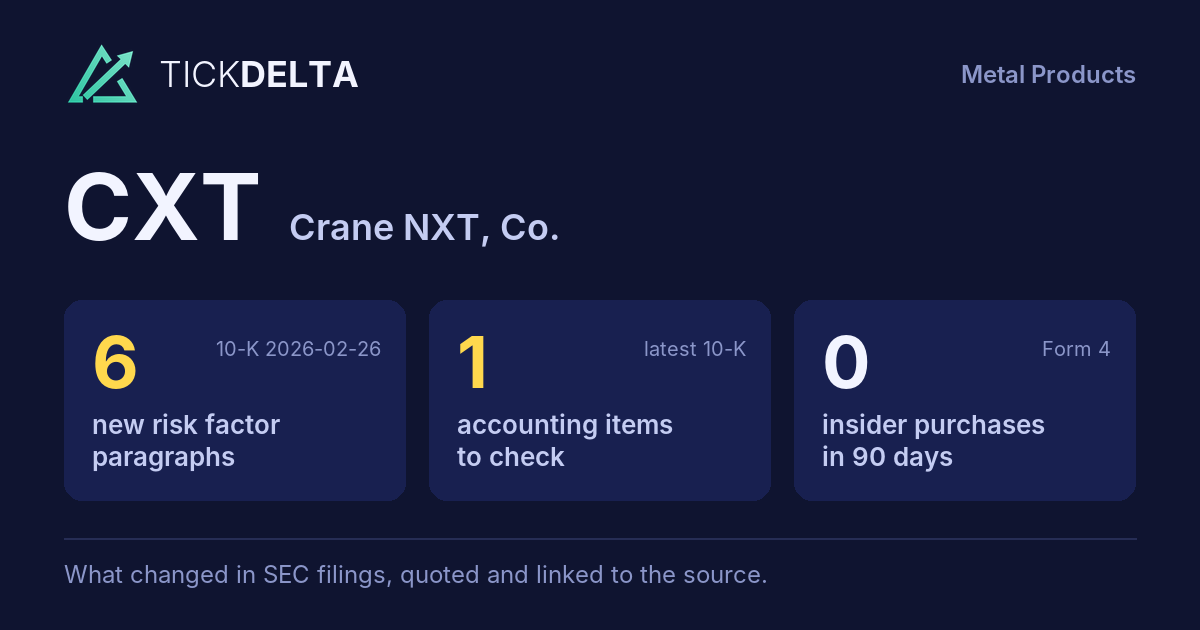
New risk paragraphs, branching off last year
Each branch is a paragraph in Risk Factors with nothing like it in the 10-K filed Feb 20, 2025. A box jumps to the paragraph as filed, below.
Paragraphs with nothing like them in last year's 10-K
6 paragraphs in Risk Factors of the 10-K filed Feb 26, 2026 with nothing like them in the 10-K filed Feb 20, 2025. Quoted exactly. Paragraphs that were only edited are under 10-K change.
•Inability of acquired businesses to timely report their results of operations; and
•Challenges in retaining key talent and critical employees from acquired businesses, which could impact operational continuity and the realization of anticipated synergies.
Our operations require significant amounts of necessary components and raw materials that are critical to our profitability and can fluctuate in price. We depend on the timely availability of significant quantities of components and raw materials, including metals such as steel and copper, electronic components, and natural fibers such as cotton and flax. The prices of these components and materials are subject to volatility driven by changes in global supply and demand dynamics, trade policies, geopolitical events, and inflationary pressures. In recent periods, we have experienced sustained cost increases for certain materials. Future price escalations, whether due to market conditions or increased tariffs, could negatively impact our cost structure, including margins.
In addition, we rely on single or sole‑source suppliers for certain critical materials and components. If any such supplier encounters financial instability, capacity limitations, quality issues, regulatory impediments, labor shortages, or operational disruptions, we may be unable to obtain alternative sources on a timely basis or at comparable cost. Such circumstances could result in production delays, cost increases, or our inability to meet customer demand or quality specifications.
If we are unable to timely source necessary components or materials, our manufacturing operations may be disrupted, delayed or temporarily stopped, which in turn could adversely affect our results of operations.
•We face an inherent risk of exposure to product liability and other claims if our products are defective or if their use causes harm to persons or property, and we may incur liability if we are unable to successfully defend such claims. Consistent with industry practice, we provide warranties on many of our products, and we could incur costs related to warranty or breach‑of‑contract claims if our products contain manufacturing or design defects or fail to meet contractual or customer specifications. Although we estimate future warranty costs based on historical trends and product sales, these estimates may be inaccurate, resulting in insufficient warranty reserves. Because many of our products are sophisticated and complex and may incorporate or rely on third‑party hardware, software, and data, notwithstanding testing and quality control, defects or errors may still occur. Undetected defects, performance failures, or deviations from customer expectations could lead to loss of customers, contractual liabilities, additional development and operational costs, or delays in customer acceptance. Moreover, because customers deploy our software in diverse and complex environments, including varied hardware, platforms, system management tools, and network configurations, the likelihood of technical issues may increase, and when products are integrated with other components or software, identifying the source of any defect or error may be difficult. If any of these risks materialize, we could face increased costs and expenses, exposure to liability claims, diversion of technical and other resources, loss of customers, or negative publicity, any of which could adversely affect our business and results of operations.
Paragraphs in the 10-Q filed Nov 4, 2026 that were not in the one before
New in the latest 10-Q
4 paragraphs in the 10-Q filed Nov 4, 2026 with nothing like them in the 10-Q filed Aug 5, 2026 (at least half the words must differ; new numbers alone do not count). Quoted exactly, grouped by the item heading above them. This is text that changed, not a judgement of how serious it is.
Financial statements and notes
A brief description of each of our segments as of September 30, 2026 is as follows:
Read in the 10-Q
2025 Restructuring - In 2026, we carried out the following activities related to restructuring programs initiated in 2025:
Read in the 10-Q
On July 2, 2026, the Company repriced and increased its existing €430.0 million Term Loan B to €480.0 million through an amendment to its Credit Agreement. The Sixth Amendment was accounted for as a debt modification and the incremental €50.0 million of cash proceeds, together with cash on hand, was primarily used to repay a portion of Term Loan A.
Read in the 10-Q
The conflict in the Middle East and evolving global trade policies, including tariffs and retaliatory trade measures, continue to create uncertainty regarding energy, freight and material costs and supply chains. The Company continues to implement pricing, productivity and supply-chain actions to mitigate these risks. The impact is not currently material to our results, however, the timing, scope and broader economic effects remain uncertain and could significantly impact the Company’s results of operations in the future.
Read in the 10-Q
The 10-Q's risk factors against the 10-K
Item 1A of the 10-Q filed Nov 4, 2026 against Item 1A of the 10-K filed Feb 26, 2026.
A 10-Q repeats only the risks that changed, so a 10-K paragraph that is missing from it is not counted as removed.
Added is a paragraph with nothing like it in the 10-K, Reworded a sentence that is in both with several words changed,
Quiet changes a sentence in both where one to four words changed and one is a hedge or a modal
(cut words struck through, new words highlighted).
Text on the page, not a score; each links to the filing at sec.gov.
What the 10-Q itself says about its risk factors:Information regarding risk factors appears in Part I, Item 1A of our Annual Report on Form 10-K for the fiscal year ended December 31, 2025. There have been no material changes in our risk factors from those disclosed in such Annual Report on Form 10-K.
Read in the 10-Q
1 paragraph in the 10-Q's Item 1A, and none of them adds, rewords or quietly edits a paragraph of the 10-K's.
Phrases used for the first time
Two-word phrases in Risk Factors of the 10-K filed Feb 26, 2026 that are in none of the 1 earlier 10-Ks stored, back to Feb 20, 2025
Where each one is used
- market volatility: •Developments in global trade policy, including possible changes to U.S. trade policies and tariffs and retaliatory trade measures taken by other countries. While we continue to expect to be able to largely offset the impact of tariffs on operating profit with pricing and productivity initiatives, the broader...
- cost increases: Our operations require significant amounts of necessary components and raw materials that are critical to our profitability and can fluctuate in price. We depend on the timely availability of significant quantities of components and raw materials, including metals such as steel and copper, electronic components,...
Used at least twice, small words left out. Counted, not picked: a phrase can be new because the company renamed something.
What was taken out
2 paragraphs of last year's Risk Factors with nothing like them now. The longest are quoted.
Sources
Item 1A of each 10-K and 10-Q on EDGAR, quoted exactly. Each paragraph links to the filing at sec.gov.
Also
10-K change: what was reworded or cut, section by section.
Work with it
Excel workbook · CSV. Google Sheet that stays up to date: paste =IMPORTDATA("https://tickdelta.com/company/CXT/export.csv") into a cell.