Form 10-K
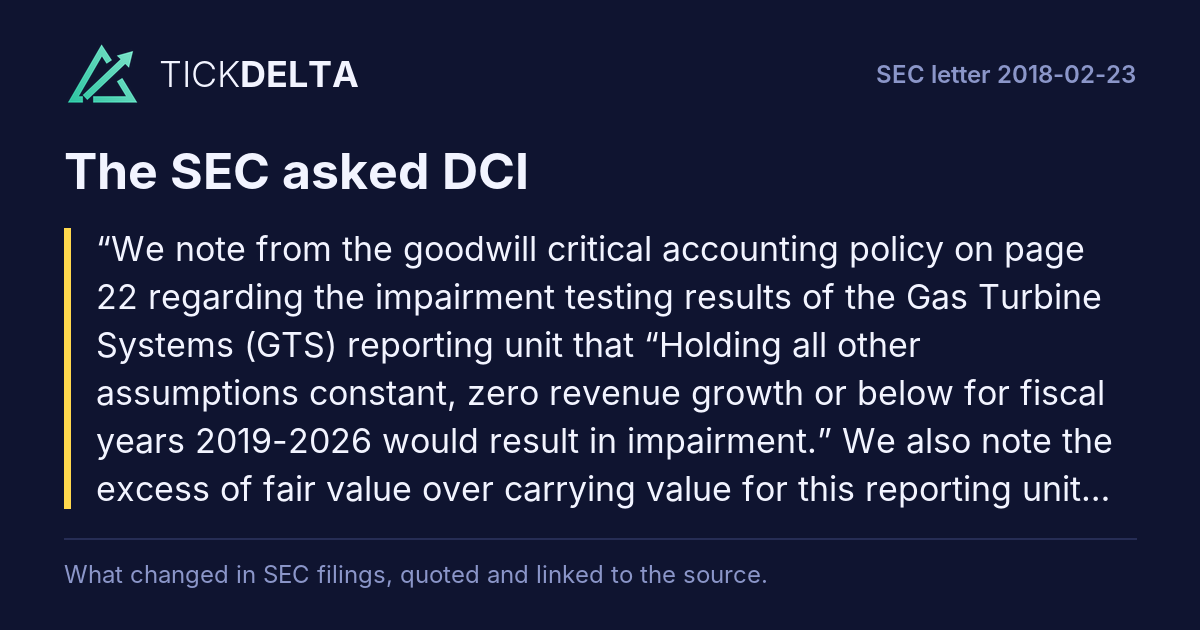
We note from the goodwill critical accounting policy on page 22 regarding the impairment testing results of the Gas Turbine Systems (GTS) reporting unit that “Holding all other assumptions constant, zero revenue growth or below for fiscal years 2019-2026 would result in impairment.” We also note the excess of fair value over carrying value for this reporting unit decreased from 38% as of the fiscal 2016 testing dateRest of the question
to 15% as of the fiscal 2017 testing date. Please tell us the revenue growth rate assumption utilized in the fiscal 2017 impairment assessment and how the decreasing revenue trend in the GTS unit (20% decline in 2016 and 18% decline in 2017) was considered in your assumptions and analysis.
For context, we design, manufacture and market advanced air inlet filtration systems for gas turbines, generators and other rotating equipment. Our systems and related air inlet products protect turbines from airborne contaminants in systems around the world. Products within our GTS business consist of first fit systems sold to gas turbine original equipment manufacturers and aftermarket replacement parts for those systems.Read in the replyRest of the answer
The first fit project sales have historically made up between 50% and 70% of our revenues and are typically at lower margins than the other products.
The Gas Turbine Systems revenue growth rate assumptions utilized in our fiscal 2017 goodwill impairment assessment were as follows:
FY'17
FY'18
FY'19
FY'20
FY'21
Annually Thereafter
-15.4
%
[*]
The decreasing revenue trend in the Gas Turbine Systems reporting unit was considered in our fiscal 2017 goodwill impairment assessment and was factored into the projected cash flows using the income approach for determining the estimated fair value of the reporting unit.
The gas turbine market has been in a cyclical decline that has significantly impacted our revenue trend for Gas Turbine Systems. The market has been under pressure resulting in low demand for new projects, causing aggressive competition and delays of projects that have already been initiated. Consequently, as noted, revenue for Gas Turbine Systems decreased 20% in fiscal 2016 and 18% in fiscal 2017.
To combat the decline in the gas turbine market and remain profitable during difficult market conditions, we made the decision to shift our strategy for Gas Turbine Systems. As disclosed in our Annual Reports on Form 10-K for the years ended July 31, 2016 and 2017, we became more selective in bidding for large turbine projects to purposefully reduce the volume in this segment and decided to significantly increase our focus on the gas turbine aftermarket business, leveraging Donaldson’s strength in selling aftermarket parts to more aggressively pursue a larger portion of this market. Since Gas Turbine Systems sales had historically been more focused on large systems, this shift led to an anticipated decline in revenue. However, going forward, we expect declining sales of large turbine projects will be partially offset by growth of aftermarket sales. This aftermarket business is expected to make up about 60% of Gas Turbine Systems in fiscal 2018, with the balance being first fit sales.
Actual sales for fiscal 2017 decreased 18%, compared with a decline of 15% we utilized in our fiscal 2017 impairment assessment. Sales for fiscal 2018 according to our most recent forecast are expected to decrease [*] from fiscal 2017, compared with a decline of [*] we utilized in our fiscal 2017 impairment assessment. The improved sales for the current forecast compared with sales utilized in the fiscal 2017 impairment assessment is largely driven by an increase in aftermarket sales. Fiscal years beyond fiscal 2018 are expected to have further increases in the aftermarket business, and then eventually large turbine projects should begin to increase again once the economic cycle turns; however, we will continue to remain selective in the projects we bid. This outlook was incorporated in the assumptions used for the fiscal 2017 goodwill impairment assessment and has begun to be substantiated in fiscal 2018 year-to-date results. We continue to support the assumptions used in the fiscal 2017 impairment assessment.
* Portions omitted pursuant to a request for confidential treatment pursuant to Rule 83 and filed separately with the Securities and Exchange Commission.
If you have further questions, please contact me at (952) 887-3489.
First report after the company's reply of Mar 22, 2018: 10-Q filed Jun 11, 2018 ↗, against the 10-Q filed Dec 8, 2017 ↗.
Tickdelta does not hold the text of both reports, so they are not compared here.
Also in this review: closing letter, 2018-03-29