Paragraph 88 · 50% changed
Every version of it
Screener
/
SEC EDGAR
/CIK 0000868780
/10-K filed Feb 27, 2026, compared with Feb 27, 2025
/Numbers from the XBRL of the 10-Ks
Nasdaq
Consumer discretionary · Auto Parts
Dorman Products, Inc. DORM
The 10-K against last year's
189 changes: 42 added, 38 removed, 106 reworded, 3 quiet changes
10-K Feb 27, 2026 vs Feb 27, 2025
Risk Factors
58.6%
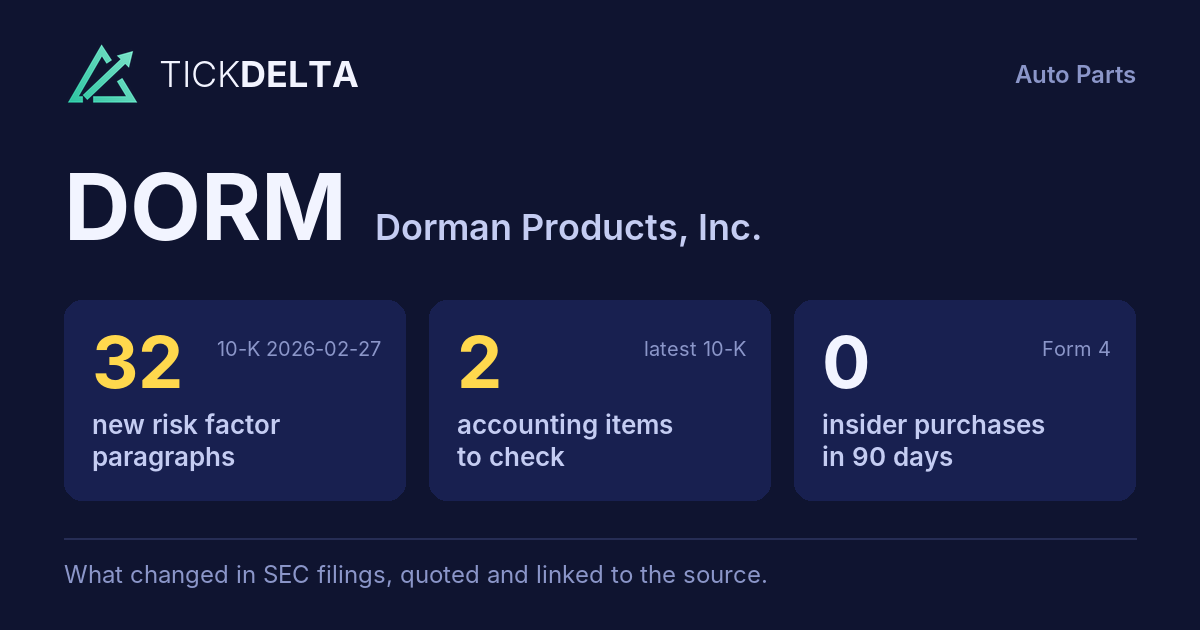
of the text changed · 7,162 words now · 32 new paragraphs, 33 gone
MD&A
27.8%
of the text changed · 5,886 words now · 10 new paragraphs, 5 gone
Legal Proceedings
6.7%
of the text changed · 542 words now
Accounting Policies
18.1%
of the text changed · 2,302 words now
10-K 0000868780-26-000014 (Feb 27, 2026) vs 10-K 0000868780-25-000009 (Feb 27, 2025)
Every paragraph, and how much of it changed
One bar per paragraph, in the order of the 10-K. Height and colour show the share of its words not in the closest paragraph a year earlier; the tallest bars are new paragraphs.
Risk Factors
113 paragraphs · 32 new · 59 reworded · 33 gone · 10-K Feb 27, 2026 against Feb 27, 2025
New paragraph
Reworded (5% of its words or more)
Same or nearly
Paragraph 103 · 50% changed
Every version of it
Paragraph 92 · 50% changed
Every version of it
As of February 24, 2025, 2026, Steven L. Berman, our Non-Executive Chairman, and his family members beneficially owned approximately 15% 13% of the Company’s outstanding common stock. As such, Mr. Berman This ownership provides them the ability to influence shareholder decisions, including Board elections and his family members could influence matters requiring the approval of shareholders, including the election of the Board of Directors and the approval of significant transactions. Such concentration of ownership may have the effect of delaying, preventing, or deterring a change in control of the Company, could deprive shareholders of an opportunity to receive a premium for their common stock as part of a sale of the Company, and might ultimately affect the market price of our common stock. Moreover, sales of substantial amounts of the shares beneficially owned by Mr. Berman and his family members, including shares held in family trusts and foundations, or the perception that such sales could occur, may lower the prevailing market price of our common stock.
Paragraph 63 · 48% changed
Every version of it
Paragraph 41 · 48% changed
Every version of it
In 2024, 2025, approximately 72% 77% of our total volume of purchases of products were purchased was sourced from suppliers in a variety of non-U.S. countries. The suppliers, with approximately 38% sourced from China, making us vulnerable to tariff increases and trade restrictions. Recent U.S. government’s trade policy with countries where we source or sell our products may change based on several factors, including, but not limited to, political and economic factors. The new political administration in the United States has signaled an intention to use tariffs more robustly in pursuing government policy and has already implemented some new tariffs. For instance, the U.S. government has imposed tariffs on certain foreign goods, including steel steel, aluminum, copper, and aluminum, and on certain vehicle parts, which parts have resulted in increased raised costs, and further tariffs or retaliatory measures from U.S. trading partners could further increase prices, reduce demand, and negatively impact global trade. If we cannot pass these costs for goods imported into the United States. When to customers or otherwise mitigate them, our financial results could suffer. In addition, when increases are made to U.S. duty rates or tariffs, reciprocal action by other countries sometimes occurs, and any such increases could impact the price of our products and cause a decline in the demand for our products. If we are unable to pass price increases on to our customer base or otherwise mitigate the costs, or if demand for our products decreases due to the higher cost, our results of operations could be materially adversely affected. In addition, further tariffs have been proposed by the United States and its trading partners and additional trade restrictions could be implemented on a broader range of products or raw materials. The resulting environment of retaliatory trade or other practices could have a material adverse effect on our business, financial condition, results of operations, customers, suppliers, and the global economy.
Paragraph 34 · 47% changed
Every version of it
We receive product shipments from our suppliers, and we ship products to our customers. As a result, our operating results depend upon on the availability and cost of third-party logistics providers, such as including ocean freight, port operators, railroad, railroads, and trucking carriers, for shipments carriers. Access to and from our suppliers and for delivery of our products to us and our customers. Our access to third-party logistics these providers is not guaranteed, and, even if we have access to logistics providers, we may be unable to transport our products at economically attractive rates in certain circumstances, particularly in cases of and adverse market conditions or infrastructure disruptions to transportation infrastructure. Fluctuations in demand for third-party logistics providers and other events impacting transportation capacity and costs, may prevent us from transporting products at competitive rates. Events such as strikes, political events, international instability, trade disputes, war, terrorism, natural disasters, adverse weather conditions, weather, congestion, increases in fuel prices, public price increases, and health issues, including pandemics, crises can impact logistics capacity and other events, may impact the availability of third-party logistics providers to ship our products or the cost to ship our products. costs. For example, logistics costs and transit times for product from our suppliers were adversely impacted during 2024 by disruptive in 2024, continued political conflict around near the Suez Canal, resulting in changes to our Canal disrupted shipping routes and increased shipping costs. To the extent we enter into long-term agreements with logistics providers, our forecasts of expected capacity needed in future periods Long-term contracts may be inaccurate because of unforeseen fluctuations in also create risk if demand for these logistics services, which could result in us paying for capacity that is not needed or result in us having to purchase additional capacity on a spot-market basis. To the extent our transportation mix changes between contracted and market volume, driven by market conditions or other variables, we may observe impacts that create favorability or unfavorability in our end-to-end logistics cost structure. In addition, our business, financial position, results of operations, or cash flows could be materially and adversely affected if we are unable to pass along increased logistics costs to our customers, or if third-party transportation capacity were to decline significantly or otherwise become unavailable.
Paragraph 14 · 46% changed
Every version of it
Paragraph 107 · 46% changed
Every version of it
We are subject to income taxes, as well as non-income-based taxes, at the federal, state, and local levels. We are subject to tax income and non-income taxes and face audits in various multiple jurisdictions. Tax authorities may disagree with certain challenge our positions we have taken and assess additional taxes. We regularly assess the likely While we evaluate audit outcomes of these audits to determine the appropriateness of set tax provisions, actual results may differ and could materially affect our tax provisions. However, there can be no assurance that we will accurately predict the outcomes of these audits, business and the actual outcomes of these audits could have a material adverse effect on our business, financial condition, and results of operations. Additionally, changes condition. Changes in tax laws or tax rulings could materially also significantly impact our effective tax rate.
Paragraph 88 · 50% changed
Every version of it
10-K Feb 27, 2025f.disease, epidemics, and health-related concerns could result in closed factories, reduced workforces, scarcity of raw materials, and scrutiny and embargoing of goods produced in infected areas.
10-K Feb 27, 2026
•epidemics causing factory closures, labor shortages, raw material scarcity, and scrutiny and embargoing of goods produced in infected areas.
Paragraph 103 · 50% changed
Every version of it
10-K Feb 27, 2025If we do not continue to develop new products and bring them to market, our business, financial condition, and results of operations could be materially impacted.
10-K Feb 27, 2026
recruit essential personnel or manage compensation effectively, our business, financial condition, and results of operations could be materially adversely affected.
Paragraph 92 · 50% changed
Every version of it
10-K Feb 27, 2025
As of February 24, 2025, Steven L. Berman, our Non-Executive Chairman, and his family members beneficially owned approximately 15% of the Company’s outstanding common stock. As such, Mr. Berman and his family members could influence matters requiring the approval of shareholders, including the election of the Board of Directors and the approval of significant transactions. Such concentration of ownership may have the effect of delaying, preventing, or deterring a change in control of the Company, could deprive shareholders of an opportunity to receive a premium for their common stock as part of a sale of the Company, and might ultimately affect the market price of our common stock. Moreover, sales of substantial amounts of the shares beneficially owned by Mr. Berman and his family members, including shares held in family trusts and foundations, or the perception that such sales could occur, may lower the prevailing market price of our common stock.
10-K Feb 27, 2026
As of February 24, 2026, Steven L. Berman, our Non-Executive Chairman, and his family beneficially owned approximately 13% of the Company’s outstanding common stock. This ownership provides them the ability to influence shareholder decisions, including Board elections and approval of significant transactions. Such
Paragraph 63 · 48% changed
Every version of it
10-K Feb 27, 2025Interest rate increases may adversely affect our financial condition and results of operations.
10-K Feb 27, 2026
Any substantial cyber-attack or data breach could materially adversely affect our business, financial condition, and results of operations.
Paragraph 41 · 48% changed
Every version of it
10-K Feb 27, 2025
In 2024, approximately 72% of our products were purchased from suppliers in a variety of non-U.S. countries. The U.S. government’s trade policy with countries where we source or sell our products may change based on several factors, including, but not limited to, political and economic factors. The new political administration in the United States has signaled an intention to use tariffs more robustly in pursuing government policy and has already implemented some new tariffs. For instance, the U.S. government has imposed tariffs on certain foreign goods, including steel and aluminum, and on certain vehicle parts, which have resulted in increased costs for goods imported into the United States. When increases are made to U.S. duty rates or tariffs, reciprocal action by other countries sometimes occurs, and any such increases could impact the price of our products and cause a decline in the demand for our products. If we are unable to pass price increases on to our customer base or otherwise mitigate the costs, or if demand for our products decreases due to the higher cost, our results of operations could be materially adversely affected. In addition, further tariffs have been proposed by the United States and its trading partners and additional trade restrictions could be implemented on a broader range of products or raw materials. The resulting environment of retaliatory trade or other practices could have a material adverse effect on our business, financial condition, results of operations, customers, suppliers, and the global economy.
10-K Feb 27, 2026
In 2025, approximately 77% of our total volume of purchases of products was sourced from non-U.S. suppliers, with approximately 38% sourced from China, making us vulnerable to tariff increases and trade restrictions. Recent U.S. tariffs on steel, aluminum, copper, and certain vehicle parts have raised costs, and further tariffs or retaliatory measures from U.S. trading partners could further increase prices, reduce demand, and negatively impact global trade. If we cannot pass these costs to customers or otherwise mitigate them, our financial results could suffer. In addition, when increases are made to U.S. duty rates or tariffs, reciprocal action by other countries sometimes occurs, and any such increases could impact the price of our products and cause a decline in the demand for our products.
Paragraph 34 · 47% changed
Every version of it
10-K Feb 27, 2025
We depend upon third-party logistics providers, such as ocean freight, port operators, railroad, and trucking carriers, for shipments to and from our suppliers and for delivery of our products to us and our customers. Our access to third-party logistics providers is not guaranteed, and, even if we have access to logistics providers, we may be unable to transport our products at economically attractive rates in certain circumstances, particularly in cases of adverse market conditions or disruptions to transportation infrastructure. Fluctuations in demand for third-party logistics providers and other events impacting transportation capacity and costs, such as strikes, political events, international trade disputes, war, terrorism, natural disasters, adverse weather conditions, congestion, increases in fuel prices, public health issues, including pandemics, and other events, may impact the availability of third-party logistics providers to ship our products or the cost to ship our products. For example, logistics costs and transit times for product from our suppliers were adversely impacted during 2024 by disruptive conflict around the Suez Canal, resulting in changes to our shipping routes and increased shipping costs. To the extent we enter into long-term agreements with logistics providers, our forecasts of expected capacity needed in future periods may be inaccurate because of unforeseen fluctuations in demand for these logistics services, which could result in us paying for capacity that is not needed or result in us having to purchase additional capacity on a spot-market basis. To the extent our transportation mix changes between contracted and market volume, driven by market conditions or other variables, we may observe impacts that create favorability or unfavorability in our end-to-end logistics cost structure. In addition, our business, financial position, results of operations, or cash flows could be materially and adversely affected if we are unable to pass along increased logistics costs to our customers, or if third-party transportation capacity were to decline significantly or otherwise become unavailable.
10-K Feb 27, 2026
We receive product shipments from our suppliers, and we ship products to our customers. As a result, our operating results depend on the availability and cost of third-party logistics providers, including ocean freight, port operators, railroads, and trucking carriers. Access to these providers is not guaranteed, and adverse market conditions or infrastructure disruptions may prevent us from transporting products at competitive rates. Events such as strikes, political instability, trade disputes, war, terrorism, natural disasters, adverse weather, congestion, fuel price increases, and health crises can impact logistics capacity and costs. For example, in 2024, continued political conflict near the Suez Canal disrupted shipping routes and increased costs. Long-term contracts may also create risk if demand
Paragraph 14 · 46% changed
Every version of it
10-K Feb 27, 2025Given the substantial price competition in our industry, our success and profitability will partially depend on our ability to maintain a competitive cost and price structure. This is the result of several industry trends, including the consolidated purchasing power of large customers, the growth of e-commerce, and actions taken by some of our competitors to attract new business, including efforts to enhance their online presence. In addition, some of our competitors may source their products from countries with more favorable U.S. tariff and trade treatment than the countries from which we source our products, enabling those competitors to offer lower prices than we do. Price reductions may be required to remain competitive, and such reductions may impact our sales and profit margins. Our future profitability will depend in part upon our ability to respond to changes in product and distribution channel mix, to continue to improve our manufacturing and distribution efficiencies, and to increase prices to address increasing costs, including costs such as tariffs that are outside of our control. In addition, our future profitability will depend in part upon our ability to generate cost reductions, including reductions in the cost of components purchased from outside suppliers, and to maintain a cost structure that will enable us to offer competitive prices. Our inability to maintain a competitive cost structure or to pass through increases in costs to our customers could have a material adverse effect on our business, financial condition, and results of operations.
10-K Feb 27, 2026
Our industry faces intense price competition. Our competitors strive to attract business in many ways, including by growing their e-commerce platforms, sourcing from countries with more favorable U.S. tariff and trade treatment, and lowering their prices. To remain competitive, we may need to reduce prices, which could impact our margins. Our ability to maintain or improve our margins depends on, among other things, enhancing manufacturing and distribution efficiency, managing product and channel mix, further diversifying our supply chain, passing through cost increases (including tariffs) where possible, and achieving cost reductions from suppliers, such as by reducing the costs of components used in our products. Our inability to maintain a competitive cost structure could have a material adverse effect on our business, financial condition, and results of operations.
Paragraph 107 · 46% changed
Every version of it
10-K Feb 27, 2025
We are subject to income taxes, as well as non-income-based taxes, at the federal, state, and local levels. We are subject to tax audits in various jurisdictions. Tax authorities may disagree with certain positions we have taken and assess additional taxes. We regularly assess the likely outcomes of these audits to determine the appropriateness of our tax provisions. However, there can be no assurance that we will accurately predict the outcomes of these audits, and the actual outcomes of these audits could have a material adverse effect on our business, financial condition, and results of operations. Additionally, changes in tax laws or tax rulings could materially impact our effective tax rate.
10-K Feb 27, 2026
We are subject to federal, state, and local income and non-income taxes and face audits in multiple jurisdictions. Tax authorities may challenge our positions and assess additional taxes. While we evaluate audit outcomes to set tax provisions, actual results may differ and could materially affect our business and financial condition. Changes in tax laws or rulings could also significantly impact our effective tax rate.
MD&A
80 paragraphs · 10 new · 52 reworded · 5 gone · 10-K Feb 27, 2026 against Feb 27, 2025
New paragraph
Reworded (5% of its words or more)
Same or nearly
Paragraph 57 · 47% changed
Our credit agreement contains affirmative and negative covenants. As of December 31, 2024, 2025, we were not in default with respect to the our credit agreement. As of December 31, 2024, there was $14.0 million in outstanding borrowings under the revolving credit facility, and $468.8 million in outstanding borrowings under the term loan portion of the credit agreement, and as of such date we had outstanding letters of credit for $1.2 million in the aggregate. Net of outstanding borrowings and letters of credit, we had $584.8 million available under the credit agreement as of December 31, 2024.
Paragraph 51 · 45% changed
Paragraph 50 · 45% changed
Paragraph 42 · 44% changed
Paragraph 37 · 43% changed
Our effective tax rate increased to remained flat at 25.9% in the years ended December 31, 2025, and December 31, 2024. The effective tax rate for the year ended December 31, 2024 from 23.3% 2025, reflected the impact of a goodwill impairment charge that increased the rate by 2.1%. The effective tax rate in the prior year ended December 31, 2023, primarily due to recording included a reserve in 2024 in connection with a state tax dispute. dispute, which increased the rate by approximately 2.5%.
Paragraph 33 · 43% changed
Paragraph 14 · 38% changed
A key component of our strategy is growth through acquisitions. On October 4, 2022, we acquired Super ATV, a leading independent supplier to the powersports aftermarket with a family of highly respected brands spanning functional accessories and upgrades, as well as replacement parts for specialty vehicles. See Note 2, "Business Acquisitions and Investments", to the Consolidated Financial Statements, included under ITEM 8 for additional information. We may acquire businesses in the future to supplement our financial growth, increase expand our customer base, add to our distribution capabilities, or enhance our product development resources, among other reasons.
Paragraph 55 · 38% changed
Paragraph 57 · 47% changed
10-K Feb 27, 2025
As of December 31, 2024, we were not in default with respect to the credit agreement. As of December 31, 2024, there was $14.0 million in outstanding borrowings under the revolving credit facility, and $468.8 million in outstanding borrowings under the term loan portion of the credit agreement, and as of such date we had outstanding letters of credit for $1.2 million in the aggregate. Net of outstanding borrowings and letters of credit, we had $584.8 million available under the credit agreement as of December 31, 2024.
10-K Feb 27, 2026
Our credit agreement contains affirmative and negative covenants. As of December 31, 2025, we were not in default with respect to our credit agreement.
Paragraph 51 · 45% changed
10-K Feb 27, 2025Over the past several years, we have continued to extend payment terms to certain customers as a result of customer requests and market demands. These extended terms have resulted in increased accounts receivable levels and significant uses of cash. Where available and when we deem appropriate, we participate in accounts receivable sales programs with several customers that allow us to sell our accounts receivable to financial institutions to offset the negative cash flow impact of these payment term extensions. However, any sales of accounts receivable through these programs ultimately result in us receiving a lesser amount of cash upfront than if we collected those accounts receivable ourselves in due course, resulting in accounts receivable factoring costs. Moreover, since these accounts receivable sales programs bear interest at rates tied to the Term SOFR or other reference rates, increases in these applicable rates increase our cost to sell our receivables and reduce the amount of cash we receive. See ITEM 7A, “Quantitative and Qualitative Disclosures about Market Risk” for more information. Further extensions of customer payment terms would result in additional uses of cash or increased costs associated with the sales of accounts receivable.
10-K Feb 27, 2026
We have and may continue to extend payment terms to certain customers in response to customer requests and market demands. These extended terms have resulted in increased accounts receivable levels and significant cash usage. Where available and when we deem appropriate, we participate in accounts receivable sales programs with several customers. The programs generally enable us to sell our accounts receivable to financial institutions at discounted rates without recourse to offset the negative cash flow impact of these
Paragraph 50 · 45% changed
10-K Feb 27, 2025Tariffs increase our use of cash since we pay for the tariffs upon the arrival of our goods in the United States but collect the cash on any passthrough price increases from our customers on a delayed basis according to the payment terms negotiated with our customers.
10-K Feb 27, 2026
Increases in tariffs accelerate our use of cash, as we pay for the higher costs upon arrival of our goods in the United States, but we collect the cash from any pass-through price increases to our customers on a delayed basis, taking into account our inventory turns and payment terms negotiated with those customers. We currently anticipate that additional liquidity needs to cover increased tariffs on imported products can be managed through additional factoring under our accounts receivable sales programs with certain customers, as well as borrowings under our existing revolving credit facility.
Paragraph 42 · 44% changed
10-K Feb 27, 2025Heavy Duty segment income from operations as a percentage of net sales decreased by 280 basis points for the year ended December 31, 2024, compared to the prior year. This decrease was primarily driven by the deleveraging of fixed costs on lower net sales and the impact of investments we made as part of initiatives to grow sales and improve margins on a long-term basis.
10-K Feb 27, 2026
productivity, and the impact of investments we made as part of initiatives to grow sales and improve margins on a long-term basis.
Paragraph 37 · 43% changed
10-K Feb 27, 2025
Our effective tax rate increased to 25.9% in the year ended December 31, 2024 from 23.3% in the year ended December 31, 2023, primarily due to recording a reserve in 2024 in connection with a state tax dispute.
10-K Feb 27, 2026
Our effective tax rate remained flat at 25.9% in the years ended December 31, 2025, and December 31, 2024. The effective tax rate for the year ended December 31, 2025, reflected the impact of a goodwill impairment charge that increased the rate by 2.1%. The effective tax rate in the prior year included a reserve in connection with a state tax dispute, which increased the rate by approximately 2.5%.
Paragraph 33 · 43% changed
10-K Feb 27, 2025Light Duty net sales increased $103.1 million, or 7.1%, for the year ended December 31, 2024 compared to the prior year, primarily due to volume increases, including sales of new products launched.
10-K Feb 27, 2026
Net sales increased $121.1 million, or 6.0%, for the year ended December 31, 2025, compared to the prior year, driven by tariff-related pricing actions in our Light Duty and Heavy Duty segments, increased customer demand in the first half of the year, and sales of new products, partially offset by reduced demand impacted by soft market conditions in the heavy duty and specialty vehicle sectors.
Paragraph 14 · 38% changed
10-K Feb 27, 2025
A key component of our strategy is growth through acquisitions. On October 4, 2022, we acquired Super ATV, a leading independent supplier to the powersports aftermarket with a family of highly respected brands spanning functional accessories and upgrades, as well as replacement parts for specialty vehicles. See Note 2, "Business Acquisitions and Investments", to the Consolidated Financial Statements, included under ITEM 8 for additional information. We may acquire businesses in the future to supplement our financial growth, increase our customer base, add to our distribution capabilities, or enhance our product development resources, among other reasons.
10-K Feb 27, 2026
A key component of our strategy is growth through acquisitions. We may acquire businesses in the future to supplement our financial growth, expand our customer base, add to our distribution capabilities, or enhance our product development resources, among other reasons.
Paragraph 55 · 38% changed
10-K Feb 27, 2025During the years ended December 31, 2024 and 2023, factoring costs associated with these accounts receivable sales programs were $51.3 million and $50.2 million, respectively. The increase in factoring costs year over year was primarily driven by higher accounts receivable sold under these programs.
10-K Feb 27, 2026
The increase in factoring costs year over year was primarily driven by higher accounts receivable sold under these programs, partially offset by lower Term SOFR rates in 2025.
A paragraph is matched with the one last year that shares the most of its words; under half in common makes it new. The paragraphs shown are the 8 reworded the most in each section.
The paragraph that changed most in each section
The redline
Marked against last year's 10-K: cut words struck through, new words highlighted.
Risk Factors279 words changed in this paragraph; it is 35% similar to last year's version.
Our historical growth and profitability have depended, in part, depend on the introduction of developing and introducing new parts to the motor vehicle aftermarket industry. In addition to growth through acquisitions, products. While we invest in research and development and acquisitions to sustain expand our portfolio, delays in development or enhance our existing product portfolio. In certain circumstances, there may be a lengthy period between commencing unforeseen market shifts can reduce the effectiveness of these development initiatives and bringing new efforts or improved products to market. In other instances, factors beyond our control may impact our ability to further our research and development activities. During any period of delay in research and development activities, technology advancements, customer demand and the markets for our profitability. New products may move in directions that we had not anticipated. There is no guarantee that our new products or product enhancements will fail to achieve market acceptance or that the acceptance, and timing of market adoption will be as predicted. As a result, there is a significant possibility that some of our development decisions, including significant expenditures on acquisitions, research and development, or investments in technologies, will not meet our expectations, and that our investment in some projects will be unprofitable. may differ from expectations. There is also a possibility that we may miss a market opportunity because we failed to invest or invested too late in a technology, product, or enhancement sought by our customers or the markets into which we sell. If we fail our markets. Significant investments in technologies, including AI, may not yield returns, and failure to make the right investments or fail to make them at the right time, competing solutions may be more attractive in the market. Investments in artificial intelligence (“AI”) also may impact our ability to develop new products. If we fail to invest in or utilize adopt AI capabilities effectively in our product development activities, or if our process—or competitors adopt or use such AI capabilities doing so more effectively in developing their own new products, successfully—could weaken our competitive position may suffer, and our revenue and profitability could be adversely affected. profitability.
Source: Item 1A, 10-K 0000868780-26-000014 vs Item 1A, 10-K 0000868780-25-000009
MD&A150 words changed in this paragraph; it is 44% similar to last year's version.
Source: Item 7, 10-K 0000868780-26-000014 vs Item 7, 10-K 0000868780-25-000009
Accounting Policies61 words changed in this paragraph; it is 50% similar to last year's version.
Recent Accounting Pronouncements. In December 2023, the FASB Financial Accounting Standards Board ("FASB") issued ASU 2023-09, Improvements to Income Tax Disclosures. The ASU expands disclosures in the income tax rate reconciliations table and cash taxes paid and is paid. We adopted this guidance effective as of December 31, 2025, on a retrospective basis. The adoption of this standard had no material impact on our results of operations, financial condition, or cash flows. Refer to Note 9 "Income Taxes," for annual periods beginning after December 15, 2024. the additional disclosures required under this standard.
Source: Item 8, Note 1 – Summary of Significant Accounting Policies, 10-K 0000868780-26-000014 vs Item 8, Note 1 – Summary of Significant Accounting Policies, 10-K 0000868780-25-000009
Legal Proceedings7 words changed in this paragraph; it is 96% similar to last year's version.
For the year ended December 31, 2023, we recorded a net decrease of $20.0 million to the contingent consideration liability for a prior acquisition, comprising a $20.5 million decrease in fair value based on the modeling of a range of performance outcomes relative to the achievement of targets established in the purchase agreement, partially offset by $0.5 million of accretion on the liability resulting from the passage of time. The net benefit was included in selling, general general, and administrative expenses in the Condensed Consolidated Statements of Operations. Operations and Comprehensive Income.
Source: Item 3, via Note 10 – Commitments and Contingencies, 10-K 0000868780-26-000014 vs Item 3, via Note 11 – Commitments and Contingencies, 10-K 0000868780-25-000009
Sentences and paragraphs added, removed or reworded
Every change, by type
Sentences and paragraphs of DORM's Risk Factors and MD&A, 10-K Feb 27, 2026 against 10-K Feb 27, 2025. Each links to the text at sec.gov.
Quiet changes are sentences kept from last year with one to four words changed, at least one of them a hedge, a modal or a qualifier (may, could, will, not, significant, material…). A year or date rolling forward is not counted.
The full word list
adverse, adversely, all, although, anticipate, anticipates, any, approximately, believe, believes, can, cannot, certain, could, expect, expects, generally, however, if, intend, intends, largely, likely, many, material, materially, may, might, most, must, never, no, not, possible, primarily, probable, should, significant, significantly, some, substantial, substantially, unlikely, will, would
AddedRisk Factors
The size of the motor vehicle aftermarket industry depends on factors such as the number of vehicles on the road, average vehicle age, change in total miles driven, regulatory changes, pricing of new and used vehicles, vehicle and component quality and warranties and maintenance programs. We believe that industry demand may be negatively impacted as vehicle and component quality improve, which could reduce part replacement frequency. Enhancements to the duration or scope of warranties and maintenance programs offered by OEMs may also further reduce demand for our products. These factors could have a material adverse effect on our business, financial condition, and results of operations.
Read it in 10-K Feb 27, 2026 at sec.gov
AddedRisk Factors
Our industry faces intense price competition, and our success depends on maintaining a competitive cost and price structure.
Read it in 10-K Feb 27, 2026 at sec.gov
AddedRisk Factors
Our business depends on the ability of our customers, such as retailers, dealers, distributors, installers, and specialty markets, to grow their businesses and compete effectively. If they fail to do so, their demand for our products may decline.
Read it in 10-K Feb 27, 2026 at sec.gov
AddedRisk Factors
Our customers’ growth and competitiveness can be affected by, among other things:
Read it in 10-K Feb 27, 2026 at sec.gov
AddedRisk Factors
•Technological Changes: Increasing vehicle complexity may require our customers to make investments in training and tools, and failure to adapt may reduce their ability to compete.
Read it in 10-K Feb 27, 2026 at sec.gov
AddedRisk Factors
forecasts are inaccurate, leading to excess capacity costs or reliance on expensive spot-market purchases. Changes in transportation mix can further affect logistics costs. If we cannot pass increased costs to customers or if capacity declines significantly, our business, financial condition, and results of operations could be materially adversely affected.
Read it in 10-K Feb 27, 2026 at sec.gov
AddedRisk Factors
Significant inflation, including rising costs for raw materials, transportation, labor, energy, and financing, may adversely impact our operations and financial performance. In recent periods, inflation has driven up the cost of key inputs such as steel, aluminum, copper, and rubber—materials essential to the production and distribution of aftermarket parts. Additionally, increased tariffs on imported goods have further exacerbated costs.
Read it in 10-K Feb 27, 2026 at sec.gov
AddedRisk Factors
Inflation in general, and the increased price of our products resulting from pricing efforts to offset the impact of tariffs, may reduce customer purchasing power and result in lower demand for our products. In addition, our gross margins may be compressed, and our competitive position could be weakened, by inflationary pressures, especially if competitors are able to absorb cost increases more effectively. These factors could materially and adversely affect our business, financial condition, and results of operations.
Read it in 10-K Feb 27, 2026 at sec.gov
Show the other 58
AddedRisk Factors
Beyond tariffs, additional trade restrictions—such as limits on foreign investment and increased regulatory requirements (e.g., export licenses)—could disrupt supply chains, reduce global trade, and harm economic stability. These unpredictable actions could materially adversely affect our business, financial condition, and results of operations.
Read it in 10-K Feb 27, 2026 at sec.gov
AddedRisk Factors
Outbreaks of contagious diseases in countries where we, our customers, or our suppliers operate may disrupt supply chains, increase costs, and reduce demand for our products. For example, the COVID-19 pandemic caused global business disruptions, supply chain delays, and higher costs for raw materials, freight, and labor.
Read it in 10-K Feb 27, 2026 at sec.gov
AddedRisk Factors
Pandemic-related risks include uncertain duration and severity, effectiveness of vaccines (if any), government restrictions, workplace mandates, and prolonged travel or commercial limitations. Supplier disruptions
Read it in 10-K Feb 27, 2026 at sec.gov
AddedRisk Factors
may lead to delays, higher costs, or the need for alternate sources, while workforce illness or quarantine could cause labor shortages. In addition, increased remote work may heighten cybersecurity risks.
Read it in 10-K Feb 27, 2026 at sec.gov
RemovedRisk Factors
RemovedRisk Factors
RemovedRisk Factors
RemovedRisk Factors
RemovedRisk Factors
RemovedRisk Factors
RemovedRisk Factors
RemovedRisk Factors
RemovedRisk Factors
RemovedRisk Factors
RemovedRisk Factors
RemovedRisk Factors
RewordedRisk Factors
Our operations, revenues, operations and operating results, as well as the operations those of our third-party manufacturers, suppliers, warehouse, distribution and logistics providers, and customers, customers may be subject to quarter-over-quarter face quarterly fluctuations and disruptions from a variety of causes outside of factors beyond our or their control, including work stoppages, market volatility, fuel and transportation prices, price changes, acts of war, terrorism, cyber incidents, pandemics, power outages, fires, earthquakes, flooding, changes in weather patterns, weather or seasonal fluctuations or other climate-based changes, severe weather, including hurricanes or hurricanes, tornadoes, or and typhoons, and other natural disasters.
Read it in 10-K Feb 27, 2026 at sec.gov
RewordedRisk Factors
RewordedRisk Factors
Adverse changes in economic conditions, including conditions—such as inflation, recession, increases in rising fuel prices, decreased reduced transportation capacity, rising higher interest rates, tariffs, labor shortages and unemployment levels, availability of shortages, unemployment, limited consumer credit, taxation, tax changes, or instability in the financial markets or credit markets may either lower market instability—may reduce demand for our products or products, increase our operational operating costs, or both.
Read it in 10-K Feb 27, 2026 at sec.gov
RewordedRisk Factors
RewordedRisk Factors
If our indebtedness is accelerated, we cannot be certain that we will have may lack sufficient funds available to pay down the indebtedness (together with accrued interest and fees), fees) or that we will have the ability may be unable to refinance the accelerated indebtedness on terms favorable to us or terms, if at all.
Read it in 10-K Feb 27, 2026 at sec.gov
RewordedRisk Factors
RewordedRisk Factors
RewordedRisk Factors
Because our sales are concentrated, of this customer concentration and the industry in which intense competition, we operate is very competitive, we often are under ongoing pressure from our customers to offer lower prices, extend payment terms, increase marketing and transportation allowances, provide enhanced rebates, discounts, rights of return and credits credits, and offer customers other terms more favorable to these customers. terms.
Read it in 10-K Feb 27, 2026 at sec.gov
RewordedRisk Factors
Our ability to make payments of principal and interest on service our indebtedness depends upon our on future performance, which is subject to company performance and general economic conditions, interest rates, industry cycles, and financial, business, and other factors, many of which are beyond our control.
Read it in 10-K Feb 27, 2026 at sec.gov
RewordedRisk Factors
If interest rates increase such that the cost of these arrangements becomes become more expensive than the cost of servicing our receivables with existing debt, we may not be able unable to rely on such arrangements, them, which could have a material adverse effect on materially adversely affect our business, financial condition, and results of operations.
Read it in 10-K Feb 27, 2026 at sec.gov
RewordedRisk Factors
Foreign Corrupt Practices Act (the "FCPA") and similar anti-bribery international laws in other jurisdictions generally prohibit companies and their intermediaries from making improper payments to government officials and, in some circumstances, non-government officials, to obtain or other persons for the purpose of obtaining or retaining retain business.
Read it in 10-K Feb 27, 2026 at sec.gov
RewordedRisk Factors
If our customers are unable to cannot grow their businesses and compete effectively, it could lead or maintain their ability to compete, they may face reduced sales, increased credit risk, and potential loss of business for those customers, which business, which, in turn, could have a material adverse effect on our business, financial condition, and results of operations.
Read it in 10-K Feb 27, 2026 at sec.gov
Quiet changesRisk Factors
We anticipate that this concentration of sales among these customers will may continue in the future.
Read it in 10-K Feb 27, 2026 at sec.gov
Quiet changesRisk Factors
Our operations would may be materially and adversely affected if our suppliers fail to perform or if we cannot manage our supply chain effectively.
Read it in 10-K Feb 27, 2026 at sec.gov
Quiet changesRisk Factors
AddedMD&A
We source the majority of our raw materials and parts from suppliers in various non-U.S. countries. In 2025, approximately 77% of our total volume of purchases of products was sourced from suppliers in various non-U.S. countries, with approximately 38% sourced from third-party suppliers in China. At the beginning of 2025, the U.S. Administration implemented new tariffs that took effect throughout the year, and it continues to engage in trade negotiations with other countries regarding the implementation of additional tariffs. These actions, as well as reactionary tariff adjustments made by other countries, have impacted our business and contributed to inflationary cost increases, and we expect these impacts to continue.
Read it in 10-K Feb 27, 2026 at sec.gov
AddedMD&A
We have taken actions designed to mitigate the impacts of tariffs, including, but not limited to, diversifying our supply chain and negotiating cost concessions from our suppliers where possible. In addition, starting in the third quarter of 2025, we implemented pass-through price increases to offset the dollar impact of certain new tariff costs. We experienced a temporary increase in gross margin in 2025 due to the price increases taking effect before the increased cost of inventory, reflecting higher tariffs, was recognized as an expense in our statement of operations. We expect gross margin to decrease as we start to recognize these higher tariff costs in our Statement of Operations and Comprehensive Income in 2026.
Read it in 10-K Feb 27, 2026 at sec.gov
AddedMD&A
On February 20, 2026, the U.S. Supreme Court issued a ruling striking down certain tariffs previously imposed under the International Emergency Economic Powers Act ("IEEPA"). The ultimate availability, timing, and amount of any potential refunds of such tariffs remain highly uncertain and are subject to further legal, regulatory, and administrative developments. Following the Supreme Court’s decision, the U.S. Administration announced its intention to invoke other laws to collect tariffs and announced new tariffs on imports from all countries, in addition to any existing non-IEEPA tariffs. There remains substantial uncertainty regarding the duration of existing and newly announced tariffs, potential changes or pauses to such tariffs, tariff levels, and whether further additional tariffs may be imposed, modified, or suspended, and the impacts of such actions on our business. There also remains substantial uncertainty regarding how countries with which the U.S. has negotiated or is in the process of negotiating tariff trade deals will respond to any further tariff actions by the U.S. Administration. We continue to monitor and evaluate these developments and assess their potential impact on our business, financial condition, and results of operations.
Read it in 10-K Feb 27, 2026 at sec.gov
AddedMD&A
Gross profit as a percentage of net sales increased 200 basis points compared to the prior year, primarily due to a timing benefit of tariff-related price increases taking effect before the increased cost of inventory, reflecting higher tariffs, was recognized as an expense in our statement of operations. Additionally, favorable mix from higher sales of new products, as well as supplier diversification, productivity, and automation initiatives, benefited the gross profit percentage during the year.
Read it in 10-K Feb 27, 2026 at sec.gov
AddedMD&A
Goodwill impairment charge represents a non-cash charge recorded in the year ended December 31, 2025, for the Heavy Duty reporting unit. As part of our annual goodwill impairment evaluation during the fourth quarter, management concluded that the carrying value of the Heavy Duty reporting unit exceeded its fair value and therefore recorded an impairment charge of $56.7 million, representing the goodwill balance in the Heavy Duty reporting unit as of the measurement date. The Heavy Duty reporting unit has been negatively impacted by continued macroeconomic challenges impacting the heavy-duty aftermarket industry, resulting in reduced projections of cash flows.
Read it in 10-K Feb 27, 2026 at sec.gov
AddedMD&A
Sales of accounts receivable under these programs, and related factoring costs, were as follows:
Read it in 10-K Feb 27, 2026 at sec.gov
AddedMD&A
During the year ended December 31, 2025, cash provided by operating activities decreased $117.4 million from the prior year primarily as a result of cash used to fund investments in inventory to meet customer demand and to pay for increased tariffs on imports, partially offset by higher proceeds from selling accounts receivable under our customer-sponsored accounts receivable sales programs.
Read it in 10-K Feb 27, 2026 at sec.gov
AddedMD&A
Goodwill is reviewed for impairment on an annual basis or whenever events or changes in circumstances indicate the carrying value of the goodwill may be impaired. For the annual test, we have the option to first assess qualitative factors to determine whether the existence of events or circumstances leads to a determination that it is more likely than not that the fair value of a reporting unit is less than its carrying amount (“Step 0”). If through the Step 0 test we determine it is more likely than not that the fair value of a reporting unit is less than its carrying amount (or if the Company elects to not perform Step 0), then we would perform a quantitative test (“Step 1”) to determine whether an impairment charge was necessary. During 2025 and 2024, we elected to perform a Step 1 test of our goodwill for the purpose of assessing goodwill for impairment.
Read it in 10-K Feb 27, 2026 at sec.gov
AddedMD&A
We estimate the fair value of our reporting units based primarily upon discounted cash flow projections for their underlying operations, which requires us to make significant assumptions regarding estimated cash flows, including long-term revenue and expense forecasts, profit margins, discount rates, and terminal growth rates. We develop these assumptions based on the market risks unique to each reporting unit. In addition to the use of discounted cash flow projections, when appropriate, our estimates of the fair values of our reporting units include the results of applying the guideline company valuation method, which is a market approach. The application of the guideline company valuation method requires us to make judgments regarding (1) the appropriate set of comparable publicly traded guideline peer companies for which observable market multiples should be considered and (2) the appropriate multiple(s) to select from the range of multiples that may be observed for those guideline companies.
Read it in 10-K Feb 27, 2026 at sec.gov
AddedMD&A
For the year ended December 31, 2025, we determined that the carrying value of our Heavy Duty reporting unit exceeded its fair value, and therefore recorded an impairment charge of $56.7 million, representing the balance of goodwill in that reporting unit. For the year ended December 31, 2024, we determined that goodwill was not impaired at that time as part of our annual goodwill impairment review.
Read it in 10-K Feb 27, 2026 at sec.gov
RemovedMD&A
RemovedMD&A
RemovedMD&A
RemovedMD&A
RemovedMD&A
RewordedMD&A
Selling, general general, and administrative expenses (“SG&A”) increased $42.8 $28.0 million, or 120 but decreased 20 basis points as a percentage of net sales for the year ended December 31, 2024, 2025, compared to the prior year, primarily due to $20.5 million of favorable fair value adjustments in the prior year period to the estimated contingent consideration obligation for an acquisition and leverage on higher compensation and benefits costs net sales that more than offset additional investments made in the current year period. year.
Read it in 10-K Feb 27, 2026 at sec.gov
RewordedMD&A
RewordedMD&A
RewordedMD&A
Light Duty net sales increased $103.1 $126.5 million, or 7.1%, 8.1%, for the year ended December 31, 2024 2025, compared to the prior year, primarily due to volume increases, including sales tariff-related pricing actions, increased customer demand in the first half of the year, and strong demand for new products launched. products.
Read it in 10-K Feb 27, 2026 at sec.gov
RewordedMD&A
RewordedMD&A
Specialty Vehicle net sales increased $1.7 decreased $6.4 million, or 0.8%, 3.0%, for the year ended December 31, 2024 2025, compared to the prior year, primarily due to volume increases, including reduced customer demand across our sales of new products launched. channels, partially offset by pricing actions.
Read it in 10-K Feb 27, 2026 at sec.gov
RewordedMD&A
Where available and when we deem appropriate, we participate in accounts receivable sales programs with several customers that allow us to sell our accounts receivable to financial institutions to offset the negative cash flow impact of these payment term extensions. customers.
Read it in 10-K Feb 27, 2026 at sec.gov
RewordedMD&A
Specialty Vehicle segment income from operations as a percentage of net sales increased decreased to 13.1% for the year ended December 31, 2025, from 15.2% for the year ended December 31, 2024, from 15.0% for the year ended December 31, 2023. 2024.
Read it in 10-K Feb 27, 2026 at sec.gov
RewordedMD&A
Refer to Note 1, “Summary of Significant Accounting Policies” 5, "Goodwill and Intangible Assets," in the accompanying consolidated financial statements for additional information on recently issued accounting pronouncements. the goodwill impairment charge recorded in 2025.
Read it in 10-K Feb 27, 2026 at sec.gov
RewordedMD&A
There can be no assurance that we will be successful in implementing such cost-saving initiatives, pricing increases, or supplier diversification in the future to offset increased inflationary costs. costs, or that the price increases we implement will not make our products uncompetitive or negatively impact customer demand.
Read it in 10-K Feb 27, 2026 at sec.gov
RewordedMD&A
Light Duty segment income from operations as a percentage of net sales increased to 20.5% for the year ended December 31, 2025, from 18.2% for the year ended December 31, 2024, from 12.8% for the year ended December 31, 2023. 2024.
Read it in 10-K Feb 27, 2026 at sec.gov
RewordedMD&A
At the time products are sold, we accrue a liability for product warranties and overstock returns as a percentage of sales based upon estimates established using historical information on the nature, frequency, and average cost of claims and the probability of customer returns.
Read it in 10-K Feb 27, 2026 at sec.gov
Sources
The two latest 10-Ks on EDGAR, section by section. Each change links to the text at sec.gov.
Also
New risk factors: paragraphs with nothing like them last year, quoted in full.
Work with it
Excel workbook · CSV. Google Sheet that stays up to date: paste =IMPORTDATA("https://tickdelta.com/company/DORM/export.csv") into a cell.