Reworded10-Q Oct 27, 2026 vs 10-K Feb 27, 2026
Screener
/
SEC EDGAR
/CIK 0000868780
/10-K filed Feb 27, 2026, compared with Feb 27, 2025
/Numbers from the XBRL of the 10-Ks
Nasdaq
Consumer discretionary · Auto Parts
Dorman Products, Inc. DORM
New risk paragraphs, branching off last year
Each branch is a paragraph in Risk Factors with nothing like it in the 10-K filed Feb 27, 2025. A box jumps to the paragraph as filed, below.
Paragraphs with nothing like them in last year's 10-K
32 paragraphs in Risk Factors of the 10-K filed Feb 27, 2026 with nothing like them in the 10-K filed Feb 27, 2025. Quoted exactly. Paragraphs that were only edited are under 10-K change.
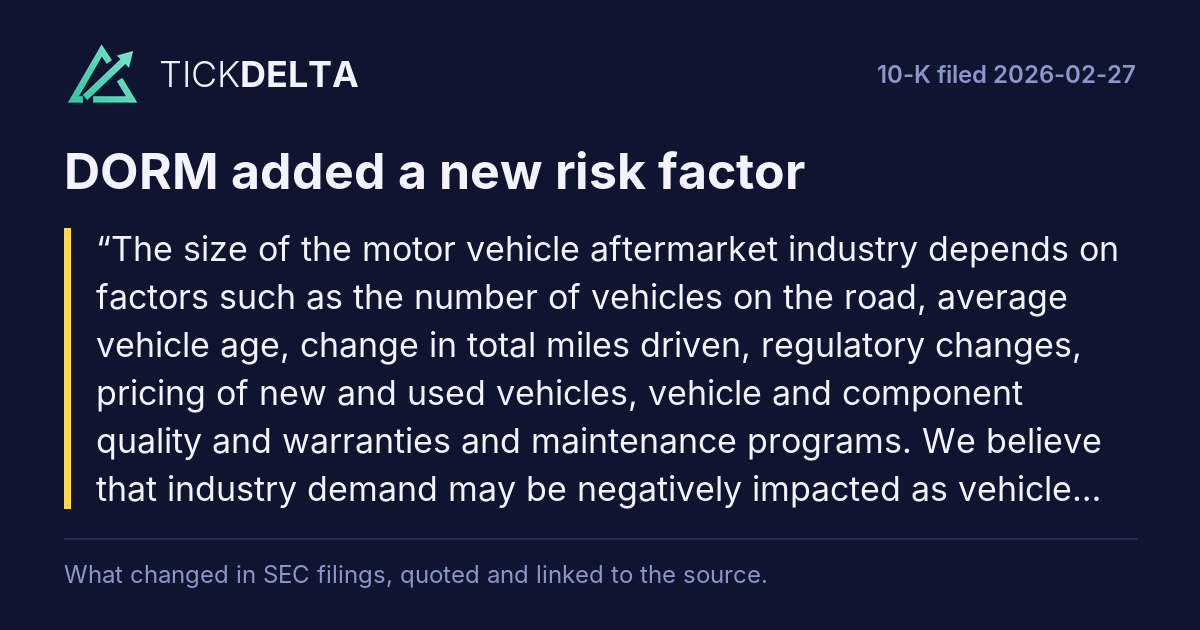
The size of the motor vehicle aftermarket industry depends on factors such as the number of vehicles on the road, average vehicle age, change in total miles driven, regulatory changes, pricing of new and used vehicles, vehicle and component quality and warranties and maintenance programs. We believe that industry demand may be negatively impacted as vehicle and component quality improve, which could reduce part replacement frequency. Enhancements to the duration or scope of warranties and maintenance programs offered by OEMs may also further reduce demand for our products. These factors could have a material adverse effect on our business, financial condition, and results of operations.
Our industry faces intense price competition, and our success depends on maintaining a competitive cost and price structure.
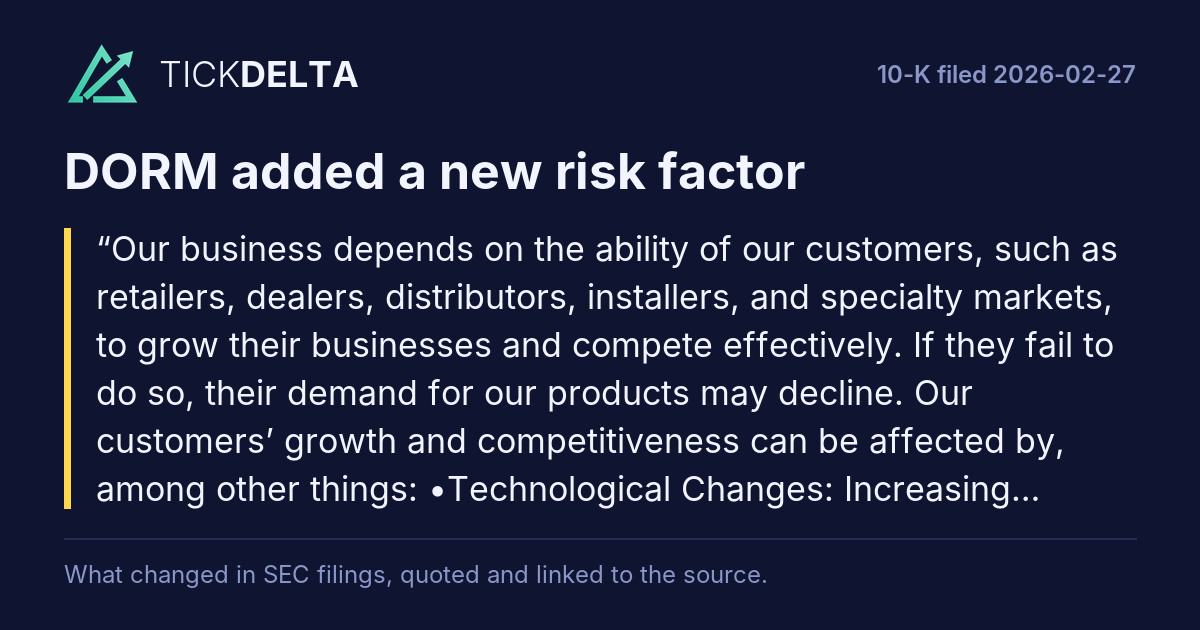
Our business depends on the ability of our customers, such as retailers, dealers, distributors, installers, and specialty markets, to grow their businesses and compete effectively. If they fail to do so, their demand for our products may decline.
Our customers’ growth and competitiveness can be affected by, among other things:
•Technological Changes: Increasing vehicle complexity may require our customers to make investments in training and tools, and failure to adapt may reduce their ability to compete.
forecasts are inaccurate, leading to excess capacity costs or reliance on expensive spot-market purchases. Changes in transportation mix can further affect logistics costs. If we cannot pass increased costs to customers or if capacity declines significantly, our business, financial condition, and results of operations could be materially adversely affected.
Significant inflation, including rising costs for raw materials, transportation, labor, energy, and financing, may adversely impact our operations and financial performance. In recent periods, inflation has driven up the cost of key inputs such as steel, aluminum, copper, and rubber—materials essential to the production and distribution of aftermarket parts. Additionally, increased tariffs on imported goods have further exacerbated costs.
Show the other 17
Inflation in general, and the increased price of our products resulting from pricing efforts to offset the impact of tariffs, may reduce customer purchasing power and result in lower demand for our products. In addition, our gross margins may be compressed, and our competitive position could be weakened, by inflationary pressures, especially if competitors are able to absorb cost increases more effectively. These factors could materially and adversely affect our business, financial condition, and results of operations.
Beyond tariffs, additional trade restrictions—such as limits on foreign investment and increased regulatory requirements (e.g., export licenses)—could disrupt supply chains, reduce global trade, and harm economic stability. These unpredictable actions could materially adversely affect our business, financial condition, and results of operations.
Outbreaks of contagious diseases in countries where we, our customers, or our suppliers operate may disrupt supply chains, increase costs, and reduce demand for our products. For example, the COVID-19 pandemic caused global business disruptions, supply chain delays, and higher costs for raw materials, freight, and labor.
Pandemic-related risks include uncertain duration and severity, effectiveness of vaccines (if any), government restrictions, workplace mandates, and prolonged travel or commercial limitations. Supplier disruptions
may lead to delays, higher costs, or the need for alternate sources, while workforce illness or quarantine could cause labor shortages. In addition, increased remote work may heighten cybersecurity risks.
The extent and duration of such disruptions cannot be predicted. Any prolonged impact could materially adversely affect our business, financial condition, and results of operations.
Our growth and profitability depend on developing and introducing new products. While we invest in research and development and acquisitions to expand our portfolio, delays in development or unforeseen market shifts can reduce the effectiveness of these efforts or impact our profitability. New products may fail to achieve market acceptance, and timing of adoption may differ from expectations. There is also a possibility that we may miss a market opportunity because we failed to invest or invested too late in a technology, product, or enhancement sought by our customers or our markets. Significant investments in technologies, including AI, may not yield returns, and failure to adopt AI effectively in our product development process—or competitors doing so more successfully—could weaken our competitive position and our revenue and profitability.
Product development may involve design and production delays, added costs, and challenges in meeting specifications. As a motor vehicle aftermarket supplier, we face additional complexity when OEMs' parts incorporate proprietary technologies that are required to interface with other vehicle systems to work properly. Without having access to those technologies, our ability to create replacement parts may be adversely impacted.
Rapid technological change in the motor vehicle aftermarket—driven by advanced electronics integration and growth in electric and fuel-cell vehicles—has increased reliance on software, firmware, and complex diagnostic tools. Restrictions on access to testing equipment, software, telematics, and repair data by OEMs or regulators could force vehicle owners to rely on dealers for service, limiting our customers’ ability to repair vehicles and our ability to design and sell new products. In addition to such restrictions and limitations, increased reliance on electronics requires significant investment in technology and exposes us to greater competition from tech-focused entrants. If we misjudge required capital or fail to deliver products that meet evolving customer needs, our competitiveness could decline, which could materially adversely affect our business, financial condition, and results of operations.
Design or quality issues in our products—including reliability or compatibility problems—could harm our reputation and business. Such issues may lead to product recalls, customer loss, revenue decline, litigation, unexpected costs, and reduced market share. Although we invest in engineering, design, manufacturing, and quality systems to minimize these risks, there is no assurance we can fully prevent or resolve them. Significant design or quality problems could materially adversely affect our business, financial condition, and results of operations.
Cyber-attacks or other information technology security breaches may cause equipment failure, disruption to our operations, or the loss or theft of sensitive data relating to our company and our employees, customers, suppliers, and business partners, including intellectual property, proprietary business information, and other sensitive material. In addition, intruders may use stolen trade secrets to develop competing or counterfeit products.
Attacks—such as malware, ransomware, and unauthorized access—are increasing in frequency and severity, and the rapid adoption of AI may heighten these risks, including through the use of deepfakes. Despite preventive measures, evolving attack techniques may outpace our defenses. Furthermore, because the techniques used to carry out cyber-attacks change frequently and in many instances are not recognized until after they are used against a target, we may be unable to anticipate these changes or implement adequate preventative measures. Responding to such incidents also could require significant costs.
In addition, we rely on third-party vendors that provide information technology services for various functions, such as human resources (e.g., payroll) and operations (e.g., logistics providers), and these vendors maintain their own information technology systems. Breaches in those systems could expose our data, intellectual property, or confidential information, disrupt operations, damage our reputation, and lead to legal claims. While we generally require these third parties to monitor and protect their information technology systems against cyber-attacks and other breaches, their efforts may not be effective.
We continually update and expand our information technology systems to enable us to run our business more efficiently, including through the incorporation of AI solutions into our information systems, operations and processes. The increasing use and evolution of AI solutions creates potential risks for loss or misuse of Company data that forms part of any data set that was collected, used, stored, or transferred to run our business. Any unintentional dissemination or intentional destruction of confidential information stored in our or our third-party providers' systems, portable media or storage devices may result in significantly increased business and security recovery costs, damages to our reputation, or costs related to defending legal claims. In addition, if the content, analyses, or recommendations that AI programs assist in producing are or are alleged to be deficient, inaccurate, or biased, then our business, financial condition, and results of operations may be adversely affected.
Our business depends on protecting our intellectual property and proprietary technologies. Among other things, we use patents, trademarks, copyrights, trade secrets, confidentiality and nondisclosure agreements, information security practices, and other measures to protect our intellectual property and proprietary technologies, but there is no assurance that we will be successful in protecting our rights or preventing misappropriation or circumvention. Protection levels vary by country, and enforcement can be uncertain and/or costly, especially in jurisdictions where intellectual property laws are weaker or where court systems to protect intellectual property rights are less developed.
Patent litigation and other challenges are expensive and unpredictable, and financial constraints may limit our ability to secure protection globally. Moreover, preventing unauthorized use or detecting theft is inherently difficult. If we fail to adequately protect our intellectual property and proprietary technology, it could materially adversely affect our ability to compete and our business, financial condition, and results of operations.
Our brands are critical to differentiating our products and driving demand. Maintaining and enhancing brand value is essential to our success and to supporting customer marketing initiatives. A decline in brand reputation—due to product defects or quality issues, recalls, warranty claims, legal proceedings, or other matters—could harm our reputation, reduce demand, and negatively impact our business. Additionally, inadequate branding strategies following acquisitions or decisions by our customers to prioritize their private-label products over our own brands could further erode brand value. Any such decline could materially adversely affect our business, financial condition, and results of operations.
If our financial performance deteriorates or economic conditions adversely change, our ability to service or refinance our indebtedness could negatively affect our financial health.
We are exposed to risks related to customer-sponsored accounts receivable sales agreements.
We regularly extend credit to customers, and a significant portion of our accounts receivable is concentrated among a few large retailers, dealers, and distributors. As of December 31, 2025, our four largest customers represented 78% of total receivables. We monitor credit terms and limits, but customers may request increases, creating risk: granting higher limits raises exposure to non-payment, while denying requests may lead customers to shift business to competitors offering better terms. If customers fail to pay or if they redirect purchases, it could materially adversely affect our business, financial condition, and results of operations.
In 2025, approximately 77% of our total volume of purchases of products was sourced from non-U.S. countries, with approximately 38% sourced from China, exposing us to significant risks, including:
The price of our common stock may fluctuate significantly due to economic conditions, market volatility, and our ability to meet analysts’ expectations. Even minor shortfalls in our performance can negatively impact our stock price. Broader market downturns or volatility unrelated to our performance may also cause declines. Such volatility may lead to securities class action litigation, which could impose substantial costs and divert management’s attention, adversely affecting our business and results. Additionally, volatility may attract shareholder activism, including proxy contests or public campaigns, which could increase costs, strain relationships with suppliers, customers, and regulators, and negatively impact our stock price.
Our success depends on retaining executive officers and other highly skilled employees and attracting new talent. Losing key personnel or failing to hire qualified staff could harm our business. Although we periodically conduct compensation benchmarking and surveys, competition for talent is intense, and rising labor demand may increase costs and challenge our ability to maintain a competitive compensation structure. If we cannot retain or
Our growth depends in part on acquiring and integrating new businesses, which carries significant risks. We may be unable to identify suitable targets, negotiate favorable terms, secure financing, complete transactions, or achieve expected revenue and profitability. Additionally, we risk spending time and money investigating and negotiating with potential acquisition partners, but not completing transactions. These could make it more difficult for us to diversify our businesses and to penetrate or expand important product offerings, geographies, or markets. In addition, integration challenges, operational disruptions, the presence or absence of adequate internal controls and/or significant fraud in the financial systems of acquired companies, and management distraction could occur, and we may not fully assess all risks inherent in the acquisition and integration process. Lastly, the value of goodwill and other intangible assets acquired could be impacted by one or more continuing unfavorable events and/or trends, which could result in significant impairment charges. Any difficulties with completing and integrating acquisitions could materially and adversely affect our business, financial condition, and results of operations.
Climate change poses financial and operational risks to our business. Extreme weather events and other potential impacts of climate change, including, but not limited to hail, floods, rising sea levels, droughts, wild fires, tornadoes, and tropical cyclones, can reduce product demand, disrupt product availability or distribution center operations, raise insurance and operating costs, disrupt ports and logistics networks, and increase supply chain expenses. Reduced product availability and demand can lead to reduced revenue, and increased costs can adversely affect our profitability. In addition, growing global focus on greenhouse gas emissions may lead to new laws and regulations that require significant compliance efforts and capital expenditures. For example, restrictions or standards adopted regarding emissions of carbon dioxide by motor vehicles or fuels could adversely affect demand for motor vehicles, annual miles driven, or the products we sell. Moreover, such restrictions and standards could lead to or require changes in motor vehicle technology and increased product development costs. While we strive to meet evolving standards, we cannot guarantee success, market acceptance of our products, or favorable returns on related investments.
Paragraphs in the 10-Q filed Oct 27, 2026 that were not in the one before
New in the latest 10-Q
20 paragraphs in the 10-Q filed Oct 27, 2026 with nothing like them in the 10-Q filed Aug 4, 2026 (at least half the words must differ; new numbers alone do not count). Quoted exactly, grouped by the item heading above them. This is text that changed, not a judgement of how serious it is.
Financial statements and notes
Interest expense and interest income are presented separately in the Condensed Consolidated Statements of Operations and Comprehensive Income. Prior year amounts, which were previously presented net, have been reclassified to conform with the current year presentation, with no impact on income from operations, net income, or earnings per share.
Read in the 10-Q
In the preceding segment tables, Other segment expenses consist of selling, general, and administrative expenses, including salaries and benefits for product development, research, sales, marketing and administrative functions, facility costs, information technology costs, and other general expenses.
Read in the 10-Q
these matters could have a material adverse impact on the Company’s cash flows, financial position, or results of operations in the period in which any such effects are recorded.
Read in the 10-Q
During the three and nine months ended September 26, 2026, we issued 11,382 shares under the ESPP, compared to 10,216 shares issued under the ESPP during the three and nine months ended September 27, 2025, in each case as part of the semi-annual purchase windows.
Read in the 10-Q
During the three and nine months ended September 26, 2026, we recorded $ 1.9 million of federal excise tax imposed on the fair value of certain stock repurchases, net of issuances, pursuant to the
Read in the 10-Q
Show the other 15
Inflation Reduction Act of 2022, which was included in Purchase and cancellation of common stock in the Condensed Consolidated Statements of Shareholders' Equity. The excise tax is excluded from both the Total cost of shares repurchased and canceled and the Average price per share in the tables above. We paid $ 0.9 million of such excise taxes to the federal government on eligible repurchases during the three and nine months ended September 26, 2026, which was included in Purchase and cancellation of common stock in the Condensed Consolidated Statements of Cash Flows.
Read in the 10-Q
other allowances in any accounting period. Revisions to these estimates are made, when necessary, based upon changes in these factors. We regularly study trends of such claims.
Read in the 10-Q
Because we capitalize tariff costs into inventory, changes in tariff costs generally are not recognized in cost of goods sold in our Statement of Operations and Comprehensive Income until the related inventory is sold. As a result, there is typically a delay between when new or increased tariffs take effect on products we source and when those costs affect our results of operations. The length of this delay depends on factors including our inventory levels, inventory turnover and the timing of purchases.
Read in the 10-Q
When price increases taken in response to higher tariff costs take effect before the higher costs are recognized in cost of goods sold, we may experience a temporary increase in gross margin. Gross margin may then decrease once the higher-cost inventory is sold and those costs are recognized. These timing differences may cause our gross margin and other results of operations to vary from period to period.
Read in the 10-Q
Three Months Ended September 26, 2026, Compared to Three Months Ended September 27, 2025
Read in the 10-Q
Nine Months Ended September 26, 2026, Compared to Nine Months Ended September 27, 2025
Read in the 10-Q
Three Months Ended September 26, 2026, Compared to Three Months Ended September 27, 2025
Read in the 10-Q
Nine Months Ended September 26, 2026, Compared to Nine Months Ended September 27, 2025
Read in the 10-Q
Other information
Name and Title of Director or Officer Date of Adoption of Agreement Expiration Date of Agreement¹ Aggregate Number of Securities to be Purchased or Sold Scott D. Leff September 2, 2026 September 1, 2027 9,257² SVP, Chief Human Resources Officer Steven L. Berman September 9, 2026 December 8, 2027 195,501³ Director Joseph P. Braun September 14, 2026 September 30, 2027 15,253⁴ SVP, General Counsel and Secretary Eric B. Luftig September 15, 2026 August 27, 2027 2,000⁵ President, Light Duty Kevin M. Olsen September 15, 2026 December 31, 2027 40,000⁶ Chairman, President and Chief Executive Officer ─────────────────────────────────────────────────────────────────────────────────────────────────────────────────────────────────────────────────────────────────────────────────────
Read in the 10-Q
¹ Each Rule 10b5-1 Plan expires upon the date shown or, if earlier, upon completion of all authorized transactions under such Plan.
Read in the 10-Q
² Plan includes (i) the sale of up to 7,500 shares of the Company’s common stock currently held by Mr. Leff and (ii) the potential exercise of vested stock options and the associated sale of up to 1,757 shares of the Company’s common stock.
Read in the 10-Q
³ Plan covers (i) 70,000 shares of the Company’s common stock owned directly by Mr. Berman and (ii) 125,501 shares of the Company’s common stock owned by certain family trusts for which Mr. Berman serves as co-trustee or that are for the benefit of Mr. Berman’s children. No sales under the Plan may commence until after completion and termination of the prior Rule 10b5-1 Plan adopted by such sellers on September 10, 2025.
Read in the 10-Q
⁴ Plan includes (i) the sale of up to 10,000 shares of the Company’s common stock currently held by Mr. Braun and (ii) the potential exercise of vested stock options and the associated sale of up to 5,253 shares of the Company’s common stock.
Read in the 10-Q
⁵ Plan includes the sale of up to 2,000 shares of the Company’s common stock currently held by Mr. Luftig.
Read in the 10-Q
⁶ Plan includes the sale of up to 40,000 shares of the Company’s common stock currently held by Mr. Olsen or remaining unsold under his prior Rule 10b5-1 Plan adopted on September 3, 2025. No sales under the Plan may commence until after expiration of such prior Rule 10b5-1 Plan.
Read in the 10-Q
The 10-Q's risk factors against the 10-K
Item 1A of the 10-Q filed Oct 27, 2026 against Item 1A of the 10-K filed Feb 27, 2026.
A 10-Q repeats only the risks that changed, so a 10-K paragraph that is missing from it is not counted as removed.
Added is a paragraph with nothing like it in the 10-K, Reworded a sentence that is in both with several words changed,
Quiet changes a sentence in both where one to four words changed and one is a hedge or a modal
(cut words struck through, new words highlighted).
Text on the page, not a score; each links to the filing at sec.gov.
Reworded10-Q Oct 27, 2026 vs 10-K Feb 27, 2026
The risks described below, which are listed in no particular order, our Annual Report on Form 10-K are not the only risks we face.
Reworded10-Q Oct 27, 2026 vs 10-K Feb 27, 2026
Additional risks and uncertainties not currently known to us or that we currently deem to be immaterial also may materially adversely affect our business, financial condition, or results of operations. and/or operating results.
Phrases used for the first time
Two-word phrases in Risk Factors of the 10-K filed Feb 27, 2026 that are in none of the 1 earlier 10-Ks stored, back to Feb 27, 2025
increase costs ×3regulatory changes ×2component quality ×2maintenance programs ×2offer customers ×2industry faces ×2faces intense ×2intense price ×2cost increases ×2lost sales ×2fuel price ×2cannot pass ×2rising costs ×2steel aluminum ×2aluminum copper ×2total volume ×2
Where each one is used
- increase costs: Outbreaks of contagious diseases in countries where we, our customers, or our suppliers operate may disrupt supply chains, increase costs, and reduce demand for our products. For example, the COVID-19 pandemic caused global business disruptions, supply chain delays, and higher costs for raw materials, freight, and labor.
- regulatory changes: The size of the motor vehicle aftermarket industry depends on factors such as the number of vehicles on the road, average vehicle age, change in total miles driven, regulatory changes, pricing of new and used vehicles, vehicle and component quality and warranties and maintenance programs. We believe that industry...
- component quality: The size of the motor vehicle aftermarket industry depends on factors such as the number of vehicles on the road, average vehicle age, change in total miles driven, regulatory changes, pricing of new and used vehicles, vehicle and component quality and warranties and maintenance programs. We believe that industry...
- maintenance programs: The size of the motor vehicle aftermarket industry depends on factors such as the number of vehicles on the road, average vehicle age, change in total miles driven, regulatory changes, pricing of new and used vehicles, vehicle and component quality and warranties and maintenance programs. We believe that industry...
- offer customers: We cannot assure you that competitors will not (i) adopt fast follower strategies, based on our new product launches, (ii) develop products or services that are equal or superior to our products, or that achieve greater market acceptance than our products, or (iii) expand into our product lines. Such risks may be...
- industry faces: Our industry faces intense price competition, and our success depends on maintaining a competitive cost and price structure.
- faces intense: Our industry faces intense price competition, and our success depends on maintaining a competitive cost and price structure.
- intense price: Our industry faces intense price competition, and our success depends on maintaining a competitive cost and price structure.
Used at least twice, small words left out. Counted, not picked: a phrase can be new because the company renamed something.
What was taken out
33 paragraphs of last year's Risk Factors with nothing like them now. The longest are quoted.
Sources
Item 1A of each 10-K and 10-Q on EDGAR, quoted exactly. Each paragraph links to the filing at sec.gov.
Also
10-K change: what was reworded or cut, section by section.
Work with it
Excel workbook · CSV. Google Sheet that stays up to date: paste =IMPORTDATA("https://tickdelta.com/company/DORM/export.csv") into a cell.