Paragraph 83 · 47% changed
Every version of it
Screener
/
SEC EDGAR
/CIK 0001833756
/10-K filed Feb 27, 2026, compared with Mar 3, 2025
/Numbers from the XBRL of the 10-Ks
Nasdaq
Industrials · Defense Electronics
Leonardo DRS, Inc. DRS
The 10-K against last year's
198 changes: 26 added, 32 removed, 137 reworded, 3 quiet changes
10-K Feb 27, 2026 vs Mar 3, 2025
Risk Factors
12.7%
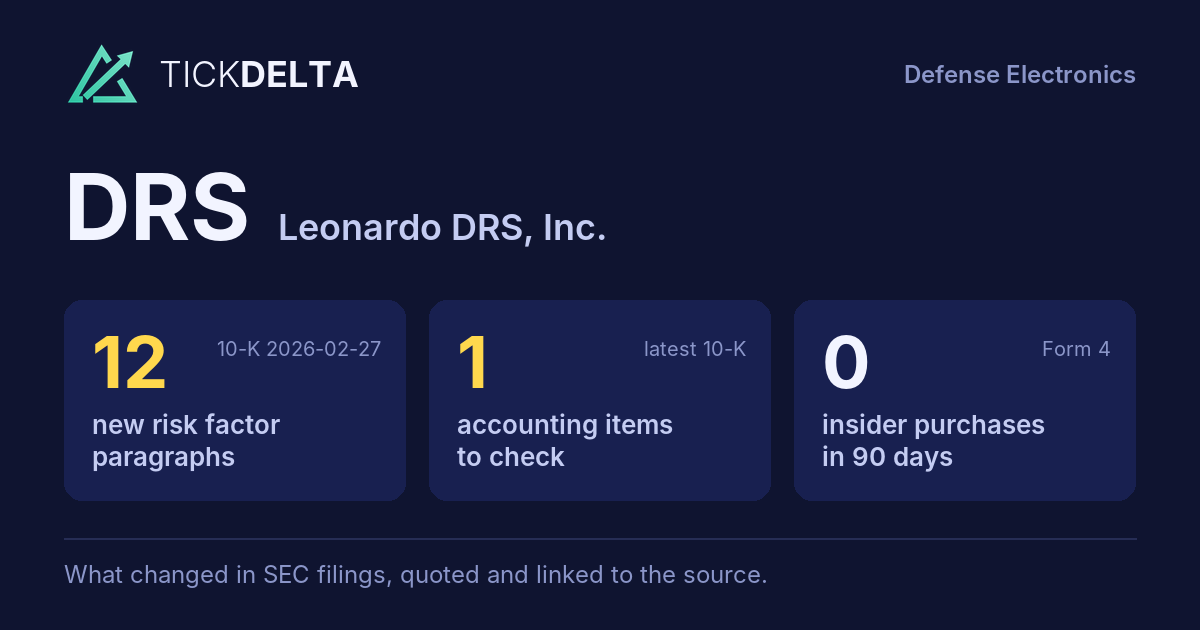
of the text changed · 24,074 words now · 12 new paragraphs, 14 gone
MD&A
28.0%
of the text changed · 8,439 words now · 14 new paragraphs, 18 gone
Legal Proceedings
26.3%
of the text changed · 647 words now
Accounting Policies
26.8%
of the text changed · 4,667 words now
10-K 0001833756-26-000013 (Feb 27, 2026) vs 10-K 0001628280-25-009248 (Mar 3, 2025)
Every paragraph, and how much of it changed
One bar per paragraph, in the order of the 10-K. Height and colour show the share of its words not in the closest paragraph a year earlier; the tallest bars are new paragraphs.
Risk Factors
287 paragraphs · 12 new · 106 reworded · 14 gone · 10-K Feb 27, 2026 against Mar 3, 2025
New paragraph
Reworded (5% of its words or more)
Same or nearly
Paragraph 224 · 47% changed
Every version of it
Paragraph 174 · 46% changed
Every version of it
Claims of intellectual property infringement might also require us to enter into costly royalty or license agreements. There can be no assurance that any of our patents and other intellectual property will not be challenged, invalidated, misappropriated or circumvented by third parties. Moreover, we may not be able to obtain royalty or license agreements on terms acceptable to us, or at all. We also may be subject to significant damages or injunctions against development and sale of certain of our products, services and solutions. Our success depends in large part on our proprietary technology. We rely on a combination of patents, copyrights, trademarks, trade secrets, know-how, confidentiality provisions and licensing arrangements to establish and protect our intellectual property rights. Our efforts, however, to protect our intellectual property and proprietary rights may not be sufficient. In addition, the laws concerning intellectual property vary among nations and the protection provided to our intellectual property by the laws and courts of foreign nations may differ from and be more limited than the protection provided in the U.S. If we fail to successfully protect and enforce these rights, our competitive position could suffer. Our pending patent and trademark registration applications may not be issued, and/or competitors may challenge the validity or scope of our patents or trademark registrations. In addition, our patents may not provide us a significant competitive advantage. We may be required to spend significant resources to monitor and enforce our intellectual property rights. Litigation to determine the scope of intellectual property rights, even if ultimately successful, could be costly and could divert management’s attention away from other aspects of our business. Further, in some cases the US government is unilaterally empowered to use, or allow our competitors to use, patented technology, subject only to the obligation to pay reasonable compensation.
Paragraph 247 · 45% changed
Every version of it
Paragraph 117 · 45% changed
Every version of it
Paragraph 215 · 44% changed
Every version of it
Paragraph 41 · 43% changed
Every version of it
Considerable uncertainty exists regarding future budget and program decisions, including U.S. defense spending priorities, what challenges budget reductions will present for the defense industry, whether annual appropriations bills for all agencies will be enacted for U.S. government fiscal year 2025 FY2027 and thereafter, and how the current administration will approach those decisions through the budgeting process. Additionally, While the current U.S. administration has discussed various changes FY2026 DoW budget was approved, there remains uncertainty with regard to defense spending levels ranging from across-the-board percentage cuts, to a change in spending allocations in favor of new priorities, and potential increases in the top-line spending profile. It remains unclear whether and to what extent the DoD’s budget may change and, if it does, to what extent our business, financial condition and results of operations may be affected. Additionally, the U.S. government’s budget deficit and the national debt could also significantly affect government budgeting priorities and could have an adverse impact on our business, financial condition and results of operations in a number of ways, including the following:
Paragraph 146 · 39% changed
Every version of it
Paragraph 83 · 47% changed
Every version of it
10-K Mar 3, 2025We enter into forward pricing rate agreements with our U.S. government clients that establish specific direct and indirect rates to be used in pricing all contracts with the applicable government agency for a specified period of time. This requires us to estimate the costs that we will incur in connection with future contracts. Failure to accurately estimate the costs that we will incur including as a result of changes in underlying assumptions, circumstances or estimates may materially reduce our profit or cause a loss on these contracts and adversely impact our business, financial condition and results of operations.
10-K Feb 27, 2026
underlying assumptions, circumstances or estimates may materially reduce our profit or cause a loss on these contracts and adversely impact our business, financial condition and results of operations.
Paragraph 224 · 47% changed
Every version of it
10-K Mar 3, 2025In general, under Section 382 of the U.S. Internal Revenue Code of 1986, as amended (the “Tax Code”), a corporation that undergoes an “ownership change” is subject to limitations on its ability to utilize its pre-change net operating losses (“NOLs”) to offset future taxable income. Future changes in our stock ownership, some of which are beyond our control, could result in an ownership change under Section 382 of the Tax Code. Furthermore, our ability to utilize NOLs of any companies that we may acquire in the future may be subject to limitations. For these reasons, we may not be able to utilize a material portion of the NOLs reflected on our balance sheet, even if we attain profitability.
10-K Feb 27, 2026
future may be subject to limitations. For these reasons, we may not be able to utilize a material portion of the NOLs reflected on our balance sheet, even if we attain profitability.
Paragraph 174 · 46% changed
Every version of it
10-K Mar 3, 2025
Claims of intellectual property infringement might also require us to enter into costly royalty or license agreements. There can be no assurance that any of our patents and other intellectual property will not be challenged, invalidated, misappropriated or circumvented by third parties. Moreover, we may not be able to obtain royalty or license agreements on terms acceptable to us, or at all. We also may be subject to significant damages or injunctions against development and sale of certain of our products, services and solutions. Our success depends in large part on our proprietary technology. We rely on a combination of patents, copyrights, trademarks, trade secrets, know-how, confidentiality provisions and licensing arrangements to establish and protect our intellectual property rights. Our efforts, however, to protect our intellectual property and proprietary rights may not be sufficient. In addition, the laws concerning intellectual property vary among nations and the protection provided to our intellectual property by the laws and courts of foreign nations may differ from and be more limited than the protection provided in the U.S. If we fail to successfully protect and enforce these rights, our competitive position could suffer. Our pending patent and trademark registration applications may not be issued, and/or competitors may challenge the validity or scope of our patents or trademark registrations. In addition, our patents may not provide us a significant competitive advantage. We may be required to spend significant resources to monitor and enforce our intellectual property rights. Litigation to determine the scope of intellectual property rights, even if ultimately successful, could be costly and could divert management’s attention away from other aspects of our business. Further, in some cases the US government is unilaterally empowered to use, or allow our competitors to use, patented technology, subject only to the obligation to pay reasonable compensation.
10-K Feb 27, 2026
Claims of intellectual property infringement might also require us to enter into costly royalty or license agreements. There can be no assurance that any of our patents and other intellectual property will not be challenged, invalidated, misappropriated or circumvented by third parties. Moreover, we may not be able to obtain royalty or license agreements on terms acceptable to us, or at all. We also may be subject to significant damages or injunctions against development and sale of certain of our products, services and
Paragraph 247 · 45% changed
Every version of it
10-K Mar 3, 2025policies that could negatively impact our profitability and adversely impact our business, financial condition and results of operations.
10-K Feb 27, 2026
remainder of the lease term. Our inability to terminate a lease when we stop fully utilizing a facility could negatively impact our business, financial condition and results of operations.
Paragraph 117 · 45% changed
Every version of it
10-K Mar 3, 2025An increase in competition from these smaller companies may force us to lower our prices or increase our spending on research and development, sales, and marketing, which could have a deleterious effect on our operating margins and profitability. As these companies continue to expand, their scale and scope may also grow, potentially allowing them to compete more directly and effectively against us. Our failure to compete effectively with these smaller, innovative companies can reduce our market share and materially impact our business, financial condition, and operating results.
10-K Feb 27, 2026
against us. Our failure to compete effectively with these smaller, innovative companies can reduce our market share and materially impact our business, financial condition, and operating results.
Paragraph 215 · 44% changed
Every version of it
10-K Mar 3, 2025We provide products and services related to hazardous and high-risk operations. Among such operations, our products and services are used in nuclear-related activities (including providing components for nuclear-powered platforms and sensors used in nuclear applications) and used in support of nuclear-related operations of third parties. Our business also involves the handling, transportation, storage and disposal of potentially dangerous chemicals and unstable materials and is subject to hazards inherent in such activities including chemical spills, storage tank leaks, discharges or releases of toxic or hazardous substances or gases and other hazards incident to the handling, transportation, storage and disposal of dangerous chemicals. We endeavor to obtain insurance agreements from financially solid, responsible, highly rated counterparties in established markets to cover significant risks and liabilities (including, for example, natural disasters, hazardous operations and products liability). Not every risk or liability can be insured, and for risks that are insurable, the policy limits and terms of coverage reasonably obtainable in the market may not be sufficient to cover all actual losses or liabilities incurred. Even if insurance coverage is available, we may not be able to obtain it or renew existing coverage at a price or on terms acceptable to us. Disputes with insurance carriers, including over policy terms, reservation of rights, the applicability of coverage (including exclusions), compliance with provisions (including notice) and/or the insolvency of one or more of our insurers may significantly affect the availability or timing of recovery, and may impact our ability to obtain insurance coverage at reasonable rates in the future.
10-K Feb 27, 2026
insurance coverage is available, we may not be able to obtain it or renew existing coverage at a price or on terms acceptable to us. Disputes with insurance carriers, including over policy terms, reservation of rights, the applicability of coverage (including exclusions), compliance with provisions (including notice) and/or the insolvency of one or more of our insurers may significantly affect the availability or timing of recovery, and may impact our ability to obtain insurance coverage at reasonable rates in the future.
Paragraph 41 · 43% changed
Every version of it
10-K Mar 3, 2025
Considerable uncertainty exists regarding future budget and program decisions, including U.S. defense spending priorities, what challenges budget reductions will present for the defense industry, whether annual appropriations bills for all agencies will be enacted for U.S. government fiscal year 2025 and thereafter, and how the current administration will approach those decisions through the budgeting process. Additionally, the current U.S. administration has discussed various changes to defense spending levels ranging from across-the-board percentage cuts, to a change in spending allocations in favor of new priorities, and potential increases in the top-line spending profile. It remains unclear whether and to what extent the DoD’s budget may change and, if it does, to what extent our business, financial condition and results of operations may be affected. Additionally, the U.S. government’s budget deficit and the national debt could also significantly affect government budgeting priorities and could have an adverse impact on our business, financial condition and results of operations in a number of ways, including the following:
10-K Feb 27, 2026
Considerable uncertainty exists regarding future budget and program decisions, including U.S. defense spending priorities, what challenges budget reductions will present for the defense industry, whether annual appropriations bills for all agencies will be enacted for U.S. government FY2027 and thereafter, and how the current administration will approach those decisions through the budgeting process. While the FY2026 DoW budget was approved, there remains uncertainty with regard to the U.S.
Paragraph 146 · 39% changed
Every version of it
10-K Mar 3, 2025As a defense contractor, we may be more likely than other companies to be a direct target of, or indirectly damaged by, physical attacks including by active shooters, terrorists or terrorist organizations. It is impossible to predict accurately the likelihood or impact of any attack on our industry generally or on our business. While we have implemented significant physical security protection measures, business continuity plans and established backup sites, in the event of an attack or a threat of an attack, these security measures and contingency plans may be inadequate to prevent significant disruptions in our business, technology or access to the infrastructure necessary to maintain our business. Such attack may harm our personnel, close our facilities or render our backup data and recovery systems inoperable. Damage to our facilities due to attacks may be significantly in excess of any amount of insurance recovery, and we may not be able to insure against such damage at a reasonable price or at all. The threat of attacks may also negatively affect our ability to attract and retain employees. Any of these events could have a material adverse effect on our business, financial condition and results of operations.
10-K Feb 27, 2026
Damage to our facilities due to attacks may be significantly in excess of any amount of insurance recovery, and we may not be able to insure against such damage at a reasonable price or at all. The threat of attacks may also negatively affect our ability to attract and retain employees. Any of these events could have a material adverse effect on our business, financial condition and results of operations.
MD&A
118 paragraphs · 14 new · 64 reworded · 18 gone · 10-K Feb 27, 2026 against Mar 3, 2025
New paragraph
Reworded (5% of its words or more)
Same or nearly
Paragraph 94 · 50% changed
We endeavor to ensure the most efficient conversion of operating income earnings into cash for deployment in our business and to maximize stockholder value through cash deployment activities. In addition to our cash position, we use various financial measures to assist in capital deployment decision-making, including cash provided by operating activities. We believe that the combination of our existing cash, access to credit facilities as described in Note 13: Debt and future cash that we expect to generate from our operations will be sufficient to meet our short and long-term liquidity needs. There can be no assurance, however, that our business will continue to generate cash flow at current levels or that anticipated operational improvements will be achieved. We may also pursue acquisitions or other strategic priorities that will require additional liquidity beyond the liquidity we generate through our operations. Our cash balance as of December 31, 2024 was $598 million compared to $467 million as of December 31, 2023.
Paragraph 65 · 48% changed
Changes in the volume and relative mix of U.S. and allied government spending as well as areas of spending growth growth, including due to the evolution of warfare, could impact our business and results of operations. In particular, our results can be affected by shifts in strategies and priorities on homeland security, intelligence, defense-related programs, infrastructure and urbanization and continued increased spending on technology and innovation, including cybersecurity with respect to our and third parties' information networks and related systems, artificial intelligence, connected communities and physical infrastructure (for example, the potential impacts for the Russia / Ukraine conflict and the Israel-Hamas war). Cost-cutting and efficiency initiatives, current and future budget restrictions, spending cuts and other efforts to reduce government spending and shifts in overall priorities could cause our government customers to reduce or delay funding or invest appropriated funds on a less consistent basis or not at all, and demand for our solutions or services could diminish. Furthermore, any disruption in the functioning of government agencies, including as a result of government closures and shutdowns, could have a negative impact on our operations and cause us to lose revenue or incur additional costs due to, among other things, our inability to maintain access and schedules for government testing or deploy our staff to customer locations or facilities as a result of such disruptions.
Paragraph 34 · 46% changed
Paragraph 87 · 43% changed
ASC’s backlog increased bookings decreased by $590 $150 million, or 24.6%, 5.7%, from $2,402 $2,609 million for the year ended December 31, 2023 2024 to $2,992 $2,459 million for the year ended December 31, 2024. This was attributed to the increased demand and 2025. The decrease in new awards is a result of certain multi-year bookings realized (noted above) which were 1.2x that of the revenue generated during the period, driving an increase in the backlog position. prior year on naval and airborne
Paragraph 99 · 42% changed
Cash used in financing activities for the year ended December 31, 2024 2025 was $56 $163 million compared to cash provided by financing activities $56 million for the year ended December 31, 2023 of $15 million. 2024. The primary change was primarily due to cash outflow for outlays related to dividends paid in the current year is driven by our $43 million period and share buy backs under the share repurchase program announced in the first quarter of debt repayments made during the period. Additionally the Company reacquired equity instruments related to employee stock vesting of $19 million. 2025. These outflows were offset in part by $16 million of cash proceeds received upon higher debt repayments in the exercise of stock options. prior year period.
Paragraph 48 · 39% changed
Paragraph 98 · 39% changed
Investing activities used $84 $154 million of cash during the year ended December 31, 2024 2025 as compared to $59 $84 million during the year ended December 31, 2023. 2024. The $25 $70 million increase is primarily due to higher capital expenditures attributed mainly to investments in capacity expansion throughout the portfolio, highlighted by our new naval power facility project in South Carolina manufacturing facility. and a $15 million investment to extend our ownership stake in Hoverfly, a power-tethered unmanned aerial systems company.
Paragraph 117 · 39% changed
Paragraph 94 · 50% changed
10-K Mar 3, 2025
We endeavor to ensure the most efficient conversion of operating income into cash for deployment in our business and to maximize stockholder value through cash deployment activities. In addition to our cash position, we use various financial measures to assist in capital deployment decision-making, including cash provided by operating activities. We believe that the combination of our existing cash, access to credit facilities as described in Note 13: Debt and future cash that we expect to generate from our operations will be sufficient to meet our short and long-term liquidity needs. There can be no assurance, however, that our business will continue to generate cash flow at current levels or that anticipated operational improvements will be achieved. We may also pursue acquisitions or other strategic priorities that will require additional liquidity beyond the liquidity we generate through our operations. Our cash balance as of December 31, 2024 was $598 million compared to $467 million as of December 31, 2023.
10-K Feb 27, 2026
We endeavor to ensure the most efficient conversion of operating earnings into cash for deployment in our business and to maximize stockholder value through cash deployment activities. In addition to our cash position, we use various financial measures to assist in capital deployment decision-making,
Paragraph 65 · 48% changed
10-K Mar 3, 2025
Changes in the volume and relative mix of U.S. government spending as well as areas of spending growth could impact our business and results of operations. In particular, our results can be affected by shifts in strategies and priorities on homeland security, intelligence, defense-related programs, infrastructure and urbanization and continued increased spending on technology and innovation, including cybersecurity with respect to our and third parties' information networks and related systems, artificial intelligence, connected communities and physical infrastructure (for example, the potential impacts for the Russia / Ukraine conflict and the Israel-Hamas war). Cost-cutting and efficiency initiatives, current and future budget restrictions, spending cuts and other efforts to reduce government spending and shifts in overall priorities could cause our government customers to reduce or delay funding or invest appropriated funds on a less consistent basis or not at all, and demand for our solutions or services could diminish. Furthermore, any disruption in the functioning of government agencies, including as a result of government closures and shutdowns, could have a negative impact on our operations and cause us to lose revenue or incur additional costs due to, among other things, our inability to maintain access and schedules for government testing or deploy our staff to customer locations or facilities as a result of such disruptions.
10-K Feb 27, 2026
Changes in the volume and relative mix of U.S. and allied government spending as well as areas of spending growth, including due to the evolution of warfare, could impact our business and results of operations. In particular, our results can be affected by shifts in strategies and priorities on homeland security, intelligence, defense-related programs, infrastructure and urbanization and continued increased spending on technology and innovation, including cybersecurity with respect to our and third parties'
Paragraph 34 · 46% changed
10-K Mar 3, 2025U.S. government contracts are, by their terms, subject to termination by the U.S. government for either convenience or default by the contractor. Fixed-price contracts provide for payment upon termination for items delivered to and accepted by the U.S. government and, if the termination is for convenience, for payment of fair compensation of work performed plus the costs of settling and paying claims by terminated subcontractors, other settlement expenses and a reasonable profit on the costs incurred. Cost-plus contracts provide that, upon termination, the contractor is entitled to reimbursement of its allowable costs and, if the termination is for convenience, a total fee proportionate to the percentage of the work completed under the contract. If a contract termination is for default, however, the contractor is paid an amount agreed upon for completed and partially completed products and services accepted by the U.S. government. In these circumstances, the U.S. government is not liable for excess costs incurred by us in procuring undelivered items from another source.
10-K Feb 27, 2026
paid an amount agreed upon for completed and partially completed products and services accepted by the U.S. government. In these circumstances, the U.S. government is not liable for excess costs incurred by us in procuring undelivered items from another source.
Paragraph 87 · 43% changed
10-K Mar 3, 2025
ASC’s backlog increased by $590 million, or 24.6%, from $2,402 million for the year ended December 31, 2023 to $2,992 million for the year ended December 31, 2024. This was attributed to the increased demand and new awards realized (noted above) which were 1.2x that of the revenue generated during the period, driving an increase in the backlog position.
10-K Feb 27, 2026
ASC’s bookings decreased by $150 million, or 5.7%, from $2,609 million for the year ended December 31, 2024 to $2,459 million for the year ended December 31, 2025. The decrease in new awards is a result of certain multi-year bookings realized in the prior year on naval and airborne
Paragraph 99 · 42% changed
10-K Mar 3, 2025
Cash used in financing activities for the year ended December 31, 2024 was $56 million compared to cash provided by financing activities for the year ended December 31, 2023 of $15 million. The primary cash outflow for the current year is driven by our $43 million of debt repayments made during the period. Additionally the Company reacquired equity instruments related to employee stock vesting of $19 million. These outflows were offset in part by $16 million of cash proceeds received upon the exercise of stock options.
10-K Feb 27, 2026
Cash used in financing activities for the year ended December 31, 2025 was $163 million compared to $56 million for the year ended December 31, 2024. The change was primarily due to cash outlays related to dividends paid in the current period and share buy backs under the share repurchase program announced in the first quarter of 2025. These outflows were offset in part by higher debt repayments in the prior year period.
Paragraph 48 · 39% changed
10-K Mar 3, 2025Backlog increased by $168 million, or 3.1%, to $5,517 million for the year ended December 31, 2024 from $5,349 million for the year ended December 31, 2023. The backlog increase is largely attributed to awards received on surface ship programs within our power and propulsion line of business.
10-K Feb 27, 2026
G&A expenses increased by $83 million, or 20.0%, from $414 million for the year ended December 31, 2024, to $497 million for the year ended December 31, 2025. The increase is largely attributed to enhanced IR&D expenditures, B&P expenditures, stock-based compensation expenses and G&A efforts to expand the business internationally.
Paragraph 98 · 39% changed
10-K Mar 3, 2025
Investing activities used $84 million of cash during the year ended December 31, 2024 as compared to $59 million during the year ended December 31, 2023. The $25 million increase is attributed mainly to investments in our new South Carolina manufacturing facility.
10-K Feb 27, 2026
Investing activities used $154 million of cash during the year ended December 31, 2025 as compared to $84 million during the year ended December 31, 2024. The $70 million increase is primarily due to higher capital expenditures attributed to capacity expansion throughout the portfolio, highlighted by our new naval power facility project in South Carolina and a $15 million investment to extend our ownership stake in Hoverfly, a power-tethered unmanned aerial systems company.
Paragraph 117 · 39% changed
10-K Mar 3, 2025As of December 31, 2024 and 2023, we had gross deferred tax assets of $297 million and $258 million, respectively, and deferred tax asset valuation allowances of $25 million and $21 million, respectively. The deferred tax assets principally relate to capitalized R&D, benefit accruals, inventory obsolescence, tax benefit carryforwards and contract reserves. The deferred tax assets as of December 31, 2024 and 2023 include $7 million and $11 million, respectively, related to tax benefit carryforwards associated with net operating losses. The increase in the deferred tax asset as compared to the prior year is primarily attributed to the capitalization of R&D expenditures pursuant to Section 174 of the Tax Code. This section was a part of the Tax Cuts and Jobs Act of 2017 and became effective for tax years beginning in 2022.
10-K Feb 27, 2026
December 31, 2025 and 2024 include $7 million related to tax benefit carryforwards associated with net operating losses. The decrease in the deferred tax asset as compared to the prior year is primarily attributed to the deduction of previously capitalized R&D expenditures pursuant to Section 174 of the Tax Code. The OBBBA allows taxpayers to make elections to deduct the capitalized expenditures over certain periods.
A paragraph is matched with the one last year that shares the most of its words; under half in common makes it new. The paragraphs shown are the 8 reworded the most in each section.
The paragraph that changed most in each section
The redline
Marked against last year's 10-K: cut words struck through, new words highlighted.
Risk Factors216 words changed in this paragraph; it is 44% similar to last year's version.
Claims of intellectual property infringement might also require us to enter into costly royalty or license agreements. There can be no assurance that any of our patents and other intellectual property will not be challenged, invalidated, misappropriated or circumvented by third parties. Moreover, we may not be able to obtain royalty or license agreements on terms acceptable to us, or at all. We also may be subject to significant damages or injunctions against development and sale of certain of our products, services and solutions. Our success depends in large part on our proprietary technology. We rely on a combination of patents, copyrights, trademarks, trade secrets, know-how, confidentiality provisions and licensing arrangements to establish and protect our intellectual property rights. Our efforts, however, to protect our intellectual property and proprietary rights may not be sufficient. In addition, the laws concerning intellectual property vary among nations and the protection provided to our intellectual property by the laws and courts of foreign nations may differ from and be more limited than the protection provided in the U.S. If we fail to successfully protect and enforce these rights, our competitive position could suffer. Our pending patent and trademark registration applications may not be issued, and/or competitors may challenge the validity or scope of our patents or trademark registrations. In addition, our patents may not provide us a significant competitive advantage. We may be required to spend significant resources to monitor and enforce our intellectual property rights. Litigation to determine the scope of intellectual property rights, even if ultimately successful, could be costly and could divert management’s attention away from other aspects of our business. Further, in some cases the US government is unilaterally empowered to use, or allow our competitors to use, patented technology, subject only to the obligation to pay reasonable compensation.
Source: Item 1A, 10-K 0001833756-26-000013 vs Item 1A, 10-K 0001628280-25-009248
MD&A159 words changed in this paragraph; it is 45% similar to last year's version.
Changes in the volume and relative mix of U.S. and allied government spending as well as areas of spending growth growth, including due to the evolution of warfare, could impact our business and results of operations. In particular, our results can be affected by shifts in strategies and priorities on homeland security, intelligence, defense-related programs, infrastructure and urbanization and continued increased spending on technology and innovation, including cybersecurity with respect to our and third parties' information networks and related systems, artificial intelligence, connected communities and physical infrastructure (for example, the potential impacts for the Russia / Ukraine conflict and the Israel-Hamas war). Cost-cutting and efficiency initiatives, current and future budget restrictions, spending cuts and other efforts to reduce government spending and shifts in overall priorities could cause our government customers to reduce or delay funding or invest appropriated funds on a less consistent basis or not at all, and demand for our solutions or services could diminish. Furthermore, any disruption in the functioning of government agencies, including as a result of government closures and shutdowns, could have a negative impact on our operations and cause us to lose revenue or incur additional costs due to, among other things, our inability to maintain access and schedules for government testing or deploy our staff to customer locations or facilities as a result of such disruptions.
Source: Item 7, 10-K 0001833756-26-000013 vs Item 7, 10-K 0001628280-25-009248
Accounting Policies153 words changed in this paragraph; it is 69% similar to last year's version.
Beginning October 4, 2022, DRS began filing a consolidated return with only DRS and subsidiaries for federal and state purposes. Prior to October 4, 2022, DRS was included in the U.S. federal and state tax returns of US Holding. DRS and US Holding had entered into a Tax Allocation Agreement (“Tax Allocation Agreement”), dated as of November 16, 2020, with members of an affiliated group, as defined in Section 1504(a) of the U.S. Internal Revenue Code of 1986, as amended (the “Tax Code”), members of one or more consolidated, combined, unitary or similar state tax groups and additional parties who are part of an “expanded affiliated group” for certain tax purposes. The agreement provided for the method of computing and allocating the consolidated U.S. federal tax liability of the affiliated group among its members and of allocating any state group tax liabilities among the state members for the taxable year ending December 31, 2008 and each subsequent year in which the parties are members of a group (whether federal or state). The agreement also provided for reimbursement of US Holding and/or DRS for payment of such tax liabilities, for compensation of any member for use of its “net operating loss” or “tax credits” in arriving at such tax liabilities and the allocation and payment of any refund arising from a carryback of net operating losses or tax credits from subsequent taxable years. Under the agreement, the parties agreed to calculate and allocate their respective tax liabilities and other tax attributes for taxable years beginning with the first consolidated taxable year that included DRS (i.e., the taxable year ended December 31, 2008) as if the agreement was then in effect. Although DRS will file filed its federal consolidated return outside of US Holding post October 3, 2022, the Tax Allocation Agreement will remain in effect for all historic unaudited periods (federal or state) and all applicable prospective periods where the expanded affiliated relationship may warrant it.
Source: Item 8, Note 1 – Summary of Significant Accounting Policies, 10-K 0001833756-26-000013 vs Item 8, Note 1 – Summary of Significant Accounting Policies, 10-K 0001628280-25-009248
Legal Proceedings131 words changed in this paragraph; it is 60% similar to last year's version.
The Environmental Protection Agency (“EPA”) episodically updates its electronic databases concerning pending Superfund sites. As of June 2023, the entry in EPA’s Superfund database for this site states that this “[s]ite does not qualify for the NPL [National Priorities List] based on existing information. The EPA has determined that no further federal action (NFFA) will be taken at this site.” As a result, DRS has eliminated the Orphan Mine reserve as a liability is no longer probable or estimable. However, it remains possible that the NPS may seek to recover damages, including for remediation and/or loss of use of certain natural resources. We believe that we have legitimate defenses to our subsidiary’s potential liability and that there are other potentially responsible parties for the environmental conditions at the site, including the U.S. government as owner, operator and arranger at the site. The potential liability associated with this matter could change substantially due to such factors as additional information on the nature or extent of contamination, methods of remediation that might be recommended or required, changes in the apportionment of costs among the responsible parties, whether the NPS seeks to recover additional damages, whether the NPS’s plans to investigate additional areas to identify a need for further remedial action for which the Company may be identified as a potentially responsible party, and other actions by governmental agencies or private parties.
Source: Item 3, 10-K 0001833756-26-000013 vs Item 3, 10-K 0001628280-25-009248
Sentences and paragraphs added, removed or reworded
Every change, by type
Sentences and paragraphs of DRS's Risk Factors and MD&A, 10-K Feb 27, 2026 against 10-K Mar 3, 2025. Each links to the text at sec.gov.
Quiet changes are sentences kept from last year with one to four words changed, at least one of them a hedge, a modal or a qualifier (may, could, will, not, significant, material…). A year or date rolling forward is not counted.
The full word list
adverse, adversely, all, although, anticipate, anticipates, any, approximately, believe, believes, can, cannot, certain, could, expect, expects, generally, however, if, intend, intends, largely, likely, many, material, materially, may, might, most, must, never, no, not, possible, primarily, probable, should, significant, significantly, some, substantial, substantially, unlikely, will, would
AddedRisk Factors
•There can be no assurance that we will continue to pay or increase our dividend or to repurchase shares of our common stock. Additionally, there can be no assurance that we will not accelerate our dividend or repurchases of our common stock.
Read it in 10-K Feb 27, 2026 at sec.gov
AddedRisk Factors
partners’ perception of us. Our ability to win new and/or follow-on contracts may be dependent upon our relationships within the defense industry.
Read it in 10-K Feb 27, 2026 at sec.gov
AddedRisk Factors
We store sensitive data, including information relating to national security and other sensitive government functions, intellectual property and technology, proprietary business information, and
Read it in 10-K Feb 27, 2026 at sec.gov
AddedRisk Factors
We seek to protect our competitive position by seeking patents, proprietary information and other intellectual property protections when possible and appropriate. However, we do not have the right to prohibit the U.S. government from using certain technologies developed by us or to prohibit third-party
Read it in 10-K Feb 27, 2026 at sec.gov
AddedRisk Factors
programs, and renewable portfolio standards by utility companies. The cost of complying, or of failing to comply, with these and other climate change and emissions regulations could have an adverse impact on our business, financial condition and results of operations.
Read it in 10-K Feb 27, 2026 at sec.gov
AddedRisk Factors
These risks differ in some respects from those associated with our U.S. business and our exposure to such risks may increase if our international business continues to grow.
Read it in 10-K Feb 27, 2026 at sec.gov
AddedRisk Factors
international expansion, or our investments in these regions do not yield expected returns, our business, financial condition, and operating results may be adversely affected.
Read it in 10-K Feb 27, 2026 at sec.gov
AddedRisk Factors
Separately, the Executive Order issued on January 7, 2026, relating to executive salaries and incentive compensation metrics applicable for defense contractors could adversely impact our ability to attract or retain executive officers.
Read it in 10-K Feb 27, 2026 at sec.gov
Show the other 67
AddedRisk Factors
Risks Relating to Our Ownership and Status under the Amended and Restated Proxy Agreement
Read it in 10-K Feb 27, 2026 at sec.gov
AddedRisk Factors
restated proxy agreement with the DoW. Among other things, the amended and restated proxy agreement:
Read it in 10-K Feb 27, 2026 at sec.gov
AddedRisk Factors
Under our existing AOP services agreements, we continue to provide Leonardo S.p.A. and its affiliates with services in support of its U.S. operations (aside from us), including services related to tax,
Read it in 10-K Feb 27, 2026 at sec.gov
AddedRisk Factors
There can be no assurance that we will continue to pay or increase our dividend or to repurchase shares of our common stock. Additionally, there can be no assurance that we will not accelerate our dividend or repurchases of our common stock.
Read it in 10-K Feb 27, 2026 at sec.gov
RemovedRisk Factors
RemovedRisk Factors
RemovedRisk Factors
RemovedRisk Factors
RemovedRisk Factors
RemovedRisk Factors
RemovedRisk Factors
RemovedRisk Factors
RemovedRisk Factors
RemovedRisk Factors
RemovedRisk Factors
RemovedRisk Factors
RewordedRisk Factors
The actual receipt of revenue from contracts included in total estimated contract value and bookings may never occur or may be delayed because: a program schedule could change or the program could be canceled; a contract’s funding or scope could be reduced, modified, delayed, de-obligated or terminated early, including as a result of a lack of appropriated funds or cost cutting initiatives and other efforts to reduce U.S. government spending and/or the automatic federal defense spending cuts required by sequestration; in the case of funded backlog, the period of performance for the contract has expired or the U.S. government has exercised its unilateral right to cancel multi-year contracts and related orders or terminate existing contracts for convenience or default; in the case of unfunded backlog, funding may not be available.
Read it in 10-K Feb 27, 2026 at sec.gov
RewordedRisk Factors
The amended and restated proxy agreement provides that the proxy holders may vote for or consent to in, their sole and absolute discretion, without consultation with US Holding or Leonardo S.p.A., the election of additional directors who are not proxy holders (and who are selected from candidates proposed by US Holding after reasonable consultation with our nominating and corporate governance committee, and subject to DCSA’s approval in certain circumstances), any changes or amendments to our certificate of incorporation or bylaws, the sale or disposal of our property, assets or business, our incurrence of debt or any pledge, mortgage or encumbrance of any of our assets, or any other matter affecting us, other than as described below.
Read it in 10-K Feb 27, 2026 at sec.gov
RewordedRisk Factors
RewordedRisk Factors
If credit in financial markets outside of the U.S. tightened, it could adversely affect the ability of our customers and suppliers to obtain financing and could result in a decrease in or cancellation of orders for our products, systems and services or impact the ability of our customers to make payments.
Read it in 10-K Feb 27, 2026 at sec.gov
RewordedRisk Factors
Failure to accurately estimate the costs that we will incur including as a result of changes in underlying assumptions, circumstances or estimates may materially reduce our profit or cause a loss on these contracts and adversely impact our business, financial condition and results of operations.
Read it in 10-K Feb 27, 2026 at sec.gov
RewordedRisk Factors
Additionally, our ability to develop other new products and technologies that anticipate changing customer requirements, reduce costs and otherwise retain or enhance our competitive position in existing and new markets will be an important factor in our future results of operations.
Read it in 10-K Feb 27, 2026 at sec.gov
RewordedRisk Factors
RewordedRisk Factors
While we currently mitigate FOCI under the interim amended and restated proxy agreement, the DoD DoW reserves the right to terminate the such proxy agreement or impose such additional security safeguards as it believes necessary in order to prevent unauthorized access to classified and controlled unclassified information and any U.S. government agency may deny or revoke our access to classified and controlled unclassified information under its jurisdiction if it considers it necessary to protect national security.
Read it in 10-K Feb 27, 2026 at sec.gov
RewordedRisk Factors
From time to time, the Company may deem it appropriate to take legal action (or threaten to take such action) against a customer, supplier, former employee, subcontractor or other industry participant to protect its contractual and other legal rights.
Read it in 10-K Feb 27, 2026 at sec.gov
RewordedRisk Factors
See “—Risks Relating to Our Ownership and Status under the Amended and Restated Proxy Agreement—Our indirect majority stockholder, Leonardo S.p.A., may have interests that are different from, or conflict with, those of our other stockholders, and their significant ownership in us may discourage change of control transactions.
Read it in 10-K Feb 27, 2026 at sec.gov
RewordedRisk Factors
The U.S. government has been pursuing and may continue to pursue these and other policies that could negatively impact our profitability and adversely impact our business, financial condition and results of operations.
Read it in 10-K Feb 27, 2026 at sec.gov
RewordedRisk Factors
The ongoing conflicts in Israel and the broader Middle East region have the potential to evolve quickly creating uncertainty along with the potential for disruptions to our Israeli operations in the region including, but not limited to, workforce calls for duty, transportation and other logistical impacts and reduced customer confidence.
Read it in 10-K Feb 27, 2026 at sec.gov
Quiet changesRisk Factors
Quiet changesRisk Factors
We are may be susceptible to a security breach, through cyber-attack, cyber-intrusion, insider threats or otherwise, and to other significant disruptions of our IT networks and related systems, or those of our customers, suppliers, vendors, subcontractors, partners, or other third parties.
Read it in 10-K Feb 27, 2026 at sec.gov
Quiet changesRisk Factors
The process of determining the funded status of these plans and our pension plan expense or income involves significant judgment, particularly with respect to our long-term return on pension assets and discount-rate discount rate assumptions.
Read it in 10-K Feb 27, 2026 at sec.gov
AddedMD&A
power and cost for our customers’ specific mission requirements and to support integration onto a wide range of tactical platforms, including mobile and power-constrained systems.
Read it in 10-K Feb 27, 2026 at sec.gov
AddedMD&A
Within ASC, we are increasingly combining sensing, computing, and software to support applications such as C-UAS, electronic warfare, and networked sensing, where performance depends on the ability to detect, process, and act on data in real time. These integrated capabilities are designed to support evolving operational concepts that emphasize distributed operations, resilient communications, and decision advantage at the tactical edge.
Read it in 10-K Feb 27, 2026 at sec.gov
AddedMD&A
businesses. This approach permeates through the Company with a focus on continuous improvement at every level.
Read it in 10-K Feb 27, 2026 at sec.gov
AddedMD&A
Over the past 12 months, the Company has invested to accelerate both increased capacity and the pacing of innovation. Throughout 2025, we increased capital expenditures over 60% and IR&D by over 40%. The investments were highlighted by the opening of a 140,000 square foot naval power and propulsion manufacturing and testing facility in South Carolina, increasing capacity for U.S. Navy submarine and shipbuilding programs. This investment was complemented by $45 million of funding for an incremental 40,000 square feet of capacity expansion.
Read it in 10-K Feb 27, 2026 at sec.gov
AddedMD&A
The U.S. and its allies continue to face a global security environment marked by heightened tensions and instability, including threats from state and non-state actors—particularly major powers—as well as terrorist organizations, and diverse regional security challenges and political instability. Demand for defense products, services, and solutions worldwide is driven by these complex and evolving security conditions, considered in the broader context of political and socioeconomic circumstances and priorities. These events, including periods of global unrest, can affect our operations and financial performance and influence demand for our products and services.
Read it in 10-K Feb 27, 2026 at sec.gov
AddedMD&A
The ongoing conflict in Ukraine, recent events in Venezuela, and threats elsewhere—particularly in the Middle East and the Western Pacific—have increased global tensions and highlighted evolving security requirements in Europe, the Middle East, the Pacific region, Latin America, and the U.S. These developments have resulted in, and may continue to result in, increased demand for defense products and services.
Read it in 10-K Feb 27, 2026 at sec.gov
AddedMD&A
We believe the current global security environment continues to underscore the need for strong deterrence and robust defense capabilities. We are actively evaluating both opportunities and risks associated with these conditions.
Read it in 10-K Feb 27, 2026 at sec.gov
AddedMD&A
government spending levels, especially within the DoW. The DoW budget is the largest defense budget in the world.
Read it in 10-K Feb 27, 2026 at sec.gov
AddedMD&A
Given the reliance on the U.S. government, funding for our programs are subject to a variety of factors that can affect our business, including: the President’s budget requests and procurement priorities and policies; the annual congressional budget authorization and appropriations process; and other U.S. government domestic and international priorities. U.S. government spending levels, particularly defense spending and the timing of funding, can affect our financial performance over the short and long term.
Read it in 10-K Feb 27, 2026 at sec.gov
AddedMD&A
The President’s FY2026 budget request was published in June 2025. The request includes $848 billion in base (discretionary) funding and $113 billion in reconciliation (mandatory) funding. The OBBBA was signed by the President on July 4, 2025, and provides more than $150 billion in mandatory funding (including the $113 billion reconciliation funding) for national defense, available through September 30, 2029.
Read it in 10-K Feb 27, 2026 at sec.gov
AddedMD&A
Separately, the NDAA for FY2026 was signed into law on December 18, 2025. The NDAA authorizes $901 billion for defense, including an $8 billion increase over the President’s DoW budget request from June 2025. On November 12, 2025, the President signed a continuing resolution to fund the U.S. government, including the DoW, through January 30, 2026. On January 20, 2026, Congress unveiled its final appropriations package, which included the Defense Appropriations Act conference report. This legislation provides $839 billion in funding for the DoW, representing an $8 billion increase over the topline in the President’s DoW budget request. On February 3, 2026, Congress passed and the President signed the Consolidated Appropriations Act, 2026, providing funding for the government through the end of the government’s fiscal year, including authority for defense accounts.
Read it in 10-K Feb 27, 2026 at sec.gov
AddedMD&A
At December 31, 2025 we changed our remaining performance obligations / backlog. The change resulted in an immaterial impact on prior year and prior quarter amounts. The following table summarizes the adjusted value of our backlog for each of the five quarters in the period ended December 31, 2025:
Read it in 10-K Feb 27, 2026 at sec.gov
RemovedMD&A
RemovedMD&A
RemovedMD&A
RemovedMD&A
RemovedMD&A
RemovedMD&A
RemovedMD&A
RemovedMD&A
RemovedMD&A
RemovedMD&A
RemovedMD&A
RemovedMD&A
RewordedMD&A
The increase 11.2% increase, which was further slightly lower than the 12.8% revenue increase, was impacted by realized adjustments on improved program performance and favorable revenue mix, due in part to the quantum laser license, which was offset by increased cost at completion estimates estimates, which negatively impacted earnings with net charges totaling approximately 1% 2% of revenue for the year ended December 31, 2024, relatively consistent with the prior year 2025 (see Note 3: 2:
Read it in 10-K Feb 27, 2026 at sec.gov
RewordedMD&A
This increase decrease in operating earnings and operating margin is attributed to the impact of the legacy ground surveillance program noted above and minor increases in G&A and IR&D expenditures which were largely offset by operational leverage realized on the expanding revenue base coupled with improved program performance on our Columbia Class program, offset in part by costs realized on our Land Surveillance program along with minor increases in G&A and IR&D expenditures. program.
Read it in 10-K Feb 27, 2026 at sec.gov
RewordedMD&A
In total, IMS’s operating earnings increased decreased by $25 $2 million, or 27.2%, 1.7%, from $92 million for the year ended December 31, 2023 to $117 million for the year ended December 31, 2024, 2024 to $115 million for the year ended December 31, 2025, driven by the increased revenue output negotiated conclusion of work on a legacy ground surveillance program noted above. earlier.
Read it in 10-K Feb 27, 2026 at sec.gov
RewordedMD&A
The revenue increase in 2024 2025 was attributed to increased customer demand across our portfolio, including our highlighted by increased revenue contribution from international customers our naval power and propulsion efforts, continued counter drone and short-range air defense (“SHORAD”) programs, as well as a stabilized supply chain enabling more efficient execution. the quantum laser license noted above.
Read it in 10-K Feb 27, 2026 at sec.gov
RewordedMD&A
Gross profit increased $88 $133 million, or 13.6%, 18.1%, from $648 million for the year ended December 31, 2023, to $736 million for the year ended December 31, 2024 2024, to $869 million for the year ended December 31, 2025, attributed to increased volume offset by the program impacts for the legacy ground surveillance program and optics and infrared programs noted above.
Read it in 10-K Feb 27, 2026 at sec.gov
RewordedMD&A
These products help support the DoD’s DoW’s need for greater situational understanding and faster decision-making at the tactical edge by leveraging AI and AI-optimized open architecture software, SAGEcore™, to rapidly transmitting share, synthesize and transmit data securely between command centers and forward-positioned defense assets and personnel. personnel, while supporting reduced latency, operational continuity, and interoperability through modular, open-system architectures.
Read it in 10-K Feb 27, 2026 at sec.gov
RewordedMD&A
The following discussion of operating results is intended to help the reader understand the results of operations and financial condition of the Company, as well as individual segments, for the year ended December 31, 2024 as compared to the year ended December 31, 2023, and for the year ended December 31, 2023 compared to December 31, 2022. periods presented.
Read it in 10-K Feb 27, 2026 at sec.gov
RewordedMD&A
RewordedMD&A
In particular, our results can be affected by shifts in strategies and priorities on homeland security, intelligence, defense-related programs, infrastructure and urbanization and continued increased spending on technology and innovation, including cybersecurity with respect to our and third parties' information networks and related systems, artificial intelligence, connected communities and physical infrastructure (for example, the potential impacts for the Russia / Ukraine conflict and the Israel-Hamas war).
Read it in 10-K Feb 27, 2026 at sec.gov
RewordedMD&A
Other, net increased decreased to $4 million for the year ended December 31, 2025, from $8 million for the year ended December 31, 2024, from $3 million for the year ended December 31, 2023 2024 driven by higher lower foreign exchange rate impacts.
Read it in 10-K Feb 27, 2026 at sec.gov
RewordedMD&A
In total, ASC segment revenue increased $287 $237 million, or 15.7%, 11.2%, from $1,831 million for the year ended December 31, 2023 to $2,118 million for the year ended December 31, 2024. 2024 to $2,355 million for the year ended December 31, 2025.
Read it in 10-K Feb 27, 2026 at sec.gov
RewordedMD&A
ASC’s backlog increased by $590 $258 million, or 24.6%, 8.6%, from $2,402 million for the year ended December 31, 2023 to $2,992 million for the year ended December 31, 2024. 2024 to $3,250 million for the year ended December 31, 2025.
Read it in 10-K Feb 27, 2026 at sec.gov
Sources
The two latest 10-Ks on EDGAR, section by section. Each change links to the text at sec.gov.
Also
New risk factors: paragraphs with nothing like them last year, quoted in full.
Work with it
Excel workbook · CSV. Google Sheet that stays up to date: paste =IMPORTDATA("https://tickdelta.com/company/DRS/export.csv") into a cell.