Added10-Q Nov 3, 2026 vs 10-K May 20, 2026
• investor and market perceptions regarding the impact of AI on our company and other SaaS/software companies;
Each branch is a paragraph in Risk Factors with nothing like it in the 10-K filed May 22, 2025. A box jumps to the paragraph as filed, below.
26 paragraphs in Risk Factors of the 10-K filed May 20, 2026 with nothing like them in the 10-K filed May 22, 2025. Quoted exactly. Paragraphs that were only edited are under 10-K change.
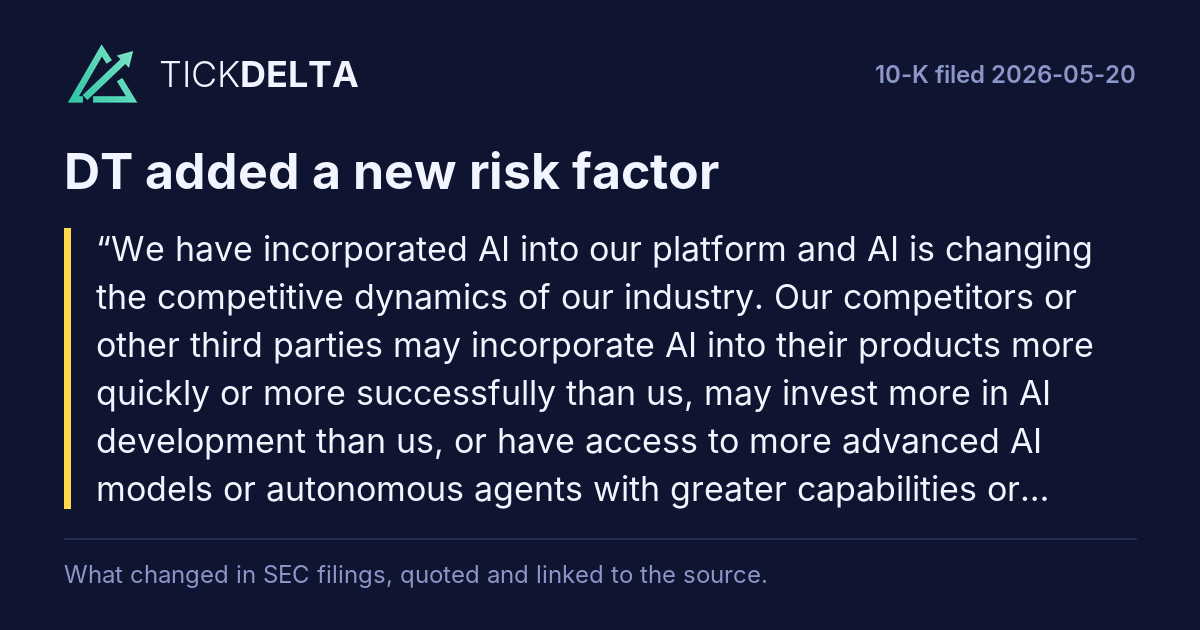
We have incorporated AI into our platform and AI is changing the competitive dynamics of our industry. Our competitors or other third parties may incorporate AI into their products more quickly or more successfully than us, may invest more in AI development than us, or have access to more advanced AI models or autonomous agents with greater capabilities or broader functionality, which could reduce demand for our platform and adversely affect our results of operations. We may also face greater competition from non-specialist solutions relying on generic LLMs, generative AI, and general-purpose agents to address a broad range of business needs. As part of our sales efforts, we must demonstrate to existing and prospective customers that our offerings are preferable to other solutions available to their organizations, including generic LLMs, software created using natural language prompts and generative AI (referred to as vibe coding) and other emerging technologies. If we are unable to continue developing and integrating advanced AI functionality into the Dynatrace platform in a way that meets customer expectations or competitive benchmarking, our market position and growth prospects could be adversely affected. For a description of additional risks related to AI, please see the risk below entitled, “Our use of new and evolving technologies, including AI in our offerings and business, may present risks and challenges that can impact our business, including by posing cybersecurity, operational, and other risks to our confidential and/or proprietary information, including personal information, and as a result we may be exposed to reputational harm and liability” along with AI-related references in other risks discussed in this section.
•greater brand recognition, longer operating histories, and greater familiarity with some of our target customers;
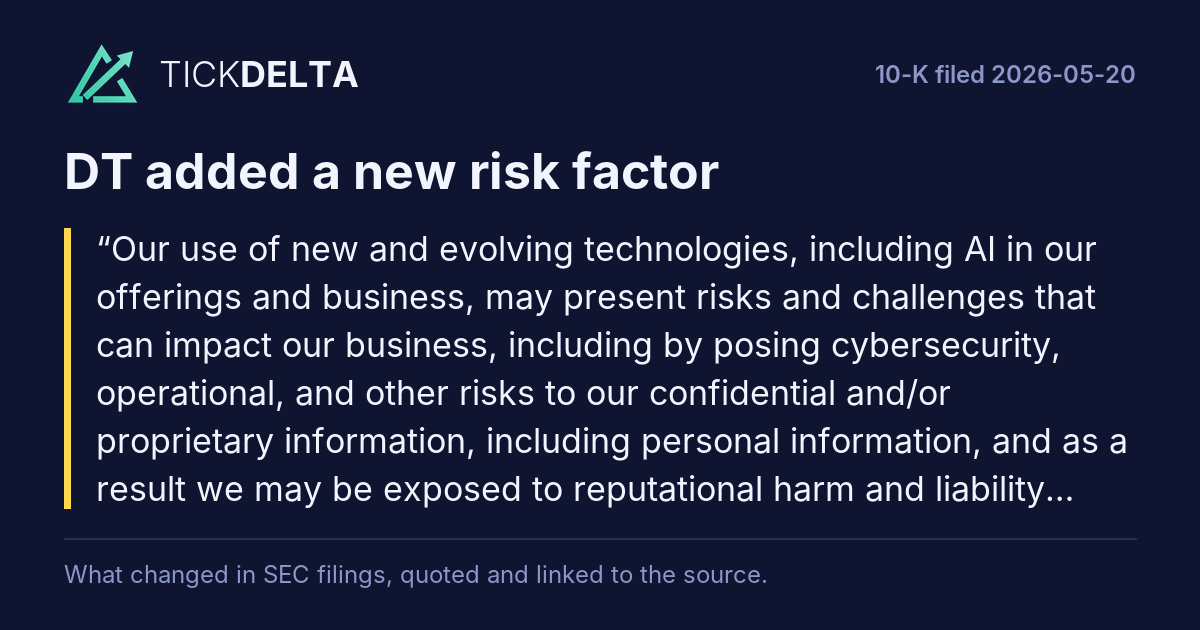
Our use of new and evolving technologies, including AI in our offerings and business, may present risks and challenges that can impact our business, including by posing cybersecurity, operational, and other risks to our confidential and/or proprietary information, including personal information, and as a result we may be exposed to reputational harm and liability.
Our company has significant experience with the use and integration of AI and we have incorporated it within our offerings for several years. We use AI technologies as a core component of the products and services we offer to customers, and for internal purposes to support our operations and performance. The operations of third parties upon which we rely also use AI. AI is rapidly evolving and developing, and our use of AI involves a broad range of risks and challenges that could negatively impact our business, including cybersecurity, data privacy, IT, IP, regulatory, legal, operational, competitive, and reputational. While we continue to invest in AI solutions and we believe that AI-related capabilities will be increasingly important to the value that the Dynatrace platform provides to our customers and to the efficiency of our operations, there can be no assurance that we will realize the desired or anticipated benefits from our AI investments.
AI technologies and solutions, including agentic and generative AI tools, may have bias, produce inaccurate, misleading, harmful, or incomplete data, content, analyses, and recommendations, or other discriminatory, hallucinatory, or unexpected results, inferences, or behaviors. As we integrate more agentic AI workflows into our platform, the actions that are taken or suggested by AI-powered agents performing without human oversight could be incorrect or unintended, resulting in negative impacts for both our company and our customers. If our use of AI were to draw controversy, it could harm our reputation and could give rise to legal or regulatory action.
While we focus on using AI in a responsible, ethical, and legal manner, our use of AI and the impact of laws, regulations, and ethical considerations for AI generally, and as they apply to our customers, are evolving rapidly and becoming increasingly complex. We expect to see increasing government and supranational regulation related to AI use and ethics, which may also significantly increase the burden and cost of research, development and compliance in this area. A growing number of legislators and regulators are adopting laws and regulations and have focused enforcement efforts on the adoption of AI and use of such technologies in compliance with ethical standards and societal expectations. These developments may increase our compliance burden and costs in connection with use of AI and lead to legal liability if we fail to meet evolving legal standards or if use of such technologies results in harms or other causes of action we did not predict. For example, the European Union (“EU”) adopted the Artificial Intelligence Act (the “AI Act”) on August 1, 2024, with significant components of the AI Act continuing to come into effect in the near future. As currently enacted, the AI Act, which may be amended as part of the EU’s Digital Omnibus, imposes significant obligations on providers and deployers of high-risk AI systems, and encourages providers and deployers of AI systems to account for EU ethical principles in their development and use of these systems. The scope of requirements depends on judicial interpretations and forthcoming legislative amendments, and non-compliance can lead to significant fines.
In the United States, new AI-related laws and rulemakings are underway or being proposed at the federal, state, and local levels. Over the past year, states have advanced, and in some cases passed, dozens of laws focusing on AI governance and regulation, including on deployment of AI in healthcare settings. At the federal level, the Trump Administration has endorsed a federal moratorium on the enforcement of state AI laws, including through a December 11, 2025 executive order on “Ensuring a National Policy Framework for Artificial Intelligence.” So far, these efforts have not been successful at curtailing state action on AI regulation, contributing to a complicated legislative patchwork, which may be litigated in state and federal courts. Current or future laws, regulations, and ethical considerations related to the use of AI technology may impact our ability to provide insights from data and use certain data to develop our offerings.
The rapid evolution of AI will require the application of significant resources to design, develop, test and maintain our products and services to help ensure that AI is implemented in accordance with applicable law and regulation and in a socially responsible manner and to minimize any real or perceived unintended harmful impacts.
We rely on third-party vendors for both our customer facing AI capabilities and AI-enabled internal tools. These vendors may not meet existing or rapidly evolving regulatory or industry standards and best practices, including with respect to privacy and data security.
Bad actors around the world use increasingly sophisticated methods, including the use of AI, to engage in fraud, scams, targeted attacks (such as model poisoning or data poisoning), and other illegal activities involving the theft and misuse of data, personal information, confidential information and IP. Our development, use, and deployment of AI may also result in misinformation or an erosion of shared understanding, increased inequality, environmental harms, and other adverse effects. These risks or their effects may also impose burdensome and costly requirements on our ability and our customers’ ability to utilize data in innovative ways.
IP ownership and license rights related to AI technologies have not been fully addressed by U.S. courts or other federal, state or international laws or regulations, and our use of certain AI technology could also give rise to risks of third party claims of infringement, misappropriation, or violation of IP rights.
As AI technology is evolving rapidly, it is not possible to predict all of the operational, technological, and legal risks that may arise related to the use of AI. For a description of additional risks related to AI, please see the AI-related references in other risks discussed in this section.
•Plaintiffs’ attorneys have sent demand letters and initiated claims and class action lawsuits alleging that companies’ uses of online trackers, such as cookies and pixels, constitutes a violation of state wiretapping laws, primarily the California Invasion of Privacy Act. To date, companies have settled most of these claims, though a risk of costly legal proceedings now exists for business practices that are common. We have been subject to some of these actions and may become subject to additional such actions in the future.
▪In the EU and UK, data protection laws are stringent and continue to evolve, resulting in possible significant operational costs for internal compliance and risk to our business. The EU has adopted the EU GDPR, and the UK has incorporated the EU GDPR into its national laws (“UK GDPR”, together with EU GDPR referred to as GDPR) which imposes strict obligations on the processing of personal data. These requirements encompass: (i) providing information to individuals regarding data processing activities; (ii) ensuring a legal basis or condition applies to the processing of personal data and, where applicable, obtaining consent from individuals to whom the data processing
•We are subject to various data transfer rules related to our ability to transfer data from one country to another. For example, regulators and legislators in the U.S. are increasingly scrutinizing and restricting certain personal data transfers and transactions involving foreign countries. For example, the U.S. Department of Justice’s January 8, 2025 rule on “Preventing Access to U.S. Sensitive Personal Data and Government-Related Data by Countries of Concern or Covered Persons” prohibits data brokerage transactions involving certain sensitive personal data categories, including health data, genetic data, and biospecimens, to countries of concern, including China. The regulations also restrict certain investment agreements, employment agreements and vendor agreements involving such data and countries of concern, absent specified cybersecurity controls. Actual or alleged violations of these regulations may be punishable by criminal and/or civil sanctions and may result in exclusion from participation in federal and state programs. These restrictions limit our ability to transfer certain data or require us to guarantee a certain level of protection when transferring data from one country to another.
As a global company, our business is increasingly exposed to risks arising from adverse changes in U.S. and international economic conditions and geopolitical instability. Uncertainty in the macroeconomic environment has resulted, and may continue to result, in volatility in credit, equity and foreign currency markets and fluctuating business confidence. Factors that could negatively affect the global economy include inflationary pressures and higher interest rates, volatile capital markets, financial and credit market disruptions, trade disputes and tariffs, political instability, natural disasters, epidemics, warfare (including the ongoing conflicts in Ukraine and the Middle East), terrorist activity, and other geopolitical events.
Economic uncertainty or instability in the U.S. or abroad could lead to a slowdown or recession, or the perception that such conditions may occur, and could result in reduced spending on technology. During periods of economic or political uncertainty, our current and prospective customers may reduce or defer operating or IT expenditures, delay or cancel technology initiatives, or seek to lower costs through contract renegotiations or reduced renewal commitments.. As a result, we may experience longer sales cycles, reduced deal sizes, lower pricing, decreased subscription renewals, and lower revenue, which could adversely affect our business, operating results, and financial condition.
Macroeconomic volatility may also affect our business indirectly through disruptions to financial markets and government operations. For example, any future U.S. federal government shutdowns, prolonged continuing resolutions, disputes over the federal debt ceiling, a U.S. sovereign default, or changes in governmental laws, regulations or policies (including the imposition of additional tariffs or taxes on U.S.-based service providers) could increase uncertainty and volatility in global markets and adversely affect customer spending decisions, capital availability, and foreign exchange rates.
We continue to invest in and operate across international markets, which exposes us to additional risks. Deterioration of economic or geopolitical conditions in regions where we conduct business, particularly Europe, where we maintain a significant portion of our research and development operations, could lead to delays or cancellations of customer orders, operational disruptions, or reduced growth opportunities. Increased geopolitical tensions, trade policy uncertainty, or the expansion or persistence of armed conflict could also heighten cybersecurity risks, disrupt our customers’ or partners’ operations, impair collections of accounts receivable, or delay payments from resellers and other partners.
Although we do not have material operations in Ukraine or the Middle East, instability in those or other regions may limit our ability to sell or export our platform in affected markets and contribute to broader economic or geopolitical instability. We cannot predict the timing, severity or duration of adverse economic conditions, geopolitical developments, or any subsequent recovery. If economic conditions worsen, recovery is delayed or uneven, or geopolitical instability intensifies, our business, operating results and financial condition could be materially adversely affected.
The “One Big Beautiful Bill Act” (the “OBBBA”), enacted in 2025, contains a broad range of tax reform provisions including immediate expensing of domestic research and development expenditures, the reinstatement of 100% bonus depreciation, and modifications to the international tax framework. The OBBBA has multiple effective dates, with certain provisions effective in fiscal 2026 and other provisions effective in subsequent years. The OBBBA did not have a material impact on our company in fiscal 2026. We do not anticipate the provisions effective in future years will have a material impact. We will continue to monitor ongoing developments and guidance and evaluate any potential impact on future periods.
Many countries have enacted or are in the process of enacting laws based on the Pillar Two proposal relating to a 15% global minimum tax issued by the Organization for Economic Cooperation and Development (“OECD”). These provisions did not have a material impact on our company in fiscal 2026. On January 5, 2026, the OECD released administrative guidance on a “side-by-side” system that would exempt U.S. parented multinational businesses from certain provisions of Pillar Two, effective for fiscal years beginning on or after January 1, 2026. We will continue to monitor ongoing developments and guidance and evaluate any potential impact on future periods.
We are and may continue to be subject to shareholder activism, proxy contests, and pressure for strategic alternatives that could disrupt our business and divert management resources.
We are and may continue to be subject to shareholder activism seeking to influence our strategic direction, board composition, capital allocation, or operations. Responding to shareholder activism, including proxy contests, public campaigns, or other actions, could divert significant time and attention of our board of directors and management team from executing our business strategy, generate substantial legal, advisory, and public relations costs, create uncertainty among our employees, vendors and partners, result in the departure of key executives or board members, force strategic decisions that prioritize short-term shareholder returns over long-term value creation, lead to unexpected changes in our business strategy, capital structure, or leadership, limit our ability to pursue acquisitions, investments, or other strategic initiatives, and result in significant stock price volatility. Furthermore, the perception that we are vulnerable to activist campaigns or a potential acquisition could make it more difficult to attract and retain key employees or
board members, negotiate favorable terms with vendors and partners, or execute long-term strategic initiatives. Even if we are successful in responding to or defending against activist proposals or an activist campaign, the distraction and costs associated with these activities could materially adversely affect our business and financial performance.
Climate change risks, regulatory compliance, and evolving stakeholder expectations may have a long-term negative impact on our business.
New in the latest 10-Q
41 paragraphs in the 10-Q filed Nov 3, 2026 with nothing like them in the 10-Q filed Aug 5, 2026 (at least half the words must differ; new numbers alone do not count). Quoted exactly, grouped by the item heading above them. This is text that changed, not a judgement of how serious it is.
The fair value of the exchangeable notes is determined based on quoted prices in inactive markets, which is considered a Level 2 valuation input. See Note 8, Long-term Debt, for further details.
Read in the 10-Q
In August 2026, Dynatrace LLC, an indirect wholly owned subsidiary of the Company, issued $ 1,437.5 million aggregate principal amount of Exchangeable Senior Notes (the “2031 Notes”). The 2031 Notes mature on September 1, 2031, unless earlier exchanged, redeemed, or repurchased. The 2031 Notes do not bear regular interest and the principal amount of the 2031 Notes does not accrete. The 2031 Notes were issued pursuant to an indenture dated as of August 20, 2026 (the “Indenture”), among Dynatrace LLC, the Company, and U.S. Bank Trust Company, National Association, as trustee. The 2031 Notes are senior, unsecured obligations of Dynatrace LLC and are fully and unconditionally guaranteed on an unsecured and unsubordinated basis by the Company.
Read in the 10-Q
The Company accounts for the 2031 Notes as a liability at amortized cost, as no embedded features require bifurcation or other separate accounting. Costs of $ 26.9 million incurred in connection with the issuance of the 2031 Notes are reported net with the liability and are amortized using the effective interest rate method over the term of the 2031 Notes.
Read in the 10-Q
The 2031 Notes are exchangeable at an initial exchange rate of 15.5585 shares of the Company’s common stock per $1,000 principal amount of 2031 Notes, which is equivalent to an initial exchange price of $ 64.27 per share and represents approximately 22.4 million shares of the Company’s common stock. The initial exchange price represented an exchange premium of approximately 35 % above the last reported sale price of $ 47.61 per share of the common stock on The New York Stock Exchange on August 17, 2026. The exchange rate of the 2031 Notes is subject to adjustment as provided in the Indenture.
Read in the 10-Q
Prior to the close of business on the business day immediately preceding June 1, 2031, holders may exchange all or any portion of the 2031 Notes only upon the occurrence of one or more of the following circumstances:
Read in the 10-Q
• during any calendar quarter commencing after the calendar quarter ending on December 31, 2026 (and only during such fiscal quarter), if the last reported sale price of the Company’s common stock for at least 20 trading days (whether or not consecutive) during a period of 30 consecutive trading days ended on, and including, the last trading day of the immediately preceding calendar quarter is greater than or equal to 150 % of the exchange price on each applicable trading day;
Read in the 10-Q
• during the five business day period after any 10 consecutive trading day period in which the trading price per $1,000 principal amount of 2031 Notes for each trading day of the measurement period was less than 98 % of the product of the last reported sale price of the Company’s common stock and the exchange rate on each such trading day;
Read in the 10-Q
• if Dynatrace LLC calls any 2031 Notes for redemption, at any time prior to the close of business on the second scheduled trading day immediately preceding the redemption date, but only with respect to the 2031 Notes called (or deemed called, in the case of an optional redemption) for redemption; or
Read in the 10-Q
• upon the occurrence of specified corporate events, as set forth in the Indenture.
Read in the 10-Q
On or after June 1, 2031 until the close of business on the second scheduled trading day immediately preceding the maturity date, holders may exchange all or any portion of their 2031 Notes at any time regardless of the foregoing circumstances. Upon exchange of the 2031 Notes, Dynatrace LLC will pay or deliver, as the case may be, cash, shares of the Company’s common stock or a combination of both, at Dynatrace LLC’s election.
Read in the 10-Q
Dynatrace LLC may not redeem the 2031 Notes prior to September 6, 2029, except in the event of a Cleanup Redemption (as defined below). On or after September 6, 2029 and prior to the 21st scheduled trading day immediately preceding the maturity date, Dynatrace LLC may redeem for cash all or any portion of the 2031 Notes (subject to a partial redemption limitation set forth in the Indenture), at its option, if the last reported sale price of the Company’s common stock has been at least 130 % of the exchange price then in effect for at least 20 trading days (whether or not consecutive) during any 30 consecutive trading day period (including the last trading day of such period) ending on, and including, the trading day immediately preceding the date on which Dynatrace LLC provides notice of redemption (an “Optional Redemption”). In addition, subject to certain conditions, Dynatrace LLC may redeem for cash all, but not less than all, of the 2031 Notes at any time prior to the 21st scheduled trading day immediately preceding the maturity date if the aggregate principal amount of the 2031 Notes that remains outstanding at such time is less than $ 100 million (a “Cleanup Redemption”). The redemption price for any 2031 Notes called for Optional Redemption or Cleanup Redemption will be equal to 100 % of the principal amount of the 2031 Notes to be redeemed, plus accrued and unpaid special interest, if any, to, but excluding, the related redemption date. No sinking fund is provided for the 2031 Notes.
Read in the 10-Q
Subject to certain conditions, holders of the 2031 Notes will have the right to require Dynatrace LLC to repurchase all or a portion of their Notes upon the occurrence of a fundamental change (as defined in the Indenture) at a repurchase price of 100 % of their principal amount plus any accrued and unpaid special interest, if any. In connection with certain corporate events or if Dynatrace LLC calls any 2031 Notes for redemption, Dynatrace LLC will, under certain circumstances, increase the exchange rate for holders who elect to exchange their 2031 Notes in connection with any such corporate event or exchange their 2031 Notes called for redemption.
Read in the 10-Q
The following table presents the net carrying value and fair value of the 2031 Notes as of September 30, 2026 (in thousands):
Read in the 10-Q
(1) The fair value was determined based on the closing quoted price of the 2031 Notes on the last trading day of the period and is classified as Level 2 in the fair value hierarchy, because the 2031 Notes are not actively traded in the market.
Read in the 10-Q
In connection with the 2031 Notes, Dynatrace LLC and the Company entered into exchangeable note hedge transactions (the “2031 Exchangeable Note Hedges”) for an aggregate premium of $ 412.6 million. The 2031 Exchangeable Note Hedges are expected to reduce the potential dilution to the Company’s common stock if the 2031 Exchangeable Notes are exchanged and/or offset any cash payments the Company may be required to make in excess of the principal amount.
Read in the 10-Q
The 2031 Exchangeable Note Hedges cover approximately 22.4 million shares of the Company’s common stock at an initial strike price of $ 64.27 per share, subject to anti-dilution adjustments substantially similar to those applicable to the 2031 Notes. The 2031 Exchangeable Note Hedges will expire upon the maturity of the 2031 Notes, if not earlier exercised or terminated.
Read in the 10-Q
Separately from the 2031 Exchangeable Note Hedges and in connection with the 2031 Notes, the Company entered into warrant transactions (the “2031 Warrants”) to acquire up to 22.4 million shares of the Company’s common stock at an initial strike price of $ 107.12 per share, subject to certain adjustments under the terms of the 2031 Warrants. The Company received proceeds of $ 244.8 million from the issuance of the 2031 Warrants. The 2031 Exchangeable Note Hedges and 2031 Warrants will generally have the effect of increasing the exchange price of the 2031 Notes to the 2031 Warrants strike price of $ 107.12 per share.
Read in the 10-Q
The Company determined that the 2031 Exchangeable Note Hedges and 2031 Warrants meet the criteria for equity classification, because they are indexed to the Company's common stock and the Company has the option to settle both in shares of common stock or in cash. The 2031 Exchangeable Note Hedges and 2031 Warrants are not remeasured as long as they continue to meet the criteria for equity classification. The Company recognized the purchase of the 2031 Exchangeable Note Hedges as a decrease in additional paid-in capital and the 2031 Warrants as an increase in additional paid-in capital.
Read in the 10-Q
The Company structured the 2031 Exchangeable Note Hedges as tax integrated for federal income tax purposes pursuant to applicable U.S. Treasury Regulations. Accordingly, the $ 412.6 million cost of the 2031 Exchangeable Note Hedges will be deductible for income tax purposes over the life of the hedges. As a result, the Company established a deferred income tax asset of $ 94.3 million at inception, with a corresponding offset in additional paid-in capital.
Read in the 10-Q
The 2026 Credit Facility is scheduled to mature on June 24, 2031 with the option for two one-year extensions. However, if an aggregate principal amount greater than $ 300.0 million on the 2031 Notes remains outstanding on June 2, 2031, the 2026 Credit Facility will instead mature on such date.
Read in the 10-Q
On October 1, 2026, the Company acquired all of the outstanding equity of Arize, an AI observability and evaluation platform delivering continual learning for agents. This acquisition will enable the Company’s customers to evaluate, operate, and continuously improve AI applications from development through production at scale.
Read in the 10-Q
The Company acquired Arize for consideration of $ 815.9 million of cash paid at closing and an aggregate 1.8 million shares of restricted common stock and RSUs, valued at $ 98.2 million as of the execution date. The shares of restricted stock are subject to release in the future and the RSUs will vest based on future service periods. These shares of restricted stock and RSUs will be recognized as share-based compensation over their respective future service periods. At closing, the Company also issued $ 26.0 million of additional RSUs to Arize employees which will vest based on future service periods.
Read in the 10-Q
The Company is in the process of allocating the purchase consideration over the fair value of identifiable assets and liabilities assumed. The financial results of Arize will be included in the Company’s condensed consolidated financial statements from the date of acquisition.
Read in the 10-Q
On October 1, 2026, we acquired Arize for consideration of $815.9 million of cash paid at closing and an aggregate 1.8 million shares of restricted stock and RSUs, valued at $98.2 million. The shares of restricted stock are subject to release in the future and the RSUs will vest based on future service periods. For additional information, please see Note 15, Subsequent Events, of the condensed consolidated financial statements included in this Quarterly Report.
Read in the 10-Q
In August 2026, we issued $1,437.5 million aggregate principal amount of Exchangeable Senior Notes (the “2031 Notes”). The 2031 Notes are senior unsecured obligations that bear no interest and mature on September 1, 2031, unless earlier exchanged, redeemed, or repurchased.
Read in the 10-Q
We received net proceeds of $1,411.5 million from the issuance of the 2031 Notes after deducting the initial purchasers’ discounts and commissions and other debt issuance costs. We used $167.8 million of the net proceeds to pay the cost of exchangeable note hedges (the “2031 Exchangeable Note Hedges”), offset by proceeds from the issuance of warrants (the “2031 Warrants”). In addition, we used $134.7 million of the net proceeds to repurchase approximately 2.8 million shares of our common stock from certain purchasers of the 2031 Notes in privately negotiated transactions.
Read in the 10-Q
Upon exchange of the 2031 Notes, we may satisfy our obligation in either cash, shares of our common stock, or a combination of both, at our election. As of September 30, 2026, $1,437.5 million aggregate principal amount of the 2031 Notes were outstanding, which could adversely affect our liquidity if settled in cash. For additional information, please see Note 8, Long-term Debt, of the condensed consolidated financial statements included in this Quarterly Report.
Read in the 10-Q
As of September 30, 2026, the 2031 Notes had an aggregate principal amount outstanding of $1,437.5 million. The 2031 Notes do not bear regular interest and the principal amount of the 2031 Notes does not accrete. Accordingly, we do not have economic interest rate exposure on the 2031 Notes. However, the fair value of the 2031 Notes fluctuates when interest rates or market prices of our common stock change. We record the 2031 Notes at amortized cost on the condensed consolidated balance sheets and present the fair value for disclosure purposes only.
Read in the 10-Q
We may not have the ability to raise the funds necessary to settle exchanges of the 2031 Notes in cash, to repay the 2031 Notes at maturity or to repurchase the 2031 Notes upon a fundamental change, and our future debt may contain limitations on our ability to pay cash upon exchange or repurchase of the 2031 Notes.
Read in the 10-Q
In August 2026, Dynatrace LLC, our indirect wholly owned subsidiary, issued $1,437.5 million aggregate principal amount of 2031 Notes, which are exchangeable senior notes due September 1, 2031. The 2031 Notes are Dynatrace LLC’s senior unsecured obligations and are fully and unconditionally guaranteed by Dynatrace, Inc. on an unsecured and unsubordinated basis. Holders of the 2031 Notes have the right, subject to certain conditions and limited exceptions, to require Dynatrace LLC to repurchase all or a portion of their 2031 Notes upon the occurrence of a fundamental change at a fundamental change repurchase price equal to 100% of the principal amount of the 2031 Notes to be repurchased, plus accrued and unpaid special interest, if any, to, but excluding the fundamental change repurchase date. Upon maturity of the 2031 Notes, Dynatrace LLC must pay the principal amount of the notes plus accrued and unpaid special interest, if any, in cash, unless the 2031 Notes have been previously repurchased, redeemed or exchanged. In addition, upon exchange of the 2031 Notes (which is discussed in more detail below), unless Dynatrace LLC solely elects to deliver, or causes to be delivered, shares of common stock to settle exchanges, Dynatrace LLC will be required to make cash payments in respect of such exchanges.
Read in the 10-Q
Dynatrace LLC or our company may not have enough available cash or be able to obtain financing upon maturity of the 2031 Notes or at the time that Dynatrace LLC is required to make repurchases of 2031 Notes surrendered therefor, the 2031 Notes are exchanged, or our company is required to pay such amounts due under the guarantee. Dynatrace LLC’s failure to repurchase 2031 Notes at a time when the repurchase is required by the related indenture or to pay any cash payable on future exchanges of the 2031 Notes or at maturity of the 2031 Notes as required by the indenture would constitute a default under the indenture. A default under the indenture governing the 2031 Notes or the fundamental change itself could also lead to a default under agreements governing our future indebtedness. If the repayment of the related indebtedness were to be accelerated after any applicable notice or grace periods, Dynatrace LLC may not have sufficient funds to repay the indebtedness and repurchase the 2031 Notes and/or make cash payments upon exchanges thereof.
Read in the 10-Q
The conditional exchange feature of the 2031 Notes, if triggered, may adversely affect our liquidity and financial condition.
Read in the 10-Q
Prior to the close of business on the business day immediately preceding June 1, 2031, the 2031 Notes are exchangeable at the option of the holders only upon the satisfaction of specified conditions and during certain periods described in the indenture related to the 2031 Notes. On or after June 1, 2031, until the close of business on the second scheduled trading day immediately preceding the maturity date, the 2031 Notes will be exchangeable at the option of the holders at any time regardless of these conditions or periods. The 2031 Notes are exchangeable at an initial exchange rate of 15.5585 shares of common stock per $1,000 principal amount of 2031 Notes, which is equivalent to an initial exchange price of approximately $64.27 per share of our common stock, subject to adjustment. Upon exchange of the 2031 Notes, Dynatrace LLC will pay or deliver, as the case may be, cash, shares of our common stock or a combination of cash and shares of our common stock, at Dynatrace LLC’s election.
Read in the 10-Q
In the event the conditional exchange feature of the 2031 Notes is triggered, holders of the 2031 Notes will be entitled to exchange their notes at any time during specified periods at their option. If one or more holders elect to exchange their 2031 Notes, unless Dynatrace LLC elects to satisfy the exchange obligation solely by delivering shares of our common stock, Dynatrace LLC would be required to settle a portion or all of the exchange obligation through the payment of cash, which could adversely affect our liquidity. In addition, even if holders do not elect to exchange their 2031 Notes, we would be required under applicable accounting rules to reclassify all or a portion of the outstanding principal of the 2031 Notes as a current rather than long-term liability, which would result in a material reduction of our net working capital.
Read in the 10-Q
The 2031 Exchangeable Note Hedges and 2031 Warrants may affect the value of the 2031 Notes and the common stock.
Read in the 10-Q
In connection with the issuance of the 2031 Notes, Dynatrace LLC entered into the 2031 Exchangeable Note Hedges with certain of the initial purchasers or affiliates thereof and certain other financial institutions (the “option counterparties”). Dynatrace, Inc. also entered into the 2031 Warrants with the option counterparties. The 2031 Exchangeable Note Hedges are expected generally to reduce the potential dilution to our common stock upon any exchange of 2031 Notes and/or offset any cash payments that Dynatrace LLC is required to make in excess of the principal amount of exchanged notes, as the case may be. However, the 2031 Warrants could separately have a dilutive effect on our common stock to the extent that the market price per share of common stock exceeds the strike price of the 2031 Warrants.
Read in the 10-Q
In addition, the option counterparties or their respective affiliates may modify their hedge positions by entering into or unwinding various derivatives with respect to the common stock and/or purchasing or selling shares of our common stock or other securities of Dynatrace LLC or Dynatrace, Inc. in secondary market transactions prior to the maturity of the 2031 Notes and are likely to do so (i) in connection with any exchanges of 2031 Notes, any redemption of 2031 Notes or any repurchase of 2031 Notes upon a fundamental change; (ii) following any other repurchase of the 2031 Notes to the extent Dynatrace LLC and Dynatrace, Inc. unwind all or a portion of the 2031 Exchangeable Note Hedges and 2031 Warrants; and (iii) if Dynatrace LLC and Dynatrace, Inc. otherwise unwind all or a portion of the 2031 Exchangeable Note Hedges and 2031 Warrants. This activity could also cause or avoid an increase or a decrease in the market price of our common stock or the 2031 Notes. The potential effect, if any, of these transactions and activities on the market price of our common stock or the 2031 Notes will depend in part on market conditions and cannot be ascertained at this time. Any of these activities could adversely affect the value of our common stock.
Read in the 10-Q
We are subject to counterparty risk with respect to the 2031 Exchangeable Note Hedges.
Read in the 10-Q
The option counterparties are financial institutions or affiliates of financial institutions, and we are subject to the risk that one or more of such option counterparties may default under the 2031 Exchangeable Note Hedges. Our exposure to the credit risk of the option counterparties will not be secured by any collateral. If any option counterparty becomes subject to insolvency proceedings, we will become an unsecured creditor in those proceedings with a claim equal to our exposure at that time under the 2031 Exchangeable Note Hedges. Our exposure will depend on many factors but, generally, the increase in our exposure will be correlated to the increase in our common stock market price and in the volatility of the market price of our common stock. In addition, upon a default by an option counterparty, we may suffer adverse tax consequences and dilution with respect to our common stock. We can provide no assurance as to the financial stability or viability of any option counterparty.
Read in the 10-Q
On September 10, 2026, Lisa Campbell, a director of the Company, adopted a Rule 10b5-1 trading arrangement that contemplates the sale of up to 3,000 shares of the Company’s common stock. The duration of the trading arrangement is from December 10, 2026 through September 10, 2027 (or earlier, if all transactions under the trading arrangement are completed).
Read in the 10-Q
On September 11, 2026, Daniel Zugelder, Executive Vice President, Chief Revenue Officer, adopted a Rule 10b5-1 trading arrangement that contemplates the sale of a portion of the net shares received upon the vesting of certain restricted stock units and performance stock units. The duration of the trading arrangement is from December 22, 2026 through December 22, 2027 (or earlier, if all transactions under the trading arrangement are completed).
Read in the 10-Q
Item 1A of the 10-Q filed Nov 3, 2026 against Item 1A of the 10-K filed May 20, 2026.
A 10-Q repeats only the risks that changed, so a 10-K paragraph that is missing from it is not counted as removed.
Added is a paragraph with nothing like it in the 10-K, Reworded a sentence that is in both with several words changed,
Quiet changes a sentence in both where one to four words changed and one is a hedge or a modal
(cut words struck through, new words highlighted).
Text on the page, not a score; each links to the filing at sec.gov.
The first 25 of 39 are shown (at most 12 of each type).
Two-word phrases in Risk Factors of the 10-K filed May 20, 2026 that are in none of the 1 earlier 10-Ks stored, back to May 22, 2025
Used at least twice, small words left out. Counted, not picked: a phrase can be new because the company renamed something.
12 paragraphs of last year's Risk Factors with nothing like them now. The longest are quoted.
Item 1A of each 10-K and 10-Q on EDGAR, quoted exactly. Each paragraph links to the filing at sec.gov.
10-K change: what was reworded or cut, section by section.
Excel workbook · CSV. Google Sheet that stays up to date: paste =IMPORTDATA("https://tickdelta.com/company/DT/export.csv") into a cell.