DVADaVita
Unless otherwise indicated in this report "DaVita", "the Company" "we", "us", "our" and other similar terms refer to DaVita Inc. and its consolidated subsidiaries. 10-K, Item 1
- Headquarters
- Denver, CO
- CEO
- Javier Rodriguez
- Next results
- around Feb 1, 2027
29 paragraphs in Risk Factors of the 10-K filed Feb 11, 2026 with nothing like them in the 10-K filed Feb 13, 2025. Quoted exactly. Paragraphs that were only edited are under 10-K change.
Compared with the Risk Factors in the latest 10-K of the other 59 Health care companies: a paragraph with at least half its words the same at another company is called similar, and the companies are listed under it. A paragraph most of them have is marked boilerplate. No line means no other company has one like it. This counts text; it does not say how serious a risk is.
•global health conditions, changing population or demographic trends, severe weather or natural disasters and general economic and political conditions;
Read in the 10-K ↗
•the number or percentage of patients with higher-paying commercial insurance and our ability to negotiate and maintain contracts with private payors on competitive terms;
•our participation in government healthcare programs, including Medicare, Medicare Advantage, Medicaid and the Department of Veterans Affairs;
•our business is labor intensive and we may experience increases in labor costs, our ability to attract and retain key leadership talent or employees, or union organizing activities;
Read in the 10-K ↗
Risks Related to Competition, Business Strategy Growth, Information Systems and New Technologies
Read in the 10-K ↗
Global health conditions, changing population or demographic trends, severe weather events or natural disasters and general economic and political conditions, all of which are highly uncertain and difficult to predict, could have a material adverse impact on our business.
We continue to be impacted by external conditions, including, but not limited to, those related to general economic, political and global health conditions, changing population or demographic trends and severe weather events or natural disasters. These conditions can impact our business in a variety of ways, including, among other things, by affecting our patient census, treatment volumes and operating and other costs as further set forth below. These conditions are generally outside of our control and none of which we can reasonably predict and are interrelated or have interdependent complex consequences. As a result, the ultimate impact of these conditions on our business over time will depend on a myriad of future developments and is highly uncertain and difficult to predict. These conditions or developments may heighten many of the other risks and uncertainties discussed herein and are particularly heightened for our patients in part because individuals with chronic illness may be more susceptible to the adverse effects of global health conditions and also because any natural or other disaster, political instability or adverse weather event that disrupts or limits the operation of any of our centers or other facilities or services may delay or otherwise impact the critical services we provide to dialysis patients.
Read in the 10-K ↗
Global health conditions may adversely impact our patient census and treatment volumes. For example, severe flu seasons and the ongoing incidence of other infectious diseases such as COVID-19 in recent years have driven elevated mortality in our patient population, which has in turn had a negative impact on treatment volume. The negative perception of vaccinations in the U.S. has exacerbated these risks. To the extent that these and other global health conditions such as any future severe flu seasons, global health crises, pandemics or epidemics drive sustained elevated mortality levels in the overall ESKD or CKD populations, we may experience adverse impacts on our new-to-dialysis admission rates, treatment volumes,
Read in the 10-K ↗
Severe weather events or natural or other disasters such as hurricanes, earthquakes, fires or flooding that damage, destroy or limit access to our facilities or impact our key suppliers or service providers could adversely impact our operations. In the past, such severe weather events or natural disasters impacting us or our suppliers have adversely impacted our patient census and treatment volumes and led to increased costs including, among other things, supply costs. If we experience such events or natural disasters in the future, we may face similar or greater risks, including among other things, potential limitations on our ability to admit new patients or provide dialysis treatments or clinical laboratory services, or potential threats to the safety of our teammates or patients at any of those locations. Such events may also require substantial expenditures and recovery time or could lead us to face other adverse consequences, including, without limitation, the potential loss of data, including protected health information (PHI) or personally identifiable information (PII), or subject us to compliance or regulatory investigations. These impacts, in the aggregate, could materially adversely impact our business, results of operations and financial condition, and could materially harm our reputation.
Read in the 10-K ↗
Political conditions may create additional risk and further intensify the impacts described above, including, among other things, global conflicts, as well as the changing U.S. political conditions that have driven changes in trade, tariff, monetary, healthcare, immigration and other policies by governmental authorities in the United States and across the globe. For example, the current administration in the United States has implemented policies and issued guidance that include: tariff and trade policies that have led to increased volatility in the global trade market; staff reduction policies at key agencies such as the Department of Health and Human Services and the Centers for Medicare & Medicaid Services (CMS) that may among other things, result in delays in Medicare enrollment, coverage verification, licensing and credentialing approval and may limit the availability of administrative and legal support that, among other things, delays claims resolution or similar processes; immigration policies that may adversely impact the labor market and treatment volume to the extent that such policies adversely impact access and availability to healthcare; and health policies and guidance related to the availability, use and adherence of vaccines, treatments and therapies; and other changes that may impact new-to-dialysis admission rates, treatment volumes, future revenues and non-acquired growth, among other things.
Read in the 10-K ↗
Changes to the complex and dynamic regulatory environment in which we operate can alter the regulatory framework of the healthcare marketplace and shape the competitive landscape for our current dialysis and ancillary businesses as well as for comprehensive and integrated kidney care markets. Such changes may require us to shift strategic priorities and initiatives to successfully compete. These changes may take the form of executive orders, presidential memoranda, legislative, regulatory and administrative developments and judicial proceedings, and may therefore be subject to evolving priorities and interpretations over time. As a result, considerable uncertainty exists surrounding the continued development of the healthcare regulatory and legislative environment including access to healthcare and the availability and affordability of commercial insurance over time. As an example, while the ACA and subsequent COVID-era legislation, including the enhanced premium tax credits offered for ACA exchange enrollment, resulted in an increasing number of patients with health insurance, recent
legislative and executive action such as the One Big Beautiful Bill Act (OBBBA) or the decision to let those enhanced premium tax credits expire at the end of 2025 may ultimately decrease the number of patients with access to health insurance, including Medicare and Medicaid. If access to healthcare is significantly altered or if other reforms limiting access to healthcare are enacted in the future, such changes could materially impact our business. Similar uncertainty surrounds government pilot programs and innovative payment models, healthcare reform measures and/or other changes or extensions to laws, regulations and other requirements at the federal and/or state level that govern our business. We have invested significant resources to adapt to any such changes or developments in the healthcare marketplace, and subsequent modifications, terminations or other developments may require additional investment or result in losses. For example, as described below in the risk factor under the heading "We invest in strategic and operational initiatives to maintain our business and expand our capabilities...", we have made substantial investments in and dedicated resources to our integrated care business, value-based care initiatives and home-based dialysis business to address regulatory developments that include innovative payment models, and these investments are subject to risk in the event the regulatory environment changes and we do not or cannot adequately adapt to such changes. More broadly, changes to the overall business and regulatory landscape, including, for example, changes related to the antitrust and competitive environment, also may require us to evaluate and adapt our operations or otherwise impact our business and ability to grow through acquisitions.
Read in the 10-K ↗
12 more
Our negotiations with payors and the related affordability and accessibility of health plan coverage for our patients occurs in a highly competitive, dynamic and complicated environment that is influenced by numerous factors, including, among other things, increasing consolidation amongst commercial payors, new business activities of commercial payors that may overlap or impact with the provider space, legislative or regulatory changes such as recent price transparency regulations, as well as general conditions in the political and economic environment. As a result, we cannot predict the ultimate result of our negotiations with payors or any future changes to patient benefits by group health plans or health insurance issuers in the group
Read in the 10-K ↗
Certain payors have challenged the ability of ESKD patients to utilize assistance from charitable organizations for the payment of premiums, including, through litigation and other legal proceedings. Certain payors have also incorporated policies into their provider manuals limiting or refusing to accept charitable premium assistance from non-profit organizations, such as the American Kidney Fund (AKF). These and other efforts by payors to restrict eligibility and affordability of commercial health plans and dialysis coverage thereunder could impact the number of our patients who are eligible to enroll in, and remain on, commercial insurance plans, including plans offered through healthcare exchanges.
We are subject to risks associated with our participation in government healthcare programs.
We participate in various federal, state and local government healthcare programs, and a substantial portion of our dialysis revenues are generated from patients who have Medicare or MA as their primary payor. As a result, we are subject to risks associated with participation in these programs as further described below. These risks relate to, among other things, changes or shortfalls in program funding and reimbursement rates, changes in legislative or administrative regulations or guidance, and government audits and investigations. Each of these risks are also subject to fluctuations in the political environment such as changing political dynamics, disruptions in federal government operations and federal budget sequestration cuts. In addition, our participation in these government healthcare programs subjects us to risks associated with
routine, regular and special governmental investigations, audits, reviews and assessments and any potential associated adverse consequences as further described in the risk factor under the heading "We are, and may in the future be, a party to various lawsuits, demands, claims, qui tam suits, governmental investigations and audits and other legal matters..."
Read in the 10-K ↗
CMS or its contractors could also implement other new payment provisions, change interpretations of existing regulations, or impose new data reporting requirements that limit our ability to be paid for services or increase our operational costs, and commercial insurers could in turn adopt similar limitations. Additionally, failures in our clinical and operational processes or systems could lead to inaccurate data reporting to CMS or other data integrity issues with respect to the reported information, potentially resulting in overpayment and potential associated liabilities, penalties, and reputational harm.
Read in the 10-K ↗
Primary coverage for a significant number of our patients also comes from state Medicaid programs partially funded by the federal government, and we have patients covered by other non-Medicare government-based programs, such as coverage through TRICARE and the VA. As state governments and other governmental organizations face increasing financial hardship and budgetary pressure, including as a result of changes in the political environment, we may in turn face reductions in payment rates, delays in the receipt of payments, limitations on enrollee eligibility or other changes to the applicable programs.
Read in the 10-K ↗
disruptions; adverse impacts to our financial results due to the costs of bargaining or implementing a grievance procedure and processing grievances; decreases in our operational flexibility and efficiency; or negative impacts on our employee culture.
We have been subject to targeted corporate campaigns by union organizers, which resulted in us expending substantial resources. Such targeted campaigns and associated expenses may continue in the future. We may also continue to face state or local ballot initiatives sponsored or promoted by union organizers, which, if passed, could impose additional requirements or limitations on our operations or profitability.
Read in the 10-K ↗
Risks Related to Competition, Business Strategy Growth, Information Systems and New Technologies
Read in the 10-K ↗
we assume financial accountability for total patient cost in these IKC and VBC arrangements, we are exposed to the risk that the funding and financial terms of these arrangements may not be sufficient to cover our expenses and the costs associated with the covered services that we are required to provide. Changes to these expenses, such as increases in staffing and labor costs or expansions in the scale or scope of covered services, may impact the profitability of these programs.
Read in the 10-K ↗
We expect the dynamic highly competitive environment in which we operate to become increasingly more competitive as the market evolves and new technologies, treatments or therapies continue to be introduced. Operating in this environment requires us to continuously adopt and adapt to developing technologies, treatments and therapies, and our failure to do so, and to do so in a manner that remains in compliance with the evolving state and federal regulatory landscape, could materially adversely affect our business, results of operations, financial condition and cash flows and could materially harm our reputation.
Our business depends significantly on effective information systems. Our information systems require an ongoing commitment of significant resources to maintain, upgrade and enhance existing systems and develop or contract for new systems in order to keep pace with an evolving cyber threat landscape in information processing technology, emerging cybersecurity risks and threats, evolving industry, legal and regulatory standards and requirements, new models of care, and other changes in our business, among other things. For example, in the clinical environment, any failure of our clinical systems or the systems of our third-party service providers could adversely impact the clinical care provided to patients, and any failure to accurately capture relevant claims data or any data integrity issues in our clinical systems with respect information reported
Read in the 10-K ↗
Artificial intelligence is increasingly driving innovations. As a result, an increasing part of implementing, operating and maintaining efficient and effective systems, technologies or processes may require the adoption of new technology and analytics that utilize artificial intelligence technologies. The use of these technologies presents certain distinct risks in part due to the novel and rapidly evolving nature of artificial intelligence and the laws and regulations that govern its use. The failure to incorporate legal requirements related to the use (or misuse) of technology, including artificial intelligence, into our internal standards could subject us to risk of regulatory actions, private party litigation and other potential liability. This dynamic environment increases the complexity of any adoption and implementation of both artificial intelligence technologies, as well as the associated governance, compliance and operational infrastructure required to responsibly and successfully utilize these technologies. As an example of this complexity, implementation and adoption risks include, among other things, potential design defects, defects in the development of algorithms or other technologies, biased data/discrimination, potential security breaches or unauthorized access to or use of PHI, failure to comply with certain state requirements or training of the model on DaVita data, insufficient human oversight or intentional or unintentional misuse, or human user error. While we have made and expect to continue to invest significant resources in the implementation of these new artificial intelligence technologies, this complexity increases execution risk and there can be no assurances that the technology will be successfully implemented in all cases for their intended purposes.
Read in the 10-K ↗
New clinical technologies may also lead to drugs, treatments or other therapies with improved clinical outcomes or are preferred by patients and their physicians, and if we are unable to incorporate these products into our business or otherwise find adequate alternatives on a cost-effective and timely basis it could impact our ability to compete effectively. For example, hemodiafiltration (HDF), a treatment that combines hemodialysis and hemofiltration to improve clearance of middle molecule uremic toxins from the blood, is a developing technology not yet widely adopted in the U.S. The adoption of this technology would require significant capital investment in equipment and infrastructure and is subject to risks associated with its cost, availability and ultimately any associated reimbursement rate. While there remains uncertainty regarding HDF’s ultimate efficacy in the U.S. market given the current absence of large-scale U.S. studies on HDF, if competitors begin to adopt HDF and it proves to be a treatment that results in improved clinical outcomes or is preferred by patients and their physicians, we could be at a competitive disadvantage if we fail to effectively integrate it into our services. International studies have shown that expanded hemodialysis with the use of medium cut-off dialyzers can similarly provide enhanced middle molecule clearance. We have made investments to evaluate these medium cut-off dialyzers for use in the U.S. In the event these medium cut-off dialyzers do not achieve clinical results or if we are unable to secure the necessary supply of medium cut-off dialyzers, we may be required to invest additional time and resources in an alternative middle-sized molecule treatment initiatives. The failure to successfully adapt to these and other technological developments could, among other things, place us at a competitive disadvantage, result in increased costs without adequate reimbursement to offset such costs, and could ultimately have a material adverse effect on our business, results of operations, financial condition and cash flows and could materially harm our reputation.
Read in the 10-K ↗
We have a substantial amount of indebtedness outstanding and we may incur substantial additional indebtedness in the future, which may limit our intended uses of capital or reduce operational flexibility, and may put additional stress on our ability to generate cash.
Read in the 10-K ↗
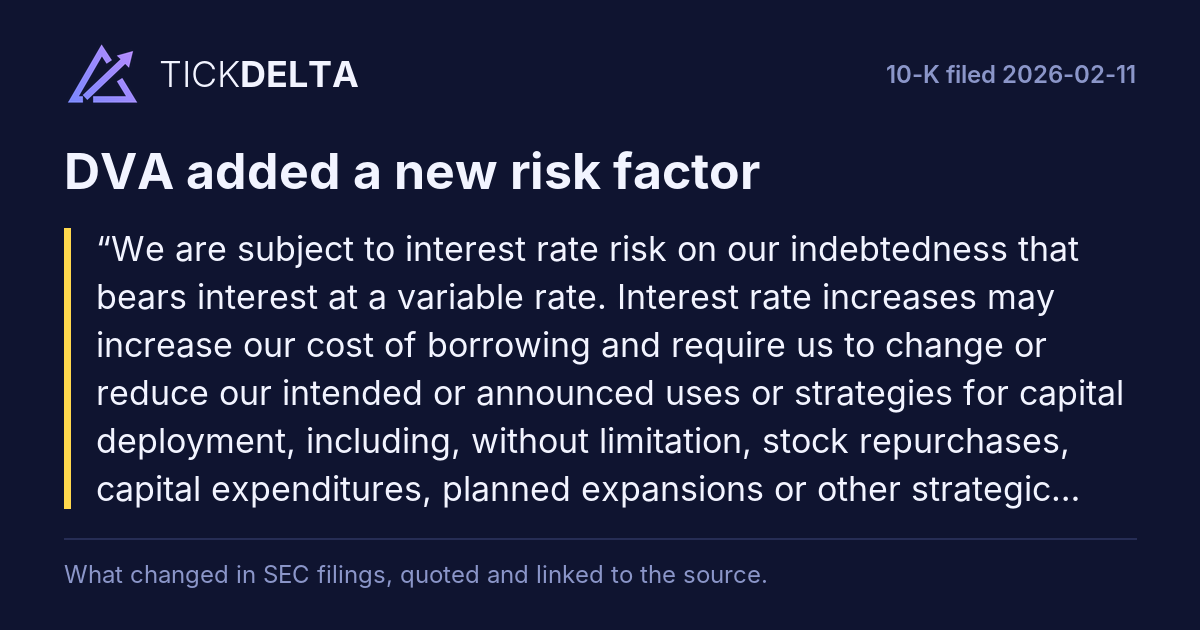
We are subject to interest rate risk on our indebtedness that bears interest at a variable rate. Interest rate increases may increase our cost of borrowing and require us to change or reduce our intended or announced uses or strategies for capital deployment, including, without limitation, stock repurchases, capital expenditures, planned expansions or other strategic initiatives.
Read in the 10-K ↗
New in the latest 10-Q
28 paragraphs in the 10-Q filed Oct 29, 2026 with nothing like them in the 10-Q filed Aug 4, 2026 (at least half the words must differ; new numbers alone do not count). Quoted exactly, grouped by the item heading above them. This is text that changed, not a judgement of how serious it is.
10-Q
Nine months ended September 30, 2026 2025 ───────────────────────────────────────────────────────────────────────────────────────────────────────────────────────────────────────────────────────────────────────────────── Cash flows from operating activities: Net income $ 887,647 $ 747,685 Adjustments to reconcile net income to net cash provided by operating activities: Depreciation and amortization 510,825 528,645 Goodwill and other asset impairment charges 62,176 — Loss on extinguishment of debt — 4,253 Stock-based compensation expense 83,378 101,559 Deferred income taxes 91,207 68,989 Equity investment loss, net 887 91,532 Other non-cash losses, net 14,668 11,522 Changes in operating assets and liabilities, net of effect of acquisitions and divestitures: Accounts receivable (67,585) (144,688) Inventories 1,103 913 Other current assets (50,210) (153,428) Other long-term assets (47,733) (21) Accounts payable (47,803) 97,879 Accrued compensation and benefits (64,671) 19,279 Other current liabilities (50,713) 16,462 Income taxes 453 (30,635) Other long-term liabilities 6,101 (14,172) Net cash provided by operating activities 1,329,730 1,345,774 Cash flows from investing activities: Additions of property and equipment (431,323) (430,434) Acquisitions (41,693) (118,337) Proceeds from asset and business sales 16,297 32,337 Purchase of debt investments held-to-maturity (66,788) (15,842) Purchase of other debt and equity investments (29,832) (3,352) Proceeds from debt investments held-to-maturity 17,020 38,051 Proceeds from sale of other debt and equity investments 4,382 6,706 Purchase of equity method investments (221,839) (2,466) Distributions from equity method investments 329 1,514 Net cash used in investing activities (753,447) (491,823) Cash flows from financing activities: Borrowings 3,511,331 4,672,170 Payments on long-term debt (3,021,008) (3,880,721) Deferred and debt related financing costs (10,602) (26,416) Purchase of treasury stock from related party (419,318) (430,286) Other purchases of treasury stock (450,862) (1,033,887) Distributions to noncontrolling interests (243,786) (232,721) Net proceeds from issuance of common stock under employee stock plans 14,509 17,583 Payment of tax withholdings on net share settlements of equity awards (68,968) (33,764) Contributions from noncontrolling interests 4,636 3,999 Proceeds from sales of additional noncontrolling interests — 169 Purchases of noncontrolling interests (70,593) (16,385) Net cash used in financing activities (754,661) (960,259) Effect of exchange rate changes on cash, cash equivalents and restricted cash (109) 21,897 Net decrease in cash, cash equivalents and restricted cash (178,487) (84,411) Cash, cash equivalents and restricted cash at beginning of the year 757,747 879,825 Cash, cash equivalents and restricted cash at end of the period $ 579,260 $ 795,414
Read in the 10-Q ↗
income Stock award plan 39 — (5,064) (5,064) Stock-settled stock-based 28,327 28,327
Read in the 10-Q ↗
income Stock award plan 34 — (3,288) (3,288) Stock-settled stock-based 38,721 38,721
Read in the 10-Q ↗
The Company maintains equity method and other minor investments in the private securities of certain other healthcare and healthcare-related businesses as follows:
Read in the 10-Q ↗
During the nine months ended September 30, 2026 and 2025, the Company recognized equity investment income of $ 24,765 and $ 23,135, respectively, from its equity method investments in nonconsolidated dialysis partnerships. The Company also recognized equity investment gains (losses) from equity method investments in other businesses of $ 1,345 and $( 95,013 ) in other income (loss), net, during the nine months ended September 30, 2026 and 2025, respectively.
Read in the 10-Q ↗
Substantially all of the Company's operating segments described in Note 13 to the condensed consolidated financial statements represents an individual reporting unit for goodwill impairment assessment purposes.
Read in the 10-Q ↗
The Company performs its annual goodwill impairment assessments at various points throughout the year for its reporting units, including in the third quarter.
Read in the 10-Q ↗
During the three months ended September 30, 2026, the Company recognized goodwill impairment charges of $ 57,104 in its China reporting unit, of which $ 31,597 was allocated to noncontrolling interests. The impairment charge resulted primarily from adverse reimbursement rate changes and corresponding operating developments across non-renal hospital services. The estimated fair value of the China reporting unit was determined using an income approach based on discounted cash flow projections.
Read in the 10-Q ↗
Further changes in patient census, operating margins, reimbursement rates, or other adverse changes in expected future cash flows or valuation assumptions could result in additional goodwill impairment charges in the future for the China reporting unit, which remains at risk of goodwill impairment as of September 30, 2026:
Read in the 10-Q ↗
(1) Excess of estimated fair value of the reporting unit over its carrying amount as of the latest assessment date.
Read in the 10-Q ↗
(2) Potential impact on estimated fair value of an increase in discount rates of 100 basis points as of the latest assessment date.
Read in the 10-Q ↗
(3) Potential impact on estimated fair value of a sustained, long-term reduction of 300 basis points in operating income as of the latest assessment date.
Read in the 10-Q ↗
April 29, 2025, the Court denied the Company’s motion to dismiss. On July 21, 2025, the Company answered the complaint. The Company disputes the allegations in the complaint and intends to defend this action accordingly.
Read in the 10-Q ↗
June 10, 2026, the Court denied the plaintiffs’ motion for class certification. The Company disputes the allegations in the class action complaint, as well as the asserted violations of the Sherman Act, and intends to defend this action accordingly.
Read in the 10-Q ↗
Subsequent to September 30, 2026 through October 27, 2026, the Company repurchased 479 shares of its common stock for $ 86,703 at an average price paid of $ 180.57 per share, inclusive of the shares repurchased from Berkshire Hathaway Inc. as discussed below.
Read in the 10-Q ↗
We have continued to invest in new technologies across our business to help modernize our technology platform and strengthen our capabilities. Over the past few years we have accelerated this investment while maintaining overall general and administrative cost discipline. In future periods, we expect to continue this overall cost discipline while decelerating the growth of the technology portion of that spend.
Read in the 10-Q ↗
On October 20, 2026, the Department of Health and Human Services (HHS) released a 2026 Kidney Care National Plan (Plan) with three principles: (i) promote competition in the kidney marketplace; (ii) address structural impediments to transplantation; and (iii) move further upstream to prevent kidney deterioration. The Plan sets forth policy recommendations to achieve these ambitious policy principles. The Plan references and builds from the Executive Order “Advancing American Kidney Heath” issued in 2019 that directed HHS to undertake initiatives to prevent kidney failure, expand patient choice in dialysis modality and transplant access, and reform the transplant system. We will monitor Plan-related developments and guidance from HHS in order to evaluate the Plan’s potential ultimate impact.
Read in the 10-Q ↗
To the extent the Plan or other government action changes the complex and dynamic regulatory environment in which we operate or otherwise impacts the reimbursement ecosystem, such changes can alter the regulatory framework of the healthcare marketplace and shape the competitive landscape for our current dialysis and ancillary businesses as well as for comprehensive and integrated kidney care markets. Such changes may require us to shift strategic priorities and initiatives to successfully compete. Considerable uncertainty exists surrounding the continued development of the Plan and any potential regulatory or policy changes to the healthcare regulatory and legislative environment, including changes that may impact our operations, healthcare access or the availability and affordability of commercial insurance over time, among other things. For additional detail on risks associated with legal, regulatory or policy changes, see the discussion in Part I Item 1A. "Risk Factors" of our 2025 Form 10-K under the headings "Our business is subject to a complex set of governmental laws, regulations and other requirements...;" "We are subject to risks associated with our participation in government healthcare programs"; and “If we are unable to compete successfully…”
Read in the 10-Q ↗
Nine months ended YTD Q3 2026 vs. YTD Q3 2025 September 30, September 30, Amount Percent
Read in the 10-Q ↗
Nine months ended YTD Q3 2026 vs. YTD Q3 2025 September 30, September 30, Amount Percent
Read in the 10-Q ↗
Nine months ended YTD Q3 2026 vs. YTD Q3 2025 September 30, September 30, Amount Percent
Read in the 10-Q ↗
Charges impacting operating income - Goodwill and other asset impairment charges. During the third quarter of 2026, we recognized goodwill and other asset impairment charges of $62 million related to our business in China. These charges resulted from a reduction in the estimated fair value of the business driven primarily by adverse reimbursement rate changes and corresponding operating developments across non-renal hospital services.
Read in the 10-Q ↗
Nine months ended YTD Q3 2026 vs. YTD Q3 2025 September 30, September 30, Amount Percent
Read in the 10-Q ↗
Nine months ended YTD Q3 2026 vs. YTD Q3 2025 September 30, September 30, Amount Percent
Read in the 10-Q ↗
(1) Represents non-cash goodwill and other asset impairment charges related to our business in China. These charges are excluded from our non-GAAP metrics because they do not occur in or reflect the ordinary course of our ongoing business, are inherently unpredictable and are non-cash amounts, the exclusion of which facilitates comparison of historical, current and forecasted financial results.
Read in the 10-Q ↗
Other information
Name and Title Date Adopted Type of Trading Arrangement(1) Nature of Trading Arrangement Duration of Trading Aggregate Number of Securities
Read in the 10-Q ↗
Arrangement Javier Rodriguez, September 7, 2026 Rule 10b5-1 Sale December 8, 2026 to August 26, Up to 115,810 Chief Executive Officer Trading 2027, or such earlier date upon shares Arrangement which all transactions are completed or expire without execution
Read in the 10-Q ↗
(1) The trading arrangement marked as a “Rule 10b5-1 trading arrangement” is intended to satisfy the affirmative defense of Rule 10b5-1(c) under the Exchange Act.
Read in the 10-Q ↗
The 10-Q's risk factors against the 10-K
Item 1A of the 10-Q filed Oct 29, 2026 against Item 1A of the 10-K filed Feb 11, 2026.
A 10-Q repeats only the risks that changed, so a 10-K paragraph that is missing from it is not counted as removed.
Added is a paragraph with nothing like it in the 10-K, Reworded a sentence that is in both with several words changed,
Quiet changes a sentence in both where one to four words changed and one is a hedge or a modal
(cut words struck through, new words highlighted and underlined).
Text on the page, not a score; each links to the filing at sec.gov.
What the 10-Q itself says about its risk factors:
Read in the 10-Q ↗
There have been no material changes to the risk factors previously disclosed in Part I, Item 1A of our Annual Report on Form 10-K (2025 10-K) for the year ended December 31, 2025 filed with Securities and Exchange Commission. You should carefully consider the risks included in our 2025 10-K, together with all the other information in this Quarterly Report on Form 10-Q, including the forward-looking statements in Part I, Item 2 of this Quarterly Report on Form 10-Q under the heading "Management's Discussion and Analysis of Financial Condition and Results of Operations."
1 paragraph in the 10-Q's Item 1A, and none of them adds, rewords or quietly edits a paragraph of the 10-K's.
Work on DVA in a spreadsheet:
Excel workbook (a sheet per section, ten years by column, charts, links to the filings) ·
CSV.
For a Google Sheet that stays up to date, paste =IMPORTDATA("https://tickdelta.com/company/DVA/export.csv") into a cell.