Form 10-K For the Fiscal Year Ended December 31, 2023
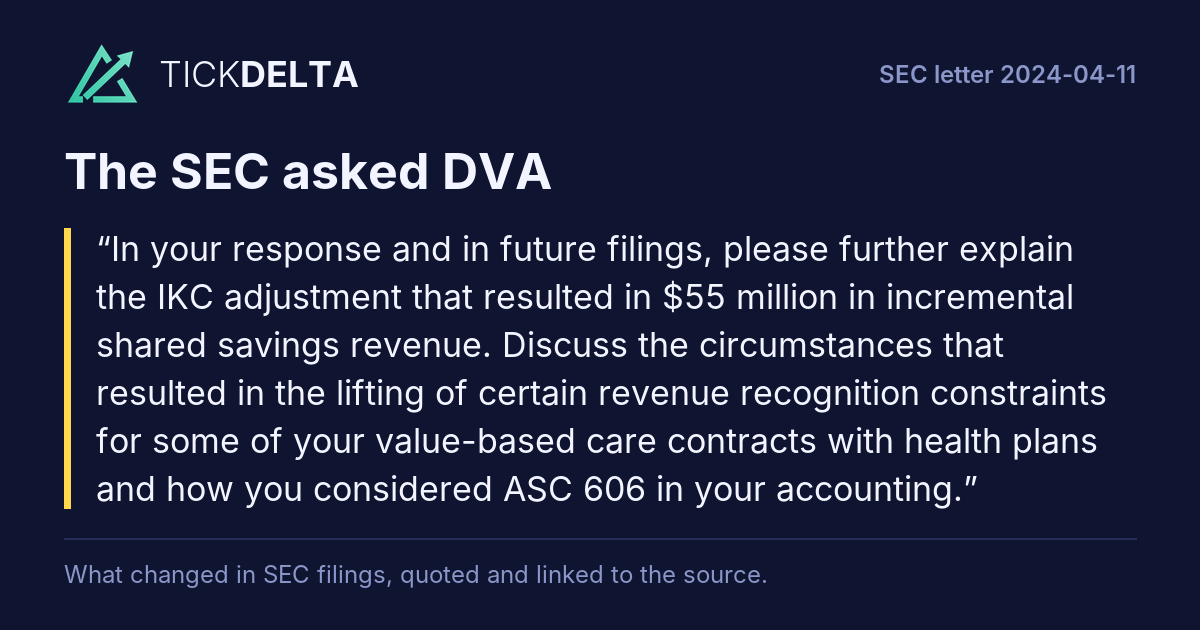
In your response and in future filings, please further explain the IKC adjustment that resulted in $55 million in incremental shared savings revenue. Discuss the circumstances that resulted in the lifting of certain revenue recognition constraints for some of your value-based care contracts with health plans and how you considered ASC 606 in your accounting.
The Company acknowledges the Staff’s comment. Our integrated kidney care (“IKC”) revenue is substantially composed of revenue from three primary sources: (i) special needs plans, (ii) our value-based care (“VBC”) contracts with health plans focused primarily on Medicare Advantage (“MA”) patients, and (iii) the CMS Comprehensive Kidney Care Contracting (“CKCC”) demonstration program for our Medicare fee-for-service patients.Read in the reply ↗Rest of the answer
The following discussion pertains only to the VBC contract portion of our IKC business.
Our revenue recognition policy and accounting for these IKC arrangements are described in Notes 1 and 2 to the consolidated financial statements included in our 2023 10-K.
Introductory summary
The $55 million IKC adjustment referred to in the “Company overview” and “Ancillary services results of operations” sections of the
2023 10-K’s Management Discussion and Analysis (MD&A) relates solely to the VBC contract portion of our IKC business.
This adjustment represents revenue recognized in 2023 for 2023 services at a level incremental to what we would have recognized for 2023 services under prior constraints as information and measurement limitations driving those recognition constraints were incrementally relieved.
Those limitations are summarily described in the last paragraph of our “Other revenues” policy in Note 1 to the consolidated financial statements included in our 2023 10-K, and changes in those limitations and their effect on the constraints during 2023 are described in more detail below.
For 2022 and prior annual reporting periods, the substantial majority of VBC shared savings revenue earned in a period was recognized in a subsequent period. This resulted in recognition of amounts earned in prior periods of $94,361, $34,600 and $11,312 during 2023, 2022 and 2021, respectively, as disclosed in Note 2 to the consolidated financial statements included in our 2023 10-K.
However for 2023 and beyond, given both our increased experience and the changes and refinements we have made with these VBC contracts, we expect that the majority of shared savings revenue earned in a period under these VBC contracts will be recognized in the period earned.
Our fiscal year 2023 therefore represents a transition year, reflecting a general shift in the timing of our revenue recognition for shared savings earned under our VBC contracts with health plans, as it included a majority of shared savings revenues earned for both 2022 and 2023.
Additional background and context follow.
General nature of these VBC arrangements:
Under our VBC contracts, we agree to provide certain care monitoring and care coordination services to a cohort of health plan members, typically dialysis patients with whom we already have a relatively high degree of contact through our dialysis services. The business premise is that if we can provide more proactive, preventative, higher-touch care monitoring and coordination for these patients, we can help reduce their total medical cost of care.
The health plans that cover these patients therefore agree to compensate us by sharing with us a portion of any aggregate reduction, or savings (i.e., “shared savings”) in the total medical cost of care that we are able to help drive for these patients. Similarly, many of our VBC contracts require us to bear full or partial shared losses if aggregate medical costs for these members exceed the applicable shared savings benchmark or target.
Heightened sensitivity to small changes:
These VBC contracts result in our earned IKC revenue being highly sensitive to changes in third party medical costs about which we do not generally have timely or direct visibility, since our entire revenue for these arrangements results from narrow margins on a much larger total cost pool.
For example, assume we have a VBC contract with an MA plan under which we agree to share equally in any reduction from $100 million of more than 5% in the total actual medical cost of care for health plan members attributed to our VBC contract for a plan year. If total cost savings come in at 7%, we would earn $1 million in revenue (i.e., one-half of the total cost savings of $2 million). But if total cost savings come in at exactly 5%, we earn no revenue at all – such that a 2% adverse change in underlying medical cost outcomes would result in a 100% reduction in our IKC shared savings revenue earned under this example contract.
Revenue recognition policy:
As summarized in the section titled “Other revenues” in Note 1 to the consolidated financial statements included in the 2023 10-K, our policy is to recognize revenue for these VBC contracts in the period in which our performance obligation is met, in accordance with ASC Topic 606, subject to the recognition constraint described in ASC 606-10-32-11. That obligation is a single group performance obligation to stand ready to provide services to health plan members aligned to our contract during the performance period.
The performance periods for our VBC contracts are typically one year in length (i.e., a “plan year”), most of them on a calendar year-end, and any of our shared savings consideration under the contract remains variable until outcomes for the performance year are finally determined, which typically takes place through a final reconciliation that is not completed until six to 12 months after the plan year ends.
ASC 606-10-32-11’s revenue recognition constraint provides that:
“An entity shall include in the transaction price some or all of an amount of variable consideration…only to the extent it is probable that a significant reversal in the amount of cumulative revenue recognized will not occur when the uncertainty associated with the variable consideration is subsequently resolved.”
As such, it has been our policy to recognize shared savings revenue under these VBC contracts only at such times, and to the extent of amounts, that we estimate it is probable that we will receive and retain for a particular performance period, whether within the performance period or thereafter as required by the constraint.
Changes in fiscal year 2023:
Prior to 2023, information and other measurement limitations typically constrained recognition of a majority of our shared savings revenue for these VBC contracts with health plans until a period subsequent to the actual performance period.
However, as noted above, as the experience of the Company and its health plan partners with these VBC contracts has grown, we have made (or experienced) a number of changes and refinements in 2023 that management believes have helped to mitigate or alleviate many of these limitations, allowing us to recognize a greater share of expected shared savings revenues for these VBC contracts sooner than we have in the past.
These changes and refinements include:
1. Normalization of medical service utilization post-pandemic – In late 2022 and throughout 2023 as the peak of the Covid-19 pandemic subsided, the dramatic disruption in utilization patterns of medical activity for health plan members has also subsided. This includes health plan members’ activities of daily life, including those that lead to acute medical needs or changes in their rate of medical utilization, the incidence rate of medical events, as well as the timing of medical procedures, all of which improves the predictability of aggregate medical costs for a particular patient population, not to mention the significantly reduced variability in medical costs that previously related to heightened mortality during the pandemic, both from Covid-19 itself and from delays in addressing other medical needs, among other factors.
First report after the company's reply of 2024-05-10: 10-Q filed 2024-08-06 ↗, against the 10-Q filed 2023-11-07 ↗.
Tickdelta does not hold the text of both reports, so they are not compared here.
In future filings, please include a footnote that describes the composition of the non- GAAP adjustments and why you believe they are not indicative of your ordinary results of operations. As a related matter, explain to us in your response why you believe that the non-GAAP adjustment for "closure costs" meets the requirements of Question 100.01 of the C&DI on Non-GAAP Financial Measures.Rest of the question
In this regard, we see that you incurred similar costs in FY22 and that you will continue to optimize your U.S. dialysis center footprint through center mergers and/or closures and expect your center closure levels in the upcoming year to mirror the current year's elevated closure levels.
VBC contracts moving into maturity – Most of our VBC contracts were still in their first or second plan years in 2021 and 2022, and our two largest VBC plans just reached final reconciliation of their first plan year in 2023.
Most interpretive or measurement questions under these complex and custom arrangements are resolved between the parties within the first two plan years. As a result, the Company now has significantly more confidence in its alignment with counterparties on interpretations concerning measurements required under these contracts.Read in the reply ↗Rest of the answer
This, in turn, provides us higher confidence in our own estimates of expected shared savings achieved for the plan year made before completion of final reconciliation.
First report after the company's reply of 2024-05-10: 10-Q filed 2024-08-06 ↗, against the 10-Q filed 2023-11-07 ↗.
Tickdelta does not hold the text of both reports, so they are not compared here.
We note the disclosure here that maintenance and repairs are charged to expense as incurred and a reference on page 65, for example, that routine repairs and maintenance are included within patient care costs. The disclosures on page 70 and 72, however, appear to indicate that certain routine maintenance is accounted for as a capital expenditure.Rest of the question
Please describe for us the specific routine maintenance costs that are accounted for as a capital expenditure and quantify the large expenditures or groups of similar expenditures. In addition, please provide us an analysis of how you determined the accounting for these separate costs or groups of costs is appropriate.
Improved member alignment information – The alignment or attribution of health plan members into our VBC contracts’ accountable cost pools by member month for a plan year can be quite complex and subject to significant time lags, particularly where there are multiple levels of nested attribution mechanics involved.Read in the reply ↗Rest of the answer
Attribution occurs primarily by a combination of insurance and clinical criteria, some of which operate prospectively and others retrospectively.
We have worked with our health plan counterparties to modify elements of our VBC contracts, or to codify protocols or practices related to these contracts, to provide us with earlier clarity on which of their members are aligned to our contracts. This is a fundamental, first-order data element underlying any reliable cost and expected shared savings estimates, which remains sensitive to complex member alignment or patient attribution mechanics.
While we continue to lack patient-level alignment information until six to
12 months after the plan year ends, our understanding of the expected aggregate impact of the alignment process for these contracts has developed as we have gained multiple plan years of experience with individual health plans as well as increased our population of other health plan contracts in the same or similar localities, allowing us to compare and contrast information among contracts to better inform our estimates.
First report after the company's reply of 2024-05-10: 10-Q filed 2024-08-06 ↗, against the 10-Q filed 2023-11-07 ↗.
Tickdelta does not hold the text of both reports, so they are not compared here.
Please identify, describe and quantify for us the specific costs included within developments and relocations, as disclosed on page 70. In addition, please fully describe for us how you determined capital expenditure accounting is appropriate for the separate costs or groups of similar costs. 9. Goodwill , page F-22
Obtaining data validation more frequently – Measures of shared savings under our VBC contracts are also subject to potentially significant adjustment for a number of patient characteristics and clinical quality measures as well as CMS-assigned risk adjustment factor (RAF) scores for each patient.
While we continue to lack key patient-level cost, characteristic and clinical quality information until six to 12 months after the plan year ends, we have modified contracts with our VBC contract counterparties, or established agreed protocols or practices pursuant thereto, to receive more timelyRead in the reply ↗Rest of the answer
and granular data on patient, cost, and other characteristics as well as summarized interim data validation to ensure that both parties are tracking toward similar financial reconciliation outcomes. This has allowed us to refine our estimates of ultimate shared savings outcomes prior to final determination.
First report after the company's reply of 2024-05-10: 10-Q filed 2024-08-06 ↗, against the 10-Q filed 2023-11-07 ↗.
Tickdelta does not hold the text of both reports, so they are not compared here.
You disclose, in part, that "since the dates of the Company’s last annual goodwill impairment assessments, there have been certain developments, events, changes in operating performance and other changes in key circumstances that have affected the Company’s businesses." Please revise your disclosure in future filings to identify the dates of your annual goodwill impairment assessment, whether you performed anRest of the question
interim impairment analysis, and to include specific facts regarding any developments, events, etc. that could impact your impairment analysis. In addition, please update your accounting policy to address your application of ASC 350-20-35-3 through 35-13. In closing, we remind you that the company and its management are responsible for the accuracy and adequacy of their disclosures, notwithstanding any review, comments, action or absence of action by the staff.
Part A of Comment #2
The Company acknowledges the Staff’s comment. To address the first sentence of the Staff’s comment 2, the Company will revise its disclosures in future filings to describe the composition of non-GAAP adjustments and include expanded discussion of the rationale for the Company’s determination that non-GAAP adjustments are not indicative of ordinary results of operations.
The proposed additional disclosure for future filings is set forth below:
Non-GAAP adjustments may include, but are not limited to, certain items such as center closure costs
(net losses on retiredRead in the reply ↗Rest of the answer
assets, lease costs, asset impairments and accelerated depreciation and amortization), goodwill impairments, severance and other restructuring costs, significant legal settlement accruals, debt extinguishment and modification costs, and significant adjustments to recognized shared savings earnings in our IKC business. Management believes that these adjustments are for costs and expenses that are not required to maintain ongoing operations and may impact certain operating income or other trends that management believes would not be indicative of the underlying ordinary results of operations.
Part B of Comment #2
Several external forces in 2021 and 2022 had a significant impact on our business. In particular, our business was uniquely impacted by Covid-19. Our patient population was particularly vulnerable to Covid-19 given their multiple comorbidities and, as a result, the mortality rates of our patients increased
[***]. This excess mortality was noted particularly during each Covid-19 surge and resulted in a compounding impact on treatment volumes that persisted even after each surge subsided. Our treatment volumes grew an average of approximately 3.5% annually over the three years prior to the pandemic, turned flat in 2020 and actually experienced a reduction of nearly 5% from the end of 2020 through the end of 2023. The result was a significant and negative long-term impact on our revenue and capacity needs across our clinic footprint. In addition, we have seen continuing growth in the percentage of our patients who have elected to dialyze at home in recent years, which has further reduced the capacity needs of our domestic in-center dialysis footprint. This growth in the percentage of our patients electing home dialysis further reduced the capacity needs of our domestic clinic footprint. This period of time also saw a rise in other inter-related external forces that put pressure on our cost structure, including, among other things, inflation, rising interest rates, and increasing labor and supply costs.
Recognizing the cumulative impact of these unique events, we completed a special strategic review of our outpatient clinic capacity requirements and utilization in the third quarter of 2022 and began to execute on the recommendations of this review shortly thereafter. However, from the time Covid-19 emerged, we had disclosed that there was a significant amount of uncertainty regarding the severity, duration and ultimate impact of the pandemic on our patient population and business, and this level of uncertainty was particularly acute during the surges throughout 2021 and into 2022. As a result, even as we executed on the 2022 review, the pandemic’s continuing impact on our patient population prompted us to initiate a secondary special review in 2023.
As a result of these special reviews, which included an assessment of potential external forces on our business, the Company implemented a special program that was internally referred to as “Footprint of the Future.” This program was intended to reduce our clinical footprint in the United States through clinic closures that were separate and apart from normal course operations and involved closures at a level and pace significantly higher than historical experience prior to Covid-19. These closures resulted in significant elevated associated costs when compared to prior years. For reference, prior to the impact of the pandemic, in 2018, 2019 and 2020, respectively, the Company sold or closed 11, 32 and 26 clinics in the U.S., and experienced a net increase in the number of centers we operated. By contrast, the Company sold or closed 65,
134, and 72 clinics in the U.S. in 2021, 2022, and 2023, respectively, and experienced a net decrease in the number of centers we operated.
Because we prioritize continuity of care for our patients and maintaining a culture of compliance and integrity with regulatory authorities and our joint venture partners, our process to close these clinics can vary in complexity and may require an extended time to close as we ensure each patient finds an alternative location to receive this life-sustaining care. As a result, the costs of closing these clinics may be realized over the course of several quarters once the decision has been made on which clinics to exit. In certain cases, we may be able to close clinics on an expedited time frame, but those closures generally result in an elevated level of costs as compared to our ordinary course clinic closures.
Management believes that the elevated costs of these center closures is not indicative of current or future normal operations as the high level of closures were part of a unique and special program that we initiated to address the wide-ranging impacts of Covid-19 on our business. Due to both the protracted impact of the pandemic and the extended period of time required to close certain clinics, we have incurred these elevated costs over several quarters. However, with the pandemic subsiding, we are nearing the end of this unique and special program and we anticipate that center closures will return to a normalized level over the next several quarters.
Management does not believe the exclusion of center closure costs from adjusted non-GAAP operating income during this period of elevated closures is misleading to investors and believes the exclusion is appropriate under Rule 100(b) of Regulation G, as these elevated costs do not exclude normal, recurring costs necessary to operate the existing business. In evaluating this non-GAAP adjustment, management considered that some clinic turnover was normal to historical operations; however, management did not want to introduce judgment into the Company’s presentation and determined instead to present all comparable periods, per Question 100.02 of the C&DI on Non-GAAP Financial Measures, to allow investors to evaluate “normal” pre-Covid level costs themselves. As a result, in the third quarter of 2022, which was the first time this non-GAAP presentation appeared, the Company presented all periods reported on a comparable basis, which presentation included recasting prior periods that reflected historical closure levels. Management anticipates the adjustment for center closure costs will cease by the end of 2024 as the number of center closures returns to levels observed in years prior to the Covid-19 pandemic.
Staff Comment
Nos. 3 and 4
Consolidated Financial Statements
Property and equipment, page F-13
3. We note the disclosure here that maintenance and repairs are charged to expense as incurred and a reference on page 65, for example, that routine repairs and maintenance are included within patient care costs. The disclosures on page 70 and 72, however, appear to indicate that certain routine maintenance is accounted for as a capital expenditure. Please describe for us the specific routine maintenance costs that are accounted for as a capital expenditure and quantify the large expenditures or groups of similar expenditures. In addition, please provide us an analysis of how you determined the accounting for these separate costs or groups of costs is appropriate.
The Company acknowledges the Staff’s comment. Please see our response to comment number 4 below which addresses both comments 3 and 4.
4. Please identify, describe and quantify for us the specific costs included within developments and relocations, as disclosed on page 70. In addition, please fully describe for us how you determined capital expenditure accounting is appropriate for the separate costs or groups of similar costs.
Response:
comment. As used in the tabular cash flow summary on page 70 at the beginning of the “Liquidity and capital resources” section of the 2023 10-K, the term “Routine maintenance” was intended to refer only to maintenance capital expenditures, (following the “Capital expenditures” header), not all expenditures for maintenance.
clarity, the Company capitalizes expenditures for the purchase of property and equipment, improvements thereon, leasehold improvements, and qualifying software costs, as well as costs to replace, extend the life of or increase the functionality of existing capital assets, where such purchases and costs have an expected benefit period of more than one year. All other expenditures related to capital assets are expensed as incurred (i.e., as repairs and maintenance expense).
By breaking out non-acquisition capital expenditures into two lines within the investing activities section of that tabular cash flow summary, the Company intended to assist the reader by distinguishing between the following two types of capital expenditures:
•
Maintenance capital expenditures – those capital expenditures considered necessary or useful to maintain the current productive capacity of the business. For the Company, this generally includes those capital expenditures made to replace, extend the life of, or improve the functionality of the Company’s existing capital assets and includes costs to renovate the Company’s dialysis centers and business offices, replace equipment such as dialysis machines, furniture and other equipment, and invest in and upgrade the various information technology systems that support the
Company’s business on an ongoing basis.
Development capital expenditures – capital expenditures incurred to expand the productive capacity of the business (that is, exclusive of business acquisitions, which are presented separately on the following “Acquisition expenditures” row in the tabular cash flow summary on page 70 of the 2023
10-K). For the Company, this generally includes those capital expenditures made to expand the Company’s business, principally though development of new (de novo) dialysis centers, expansions of existing centers, for center relocations that also expand the Company’s unit capacity in a particular market, and new or expanded dialysis operations at hospitals the Company serves.
As requested in the Staff’s comment 3, the following table summarizes the principal components of the Company’s maintenance capital expenditures, as described above, which were previously labelled “Routine maintenance/IT/other” in the table on page 70 of the 2023 10-K:
Year-ended December 31,
2023
2022
[***]
$
Maintenance capital expenditures
406,056
431,293
As requested in the Staff’s comment 4, the following table summarizes the principal components of the Company’s development capital expenditures, as described above, which were previously labeled “Developments and relocations” in the table on page 70 of the 2023 10-K:
Development capital expenditures
161,927
172,137
In future quarterly and annual filings, within the cash flow summary at the beginning of our liquidity discussion in MD&A, we propose to rename these lines as “Maintenance capital expenditures” and “Development capital expenditures” with the following explanatory footnotes to the table, respectively:
Maintenance capital expenditures represent capital expenditures to maintain the productive capacity of the business and include those made for investments in information technology, dialysis center renovations, capital asset replacements, and any other capital expenditures that are not development or acquisition expenditures.
Development capital expenditures represent capital expenditures (other than acquisition expenditures) made to expand the productive capacity of the business and include those for new U.S. and international dialysis center developments, dialysis center expansions, and new or expanded contracted hospital operations.
For ease of reference, this proposed change has been reflected in the cash flow summary table at the beginning of our liquidity discussion in MD&A, on pages 34 and 35, within our Quarterly Report on Form 10-Q for the quarter ended March 31, 2024 filed with the SEC on May 2, 2024.
The Company will also expand the description of its accounting policy for property and equipment in Note 1 to the consolidated financial statements included in its Annual Report on Form 10-K for the year ending December 31, 2024 (the “2024 10-K”) as follows (with added text compared to the 2023 10-K underlined):
Property and equipment
The Company capitalizes expenditures to purchase property and equipment, improvements thereon, leasehold improvements, and qualifying software costs, as well as costs to replace, extend the life of or increase the functionality of existing capital assets, where such purchases and costs have an expected benefit period of more than one year. All other expenditures related to capital assets are expensed as incurred (i.e., as repairs and maintenance expense).
Property and equipment is stated at cost less accumulated depreciation and amortization and is further reduced by any impairments. Maintenance and repairs are charged to expense as incurred. Property and equipment assets are reviewed for possible impairment whenever significant events or changes in circumstances indicate that an impairment may have occurred. Property and equipment impairment assessments are performed at a location or market level, as applicable, based on the specific cash flows they support or protect. If the Company commits to a plan to dispose of a long-lived asset before the end of its previously estimated useful life, cash flow estimates are revised accordingly, and the Company records an asset impairment, if applicable, or accelerates depreciation over the revised estimated useful life. Upon sale or retirement of long-lived assets, the cost and related accumulated depreciation or amortization are removed from the balance sheet and any resulting gain or loss is included in current operating expenses.
Staff Comment No. 5
9. Goodwill, page F-22
5. You disclose, in part, that “since the dates of the Company’s last annual goodwill impairment assessments, there have been certain developments, events, changes in operating performance and other changes in key circumstances that have affected the Company’s businesses.” Please revise your disclosure in future filings to identify the dates of your annual goodwill impairment assessment, whether you performed an interim impairment analysis, and to include specific facts regarding any developments, events, etc. that could impact your impairment analysis. In addition, please update your accounting policy to address your application of ASC 350-20-35-3 through 35-13.
Response:
comment. The Company would like to clarify that its disclosure quoted in the Staff’s comment was intended to confirm that since the last annual assessment performed for each reporting unit, normal business operations continued. It was not meant to imply that any specific event or circumstance, such as those described under ASC 350-20-35-3C, had occurred that would cause us to question whether the fair value of a reporting unit is less than its carrying amount. We propose to remove this disclosure in future filings.
The
Company sets its annual impairment assessments at various dates during the year. In most cases the dates are set to generally align with the quarter in which the Company originally entered the underlying business or geographic region associated with a reporting unit. As of December 31, 2023, our formal annual goodwill impairment assessment dates by reporting unit were as follows:
Reporting unit (RU)
Assessment date
In order to address the concerns raised by the Staff in comment 5, the Company proposes to revise its accounting policy and disclosures related to goodwill in future filings and include an accompanying description of how we apply ASC 350-20-35-3 through
35-13.
These proposed changes to future filings are shown below (where new or changed content compared to prior filings is underlined and with brackets around assertions that remain dependent upon future events), which we believe fulfills the requirements of U.S. GAAP, including ASC 350-20, and applicable SEC regulations.
Proposed revisions in future filings:
Annual Report on Form 10-K for the fiscal year ended December 31, 2024
Notes to Consolidated Financial Statements
Note 1. Organization and summary of significant accounting policies
Goodwill
Goodwill represents the difference between the fair value of businesses acquired and the fair value of the identifiable tangible and intangible net assets acquired. Goodwill is not amortized, but is assessed by individual reporting unit for impairment as circumstances warrant and at least annually.
The Company operates multiple reporting units. The Company’s annual impairment assessment is performed in the third quarter for its
U.S. dialysis reporting unit and at various points throughout the year for its other reporting units. In addition to these annual impairment assessments, the Company also performs impairment assessments at intervening periods when a reporting unit is considered at-risk of significant goodwill impairment.
In performing these assessments, the Company may first assess goodwill for impairment qualitatively as determined appropriate. If goodwill is more likely than not impaired, the Company is required to perform a quantitative assessment. When performing quantitative goodwill impairment assessments, the Company estimates fair value using either appraisals developed with an independent third party valuation firm, which consider both discounted cash flow estimates for the subject business and observed market multiples for similar businesses, or recent good-faith offer prices received for the subject business that would be acceptable to the Company. An impairment charge is recognized when and to the extent a reporting unit’s carrying amount is determined to exceed its fair value after taking into account the effect of deferred taxes arising from the impairment. See Note [9] for further details.
Note [9.] Goodwill
....
Each of the Company’s operating segments described in Note [24] to these consolidated financial statements represents an individual reporting unit for goodwill impairment assessment purposes.
Within the U.S. dialysis operating segment, the Company considers each of its dialysis centers to constitute an individual business for which discrete financial information is available. However, since these dialysis centers have similar operating and economic characteristics, and the allocation of resources and significant investment decisions concerning these businesses are highly centralized and the benefits broadly distributed, the Company has aggregated these centers and deemed them to constitute a single reporting unit.
The Company has applied a similar aggregation to the physician practices in its physician services reporting units and to the dialysis centers within each international reporting unit. For the Company’s other operating segments, discrete business components below the operating segment level constitute individual reporting units.
[The Company performed various other interim and annual impairment assessments during the year ended
December 31, 2024, with no impairment indicated. None of the Company’s reporting units were considered at risk of significant goodwill impairment as of December 31, 2024.]
During the year ended December 31, 2023, the Company performed its annual impairment assessment of its transplant software reporting unit and recognized a goodwill impairment charge of $26,083 in that reporting unit, or $19,575 net of tax. This charge resulted from a reduction in estimated fair value for the business driven primarily from the business not achieving its revenue targets, with reduced revenue expectations for future years, as well as an increase in the risk-free rate. After this impairment charge, the transplant software reporting unit had a goodwill balance of $14,424 remaining.
Quarterly Report on Form 10-Q for the quarter ended June 30, 2024
Note [5].
[The Company did not recognize any goodwill impairment charges during the six months ended June 30, 2024.
The Company performed various annual impairment assessments during the six months ended June 30, 2024, with no impairment indicated. None of the Company’s various reporting units were considered at risk of significant goodwill impairment as of June 30, 2024.]
* * *
We believe the foregoing is responsive to your comments. We understand that you will be reviewing our responses and may have additional comments. We are available to discuss any of our responses above at your convenience. Please do not hesitate to contact the undersigned at (206) 419-2019.
First report after the company's reply of 2024-05-10: 10-Q filed 2024-08-06 ↗, against the 10-Q filed 2023-11-07 ↗.
Tickdelta does not hold the text of both reports, so they are not compared here.
We have reviewed your proposed revised disclosure and response to prior comment 2 and have the following comment. To allow investors to fully assess your non-GAAP measures, please provide a separate footnote for each non-GAAP adjustment that includes company specific information describing the facts and circumstances related to the adjustment.
The
Company acknowledges the Staff’s comment. In future filings, the Company will provide a separate footnote for each non-GAAP adjustment that includes the facts and circumstances related to such adjustment or will cross reference to where such information is included elsewhere in the document. An example of how such proposed disclosure would have appeared in the 2023 10-K is set forth below (with added text compared to the as-filed 2023 10-K underlined):
Year ended December 31, 2023
U.S.
dialysis
Ancillary services
Corporate administration
U.S. IKC
U.S.Read in the reply ↗Rest of the answer
Other
International
Total
Consolidated
(dollars in millions)
Operating income (loss)
$
1,775
(39
)
(25
(9
(163
1,603
Center closure charges(1)
Severance and other costs(2)
—
Legal matter(3)
IKC adjustment(4)
(55
Earn-out revaluation(5)
(8
Goodwill impairment(5)
Adjusted operating income (loss)
1,900
(93
(7
(45
(122
1,734
Year ended December 31, 2022
1,565
(125
(97
(130
1,339
1,668
(124
(89
(129
1,450
Certain columns or rows may not sum or recalculate due to the presentation of rounded numbers.
(1)
Represents predominately non-cash expenses related to our strategic center capacity reduction program, which was driven by the significant impact the COVID-19 pandemic had on our patient census. These costs include asset impairments, net losses on assets retired, accelerated depreciation and amortization, and lease termination costs. See additional discussion above under the heading “Closure costs” within “U.S. dialysis results of operations”. This strategic capacity reduction program was unusual and non-recurring in nature for us, centers closed were not necessary to sustain our service levels or revenue volume, and these charges are anticipated to be completed within a finite period of time.
(2)
Includes severance and other termination costs related to a prior strategic restructuring initiative and associated transition of certain general and administrative support functions to a third party. See additional discussion above under the heading “Severance costs” within “U.S. dialysis results of operations” and “Severance and other costs” within “Ancillary services results of operations”.
(3)
Represents an accrual for potential third-party settlement costs for the matter further described in Note 8 to our condensed consolidated financial statements under the heading “2017 U.S. Attorney Colorado Investigation”. We have excluded this charge, which had been previously disclosed, from our non-GAAP metrics because, among other things, we do not believe it is indicative of our ordinary results of operations. In this instance, among the factors considered were that the claim relates to prior ancillary operations or activities that the Company sold or closed (or otherwise ceased) prior to June 2020, and the charge is significant and may obscure analysis of underlying trends and financial performance of our current business.
(4)
Our fiscal year 2023 results included a majority of shared savings revenues earned for both 2022 and 2023 as a result of a general shift in the timing of recognition for shared savings under our VBC contracts with health plans due to the lifting of certain revenue recognition constraints in 2023. This amount represents the effect of shared savings revenues recognized in 2023 incremental to what we would have recognized under prior year constraints. We have excluded this benefit to operating income because it is both unusual to our business and significant in size, and may obscure analysis of underlying trends and financial performance. See additional discussion above under “IKC adjustment” within “Other–Ancillary Services”.
(5)
Represents a goodwill impairment charge, and related gain from a reduction in earn-out obligation values, for our transplant software business. See additional discussion above under the heading “Goodwill impairment charge and related items” within
“Ancillary services results of operations”. This charge and gain are excluded from our non-GAAP metrics because they do not occur in or reflect the ordinary course of our ongoing business operations, are inherently unpredictable and, in the case of impairments, are non-cash amounts, the exclusion of which facilitates comparison of historical, current, and forecasted financial results.
However, please note that, per our response to Comment No. 2 below, the Company will be removing the adjustment for center closure charges from its non-GAAP measures for all periods in future filings.
First report after the company's reply of 2024-07-12: 10-Q filed 2024-08-06 ↗, against the 10-Q filed 2023-11-07 ↗.
Tickdelta does not hold the text of both reports, so they are not compared here.
As a related matter, your adjustment for center closure charges does not appear consistent with Question 100.01 of the Non-GAAP Financial Measures C&DI since the charges are repeatedly occurring over multiple years and are a cash expense related to your business strategy. Please remove the adjustment for center closure charges from your non-GAAP measures in future filings.
The Company acknowledges the Staff’s comment, and will remove adjustments for center closure charges from its non-GAAP measures for all periods in future filings.
However, while we respectfully acknowledge and accept the Staff’s position on this matter, as set forth in our prior response, the Company continues to believe that its adjustments for center closure costs over the relevant period, resulting from our strategic capacity reduction in response to the COVID-19 pandemic, were appropriate as we believe they were not indicative of our ordinary or “normal” results of operations but ratherRead in the reply ↗Rest of the answer
a response to the significant impact on our business of a hopefully unique and never-to happen-again event that took the lives of so many of our patients. For context, our historical operations have included only immaterial charges for center closures. The adjustments related to this strategic capacity reduction were also predominately non-cash in nature (including only an immaterial amount of normal base-rate depreciation and amortization, no rent expense, and only cash costs for lease terminations) and the centers closed were not necessary to sustain our unit service levels or revenue volumes.
First report after the company's reply of 2024-07-12: 10-Q filed 2024-08-06 ↗, against the 10-Q filed 2023-11-07 ↗.
Tickdelta does not hold the text of both reports, so they are not compared here.
We note your revised disclosure and response to prior comment 4. Please provide us the following additional information to help us understand the accounting for costs incurred for the relocations of centers. • Tell us why your proposed revised disclosure does not state that development capital expenditures includes costs to relocate centers; • Quantify the amount of development capital expenditures related to theRest of the question
relocation of centers during the two most recent fiscal years and most recent interim period; • Tell us whether all relocations result in an increase in capacity and if all relocations result in an increase in revenues; • Tell us if there are any circumstances in which you expense costs related to relocations; and • Explain how you concluded that the costs incurred in relocating centers extend the useful life of the underlying assets or improve quantity or quality of goods or services produced by the asset.
We acknowledge the Staff’s comment, and confirm that we classify capital expenditures for dialysis center relocations as “Development capital expenditures”. The explanatory footnotes we had proposed in response to the Staff’s prior comment number 4 included a summary description of both our
“Maintenance capital expenditures” and “Development capital expenditures”.Read in the reply ↗Rest of the answer
These summary descriptions included examples of the types of expenditures that generally fall within each of these categories, but were not intended to be an exhaustive list of such expenditures.
In future filings, we will revise our previously proposed footnotes to this table as follows to specifically state that capital expenditures for dialysis center relocations are included in our “Development capital expenditures” (with changes indicated by underline):
Maintenance capital expenditures represent capital expenditures to maintain the productive capacity of the business and include those made for investments in information technology, dialysis center renovations, capital asset replacements, and any other capital expenditures that are not development or acquisition expenditures.
Development capital expenditures principally represent capital expenditures (other than acquisition expenditures) made to expand the productive capacity of the business and include those for new U.S. and international dialysis center developments, dialysis center expansions and relocations, and new or expanded contracted hospital operations.
Quantify the amount of development capital expenditures related to the relocation of centers during the two most recent fiscal years and most recent interim period;
Response: Our capital expenditures for dialysis center relocations have been as follows for the periods requested:
Three months ended March 31,
2024
Year-ended December 31,
2022
U.S. dialysis center relocations
[***
]
Tell us whether all relocations result in an increase in capacity and if all relocations result in an increase in revenues;
Response: A high majority of our dialysis center relocations include an increase in our service capacity and expected increased revenues. Center relocations most commonly arise due to capacity constraints, and are made either to increase the number of dialysis stations for a center, or to increase the number of peritoneal dialysis clinic rooms available to support our growing home dialysis business from that center.
However, a minority of our relocations are driven by certain external factors that do not involve capacity expansions or expected incremental revenue. For example, we may relocate a center due to an inability to agree on mutually acceptable terms for extending the underlying property lease. Since these non-expansion relocations represent a small minority of our total relocation expenditures, we have not separately classified these costs apart from relocations to expand capacity.
Relocations involving an expansion in our service capacity are typically undertaken if they are expected to result in an increase in revenue and a positive return on the incremental investments required. However, while expanding relocations are underwritten based on their ability to drive an increase in revenue, there is no guarantee that those expected revenue increases will actually occur.
Tell us if there are any circumstances in which you expense costs related to relocations;
Response: We expense all costs related to center relocations except those that specifically qualify for capitalization under our property and equipment accounting policy described in Note 1 to the consolidated financial statements included in our 2023 10-K, the description of which will be expanded in our Annual Report on Form
10-K for the year ended December 31, 2024 as provided in our response letter dated May 10, 2024 to the Staff’s prior comment numbers 3 and 4.
For example, new leasehold improvements, new medical equipment, and new furniture for the new physical location are capitalized as additions to property and equipment pursuant to our capitalization policy and placed into service when the new location opens, while unrecoverable carrying amounts for capital assets at the old physical location that are not repurposed or sold are written off at their cease-use date, to the extent their amortization or depreciation have not been accelerated in anticipation of the relocation first.
We rarely relocate movable tangible property (such as sensitive medical equipment or furniture) from the old to the new location in a center relocation, due to the timing constraints involved for the critical life-sustaining dialysis care involved. However, when we do transfer movable property or equipment from one physical location to another (as part of a center relocation or otherwise), we do not capitalize any costs of that transfer (such as transportation costs or other indirect costs) to the carrying value of the capital assets transferred, because the relocation itself typically does not extend the useful life or improve the service level of the specific assets transferred.
Rather, all direct and indirect costs associated with center relocations other than new capital asset purchases, lease right-of-use assets or leasehold improvements, such as any transportation costs and the cost of additional staff time and attention concerning the pre-existing capital assets, are expensed as incurred and are not typically consequential to our consolidated financial statements.
Explain how you concluded that the costs incurred in relocating centers extend the useful life of the underlying assets or improve quantity or quality of goods or services produced by the asset.
Response: We do not normally make this conclusion for any particular capital asset as part of a center relocation or other physical asset transfer.
Rather, as described above, in a center relocation new leasehold improvements, new furniture, new equipment, and other new capital assets purchased for the new location are capitalized pursuant to our property and equipment capitalization policy (more fully described in our prior response), while unrecoverable capital assets at the prior location are written off.
As mentioned above, when we do move tangible property and equipment from one location to another (whether as part of a center relocation or otherwise), we do not capitalize any costs of such transfer, because the transfer of the asset itself typically does not extend the useful life or improve the service level of the capital assets transferred.
* * *
We believe the foregoing is responsive to your comments. We understand that you will be reviewing our responses and may have additional comments. We are available to discuss any of our responses above at your convenience. Please do not hesitate to contact the undersigned at (206) 419-2019.
First report after the company's reply of 2024-07-12: 10-Q filed 2024-08-06 ↗, against the 10-Q filed 2023-11-07 ↗.
Tickdelta does not hold the text of both reports, so they are not compared here.
Also in this review: closing letter, 2024-07-23