Form 10-K for the Year Ended June 29, 2022
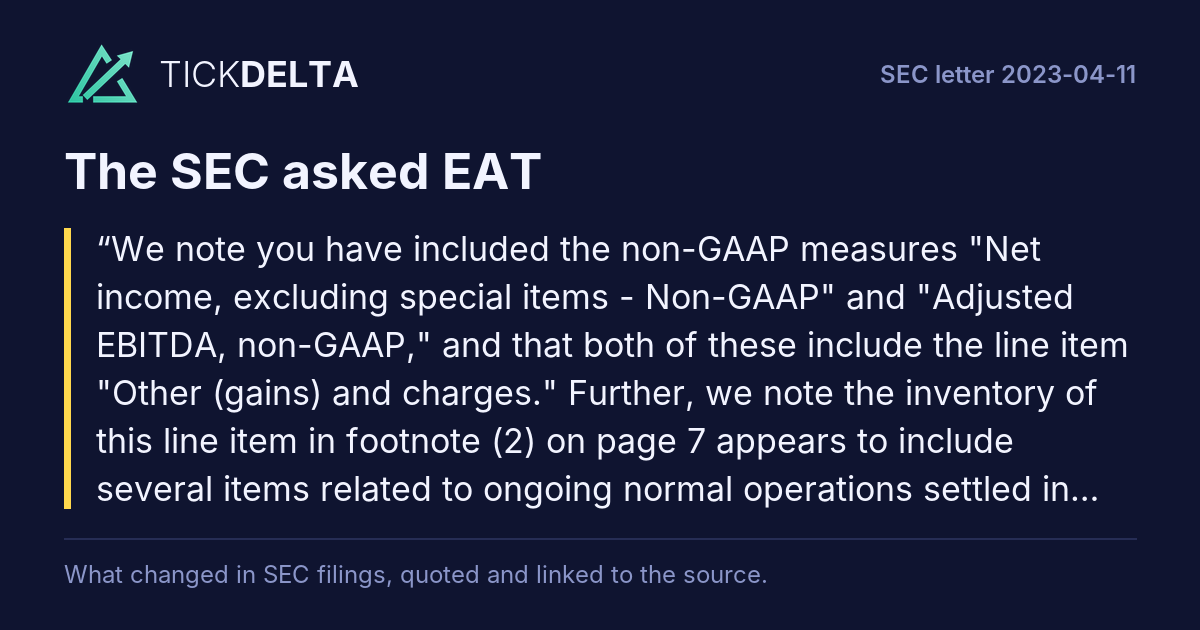
We note you have included the non-GAAP measures "Net income, excluding special items - Non-GAAP" and "Adjusted EBITDA, non-GAAP," and that both of these include the line item "Other (gains) and charges." Further, we note the inventory of this line item in footnote (2) on page 7 appears to include several items related to ongoing normal operations settled in cash.Rest of the question
Please support the inclusion of each line item included in Other (gains) and charges as reconciling items to your non-GAAP measures. Refer to the guidance in Question 100.01 of the staff's Compliance and Disclosure Interpretations on Non-GAAP Financial Measures.
As noted by the Staff, we utilize non-GAAP measures in analyzing operating performance and believe the presentation of these measures in our quarterly earnings releases provides investors with information that is beneficial to gaining a more in depth understanding of the Company’s financial results. Specifically, we present Net Income and earnings before interest, taxes, depreciation, and amortization (EBITDA) excluding special items to better represent the normal and recurring results of our restaurant operations.Read in the replyRest of the answer
We believe excluding certain expenses and gains provides a clearer understanding of our operational performance considering the nature, timing, and materiality of the excluded transactions. Additionally, management utilizes adjusted results for purposes of analyzing business performance internally as well as presenting operating results to external stakeholders. These adjustments primarily include gains and charges related to restaurant closures, severance and other benefits, natural disasters, enterprise system implementation costs, remodel-related costs, and lease contingencies. The following explanations provide a more detailed description and justification of each line item presented in footnote (2) on page 7 of Exhibit 99.1 for the twenty-six week period ended December 28, 2022:
Restaurant Closure Charges
This line item includes the following costs associated with the closure of 11 restaurants (in millions):
Non-cash long-lived assets, net $ 2.8
Non-cash restaurant supplies and inventory 0.8
Restaurant exit costs 0.7
Non-cash lease-related costs 0.3
Non-cash other 0.2
Total $ 4.8
•Non-cash long-lived assets, net represents the net book value of leasehold improvements, equipment, and right of use assets abandoned or disposed when the restaurants were closed. This amount includes approximately $1.6 million associated with a new prototype test restaurant that was closed in connection with a change in strategic direction. This action was taken as part of the restructuring initiatives enacted by the company’s new CEO.
•Non-cash restaurant supplies and inventory includes the write-off of food service items previously used to operate the restaurants that are disposed of at the time of closure (pots, pans, plates, glasses, utensils, silverware, etc.).
•Restaurant exit costs includes restaurant employee severance, location security, and miscellaneous expenses associated with leaving the property.
•Lease-related costs represents the periodic accretion of the lease liability associated with closed restaurant locations.
•Non-cash other includes the write-off of restaurant-level assets such as unamortized franchise rights and the unamortized balance of prepaid liquor and other business licenses.
As the pandemic has substantially subsided, we have gained more clarity regarding the operating environment for the casual dining industry going forward. We are now operating in a new economic environment and customer preferences have shifted away from in-person shopping and dining in some trade areas. As these factors have become more solidified, the Company decided to close a small number of restaurants that will no longer meet our operational and financial requirements. The Company currently operates 1,184 company-owned restaurants and we view closures as a non-routine component of our operations. These closures represent less than one percent of our restaurant portfolio and the costs listed above are recorded when a restaurant is closed. We exclude the cost of closing restaurants as the timing and frequency of restaurant closures can vary considerably. The majority of the costs relate to non-cash write-offs of leasehold improvements, restaurant equipment, right of use assets, restaurant supplies, and inventory. Accordingly, management does not believe that restaurant closures and related costs are fundamental to the Company’s business strategy and skew the current operating results in the period in which closure costs are incurred. We have previously removed these costs from our results and believe our investors and stakeholders are aligned with the usefulness of this presentation. Disclosures describing the nature of these costs are included in the Form 8-K exhibit 99.1, Form 10-Q, and Form 10-K.
Severance and Other Benefit Charges
These charges represent severance and other benefit costs related to corporate restructuring activities and a strategic realignment. Kevin Hochman was appointed President and CEO effective June 6, 2022 in connection with the retirement of our previous CEO. This is the first change in the Company’s CEO since January 2013. Mr. Hochman’s highest priority as the new CEO was to reassess the company’s business strategy, organizational culture, and talent to make the necessary changes to best enable a change in strategic direction. The results of this effort included a new organizational structure for the corporate and restaurant operations staff, and the separation of executive leaders and certain support staff members in Marketing, Human Resources, Culinary, Restaurant Operations, and Supply Chain. Restructuring actions and significant staff changes are not frequent and in this case were executed after a significant shift in strategy in connection with the appointment of a new CEO. We paid approximately $2.9 million in severance and other benefits to employees who were terminated because of these restructuring actions. These severance charges are not directly connected to the operational results of our restaurants, and we believe excluding these amounts provides greater clarity and insight into our operating results.
Loss From Natural Disasters, Net of (Insurance Recoveries)
These charges relate to restaurant-level assets, primarily leasehold improvements and equipment, that were significantly damaged or destroyed by the impact of significant weather events. In September 2022 Hurricane Ian, a category 4 storm, significantly damaged certain restaurants in Florida. Additionally, we experienced property damage related to the major winter storm in December 2022. We occasionally experience property damage from hurricanes, storms, floods, and fires at various restaurant locations in certain regions susceptible to such events. Property losses related to hurricanes and other natural disasters is not a normal component of our current or ongoing operational results.
Enterprise System Implementation Costs
We are implementing an enterprise system which includes a significant and complete change in software and functionality for most of our corporate functions including accounting, payroll, supply chain, and human resources. This change is impacting the majority of our information system and business processes. These charges include software subscription fees, certain consulting fees, and contract labor associated with the project that are not capitalized. System changes of this magnitude are rare and not a normal part of our business and restaurant operations.
Remodel-related Costs (Non-cash)
Certain assets are discarded or replaced when we remodel a restaurant. These assets consist of leasehold improvements, furniture, fixtures, and equipment, and the remodel-related costs represent the non-cash write off of these assets that would otherwise have been depreciated over time. The amount and composition of these charges varies depending on the restaurant prototype, restaurant age, and extent of the remodel activity. The decision to remodel a restaurant or group of restaurants is based on our strategy of adjusting the cosmetic features of the restaurant to generate traffic and align with consumer preferences and does not occur on a regular schedule. We believe excluding these charges from our results creates an improved understanding of our current and ongoing results from operations.
Lease Contingencies
We have divested restaurant brands in previous years and pursuant to the terms of some of the restaurant leases assigned to the buyers the Company was obligated to remain secondarily liable as a guarantor. The charges incurred in fiscal 2022 were related to restaurant brands that were sold in 2006 and 2008, each of which experienced significant operating challenges during the COVID-19 pandemic that resulted in their failure to pay rent on certain leases. The landlords of these leases then sought payment from the Company as the guarantor or original tenant. Prior to the COVID-19 pandemic, we only incurred charges related to these guarantees related to the bankruptcy of a former brand, a very infrequent event. We do not operate the restaurant brands associated with these charges and have no association with the ongoing operations of these restaurants and therefore believe it is relevant to remove these charges from our current operating results.
Other
Other includes the following gains and charges, with additional details below (in millions):
Restructuring $ 1.1
Legal settlements 0.8
COVID-19 and miscellaneous 0.8
Gain on lease termination (0.8)
Total $ 1.9
Restructuring relates to certain costs incurred in connection with the strategy shift implemented by the new CEO. We discontinued an initiative that entailed testing the effectiveness of robots to perform certain operational tasks in our restaurants. The charges primarily related to the non-cash write-off of the capitalized robot equipment. Additionally, we incurred inventory charges as we streamlined our menu by eliminating certain items and shifting the marketing focus to core menu items. Legal settlements in fiscal 2023 relate to settled alcohol service cases. We exclude all irregular, significant legal settlements from our operational results as these settlements vary in terms of nature of the claim, timing, frequency, and significance. COVID-19 and miscellaneous includes the ongoing payment of wages to restaurant employees that are temporarily rendered unavailable to work due to our COVID-19 safety protocols and is net of the employee retention credits. We also incurred charges primarily related to the acquisition of restaurants from franchisees and our prior corporate office facility we no longer utilize.
First report after the company's reply of May 10, 2023: 10-K filed Aug 23, 2023 ↗, against the 10-K filed Aug 26, 2022 ↗.
Tickdelta does not hold the text of both reports, so they are not compared here.
We note you reconcile "Adjusted EBITDA, non-GAAP" to operating income. Please tell us your consideration of Question 103.02 of the staff's Compliance and Disclosure Interpretations on non-GAAP Financial Measures in determining the most directly comparable GAAP financial measure.Rest of the question
If you determine Net Income to be the most directly comparable financial measure, please revise to include Net Income with equal or greater prominence to the presentation of your "Adjusted EBITDA, non-GAAP" measure.
We acknowledge the Staff’s guidance in the answer to Question 103.02 of the Compliance and Disclosure Interpretations on non-GAAP Financial Measures and will revise our disclosure in future filings to include Net Income with equal or greater prominence to Adjusted EBITDA and reconcile Adjusted EBITDA to Net Income.Read in the reply
First report after the company's reply of May 10, 2023: 10-K filed Aug 23, 2023 ↗, against the 10-K filed Aug 26, 2022 ↗.
Tickdelta does not hold the text of both reports, so they are not compared here.
Also in this review: request for more time, Apr 21, 2023, closing letter, 2023-05-22