Paragraph 72 · 50% changed
Every version of it
Screener
/
SEC EDGAR
/CIK 0000890564
/10-K filed Feb 25, 2026, compared with Feb 24, 2025
/Numbers from the XBRL of the 10-Ks
NYSE
Industrials · Help Supply Services
Everforth Inc EFOR
The 10-K against last year's
69 changes: 10 added, 7 removed, 52 reworded
10-K Feb 25, 2026 vs Feb 24, 2025
Risk Factors
15.7%
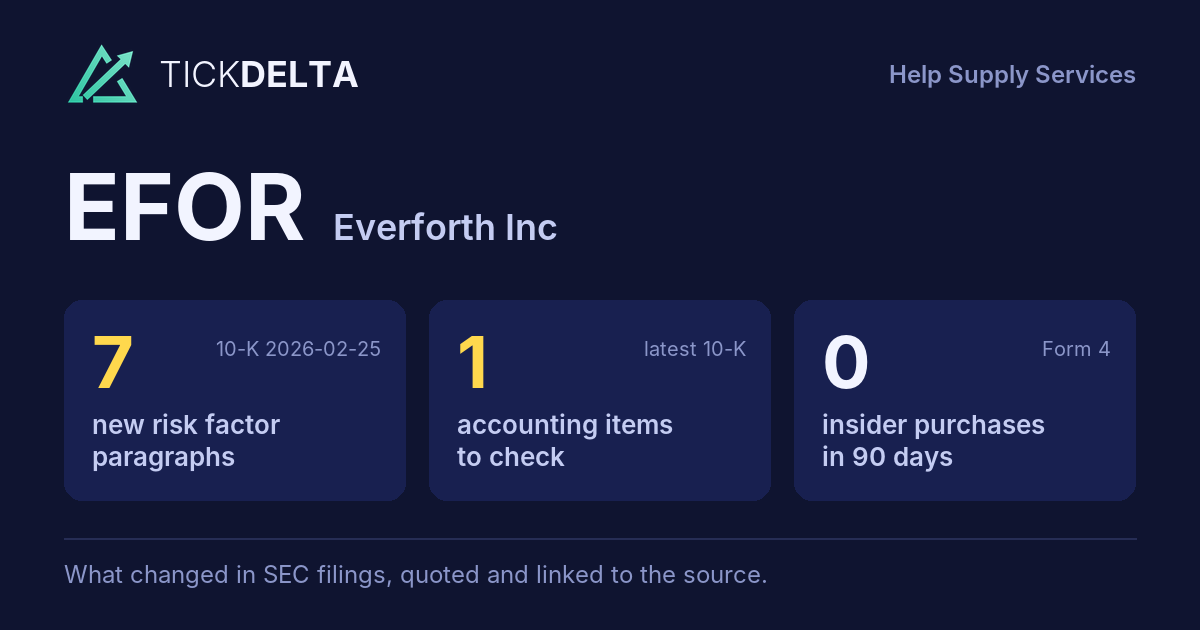
of the text changed · 8,746 words now · 7 new paragraphs, 4 gone
MD&A
29.1%
of the text changed · 1,848 words now · 3 new paragraphs, 3 gone
Legal Proceedings
13.7%
of the text changed · 266 words now
Accounting Policies
3.5%
of the text changed · 2,945 words now
10-K 0000890564-26-000013 (Feb 25, 2026) vs 10-K 0000890564-25-000008 (Feb 24, 2025)
Every paragraph, and how much of it changed
One bar per paragraph, in the order of the 10-K. Height and colour show the share of its words not in the closest paragraph a year earlier; the tallest bars are new paragraphs.
Risk Factors
90 paragraphs · 7 new · 37 reworded · 4 gone · 10-K Feb 25, 2026 against Feb 24, 2025
New paragraph
Reworded (5% of its words or more)
Same or nearly
Paragraph 52 · 49% changed
Every version of it
Paragraph 62 · 48% changed
Every version of it
We rely on teaming relationships with other prime contractors and subcontractors in order to submit bids for large procurements or other opportunities where we believe the combination of services, products, and solutions provided by us and our teammates will help us to win and perform the contract. under contracts. Our future revenues and growth prospects could be adversely affected if other contractors eliminate or reduce their contract relationships with us, or if the U.S. government terminates or reduces these other contractors’ programs, does not award them new contracts, or refuses to pay under a contract. We may have disputes with our subcontractors arising from, among other things, the quality and timeliness of work performed by the subcontractor, customer concerns about the subcontractor, our failure to extend existing task orders or issue new task orders under a subcontract, our hiring of a subcontractor’s personnel, or the subcontractor’s failure to comply with applicable law. If any of our subcontractors fail to satisfactorily perform the agreed-upon services or have regulatory compliance or other problems, our ability to fulfill our obligations as a prime contractor or higher tier subcontractor may be jeopardized. When we are in the role of a subcontractor, we often lack control over fulfillment of a contract, and poor performance on the contract could impact our customer relationship, even when we perform as required. Moreover, our revenues and operating results could be adversely affected if any prime contractor chose to offer directly to the customer services of the type that we provide, or if they team with other companies to provide those services.
Paragraph 82 · 46% changed
Every version of it
Paragraph 41 · 46% changed
Every version of it
Paragraph 37 · 28% changed
Every version of it
Our outstanding long-term debt at December 31, 2024 included 2025, is comprised of (i) a Senior Secured Credit Facility, inclusive of term loan of $493.8 million under our senior secured credit facility due 2030, A and $550.0 million of 4.625% unsecured senior notes due 2028. We have B, as well as a $500.0 million senior secured revolving credit facility due 2028, which is fully available as facility, and (ii) Unsecured Senior Notes, see Note 9. Long-Term Debt in Item 8. Financial Statements and Supplementary Data. The components of December 31, 2024. Our term loan has a our Senior Secured Credit Facility have variable interest rate, rates, making us vulnerable to increases in interest rates. Additionally, we use a portion of our cash provided by operations for interest payments on our debt rather than for our operations.
Paragraph 26 · 26% changed
Every version of it
Although we conduct diligence on third-party AI developers, we will not be able to control the manner in which third-party AI technologies are developed or maintained. Legal and regulatory frameworks related to the use of AI are rapidly evolving worldwide, including due worldwide and there is divergence among such AI laws and regulations. The continued enactment or expansion of laws and regulations related to the perceived or actual risks use of bias, unfair discrimination, transparency, AI in our operations could result in increased compliance costs related to our use of AI. Violations of these laws may lead to reputational damage, financial penalties and information security. increased regulatory scrutiny and oversight. Furthermore, because AI technology itself is highly complex and rapidly developing, it is not possible to predict all of the legal, operational, or technological risks that may arise relating to the use of AI.
Paragraph 18 · 24% changed
Every version of it
Paragraph 72 · 50% changed
Every version of it
10-K Feb 24, 2025The IT services and solutions industry is regulated in the United States and other countries in which we operate. We are subject to federal, state, and local laws and regulations governing the employer/employee relationship, such as those related to payment of federal, state, and local payroll and unemployment taxes for our corporate employees and billable professional employees, tax withholding, social security or retirement benefits, licensing, wage and hour requirements, paid sick leave, paid family leave and other leaves, employee benefits, pay equity, non-discrimination, sexual harassment, and workers’ compensation; and we must further comply with immigration laws and a wide variety of notice and administrative requirements, such as record keeping, written contracts, notification, and reporting. We are also subject to U.S. laws and regulations relating to government contracts with federal agencies. In certain other countries, we may not be considered the legal employer of our temporary personnel, however we are still responsible for collecting taxes and social security deductions and transmitting these amounts to the taxing authorities.
10-K Feb 25, 2026
contracts with federal agencies. In certain other countries, we may not be considered the legal employer of our temporary personnel, however we are still responsible for collecting taxes and social security deductions and transmitting these amounts to the taxing authorities.
Paragraph 52 · 49% changed
Every version of it
10-K Feb 24, 2025Our business depends upon continued U.S. government expenditures on cybersecurity, cloud and enterprise IT, AI/ML, digital transformation, and other programs that we support. During 2024, revenues from contracts directly with U.S. federal government agencies were 24 percent of consolidated revenues. All of our government contracts can be terminated by the U.S. government either for its convenience or if we default by failing to perform under the contract. The U.S. government conducts periodic reviews of U.S. defense strategies and priorities, which may shift Department of Defense budgetary priorities, reduce overall spending, or delay contract or task order awards for defense-related programs from which we would otherwise expect to derive a significant portion of our future revenues. Any of these changes could impair our ability to obtain new contracts or contract renewals. Any new contracting requirements or procurement methods could be costly or administratively difficult for us to implement. Our revenues, cash flows, and operating results could be adversely affected by spending caps or changes in budgetary priorities, as well as by delays in the government budget process, program starts, the award of contracts or task orders under contracts, or by a government shutdown. Considerable uncertainty exists regarding how future budget and program decisions will unfold, including the spending priorities of the U.S. government and the uncertainty related to the administration's efforts to improve efficiency. Because the U.S. Congress did not complete a budget before the end of the 2024 fiscal year, government operations are currently being funded through short-term continuing resolutions. These continuing resolutions authorize agencies of the U.S. government to continue to operate, but do not authorize new spending initiatives. When the U.S. government operates under a continuing resolution, contract awards may be delayed, canceled, or funded at lower levels which could adversely impact our operations, cash flows, and financial results. Failure to complete a budget for fiscal year 2025 or to provide for another continuing resolution by applicable deadlines may result in a federal government shutdown, which could cause us to incur labor or other costs without reimbursement under customer contracts or the delay or cancellation of key programs, and could adversely impact our operations, cash flows, and financial results.
10-K Feb 25, 2026
authorize new spending initiatives. When the U.S. government operates under a continuing resolution, contract awards may be delayed, canceled, or funded at lower levels which could adversely impact our operations, cash flows, and financial results. Failure to complete a budget or to provide for another continuing resolution by applicable deadlines may result in a federal government shutdown, which could cause us to incur labor or other costs without reimbursement under customer contracts or the delay or cancellation of key programs, and could adversely impact our operations, cash flows, and financial results.
Paragraph 62 · 48% changed
Every version of it
10-K Feb 24, 2025
We rely on teaming relationships with other prime contractors and subcontractors in order to submit bids for large procurements or other opportunities where we believe the combination of services, products, and solutions provided by us and our teammates will help us to win and perform the contract. Our future revenues and growth prospects could be adversely affected if other contractors eliminate or reduce their contract relationships with us, or if the U.S. government terminates or reduces these other contractors’ programs, does not award them new contracts, or refuses to pay under a contract. We may have disputes with our subcontractors arising from, among other things, the quality and timeliness of work performed by the subcontractor, customer concerns about the subcontractor, our failure to extend existing task orders or issue new task orders under a subcontract, our hiring of a subcontractor’s personnel, or the subcontractor’s failure to comply with applicable law. If any of our subcontractors fail to satisfactorily perform the agreed-upon services or have regulatory compliance or other problems, our ability to fulfill our obligations as a prime contractor or higher tier subcontractor may be jeopardized. When we are in the role of a subcontractor, we often lack control over fulfillment of a contract, and poor performance on the contract could impact our customer relationship, even when we perform as required. Moreover, our revenues and operating results could be adversely affected if any prime contractor chose to offer directly to the customer services of the type that we provide, or if they team with other companies to provide those services.
10-K Feb 25, 2026
We rely on teaming relationships with other prime contractors and subcontractors in order to submit bids for large procurements or other opportunities where we believe the combination of services, products, and solutions provided by us and our teammates will help us to win and perform under contracts. Our future revenues and growth prospects could be adversely affected if other contractors eliminate or reduce their
Paragraph 82 · 46% changed
Every version of it
10-K Feb 24, 2025We believe that the successful execution of our business strategy and our ability to build upon our business and acquisitions of new businesses depends on the continued employment of key members of our senior management team and maintaining good succession plans for their retirement or other departure. If we cannot attract and retain qualified personnel or effectively implement appropriate succession plans, it could have a material adverse impact to our business, financial condition, and/or results of operations. We have provided short-term and long-term incentive compensation to our key management in an effort to retain them, and have prepared succession plans at such time as their employment ends. However, if members of our senior management team become unable or unwilling to continue in their present positions, or our succession plans are not adequate, we could incur significant costs and experience business disruption related to time spent on efforts to replace them, and our financial results and our business could be adversely affected. Additionally, we must continue to recruit, train, and develop management team members in order to achieve our current business objectives and execute on our succession plans. A failure to support leadership excellence through adequate resources, expectations and training required for growth or in the event of the loss of key members of our senior management team could jeopardize our ability to meet our business performance expectations and adversely affect our financial results.
10-K Feb 25, 2026
develop management team members in order to achieve our current business objectives and execute on our succession plans. A failure to support leadership excellence through adequate resources, expectations and training required for growth or in the event of the loss of key members of our senior management team could jeopardize our ability to meet our business performance expectations and adversely affect our financial results.
Paragraph 41 · 46% changed
Every version of it
10-K Feb 24, 2025Demand for the IT services and solutions that we provide is significantly affected by global market and economic conditions, including recessions, inflation, interest rates, tax rates, and economic uncertainty. Our business is particularly susceptible to economic conditions in the United States where our clients or operations are concentrated. As economic activity slows, many clients or potential clients reduce their use of and reliance upon billable professionals, which reduces the demand for the Company’s services and could significantly decrease the Company’s revenues and profits. During periods of reduced economic activity, we may also be subject to increased competition for market share and pricing pressure. As a result, any significant economic downturn in the United States or other countries in which we operate could have a material adverse effect on our business, financial condition, and results of operations.
10-K Feb 25, 2026
share and pricing pressure. As a result, any significant economic downturn in the United States or other countries in which we operate could have a material adverse effect on our business, financial condition, and results of operations.
Paragraph 37 · 28% changed
Every version of it
10-K Feb 24, 2025
Our outstanding debt at December 31, 2024 included a term loan of $493.8 million under our senior secured credit facility due 2030, and $550.0 million of 4.625% unsecured senior notes due 2028. We have a $500.0 million senior secured revolving credit facility due 2028, which is fully available as of December 31, 2024. Our term loan has a variable interest rate, making us vulnerable to increases in interest rates. Additionally, we use a portion of our cash provided by operations for interest payments on our debt rather than for our operations.
10-K Feb 25, 2026
Our long-term debt at December 31, 2025, is comprised of (i) a Senior Secured Credit Facility, inclusive of term loan A and B, as well as a revolving credit facility, and (ii) Unsecured Senior Notes, see Note 9. Long-Term Debt in Item 8. Financial Statements and Supplementary Data. The components of our Senior Secured Credit Facility have variable interest rates, making us vulnerable to increases in interest rates. Additionally, we use a portion of our cash provided by operations for interest payments on our debt rather than for our operations.
Paragraph 26 · 26% changed
Every version of it
10-K Feb 24, 2025
Although we conduct diligence on third-party AI developers, we will not be able to control the manner in which third-party AI technologies are developed or maintained. Legal and regulatory frameworks related to the use of AI are rapidly evolving worldwide, including due to the perceived or actual risks of bias, unfair discrimination, transparency, and information security. Furthermore, because AI technology itself is highly complex and rapidly developing, it is not possible to predict all of the legal, operational, or technological risks that may arise relating to the use of AI.
10-K Feb 25, 2026
Although we conduct diligence on third-party AI developers, we will not be able to control the manner in which third-party AI technologies are developed or maintained. Legal and regulatory frameworks related to the use of AI are rapidly evolving worldwide and there is divergence among such AI laws and regulations. The continued enactment or expansion of laws and regulations related to the use of AI in our operations could result in increased compliance costs related to our use of AI. Violations of these laws may lead to reputational damage, financial penalties and increased regulatory scrutiny and oversight. Furthermore, because AI technology itself is highly complex and rapidly developing, it is not possible to predict all of the legal, operational, or technological risks that may arise relating to the use of AI.
Paragraph 18 · 24% changed
Every version of it
10-K Feb 24, 2025The failure to prevent a cybersecurity incident affecting our or third-party systems could result in the disruption of our services or the disclosure or misuse of sensitive information, which could harm our reputation, decrease demand for our services and products, expose us to liability, penalties, and remedial costs, or otherwise adversely affect our financial performance.
10-K Feb 25, 2026
Additionally, if there is a disruption or security breach of our outsourced services that results in a loss or damage to our data, or an unauthorized disclosure of confidential, personally identifiable, or sensitive data, our business and financial results could be materially adversely affected. See “The failure to prevent a cybersecurity incident affecting our or third-party systems could result in the disruption of our services or the disclosure or misuse of sensitive information, which could harm our reputation, decrease demand for our services and products, expose us to liability, penalties, and remedial costs, or otherwise adversely affect our financial performance.”
MD&A
26 paragraphs · 3 new · 15 reworded · 3 gone · 10-K Feb 25, 2026 against Feb 24, 2025
New paragraph
Reworded (5% of its words or more)
Same or nearly
Paragraph 7 · 47% changed
Consolidated gross profit declined 7.5 2.9 percent on consistent with the decline in revenues, resulting in a revenue decline consistent gross margin of 7.9 percent. 28.9 percent in each year. Gross margin for the Commercial Segment was 28.9 percent, an expansion of 10 up 30 basis points year-over-year, points, reflecting a higher mix of Commercial consulting revenues (which carry a higher gross revenues. Gross margin than assignment revenues and for the Federal Government Segment revenues), was down 70 basis points, primarily due to a higher volume of revenues from low-margin software licenses, the loss of certain higher margin contracts as well as margin expansion in these revenues. a result of initiatives associated with DOGE, and higher rates of fringe benefits.
Paragraph 15 · 43% changed
Net cash provided by operating activities was $327.9 million in 2025, compared with $400.0 million in 2024, 2024. The year-over-year decrease primarily relates to changes in operating assets and liabilities which generated net cash outflow of $3.5 million in 2025 compared with $456.9 net cash inflow of $46.1 million in 2023. Net 2024. These changes are mainly attributable to accounts receivable days sales outstanding which increased in 2025 and decreased in 2024. The year-over-year decrease was also due to lower net cash provided by operating activities before changes in operating assets and liabilities liabilities, which was $353.9 million, $331.4 million in 2025, compared with $400.8 $353.9 million in 2023. Net cash provided by changes in operating assets and liabilities was $46.1 million, compared with $56.1 million in 2023. 2024.
Paragraph 4 · 39% changed
Paragraph 11 · 34% changed
The provision for income taxes was $64.9 $49.1 million, down from $78.4 $64.9 million in 2023 2024 due to lower income before income taxes. The effective tax rate of 27.0 30.2 percent was slightly higher than the effective tax rate of 26.3 27.0 percent in 2023. 2024. The increase in the effective income tax rate was primarily due to higher non-deductible executive compensation related to the termination of the Company’s deferred compensation plan (see Note 12. Stock-Based Compensation and Other Employee Benefit Plans in Item 8. Financial Statements and Supplementary Data), and tax shortfalls related to stock-based compensation arrangements.
Paragraph 10 · 34% changed
Interest expense, net, which consists primarily of cash-based interest expense, amortization and adjustments to deferred loan costs, and interest income, was $67.7 million, up from $64.3 million, down from $66.4 million in 2023. 2024. The decrease increase was primarily the result of due to higher interest income and lower debt amendment fees (related to refinancing the senior secured credit facility in both periods), partially offset by higher interest expense on the senior secured credit facility. outstanding borrowings. The weighted-average outstanding borrowings for 2025 and 2024 were $1.21 billion and 2023 were 5.6 percent, and $1.05 billion and the cash-based interest expense rate was 6.0 percent and 5.9 percent (excluding interest income and costs related to debt amendments), percent, respectively.
Paragraph 17 · 32% changed
Net cash used in financing activities in 2025 was $29.4 million and primarily consisted of $170.1 million to repurchase the Company's common stock, offset by net borrowings under the senior secured credit facility totaling $138.7 million. Net cash used in financing activities in 2024 was $333.2 million, million and primarily consisted of $327.2 million to repurchase the Company's common stock and required principal payments of $5.0 million on the term loan B. Net cash used in financing activities in 2023 was $310.9 million and primarily consisted of $273.1 million to repurchase the Company's common stock, net repayments of borrowings under the revolving credit facility totaling $31.5 million, a required quarterly principal payment of $1.3 million on the term loan B, as well as the effects stock.
Paragraph 8 · 32% changed
Selling, general general, and administrative ("SG&A") expenses consist primarily of compensation expense for our field operations and corporate staff, rent, information systems, marketing, telecommunications, public company expenses expenses, and other general and administrative expenses. SG&A expenses were $854.0 million (21.5 percent of revenues), compared with $821.2 million (20.0 percent of revenues), compared with $844.2 million (19.0 percent of revenues) in 2023. The decrease in 2024. SG&A expenses for the year ended December 31, 2025 included $26.5 million in acquisition, integration, and strategic planning expenses, inclusive of $5.2 million in charges related to strategic workforce optimization initiatives. Additionally, in 2025, there was primarily due a $4.4 million write-off charge related to lower compensation-related expense. previously capitalized costs for software enhancements that will no longer be placed into service.
Paragraph 16 · 32% changed
Net cash used in investing activities in 2025 was $343.9 million, comprised of $304.1 million used to acquire TopBloc (see Note 6. Acquisition in Item 8. Financial Statements and Supplementary Data) and $39.8 million used for capital expenditures. Net cash used in investing activities in 2024 was $35.3 million and $40.5 million for 2024 and 2023, respectively, and primarily related to capital expenditures.
Paragraph 7 · 47% changed
10-K Feb 24, 2025
Consolidated gross profit declined 7.5 percent on a revenue decline of 7.9 percent. Gross margin was 28.9 percent, an expansion of 10 basis points year-over-year, reflecting a higher mix of Commercial consulting revenues (which carry a higher gross margin than assignment revenues and Federal Government Segment revenues), as well as margin expansion in these revenues.
10-K Feb 25, 2026
Consolidated gross profit declined 2.9 percent consistent with the decline in revenues, resulting in a consistent gross margin of 28.9 percent in each year. Gross margin for the Commercial Segment was up 30 basis points, reflecting a higher mix of consulting revenues. Gross margin for the Federal Government Segment was down 70 basis points, primarily due to a higher volume of revenues from low-margin software licenses, the loss of certain higher margin contracts as a result of initiatives associated with DOGE, and higher rates of fringe benefits.
Paragraph 15 · 43% changed
10-K Feb 24, 2025
Net cash provided by operating activities was $400.0 million in 2024, compared with $456.9 million in 2023. Net cash provided by operating activities before changes in operating assets and liabilities was $353.9 million, compared with $400.8 million in 2023. Net cash provided by changes in operating assets and liabilities was $46.1 million, compared with $56.1 million in 2023.
10-K Feb 25, 2026
Net cash provided by operating activities was $327.9 million in 2025, compared with $400.0 million in 2024. The year-over-year decrease primarily relates to changes in operating assets and liabilities which generated net cash outflow of $3.5 million in 2025 compared with net cash inflow of $46.1 million in 2024. These changes are mainly attributable to accounts receivable days sales outstanding which increased in 2025 and decreased in 2024. The year-over-year decrease was also due to lower net cash provided by operating activities before changes in operating assets and liabilities, which was $331.4 million in 2025, compared with $353.9 million in 2024.
Paragraph 4 · 39% changed
10-K Feb 24, 2025From an industry perspective, the Company operates in six broad industry verticals. Commercial Segment revenues (70.0 percent of total revenues) were down 9.6 percent year-over-year and are categorized into five broad industry verticals: (i) Financial Services, (ii) Consumer and Industrials, (iii) Healthcare, (iv) Technology, Media and Telecom ("TMT"), and (v) Business and Government Services. The TMT industry vertical had low single-digit growth, while the remaining four industry verticals declined year-over-year. Federal Government Segment revenues (30.0 percent of total revenues), the sixth industry vertical, were down 3.5 percent year-over-year, reflecting lower third-party software licenses revenues compared with the prior year.
10-K Feb 25, 2026
Commercial Segment revenues (70.1 percent of total revenues) were down 2.7 percent year-over-year and are categorized into five industries: (i) Consumer and Industrial, (ii) Financial Services, (iii) Technology, Media and Telecom ("TMT"), (iv) Healthcare, and (v) Business Services. The Consumer and Industrials industry was up low-teens and Healthcare was up low single digits, while the remaining three industries declined. Federal Government Segment revenues (29.9 percent of total revenues) were down 3.3 percent year-over-year. Federal Government Segment revenues are categorized into four customer types: (i) Defense and Intelligence, (ii) National Security, (iii) Civilian, and (iv) other clients. Federal Civilian and Defense and Intelligence both declined year-over-year, while National Security was up.
Paragraph 11 · 34% changed
10-K Feb 24, 2025
The provision for income taxes was $64.9 million, down from $78.4 million in 2023 due to lower income before income taxes. The effective tax rate of 27.0 percent was slightly higher than the effective tax rate of 26.3 percent in 2023.
10-K Feb 25, 2026
The provision for income taxes was $49.1 million, down from $64.9 million in 2024 due to lower income before income taxes. The effective tax rate of 30.2 percent was higher than the effective tax rate of 27.0 percent in 2024. The increase in the effective income tax rate was primarily due to higher non-deductible executive compensation related to the termination of the Company’s deferred compensation plan (see Note 12. Stock-Based Compensation and Other Employee Benefit Plans in Item 8. Financial Statements and Supplementary Data), and tax shortfalls related to stock-based compensation arrangements.
Paragraph 10 · 34% changed
10-K Feb 24, 2025
Interest expense, net, which consists primarily of cash-based interest expense, amortization and adjustments to deferred loan costs, and interest income, was $64.3 million, down from $66.4 million in 2023. The decrease was primarily the result of higher interest income and lower debt amendment fees (related to refinancing the senior secured credit facility in both periods), partially offset by higher interest expense on the senior secured credit facility. The weighted-average outstanding borrowings for 2024 and 2023 were $1.05 billion and the cash-based interest expense rate was 6.0 percent and 5.9 percent (excluding interest income and costs related to debt amendments), respectively.
10-K Feb 25, 2026
Interest expense, net, which consists primarily of cash-based interest expense, amortization and adjustments to deferred loan costs, and interest income, was $67.7 million, up from $64.3 million in 2024. The increase was due to higher outstanding borrowings. The weighted-average outstanding borrowings for 2025 and 2024 were $1.21 billion and 5.6 percent, and $1.05 billion and 6.0 percent, respectively.
Paragraph 17 · 32% changed
10-K Feb 24, 2025
Net cash used in financing activities in 2024 was $333.2 million, and primarily consisted of $327.2 million to repurchase the Company's common stock and required principal payments of $5.0 million on the term loan B. Net cash used in financing activities in 2023 was $310.9 million and primarily consisted of $273.1 million to repurchase the Company's common stock, net repayments of borrowings under the revolving credit facility totaling $31.5 million, a required quarterly principal payment of $1.3 million on the term loan B, as well as the effects
10-K Feb 25, 2026
Net cash used in financing activities in 2025 was $29.4 million and primarily consisted of $170.1 million to repurchase the Company's common stock, offset by net borrowings under the senior secured credit facility totaling $138.7 million. Net cash used in financing activities in 2024 was $333.2 million and primarily consisted of $327.2 million to repurchase the Company's common stock.
Paragraph 8 · 32% changed
10-K Feb 24, 2025
Selling, general and administrative ("SG&A") expenses consist primarily of compensation expense for our field operations and corporate staff, rent, information systems, marketing, telecommunications, public company expenses and other general and administrative expenses. SG&A expenses were $821.2 million (20.0 percent of revenues), compared with $844.2 million (19.0 percent of revenues) in 2023. The decrease in SG&A expenses was primarily due to lower compensation-related expense.
10-K Feb 25, 2026
Selling, general, and administrative ("SG&A") expenses consist primarily of compensation expense for our field operations and corporate staff, rent, information systems, marketing, telecommunications, public company expenses, and other general and administrative expenses. SG&A expenses were $854.0 million (21.5 percent of revenues), compared with $821.2 million (20.0 percent of revenues) in 2024. SG&A expenses for the year ended December 31, 2025 included $26.5 million in acquisition, integration, and strategic planning expenses, inclusive of $5.2 million in charges related to strategic workforce optimization initiatives. Additionally, in 2025, there was a $4.4 million write-off charge related to previously capitalized costs for software enhancements that will no longer be placed into service.
Paragraph 16 · 32% changed
10-K Feb 24, 2025
Net cash used in investing activities was $35.3 million and $40.5 million for 2024 and 2023, respectively, and primarily related to capital expenditures.
10-K Feb 25, 2026
Net cash used in investing activities in 2025 was $343.9 million, comprised of $304.1 million used to acquire TopBloc (see Note 6. Acquisition in Item 8. Financial Statements and Supplementary Data) and $39.8 million used for capital expenditures. Net cash used in investing activities in 2024 was $35.3 million related to capital expenditures.
A paragraph is matched with the one last year that shares the most of its words; under half in common makes it new. The paragraphs shown are the 8 reworded the most in each section.
The paragraph that changed most in each section
The redline
Marked against last year's 10-K: cut words struck through, new words highlighted.
Risk Factors200 words changed in this paragraph; it is 38% similar to last year's version.
We rely on teaming relationships with other prime contractors and subcontractors in order to submit bids for large procurements or other opportunities where we believe the combination of services, products, and solutions provided by us and our teammates will help us to win and perform the contract. under contracts. Our future revenues and growth prospects could be adversely affected if other contractors eliminate or reduce their contract relationships with us, or if the U.S. government terminates or reduces these other contractors’ programs, does not award them new contracts, or refuses to pay under a contract. We may have disputes with our subcontractors arising from, among other things, the quality and timeliness of work performed by the subcontractor, customer concerns about the subcontractor, our failure to extend existing task orders or issue new task orders under a subcontract, our hiring of a subcontractor’s personnel, or the subcontractor’s failure to comply with applicable law. If any of our subcontractors fail to satisfactorily perform the agreed-upon services or have regulatory compliance or other problems, our ability to fulfill our obligations as a prime contractor or higher tier subcontractor may be jeopardized. When we are in the role of a subcontractor, we often lack control over fulfillment of a contract, and poor performance on the contract could impact our customer relationship, even when we perform as required. Moreover, our revenues and operating results could be adversely affected if any prime contractor chose to offer directly to the customer services of the type that we provide, or if they team with other companies to provide those services.
Source: Item 1A, 10-K 0000890564-26-000013 vs Item 1A, 10-K 0000890564-25-000008
MD&A109 words changed in this paragraph; it is 48% similar to last year's version.
Source: Item 7, 10-K 0000890564-26-000013 vs Item 7, 10-K 0000890564-25-000008
Accounting Policies53 words changed in this paragraph; it is 84% similar to last year's version.
Leases — The Company has operating leases for corporate offices, branch offices, and data centers, which have lease terms ranging from one year to 13.3 13 years. At the inception of a contract, the Company determines if the contract contains a lease. A contract contains a lease if it conveys the right to control the use of an identified asset for a period of time in exchange for consideration. Operating lease ROU right-of-use assets and lease liabilities are recognized at the lease commencement date, based on the present value of the future minimum lease payments. The Company’s leases do not provide an implicit rate of return. Therefore, the Company uses its incremental borrowing rate ("IBR") in determining the present value of lease payments. In determining the IBR, the Company considers its credit rating and the current market interest rates. The IBR approximates the interest rate the Company would pay on collateralized debt with similar terms and payments as the lease agreements and in a similar economic environment where the leased assets are located. Leases with an initial term of 12 months or less are not recorded on the balance sheet. The Company does not have finance leases.
Source: Item 8, Note 2 – Summary of Significant Accounting Policies, 10-K 0000890564-26-000013 vs Item 8, Note 2 – Summary of Significant Accounting Policies, 10-K 0000890564-25-000008
Legal Proceedings19 words changed in this paragraph; it is 79% similar to last year's version.
Purchase Obligations — The Company's purchase obligations include non-cancelable job board service agreements, outsourcing services, software maintenance and license agreements and software subscriptions. The following is a summary of these obligations as of December 31, 2024, which excludes lease liabilities and other current liabilities that are included in the accompanying consolidated balance sheets 2025 (in millions):
Source: Item 3, via Note 10 – Commitments and Contingencies, 10-K 0000890564-26-000013 vs Item 3, via Note 9 – Commitments and Contingencies, 10-K 0000890564-25-000008
Sentences and paragraphs added, removed or reworded
Every change, by type
Sentences and paragraphs of EFOR's Risk Factors and MD&A, 10-K Feb 25, 2026 against 10-K Feb 24, 2025. Each links to the text at sec.gov.
Quiet changes are sentences kept from last year with one to four words changed, at least one of them a hedge, a modal or a qualifier (may, could, will, not, significant, material…). A year or date rolling forward is not counted.
The full word list
adverse, adversely, all, although, anticipate, anticipates, any, approximately, believe, believes, can, cannot, certain, could, expect, expects, generally, however, if, intend, intends, largely, likely, many, material, materially, may, might, most, must, never, no, not, possible, primarily, probable, should, significant, significantly, some, substantial, substantially, unlikely, will, would
AddedRisk Factors
Our strategic alliances and third-party partnerships often involve complex cooperation and resource sharing, and their success depends on the continued alignment of goals and effective coordination. There is no guarantee that our current partners will continue to collaborate with us on favorable terms, or at all. The loss of a significant partner, or the failure of an alliance to achieve its intended objectives, could result in a direct and immediate loss of referrals and future opportunities. The failure of an alliance could also harm our reputation and make it more difficult to form new partnerships in the future.
Read it in 10-K Feb 25, 2026 at sec.gov
AddedRisk Factors
We outsource certain aspects of our business operations, which could result in disruption, unexpected increased costs, and reputational risk.
Read it in 10-K Feb 25, 2026 at sec.gov
AddedRisk Factors
We have recently outsourced, and may further outsource, certain back-office support functions to a third-party vendor in an effort to improve efficiency, strengthen our operations, and capture cost savings. As a result, we depend on a single third-party vendor relationship to ensure that certain of our business needs are sufficiently met, and there is no guarantee that such third party will be able to provide an adequate level of support and perform in accordance with our expectations. Our outsourcing arrangement thus exposes us to additional risks, including, among others, potential disruptions to our business operations, unexpected costs, reputational risk, and risks related to applicable laws and public perceptions about outsourcing. In addition, it could be difficult and costly, or potentially adversely affect our business continuity and margins, if we need to replace the vendor for performance or economic reasons.
Read it in 10-K Feb 25, 2026 at sec.gov
AddedRisk Factors
As a result of outsourcing, we may experience reduced control over processes and quality, leading to inconsistencies, unmet standards, and misalignment with our strategic goals, impacting our brand. Thus, our business could be adversely impacted if we are unable to effectively manage this third-party relationship and the agreements under which our third-party vendor operates. Further, unexpected costs or failure to achieve projected savings may negate the intended benefits of outsourcing.
Read it in 10-K Feb 25, 2026 at sec.gov
AddedRisk Factors
Our outsourced vendor’s failure to meet its obligations to us or perform to our standards or legal requirements in a timely fashion, or at all; service interruption; or other poor performance could disrupt our operations and/or negatively impact customer service, affecting revenue, client satisfaction, and our reputation in the market and have a significant adverse effect on our business. While we have policies and procedures for managing these relationships, they inherently involve a lesser degree of control over business operations, governance and compliance, thereby potentially increasing our financial, legal, reputational and operational risk.
Read it in 10-K Feb 25, 2026 at sec.gov
AddedRisk Factors
We have been integrating AI into our business and services in both the commercial and government markets to meet client demand and to maintain competitiveness in a highly competitive and rapidly evolving market. We have made substantial investments in developing and supporting AI capabilities and services, and we anticipate making further investments in the future. If we are unable to quickly develop, adopt, and deploy AI technologies, we risk falling behind our industry competitors. In addition to facing significant competition from other companies that are developing AI technologies, our own clients may develop their own internal AI-related capabilities, which could lead to reduced demand for our services or solutions. Additionally, while AI is currently the focus of significant investment and strategic prioritization, there is a risk that if the expected value of AI does not materialize at scale, or if high-profile AI failures emerge, clients may reassess their AI plans, which could lead to reduced spending and negatively impact our financial condition and results of operations.
Read it in 10-K Feb 25, 2026 at sec.gov
AddedRisk Factors
our customers’ systems and processes, any circumvention or failure of our cybersecurity defenses or measures could compromise the confidentiality, integrity, and availability of our customers’ own IT systems or Confidential Information as well.
Read it in 10-K Feb 25, 2026 at sec.gov
RemovedRisk Factors
Show the other 33
RemovedRisk Factors
RemovedRisk Factors
RemovedRisk Factors
RewordedRisk Factors
Any non-compliance failure or perceived non-compliance failure by us or our vendors to comply with the applicable laws, rules, regulations and other requirements related to consumer protection, information security, data protection and privacy laws applicable to our business could result in legal claims or proceedings (including class actions), governmental enforcement actions and investigations, fines, and other penalties that could potentially have an adverse effect on our operations and reputation. reputation including a loss of confidence in us or damage to our brands.
Read it in 10-K Feb 25, 2026 at sec.gov
RewordedRisk Factors
Our future revenues and growth prospects could be adversely affected if other contractors eliminate or reduce their contract relationships with us, or if the U.S. government terminates or reduces these other contractors’ programs, does not award them new contracts, or refuses to pay under a contract.
Read it in 10-K Feb 25, 2026 at sec.gov
RewordedRisk Factors
Our revenues declined this past year due to adverse macroeconomic conditions, including an IT industry recession. including, but not limited to, increasing interest rates, tariffs, efforts by the Department of Government Efficiency ("DOGE"), and a government shutdown.
Read it in 10-K Feb 25, 2026 at sec.gov
RewordedRisk Factors
Legal and regulatory frameworks related to the use of AI are rapidly evolving worldwide, including due to the perceived or actual risks of bias, unfair discrimination, transparency, worldwide and information security. there is divergence among such AI laws and regulations.
Read it in 10-K Feb 25, 2026 at sec.gov
RewordedRisk Factors
Federal government agencies, including the Defense Contract Audit Agency and the Defense Contract Management Agency, agencies routinely audit and investigate government contracts and government contractors’ contractors’, whether commercial or federal, administrative processes and systems.
Read it in 10-K Feb 25, 2026 at sec.gov
RewordedRisk Factors
The success of our business depends upon our ability to continually secure new long-term consulting projects as well as shorter-term assignment contracts from clients and organize custom fit teams to fill them with meet our billable professionals. clients’ needs.
Read it in 10-K Feb 25, 2026 at sec.gov
RewordedRisk Factors
RewordedRisk Factors
We and our vendors are subject to data privacy, protection, and security laws, rules, regulations, industry standards and other requirements, including the European Union General Data Protection Act ("GDPR") and Regulation ("EU GDPR"), the U.K.’s Data Protection Act 2018 (which implements the GDPR into U.K. law).
Read it in 10-K Feb 25, 2026 at sec.gov
RewordedRisk Factors
If we do not sufficiently invest in new technology and industry developments (such (including artificial intelligence as emerging job and resume posting services), more fully described below), appropriately implement new technologies, or evolve our business at sufficient speed and scale in response to such developments, or if we do not make the right strategic investments to respond to these developments, our services, results of operations, and ability to develop and maintain our business could be adversely affected.
Read it in 10-K Feb 25, 2026 at sec.gov
RewordedRisk Factors
RewordedRisk Factors
Such standards may change over time, which could result in significant revisions to our current goals, reported progress in achieving such goals, emissions reduction targets or ability to achieve such goals targets in the future.
Read it in 10-K Feb 25, 2026 at sec.gov
RewordedRisk Factors
Considerable uncertainty exists regarding how future budget and program decisions will unfold, including the spending priorities of the U.S. government and the uncertainty related to the administration's efforts to improve efficiency. government.
Read it in 10-K Feb 25, 2026 at sec.gov
AddedMD&A
Amortization of intangible assets was $64.8 million, up from $58.1 million in 2024. The increase relates to amortization of intangible assets associated with the acquisition of TopBloc (see Note 6. Acquisition in Item 8. Financial Statements and Supplementary Data), partially offset by lower amortization from older intangible assets that are reaching, or have reached, the end of their useful lives.
Read it in 10-K Feb 25, 2026 at sec.gov
AddedMD&A
(3) Purchase obligations include non-cancelable job board service agreements, outsourcing services, software maintenance and license agreements and software subscriptions. In the fourth quarter of 2025, the Company entered into a multi-year contract for outsourcing services.
Read it in 10-K Feb 25, 2026 at sec.gov
AddedMD&A
During the second quarter of 2025, the Company terminated its deferred compensation plan (“DCP”). The final distribution of all participant account assets will occur in June 2026. As of December 31, 2025, the plan assets and liabilities were $19.1 million and were included in other current assets and other current liabilities on the consolidated balance sheet. As of December 31, 2024, the plan assets and liabilities were $17.8 million, of which $1.7 million was included in other current assets and other current liabilities, and the remaining $16.1 million was included in other non-current assets and other long-term liabilities on the consolidated balance sheet.
Read it in 10-K Feb 25, 2026 at sec.gov
RemovedMD&A
RemovedMD&A
RemovedMD&A
RewordedMD&A
Net cash used in financing activities in 2023 2025 was $310.9 $29.4 million and primarily consisted of $273.1 $170.1 million to repurchase the Company's common stock, offset by net repayments of borrowings under the revolving senior secured credit facility totaling $31.5 million, a required quarterly principal payment of $1.3 million on the term loan B, as well as the effects $138.7 million.
Read it in 10-K Feb 25, 2026 at sec.gov
RewordedMD&A
RewordedMD&A
Federal Government Segment revenues, which are all consulting revenues, were $1.2 billion, down 3.5 3.3 percent year-over-year mainly related to the loss of certain contracts as stated above. a result of initiatives associated with DOGE.
Read it in 10-K Feb 25, 2026 at sec.gov
RewordedMD&A
SG&A expenses were $854.0 million (21.5 percent of revenues), compared with $821.2 million (20.0 percent of revenues), compared with $844.2 million (19.0 percent of revenues) in 2023. 2024.
Read it in 10-K Feb 25, 2026 at sec.gov
RewordedMD&A
RewordedMD&A
Net cash used in financing activities in 2024 was $333.2 million, million and primarily consisted of $327.2 million to repurchase the Company's common stock and required principal payments of $5.0 million on the term loan B. stock.
Read it in 10-K Feb 25, 2026 at sec.gov
RewordedMD&A
(i) Consumer and Industrial, (ii) Financial Services, (ii) Consumer and Industrials, (iii) Healthcare, (iv) Technology, Media and Telecom ("TMT"), (iv) Healthcare, and (v) Business and Government Services.
Read it in 10-K Feb 25, 2026 at sec.gov
RewordedMD&A
We believe that our cash and cash equivalents on hand, expected operating cash flows, and availability under our revolving credit facility will be sufficient to fulfill our obligations, working capital requirements, capital expenditures, and capital expenditures for the next 12 months. anticipated acquisitions (see Note 17.
Read it in 10-K Feb 25, 2026 at sec.gov
RewordedMD&A
Net cash provided by operating activities was $327.9 million in 2025, compared with $400.0 million in 2024, compared with $456.9 million in 2023. 2024.
Read it in 10-K Feb 25, 2026 at sec.gov
RewordedMD&A
Net cash used in investing activities in 2024 was $35.3 million and $40.5 million for 2024 and 2023, respectively, and primarily related to capital expenditures.
Read it in 10-K Feb 25, 2026 at sec.gov
RewordedMD&A
Assignment revenues, which totaled $1.7 $1.5 billion (42.5 (37.7 percent of total revenues), were down 16.3 13.8 percent year-over-year, reflecting continued softness in the portions of the Commercial Segment Business that are more sensitive to changes in the macroeconomic cycles (i.e., more cyclical). cycles.
Read it in 10-K Feb 25, 2026 at sec.gov
RewordedMD&A
Gross profit is comprised of revenues revenues, less costs of services, which consist primarily of compensation for our contract billable professionals, other direct costs, and reimbursable out-of-pocket expenses.
Read it in 10-K Feb 25, 2026 at sec.gov
Sources
The two latest 10-Ks on EDGAR, section by section. Each change links to the text at sec.gov.
Also
New risk factors: paragraphs with nothing like them last year, quoted in full.
Work with it
Excel workbook · CSV. Google Sheet that stays up to date: paste =IMPORTDATA("https://tickdelta.com/company/EFOR/export.csv") into a cell.