Added10-Q Oct 30, 2026 vs 10-K Feb 25, 2026
There have been no material changes to the risk factors previously described in our 2025 10-K.
Each branch is a paragraph in Risk Factors with nothing like it in the 10-K filed Feb 24, 2025. A box jumps to the paragraph as filed, below.
7 paragraphs in Risk Factors of the 10-K filed Feb 25, 2026 with nothing like them in the 10-K filed Feb 24, 2025. Quoted exactly. Paragraphs that were only edited are under 10-K change.
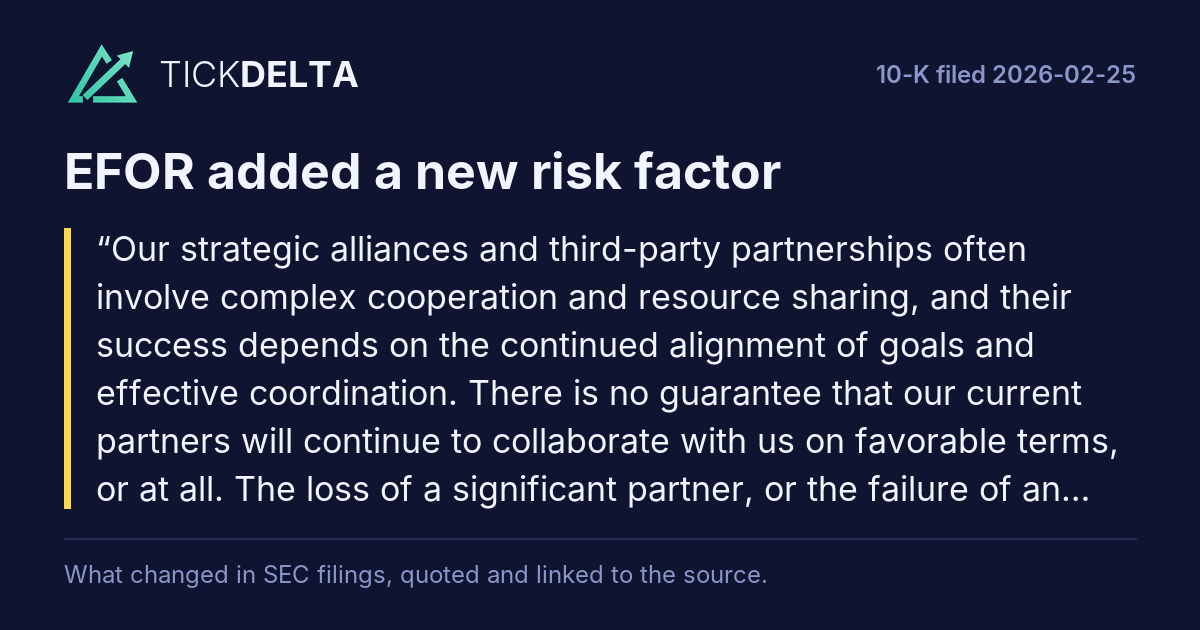
Our strategic alliances and third-party partnerships often involve complex cooperation and resource sharing, and their success depends on the continued alignment of goals and effective coordination. There is no guarantee that our current partners will continue to collaborate with us on favorable terms, or at all. The loss of a significant partner, or the failure of an alliance to achieve its intended objectives, could result in a direct and immediate loss of referrals and future opportunities. The failure of an alliance could also harm our reputation and make it more difficult to form new partnerships in the future.
We outsource certain aspects of our business operations, which could result in disruption, unexpected increased costs, and reputational risk.
We have recently outsourced, and may further outsource, certain back-office support functions to a third-party vendor in an effort to improve efficiency, strengthen our operations, and capture cost savings. As a result, we depend on a single third-party vendor relationship to ensure that certain of our business needs are sufficiently met, and there is no guarantee that such third party will be able to provide an adequate level of support and perform in accordance with our expectations. Our outsourcing arrangement thus exposes us to additional risks, including, among others, potential disruptions to our business operations, unexpected costs, reputational risk, and risks related to applicable laws and public perceptions about outsourcing. In addition, it could be difficult and costly, or potentially adversely affect our business continuity and margins, if we need to replace the vendor for performance or economic reasons.
As a result of outsourcing, we may experience reduced control over processes and quality, leading to inconsistencies, unmet standards, and misalignment with our strategic goals, impacting our brand. Thus, our business could be adversely impacted if we are unable to effectively manage this third-party relationship and the agreements under which our third-party vendor operates. Further, unexpected costs or failure to achieve projected savings may negate the intended benefits of outsourcing.
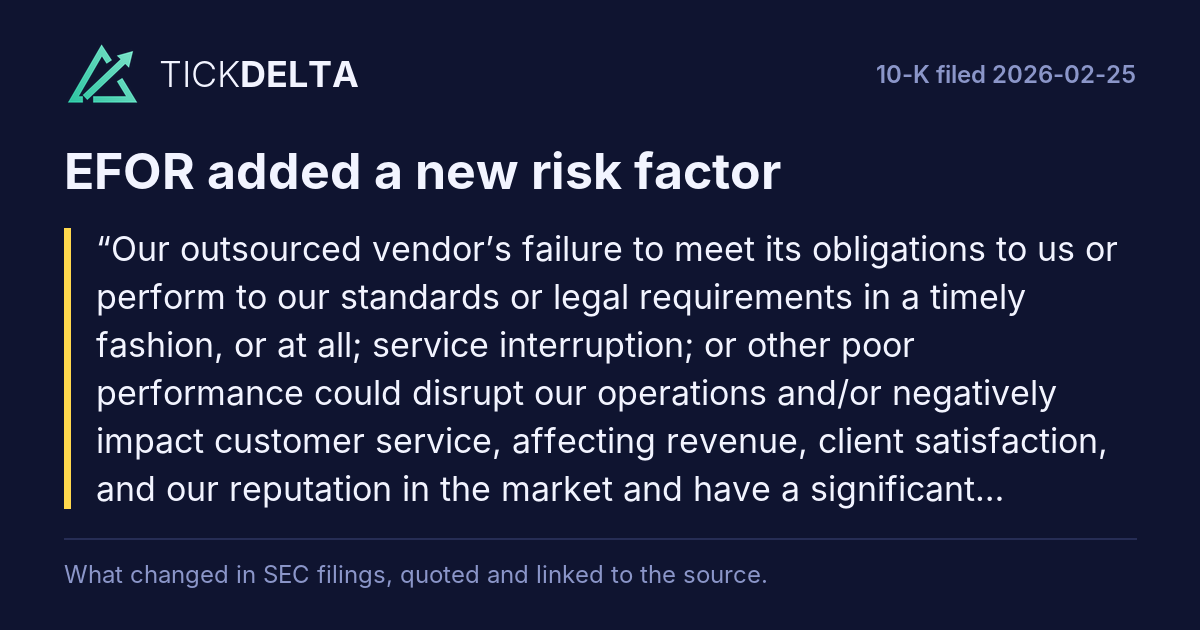
Our outsourced vendor’s failure to meet its obligations to us or perform to our standards or legal requirements in a timely fashion, or at all; service interruption; or other poor performance could disrupt our operations and/or negatively impact customer service, affecting revenue, client satisfaction, and our reputation in the market and have a significant adverse effect on our business. While we have policies and procedures for managing these relationships, they inherently involve a lesser degree of control over business operations, governance and compliance, thereby potentially increasing our financial, legal, reputational and operational risk.
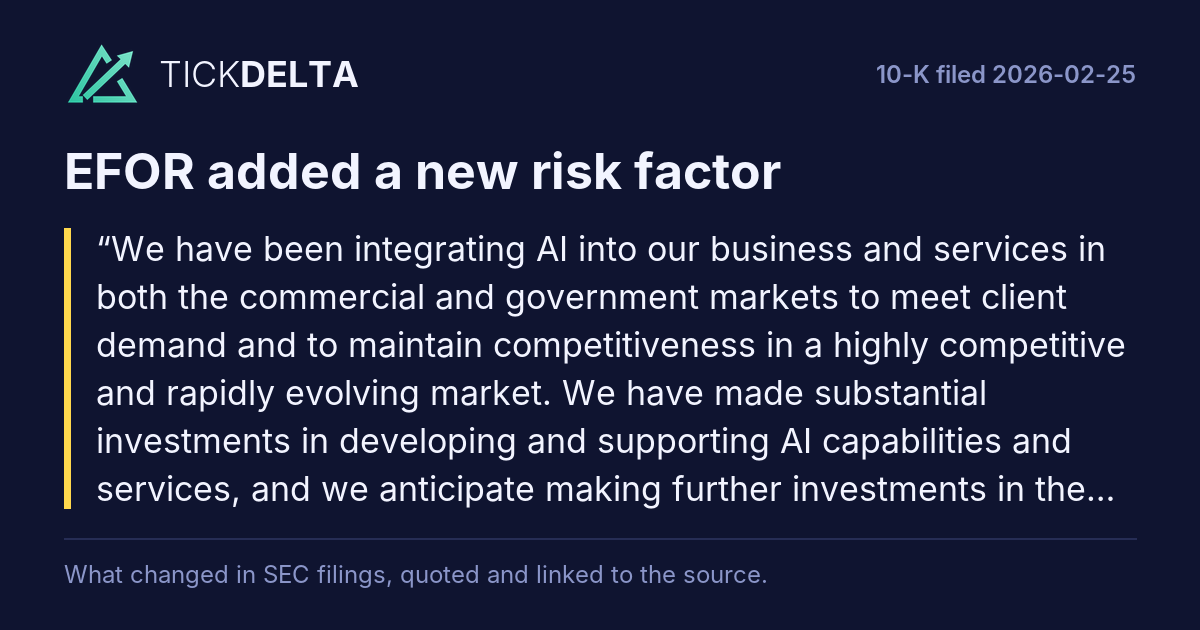
We have been integrating AI into our business and services in both the commercial and government markets to meet client demand and to maintain competitiveness in a highly competitive and rapidly evolving market. We have made substantial investments in developing and supporting AI capabilities and services, and we anticipate making further investments in the future. If we are unable to quickly develop, adopt, and deploy AI technologies, we risk falling behind our industry competitors. In addition to facing significant competition from other companies that are developing AI technologies, our own clients may develop their own internal AI-related capabilities, which could lead to reduced demand for our services or solutions. Additionally, while AI is currently the focus of significant investment and strategic prioritization, there is a risk that if the expected value of AI does not materialize at scale, or if high-profile AI failures emerge, clients may reassess their AI plans, which could lead to reduced spending and negatively impact our financial condition and results of operations.
our customers’ systems and processes, any circumvention or failure of our cybersecurity defenses or measures could compromise the confidentiality, integrity, and availability of our customers’ own IT systems or Confidential Information as well.
New in the latest 10-Q
1 paragraph in the 10-Q filed Oct 30, 2026 with nothing like it in the 10-Q filed Jul 31, 2026 (at least half the words must differ; new numbers alone do not count). Quoted exactly, grouped by the item heading above them. This is text that changed, not a judgement of how serious it is.
2026 2025 Senior Secured Credit Facility: $600 million revolving credit facility, due 2031 $ 373.0 $ 45.0 Term loan A — 98.8 Term loan B, due 2030 485.0 488.8 Unsecured Senior Notes, due 2028 541.0 550.0 1,399.0 1,182.6 Unamortized deferred loan costs (3.0) (4.4) Principal payments due in the next 12 months (5.0) (8.8) Long-term debt $ 1,391.0 $ 1,169.4
Read in the 10-Q
Item 1A of the 10-Q filed Oct 30, 2026 against Item 1A of the 10-K filed Feb 25, 2026.
A 10-Q repeats only the risks that changed, so a 10-K paragraph that is missing from it is not counted as removed.
Added is a paragraph with nothing like it in the 10-K, Reworded a sentence that is in both with several words changed,
Quiet changes a sentence in both where one to four words changed and one is a hedge or a modal
(cut words struck through, new words highlighted).
Text on the page, not a score; each links to the filing at sec.gov.
Two-word phrases in Risk Factors of the 10-K filed Feb 25, 2026 that are in none of the 1 earlier 10-Ks stored, back to Feb 24, 2025
Used at least twice, small words left out. Counted, not picked: a phrase can be new because the company renamed something.
4 paragraphs of last year's Risk Factors with nothing like them now. The longest are quoted.
Item 1A of each 10-K and 10-Q on EDGAR, quoted exactly. Each paragraph links to the filing at sec.gov.
10-K change: what was reworded or cut, section by section.
Excel workbook · CSV. Google Sheet that stays up to date: paste =IMPORTDATA("https://tickdelta.com/company/EFOR/export.csv") into a cell.