Paragraph 83 · 47% changed
Every version of it
Screener
/
SEC EDGAR
/CIK 0001125376
/10-K filed Feb 4, 2026, compared with Feb 5, 2025
/Numbers from the XBRL of the 10-Ks
Nasdaq
Health care · Skilled Nursing Care Facilities
Ensign Group, Inc ENSG
The 10-K against last year's
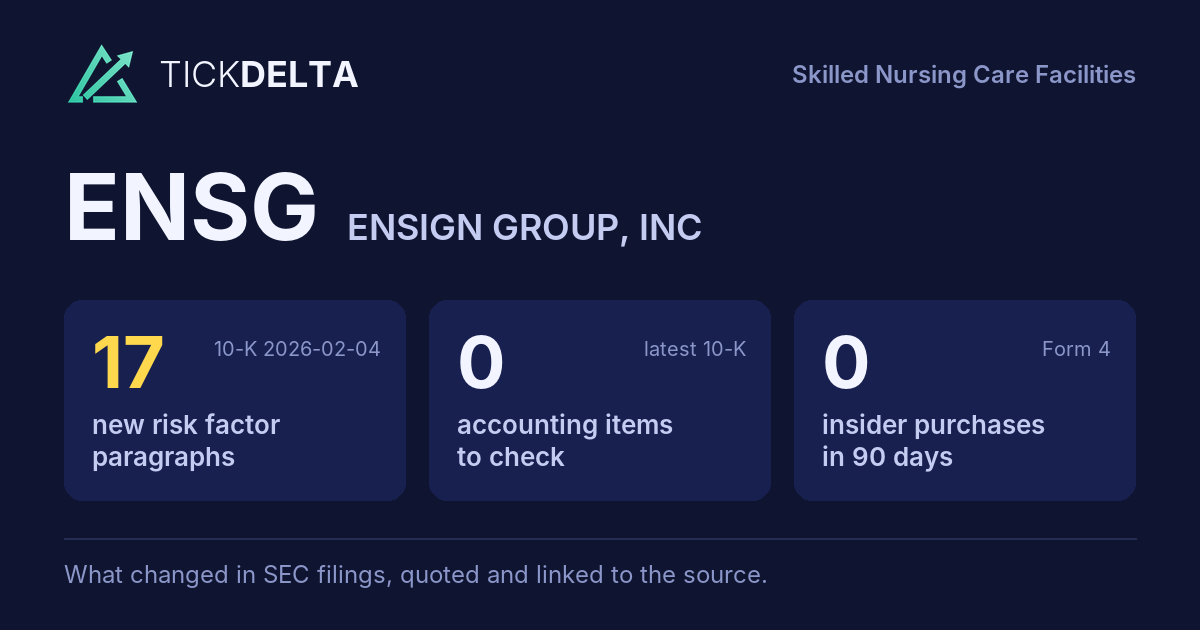
164 changes: 22 added, 17 removed, 122 reworded, 3 quiet changes
10-K Feb 4, 2026 vs Feb 5, 2025
Risk Factors
11.3%
of the text changed · 25,420 words now · 17 new paragraphs, 15 gone
MD&A
12.7%
of the text changed · 9,765 words now · 5 new paragraphs, 2 gone
Legal Proceedings
12.4%
of the text changed · 2,112 words now
Accounting Policies
9.0%
of the text changed · 4,510 words now
10-K 0001125376-26-000007 (Feb 4, 2026) vs 10-K 0001125376-25-000021 (Feb 5, 2025)
Every paragraph, and how much of it changed
One bar per paragraph, in the order of the 10-K. Height and colour show the share of its words not in the closest paragraph a year earlier; the tallest bars are new paragraphs.
Risk Factors
290 paragraphs · 17 new · 73 reworded · 15 gone · 10-K Feb 4, 2026 against Feb 5, 2025
New paragraph
Reworded (5% of its words or more)
Same or nearly
Paragraph 62 · 45% changed
Every version of it
Paragraph 74 · 43% changed
Every version of it
Paragraph 155 · 41% changed
Every version of it
Paragraph 140 · 39% changed
Every version of it
Paragraph 56 · 32% changed
Every version of it
•administrative or legislative changes to base rates or the bases for payment, including changes to the rates at which Medicare will reimburse services; services, including the imposition of, and periodic delay in imposing, reductions in reimbursement based on the sequestration of Medicare reimbursement;
Paragraph 61 · 31% changed
Every version of it
Reductions in reimbursement rates or the scope of services being reimbursed could have a material, adverse effect on our revenue, financial condition and results of operations or even result in reimbursement rates that are insufficient to cover our operating costs. In addition, CMS may make future adjustments to reimbursement levels and underlying reimbursement formulae as it continues to monitor the impact of current payments system on patient outcomes and budget neutrality. The Biden-Harris Administration focused on studying the nursing home industry and directed HHS to issue proposed rules based on those studies, including changes to SNF facility reimbursement and specifically, the SNF-VBP Program, which may also adversely affect our reimbursement. The change in presidency following the 2024 presidential election may result in different focuses with respect to the nursing home industry. The new current Presidential Administration's policy directives and priorities regarding the nursing home industry and SNFs in particular are not yet fully known. These metrics potentially affecting our revenues As of July 4, 2025, Congress passed and expenses the current Presidential Administration signed into law the OBBB, which reversed and limited the efficacy of certain parts of the ACA, including expansion of the Medicaid program in future government fiscal years include the SNF healthcare-associated infections (HAI) measurement, total nursing hours per resident day measures, and discharge participating states. Additionally, CMS has prescribed strict guidelines regarding how SNFs’ are able to community - post acute care measure. The Interoperability Final Rule’s implementation beginning in 2026, and to be completed by January 1, 2027, may also adversely affect our reimbursement paid through Medicare, specifically including Medicare Advantage. use pre-admission arbitration agreements.
Paragraph 150 · 30% changed
Every version of it
Other states that do not require certificates of need have effectively barred the expansion of existing facilities and the establishment of new ones by placing partial or complete moratoria on the number of new Medicaid beds those states will certify in certain areas or throughout the entire state. Still other states have established such stringent development standards and approval procedures for constructing new healthcare facilities that the construction of new facilities, or the expansion or renovation of existing facilities, may become cost-prohibitive or extremely time-consuming. In addition, some states require the approval of the state Attorney General for acquisition of a facility being operated by a non-profit organization. For example, in California a non-profit seller must provide written notice to the Attorney General detailing the proposed transaction. The Attorney General must then review the transaction and provide written consent (or conditional consent) before it can proceed to closing. The Attorney General's review often includes at least one public meeting to gather community input on the transaction's effects. An independent healthcare impact statement may be prepared to assess potential effects on the availability, accessibility, and affordability of healthcare services, including charity care levels, emergency services, and community benefits. The Attorney General has discretion to approve, conditionally approve, or deny the transaction.
Paragraph 83 · 47% changed
Every version of it
10-K Feb 5, 2025As a result of the 2024 presidential election, changes in the Presidency and both houses of Congress may result in significant changes in, and have resulted in uncertainty with respect to, legislation, regulation, implementation or repeal of laws and rules related to government health programs, including Medicare and Medicaid. In particular, proposals regarding HHS and certain programs and regulation concerning health care, including Medicare, Medicaid, and the ACA, have indicated that the incoming Presidential Administration seeks to make changes to these programs and laws, as well as their implementation. Other pending legislation, such as the Protecting America’s Seniors’ Access to Care Act and Protecting America's Rural Seniors' Access Act, which seek to halt HHS and CMS from finalizing and enforcing its proposed rule for staffing requirements, indicates a bipartisan interest in restraining HHS’s ability to finalize, implement and enforce regulations that may be burdensome on our independent subsidiaries, creating still more uncertainty and unpredictability in the legislative process.
10-K Feb 4, 2026
The current Presidential administration and control of Congress by the President's political party have resulted in changes that have caused, and will continue to cause, uncertainty with respect to legislation, regulation, implementation or repeal of laws and rules related to government health programs, including Medicare and Medicaid. This includes changes to the Medicaid program contained in the OBBB, which could reduce Medicaid funds available for reimbursement, potentially limit the amount of reimbursement paid by Medicaid for our services, potentially limit our potential resident population, adversely affect potential residents’ eligibility and ability to pay for services performed by our independent subsidiaries. Further, proposals regarding HHS and certain programs and regulations concerning health care, including Medicare, Medicaid, and the ACA, have indicated that the current Presidential administration seeks to make changes to these programs and laws, as well as their implementation.
Paragraph 62 · 45% changed
Every version of it
10-K Feb 5, 2025Reductions in reimbursement rates or the scope of services being reimbursed could have a material, adverse effect on our revenue, financial condition and results of operations or even result in reimbursement rates that are insufficient to cover our operating costs. In addition, CMS may make future adjustments to reimbursement levels and underlying reimbursement formulae as it continues to monitor the impact of current payments system on patient outcomes and budget neutrality. The Biden-Harris Administration focused on studying the nursing home industry and directed HHS to issue proposed rules based on those studies, including changes to SNF facility reimbursement and specifically, the SNF-VBP Program, which may also adversely affect our reimbursement. The change in presidency following the 2024 presidential election may result in different focuses with respect to the nursing home industry. The new Presidential Administration's policy directives and priorities regarding the nursing home industry and SNFs in particular are not yet known. These metrics potentially affecting our revenues and expenses in future government fiscal years include the SNF healthcare-associated infections (HAI) measurement, total nursing hours per resident day measures, and discharge to community - post acute care measure. The Interoperability Final Rule’s implementation beginning in 2026, and to be completed by January 1, 2027, may also adversely affect our reimbursement paid through Medicare, specifically including Medicare Advantage.
10-K Feb 4, 2026
The metrics potentially affecting our revenues and expenses in future government fiscal years include the SNF healthcare-associated infections (HAI) measurement, total nursing hours per resident day measures, and discharge to community - post acute care measure. The Interoperability Final Rule’s implementation beginning in 2026, and to be completed by January 1, 2027, may also adversely affect our reimbursement paid through Medicare, specifically including Medicare Advantage.
Paragraph 74 · 43% changed
Every version of it
10-K Feb 5, 2025For example, Washington state incorporates the costs of direct care, indirect care, and capital expenditures for SNF services in computing the State’s Medicaid payments to nursing facilities. Using periodically updated calculations that account for factors including case acuity, fair market value of capital expenditures, inflation, and facility performance, Washington sets facility compensation so that the majority of Medicaid reimbursement paid to a skilled nursing facility is used for care-related activities, with limitations on how much a facility’s reimbursement may increase from year to year. Washington state first adopted this care-based payment model in 2015 and has periodically updated it since, including in 2020, 2022, and 2023; it is expected that Washington will continue to amend this law in the future. For state fiscal year 2024, Texas requires all nursing facilities must show that a portion of funds paid to SNFs by Texas’s Medicaid program, including both fee-for-service and managed care reimbursement, were expended for direct care activities, including direct care staff wages and benefits. In addition, California in the past has proposed bills that, if passed, would require nursing facilities to spend a stated percentage of revenue on direct patient-related services. While the most recent attempt by the California Assembly (Bill 1537) to impose direct spending requirements on SNFs has been placed in suspense with no action being taken, similar legislation in the future may seek to impose identical or analogous funding requirements for SNFs operating in California or other states.
10-K Feb 4, 2026
In addition, California in the past has proposed bills that, if passed, would require nursing facilities to spend a stated percentage of revenue on direct patient-related services. While the most recent attempt by the California Assembly (Bill 1537) to impose direct spending requirements on SNFs has been placed in suspense with no action being taken, similar legislation in the future may seek to impose identical or analogous funding requirements for SNFs operating in California or other states.
Paragraph 155 · 41% changed
Every version of it
10-K Feb 5, 2025As another example, Texas passed a bill which partially restored Medicaid state relief funding for SNFs through August 31, 2023, while it also considered legislation that contained direct care spending requirements and ownership, similar to proposed federal rulemaking discussed in Item 1., Government Regulation. While this bill provided financial relief to our independent subsidiaries in Texas, other proposed bills may impose the same regulatory requirements and limitations inherent in both the proposed legislation in other states and the federally proposed rule requiring disclosure of such information in applications and change-of-ownership disclosures, which may adversely affect our business, operations, and profitability.
10-K Feb 4, 2026
Other new and proposed legislation may impose the same regulatory requirements and limitations inherent in both the proposed legislation in other states and the federally proposed rule requiring disclosure of such information in applications and change-of-ownership disclosures, which may adversely affect our business, operations, and profitability.
Paragraph 140 · 39% changed
Every version of it
10-K Feb 5, 2025Federal laws and regulations, such as the Staffing Rule, may increase our costs of maintaining qualified nursing and skilled personnel, or make it more difficult for us to attract or retain qualified nurses and skilled staff members. Proposed legislation, such as the previously proposed Nursing Home Improvement Act and the proposed HCBS Access Act, may make it more expensive to compete for, hire, and retain nursing staff, if passed into law in substantially the same form as previously introduced to Congress. The Biden-Harris Administration sought to increase staffing level requirements for the nursing home industry and to tie reimbursement to the salary, benefits, and retention of staff, which may increase our labor costs. The change in Presidential Administration may not result in a change in this policy, and instead it is possible that HHS and CMS, under new leadership, could impose more stringent requirements for staffing. CMS has published guidance to surveyors addressing topics that specifically include nurse staffing and collection of payroll data to evaluate appropriate staffing levels, which may lead to future regulations that increase our staffing requirements and labor costs or lower revenues.
10-K Feb 4, 2026
Laws and regulations may increase our costs of maintaining qualified nursing and skilled personnel, or make it more difficult for us to attract or retain qualified nurses and skilled staff members. Proposed legislation, such as the previously proposed Nursing Home Improvement Act and the proposed HCBS Access Act, may make it more expensive to compete for, hire, and retain nursing staff, if passed into law in substantially the same form as previously introduced to Congress. Although the Staffing Rule is not likely to take effect due to HHS and CMS's abandonment of appeals in its defense, promulgation of an interim final rule to prohibit the Staffing Rule's staffing ratios from taking effect, and defunding of the Staffing Rule by the OBBB, future presidential administrations may revive this concept and seek to restore that rule or impose new staffing rules that are equally or more stringent.
Paragraph 56 · 32% changed
Every version of it
10-K Feb 5, 2025
•administrative or legislative changes to base rates or the bases for payment, including changes to the rates at which Medicare will reimburse services;
10-K Feb 4, 2026
•administrative or legislative changes to base rates or the bases for payment, including changes to the rates at which Medicare will reimburse services, including the imposition of, and periodic delay in imposing, reductions in reimbursement based on the sequestration of Medicare reimbursement;
Paragraph 61 · 31% changed
Every version of it
10-K Feb 5, 2025
Reductions in reimbursement rates or the scope of services being reimbursed could have a material, adverse effect on our revenue, financial condition and results of operations or even result in reimbursement rates that are insufficient to cover our operating costs. In addition, CMS may make future adjustments to reimbursement levels and underlying reimbursement formulae as it continues to monitor the impact of current payments system on patient outcomes and budget neutrality. The Biden-Harris Administration focused on studying the nursing home industry and directed HHS to issue proposed rules based on those studies, including changes to SNF facility reimbursement and specifically, the SNF-VBP Program, which may also adversely affect our reimbursement. The change in presidency following the 2024 presidential election may result in different focuses with respect to the nursing home industry. The new Presidential Administration's policy directives and priorities regarding the nursing home industry and SNFs in particular are not yet known. These metrics potentially affecting our revenues and expenses in future government fiscal years include the SNF healthcare-associated infections (HAI) measurement, total nursing hours per resident day measures, and discharge to community - post acute care measure. The Interoperability Final Rule’s implementation beginning in 2026, and to be completed by January 1, 2027, may also adversely affect our reimbursement paid through Medicare, specifically including Medicare Advantage.
10-K Feb 4, 2026
Reductions in reimbursement rates or the scope of services being reimbursed could have a material, adverse effect on our revenue, financial condition and results of operations or even result in reimbursement rates that are insufficient to cover our operating costs. In addition, CMS may make future adjustments to reimbursement levels and underlying reimbursement formulae as it continues to monitor the impact of current payments system on patient outcomes and budget neutrality. The Biden-Harris Administration focused on studying the nursing home industry and directed HHS to issue proposed rules based on those studies, including changes to SNF facility reimbursement and specifically, the SNF-VBP Program, which may also adversely affect our reimbursement. The current Presidential Administration's policy directives and priorities regarding the nursing home industry and SNFs in particular are not yet fully known. As of July 4, 2025, Congress passed and the current Presidential Administration signed into law the OBBB, which reversed and limited the efficacy of certain parts of the ACA, including expansion of the Medicaid program in participating states. Additionally, CMS has prescribed strict guidelines regarding how SNFs’ are able to use pre-admission arbitration agreements.
Paragraph 150 · 30% changed
Every version of it
10-K Feb 5, 2025
Other states that do not require certificates of need have effectively barred the expansion of existing facilities and the establishment of new ones by placing partial or complete moratoria on the number of new Medicaid beds those states will certify in certain areas or throughout the entire state. Still other states have established such stringent development standards and approval procedures for constructing new healthcare facilities that the construction of new facilities, or the expansion or renovation of existing facilities, may become cost-prohibitive or extremely time-consuming. In addition, some states require the approval of the state Attorney General for acquisition of a facility being operated by a non-profit organization.
10-K Feb 4, 2026
Other states that do not require certificates of need have effectively barred the expansion of existing facilities and the establishment of new ones by placing partial or complete moratoria on the number of new Medicaid beds those states will certify in certain areas or throughout the entire state. Still other states have established such stringent development standards and approval procedures for constructing new healthcare facilities that the construction of new facilities, or the expansion or renovation of existing facilities, may become cost-prohibitive or extremely time-consuming. In addition, some states require the approval of the state Attorney General for acquisition of a facility being operated by a non-profit organization. For example, in California a non-profit seller must provide written notice to the Attorney General detailing the proposed transaction. The Attorney General must then review the transaction and provide written consent (or conditional consent) before it can proceed to closing. The Attorney General's review often includes at least one public meeting to gather community input on the transaction's effects. An independent healthcare impact statement may be prepared to assess potential effects on the availability, accessibility, and affordability of healthcare services, including charity care levels, emergency services, and community benefits. The Attorney General has discretion to approve, conditionally approve, or deny the transaction.
MD&A
152 paragraphs · 5 new · 62 reworded · 2 gone · 10-K Feb 4, 2026 against Feb 5, 2025
New paragraph
Reworded (5% of its words or more)
Same or nearly
Paragraph 13 · 47% changed
Subsequent to December 31, 2024, 2025, Standard Bearer added $50.9 approximately $18.1 million of real estate associated with four two stand-alone skilled nursing operations and one campus operation. Four operations, as discussed above, where all of the acquisitions stand-alone skilled nursing facilities were related to exercising purchase options from CareTrust REIT, Inc. (CareTrust) lease arrangements, which the operations are currently operated and managed by our independent subsidiaries. The remaining real estate acquisition was leased back to our independent subsidiaries. In addition, Standard Bearer had previously purchased the real estate for two of stand-alone skilled nursing operations, which were subsequently transferred from a third-party operator to the Company’s independent subsidiaries.
Paragraph 105 · 37% changed
Revenue in our Same Facilities increased $195.3 $209.5 million, or 6.9%, 6.5%, compared to the same period in 2023, year ended December 31, 2024, due to increased occupancy from long-term care patients, strong skilled days and revenue per patient day. Our diligent continuous efforts to strengthen our partnerships with various managed care organizations, hospitals and local communities, communities increased our managed care revenue by 12.1%, mainly due to increases 9.3%, resulting from an increase in managed care days of 6.5% and revenue per patient day of 3.6%. day. We continued to see a shift in grow our Medicare patient population from Medicare in addition to managed care as capturing market share in the increases in Medicare Advantage enrollment continues to account for a larger portion enrollments of the overall Medicare eligible population. In addition, Medicaid Our Medicare revenue increased by $89.8 million or 6.8%, mainly from the increases 4.1% due to an increase in Medicaid Medicare days and revenue per patient day. Our In addition, our other skilled mix days and revenue percentage decline was due has continued to our non-skilled days and revenue growing at a faster pace than our skilled days and revenue. Both skilled and non-skilled days and revenue increased from increase as we support the prior year. needs of local communities through the expansion of the Veterans Affairs programs.
Paragraph 103 · 37% changed
Paragraph 122 · 34% changed
Other income (expense), income, net — Other income (expense), net as a percentage of revenue increased by 0.2%. Other income primarily includes interest income from our investments, interest expense related to our debt and deferred compensation gains and losses. Other income (expense), income, net increased by $10.4 $2.5 million due to increases a $2.4 million realized gain on other investments not core to our business operations and a $3.2 million gain on our deferred compensation plan offset by a decrease in interest income from of $4.2 million as we utilized our investments and gains cash on hand to fund more real estate purchases during the period. Changes in our deferred compensation plan which incurs are a result of gains or losses depending on market performance. During the years ended December 31, 2024 and 2023, the deferred compensation plan had gains Other income, net as a percentage of $5.2 million and $4.6 million, respectively. We also recorded an offsetting expense allocated between cost of services and general and administrative expenses. revenue decreased by 0.1%.
Paragraph 104 · 34% changed
Paragraph 106 · 33% changed
Revenue generated by in our Transitioning Facilities increased $34.3 $62.8 million, or 7.3%, primarily 9.0%, compared to the year ended December 31, 2024, due to improved occupancy growth, increases in skilled mix days and revenue per patient day. The increases in revenue were derived from managed care revenue of 25.5%, Medicare revenue of 2.1%, 19.9%, Medicaid revenue of 3.9% 7.0% and private revenue of 16.5%. These 29.5%. The increases demonstrate are a result of an increase in patient days across all payer types, which reflect our ability operational fundamentals as we continue to focus on increasing occupancy across payer types. Included in the year ended December 31, 2023 is the revenue related to a facility that was not operating at full capacity starting in the first quarter of 2024 due to flooding. transition and integrate these facilities.
Paragraph 107 · 32% changed
Paragraph 119 · 32% changed
Rent-cost of services — Our rent-cost of services as a percentage of revenue decreased by 0.2% 0.4% to 5.1%, 4.7%, as the expansions in our operational expansions included a higher mix of footprint have resulted from more real estate purchases. purchases than leased properties.
Paragraph 13 · 47% changed
10-K Feb 5, 2025
Subsequent to December 31, 2024, Standard Bearer added $50.9 million of real estate associated with four stand-alone skilled nursing operations and one campus operation. Four of the acquisitions were related to exercising purchase options from CareTrust REIT, Inc. (CareTrust) lease arrangements, which the operations are currently operated and managed by our independent subsidiaries. The remaining real estate acquisition was leased back to our independent subsidiaries.
10-K Feb 4, 2026
Subsequent to December 31, 2025, Standard Bearer added approximately $18.1 million of real estate associated with two stand-alone skilled nursing operations, as discussed above, where all of the stand-alone skilled nursing facilities were leased back to our independent subsidiaries. In addition, Standard Bearer had previously purchased the real estate for two of stand-alone skilled nursing operations, which were subsequently transferred from a third-party operator to the Company’s independent subsidiaries.
Paragraph 105 · 37% changed
10-K Feb 5, 2025
Revenue in our Same Facilities increased $195.3 million, or 6.9%, compared to the same period in 2023, due to increased occupancy from long-term care patients, strong skilled days and revenue per patient day. Our diligent efforts to strengthen our partnerships with various managed care organizations, hospitals and local communities, increased our managed care revenue by 12.1%, mainly due to increases in managed care days of 6.5% and revenue per patient day of 3.6%. We continued to see a shift in our patient population from Medicare to managed care as Medicare Advantage enrollment continues to account for a larger portion of the overall Medicare eligible population. In addition, Medicaid revenue increased by $89.8 million or 6.8%, mainly from the increases in Medicaid days and revenue per patient day. Our skilled mix days and revenue percentage decline was due to our non-skilled days and revenue growing at a faster pace than our skilled days and revenue. Both skilled and non-skilled days and revenue increased from the prior year.
10-K Feb 4, 2026
Revenue in our Same Facilities increased $209.5 million, or 6.5%, compared to the year ended December 31, 2024, due to increased occupancy from strong skilled days and revenue per patient day. Our continuous efforts to strengthen our partnerships with various managed care organizations, hospitals and local communities increased our managed care revenue by 9.3%, resulting from an increase in managed care days and revenue per patient day. We continued to grow our Medicare patient population in addition to capturing market share in the increases in Medicare Advantage enrollments of the overall Medicare eligible population. Our Medicare revenue increased by 4.1% due to an increase in Medicare days and revenue per day. In addition, our other skilled revenue has continued to increase as we support the needs of local communities through the expansion of the Veterans Affairs programs.
Paragraph 103 · 37% changed
10-K Feb 5, 2025(5)Facility Closed results represent a closed operation during the year ended December 31, 2024 due to the transitioning of an intermediate care facility program to a group home setting, which is included in the All Other category. The skilled services revenue was excluded from Same Facility results for the years ended December 31, 2024 and 2023 for comparison purposes.
10-K Feb 4, 2026
(5)Skilled services revenue and key performance metrics for a closed facility were not material and has been excluded from Same Facilities results during the year ended December 31, 2024. The facility was closed in 2024 as the program was transitioned from an intermediate care facility to a group home setting.
Paragraph 122 · 34% changed
10-K Feb 5, 2025
Other income (expense), net — Other income (expense), net as a percentage of revenue increased by 0.2%. Other income primarily includes interest income from our investments, interest expense related to our debt and deferred compensation gains and losses. Other income (expense), net increased by $10.4 million due to increases in interest income from our investments and gains in our deferred compensation plan which incurs gains or losses depending on market performance. During the years ended December 31, 2024 and 2023, the deferred compensation plan had gains of $5.2 million and $4.6 million, respectively. We also recorded an offsetting expense allocated between cost of services and general and administrative expenses.
10-K Feb 4, 2026
Other income, net — Other income primarily includes interest income from our investments, interest expense related to our debt and deferred compensation gains and losses. Other income, net increased by $2.5 million due to a $2.4 million realized gain on other investments not core to our business operations and a $3.2 million gain on our deferred compensation plan offset by a decrease in interest income of $4.2 million as we utilized our cash on hand to fund more real estate purchases during the period. Changes in our deferred compensation plan are a result of gains or losses depending on market performance. Other income, net as a percentage of revenue decreased by 0.1%.
Paragraph 104 · 34% changed
10-K Feb 5, 2025Our total revenue increased by $531.1 million, or 14.2%, compared to the year ended December 31, 2023. The increase in revenue was primarily driven by an increase in occupancy of 2.7% and 4.1% from our skilled services in Same Facilities and Transitioning Facilities, respectively, coupled with increasing daily revenue rates and the impact of acquisitions. Additionally, our skilled services in Recently Acquired Facilities increased total revenue by $271.7 million, when compared to the same period in 2023.
10-K Feb 4, 2026
Skilled services revenue increased $761.0 million, or 18.7%, compared to the year ended December 31, 2024. The increases in skilled services revenue were across all payer types, primarily driven by strong occupancy and skilled mix performance across our skilled services operations. Our consolidated occupancy increased by 2.1% to 82.2% during the year ended December 31, 2025 compared to the same period in 2024 across all payors, with an increase in skilled days from our operations within Same Facilities and Transitioning Facilities.
Paragraph 106 · 33% changed
10-K Feb 5, 2025
Revenue generated by our Transitioning Facilities increased $34.3 million, or 7.3%, primarily due to improved occupancy growth, increases in skilled mix days and revenue per patient day. The increases in revenue were derived from managed care revenue of 25.5%, Medicare revenue of 2.1%, Medicaid revenue of 3.9% and private revenue of 16.5%. These increases demonstrate our ability to focus on increasing occupancy across payer types. Included in the year ended December 31, 2023 is the revenue related to a facility that was not operating at full capacity starting in the first quarter of 2024 due to flooding.
10-K Feb 4, 2026
Revenue in our Transitioning Facilities increased $62.8 million, or 9.0%, compared to the year ended December 31, 2024, due to improved occupancy growth, increases in skilled mix days and revenue per patient day. The increases in revenue were derived from managed care revenue of 19.9%, Medicaid revenue of 7.0% and private revenue of 29.5%. The increases are a result of an increase in patient days across all payer types, which reflect our operational fundamentals as we continue to transition and integrate these facilities.
Paragraph 107 · 32% changed
10-K Feb 5, 2025Skilled services revenue generated by Recently Acquired Facilities increased by approximately $271.7 million compared to the year ended December 31, 2023. The increases were primarily due to 31 operational expansions between January 1, 2024 and December 31, 2024 across ten states.
10-K Feb 4, 2026
Revenue in our Recently Acquired Facilities increased $489.2 million, compared to the year ended December 31, 2024. The 41 operational expansions between January 1, 2025 and December 31, 2025 across 14 states contributed $339.8 million of the total increase.
Paragraph 119 · 32% changed
10-K Feb 5, 2025
Rent-cost of services — Our rent-cost of services as a percentage of revenue decreased by 0.2% to 5.1%, as our operational expansions included a higher mix of real estate purchases.
10-K Feb 4, 2026
Rent-cost of services — Our rent-cost of services as a percentage of revenue decreased by 0.4% to 4.7%, as the expansions in our footprint have resulted from more real estate purchases than leased properties.
A paragraph is matched with the one last year that shares the most of its words; under half in common makes it new. The paragraphs shown are the 8 reworded the most in each section.
The paragraph that changed most in each section
The redline
Marked against last year's 10-K: cut words struck through, new words highlighted.
Risk Factors169 words changed in this paragraph; it is 49% similar to last year's version.
Source: Item 1A, 10-K 0001125376-26-000007 vs Item 1A, 10-K 0001125376-25-000021
MD&A133 words changed in this paragraph; it is 56% similar to last year's version.
Revenue in our Same Facilities increased $195.3 $209.5 million, or 6.9%, 6.5%, compared to the same period in 2023, year ended December 31, 2024, due to increased occupancy from long-term care patients, strong skilled days and revenue per patient day. Our diligent continuous efforts to strengthen our partnerships with various managed care organizations, hospitals and local communities, communities increased our managed care revenue by 12.1%, mainly due to increases 9.3%, resulting from an increase in managed care days of 6.5% and revenue per patient day of 3.6%. day. We continued to see a shift in grow our Medicare patient population from Medicare in addition to managed care as capturing market share in the increases in Medicare Advantage enrollment continues to account for a larger portion enrollments of the overall Medicare eligible population. In addition, Medicaid Our Medicare revenue increased by $89.8 million or 6.8%, mainly from the increases 4.1% due to an increase in Medicaid Medicare days and revenue per patient day. Our In addition, our other skilled mix days and revenue percentage decline was due has continued to our non-skilled days and revenue growing at a faster pace than our skilled days and revenue. Both skilled and non-skilled days and revenue increased from increase as we support the prior year. needs of local communities through the expansion of the Veterans Affairs programs.
Source: Item 7, 10-K 0001125376-26-000007 vs Item 7, 10-K 0001125376-25-000021
Accounting Policies128 words changed in this paragraph; it is 30% similar to last year's version.
Source: Item 8, Note 2 – SUMMARY OF SIGNIFICANT ACCOUNTING POLICIES, 10-K 0001125376-26-000007 vs Item 8, Note 2 – SUMMARY OF SIGNIFICANT ACCOUNTING POLICIES, 10-K 0001125376-25-000021
Legal Proceedings110 words changed in this paragraph; it is 70% similar to last year's version.
We and our independent subsidiaries have been, and continue to be, subject to claims, findings and legal actions that arise in the ordinary course of the various businesses, including in connection with the delivery of healthcare and non-healthcare services. These claims include but are not limited to potential claims related to patient care and treatment (professional negligence claims) as well as employment related claims. In addition, these claims could impact our ability to procure insurance to cover our exposure related to the various services provided by our independent subsidiaries to their residents, customers and patients. In 2025, we agreed to settle substantially all alleged wage, hour or labor code-related violations asserted on a class or representative basis against our independent subsidiaries in California for purported violations occurring during the six year period ending December 2025, for $12.0 million, pending court approval. While we have been able to settle or otherwise resolve many of these types of claims without an ongoing material adverse effect on our business, a significant increase in the number of these claims, or an increase in the amounts owing owed should plaintiffs be successful in their prosecution of remaining or future claims, could materially adversely affect our business, financial condition, results of operations and cash flows. In addition, these claims could impact our ability to procure insurance to cover our exposure related to the various services provided by our independent subsidiaries to their residents, customers and patients.
Source: Item 3, 10-K 0001125376-26-000007 vs Item 3, 10-K 0001125376-25-000021
Sentences and paragraphs added, removed or reworded
Every change, by type
Sentences and paragraphs of ENSG's Risk Factors and MD&A, 10-K Feb 4, 2026 against 10-K Feb 5, 2025. Each links to the text at sec.gov.
Quiet changes are sentences kept from last year with one to four words changed, at least one of them a hedge, a modal or a qualifier (may, could, will, not, significant, material…). A year or date rolling forward is not counted.
The full word list
adverse, adversely, all, although, anticipate, anticipates, any, approximately, believe, believes, can, cannot, certain, could, expect, expects, generally, however, if, intend, intends, largely, likely, many, material, materially, may, might, most, must, never, no, not, possible, primarily, probable, should, significant, significantly, some, substantial, substantially, unlikely, will, would
AddedRisk Factors
•The OHCA CMIR has the potential to delay, and ultimately prevent, proposed transactions and require disclosure of confidential information.
Read it in 10-K Feb 4, 2026 at sec.gov
AddedRisk Factors
•Our implementation of a new enterprise resource planning (ERP) system may adversely affect our business and results of operations or the effectiveness of our internal controls over financial reporting.
Read it in 10-K Feb 4, 2026 at sec.gov
AddedRisk Factors
The changes to the Medicaid program enacted in the OBBB limits avenues for states to generate Medicaid funding, and may limit who may qualify for Medicaid long-term care benefits. Additionally, states must conduct Medicaid eligibility redeterminations every six months, rather than annually, for individuals enrolled under Medicaid. Any discontinuance or reduction in federal matching of provider tax-related Medicaid expenditures or delays in eligibility or coverage could have a significant and adverse effect on states' Medicaid expenditures (e.g., California, Colorado, and Nevada), and as a result could have a material and adverse effect on our business, financial condition or results of operations.
Read it in 10-K Feb 4, 2026 at sec.gov
AddedRisk Factors
Additionally, although the CR ending the federal government shutdown extends telehealth waivers and flexibilities for SNFs and providers, uncertainty about their permanent status continues to create significant payment and reimbursement challenges.
Read it in 10-K Feb 4, 2026 at sec.gov
AddedRisk Factors
As the initial telehealth waivers and flexibilities have remained in place over time, Congress has suggested making such waivers and flexibilities permanent through permanent legislation changing the Medicare Act. No amendment to existing law has occurred to make the telehealth waivers that were first granted during the PHE permanent, and the payment for telehealth continues to be addressed through periodic spending legislation passed by Congress (see Proposed, Anticipated and Recently Issued Rulemaking and Administrative Actions). The lack of formality making these telehealth flexibilities permanent through a change in law creates continued uncertainty around their future availability. During the government shutdown, certain telehealth services became non-reimbursable because they did not conform to pre-pandemic telehealth rules, requiring providers and suppliers to revert back to pre-pandemic operation models.
Read it in 10-K Feb 4, 2026 at sec.gov
AddedRisk Factors
Based on this treatment of telehealth flexibilities through periodic spending bills and temporary rulemaking, rather than a permanent amendment of the Medicare Act, providers, SNFs, and our independent subsidiaries face difficult decisions about how to conduct their operations so that they may be reimbursed for their services provided to Medicare beneficiaries.
Read it in 10-K Feb 4, 2026 at sec.gov
AddedRisk Factors
With the passage of the IRA in 2022, Congress expanded and supplemented the ACA, including through the continuation of federally funded insurance premium subsidies. This modification of the ACA by the IRA indicates that Congress may continue to change and expand the ACA in the future. Since the commencement of the current Presidential Administration in January of 2025, there have been executive actions and proposed legislation, including the enactment of the OBBB, which undoes or limits the effect of portions of the ACA, including its Medicaid expansion provisions. The OBBB’s provisions may also affect the availability of Medicaid for potential beneficiaries due to work requirements, limit eligibility for our independent subsidiaries’ services due to caps on home equity that may be disregarded for eligibility purposes and also limit the reimbursement available for our services under Medicaid. These legislative changes, and the effects of the current Presidential Administration’s executive orders, are not yet fully realized in terms of their effects on our business.
Read it in 10-K Feb 4, 2026 at sec.gov
AddedRisk Factors
On April 2, 2025, President Trump signed an executive order to impose a variety of tariffs on the global trading partners of the United States. In the months since then, the tariffs with various countries have been increased, decreased, paused, and been reinstated as part of a broader trade negotiation strategy that has caused uncertainty in various product markets. These tariffs have the potential to increase costs on goods that are imported into the United States. As it pertains to our independent subsidiaries, tariffs on medical supplies may lead to higher costs to providers and the federal government through the Medicare and Medicaid programs and may impact the formulas used to calculate federal reimbursements.
Read it in 10-K Feb 4, 2026 at sec.gov
Show the other 50
AddedRisk Factors
The OHCA CMIR has the potential to delay or prevent proposed transactions and require disclosure of confidential information.
Read it in 10-K Feb 4, 2026 at sec.gov
AddedRisk Factors
The California OHCA CMIR process may delay, and potentially ultimately prevent, the closing of certain proposed transactions. If a CMIR results in a negative finding and generates a referral to the California Attorney General, that could result in the parties not being able to conclude the proposed transaction and possibly require the subject facilities to appoint new managers. Any delay or prevention of completing transactions could have adverse effect on the operations of our independent subsidiaries. The risk of an adverse regulatory outcome, competitive harm, or potential legal action will persist until the CMIR is successfully concluded.
Read it in 10-K Feb 4, 2026 at sec.gov
AddedRisk Factors
The CMIR process also seeks the disclosure of confidential information regarding our independent subsidiaries’ reimbursement rates and financial performance. This information is subject to contractual confidentiality obligations and otherwise proprietary to our business and is likewise a source of competitive advantage in the marketplace. If this information is disclosed to, or otherwise obtained by OHCA, we anticipate that it will be publicly available and could provide competitors with otherwise unavailable data on the financial operations and reimbursement relationships of our independent subsidiaries.
Read it in 10-K Feb 4, 2026 at sec.gov
AddedRisk Factors
We have filed a Petition in the Superior Court of the State of California, County of Orange, seeking a declaration that the CMIR regulations violate the United States Constitution and/or the California Constitution, and is void and unenforceable as applied to us. We have requested that OHCA be ordered to withdraw the subpoena and close the inquiry, so the underlying transaction can be completed.
Read it in 10-K Feb 4, 2026 at sec.gov
RemovedRisk Factors
RemovedRisk Factors
RemovedRisk Factors
RemovedRisk Factors
RemovedRisk Factors
RemovedRisk Factors
RemovedRisk Factors
RemovedRisk Factors
RemovedRisk Factors
RemovedRisk Factors
RemovedRisk Factors
RemovedRisk Factors
RewordedRisk Factors
RewordedRisk Factors
RewordedRisk Factors
While it is not possible to predict whether and when any such changes will occur, specific proposals discussed during and after made by the election, current Administration or others in anticipation of mid-term elections in the U.S., including a repeal or material amendment of the ACA ACA, potential cuts to the Medicare or Medicaid programs by Congress through the budget reconciliation process, or other laws affecting the provision of healthcare services, could harm our business, operating results and financial condition.
Read it in 10-K Feb 4, 2026 at sec.gov
RewordedRisk Factors
The outcome of the 2024 presidential election, including change in control of the Senate and Presidency from the Democratic to the Republican party, current Presidential Administration may result in a reversal reverse some of these orders, cause significant changes in HHS and CMS policy and rulemaking, and a reduced reduce the likelihood of successful legislation that seeks to provide more resources to creating pathways to care-based careers.
Read it in 10-K Feb 4, 2026 at sec.gov
RewordedRisk Factors
The SNF PPS FY 2025 Final Rule implemented increased PPS introduced higher penalties that surveyors may can impose on SNFs for perceived non-compliance if they are found to be non-compliant with CMS’s requirements for SNF participation in Medicare. Medicare program.
Read it in 10-K Feb 4, 2026 at sec.gov
RewordedRisk Factors
Additionally, CMS's recently finalized rule requiring disclosure of ownership and financial relationships between nursing facilities and property owners or management entities, which now carries new requirements for re-certification that have been delayed in implementation and may take effect at a future, yet-unknown date, as well as other state rules over ownership transparency, may provide an additional basis for further investigation, administrative action, and ultimately fines, penalties, or sanctions and could dissuade individuals and businesses from doing business with us or our independent subsidiaries.
Read it in 10-K Feb 4, 2026 at sec.gov
RewordedRisk Factors
Additionally, CMS issued its the 42 CFR Part 2 final rule issued in 2024 updating the separate confidentiality requirements for Substance Use Disorder substance use disorder (SUD) records maintained. requires compliance by February 16 ,2026.
Read it in 10-K Feb 4, 2026 at sec.gov
RewordedRisk Factors
In addition, in 2023, CMS updated the survey resources that and guidelines used both by CMS and state surveyors use in evaluating our SNFs’ compliance with federal Requirements for Participation, incorporating recent changes to CMS’s methods for surveying infection control procedures. participation requirements.
Read it in 10-K Feb 4, 2026 at sec.gov
RewordedRisk Factors
The ACA continues to be a salient political topic and proposed changes to it may become the subject of campaign promises, litigation, administrative action, or legislation following under the 2024 presidential election. current Presidential Administration, and the Senate, where the Republican party now holds a majority of seats.
Read it in 10-K Feb 4, 2026 at sec.gov
RewordedRisk Factors
RewordedRisk Factors
Certain results of the Biden-Harris Administration’s rulemaking, including enhanced enforcement ability, may be retained under the new current Presidential Administration. Administration, as signaled by its recent decision to prohibit pre-dispute agreements to arbitrate disputes in SNF admission agreements.
Read it in 10-K Feb 4, 2026 at sec.gov
RewordedRisk Factors
These enhanced penalties and enforcement activities precedes greater focus by CMS in obtaining oversight over SFFs, and continuing that oversight even after those SFFs improve, improve as recommended by the OIG in its October 24, 2025 report and recommendations regarding the SFF program, and subjecting them to more exacting and routine oversight.
Read it in 10-K Feb 4, 2026 at sec.gov
Quiet changesRisk Factors
We currently have no facilities one facility placed on SFF status.
Read it in 10-K Feb 4, 2026 at sec.gov
Quiet changesRisk Factors
In November of 2023, OIG added to its work plan an audit of nursing homes' nurse staffing hours reported in CMS's payroll-based journal, for which OIG expects expected to issue a report in FY 2025.
Read it in 10-K Feb 4, 2026 at sec.gov
Quiet changesRisk Factors
If we fail to comply with applicable environmental laws, we would will face increased expenditures in terms of fines and remediation of the underlying problems, potential litigation relating to exposure to such materials, and a potential decrease in value to our business and in the value of our underlying assets.
Read it in 10-K Feb 4, 2026 at sec.gov
AddedMD&A
Insignia Pathway - In November 2025, we donated $10.0 million to Insignia Pathway, a non-profit organization formed in 2024 with a mission to empower, support and expand the post-acute care workforce. Insignia Pathway is dedicated to inspiring the current and next generation to choose careers in this essential field. In its first year of operation, the charity awarded over $1.0 million in grants to Registered Nurses from 23 countries who have committed to work for U.S.-based skilled nursing providers. In total, we have donated $45.0 million to Insignia Pathway since its formation.
Read it in 10-K Feb 4, 2026 at sec.gov
AddedMD&A
Litigation — During the year ended December 31, 2025, we agreed to settle all alleged wage, hour or labor code-related violations asserted on a class or representative basis against our independent subsidiaries in California for purported violations occurring during the six year period ending December 2025, for $12.0 million, pending court approval.
Read it in 10-K Feb 4, 2026 at sec.gov
AddedMD&A
(2) Represents gains on the sale of investments that are not part of our core business operations. These investments have no observable market prices and are held at historical cost basis until sold or impaired.
Read it in 10-K Feb 4, 2026 at sec.gov
AddedMD&A
(2) Represents gains on the sale of investments that are not part of our core business operations. These investments have no observable market prices and are held at historical cost basis until sold or impaired.
Read it in 10-K Feb 4, 2026 at sec.gov
AddedMD&A
Our average Medicaid rates increased 4.6% due to state reimbursement increases, our participation in Medicaid supplemental payment and quality improvement programs in various states.
Read it in 10-K Feb 4, 2026 at sec.gov
RemovedMD&A
RemovedMD&A
RewordedMD&A
Year Ended December 31, 2025 2024 2023 Change % Change TRANSITIONING SAME FACILITY RESULTS:(3) RESULTS:(2)(5) (Dollars in thousands) Skilled services revenue $ 507,143 3,424,421 $ 472,808 3,214,896 $ 34,335 7.3% 209,525 6.5% Number of facilities at period end 40 40 210 210 — —% Number of campuses at period end(1) 1 1 25 25 — —% Actual patient days 1,336,074 1,302,680 33,394 2.6% 7,579,892 7,382,176 197,716 2.7% Occupancy percentage — Operational beds 76.0 82.9 % 73.0 80.9 % 3.0 2.0 % 4.1% 2.5% Skilled mix by nursing days 21.8 32.3 % 20.7 31.1 % 1.1 1.2 % 5.3% 3.9% Skilled mix by nursing revenue 38.4 51.2 % 38.4 49.5 % — 1.7 % —% 3.4%
Read it in 10-K Feb 4, 2026 at sec.gov
RewordedMD&A
Year Ended December 31, 2025 2024 2023 Change % Change TRANSITIONING FACILITY RESULTS:(3) (Dollars in thousands) Skilled services revenue $ 507,143 760,325 $ 472,808 697,529 $ 34,335 7.3% 62,796 9.0% Number of facilities at period end 40 40 48 48 — —% Number of campuses at period end(1) 1 1 2 2 — —% Actual patient days 1,336,074 1,302,680 33,394 2.6% 1,703,570 1,639,695 63,875 3.9% Occupancy percentage — Operational beds 76.0 84.2 % 73.0 80.8 % 3.0 3.4 % 4.1% 4.2% Skilled mix by nursing days 21.8 29.6 % 20.7 27.8 % 1.1 1.8 % 5.3% 6.5% Skilled mix by nursing revenue 38.4 50.8 % 38.4 48.6 % — 2.2 % —% 4.5%
Read it in 10-K Feb 4, 2026 at sec.gov
RewordedMD&A
(In thousands) Income before provision for income taxes $ 455,622 $ 386,094 $ 272,762 Stock-based compensation expense 48,299 36,226 30,767 Litigation(1) 12,000 (1,425) 60,781 Loss (gain) on long-lived assets and gain (Gain) loss on business interruption recoveries and long-lived assets, net (3,285) 2,335 (1,132) Gain on other investments(2) (2,437) — Acquisition related costs(2) costs(3) 2,211 1,019 814 Costs incurred related to system implementations 2,430 2,953 963 Depreciation and amortization - patient base(3) base(4) 1,020 574 355 Interest expense - write off deferred financing fees(4) fees(5) — 200 — ADJUSTED EBT $ 515,860 $ 427,976 $ 365,310
Read it in 10-K Feb 4, 2026 at sec.gov
RewordedMD&A
The $29.5 $217.1 million decrease increase in cash provided by operating activities for the year ended December 31, 2024 2025 compared to the same period in 2023 2024 was due to payment an increase in operational performance and timing of the $48.0 million related to the litigation matter discussed in Item 3., Legal Proceedings payments and we funded $35.0 million to Insignia Pathway, which is discussed in Recent Activities. accounts receivable collections.
Read it in 10-K Feb 4, 2026 at sec.gov
RewordedMD&A
The $1.6 $9.6 million increase in cash provided used by financing activities for the year ended December 31, 2024 2025 compared to the same period in 2023, 2024, was primarily due to $20.0 million of share repurchases in 2025 as part of our stock option exercises repurchase program offset by an increase in cash provided by the purchase issuance of non-controlling interest in one of our ancillary businesses. stock options.
Read it in 10-K Feb 4, 2026 at sec.gov
RewordedMD&A
Operational and New State Expansions — During the year ended December 31, 2024, 2025, we expanded our operations with the addition of 28 40 stand-alone skilled nursing operations, five stand-alone senior living operations and three one campus operations, which added a total of 3,030 operational skilled nursing beds and 218 operational senior living units to be operated by our independent subsidiaries. operation.
Read it in 10-K Feb 4, 2026 at sec.gov
RewordedMD&A
Stock-based compensation expense 48,299 36,226 30,767 Litigation(1) 12,000 (1,425) 60,781 Loss (gain) on long-lived assets and gain (Gain) loss on business interruption recoveries and long-lived assets, net (3,285) 2,335 (1,132) Gain on other investments(2) (2,437) — Acquisition related costs(2) costs(3) 2,211 1,019 814 Costs incurred related to system implementations 2,430 2,953 963 ADJUSTED EBITDA $ 602,350 $ 490,392 $ 425,762 Rent—cost of services 239,312 216,016 197,358 ADJUSTED EBITDAR $ 706,408 841,662
Read it in 10-K Feb 4, 2026 at sec.gov
RewordedMD&A
RewordedMD&A
Subsequent to December 31, 2024, 2025, Standard Bearer added $50.9 approximately $18.1 million of real estate associated with four two stand-alone skilled nursing operations and one campus operation. operations, as discussed above, where all of the stand-alone skilled nursing facilities were leased back to our independent subsidiaries.
Read it in 10-K Feb 4, 2026 at sec.gov
RewordedMD&A
We continued to see a shift in grow our Medicare patient population from Medicare in addition to managed care as capturing market share in the increases in Medicare Advantage enrollment continues to account for a larger portion enrollments of the overall Medicare eligible population.
Read it in 10-K Feb 4, 2026 at sec.gov
RewordedMD&A
RewordedMD&A
Cash paid to fund acquisitions was $323.3 million for the year ended December 31, 2025 compared to $156.5 million for the year ended December 31, 2024 compared to cash paid of $69.0 million for the year ended December 31, 2023. 2024.
Read it in 10-K Feb 4, 2026 at sec.gov
Sources
The two latest 10-Ks on EDGAR, section by section. Each change links to the text at sec.gov.
Also
New risk factors: paragraphs with nothing like them last year, quoted in full.
Work with it
Excel workbook · CSV. Google Sheet that stays up to date: paste =IMPORTDATA("https://tickdelta.com/company/ENSG/export.csv") into a cell.