Screener / SEC EDGAR /CIK 0001125376 /10-K filed Feb 4, 2026, compared with Feb 5, 2025 /Numbers from the XBRL of the 10-Ks
Nasdaq Health care · Skilled Nursing Care Facilities

Ensign Group, Inc ENSG

Compare with peers Embed
New in the 10-K 17 paragraphs with nothing like them in the 10-K filed Feb 5, 2025 New in the 10-Q 44 paragraphs not in the 10-Q filed Jul 27, 2026 10-Q against the 10-K 72 risk factor paragraphs and sentences added or reworded

New risk paragraphs, branching off last year

Each branch is a paragraph in Risk Factors with nothing like it in the 10-K filed Feb 5, 2025. A box jumps to the paragraph as filed, below.

17 new

Paragraphs with nothing like them in last year's 10-K

Quoted exactly

17 paragraphs in Risk Factors of the 10-K filed Feb 4, 2026 with nothing like them in the 10-K filed Feb 5, 2025. Quoted exactly. Paragraphs that were only edited are under 10-K change.

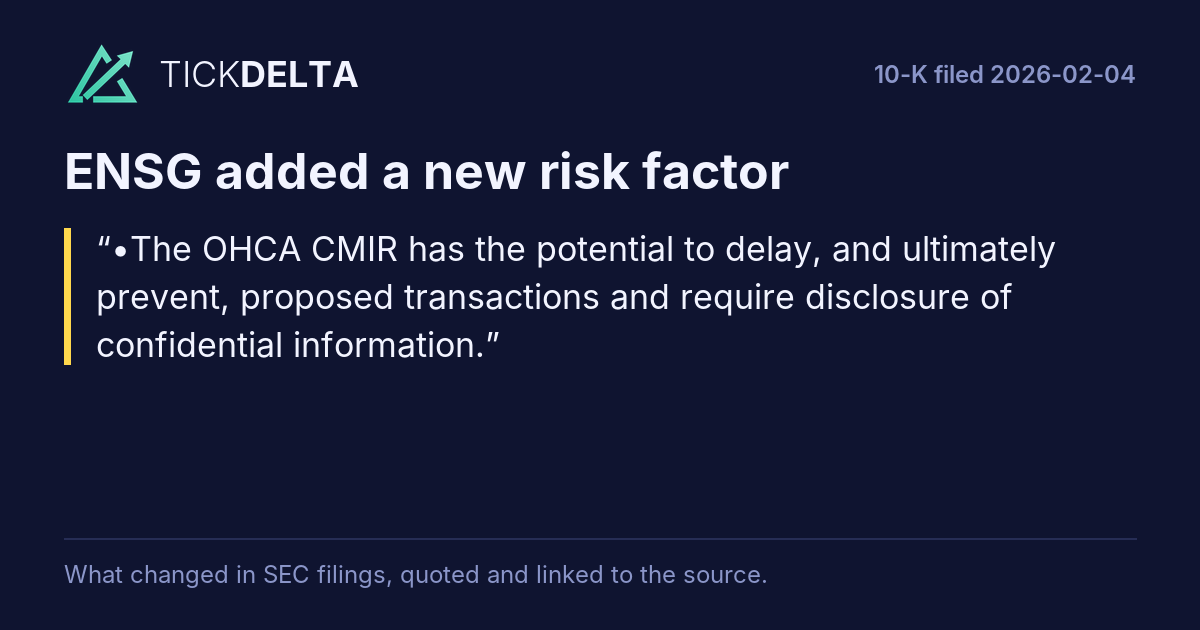
•The OHCA CMIR has the potential to delay, and ultimately prevent, proposed transactions and require disclosure of confidential information.

Read in the 10-K

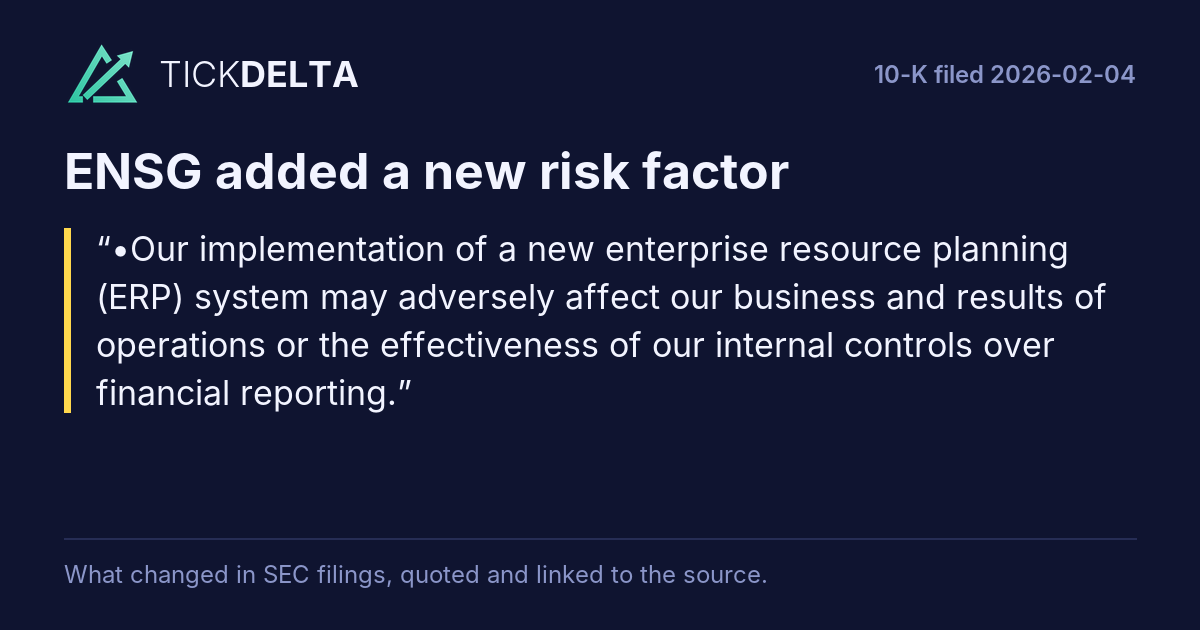
•Our implementation of a new enterprise resource planning (ERP) system may adversely affect our business and results of operations or the effectiveness of our internal controls over financial reporting.

Read in the 10-K

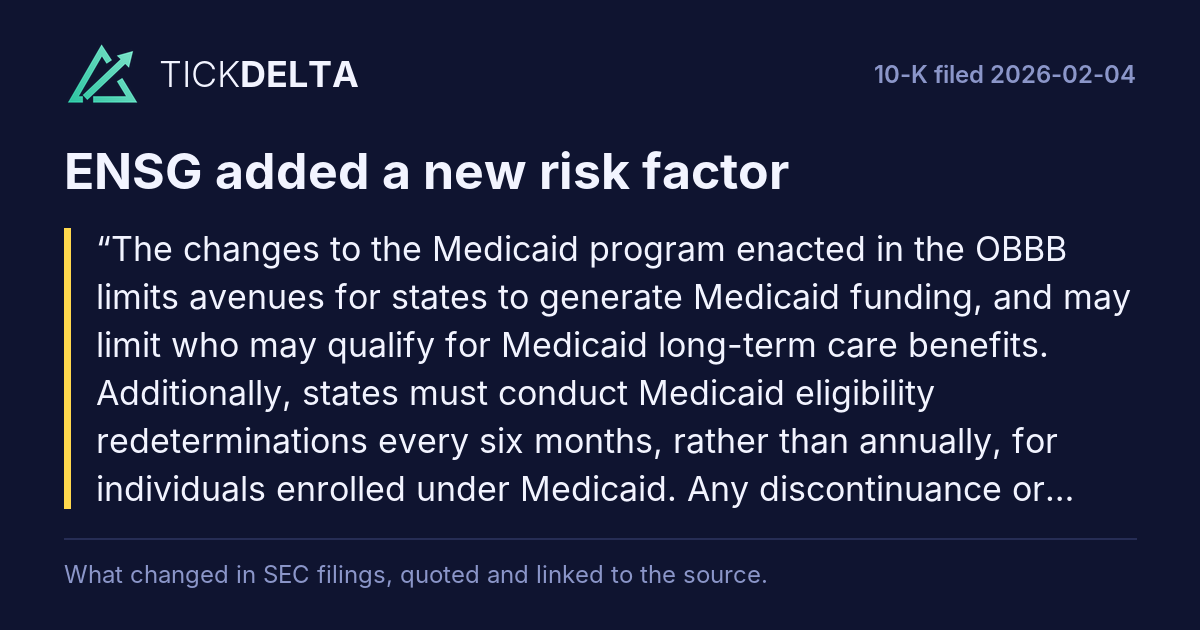
The changes to the Medicaid program enacted in the OBBB limits avenues for states to generate Medicaid funding, and may limit who may qualify for Medicaid long-term care benefits. Additionally, states must conduct Medicaid eligibility redeterminations every six months, rather than annually, for individuals enrolled under Medicaid. Any discontinuance or reduction in federal matching of provider tax-related Medicaid expenditures or delays in eligibility or coverage could have a significant and adverse effect on states' Medicaid expenditures (e.g., California, Colorado, and Nevada), and as a result could have a material and adverse effect on our business, financial condition or results of operations.

Additionally, although the CR ending the federal government shutdown extends telehealth waivers and flexibilities for SNFs and providers, uncertainty about their permanent status continues to create significant payment and reimbursement challenges.

As the initial telehealth waivers and flexibilities have remained in place over time, Congress has suggested making such waivers and flexibilities permanent through permanent legislation changing the Medicare Act. No amendment to existing law has occurred to make the telehealth waivers that were first granted during the PHE permanent, and the payment for telehealth continues to be addressed through periodic spending legislation passed by Congress (see Proposed, Anticipated and Recently Issued Rulemaking and Administrative Actions). The lack of formality making these telehealth flexibilities permanent through a change in law creates continued uncertainty around their future availability. During the government shutdown, certain telehealth services became non-reimbursable because they did not conform to pre-pandemic telehealth rules, requiring providers and suppliers to revert back to pre-pandemic operation models.

Based on this treatment of telehealth flexibilities through periodic spending bills and temporary rulemaking, rather than a permanent amendment of the Medicare Act, providers, SNFs, and our independent subsidiaries face difficult decisions about how to conduct their operations so that they may be reimbursed for their services provided to Medicare beneficiaries.

Read in the 10-K

With the passage of the IRA in 2022, Congress expanded and supplemented the ACA, including through the continuation of federally funded insurance premium subsidies. This modification of the ACA by the IRA indicates that Congress may continue to change and expand the ACA in the future. Since the commencement of the current Presidential Administration in January of 2025, there have been executive actions and proposed legislation, including the enactment of the OBBB, which undoes or limits the effect of portions of the ACA, including its Medicaid expansion provisions. The OBBB’s provisions may also affect the availability of Medicaid for potential beneficiaries due to work requirements, limit eligibility for our independent subsidiaries’ services due to caps on home equity that may be disregarded for eligibility purposes and also limit the reimbursement available for our services under Medicaid. These legislative changes, and the effects of the current Presidential Administration’s executive orders, are not yet fully realized in terms of their effects on our business.

Read in the 10-K

On April 2, 2025, President Trump signed an executive order to impose a variety of tariffs on the global trading partners of the United States. In the months since then, the tariffs with various countries have been increased, decreased, paused, and been reinstated as part of a broader trade negotiation strategy that has caused uncertainty in various product markets. These tariffs have the potential to increase costs on goods that are imported into the United States. As it pertains to our independent subsidiaries, tariffs on medical supplies may lead to higher costs to providers and the federal government through the Medicare and Medicaid programs and may impact the formulas used to calculate federal reimbursements.

Read in the 10-K
Show the other 4

The OHCA CMIR has the potential to delay or prevent proposed transactions and require disclosure of confidential information.

The California OHCA CMIR process may delay, and potentially ultimately prevent, the closing of certain proposed transactions. If a CMIR results in a negative finding and generates a referral to the California Attorney General, that could result in the parties not being able to conclude the proposed transaction and possibly require the subject facilities to appoint new managers. Any delay or prevention of completing transactions could have adverse effect on the operations of our independent subsidiaries. The risk of an adverse regulatory outcome, competitive harm, or potential legal action will persist until the CMIR is successfully concluded.

The CMIR process also seeks the disclosure of confidential information regarding our independent subsidiaries’ reimbursement rates and financial performance. This information is subject to contractual confidentiality obligations and otherwise proprietary to our business and is likewise a source of competitive advantage in the marketplace. If this information is disclosed to, or otherwise obtained by OHCA, we anticipate that it will be publicly available and could provide competitors with otherwise unavailable data on the financial operations and reimbursement relationships of our independent subsidiaries.

We have filed a Petition in the Superior Court of the State of California, County of Orange, seeking a declaration that the CMIR regulations violate the United States Constitution and/or the California Constitution, and is void and unenforceable as applied to us. We have requested that OHCA be ordered to withdraw the subpoena and close the inquiry, so the underlying transaction can be completed.

Read in the 10-K

In June 2025, CMS announced that from July 2025 onward, it will only incorporate the two most recent surveys for Nursing Home Care Compare and the Five Star Quality Rating system. In addition, CMS changed certain weight factors to scores under such survey programs. These changes have the potential to affect the sample of data evaluated under such surveys which could negatively impact SNFs with more recent compliance issues.

As of July 30, 2025, the Nursing Home Compare updates have been temporarily paused until October 2025 due to CMS's transition to a cloud-based system for survey data. During this pause, CMS indicated it will validate data integrity and engage in verification of reporting information for meeting quality standards. This impacts existing viewpoint of SNFs because there is no opportunity to provide new data to update scores. Further it increases the chance of audit by CMS if there are potential findings of data integrity or verification issues. Beginning in January 2026, CMS's change to the reporting of its long-stay antipsychotic medication quality measure reflecting both Medicare and Medicaid claims data, as well as Medicare Advantage data. The consequences of this measurement is expected by industry observers to cause an upward shift in reported rates of antipsychotic medication usage, with CMS applying more scrutiny to data within the MDS excluded from this specific measure.

Read in the 10-K

•a limitation or inability to require arbitration of disputes increases legal costs, exposure, and the unpredictability of jury decisions;

Read in the 10-K

Our implementation of a new enterprise resource planning (ERP) system may adversely affect our business and results of operations or the effectiveness of our internal controls over financial reporting.

In January 2026, we implemented a new ERP system designed to unify our existing processes, enhance access to real-time operational data, and ensure we are fully equipped to support future growth. This implementation involves significant complexity, including data migration, system integration, process redesign, and requires significant resources and changes to business and financial processes. However, implementation carries risks such as operational disruptions and delays and could adversely affect our ability to operate our business. Any material weakness in the design and implementation of the new ERP system could also result in potentially materially higher costs than we had incurred previously and otherwise negatively impact our financial reporting and internal controls. Any of these consequences could have a material adverse effect on our results of operations and financial condition.

Read in the 10-K

Paragraphs in the 10-Q filed Oct 27, 2026 that were not in the one before

New in the latest 10-Q

44 paragraphs in the 10-Q filed Oct 27, 2026 with nothing like them in the 10-Q filed Jul 27, 2026 (at least half the words must differ; new numbers alone do not count). Quoted exactly, grouped by the item heading above them. This is text that changed, not a judgement of how serious it is.

Financial statements and notes

Nine Months Ended September 30, (In thousands) 2026 2025 ─────────────────────────────────────────────────────────────────────────────────────────────────────────────────────────────────────────────────────────────────── Cash flows from operating activities: Net income $ 303,974 $ 248,730 Adjustments to reconcile net income to net cash provided by operating activities: Depreciation and amortization 92,853 76,606 Amortization of deferred financing fees 917 793 Stock-based compensation 49,105 35,375 Insurance proceeds, loss (gain) on long-lived assets and other investments 1,911 (1,003) Other operating activities, net 3,743 12,297 Change in operating assets and liabilities Accounts receivable (29,305) (44,356) Prepaid income taxes (28,189) (19,507) Prepaid expenses and other assets (4,735) (7,716) Cash surrender value of life insurance policy premiums (16,755) (16,332) Deferred compensation liability 16,720 16,332 Operating lease obligations (10) (3,265) Accounts payable 25,776 5,449 Accrued wages and related liabilities 15,823 27,549 Other accrued liabilities 11,602 27,081 Accrued self-insurance liabilities 68,918 22,917 NET CASH PROVIDED BY OPERATING ACTIVITIES $ 512,348 $ 380,950 Cash flows from investing activities: Purchase of property and equipment (135,915) (143,714) Cash payments for acquisitions (539,940) (240,300) Cash proceeds from insurance recoveries and sale of assets 6,704 3,691 Purchases of investments (82,835) (91,791) Maturities of investments 60,847 82,278 Other investing activities 202 599 NET CASH USED IN INVESTING ACTIVITIES $ (690,937) $ (389,237) Cash flows from financing activities: Proceeds from debt (Note 13) 60,000 — Payments on debt (3,155) (3,050) Issuance of common stock upon exercise of options 21,797 22,726 Repurchase of shares of common stock to satisfy tax withholding obligations (980) (1,071) Repurchase of shares of common stock (Note 19) (47,430) (20,000) Dividends paid (11,360) (10,791) Payments of deferred financing costs (6,503) — Other financing activities (69) (457) NET CASH PROVIDED BY (USED IN) FINANCING ACTIVITIES $ 12,300 $ (12,643) Net decrease in cash and cash equivalents (166,289) (20,930) Cash and cash equivalents beginning of period 503,881 464,598 Cash and cash equivalents end of period $ 337,592 $ 443,668

Read in the 10-Q

Subsequent to September 30, 2026, the Company entered into three new master leases to add 17 stand-alone skilled nursing facilities and two campuses operated by the Company's independent subsidiaries with initial terms ranging from 15 to 20 years. As a result, the Company operates under 21 master lease arrangements. In connection with the new master leases, the Company recognized approximately $ 265,224 of additional lease liabilities and right-of-use assets.

Read in the 10-Q

On October 8, 2026, a purported stockholder filed a putative securities class action complaint in the United States District Court for the Central District of California captioned Nicholas Perusek v. The Ensign Group, Inc., et. al., Case No. 8:26-cv-02963. The complaint asserts claims under Sections 10(b) and 20(a) of the Securities Exchange Act of 1934 on behalf of purchasers of the Company's securities between February 10, 2022 and June 18, 2026. The complaint alleges, among other things, that the defendants made materially false or misleading statements and omitted material information regarding the Company's regulatory compliance, quality of care, staffing practices, CMS ratings, Medicare and Medicaid reimbursement practices, and administrator licensing practices. The complaint seeks unspecified compensatory damages, attorneys' fees and costs, and other relief.

Read in the 10-Q

The Company intends to vigorously defend against these matters. The Company is unable at this time to determine whether any loss will ultimately occur or to reasonably estimate the possible loss or range of loss associated with these matters. Accordingly, no amounts have been accrued in the accompanying condensed consolidated financial statements.

Read in the 10-Q

Revolving Credit Facility Amendment - On August 19, 2026, we, including Standard Bearer, Truist Bank, as administrative agent, and the lenders party thereto amended our Credit Facility to increase the aggregate principal amount to $800.0 million and extended the maturity date to August 19, 2031. Borrowings are supported by a lending consortium arranged by Truist Bank. As of September 30, 2026, there was $60.0 million outstanding debt under the Credit Facility.

Read in the 10-Q
Show the other 39

CMS Nurses for Nursing Homes Initiative - On October 23, 2026, CMS announced the nationwide launch of its Nurses for Nursing Homes initiative, a workforce recruitment and retention program designed to increase nurse staffing in nursing homes, particularly in rural and higher labor-shortage areas. Under the initiative, eligible nursing students and licensed nurses may receive up to $40 thousand in student loan repayment and/or a $10 thousand stipend in exchange for a three-year service commitment at a qualifying nursing facility. CMS stated that the program is funded through federal and state nursing home civil monetary penalty funds, with approximately $275 million committed nationwide, and is expected to support more than 4,000 nurses. Participation is limited to qualifying nursing facilities selected by CMS and participating states based on workforce needs and labor market conditions.

Read in the 10-Q

In addition, on July 16, 2026, CMS published the CY 2027 PFS Proposed Rule, which could continue to change these rules.

Read in the 10-Q

In addition, on July 16, 2026, CMS published the CY 2027 Medicare Physician Fee Schedule Proposed Rule, which could continue to change these rules.

Read in the 10-Q

CMS continues to modify the quality measures, standardized patient assessment data elements and reporting requirements applicable to the SNF QRP and its Five-Star Quality Rating System. These changes have included measures related to staffing levels and turnover, resident function, healthcare personnel vaccination and social determinants of health. Beginning in FY 2026, CMS increased the Minimum Data Set (MDS) data completion threshold to 90%. In addition, although CMS initially intended to begin incorporating additional and modified standardized patient assessment data elements related to social determinants, including living situation, food security, utility access and transportation, CMS removed the measures in the FY 2026 PPS.

Read in the 10-Q

CMS has also implemented a SNF QRP data validation program beginning in FY 2026, under which selected SNFs are required to submit medical record documentation to validate reported MDS data.

Read in the 10-Q

Skilled Nursing Facility Value-Based Purchasing (SNF-VBP) Program - The SNF-VBP Program incentivizes SNFs by awarding payments based on the quality of care provided to Medicare beneficiaries, primarily measured through hospital readmission rates. Over time, CMS has expanded and refined the program, including adding measures related to healthcare-associated infections requiring hospitalization, nursing staffing and successful discharge to the community, and replacing the SNF 30-Day All-Cause Readmission Measure (SNFRM) with the SNF Within-Stay Potentially Preventable Readmission (SNF WS PPR) measure beginning in FY 2028. CMS also adopted various administrative and technical changes to the program's measures, scoring and data review processes each and every year.

Read in the 10-Q

The Bipartisan Budget Act of 2018 eliminated the former annual therapy caps and established requirements for services exceeding specified annual thresholds. Claims for PT and SLP services combined, and separately for OT services, that exceed the applicable threshold must include the KX modifier, through which the provider attests that the services are medically necessary and appropriately documented in the patient’s medical record. For CY 2026, these thresholds were $2,480 for PT and SLP services combined and $2,480 for OT services. Claims exceeding $3,000 remain subject to targeted medical review. In addition, the Multiple Procedure Payment Reduction (“MPPR”) generally reduces the practice expense component of reimbursement for certain therapy services when multiple therapy procedures are furnished to the same patient on the same day.

Read in the 10-Q

Medicare has continued to modify the requirements applicable to Part B therapy services, including through changes to documentation, supervision and telehealth requirements. Certain telehealth flexibilities initially implemented during the COVID-19 public health emergency have subsequently been extended, including the ability of PTs, OTs and SLPs to furnish certain Medicare services through telehealth. The Consolidated Appropriations Act, 2026 extended certain Medicare telehealth flexibilities through December 31, 2027.

Read in the 10-Q

In addition, CMS continues to transition risk models for reimbursement of PACE organization. For CY 2026, CMS is using a risk score computed from 10% of the risk score from the 2024 CMS-HCC model and 90% the 2017 CMS-HCC model.

Read in the 10-Q

Five-Star Quality Reporting Metrics - CMS maintains a Five-Star Quality Rating System for nursing homes that assigns an overall rating ranging from one to five stars based primarily on three components: health inspections, staffing and quality measures. These ratings are publicly reported on Medicare’s Nursing Home Care Compare website and are intended to provide consumers with information regarding the quality and performance of Medicare- and Medicaid-certified nursing homes. CMS periodically modifies the measures, data sources, risk-adjustment methodologies, scoring thresholds and weighting used to determine Five-Star ratings. These changes have generally increased the rigor of the rating methodology and may make it more challenging for facilities to achieve and maintain four- and five-star ratings.

Read in the 10-Q

CMS has made several significant changes to the Five-Star methodology in recent years. In 2024, CMS revised the staffing case-mix methodology to use PDPM and made changes to certain staffing measures, including extending the period used to identify employee turnover from 60 to 90 consecutive days. CMS also revised risk-adjustment methodologies for certain claims-based quality measures and adjusted scoring thresholds used in determining quality measure ratings.

Read in the 10-Q

Beginning with the January 2025 refresh, CMS implemented changes to four quality measures following revisions to the MDS. Among other changes, CMS replaced the short-stay functional improvement measure with a measure assessing whether SNF residents meet or exceed an expected level of function at discharge, revised certain long-stay measures related to activities of daily living and walking independence, and replaced the long-stay high-risk pressure ulcer measure with a measure covering residents with pressure ulcers more broadly. CMS also recalibrated the scoring thresholds for these measures, further modifying the performance levels necessary to achieve higher quality measure ratings.

Read in the 10-Q

In June 2025, CMS further revised the health inspection component by reducing the number of standard health surveys used to calculate the rating from three surveys to two. Under the revised methodology, the most recent standard survey is weighted 75% and the second most recent survey is weighted 25%. As a result, more recent survey performance has a greater influence on a facility’s health inspection rating, which may result in greater variability in a facility’s Five-Star rating following a survey. CMS also announced changes to Nursing Home Care Compare, including publication of aggregated performance information for nursing home chains and modifications to certain information displayed on individual facility profiles.

Read in the 10-Q

In 2026, CMS implemented additional changes to the quality measure component, including revisions to the long-stay antipsychotic medication measure. The revised measure incorporates additional data sources, including Medicare and Medicaid claims and Medicare Advantage encounter data, in addition to MDS information, and uses a decile-based scoring methodology. The broader data sources are expected to capture antipsychotic medication use not previously identified through MDS reporting alone, potentially affecting facility quality measure scores and overall Five-Star ratings.

Read in the 10-Q

Collectively, these changes reflect CMS’s continued refinement of the Five-Star Quality Rating System and may increase the level of performance required to achieve and maintain higher ratings. As CMS continues to revise measures, underlying data sources, risk-adjustment methodologies, scoring thresholds and component weightings, the Five-Star ratings of our affiliated skilled nursing facilities may change, including as a result of changes in CMS methodology rather than changes in the underlying quality of care or operations of such facilities.

Read in the 10-Q

On June 28, 2024, the United States Supreme Court issued its decision in Loper Bright Enterprises v. Raimondo, overruling the longstanding Chevron doctrine. Following Loper Bright, courts must exercise independent judgment in interpreting statutory provisions and determining whether an agency acted within its statutory authority. The decision may significantly affect the interpretation and enforcement of federal healthcare laws and regulations, including those administered by HHS and CMS, and could result in increased legal challenges to federal agency actions.

Read in the 10-Q

We recently concluded the process described above for a proposed transaction with a nonprofit health facility in California that began in December 2024. On October 2, 2026, we received conditional approval from the AG on the transaction. We are currently evaluating the potential implications of the conditions for the proposed transaction and the appropriate path forward in light of this development.

Read in the 10-Q

(2) Represents specific proceedings and adjustments arising outside of the ordinary course of business.

Read in the 10-Q

(3) Represents gains on the sale of investments that are not part of our core business operations. These investments have no observable market prices and are held at historical cost basis until sold or impaired.

Read in the 10-Q

(4) Represents the write off of deferred financing fees associated with the Credit Facility.

Read in the 10-Q

(2) Represents specific proceedings and adjustments arising outside of the ordinary course of business.

Read in the 10-Q

(3) Represents gains on the sale of investments that are not part of our core business operations. These investments have no observable market prices and are held at historical cost basis until sold or impaired.

Read in the 10-Q

(4) Represents the write off of deferred financing fees associated with the Credit Facility.

Read in the 10-Q

(2) Represents specific proceedings and adjustments arising outside of the ordinary course of business.

Read in the 10-Q

(3) Represents gains on the sale of investments that are not part of our core business operations. These investments have no observable market prices and are held at historical cost basis until sold or impaired.

Read in the 10-Q

The continued trend of hospitals discharging higher-acuity patients into skilled nursing settings has reinforced opportunities to expand our higher-acuity services. Across our portfolio, our local clinical teams have met this demand, building the specialized resources and care programs necessary to serve this growing and more medically complex patient population.

Read in the 10-Q

Risk Factors

• Our ability to obtain and maintain eligibility for the RBS program or related public designations, or the loss of such eligibility, may affect the perception of the quality of our services among residents, referral sources, employees, regulators, and other stakeholders.

Read in the 10-Q

• Our operations are subject to extensive federal and state licensure requirements, and the failure to obtain, maintain, renew, or transfer required licenses could adversely affect our business, financial condition, and results of operations.

Read in the 10-Q

Our ability to obtain and maintain eligibility for the RBS program or related public designations, or the loss of such eligibility, may affect the perception of the quality of our services among residents, referral sources, employees, regulators, and other stakeholders.

Read in the 10-Q

Participation in, or exclusion from, the the RBS program and the receipt of related public designations may be viewed by residents, prospective residents and their families, referral sources, employees, regulators and other stakeholders as indicators of the quality of care and services provided by our facilities. Our eligibility for, and performance under, the RBS program may depend on a variety of factors, including clinical outcomes, regulatory compliance, survey results, staffing or other performance measures, some of which may be outside of our control or may change over time. Loss of eligibility or recognition as well as adverse survey outcomes could adversely affect our reputation, referrals, occupancy, employee recruitment and retention, and relationships with residents, regulators and other stakeholders, which could adversely affect our business, financial condition and results of operations.

Read in the 10-Q

Increased competition for, or a shortage of, nurses or other trained personnel, together with ongoing inflationary pressures, may require us to enhance our pay and benefits packages to attract and retain qualified employees. Recent changes in federal immigration policy and increased uncertainty surrounding the immigration process have further constrained the availability of workers. Changes affecting employment-based visas, processing times, and heightened scrutiny may delay or limit the ability of foreign workers to enter or remain in the U.S. workforce. These conditions may reduce our available pool of qualified healthcare personnel and other workers, increase competition for labor, and place additional upward pressure on wages and benefits.

Read in the 10-Q

Federal healthcare workforce policies continue to evolve, including initiatives intended to expand access to training, improve recruitment and retention, and support career development for healthcare workers. Changes in presidential administrations, leadership at HHS or CMS, legislative priorities or other federal policy objectives may result in the modification, delay, discontinuation or expansion of existing initiatives, rulemaking and enforcement activities. Such changes could affect workforce-related requirements, compliance obligations and other regulatory matters applicable to our operations.

Read in the 10-Q

We also are, and may in the future be, subject to securities, derivative, or other stockholder litigation alleging violations of securities laws, breaches of fiduciary duty, deficiencies in corporate governance, inadequate disclosures, insider trading, executive compensation matters, related-party transactions, or other claims. The defense and resolution of such matters may result in substantial legal fees, settlement costs, diversion of management attention, increased directors' and officers' insurance costs, and reputational harm, any of which could materially adversely affect our business, financial condition, and results of operations.

Read in the 10-Q

Our operations are subject to extensive federal and state licensure requirements, and the failure to obtain, maintain, renew, or transfer required licenses could adversely affect our business, financial condition, and results of operations.

Read in the 10-Q

Our independent subsidiaries are subject to extensive federal, state, and local laws, regulations, licensing requirements, certification standards, and governmental oversight. At the federal level, compliance with Medicare and Medicaid participation requirements, conditions of payment, survey and enforcement requirements, and other healthcare regulations is critical to our operations. In addition to Federal requirements, the facilities are subject to extensive licensing, certification, permit, and regulatory requirements imposed by state health care agencies and other governmental authorities. These requirements vary by jurisdiction and may change periodically. Failure to obtain, maintain, renew, or successfully transfer required licenses, permits, certifications, or approvals in connection with acquisitions, changes of ownership, changes in operations, or routine renewals could result in delays in completing transactions, restrictions on operations, fines, sanctions, temporary management, admission holds, suspension of services, or the loss of operating licenses. In addition, state agencies may increase scrutiny of ownership structures, management arrangements, related-party transactions, quality-of-care matters, staffing levels, and financial condition. Any adverse licensing action, unexpected delay in approval, or change in regulatory requirements could increase our costs, disrupt operations, delay the realization of anticipated benefits from acquisitions, and materially adversely affect our business, financial condition, results of operations, and cash flows.

Read in the 10-Q

In addition, transactions involving California nursing facilities may be subject to review by the California Office of Health Care Affordability (OHCA), which may require advance notice filings and may conduct a cost and market impact review (CMIR) that can extend transaction timelines or create additional closing conditions. For example, OHCA is currently conducting a CMIR of a proposed transaction involving three of our independent subsidiaries in California, and has issued a subpoena in connection with that review. The transaction cannot be completed while the inquiry is pending, and we have filed a petition in Orange County Superior Court challenging OHCA’s authority; we cannot predict the outcome of that proceeding or the CMIR, or whether, when or on what terms the transaction may be completed. Transactions may also require approvals or enrollment actions from CMS and the California Department of Health Care Services (DHCS) relating to Medicare and Medi-Cal provider participation. Further, when a facility is owned by a nonprofit organization, approval from the California Attorney General (AG) is required before the transaction can be completed. The AG may impose conditions, request additional information, or delay approvals for extended periods.

Read in the 10-Q

Failure to obtain any required approvals, satisfy applicable conditions, or complete required enrollment and licensing actions could prevent a transaction from closing, result in the loss of expected revenues, require significant additional expenditures, or adversely affect our financial condition, results of operations, and growth strategy.

Read in the 10-Q

• stockholder action by written consent is limited to actions previously approved by the Board of Directors;

Read in the 10-Q

Other information

Chad A. Keetch, Chief Investment Officer and Executive Vice President, entered into a Rule 10b5-1 trading arrangement on September 1, 2026. Pursuant to the 10b5-1 plan, Mr. Keetch may make gifts of the Company's common stock having an aggregate value of up to $300 thousand between November 30, 2026 and December 31, 2026.

Read in the 10-Q

The 10-Q's risk factors against the 10-K

Item 1A of the 10-Q filed Oct 27, 2026 against Item 1A of the 10-K filed Feb 4, 2026. A 10-Q repeats only the risks that changed, so a 10-K paragraph that is missing from it is not counted as removed. Added is a paragraph with nothing like it in the 10-K, Reworded a sentence that is in both with several words changed, Quiet changes a sentence in both where one to four words changed and one is a hedge or a modal (cut words struck through, new words highlighted). Text on the page, not a score; each links to the filing at sec.gov.

Added10-Q Oct 27, 2026 vs 10-K Feb 4, 2026
• Our ability to obtain and maintain eligibility for the RBS program or related public designations, or the loss of such eligibility, may affect the perception of the quality of our services among residents, referral sources, employees, regulators, and other stakeholders.

Read it in the 10-Q at sec.gov

Added10-Q Oct 27, 2026 vs 10-K Feb 4, 2026
• Our operations are subject to extensive federal and state licensure requirements, and the failure to obtain, maintain, renew, or transfer required licenses could adversely affect our business, financial condition, and results of operations.

Read it in the 10-Q at sec.gov

Added10-Q Oct 27, 2026 vs 10-K Feb 4, 2026
Consistent with the Administration’s focus on strengthening Medicaid program integrity and reducing waste, fraud, and abuse, regulatory activity has accelerated following the 2025 reconciliation legislation, particularly around implementation of the OBBB.

Read it in the 10-Q at sec.gov

Added10-Q Oct 27, 2026 vs 10-K Feb 4, 2026
CMS's recent rulemaking while largely intended to carry provisions of the OBBB into effect makes it more difficult for states to obtain waivers in enacting taxes on Medicaid-participating providers in order to fund that state's share of its Medicaid obligations.

Read it in the 10-Q at sec.gov

Added10-Q Oct 27, 2026 vs 10-K Feb 4, 2026
Our ability to obtain and maintain eligibility for the RBS program or related public designations, or the loss of such eligibility, may affect the perception of the quality of our services among residents, referral sources, employees, regulators, and other stakeholders.

Read it in the 10-Q at sec.gov

Show the other 25
Added10-Q Oct 27, 2026 vs 10-K Feb 4, 2026
Participation in, or exclusion from, the the RBS program and the receipt of related public designations may be viewed by residents, prospective residents and their families, referral sources, employees, regulators and other stakeholders as indicators of the quality of care and services provided by our facilities. Our eligibility for, and performance under, the RBS program may depend on a variety of factors, including clinical outcomes, regulatory compliance, survey results, staffing or other performance measures, some of which may be outside of our control or may change over time. Loss of eligibility or recognition as well as adverse survey outcomes could adversely affect our reputation, referrals, occupancy, employee recruitment and retention, and relationships with residents, regulators and other stakeholders, which could adversely affect our business, financial condition and results of operations.

Read it in the 10-Q at sec.gov

Added10-Q Oct 27, 2026 vs 10-K Feb 4, 2026
On January 28, 2026, CMS updated its guidance for the SFF program to place greater emphasis on the prevalence of resident falls when selecting facilities for inclusion in the program. As a result, CMS will prioritize falls-related data, rather than staffing metrics, when evaluating comparable facilities recommended by state survey agencies for participation in the SFF program. The January 2026 guidance also enhances program oversight by making inspections less predictable, including requiring life safety code and emergency preparedness surveys to be conducted at least annually, with other surveys occurring more frequently as determined by CMS or the applicable state surveying agency.

Read it in the 10-Q at sec.gov

Added10-Q Oct 27, 2026 vs 10-K Feb 4, 2026
Increased competition for, or a shortage of, nurses or other trained personnel, together with ongoing inflationary pressures, may require us to enhance our pay and benefits packages to attract and retain qualified employees. Recent changes in federal immigration policy and increased uncertainty surrounding the immigration process have further constrained the availability of workers. Changes affecting employment-based visas, processing times, and heightened scrutiny may delay or limit the ability of foreign workers to enter or remain in the U.S. workforce. These conditions may reduce our available pool of qualified healthcare personnel and other workers, increase competition for labor, and place additional upward pressure on wages and benefits.

Read it in the 10-Q at sec.gov

Added10-Q Oct 27, 2026 vs 10-K Feb 4, 2026
Federal healthcare workforce policies continue to evolve, including initiatives intended to expand access to training, improve recruitment and retention, and support career development for healthcare workers. Changes in presidential administrations, leadership at HHS or CMS, legislative priorities or other federal policy objectives may result in the modification, delay, discontinuation or expansion of existing initiatives, rulemaking and enforcement activities. Such changes could affect workforce-related requirements, compliance obligations and other regulatory matters applicable to our operations.

Read it in the 10-Q at sec.gov

Added10-Q Oct 27, 2026 vs 10-K Feb 4, 2026
We also are, and may in the future be, subject to securities, derivative, or other stockholder litigation alleging violations of securities laws, breaches of fiduciary duty, deficiencies in corporate governance, inadequate disclosures, insider trading, executive compensation matters, related-party transactions, or other claims. The defense and resolution of such matters may result in substantial legal fees, settlement costs, diversion of management attention, increased directors' and officers' insurance costs, and reputational harm, any of which could materially adversely affect our business, financial condition, and results of operations.

Read it in the 10-Q at sec.gov

Added10-Q Oct 27, 2026 vs 10-K Feb 4, 2026
Our operations are subject to extensive federal and state licensure requirements, and the failure to obtain, maintain, renew, or transfer required licenses could adversely affect our business, financial condition, and results of operations.

Read it in the 10-Q at sec.gov

Added10-Q Oct 27, 2026 vs 10-K Feb 4, 2026
Our independent subsidiaries are subject to extensive federal, state, and local laws, regulations, licensing requirements, certification standards, and governmental oversight. At the federal level, compliance with Medicare and Medicaid participation requirements, conditions of payment, survey and enforcement requirements, and other healthcare regulations is critical to our operations. In addition to Federal requirements, the facilities are subject to extensive licensing, certification, permit, and regulatory requirements imposed by state health care agencies and other governmental authorities. These requirements vary by jurisdiction and may change periodically. Failure to obtain, maintain, renew, or successfully transfer required licenses, permits, certifications, or approvals in connection with acquisitions, changes of ownership, changes in operations, or routine renewals could result in delays in completing transactions, restrictions on operations, fines, sanctions, temporary management, admission holds, suspension of services, or the loss of operating licenses. In addition, state agencies may increase scrutiny of ownership structures, management arrangements, related-party transactions, quality-of-care matters, staffing levels, and financial condition. Any adverse licensing action, unexpected delay in approval, or change in regulatory requirements could increase our costs, disrupt operations, delay the realization of anticipated benefits from acquisitions, and materially adversely affect our business, financial condition, results of operations, and cash flows.

Read it in the 10-Q at sec.gov

Reworded10-Q Oct 27, 2026 vs 10-K Feb 4, 2026
Although the Staffing Rule is not likely to take effect due to HHS and CMS's abandonment of appeals in its defense, promulgation of an interim final rule to prohibit the Staffing Rule's staffing ratios from taking effect, and defunding of the Staffing Rule by the OBBB, The current or future presidential administrations may revive this concept and seek to restore that rule or impose new staffing rules that are equally or more stringent.

Read it in the 10-Q at sec.govThe 10-K sentence

Reworded10-Q Oct 27, 2026 vs 10-K Feb 4, 2026
We derived 23.2% and 23.7% and 24.9% of our service revenue from the Medicare programs for the years three and nine months ended December 31, 2025 September 30, 2026, respectively, and 2024, 23.5% and 24.0% for the three and nine months ended September 30, 2025, respectively.

Read it in the 10-Q at sec.govThe 10-K sentence

Reworded10-Q Oct 27, 2026 vs 10-K Feb 4, 2026
In fact, Medicaid is our largest source of revenue, accounting for 45.8% 45.3% and 46.0% 45.1% of our revenue for the years three and nine months ended December 31, 2025 September 30, 2026, respectively, and 2024, 46.0% and 45.6% for the three and nine months ended September 30, 2025, respectively.

Read it in the 10-Q at sec.govThe 10-K sentence

Reworded10-Q Oct 27, 2026 vs 10-K Feb 4, 2026
Under provider tax arrangements, states collect taxes from healthcare providers and then use the revenue to pay the providers as a Medicaid expenditure, generate non-federal share of Medicaid, which allows the states to then claim additional federal matching funds on the to help offset cost of care by providing additional reimbursements.

Read it in the 10-Q at sec.govThe 10-K sentence

Reworded10-Q Oct 27, 2026 vs 10-K Feb 4, 2026
This includes changes in health care payment through the CAA 2026, and more extensive changes to the Medicaid program contained in the OBBB, OBBB and CMS's subsequent rulemaking discussed in Part I., Item 2., under Government Regulation, which could reduce Medicaid funds available for reimbursement, potentially limit the amount of reimbursement paid by Medicaid for our services, potentially limit our potential resident population, adversely affect potential residents’ eligibility and ability to pay for services performed by our independent subsidiaries.

Read it in the 10-Q at sec.govThe 10-K sentence

Reworded10-Q Oct 27, 2026 vs 10-K Feb 4, 2026
Among the changes being implemented by CMS are provisions of the IMPACT Act, which imposes a stringent timeline established requirements for implementing benchmark standardized patient assessment data and quality and resource-use measures and data metrics across facilities that include post-acute care providers, including SNFs.

Read it in the 10-Q at sec.govThe 10-K sentence

Reworded10-Q Oct 27, 2026 vs 10-K Feb 4, 2026
If we fail are unable to attract and retain qualified and skilled personnel, our ability to conduct our business operations provide services and maintain quality standards could be harmed. adversely affected, which could harm our operations, financial performance, and profitability.

Read it in the 10-Q at sec.govThe 10-K sentence

Reworded10-Q Oct 27, 2026 vs 10-K Feb 4, 2026
In furtherance of this rule, CMS proposed is requiring requires all SNFs to revalidate certain information using CMS's newly promulgated SNF Attachment by January 1, 2026; however, CMS issued sub-regulatory guidance suspending the deadline and did not set a new deadline for the submission. 2026.

Read it in the 10-Q at sec.govThe 10-K sentence

Reworded10-Q Oct 27, 2026 vs 10-K Feb 4, 2026
For the years three and nine months ended December 31, 2025 September 30, 2026, 68.5% and 2024, 69.5% and 70.9% 68.8% of our revenue revenue, respectively, was provided by government payors that reimburse us at predetermined rates, respectively. rates.

Read it in the 10-Q at sec.govThe 10-K sentence

Reworded10-Q Oct 27, 2026 vs 10-K Feb 4, 2026
During the year nine months ended December 31, 2025, September 30, 2026, we expanded our operations through a combination of a long-term leases lease and real estate purchases, with the addition of 40 23 stand-alone skilled nursing operations, five stand-alone senior living operations and one two campus operation. operations.

Read it in the 10-Q at sec.govThe 10-K sentence

Reworded10-Q Oct 27, 2026 vs 10-K Feb 4, 2026
While we do not believe we are in violation of these prohibitions, we cannot assure you that governmental officials charged with the responsibility for enforcing these prohibitions will not assert it may be asserted that we are violating the provisions of such laws and regulations.

Read it in the 10-Q at sec.govThe 10-K sentence

Reworded10-Q Oct 27, 2026 vs 10-K Feb 4, 2026
Although we We have always been and will continue to be subject to post-payment audits and reviews, and may be subject to more intensive “probe reviews” performed by Medicare administrative contractors contractors, which in recent years appear to be a regular procedure with our fiscal intermediaries.

Read it in the 10-Q at sec.govThe 10-K sentence

Quiet changes10-Q Oct 27, 2026 vs 10-K Feb 4, 2026
For state fiscal year 2024, Texas requires all nursing facilities must to show that a portion of funds paid to SNFs by Texas’s Medicaid program, including both fee-for-service and managed care reimbursement, were expended for direct care activities, including direct care staff wages and benefits.

Read it in the 10-Q at sec.govThe 10-K sentence

Quiet changes10-Q Oct 27, 2026 vs 10-K Feb 4, 2026
Our success depends upon our ability to retain and attract nurses of all levels and other skilled personnel, such as Certified Nurse Assistants, social workers and speech, physical and occupational therapists, as well as skilled management personnel responsible for day-to-day facility operation.

Read it in the 10-Q at sec.govThe 10-K sentence

The first 30 of 72 are shown (at most 12 of each type).

Phrases used for the first time

Two-word phrases in Risk Factors of the 10-K filed Feb 4, 2026 that are in none of the 1 earlier 10-Ks stored, back to Feb 5, 2025

erp system ×4government shutdown ×4ohca cmir ×3proposed transactions ×3telehealth waivers ×3medicaid funds ×3mid-term elections ×2enforcements reimbursements ×2ultimately prevent ×2prevent proposed ×2require disclosure ×2new enterprise ×2enterprise resource ×2resource planning ×2planning erp ×2yet fully ×2
Where each one is used
  • erp system: •Our implementation of a new enterprise resource planning (ERP) system may adversely affect our business and results of operations or the effectiveness of our internal controls over financial reporting.
  • government shutdown: Additionally, although the CR ending the federal government shutdown extends telehealth waivers and flexibilities for SNFs and providers, uncertainty about their permanent status continues to create significant payment and reimbursement challenges.
  • ohca cmir: •The OHCA CMIR has the potential to delay, and ultimately prevent, proposed transactions and require disclosure of confidential information.
  • proposed transactions: •The OHCA CMIR has the potential to delay, and ultimately prevent, proposed transactions and require disclosure of confidential information.
  • telehealth waivers: Additionally, although the CR ending the federal government shutdown extends telehealth waivers and flexibilities for SNFs and providers, uncertainty about their permanent status continues to create significant payment and reimbursement challenges.
  • medicaid funds: The current Presidential administration and control of Congress by the President's political party have resulted in changes that have caused, and will continue to cause, uncertainty with respect to legislation, regulation, implementation or repeal of laws and rules related to government health programs, including...
  • mid-term elections: •Anticipated changes in the U.S. political environment, including those as a result of the current Presidential administration and Congress, potential changes in control of one or both houses of Congress due to mid-term elections to occur in November 2026, and to regulatory agencies, particularly HHS, may result in...
  • enforcements reimbursements: •Anticipated changes in the U.S. political environment, including those as a result of the current Presidential administration and Congress, potential changes in control of one or both houses of Congress due to mid-term elections to occur in November 2026, and to regulatory agencies, particularly HHS, may result in...

The 10-K at sec.gov

Used at least twice, small words left out. Counted, not picked: a phrase can be new because the company renamed something.

What was taken out

15 paragraphs of last year's Risk Factors with nothing like them now. The longest are quoted.

Across all companies
Our cash, cash equivalents and investments are held in a variety of interest-bearing instruments, including U.S. treasury securities. As a result of the uncertain domestic and global political, economic, credit and financial market conditions, including the increases in the federal funds rate since 2021, with limited decreases in 2024, and Consumer Price Index increases above historical norms for 2024, investments in these types of financial instruments pose risks arising from liquidity and credit concerns. Given that future deterioration in the U.S. and global credit and financial markets...
In the 10-K filed Feb 5, 2025
On April 22, 2024, CMS issued the Staffing Rule, establishing minimum staffing standards for SNFs. As discussed in more detail in Item 1., under Government Regulation, the Staffing Rule contains three primary staffing requirements which are phased in over the next several years. Due to pending legislation in both the House of Representatives and the Senate, industry litigation filed to dispute the Staffing Rule's validity and enforceability, as well as the long phase-in of the Staffing Rule's requirements, the exact effects of the Staffing Rule cannot yet be ascertained. Given the pending...
In the 10-K filed Feb 5, 2025
You should carefully consider each of the following risk factors. The risk factors generally have been separated into two categories: risks relating to our business and our industry and risks relating to our common stock. Based on the information currently known to us, we believe that the following information identifies the most significant risk factors affecting our company in each of these categories of risks. However, the risks and uncertainties we face are not limited to those set forth in the risk factors described below. Additional risks and uncertainties not presently known to us...
In the 10-K filed Feb 5, 2025
If any of the following risks and uncertainties develops into actual events, these events could have a material adverse effect on our business, financial condition or results of operations. In such case, the trading price of our common stock could decline. You should carefully read the following risk factors, together with the financial statements, related notes and other information contained in this Annual Report on Form 10-K. This Annual Report on Form 10-K contains forward-looking statements that contain risks and uncertainties. Please refer to the section entitled "Cautionary Note...
In the 10-K filed Feb 5, 2025

Sources

Item 1A of each 10-K and 10-Q on EDGAR, quoted exactly. Each paragraph links to the filing at sec.gov.

Also

10-K change: what was reworded or cut, section by section.

Work with it

Excel workbook · CSV. Google Sheet that stays up to date: paste =IMPORTDATA("https://tickdelta.com/company/ENSG/export.csv") into a cell.

Next:10-K change
Esc

Type a ticker such as AAPL, a name, an investor such as Buffett, or a topic such as tariffs. ↑ ↓ to move, Enter to open.