Paragraph 32 · 48% changed
Every version of it
Screener
/
SEC EDGAR
/CIK 0001101302
/10-K filed Feb 11, 2026, compared with Feb 12, 2025
/Numbers from the XBRL of the 10-Ks
Nasdaq
Materials · Plastics Products
Entegris Inc ENTG
The 10-K against last year's
140 changes: 30 added, 30 removed, 80 reworded
10-K Feb 11, 2026 vs Feb 12, 2025
Risk Factors
22.1%
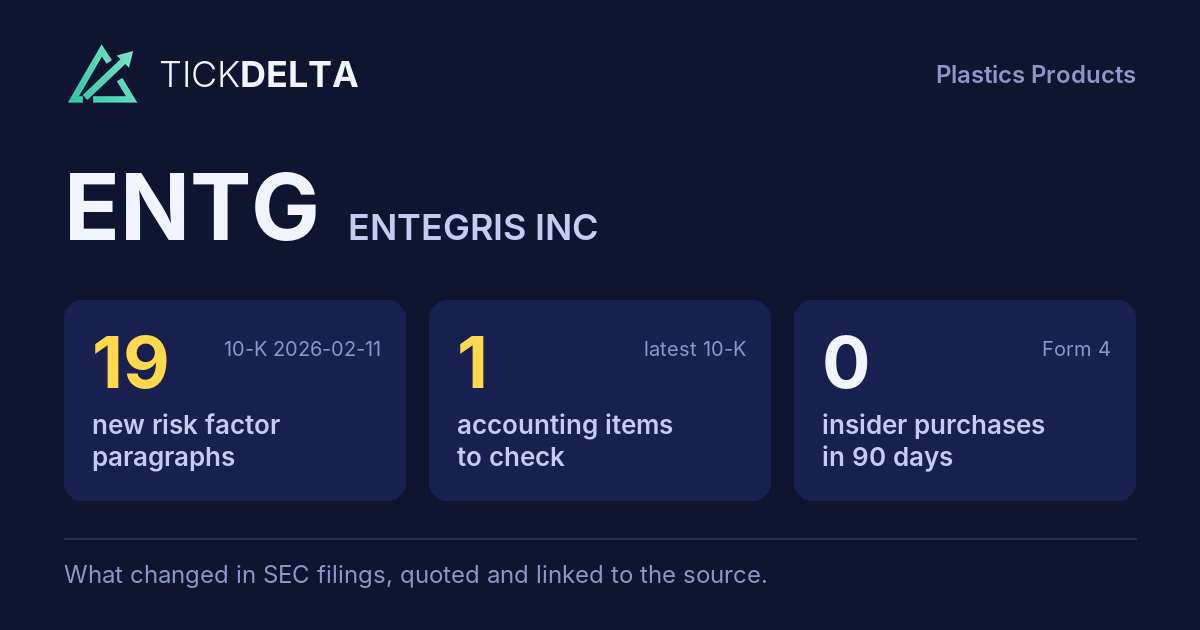
of the text changed · 12,118 words now · 19 new paragraphs, 14 gone
MD&A
30.5%
of the text changed · 7,348 words now · 11 new paragraphs, 16 gone
Legal Proceedings
0.0%
of the text changed · 174 words now
10-K 0001101302-26-000012 (Feb 11, 2026) vs 10-K 0001101302-25-000015 (Feb 12, 2025) Not compared: Accounting Policies.
Every paragraph, and how much of it changed
One bar per paragraph, in the order of the 10-K. Height and colour show the share of its words not in the closest paragraph a year earlier; the tallest bars are new paragraphs.
Risk Factors
175 paragraphs · 19 new · 51 reworded · 14 gone · 10-K Feb 11, 2026 against Feb 12, 2025
New paragraph
Reworded (5% of its words or more)
Same or nearly
Paragraph 17 · 46% changed
Every version of it
Our revenue is primarily dependent upon demand from the global semiconductor ecosystem ecosystem. Fluctuations in demand, whether from industry cyclicality, changes in consumer spending, macroeconomic conditions, or other factors, may cause our revenues and fluctuations in demand for semiconductors and the overall volume of semiconductor manufacturing may decrease demand for our products and may operating results to vary significantly, which could adversely affect our business.
Paragraph 172 · 44% changed
Every version of it
Paragraph 25 · 43% changed
Every version of it
•procurement shortages, shortages and related increased prices, and the failure of suppliers to perform their obligations and additional expenses we may incur to respond promptly to mitigate any supply shortages or other supplier problems; obligations;
Paragraph 30 · 42% changed
Every version of it
Paragraph 149 · 40% changed
Every version of it
We operate in a highly competitive, global industry. We face many domestic and international competitors, some of which have substantially greater manufacturing, financial, research and development and marketing resources than we do. In addition, some of our competitors may have better-established customer relationships than we do, which may enable them to have their products specified for use more frequently and more quickly by these customers. We also face competition from smaller, regional companies that focus on serving customers in their regions. Further, customers continually evaluate the benefits of internal manufacturing versus outsourcing, and a customer’s decision to internally manufacture products that we provide may negatively impact us. If we are unable to maintain our competitive position, we could experience downward pressure on prices, fewer customer orders, reduced margins, the inability to take advantage of new business opportunities and a loss of market share, any of which could have a material adverse effect on our results of operations. Further, we expect that existing and new competitors will improve their products and introduce new products with enhanced performance characteristics. The introduction of new products or more efficient production of existing products by competitors could diminish our market share and increase pricing pressure on our products.
Paragraph 111 · 37% changed
Every version of it
From time to time, we may receive and enter agreements for grants, subsidies, loans, tax benefits arrangements and other incentives from national, state and local governments in jurisdictions throughout the world designed to encourage us to establish, maintain or increase our investment, research and development and production activities in those jurisdictions. Our future business plans are impacted by obtaining these government incentives, which may take various forms, including grants, subsidies, loans, and tax arrangements, and they typically require us to achieve or maintain certain levels of investment, capital spending, employment, technology deployment or development milestones, construction or production milestones, or research and development activities to qualify for such incentives or could restrict us from undertaking certain activities. Compliance with these requirements may add complexity to our operations and increase our costs, and a failure to comply could result in cancelation of agreements or transactions, investigations, civil and criminal penalties, forfeiture of profits, reduction, termination or clawback of any funding, suspension or debarment from doing business with the government, or other penalties, any of which could have a material and adverse effect on our business, financial condition and results of operations. For example, we have entered into a direct funding agreement with the U.S. Department of Commerce to receive a grant under the U.S. CHIPS and Science Act of 2022. We may be unable to successfully achieve the milestones and ancillary requirements to qualify for these incentives or such incentives may otherwise be withheld. We also may be unable to obtain future incentives, which may put us at a disadvantage against competitors, especially foreign competitors that may benefit from such incentives in the countries in which they are headquartered.
Paragraph 123 · 37% changed
Every version of it
We may be unable to maintain sufficient cash flow from operating activities to permit us to pay the principal of, premium, if any, and interest on our indebtedness. Our ability to make scheduled payments on or to refinance our debt obligations depends on our financial condition and operating performance and the condition of the capital markets, which are subject to prevailing economic, industry and competitive conditions, as well as many financial, business, legislative, political, regulatory and other factors beyond our control. If our cash flow and capital resources are insufficient to fund our debt service obligations, we could face substantial liquidity problems, be forced to reduce or delay investments and capital expenditures, dispose of material assets or operations, seek additional debt or equity capital or restructure or refinance our indebtedness, any of which could have a material adverse effect on our business, financial position and results of operations. In addition, the level and quality of our earnings, operations, business and management, among other things, will impact the determination of our credit ratings. Any failure to make payments of interest and principal on our outstanding indebtedness on a timely basis may result in a decrease in the ratings assigned to us by the ratings agencies, which may negatively impact our access to the debt capital markets and increase our cost of borrowing. In addition, we may be unable to maintain the current creditworthiness or prospective credit rating of the Company. Any actual or anticipated changes or downgrades in such credit rating may have a negative impact on our liquidity, capital position or access to capital markets and affect our ability to obtain any future required financing on acceptable terms or at all.
Paragraph 32 · 48% changed
Every version of it
10-K Feb 12, 2025Global economic uncertainty may materially and adversely affect our business, financial condition and results of operations.
10-K Feb 11, 2026
As a result of global economic uncertainty, we may experience reduced demand for our products, increased costs, challenges in forecasting our operating results and identifying and prioritizing business risks, and other negative effects, any of which may materially and adversely affect our business, financial condition and results of operations.
Paragraph 17 · 46% changed
Every version of it
10-K Feb 12, 2025
Our revenue is primarily dependent upon demand from the global semiconductor ecosystem and fluctuations in demand for semiconductors and the overall volume of semiconductor manufacturing may decrease demand for our products and may adversely affect our business.
10-K Feb 11, 2026
Our revenue is primarily dependent upon demand from the global semiconductor ecosystem. Fluctuations in demand, whether from industry cyclicality, changes in consumer spending, macroeconomic conditions, or other factors, may cause our revenues and operating results to vary significantly, which could adversely affect our business.
Paragraph 172 · 44% changed
Every version of it
10-K Feb 12, 2025•an acquired company may have inadequate or ineffective internal controls over financial reporting, disclosure controls and procedures, cybersecurity, privacy, environmental, health and safety, anti-bribery, anti-corruption, human resource or other policies or practices, which may require unexpected or additional integration, mitigation and remediation costs;
10-K Feb 11, 2026
or other policies or practices, which may require unexpected or additional integration, mitigation and remediation costs;
Paragraph 25 · 43% changed
Every version of it
10-K Feb 12, 2025
•procurement shortages, increased prices, the failure of suppliers to perform their obligations and additional expenses we may incur to respond promptly to mitigate any supply shortages or other supplier problems;
10-K Feb 11, 2026
•procurement shortages and related increased prices, and the failure of suppliers to perform their obligations;
Paragraph 30 · 42% changed
Every version of it
10-K Feb 12, 2025During downturns in the semiconductor industry, which can occur suddenly, we typically experience greater pricing pressure and shifts in product and customer mix, which can adversely affect our gross margin and net income. The semiconductor industry is also affected by seasonal shifts in demand, and as a result, we have in the past and may experience in the future short-term fluctuation in our results of operations from one period to the next. We are unable to predict the timing, duration or severity of any current or future downturns in the semiconductor industry. Furthermore, the semiconductor industry is subject to rapid advancements and demand for new and emerging technologies, such as artificial intelligence. If we do not have, or are unable to develop, products and solutions that are utilized to manufacture semiconductors that enable new end-user demand trends, we may not be able to grow our revenue as fast as anticipated and our results of operations may be impacted.
10-K Feb 11, 2026
Furthermore, the semiconductor industry is subject to rapid advancements and demand for new and emerging technologies, such as AI. If we do not have, or are unable to develop, products and solutions that are utilized to manufacture semiconductors that enable new end-user demand trends, we may not be able to grow our revenue as fast as anticipated and our results of operations may be impacted. Furthermore, our performance is dependent, in large part, on our exposure to certain market trends and the growth of certain segments of the semiconductor ecosystem. For example, we have less exposure to the market for back-end assembly and testing. If certain markets in which we have limited or no exposure grow more rapidly than the markets we serve, our growth relative to our competitors may lag.
Paragraph 149 · 40% changed
Every version of it
10-K Feb 12, 2025
We operate in a highly competitive, global industry. We face many domestic and international competitors, some of which have substantially greater manufacturing, financial, research and development and marketing resources than we do. In addition, some of our competitors may have better-established customer relationships than we do, which may enable them to have their products specified for use more frequently and more quickly by these customers. We also face competition from smaller, regional companies that focus on serving customers in their regions. Further, customers continually evaluate the benefits of internal manufacturing versus outsourcing, and a customer’s decision to internally manufacture products that we provide may negatively impact us. If we are unable to maintain our competitive position, we could experience downward pressure on prices, fewer customer orders, reduced margins, the inability to take advantage of new business opportunities and a loss of market share, any of which could have a material adverse effect on our results of operations. Further, we expect that existing and new competitors will improve their products and introduce new products with enhanced performance characteristics. The introduction of new products or more efficient production of existing products by competitors could diminish our market share and increase pricing pressure on our products.
10-K Feb 11, 2026
We operate in a highly competitive, global industry. We face many domestic and international competitors, some of which have substantially greater manufacturing, financial, research and development and marketing resources than we do. In addition, some of our competitors may have better-established customer relationships than we do, which may enable them to have their products specified for use more frequently and more quickly by these customers. We also face competition from smaller,
Paragraph 111 · 37% changed
Every version of it
10-K Feb 12, 2025
From time to time, we may receive and enter agreements for grants, tax benefits and other incentives from national, state and local governments in jurisdictions throughout the world designed to encourage us to establish, maintain or increase our investment, research and development and production activities in those jurisdictions. Our future business plans are impacted by obtaining these government incentives, which may take various forms, including grants, subsidies, loans, and tax arrangements, and typically require us to achieve or maintain certain levels of investment, capital spending, employment, technology deployment or development milestones, construction or production milestones, or research and development activities to qualify for such incentives or could restrict us from undertaking certain activities. Compliance with these requirements may add complexity to our operations and increase our costs, and a failure to comply could result in cancelation of agreements or transactions, investigations, civil and criminal penalties, forfeiture of profits, reduction, termination or clawback of any funding, suspension or debarment from doing business with the government, or other penalties, any of which could have a material and adverse effect on our business, financial condition and results of operations. For example, we have entered into a direct funding agreement with the U.S. Department of Commerce to receive a grant under the U.S. CHIPS and Science Act of 2022. We may be unable to successfully achieve the milestones and ancillary requirements to qualify for these incentives or such incentives may otherwise be withheld. We also may be unable to obtain future incentives, which may put us at a disadvantage against competitors, especially foreign competitors that may benefit from such incentives in the countries in which they are headquartered.
10-K Feb 11, 2026
From time to time, we may receive and enter agreements for grants, subsidies, loans, tax arrangements and other incentives from national, state and local governments in jurisdictions throughout the world designed to encourage us to establish, maintain or increase our investment, research and development and production activities in those jurisdictions. Our future business plans are impacted by obtaining these government incentives, and they typically require us to achieve or maintain certain levels of investment, capital spending, employment, technology deployment or development milestones, construction or production milestones, or research and development activities to qualify for such incentives or could restrict us from undertaking certain
Paragraph 123 · 37% changed
Every version of it
10-K Feb 12, 2025
We may be unable to maintain sufficient cash flow from operating activities to permit us to pay the principal of, premium, if any, and interest on our indebtedness. Our ability to make scheduled payments on or to refinance our debt obligations depends on our financial condition and operating performance and the condition of the capital markets, which are subject to prevailing economic, industry and competitive conditions, as well as many financial, business, legislative, political, regulatory and other factors beyond our control. If our cash flow and capital resources are insufficient to fund our debt service obligations, we could face substantial liquidity problems, be forced to reduce or delay investments and capital expenditures, dispose of material assets or operations, seek additional debt or equity capital or restructure or refinance our indebtedness, any of which could have a material adverse effect on our business, financial position and results of operations. In addition, the level and quality of our earnings, operations, business and management, among other things, will impact the determination of our credit ratings. Any failure to make payments of interest and principal on our outstanding indebtedness on a timely basis may result in a decrease in the ratings assigned to us by the ratings agencies, which may negatively impact our access to the debt capital markets and increase our cost of borrowing. In addition, we may be unable to maintain the current creditworthiness or prospective credit rating of the Company. Any actual or anticipated changes or downgrades in such credit rating may have a negative impact on our liquidity, capital position or access to capital markets and affect our ability to obtain any future required financing on acceptable terms or at all.
10-K Feb 11, 2026
We may be unable to maintain sufficient cash flow from operating activities to permit us to pay the principal of, premium, if any, and interest on our indebtedness. Our ability to make scheduled payments on or to refinance our debt obligations depends on our financial condition and operating performance and the condition of the capital markets, which are subject to prevailing economic, industry and competitive conditions, as well as many financial, business, legislative, political, regulatory and other factors beyond our control. If our cash flow and capital resources are insufficient to fund our debt service obligations, we could
MD&A
122 paragraphs · 11 new · 54 reworded · 16 gone · 10-K Feb 11, 2026 against Feb 12, 2025
New paragraph
Reworded (5% of its words or more)
Same or nearly
Paragraph 110 · 44% changed
Paragraph 120 · 44% changed
Paragraph 48 · 43% changed
Paragraph 109 · 43% changed
Paragraph 119 · 43% changed
Paragraph 90 · 41% changed
Non-GAAP Net Income is defined by the Company as net income before, as applicable, (1) goodwill impairment, (2) deal income, adjusted to exclude the impact of any Special Items and transaction costs, (3) integration costs, (4) restructuring costs, (5) patent infringement settlement gain, net (6) acquired tax equalization asset reduction, (7) loss on extinguishment of debt and modification, (8) (gain) loss on sale of businesses and held-for-sale assets, net, (9) gain on termination of the alliance agreement, (10) Infineum termination fee, net, (11) impairment of long-lived assets, (12) amortization of intangible assets, (13) the tax effect of the foregoing adjustments to net income, stated on a per share basis, divided by diluted weighted average shares outstanding. Non-GAAP EPS is defined as Non-GAAP Net Income divided by our diluted weighted-average shares outstanding.
Paragraph 72 · 40% changed
Paragraph 94 · 40% changed
Paragraph 110 · 44% changed
10-K Feb 12, 20251 Non-cash impairment charges associated with goodwill of our former Electronic Chemicals business and a small, industrial specialty chemicals business.
10-K Feb 11, 2026
6 Impairment of long-lived assets related to a small, industrial specialty chemicals business.
Paragraph 120 · 44% changed
10-K Feb 12, 20251 Non-cash impairment charges associated with goodwill of our former Electronic Chemicals business and a small, industrial specialty chemicals business.
10-K Feb 11, 2026
8 Impairment of long-lived assets related to a small, industrial specialty chemicals business.
Paragraph 48 · 43% changed
10-K Feb 12, 2025Impairment on long-lived assets, see Note 3 to the Company’s Consolidated Financial Statements (17,497)
10-K Feb 11, 2026
The Company reports its financial performance based on two reportable segments. See Note 20 to the consolidated financial statements for additional information on the Company’s two segments.
Paragraph 109 · 43% changed
10-K Feb 12, 20259 (Gain) loss from the sale of certain businesses and held-for-sale assets, net.
10-K Feb 11, 2026
5 Loss (gain) from the sale of the Company’s PIM and small, industrial specialty chemicals businesses.
Paragraph 119 · 43% changed
10-K Feb 12, 20259 (Gain) loss from the sale of certain businesses and held-for-sale assets, net.
10-K Feb 11, 2026
7 Loss (gain) from the sale of the Company’s PIM and small, industrial specialty chemicals businesses.
Paragraph 90 · 41% changed
10-K Feb 12, 2025
Non-GAAP Net Income is defined by the Company as net income before, as applicable, (1) goodwill impairment, (2) deal and transaction costs, (3) integration costs, (4) restructuring costs, (5) patent infringement settlement gain, net (6) acquired tax equalization asset reduction, (7) loss on extinguishment of debt and modification, (8) (gain) loss on sale of businesses and held-for-sale assets, net, (9) gain on termination of the alliance agreement, (10) Infineum termination fee, net, (11) impairment of long-lived assets, (12) amortization of intangible assets, (13) the tax effect of the foregoing adjustments to net income, stated on a per share basis, divided by diluted weighted average shares outstanding. Non-GAAP EPS is defined as Non-GAAP Net Income divided by our diluted weighted-average shares outstanding.
10-K Feb 11, 2026
Non-GAAP Net Income is defined by the Company as net income, adjusted to exclude the impact of any Special Items and the tax effect of the foregoing adjustments to net income, stated on a per share basis, divided by diluted weighted average shares outstanding. Non-GAAP EPS is defined as Non-GAAP Net Income divided by our diluted weighted-average shares outstanding.
Paragraph 72 · 40% changed
10-K Feb 12, 2025The Company has commitments under the Revolving Facility of $575.0 million. The Revolving Facility bears interest at a rate per annum equal to, at the Company’s option, either a base rate (such as prime rate) or SOFR, plus, in each case, an applicable margin. During the twelve months ended December 31, 2024, the Company borrowed and repaid $140.0 million under this Revolving Facility and no balance was outstanding at December 31, 2024.
10-K Feb 11, 2026
During the twelve months ended December 31, 2025, the Company borrowed and repaid $567.0 million under this Revolving Facility and no balance was outstanding at December 31, 2025.
Paragraph 94 · 40% changed
10-K Feb 12, 2025Management uses Adjusted EBITDA and Adjusted Operating Income to assist it in evaluations of the Company’s operating performance by excluding items that management does not consider as relevant in the results of its ongoing operations. Internally, these non-GAAP measures are used by management for planning and forecasting purposes, including the preparation of internal budgets; for allocating resources to enhance financial performance; for evaluating the effectiveness of operational strategies; and for evaluating the Company’s capacity to fund capital expenditures, secure financing and expand its business.
10-K Feb 11, 2026
of internal budgets; for allocating resources to enhance financial performance; for evaluating the effectiveness of operational strategies; and for evaluating the Company’s capacity to fund capital expenditures, secure financing and expand its business.
A paragraph is matched with the one last year that shares the most of its words; under half in common makes it new. The paragraphs shown are the 8 reworded the most in each section.
The paragraph that changed most in each section
The redline
Marked against last year's 10-K: cut words struck through, new words highlighted.
Risk Factors183 words changed in this paragraph; it is 52% similar to last year's version.
We may be unable to maintain sufficient cash flow from operating activities to permit us to pay the principal of, premium, if any, and interest on our indebtedness. Our ability to make scheduled payments on or to refinance our debt obligations depends on our financial condition and operating performance and the condition of the capital markets, which are subject to prevailing economic, industry and competitive conditions, as well as many financial, business, legislative, political, regulatory and other factors beyond our control. If our cash flow and capital resources are insufficient to fund our debt service obligations, we could face substantial liquidity problems, be forced to reduce or delay investments and capital expenditures, dispose of material assets or operations, seek additional debt or equity capital or restructure or refinance our indebtedness, any of which could have a material adverse effect on our business, financial position and results of operations. In addition, the level and quality of our earnings, operations, business and management, among other things, will impact the determination of our credit ratings. Any failure to make payments of interest and principal on our outstanding indebtedness on a timely basis may result in a decrease in the ratings assigned to us by the ratings agencies, which may negatively impact our access to the debt capital markets and increase our cost of borrowing. In addition, we may be unable to maintain the current creditworthiness or prospective credit rating of the Company. Any actual or anticipated changes or downgrades in such credit rating may have a negative impact on our liquidity, capital position or access to capital markets and affect our ability to obtain any future required financing on acceptable terms or at all.
Source: Item 1A, 10-K 0001101302-26-000012 vs Item 1A, 10-K 0001101302-25-000015
MD&A157 words changed in this paragraph; it is 58% similar to last year's version.
Goodwill is tested for impairment annually as of August 31. If circumstances change during interim periods between annual tests that would more likely than not reduce the fair value of a reporting unit below its carrying value, the Company will test goodwill for impairment. Factors that would necessitate an interim goodwill impairment assessment include a sustained decline in the Company's stock price, effects on a reporting unit such as a change in the composition or carrying amounts of its net assets, prolonged negative industry or economic trends, or significant under-performance relative to expected, historical or projected future operating results. Management uses judgment We allocate goodwill to determine whether to use a qualitative analysis or a quantitative fair value measurement for its goodwill impairment testing. The Company's fair value measurement approach combines the income and market valuation techniques for each of the Company’s reporting units at the time of acquisition or when there is a change in the reporting structure and base that carry goodwill. These valuation techniques use estimates allocation on which reporting units will benefit from the acquired assets and assumptions including, but not limited to, the determination of appropriate market comparable, projected future cash flows (including timing liabilities. Reporting units are defined as operating segments or one level below an operating segment, referred to as a component. The Company has defined its reporting units as its operating segments, MS and profitability), the discount rate reflecting the risk inherent APS as disclosed in future cash flows, the perpetual growth rate, and projected future economic and market conditions. Note 20 to our consolidated financial statements.
Source: Item 7, 10-K 0001101302-26-000012 vs Item 7, 10-K 0001101302-25-000015
Sentences and paragraphs added, removed or reworded
Every change, by type
Sentences and paragraphs of ENTG's Risk Factors and MD&A, 10-K Feb 11, 2026 against 10-K Feb 12, 2025. Each links to the text at sec.gov.
Quiet changes are sentences kept from last year with one to four words changed, at least one of them a hedge, a modal or a qualifier (may, could, will, not, significant, material…). A year or date rolling forward is not counted.
The full word list
adverse, adversely, all, although, anticipate, anticipates, any, approximately, believe, believes, can, cannot, certain, could, expect, expects, generally, however, if, intend, intends, largely, likely, many, material, materially, may, might, most, must, never, no, not, possible, primarily, probable, should, significant, significantly, some, substantial, substantially, unlikely, will, would
AddedRisk Factors
Our revenue is primarily dependent upon demand from the global semiconductor ecosystem. The semiconductor industry has historically been, and is likely to continue to be, cyclical with periodic downturns, resulting in decreased demand for our products, which has negatively impacted our results of operations in the past and could do so again in the future. Our revenues and operating results may fluctuate significantly from quarter-to-quarter or year-to-year due to a number of factors, many of which are outside our control. A lower volume of sales can have a large and disproportionate impact on our profitability because some of our expenses are fixed in the short term.
Read it in 10-K Feb 11, 2026 at sec.gov
AddedRisk Factors
Factors that may negatively impact the demand for our solutions or cause our financial results to fluctuate unpredictably include, but are not limited to:
Read it in 10-K Feb 11, 2026 at sec.gov
AddedRisk Factors
•decreased consumer spending or changes in purchasing habits related to (1) macroeconomic uncertainty, market conditions, slow or negative economic growth or uncertainty about economic and other policies; or (2) geopolitical instability, including the Russian invasion of Ukraine and conflicts in the Middle East;
Read it in 10-K Feb 11, 2026 at sec.gov
AddedRisk Factors
•trends in the semiconductor industry and demand trends for different types of electronic devices such as logic versus memory integrated circuit (“IC”) devices, or digital versus analog IC devices, and the various technology nodes at which those products are manufactured;
Read it in 10-K Feb 11, 2026 at sec.gov
AddedRisk Factors
•the short order-to-delivery time for our products; market share and competitive losses; and pricing changes by us and our competitors;
Read it in 10-K Feb 11, 2026 at sec.gov
AddedRisk Factors
and the technical sensitivity of many of our products. Disruptions to transportation routes, ports, air freight capacity, or regional infrastructure in Asia (including in locations where we or our suppliers manufacture or where key customers operate) could further delay deliveries, increase costs, or reduce our ability to serve customers.
Read it in 10-K Feb 11, 2026 at sec.gov
AddedRisk Factors
These measures could also increase our costs (including logistics, compliance, and supplier qualification costs), disrupt our sourcing and manufacturing plans, and adversely affect our ability to meet customer requirements or contractual commitments.
Read it in 10-K Feb 11, 2026 at sec.gov
AddedRisk Factors
Sales to a limited number of large customers constitute a significant portion of our overall revenue, shipments, cash flows, collections and profitability and our success is tied in part to their competitive position in their respective markets. Our top ten customers accounted for 50%, 48% and 43% of our net sales in 2025, 2024 and 2023, respectively. Consolidation among semiconductor manufacturers, shifts in customer build plans, and evolving procurement strategies (including efforts to localize supply chains in response to export controls or trade policies) may increase these customers’ bargaining power and result in pricing pressure, more restrictive commercial terms (including audit, cybersecurity, ESG, and flow-down requirements), longer payment cycles, or demands for dual sourcing or rapid qualification of alternative products. If we are unable to satisfy these requirements on commercially reasonable terms, we could lose design wins, experience reduced volumes, or incur additional costs, any of which could materially adversely affect our results of operations.
Read it in 10-K Feb 11, 2026 at sec.gov
Show the other 63
AddedRisk Factors
result in reduced orders, higher manufacturing costs, delays in acceptance and payment, additional service and warranty expense and damage to our reputation, which may adversely affect our revenue and results of operations.
Read it in 10-K Feb 11, 2026 at sec.gov
AddedRisk Factors
We continue to devote significant resources to network security, threat monitoring and other measures to protect our systems and data from unauthorized access or misuse, and we may be required to expend greater resources in the future, especially in the face of evolving and increasingly sophisticated cybersecurity threats and laws, regulations, contractual and other actual and asserted obligations to which we are or may become subject relating to privacy, data protection, and cybersecurity. These security procedures and protection systems are costly and yet they may not be fail-safe. We may still suffer cybersecurity and other incidents, which could have a material adverse effect on our business or operations.
Read it in 10-K Feb 11, 2026 at sec.gov
AddedRisk Factors
Recent tariffs and other trade actions taken by the U.S. and other countries where we do business have increased, and may continue to increase, our import and export costs, requiring us, in certain situations, to increase our prices, add a surcharge or find alternative suppliers which, in turn, may harm our relationships with customers, reduce demand for our products and decrease our profitability.
Read it in 10-K Feb 11, 2026 at sec.gov
AddedRisk Factors
In recent years, including during 2025, the U.S. government has imposed tariffs and implemented other trade actions affecting products and materials imported into the U.S. In response to these tariffs and other changes in U.S. trade policy, several countries, including China, have threatened or imposed retaliatory tariffs on U.S. exports. The continuing imposition of tariffs by the U.S. and others may also give rise to further escalations of protectionist and retaliatory trade measures. Tariffs and related trade measures may be expanded, modified or restructured, and exemptions or exclusions may be limited or unavailable, which could further increase costs or disrupt supply chains.
Read it in 10-K Feb 11, 2026 at sec.gov
RemovedRisk Factors
RemovedRisk Factors
RemovedRisk Factors
RemovedRisk Factors
RemovedRisk Factors
RemovedRisk Factors
RemovedRisk Factors
RemovedRisk Factors
RemovedRisk Factors
RemovedRisk Factors
RemovedRisk Factors
RemovedRisk Factors
RewordedRisk Factors
Such uncertain and volatile conditions conditions, particularly if present in any of our key sales or manufacturing regions regions, can cause or exacerbate negative trends in business and consumer spending, which, in turn, historically have historically had a negative impact on increased our manufacturing and delivery costs and reduced customer demand for our products and costs of manufacturing and delivering our products. (and may do so in the future).
Read it in 10-K Feb 11, 2026 at sec.gov
RewordedRisk Factors
RewordedRisk Factors
RewordedRisk Factors
We are unable to predict the timing, duration or severity of any current or future downturns in the semiconductor industry. industry and cost control or other measures we implement to maintain profitability during such downturns or periods of limited growth may constrain or limit our ability to capitalize on subsequent industry recoveries.
Read it in 10-K Feb 11, 2026 at sec.gov
RewordedRisk Factors
If we were to lose any one of these or other critical sources, or there is as an industry-wide increase in demand for, or the discontinuation of, raw materials or other components used in our products, it could be difficult for us, or we may be unable, impossible to find an alternative supplier to provide certain raw materials and components, in supplier, which case could adversely affect our operations could be adversely affected. operations.
Read it in 10-K Feb 11, 2026 at sec.gov
RewordedRisk Factors
RewordedRisk Factors
Because a significant amount of our sales and manufacturing activity occurs outside the U.S., we are exposed to risks inherent in operating a global business. business, including changes in economic policy, geopolitical tensions and challenges in managing a diverse workforce and operating under differing business and legal environments, which may harm our reputation or profitability.
Read it in 10-K Feb 11, 2026 at sec.gov
RewordedRisk Factors
Changes in or ambiguous interpretations of laws, regulations and standards standards, and the speed with which new regulations may be enacted and come into effect, may create uncertainty regarding compliance matters. matters or instances where we may not be in full compliance.
Read it in 10-K Feb 11, 2026 at sec.gov
RewordedRisk Factors
RewordedRisk Factors
Each of these laws, rules and regulations imposes costs on our business, including financial costs and potential diversion of our management’s attention, and may present risks to our business, including potential fines, restrictions on our actions and reputational damage if we do not fully comply. attention.
Read it in 10-K Feb 11, 2026 at sec.gov
RewordedRisk Factors
Furthermore, government authorities may take retaliatory actions, impose conditions that require the use of local suppliers or partnerships with local companies, increase tariff and other customs costs costs, impose export restrictions on raw materials and components, such as the restrictions imposed on critical materials and minerals by China in 2025, or require the license or other transfer of intellectual property, which could have a significant adverse impact on our business.
Read it in 10-K Feb 11, 2026 at sec.gov
RewordedRisk Factors
If we were to lose any of our significant customers, if our products are not specified for our significant customers’ products products, if our customers lose market share to competitors with whom we do not have as strong relationships or as favorable commercial terms, or if we suffer a material reduction in their purchase orders, our revenue could decline and our business, financial condition and results of operations could be materially and adversely affected.
Read it in 10-K Feb 11, 2026 at sec.gov
AddedMD&A
Recent and continuing developments in U.S. and foreign trade policy have heightened global trade tensions and sparked significant uncertainty in macroeconomic and geopolitical environments, particularly with respect to China. The nature of our global business exposes us to risks associated with trade conflicts between the U.S. and its trading partners. Additionally, our manufacturing operations rely on a global supply chain to manufacture our products, including, in some instances, raw materials from China. The recent tariffs and other similar trade policies may increase our sourcing and manufacturing costs, force us to find alternative suppliers, or result in manufacturing and delivery delays. As a result, we may face a reduction in the demand for, and in the competitiveness of, our products, harm to our relationships with our customers, and decreased profitability. These issues may be exacerbated by the overall macroeconomic uncertainty stemming from current trade tensions which may slow economic growth and negatively impact the demand for products containing semiconductors, thereby decreasing the demand for our products.
Read it in 10-K Feb 11, 2026 at sec.gov
AddedMD&A
Our strategy has been, and will continue to be, to build a resilient and robust supply chain and a global manufacturing footprint near our customers. While this strategy should mitigate the Company from financial and operational impacts of a volatile trade environment in the medium to long term, our business could still be impacted by sudden changes in trade policy in the near term, particularly, for example, our products manufactured in the United States and sold to customers located in China. Given the dynamic nature of this situation, the direct and indirect impact to our customers and our business is difficult to quantify; however, we will continue to closely monitor this evolving situation, further leverage our global footprint and regional supply chain, and explore additional options to mitigate this volatility.
Read it in 10-K Feb 11, 2026 at sec.gov
AddedMD&A
In January 2026, we completed an assessment of the useful lives of our property, plant and equipment and adjusted the estimated useful lives of certain property, plant and equipment to more closely reflect the expected economic lives of these assets. These adjustments followed an analysis of our actual usage of assets, including the technological and physical obsolescence of these assets, our ability to continue to use equipment, historical usage trends, and anticipated capital plans and technology roadmaps, as well as industry trends and practices. Based on this analysis, we determined that the increase in useful lives was warranted and consistent with the Company’s historical and anticipated use of these assets. The updated estimated useful lives of certain assets for financial reporting purposes are as follows: buildings and improvements, 5 to 35 years increased to 5 to 40 years; manufacturing equipment, 5 to 10 years increased 5 to 14 years; canister and cylinder 3 to 12 years increased to 3 to 19 years; molds 3 to 5 years increased to 3 to 9 years and lab equipment, 3 to 8 years increased to 3 to 9 years.
Read it in 10-K Feb 11, 2026 at sec.gov
AddedMD&A
This change in accounting estimate is effective beginning in fiscal year 2026 and is applied prospectively to the assets on our balance sheet as of December 31, 2025 and to future asset purchases. Based on the carrying amount of the assets included in property, plant and equipment, net in our Consolidated Balance Sheet as of December 31, 2025, we expect total depreciation expense in 2026 to be reduced by $72.9 million. We expect this change will result in an increase in gross margin of approximately $52.4 million, a decrease in ER&D expenses of approximately $11.4 million and a decrease in ending inventory values of $9.1 million.
Read it in 10-K Feb 11, 2026 at sec.gov
AddedMD&A
The following table sets forth the results of operations and the relationship between various components of operations, stated as a percent of net sales, for 2025 and 2024. (Dollars in millions) 2025 2024 % of net sales % of net sales Net sales $ 3,196.6 100.0 % $ 3,241.2 100.0% Cost of sales 1,776.7 55.6 1,754.5 54.1 Gross profit 1,419.9 44.4 1,486.7 45.9 Selling, general and administrative expenses 450.6 14.1 446.6 13.8 Engineering, research and development expenses 329.0 10.3 316.1 9.8 Amortization of intangible assets 184.4 5.8 190.1 5.9 Operating income 455.9 14.3 533.9 16.5 Interest expense 199.8 6.3 215.2 6.6 Interest income (7.9) (0.2) (7.3) (0.2) Other expense, net 9.4 0.3 4.0 0.1 Income before income taxes 254.6 8.0 322.0 9.9 Income tax expense 18.0 0.6 28.3 0.9 Equity in net loss of affiliates 1.0 — 0.9 — Net income $ 235.6 7.4 $ 292.8 9.0
Read it in 10-K Feb 11, 2026 at sec.gov
AddedMD&A
Employee costs (excluding restructuring costs of $3.1 included in the line above) (3.9)
Read it in 10-K Feb 11, 2026 at sec.gov
AddedMD&A
The decrease in the effective tax rate from 2024 to 2025 primarily relates to lower income and the release of unrecognized tax benefits resulting from the expiration of applicable statute of limitations. This benefit was partially offset by an increase in discrete tax expense recorded associated with share-based compensation and the enactment of the One Big Beautiful Bill Act.
Read it in 10-K Feb 11, 2026 at sec.gov
AddedMD&A
(In millions) Total Due within one year of December 31, 2025 Due later than one year from December 31, 2025 Long-term debt (principal) $ 3,745.0 $ — $ 3,745.0 Interest payments on long-term debt 655.3 184.5 470.8 Capital purchase obligations 60.0 42.5 17.5 Supply purchase obligations 150.5 88.1 62.4 Operating and financing leases 151.3 21.6 129.7 Income tax liabilities 123.2 82.4 40.8 Total $ 4,885.3 $ 419.1 $ 4,466.2
Read it in 10-K Feb 11, 2026 at sec.gov
AddedMD&A
The non-GAAP financial measures exclude certain specific items (“Special Items”), including certain items related to mergers and acquisitions; divestitures; restructuring and severance charges; impairments of assets; refinancing; certain income tax items and other discrete adjustments related to non-recurring, unusual or unanticipated charges, expenses or gains. We evaluate Special Items on an individual basis. Our evaluation of whether to exclude a Special Item for purposes of determining our non-GAAP financial measures considers both the quantitative and qualitative aspects of the Special Item, including among other things (i) its nature, (ii) whether or not it relates to our ongoing business operations, and (iii) whether or not we expect it to occur as part of our normal business on a regular basis.
Read it in 10-K Feb 11, 2026 at sec.gov
AddedMD&A
3 Restructuring charges resulting from discrete cost saving initiatives inclusive of employee termination benefit, contract termination costs and asset impairment charges, primarily related to (i) an internal reorganization, combining two complementary divisions into one and realigning our customer facing organization and (ii) workforce reductions, contract termination costs and the abandonment of certain capital equipment no longer necessary for the Company’s long-term objectives.
Read it in 10-K Feb 11, 2026 at sec.gov
RemovedMD&A
RemovedMD&A
RemovedMD&A
RemovedMD&A
RemovedMD&A
RemovedMD&A
RemovedMD&A
RemovedMD&A
RemovedMD&A
RemovedMD&A
RemovedMD&A
RemovedMD&A
RewordedMD&A
Professional fees 3 2,574 36,650 1 — 2.6 Severance costs 4 794 1,478 Retention costs 5 2 — 1,687 Other costs 6 — 13,710 0.8 Restructuring costs 7 3,930 14,745 3 29.7 3.9 Patent infringement settlement gain, net 8 (20,033) 4 — (20.0) Acquired tax equalization asset reduction 9 2,959 5 — 3.0 Loss on extinguishment of debt and modification 10 14,348 29,896 (Gain) loss 6 3.2 14.3 Loss (gain) on sale of businesses and held-for-sale assets, businesses, net 11 (4,311) 23,839 Gain on termination of alliance agreement 12 — (184,754) Infineum termination fee, net 13 — (10,877) 7 10.9 (4.3) Impairment on long-lived assets 14 12,967 30,464 8 — 13.0 Amortization of intangible assets 15 190,119 214,477 9 184.4 190.1 Tax effect of adjustments to net income and discrete tax items 16 (40,146) (71,284) 10 (45.3) (40.2) Non-GAAP net income $ 455,988 418.5 $ 398,918 456.0 Diluted earnings per common share $ 1.55 $ 1.93 $ 1.20 Effect of adjustments to net income $ 1.07 1.20 $ 1.45 1.08 Diluted non-GAAP earnings per common share $ 2.75 $ 3.00 $ 2.64 Diluted weighted average shares outstanding 151,840 150,945 152.2 151.8
Read it in 10-K Feb 11, 2026 at sec.gov
RewordedMD&A
These risks and uncertainties include, but are not limited to, fluctuations in the demand for semiconductors and the overall volume of semiconductor manufacturing; semiconductors; the impact of global economic uncertainty, including volatile financial markets, inflationary pressures and interest rate fluctuations, economic recessions, national debt and bank failures, raw material shortages, supply and labor constraints, and price increases; fluctuations in the Company’s revenues and operating results and their impact on the Company’s stock price; supply chain interruptions and the Company’s dependence on sole, single and limited source suppliers; operational, political and legal risks of associated with the Company’s international operations; the impact of operations, including those related to geopolitical uncertainty and regional and global instabilities, hostilities instabilities and geopolitical uncertainty, hostilities, including, but not limited to, the ongoing conflicts between Ukraine and Russia, and between Israel and Hamas, as well as the global responses thereto; tariffs, additional taxes, and other protectionist measures resulting from international trade disputes, strained international relations, and changes in foreign and national security policy; export controls, economic sanctions, and similar restrictions; the concentration and consolidation of the Company’s customer base; the Company’s ability to meet rapid demand shifts; the Company’s ability to continue technological innovation and to introduce new products to meet customers’ rapidly changing requirements; manufacturing and other operational disruptions or delays; the risks associated with the use and manufacture of hazardous materials; goodwill impairment; challenges in attracting and retaining qualified personnel; the Company’s ability to protect and enforce intellectual property rights;
Read it in 10-K Feb 11, 2026 at sec.gov
RewordedMD&A
Professional fees 3 2,574 36,650 1 — 2.6 Severance costs 4 794 1,478 Retention costs 5 2 — 1,687 Other costs 6 — 13,710 0.8 Restructuring costs 7 3,930 14,745 3 29.7 3.9 Acquired tax equalization asset reduction 8 2,959 4 — (Gain) loss 3.0 Loss (gain) on sale of businesses and held-for-sale assets, businesses, net 9 (4,311) 23,839 Gain on termination of alliance agreement 10 — (184,754) 5 10.9 (4.3) Impairment of long-lived assets 11 12,967 30,464 6 — 13.0 Amortization of intangible assets 12 190,119 214,477 7 184.4 190.1 Adjusted Operating Income 742,954 769,672 680.9 743.0 Adjusted Operating Margin 21.3 % 22.9 % 21.8 % Depreciation 188,120 172,683 205.3 188.1 Adjusted EBITDA $ 931,074 886.2 $ 942,355 931.1 Adjusted EBITDA – as a % of net sales 27.7 % 28.7 % 26.7 %
Read it in 10-K Feb 11, 2026 at sec.gov
RewordedMD&A
Adjusted EBITDA is defined by the Company as net income before, as applicable, adjusted to exclude (1) equity in net loss of affiliates, (2) income tax expense (benefit), expense, (3) interest expense, (4) interest income, (5) other expense, net, (6) goodwill impairment, depreciation, and (7) deal and transaction costs, (8) integration costs, (9) restructuring costs, (10) acquired tax equalization asset reduction, (11) (gain) loss on sale the impact of businesses and held-for-sale assets, net, (12) gain on termination of the alliance agreement, (13) impairment of long-lived assets, (14) amortization of intangible assets, and (15) depreciation. any Special Items.
Read it in 10-K Feb 11, 2026 at sec.gov
RewordedMD&A
(In thousands) millions) 2025 2024 2023 Net sales $ 3,241,208 3,196.6 $ 3,523,926 3,241.2 Net income $ 292,787 235.6 $ 180,669 292.8 Net income - as a % of net sales 7.4 % 9.0 % 5.1 % Adjustments to net income Equity in net loss of affiliates 933 414 1.0 0.9 Income tax expense (benefit) 28,332 (8,413) 18.0 28.3 Interest expense 215,217 312,378 199.8 215.2 Interest income (7,368) (11,257) (7.9) (7.3) Other expense, net 4,021 25,367 9.4 4.0 GAAP – Operating income 533,922 499,158 455.9 533.9 Operating margin - as a % of net sales 14.3 % 16.5 % 14.2 % Goodwill impairment 1 — 115,217 Deal and transaction costs 2 — 3,001 Integration costs:
Read it in 10-K Feb 11, 2026 at sec.gov
RewordedMD&A
IT system failures, network disruptions, and cybersecurity risks; tariffs, additional taxes and other protectionist measures resulting from international trade disputes, strained international relations and changes in foreign and national security policy; the risks associated with the use and manufacture of hazardous materials; goodwill impairment; challenges in attracting and retaining qualified personnel; the Company’s ability to protect and enforce intellectual property rights; artificial intelligence; the Company’s environmental, social, and governance commitments; legal and regulatory risks, including changes in laws and regulations related to the environment, health and safety, accounting standards, and corporate governance, across the jurisdictions in which the Company operates; changes in taxation or adverse tax rulings; the Company’s ability to effectively implement any organizational changes; the ability to obtain government incentives and the possibility that competitors will benefit from government incentives; the amount and consequences of the Company’s indebtedness, its ability to repay its debt and to obtain future financing, and the Company’s obligations under its current outstanding credit facilities; volatility in the Company’s stock price; the payment of cash dividends and the adoption of future share repurchase programs; challenges associated with a potential change of control; substantial competition; the Company’s ability to identify, complete and integrate acquisitions, joint ventures, divestitures or other similar transactions; the impacts of climate change; and other matters.
Read it in 10-K Feb 11, 2026 at sec.gov
RewordedMD&A
(In thousands) millions) Year ended December 31, 2025 Year ended December 31, 2024 Year ended December 31, 2023 Net cash provided by operating activities $ 631,721 695.4 $ 644,476 631.7 Net cash (used in) provided by used in investing activities (67,079) 553,071 (300.8) (67.1) Net cash used in financing activities (688,987) (1,297,543) Decrease (366.9) (688.9) Increase (decrease) in cash, cash and cash equivalents and restricted cash (127,716) (106,510) 31.2 (127.7)
Read it in 10-K Feb 11, 2026 at sec.gov
RewordedMD&A
As described in the table above, the decrease in net sales was primarily attributable to (i) the absence of $33.9 million in sales totaling $434.2 million associated with the divested businesses PIM business and (ii) a reduction of $23.4 $14.2 million attributable of sales mainly due to unfavorable foreign currency translation effects, primarily related to the weakening of the Japanese yen relative to the U.S. dollar decreased semiconductor market demand compared to the year ago period ended December 31, 2023. 2024.
Read it in 10-K Feb 11, 2026 at sec.gov
RewordedMD&A
Sales percentage on a geographic basis for 2025 and 2024 and 2023 and the percentage increase (decrease) in sales for 2024 2025 compared to sales for 2023 2024 were as follows:Year ended December 31, 2024 2025 December 31, 2023 2024 Percentage increase (decrease) in sales North America 18% 21% 25% (25)% (16)% Taiwan 23% 20% 17% 12% 11% China 21% 16% 18% 21% (2)% South Korea 13% 13% (6)% 2% Japan 10% 10% (16)% 3% Europe 7% 8% 11% (32)% (13)% Southeast Asia 8% 7% 7% (12)% 10%
Read it in 10-K Feb 11, 2026 at sec.gov
RewordedMD&A
These declines sales were partially offset by an increase of $174.9 $3.5 million of sales due attributable to increased semiconductor market demand favorable foreign currency translation effects, primarily related to the strengthening of the Taiwanese dollar, Japanese yen and euro relative to the U.S. dollar compared to the year ago period ended December 31, 2023. 2024.
Read it in 10-K Feb 11, 2026 at sec.gov
RewordedMD&A
Year ended (In thousands) millions) December 31, 2025 December 31, 2024 December 31, 2023 Percent change Adjusted Operating Income $ 742,954 $769,672 (3.5)% 680.9 $743.0 (8.4)% Adjusted Operating Margin - as a % of net sales 22.9 21.3 % 21.8% 22.9% Adjusted EBITDA $ 931,074 $942,355 (1.2)% 886.2 $931.1 (4.8)% Adjusted EBITDA - as a % of net sales 28.7 27.7 % 26.7% 28.7% Non-GAAP EPS $ 3.00 $2.64 13.6% 2.75 $3.00 (8.3)%
Read it in 10-K Feb 11, 2026 at sec.gov
RewordedMD&A
Sources
The two latest 10-Ks on EDGAR, section by section. Each change links to the text at sec.gov.
Also
New risk factors: paragraphs with nothing like them last year, quoted in full.
Work with it
Excel workbook · CSV. Google Sheet that stays up to date: paste =IMPORTDATA("https://tickdelta.com/company/ENTG/export.csv") into a cell.