Entegris Inc ENTG
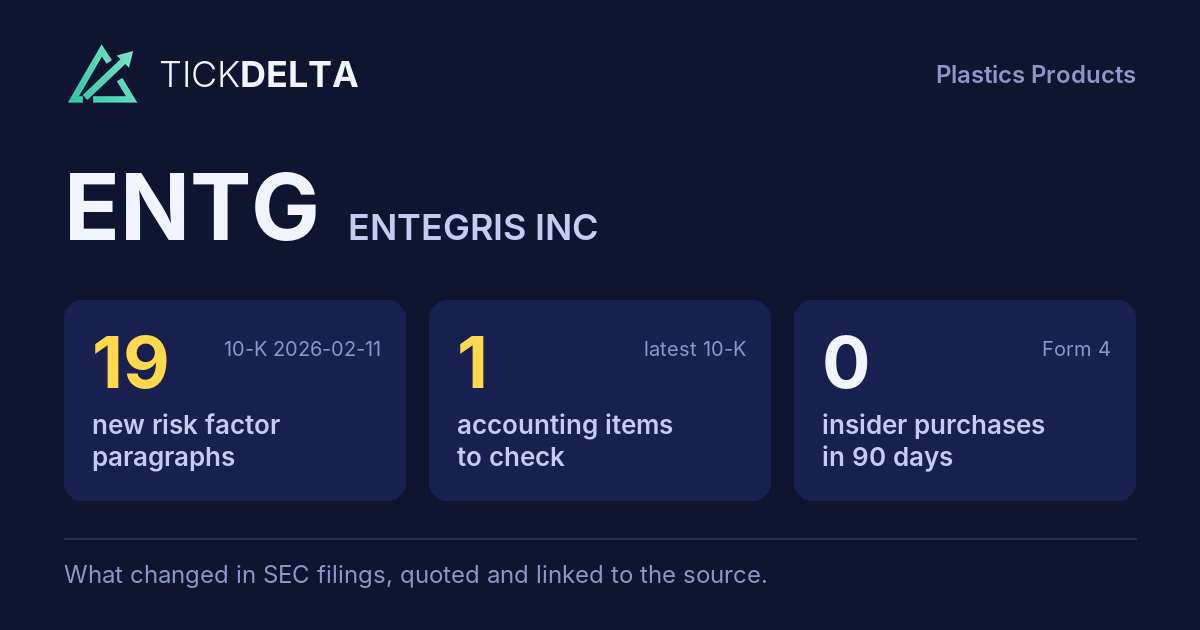
New risk paragraphs, branching off last year
Each branch is a paragraph in Risk Factors with nothing like it in the 10-K filed Feb 12, 2025. A box jumps to the paragraph as filed, below.
Paragraphs with nothing like them in last year's 10-K
19 paragraphs in Risk Factors of the 10-K filed Feb 11, 2026 with nothing like them in the 10-K filed Feb 12, 2025. Quoted exactly. Paragraphs that were only edited are under 10-K change.
Our revenue is primarily dependent upon demand from the global semiconductor ecosystem. The semiconductor industry has historically been, and is likely to continue to be, cyclical with periodic downturns, resulting in decreased demand for our products, which has negatively impacted our results of operations in the past and could do so again in the future. Our revenues and operating results may fluctuate significantly from quarter-to-quarter or year-to-year due to a number of factors, many of which are outside our control. A lower volume of sales can have a large and disproportionate impact on our profitability because some of our expenses are fixed in the short term.
Factors that may negatively impact the demand for our solutions or cause our financial results to fluctuate unpredictably include, but are not limited to:
•decreased consumer spending or changes in purchasing habits related to (1) macroeconomic uncertainty, market conditions, slow or negative economic growth or uncertainty about economic and other policies; or (2) geopolitical instability, including the Russian invasion of Ukraine and conflicts in the Middle East;
•trends in the semiconductor industry and demand trends for different types of electronic devices such as logic versus memory integrated circuit (“IC”) devices, or digital versus analog IC devices, and the various technology nodes at which those products are manufactured;
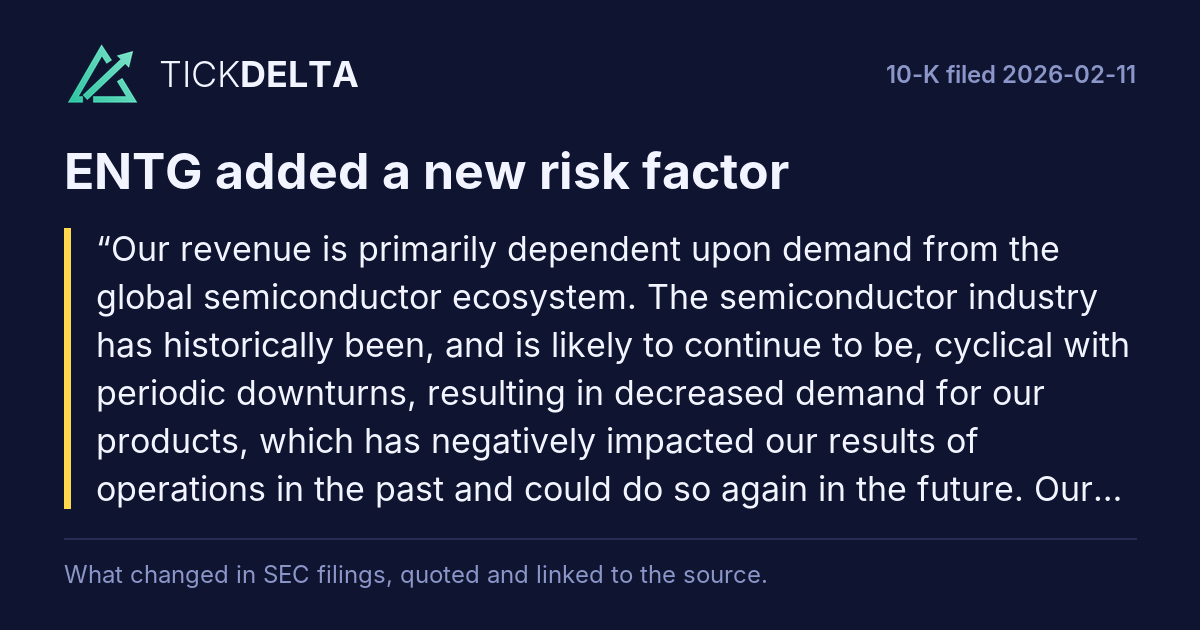
•the short order-to-delivery time for our products; market share and competitive losses; and pricing changes by us and our competitors;
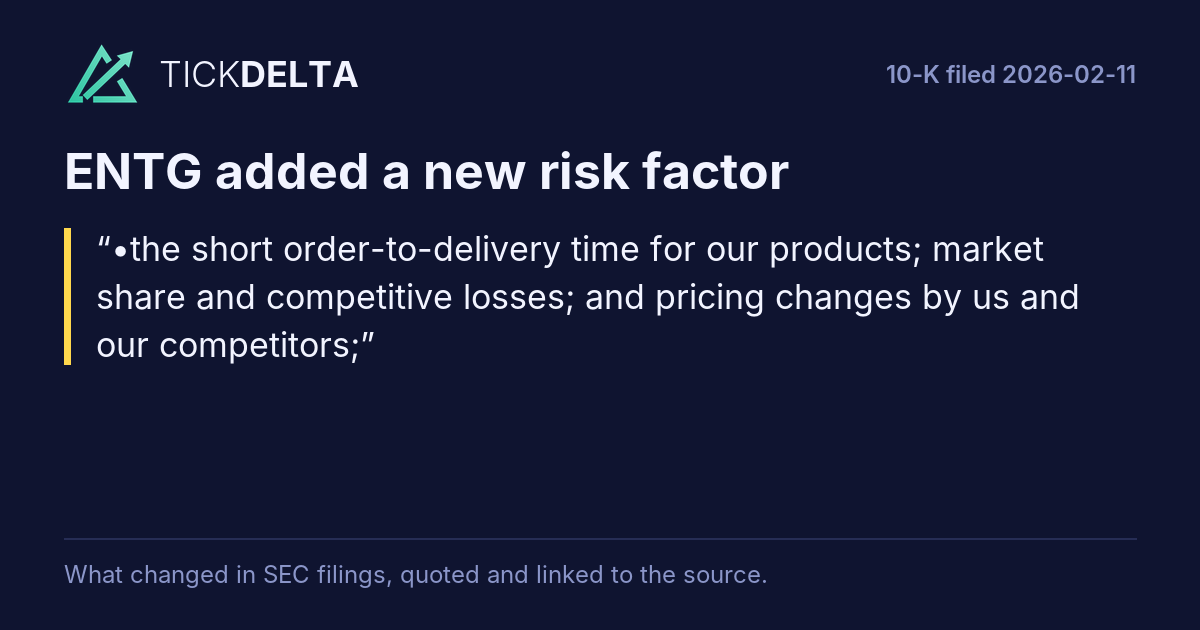
and the technical sensitivity of many of our products. Disruptions to transportation routes, ports, air freight capacity, or regional infrastructure in Asia (including in locations where we or our suppliers manufacture or where key customers operate) could further delay deliveries, increase costs, or reduce our ability to serve customers.
These measures could also increase our costs (including logistics, compliance, and supplier qualification costs), disrupt our sourcing and manufacturing plans, and adversely affect our ability to meet customer requirements or contractual commitments.
Sales to a limited number of large customers constitute a significant portion of our overall revenue, shipments, cash flows, collections and profitability and our success is tied in part to their competitive position in their respective markets. Our top ten customers accounted for 50%, 48% and 43% of our net sales in 2025, 2024 and 2023, respectively. Consolidation among semiconductor manufacturers, shifts in customer build plans, and evolving procurement strategies (including efforts to localize supply chains in response to export controls or trade policies) may increase these customers’ bargaining power and result in pricing pressure, more restrictive commercial terms (including audit, cybersecurity, ESG, and flow-down requirements), longer payment cycles, or demands for dual sourcing or rapid qualification of alternative products. If we are unable to satisfy these requirements on commercially reasonable terms, we could lose design wins, experience reduced volumes, or incur additional costs, any of which could materially adversely affect our results of operations.
Show the other 7
result in reduced orders, higher manufacturing costs, delays in acceptance and payment, additional service and warranty expense and damage to our reputation, which may adversely affect our revenue and results of operations.
We continue to devote significant resources to network security, threat monitoring and other measures to protect our systems and data from unauthorized access or misuse, and we may be required to expend greater resources in the future, especially in the face of evolving and increasingly sophisticated cybersecurity threats and laws, regulations, contractual and other actual and asserted obligations to which we are or may become subject relating to privacy, data protection, and cybersecurity. These security procedures and protection systems are costly and yet they may not be fail-safe. We may still suffer cybersecurity and other incidents, which could have a material adverse effect on our business or operations.
Recent tariffs and other trade actions taken by the U.S. and other countries where we do business have increased, and may continue to increase, our import and export costs, requiring us, in certain situations, to increase our prices, add a surcharge or find alternative suppliers which, in turn, may harm our relationships with customers, reduce demand for our products and decrease our profitability.
In recent years, including during 2025, the U.S. government has imposed tariffs and implemented other trade actions affecting products and materials imported into the U.S. In response to these tariffs and other changes in U.S. trade policy, several countries, including China, have threatened or imposed retaliatory tariffs on U.S. exports. The continuing imposition of tariffs by the U.S. and others may also give rise to further escalations of protectionist and retaliatory trade measures. Tariffs and related trade measures may be expanded, modified or restructured, and exemptions or exclusions may be limited or unavailable, which could further increase costs or disrupt supply chains.
These tariffs and other trade measures could have a material adverse effect on our business, results of operations, or financial condition. Our business and operating results are heavily dependent on international trade. We import raw materials and finished goods into the U.S. and we export products from the U.S. to our customers throughout the world, including those in China. Because of the recent tariffs and other trade restrictions, we have experienced increased and additional costs with respect to our import and export of such materials, finished goods, and products, and we may continue to experience these costs. In turn, we may be required to increase the prices of our products or add surcharges, which may reduce demand and harm our relationships with our customers. If we do not, or are unable to, increase prices or add surcharges without reducing demand, we may experience reduced profitability. Furthermore, retaliatory tariffs imposed by countries where we have significant sales, like China, could cause our customers to source products from local and non-U.S. competitors, which could further reduce demand for, and the overall competitiveness of, our products and decrease our market share. Additionally, we may be required to source our materials from alternative suppliers which could significantly increase our costs, lead to significant delays, and result in reliability or quality issues, all of which could harm our reputation and decrease demand for our products. The extent and duration of the tariffs and the resulting impact on general economic conditions and on our business are uncertain and depend on various factors, such as negotiations and overall relationships between the U.S. and affected countries, the responses of other countries or regions, exemptions or exclusions that may be granted, availability and cost of alternative sources of supply, and demand for our products in affected markets.
potentially creating significant product liability exposure for us. Our insurance coverage may be inadequate to satisfy any such liabilities, and our financial results or financial condition could be adversely affected.
As we incorporate AI capabilities into our operations, we may be subject to various risks, including compliance risks, the potential for AI to produce inaccurate results, intellectual property and cybersecurity risks, and the risk that we are unable to use AI as successfully as our competitors, which may result in legal liability, reputational damage and other harm to our business.
AI technology is complex and rapidly evolving, as are the operational, competitive, legal and regulatory environments in which it exists. We are increasingly incorporating AI capabilities into our business operations and our ways of working, which can be both challenging and costly. For example, we may experience difficulty in effectively using, or be unable to use, AI in a manner that benefits our business operations, enhances our efficiency and enables us to improve our products and services more rapidly. AI algorithms or training methodologies may also be flawed, and datasets may contain irrelevant, insufficient or biased information, which can cause errors in outputs. This may give rise to legal liability, reputational damage and other adverse effects. Our business may be further negatively impacted if our competitors are more successful than we are in executing their AI strategies and developing superior products and services with the aid of AI technology.
In addition, the use of AI in the development of our products and services could cause the loss of intellectual property, as well as subject us to risks related to intellectual property infringement or misappropriation, data privacy and cybersecurity. Countries may also adopt laws and regulations related to AI that could cause us to incur greater compliance costs or limit the use of AI in our business. Any failure or perceived failure by us to comply with such legal or regulatory requirements could subject us to legal liabilities, damage our reputation, or otherwise have a material and adverse impact on our business.
We receive government incentives, grants, and subsidies that are subject to conditions, reporting requirements, and compliance obligations, and failure to satisfy these requirements could result in the reduction, termination, or clawback of benefits, as well as potential penalties or reputational harm, any of which could adversely affect our business, financial condition, and results of operations.
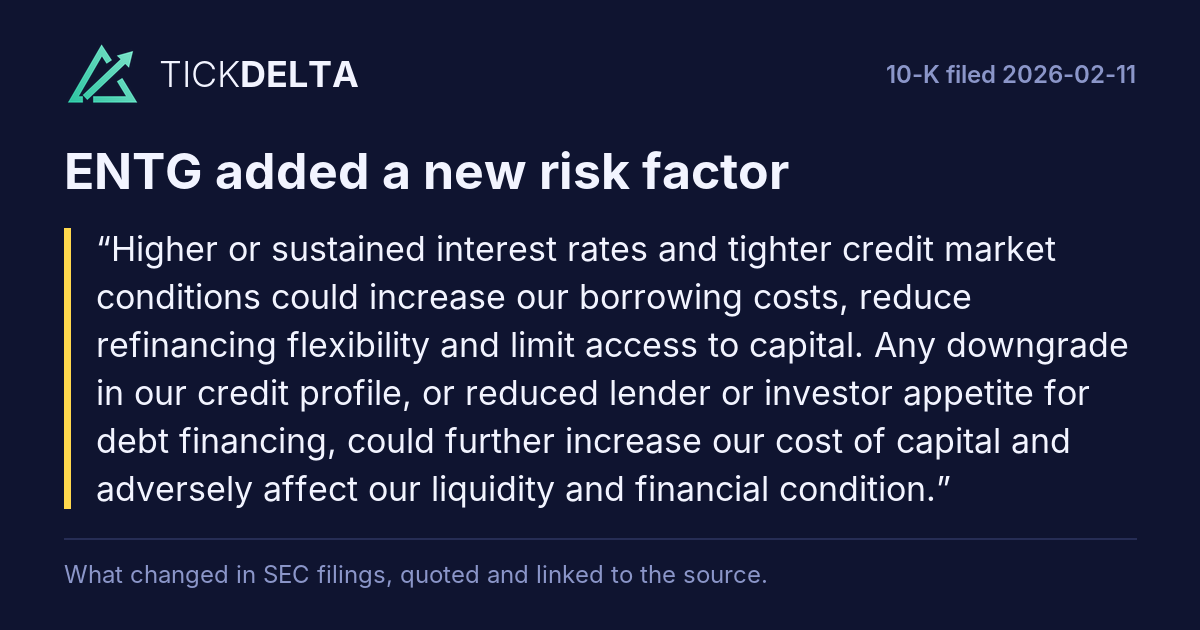
Higher or sustained interest rates and tighter credit market conditions could increase our borrowing costs, reduce refinancing flexibility and limit access to capital. Any downgrade in our credit profile, or reduced lender or investor appetite for debt financing, could further increase our cost of capital and adversely affect our liquidity and financial condition.
Paragraphs in the 10-Q filed Oct 29, 2026 that were not in the one before
New in the latest 10-Q
25 paragraphs in the 10-Q filed Oct 29, 2026 with nothing like them in the 10-Q filed Aug 4, 2026 (at least half the words must differ; new numbers alone do not count). Quoted exactly, grouped by the item heading above them. This is text that changed, not a judgement of how serious it is.
10-Q
• Fluctuations in demand for semiconductors and volume of semiconductor manufacturing.
Read in the 10-Q
• Global economic uncertainty, including volatile financial markets, inflation and increased costs, trade wars, fluctuations in interest rates, economic recessions, and national debt and bank failures.
Read in the 10-Q
• Supply chain risks, including partial reliance on sole, single or limited source suppliers.
Read in the 10-Q
• Challenges inherent in operating a global business, including managing complex political, legal, regulatory, and operational environments across the jurisdictions in which the Company operates.
Read in the 10-Q
• The impact of export controls, economic sanctions and other similar restrictions.
Read in the 10-Q
Show the other 20
• Information technology (“IT”) system failures, network disruptions, data breaches, and other cybersecurity threats.
Read in the 10-Q
• The impact of being subject to numerous rapidly evolving environmental laws and regulations across many jurisdictions.
Read in the 10-Q
• Risks related to the regulatory environment, including compliance costs and being subject to potentially inconsistent or conflicting regulations.
Read in the 10-Q
• The impact of government incentives, including added operational complexity and competition.
Read in the 10-Q
• The impact of our indebtedness, including our ability to obtain future financing.
Read in the 10-Q
• Risks related to our ability to generate sufficient cash to service our indebtedness.
Read in the 10-Q
• Restrictions on our operations as a result of the terms of the Amended Credit Agreement (as defined below) and the Indentures (as defined below).
Read in the 10-Q
• Provisions in our charter documents and Delaware law may delay or prevent us from being acquired.
Read in the 10-Q
• Our ability to successfully acquire or integrate other businesses, form joint ventures, or divest businesses.
Read in the 10-Q
• The impact of climate change, including changes in market dynamics and stakeholder expectations, and unexpected operational disruptions.
Read in the 10-Q
• The other factors and additional information described in the Company’s Annual Report on Form 10-K for the fiscal year ended December 31, 2025, filed with the Securities and Exchange Commission (the “SEC”) on February 11, 2026, including under the heading “Risk Factors” in Part I, Item 1A, and in the Company’s other periodic filings with the SEC.
Read in the 10-Q
Except as required under the federal securities laws and the rules and regulations of the SEC, the Company undertakes no obligation to update any forward-looking statements or information contained herein, which speak as of their respective dates.
Read in the 10-Q
Financial statements and notes
In December 2025, the FASB issued ASU No. 2025-10, Government Grants (Topic 832): Accounting for Government Grants Received by Business Entities (“ASU 2025-10”), which establishes authoritative guidance on the recognition, measurement, presentation and disclosure of government grants received by business entities. The amendments in ASU 2025-10 are effective for annual reporting periods beginning after December 15, 2028, and interim reporting periods within those annual reporting periods, with early adoption permitted. The Company is currently evaluating the impact of adopting ASU 2025-10 but does not expect ASU 2025-10 adoption to have a material impact on its consolidated financial statements.
Read in the 10-Q
Level 1: Assets consist of cash and cash equivalents, including investments in institutional money market funds, and investments in mutual funds. Institutional money market funds and mutual funds are valued using quoted prices in active markets for identical assets. Cash held in various bank accounts to support the Company's operations is carried at cost, which approximates fair value due to its short-term nature.
Read in the 10-Q
(1) The mutual fund investment is shown as a component of other noncurrent assets on the condensed consolidated balance sheet.
Read in the 10-Q
Sales increased year over year in all disclosed geographic regions as a result of stronger demand for our products, particularly for products supporting the advanced nodes, except in China, where sales were flat compared with the prior-year period.
Read in the 10-Q
(1) In the three months ended September, 26, 2026, the Company received $8.3 million of refunds of International Emergency Economic Powers Act (IEEPA) tariffs that were recognized in cost of goods sold as incurred from April 2025 through February 2026 and were not excluded from the Company's non-GAAP results in those periods. The Company excluded the refunds from non-GAAP results because they represent a discrete, non-recurring, out-of-period recovery arising from a legal and regulatory development rather than ongoing operating performance.
Read in the 10-Q
(7) As a result of displaying amounts in millions, the per-share components may not sum due to rounding.
Read in the 10-Q
Other information
During the fiscal quarter ended September 26, 2026, no director or officer, as defined in Rule 16a-1 under the Exchange Act, adopted, modified or terminated a “Rule 10b5-1 trading arrangement” or a “non-Rule 10b5-1 trading arrangement,” each as defined in Item 408(a) of Regulation S-K.
Read in the 10-Q
The 10-Q's risk factors against the 10-K
Item 1A of the 10-Q filed Oct 29, 2026 against Item 1A of the 10-K filed Feb 11, 2026.
A 10-Q repeats only the risks that changed, so a 10-K paragraph that is missing from it is not counted as removed.
Added is a paragraph with nothing like it in the 10-K, Reworded a sentence that is in both with several words changed,
Quiet changes a sentence in both where one to four words changed and one is a hedge or a modal
(cut words struck through, new words highlighted).
Text on the page, not a score; each links to the filing at sec.gov.
What the 10-Q itself says about its risk factors:In addition to the other information set forth in this Quarterly Report, you should carefully consider the risk factors and other cautionary statements described in Part I, Item 1A. “Risk Factors” in our Annual Report, which could materially affect our business, financial condition or future results. There have been no material changes to the risk factors described in our Annual Report.
Read in the 10-Q
1 paragraph in the 10-Q's Item 1A, and none of them adds, rewords or quietly edits a paragraph of the 10-K's.
Phrases used for the first time
Two-word phrases in Risk Factors of the 10-K filed Feb 11, 2026 that are in none of the 1 earlier 10-Ks stored, back to Feb 12, 2025
Where each one is used
- alternative suppliers: The Company’s strategies to limit its reliance on single, sole or limited source suppliers and utilize alternative sources are not feasible or practical in all circumstances. For example, we rely on single, sole or limited source suppliers for certain raw materials that are critical to manufacturing our products,...
- trade measures: In recent years, including during 2025, the U.S. government has imposed tariffs and implemented other trade actions affecting products and materials imported into the U.S. In response to these tariffs and other changes in U.S. trade policy, several countries, including China, have threatened or imposed retaliatory...
- tariffs imposed: •legal, tax, accounting or regulatory changes (including changes in import/export regulations and tariffs, such as regulations imposed by the U.S. government restricting exports to China or regulations imposed by other countries restricting the export of certain materials or the re-export of products containing...
- increase costs: and the technical sensitivity of many of our products. Disruptions to transportation routes, ports, air freight capacity, or regional infrastructure in Asia (including in locations where we or our suppliers manufacture or where key customers operate) could further delay deliveries, increase costs, or reduce our...
- critical materials: Several factors outside of our control, including, but not limited to, surges in demand for semiconductors, changes in trade policies, the imposition of foreign export controls on critical materials and minerals and international conflicts, have resulted in, and may in the future result in, a shortage of raw...
- commercial terms: Sales to a limited number of large customers constitute a significant portion of our overall revenue, shipments, cash flows, collections and profitability and our success is tied in part to their competitive position in their respective markets. Our top ten customers accounted for 50%, 48% and 43% of our net sales...
- design wins: Sales to a limited number of large customers constitute a significant portion of our overall revenue, shipments, cash flows, collections and profitability and our success is tied in part to their competitive position in their respective markets. Our top ten customers accounted for 50%, 48% and 43% of our net sales...
- recent tariffs: Recent tariffs and other trade actions taken by the U.S. and other countries where we do business have increased, and may continue to increase, our import and export costs, requiring us, in certain situations, to increase our prices, add a surcharge or find alternative suppliers which, in turn, may harm our...
Used at least twice, small words left out. Counted, not picked: a phrase can be new because the company renamed something.
What was taken out
14 paragraphs of last year's Risk Factors with nothing like them now. The longest are quoted.
Sources
Item 1A of each 10-K and 10-Q on EDGAR, quoted exactly. Each paragraph links to the filing at sec.gov.
Also
10-K change: what was reworded or cut, section by section.
Work with it
Excel workbook · CSV. Google Sheet that stays up to date: paste =IMPORTDATA("https://tickdelta.com/company/ENTG/export.csv") into a cell.