Screener / SEC EDGAR /CIK 0000006955 /10-K filed Oct 29, 2026, compared with Oct 17, 2025 /Numbers from the XBRL of the 10-Ks
NYSE Industrials · Industrial Machinery

Enerpac Tool Group Corp EPAC

Compare with peers Embed
SEC comment letters, last 20 years

3 reviews of EPAC's filings by SEC staff

UPLOAD and CORRESP
Reviews 3 latest letter Dec 19, 2017
Questions asked 21 each answered in the company's own letter
No closing letter 0 reviews without a letter saying the staff completed it

When the SEC's staff reviews a filing, it writes to the company with numbered questions, and the company answers each one in a letter. SEC publishes the exchange once the review is over, at least 20 business days later. A question is not an accusation; most reviews end with the company adding detail to its next filing.

How the reviews went

Every review on EDGAR, from the first staff letter to the letter that closes it

  1. 1. Staff letters 5 UPLOAD
  2. 2. Questions in them 21 numbered comments
  3. 3. Company replies 5 CORRESP
  4. 4. Reviews closed 3 of 3 closing letter

Half the closed reviews took 50 days or less from the first letter to the closing letter.

Form 10-K

2017-12-19 to 2018-01-23 · 2 questions · 1 letter from the SEC, 1 from the company
Review closed 2018-01-23
RevenueGoodwill and impairment
Note 1- Summary of Significant Accounting Policies, page 35 · Revenue Recognition, page 36
SEC asked (1)
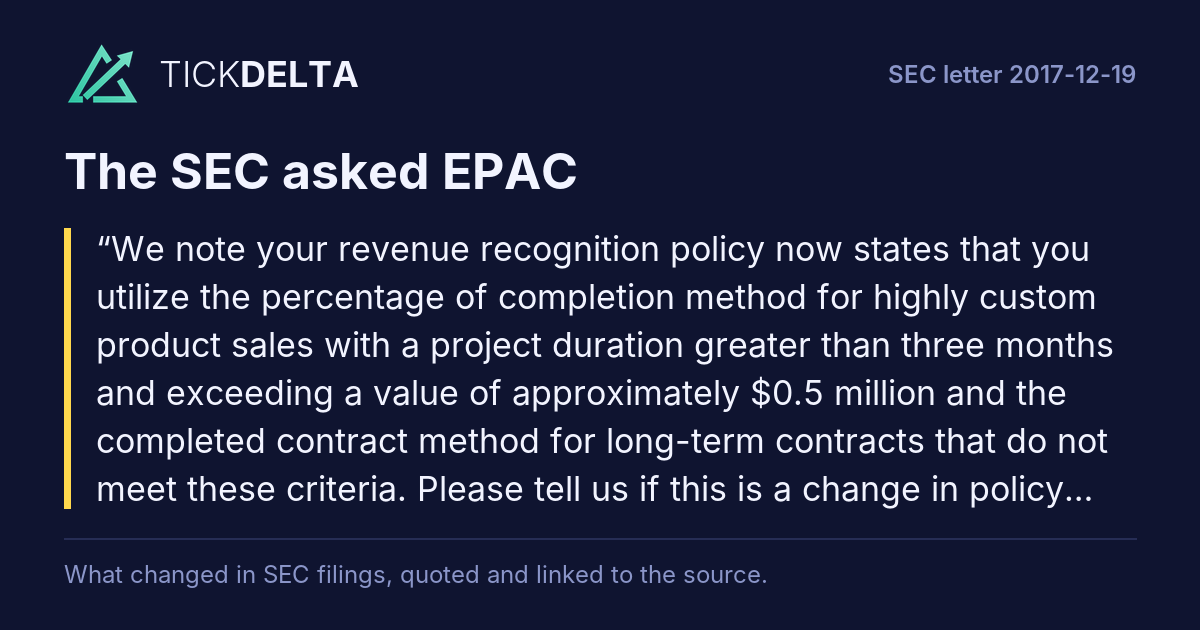
We note your revenue recognition policy now states that you utilize the percentage of completion method for highly custom product sales with a project duration greater than three months and exceeding a value of approximately $0.5 million and the completed contract method for long-term contracts that do not meet these criteria.
Rest of the question

Please tell us if this is a change in policy from previous years and the amount of revenue recognized under each of these methods for each period presented.

EPAC answered
Our disclosure related to utilization of the percentage of completion method (POC) for highly custom product sales with a project duration greater than three months and exceeding a value of approximately $0.5 million does not represent a change in policy from previous years. POC has been utilized by the Company for many years. Rather, the inclusion of this disclosure in fiscal 2017 was motivated by our ongoing assessment of the future impact of adopting ASU 2014-09, Revenue from Contracts With Customers (first applicable for the Company’s fiscal 2019).
Rest of the answer

While not expected to be significant to the Company as a whole, we anticipate our current use of POC to be different (in some cases) under the new guidance. Considering this potential future impact upon adoption, we thought it appropriate to clarify our use of POC in our broader revenue recognition disclosure in fiscal 2017.

The amount of revenue recognized under POC for fiscal years 2017, 2016, and 2015 was $25 million, $55 million, and $51 million, respectively. This represents approximately 4% of consolidated total revenue over the same time period (in aggregate). The sequential decline in revenue recognized under POC is due to the combination of declining oil & gas market conditions over this timeframe and a discrete large project in fiscal 2016.

Actuant defines “long-term” contracts for highly custom product sales to be those with a project/manufacturing duration of a few months to 18 months. The vast majority of Actuant’s long-term contracts for highly custom product sales are recognized under POC. As a result, the value of long-term contracts for highly custom product sales (under Actuant’s definition) recognized under the completed contract method is clearly insignificant or immaterial. The Company’s use of various thresholds (i.e. three month project duration and approximately $0.5 million) represents a policy election established for administrative ease, efficiency, and a reduction in accounting complexity for a small number of projects falling outside these thresholds. Because the Company does not track these smaller projects across its diverse businesses, specific quantification of the amount recognized under the completed contract method is not practical for the requested timeframe.

Read in the reply
In its next report

First report after the company's reply of Jan 9, 2018: 10-Q filed Apr 9, 2018 ↗, against the 10-Q filed Jul 7, 2017 ↗.

Tickdelta does not hold the text of both reports, so they are not compared here.
Note 5- Divestiture Activities, page 40
SEC asked (2)
We note your disclosure that you anticipate incurring additional disposal charges of approximately $15- $20 million in 2018. Please tell us the nature of these charges, and why it is appropriate to record them in 2018. Further, confirm whether or not you had any goodwill recorded at August 31, 2017 related to Viking.
Rest of the question

In this regard, we note you recorded goodwill charges in 2016 related to Viking, but you did not appear to record any impairment charges in 2017 related to goodwill. No such charges appear to be included in the $117 million impairment and disposal charges recorded in the fourth quarter.

EPAC answered
The remaining $15-20 million in after-tax impairment and divestiture charges to be recognized in fiscal 2018 are comprised of three items as follows:

a.

Facility Exit Charges ($5 - $6 million) - The Company is party to a number of real estate leases for properties that will become idle as a result of divesting the Viking operations. We do not anticipate being able to sublease any of these properties given market conditions and the state of the oil & gas industry in the areas in which they are located.
Rest of the answer

As of August 31, 2017, the Company continued to occupy and utilize these properties and continued to do so until closing of the transaction effective December 1, 2017. As a result of this continuing use and occupancy, we were unable to accrue such amounts as of August 31, 2017 and will instead recognize such amounts in our second quarter of fiscal 2018 (upon transaction closing which equates to the cease-use date). This treatment is consistent with ASC 420-10, Exit or Disposal Cost Obligations.

b.

Income Taxes ($9 - $11 million) - This amount represents the remaining net deferred tax assets associated with the Viking business as of August 31, 2017. Such deferred tax assets relate primarily to book to tax differences resulting from the impairment of fixed assets (recorded for book purposes) in fiscal 2017. The reduction in value to the tax basis of these same assets is not recognized for tax purposes until transaction closing effective December 1, 2017. As a result, such charges were not recorded at August 31, 2017 and will instead be realized in our second quarter of fiscal 2018 (upon transaction closing). This treatment is consistent with ASC 740-10, Income Taxes.

c.

Other ($1 - $3 million) - Amounts estimated (for disclosure purposes) as of August 31, 2017 to account for potential changes in estimates related to future proceeds to be received (subject to closing provisions), eventual costs to sell, net book value of net assets upon closing, changes in foreign currency exchange rates, and other miscellaneous charges related to the transaction upon closing. Such amounts were not recorded as of August 31, 2017 as these amounts represent disclosure-only estimates of potential changes in the subsequent period to amounts recorded as of August 31, 2017.

Additionally, we confirm that we did not have any recorded goodwill (or intangible asset) balances related to Viking as of August 31, 2017. All goodwill (and intangible assets) associated with the 2013 acquisition of Viking were written off in connection with the impairments recorded in both fiscals 2015 and 2016.

Read in the reply
In its next report

First report after the company's reply of Jan 9, 2018: 10-Q filed Apr 9, 2018 ↗, against the 10-Q filed Jul 7, 2017 ↗.

Tickdelta does not hold the text of both reports, so they are not compared here.

Also in this review: closing letter, 2018-01-23

Form 10-K

2017-02-09 to 2017-03-31 · 10 questions · 2 letters from the SEC, 2 from the company
Review closed 2017-03-31
Results discussion (MD&A)Liquidity and cashIncome taxesSegmentsExecutive payNon-GAAP measuresRussia and UkraineRevenue
General
SEC asked (1)
On page 4 you identify certain automakers to whom you sell your products. We are aware of publicly available information indicating that some of those automakers sell vehicles in Sudan and/or Syria, countries which are designated as state sponsors of terrorism by the State Department and are subject to U.S. economic sanctions and export controls. You do not include disclosure about any contacts with Sudan or Syria.
Rest of the question

Please describe to us the nature and extent of any past, current and anticipated contacts with Sudan and Syria, whether through subsidiaries, distributors, OEMs or other direct or indirect arrangements. You should describe any products, technology and services you have provided into Sudan and Syria, directly or indirectly, and any agreements, arrangements or other contacts you have had with the governments of Sudan and Syria or entities they control.

EPAC answered
The Company has no known past, current, or anticipated contacts with Sudan or Syria, directly or indirectly through its subsidiaries, affiliates, distributors, customers (OEM or otherwise), or other direct or indirect arrangements. Further, the Company does not have any subsidiaries, affiliates, offices, investments or employees in Sudan or Syria.
Rest of the answer

The Company does not have any distributors or other business partners that are approved to sell the Company’s products into Sudan or Syria.

The Company maintains a trade management system, including a Company policy, trade compliance procedures, and standard commercial terms and conditions, to help ensure the Company’s compliance with U.S. economic sanctions and export controls administered by the U.S. Treasury’s Office of Foreign Assets Control (“OFAC”) and the U.S. Commerce Department Bureau of Industry and Security (“BIS”). The Company believes it is in compliance with all applicable U.S. economic sanctions and export controls, including those regarding countries identified as state sponsors of terrorism by the U.S. Department of State.

While we do sell certain of our component products to the automakers identified in the above referenced filing (or to OEMs who supply these automakers), neither the Company nor any of its subsidiaries is in any way connected with any commercial activity between those automakers and Sudan or Syria, if applicable. The

Company sells its component products to these automakers (or to OEMS who supply these automakers), who in turn sell various types of vehicles to end-users throughout the world. The Company has no control over the sale of these vehicles to end-users and does not direct any of its selling/commercial efforts towards sales to Sudan or Syria.

To the Company’s knowledge, it does not provide, directly or indirectly, any products, technology or services into Sudan or Syria, and has not had any agreements, arrangements or other contacts with the Governments of Sudan or Syria or with entities known to be controlled by the Governments of Sudan or Syria.

Read in the reply
General
SEC asked (2)
Please discuss the materiality of any contacts with Sudan and Syria you describe in response to the comment above, and whether the contacts constitute a material investment risk for your security holders. You should address materiality in quantitative terms, including the approximate dollar amounts of any revenues, assets and liabilities associated with Sudan and Syria for the last three fiscal years and the
Rest of the question

subsequent interim period. Also, address materiality in terms of qualitative factors that a reasonable investor would deem important in making an investment decision, including the potential impact of corporate activities upon a company’s reputation and share value. Various state and municipal governments, universities and other investors have proposed or adopted divestment or similar initiatives regarding investment in companies that do business with U.S.-designated state sponsors of terrorism. You should address the potential impact of the investor sentiment evidenced by such actions directed toward companies that have operations associated with Sudan and Syria.

EPAC answered
As indicated above, the Company does not have any direct or indirect, past or current contacts with Sudan or Syria. The Company has no assets in, or revenues generated from, Sudan or Syria. Further, the Company does not believe its relationship with the automakers identified in the above referenced filing (or with OEMs who supply these automakers) to be a source of negative investor sentiment against the Company or the cause of potential harm to the Company’s reputation or share value.
Rest of the answer

The Company has not received any communications from investors, analysts, activist groups or others expressing concern regarding the Company’s relationship with such automakers (or with OEMs who supply these automakers). As described above, the Company is not associated with any business activities that these automakers may have in Sudan or Syria. Accordingly, the Company believes that there is not a material investment risk to the Company’s security holders.

Read in the reply
Note 1- Summary of Significant Accounting Policies, page 34 · Restructuring, page 35
SEC asked (3)
We note you recorded material restructuring charges of $14.6 million in fiscal year 2016. Please expand your disclosure to quantify the total amount of costs expected to be incurred, the amount incurred in the period, and the cumulative amount incurred to date, net of any adjustments, for each reportable segment for which costs were incurred.
Rest of the question

Further, to the extent material, quantify the anticipated future cost savings at the consolidated and reportable segment levels along with the timing of the future cost savings. In subsequent periods, disclose if the anticipated cost savings were realized. If actual savings are not achieved as expected or are achieved in periods other than as expected, disclose the reasons and estimated effects on your operating results and liquidity. Refer to SAB Topic 5:P.4 for guidance. This also applies to your interim reports on Form 10-Q.

EPAC answered
Beginning in fiscal 2016, the Company initiated various actions as part of a Restructuring Plan (the “Plan”) including workforce reductions, plant consolidations to reduce manufacturing overhead, satellite office closures, the continued movement of production and product sourcing to low cost alternatives and the centralization and standardization of certain administrative functions. The Plan was expected to result in restructuring charges of approximately $20 to $25 million in aggregate in fiscals 2016 and 2017. The Company generally expects a two year payback (i.e.
Rest of the answer

savings) on restructuring actions.

In the Company’s Form 10-K referenced above, the Company specifically discloses the actual restructuring charges incurred (for each reportable segment and in total) through August 31, 2016 on page 35. Similarly, the Company discloses year-to-date fiscal 2017 restructuring charges (for each reportable segment and in total) on page 8 of its Form 10-Q for the fiscal quarter ended November 30, 2016.

In future filings, the Company will expand its disclosures to include the cumulative amount of restructuring charges incurred to-date under the Plan. Additionally, the Company will quantify the total amount and timing of future costs expected to be incurred, the cost savings realized to-date and anticipated future cost savings (along with the timing or if such cost savings are not realized) under the Plan in accordance with the guidance in SAB Topic 5:P.4.

As illustration, the Company would have added the following disclosure to its most recently filed Form 10-Q for the fiscal quarter ended November 30, 2016 (either in “Note 3. Restructuring” or in “Management’s Discussion and Analysis of Financial Condition and Results of Operations”):

“The Company anticipates restructuring initiatives and related pre-tax charges continuing for the balance of fiscal 2017, including approximately $3 to $5 million of additional pre-tax restructuring charges. The Company does not anticipate significant pre-tax restructuring charges to continue into fiscal 2018, though plant consolidations and production movements between plants will remain a focus for the Company.

Pre-tax cost savings realized from executing these restructuring initiatives totaled approximately $8 million in fiscals 2016 and 2017 (to-date). The Company anticipates realizing an additional approximately $11 to $13 million in pre-tax cost savings for the balance of fiscal 2017 and in fiscal 2018 for all restructuring initiatives implemented in fiscals 2016 and 2017.”

Read in the reply
In its next report

First report after the company's reply of Mar 6, 2017: 10-Q filed Apr 7, 2017 ↗, against the 10-Q filed Jan 9, 2017 ↗.

Tickdelta does not hold the text of both reports, so they are not compared here.

Note 10- Income Taxes
SEC asked (4)
Upon your divestiture of the Sanlo business, you recorded a $5.1 million pre-tax loss and a $1.6 million after-tax gain. Please help us better understand the impact of income taxes on this transaction pursuant to ASC 740 and correspondingly how this resulted in the recording of an after-tax gain in light of the pre-tax loss.
EPAC answered
The Company advises the Staff as follows regarding the fiscal 2016 divestiture of the Sanlo business, with the sole purpose of aiding the Staff’s understanding of the impact of income taxes on this transaction pursuant to ASC 740.

For income tax purposes, this divestiture was treated as a sale of stock. The difference between the pre-tax loss ($5.1 million) and after-tax gain ($1.6 million) is due to the book and income tax basis differential, which resulted in an income tax loss of $8.4 million which is greater than the aforementioned book loss of $5.1 million.
Rest of the answer

The income tax loss from the sale of stock yields a $3.0 million income tax benefit in addition to the impact of absorbing the carrying value of net deferred tax liabilities of $3.7 million (primarily related to goodwill and intangible asset temporary differences) as of the date of the divestiture. The book loss of $5.1 million combined with the total income tax benefit of $6.7 million results in a net after-tax gain of $1.6 million upon divestiture.

Read in the reply
In its next report

First report after the company's reply of Mar 6, 2017: 10-Q filed Apr 7, 2017 ↗, against the 10-Q filed Jan 9, 2017 ↗.

Tickdelta does not hold the text of both reports, so they are not compared here.

Results of Operations · Income Tax Expense, page 24
SEC asked (5)
Please help us better understand the components of your income tax benefit of $3 million for the three months ended November 30, 2016. Of this $3 million, we note that you recorded a $2.9 million tax benefit during the three months ended November 30, 2016 related to the discrete director and officer transition charges of $7.8 million.
Rest of the question

After removing both the expense and income tax benefit associated with these discrete director and officer transition charges, it appears that you have an income tax benefit of approximately $.1 million on pre-tax income of $9.8 million. Please help us better understand, and further clarify in your disclosures, why the effective tax rate on the remainder of your earnings would be significantly lower than both your statutory rate and your effective income tax rates in prior periods. For example, we note that your effective income tax rate for the three months ended November 30, 2015 was 12.4%.

EPAC answered
The Company advises the Staff as follows - with the purpose of aiding the Staff’s understanding of the Company’s first quarter effective income tax rate (excluding the discrete director and officer transition charges as indicated by the Staff).

General:

The Company's income tax expense (or benefit) is impacted by a number of factors, including the amount of taxable earnings derived in foreign jurisdictions with income tax rates that are lower than the U.S.
Rest of the answer

federal statutory rate, permanent items, state income tax rates and the ability to utilize various income tax credits and net operating loss carryforwards.

In the Company’s Form 10-Q referenced above, the Company specifically discloses that the key items impacting its effective income tax rate in both periods presented include 1) the “proportion of earnings in foreign jurisdictions” and 2) the “amount of tax benefits derived from tax planning initiatives.” Specific to fiscal 2017, excluding the director and officer transition charges, foreign income tax rate differential reduced the first quarter effective income tax rate from the 35% federal statutory rate by 20%, while income tax planning initiatives reduced the first quarter effective income tax rate by 17%.

Proportion of earnings in foreign jurisdictions - to quantify the impact of this item on the effective income tax rate, the Company discloses the percent of earnings before income taxes derived from foreign jurisdictions for both periods presented and indicates that income tax rates in these foreign jurisdictions are lower than the U.S. statutory rate, “Our earnings before income taxes consisted of 80% of earnings from foreign jurisdictions in fiscal 2017, compared to 75% in fiscal 2016, which had the impact of reducing the current year effective income tax rate.” With this information, a reader of the financial statements is 1) able to anticipate a lower than U.S. statutory effective income tax rate for both periods presented and 2) anticipate a lower effective income tax rate in fiscal 2017 versus fiscal 2016 based upon the comparative year differential in foreign-based earnings percentages.

Amount of tax benefits derived from tax planning initiatives - to provide relative context to the impact of this item on the effective income tax rate, the Company uses descriptive modifiers such as “significantly lower than the federal income tax rate” to describe fiscal 2017 income tax planning initiatives versus only “lower than the federal income tax rate” for fiscal 2016 income tax planning initiatives. It is important to note the effective rate impact of income tax planning is more significant in a year of “reduced earnings before income taxes” such as fiscal 2017 and is a further contributing factor to a significantly lower than federal income tax rate. As such, a reader of the financial statements is 1) able to anticipate a lower than U.S. statutory effective income tax rate for both periods presented and 2) anticipate a lower effective income tax rate in fiscal 2017 versus fiscal 2016 based upon a more significant impact of tax planning initiatives in fiscal 2017. The primary income tax planning initiative in fiscal 2017 includes the recognition of a tax benefit of certain losses from prior years for which no tax benefit was previously recognized. The primary income tax planning initiative in fiscal 2016 included certain foreign currency gains and losses recognized for tax purposes.

As a result, the Company’s view is our existing disclosures are generally adequate and consistent with our letter to you dated February 25, 2016 in which we committed to “expand our disclosures to quantify the factors impacting income tax expense and the effective tax rate.”

Read in the reply
In its next report

First report after the company's reply of Mar 6, 2017: 10-Q filed Apr 7, 2017 ↗, against the 10-Q filed Jan 9, 2017 ↗.

Tickdelta does not hold the text of both reports, so they are not compared here.

Executive Compensation, page 18 · Annual Bonus, page 21
SEC asked (6)
In future filings, if you believe disclosure of the Combined Management Measure targets would cause competitive harm in reliance upon Item 402(b) of Regulation S-K, please disclose how difficult it will be for the executive or how likely it will be for the company to achieve the undisclosed CMM targets.
Rest of the question

Please see Regulation S-K Compliance & Disclosure Interpretation 118.04 and Instruction 4 to Item 402(b) of Regulation S-K.

EPAC answered
Annual bonus targets established for the Company’s executives are directly aligned to shareholder interests and are established based upon the anticipated achievement of annual operating plans. The annual operating plans serving as the basis for the annual bonus targets of our executives are established based upon realistic expectations for maximizing the Company’s performance in light of market realities and potential.

As noted on page 23 of the Definitive Proxy Statement on Schedule 14A, the Company modified the annual bonus for fiscal 2017 to include the financial metrics of core sales,
Rest of the answer

EBITDA margin, and free cash flow (effectively replacing the Combined Management Measure). Currently, we believe these new metrics to be less proprietary and more translatable to actual GAAP and reconciled non-GAAP results than our historic Combined Management Measure. As a result, we currently anticipate we will directly disclose the specific annual bonus targets for our named executive officers (NEOs) in future filings and we will no longer rely upon Item 402(b) of Regulation S-K. To the extent we do elect to rely upon Item 402(b) of Regulation S-K, we will be sure to incorporate the additional disclosures requested by the Staff in future filings.

Read in the reply
In its next report

First report after the company's reply of Mar 6, 2017: 10-Q filed Apr 7, 2017 ↗, against the 10-Q filed Jan 9, 2017 ↗.

Tickdelta does not hold the text of both reports, so they are not compared here.

Equity Compensation, page 23 · Performance Based Restricted Stock, page 23
SEC asked (7)
We note your disclosure that you awarded performance share awards based upon a three year measurement period. In future filings, please disclose the Free Cash Flow Conversion and TSR targets, the actual Free Cash Flow Conversion and TSR performance, and how you determine the actual payout of the awards to each of your named executive officers, or provide us with your analysis for concluding that the disclosure of
Rest of the question

such targets is not required because it would result in competitive harm and that such disclosure may be omitted pursuant to Instruction 4 to Item 402(b) of Regulation S-K. If you omit the disclosure of targets because it will result in competitive harm in reliance upon Item 402(b) of Regulation S- K, in future filings, state so, and include a discussion of how difficult it will be for the executive or how likely it will be for the company to achieve the undisclosed target level or other factor or criteria. Please see Regulation S-K Compliance & Disclosure Interpretation 118.04 and Instruction 4 to Item 402(b) of Regulation S-K.

EPAC answered
The Company typically grants performance based restricted stock (“Performance Shares”) to our executives once per fiscal year, at the beginning of the fiscal year. The Company’s Performance Share awards have a 3-year performance period, with vesting based 50% on achievement of an absolute Free Cash Flow Conversion target and 50% on the Company’s TSR relative to the S&P 600 SmallCap Industrial Index (approximately 90 companies).
Rest of the answer

This has been our practice for several fiscal years.

As a result, within each fiscal year, there is only one new grant of Performance Shares (for which performance targets would be disclosed) and only one potential vesting of Performance Shares (for which actual results would be disclosed). Regarding our most recent Definitive Proxy Statement on Schedule 14A, we disclosed the Free Cash Flow Conversion and TSR targets for the fiscal 2016 Performance Share grant on page 23 in tabular format (as follows):

Measure

Threshold

Target

Maximum

Vesting Scale (as a percentage of Target)

50%

100%

150%

Relative TSR Percentile

25th

50th

75th

Free Cash Flow Conversion

115%

140%

Additionally, we disclosed the actual vesting percent for the Free Cash Flow Conversion and TSR metrics for the fiscal 2014 Performance Share grant (vesting in fiscal 2016) on page 24 when we state “The three-year measurement period for the fiscal 2014 Performance Share grant ended August 31, 2016 and resulted in the vesting of 122% of the Free Cash Flow Conversion restricted stock shares and 0% of the TSR restricted stock shares.”

We believe our disclosures surrounding the fiscal 2016 Performance Share grant to be adequate and appropriate. As it relates to Performance Shares vesting in the fiscal year, in future filings, we will replace our existing disclosure (on page 24) with the following tabular format (utilizing the most recently completed 3 year performance period as an illustrative example):

Read in the reply
In its next report

First report after the company's reply of Mar 6, 2017: 10-Q filed Apr 7, 2017 ↗, against the 10-Q filed Jan 9, 2017 ↗.

Tickdelta does not hold the text of both reports, so they are not compared here.

Form 8-K Filed December 21, 2016
SEC asked (8)
We note you present projected Adjusted EPS and Free Cash Flow for 2017 without presenting and reconciling to corresponding GAAP amounts. Please revise your disclosures pursuant to the guidance provided in Question 102.10 of the updated Compliance and Disclosure Interpretations issued on May 17, 2016.
EPAC answered
The Company does not develop or provide external guidance for GAAP EPS or Cash Flow from Operations due to the inherent difficulties in predicting the amounts and timing of certain future restructuring costs, business gains/losses, impairments, tax adjustments, refinancing costs and other items that we generally exclude from Adjusted EPS or Free Cash Flow.
Rest of the answer

However, in future filings, the Company will provide the requested reconciliation with the above difficulties noted in the footnote to the reconciliation.

The Company hereby acknowledges that:

•

The Company is responsible for the adequacy and accuracy of the disclosures in the filings,

Staff comments or changes to disclosures in response to Staff comments do not foreclose the Commission from taking any action with respect to the filings, and

The Company may not assert Staff comments as a defense in any proceeding initiated by the Commission or any person under the federal securities laws of the United States.

Read in the reply
Note 1- Summary of Significant Accounting Policies, page 34 · Restructuring, page 35
SEC asked (1)
We have read your response to prior comment 3 in our letter to you dated February 9, 2017. In addition to the other information you will provide about your restructuring activities, please confirm that you will also quantify the anticipated cost savings at the segment level.
EPAC answered
Actuant Corporation, a Wisconsin corporation (the “Company”), hereby submits the following responses to the comments in your letter dated March 20, 2017 (the “Comment Letter”) with respect to the above referenced filing. For convenience, each of the Staff’s comments are reprinted below in bold italics, followed by our responses. Form 10-K for Fiscal Year Ended August 31, 2016 Note 1- Summary of Significant Accounting Policies, page 34 We have read your response to prior comment 3 in our letter to you dated February 9, 2017.
Rest of the letter

In addition to the other information you will provide about your restructuring activities, please confirm that you will also quantify the anticipated cost savings at the segment level. Response: We confirm the additional restructuring-related disclosures we described in our original response to comment #3 will also include quantification of the restructuring cost savings at the segment level. All such additional disclosures will be included starting with our Form 10-Q for the fiscal quarter ended February 28, 2017 to be filed with the SEC on or before April 10, 2017. We have read your response to prior comment 5. Please expand your disclosures in MD&A to separately quantify the amount by which your effective tax rate was impacted by material factors. For example, please disclose the percentage by which your effective tax rate was impacted due to earnings in foreign jurisdictions. Please also disclose the following in regards to your tax planning strategies: Quantify the impact of tax planning strategies on your effective tax rate Disclose the nature of these tax strategies; and Disclose whether there are any known factors that may impact your ability to use these same tax planning strategies to generate similar amounts of tax benefits in future periods. See Sections 501.02 and 501.14 of the Financial Reporting Codification for guidance. Response: Beginning with our Form 10-Q for the fiscal quarter ended February 28, 2017, we will quantify in our disclosures the amount(s) by which material factors influence our effective tax rate. Additionally, specific to the topic of tax planning and to the extent relevant, we will quantify and disclose the nature of tax planning strategies, including commentary about factors that may impact our ability to utilize these same tax planning strategies in future periods. For example, within our Form 10-Q for the fiscal quarter ended February 28, 2017, we will include disclosure consistent with the following language: “Both the current and prior year effective income tax rates were impacted by the proportion of earnings in foreign jurisdictions with income tax rates lower than the US federal income tax rate and the amount of income tax benefits from tax planning initiatives. The Company's earnings (loss) before income taxes were made up of 85% of earnings from foreign jurisdictions in both fiscal 2017 and 2016. This foreign income tax rate differential had the effect of reducing the effective income tax rate from the 35% U.S. statutory tax rate by 21.2% and by 19.6%, in fiscal 2017 and 2016, respectively, excluding the second quarter fiscal 2016 impairment charge. In addition, the recognition of income tax planning benefits resulting from certain losses from prior years for which no income tax benefit was previously recognized resulted in a 19.4% reduction from the 35% U.S. statutory tax rate for fiscal 2017. Income tax planning benefits related to certain foreign currency gains and losses recognized for tax purposes resulted in a 10.1% reduction from the 35% U.S. statutory tax rate for fiscal 2016, excluding the impairment charge. The tax benefits related to these tax planning initiatives are not expected to repeat in future periods due to certain tax attributes that are no longer available and subsequent changes in relevant tax laws.”

One letter for all the questions, without numbered answers. Read the reply
In its next report

First report after the company's reply of Mar 29, 2017: 10-Q filed Apr 7, 2017 ↗, against the 10-Q filed Jan 9, 2017 ↗.

Tickdelta does not hold the text of both reports, so they are not compared here.

Results of Operations · Income Tax Expense, page 24
SEC asked (2)
We have read your response to prior comment 5. Please expand your disclosures in MD&A to separately quantify the amount by which your effective tax rate was impacted by material factors. For example, please disclose the percentage by which your effective tax rate was impacted due to earnings in foreign jurisdictions.
Rest of the question

Please also disclose the following in regards to your tax planning strategies:  Quantify the impact of tax planning strategies on your effective tax rate;  Disclose the nature of these strategies; and  Disclose whether there are any known factors that may impact your ability to use these same tax planning strategies to generate similar amounts of tax benefits in future periods. See Sections 501.02 and 501.14 of the Financial Reporting Codification for guidance.

EPAC answered

See the reply above.

In its next report

First report after the company's reply of Mar 29, 2017: 10-Q filed Apr 7, 2017 ↗, against the 10-Q filed Jan 9, 2017 ↗.

Tickdelta does not hold the text of both reports, so they are not compared here.

Also in this review: closing letter, 2017-03-31

Form 10-K

2016-02-05 to 2016-03-28 · 9 questions · 2 letters from the SEC, 2 from the company
Review closed 2016-03-28
Results discussion (MD&A)SegmentsIncome taxesGoodwill and impairmentCritical estimatesRevenueNon-GAAP measuresLiquidity and cashDebt
Operations, page 16 · Segment Results, page 17
SEC asked (1)
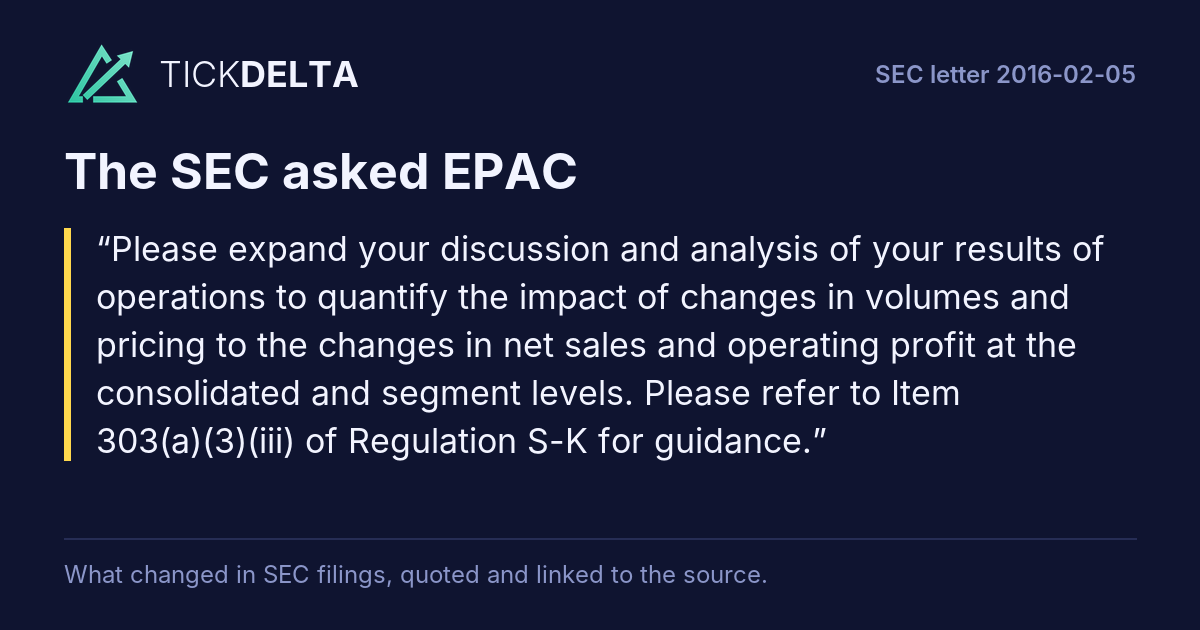
Please expand your discussion and analysis of your results of operations to quantify the impact of changes in volumes and pricing to the changes in net sales and operating profit at the consolidated and segment levels. Please refer to Item 303(a)(3)(iii) of Regulation S-K for guidance.
EPAC answered
Changes in pricing in the Industrial and Engineered Solutions segments were not a significant factor in the comparability of sales or operating profit for the periods presented and therefore no mention of pricing was included in our discussion and analysis of results of operations for these two segments.
Rest of the answer

However, as disclosed in the Business Update section of MD&A, the Energy segment experienced pricing pressure in fiscal 2015 and in certain cases, granted pricing concessions in response to customer demands and competitive pressure brought about by excess capacity (due to lower Energy industry capital spending). Historically, pricing changes have not been significant for our Energy Maintenance and Integrity business. Due to the nature of our Other Energy businesses, we do not separately analyze the impact of pricing and volume, as sales typically involve contract by contract negotiated pricing and the lack of comparable deliverables (scope of service and products, timing, technical know-how, mix of product, on-shore, off-shore, geographic location, etc).

Changes in sales volumes are the primary driver of core sales (sales excluding the impact of acquisitions, divestitures and changes in foreign currency exchange rates) and operating profit at the consolidated and segment levels. In future filings, we will provide disclosure if we experience meaningful changes in customer pricing.

Read in the reply
In its next report

First report after the company's reply of Feb 25, 2016: 10-Q filed Apr 8, 2016 ↗, against the 10-Q filed Jan 8, 2016 ↗.

Tickdelta does not hold the text of both reports, so they are not compared here.

Operations, page 16 · Segment Results, page 17
SEC asked (2)
Please quantify the impact of each factor impacting each segment’s operating margin for each period presented. Please also ensure that your discussion and analysis of your segment results provides investors with an understanding of each material factor impacting your segment results.
Rest of the question

For example, we note that you attribute the 280 basis points decline in the Industrial Segment’s operating margin for fiscal year 2015 compared to fiscal year 2014 to (a) lower production levels and (b) unfavorable mix without (1) quantifying the extent to which each contributed to the 280 basis points decline and (2) without providing an analysis of the reasons underlying these effects to allow an investor to see the business through the eyes of management. Please refer to Item 303(a)(3)(i) of Regulation S-K and Sections 501.12.b.3. and 501.12.b.4 of the Financial Reporting Codification for guidance.

EPAC answered
In future filings, we will enhance our discussion and analysis by providing additional quantitative disclosures contemplated by Item 303(a)(3)(i) of Regulations S-K and Sections 501.12.b.3 and 501.12.b.4 of the Financial Reporting Codification. To illustrate, the following is the enhanced Industrial Segment disclosures comparing fiscal 2015 to fiscal 2014, with additions underscored and deletions crossed out:

Industrial Segment: Fiscal 2015 compared to Fiscal 2014

Fiscal 2015 Industrial segment net sales decreased by $12 million (3%) to $402 million.
Rest of the answer

Excluding $29 million of additional sales from the recent Hayes acquisition and the $21 million unfavorable impact of changes in foreign currency exchange rates, fiscal 2015 core sales declined 3%. Sales volumes declined due to reduced general industrial activity, unfavorable market conditions in several served markets (including oil & gas and mining), as well as recent distributor inventory destocking. Lower production levels and unfavorable mix resulted in lower operating profit margins in fiscal 2015.

Operating profit margin was 26.3% in fiscal 2015 compared to 29.1% in the prior year. Unfavorable acquisition mix, due to a full year of sales from the Hayes acquisition in fiscal 2014 (which generates lower profit margins than the segment in aggregate) and reduced absorption of fixed manufacturing and selling, administrative and engineering expenses (due to lower production and sales levels) equally contributed to the 280 basis point reduction in operating profit margins.

Read in the reply
In its next report

First report after the company's reply of Feb 25, 2016: 10-Q filed Apr 8, 2016 ↗, against the 10-Q filed Jan 8, 2016 ↗.

Tickdelta does not hold the text of both reports, so they are not compared here.

Critical Accounting Policies, page 22 · Goodwill and Long-Lived Assets, page 22
SEC asked (3)
We note the last sentence that you included for the annual impairment review, estimates and sensitivity section that includes general factors that could “impact the assumptions used in the valuations and ultimately result in future impairment charges.” Please expand your disclosures to provide the specific facts and circumstances that could reasonably occur and result in a change in the assumptions used to estimate
Rest of the question

the fair value of each reporting unit and result in the recognition of a material impairment charge. Please refer to Item 303(a)(3) of Regulation S-K, Sections 216, 501.02, 501.12.b.3 and 501.14 of the Financial Reporting Codification, and SAB 5:P.4 for guidance.

EPAC answered
In future filings, we will expand our disclosures to provide specific facts and circumstance that could reasonably occur and result in a change in the assumptions used to estimate the fair value of each reporting unit and result in the recognition of a material impairment charge. As an example, the following is our disclosure regarding the fiscal 2015 year-end impairment test, with additions underscored and deletions crossed out:

Fiscal 2015 Year-End Impairment Test: Our fourth quarter fiscal 2015 impairment review resulted in three reporting units (Viking, Cortland and maximatecc) having an
Rest of the answer

estimated fair value that exceeded the carrying value (expressed as a percentage of the carrying value) by less than 30%.

Cortland and Viking Reporting Units: While we believe that our Energy businesses will continue to generate positive cash flows and earnings, the financial projections utilized in the year-end impairment review considered historical results and the current challenging conditions in the global oil & gas markets. The estimated fair value of the Cortland and Viking reporting units exceeded the carrying value by 15% and 26%, respectively. Estimated future cash flows from the Cortland business assume low single digit sales growth in fiscal 2016 (after a greater than 20% sales decline in fiscal 2015) and slightly improved profitability, the result of previously completed restructuring actions and material cost reductions. Recent decisions by asset owners in the North Sea to reduce oil drilling activity haves resulted in reduced near term sales expectations for Viking. However, estimated future cash flows from Viking are expected to improve compared to fiscal 2015, due to the benefit of reduced headcount, facility consolidations and lower Viking capital expenditures and working capital requirements. The assumptions that have the most significant impact on the estimated fair value of the reporting units are the discount rate (10.9% at August 31, 2015) and the sales growth rate (including 3.5% in the terminal year). Changes in market conditions, primarily the oil & gas industry's reduced capital spending on drilling and exploration activities, as well as competitor pricing (given the excess capacity due to reduced customer spending) and further declines in oil and gas prices, could reasonably change in the future and result in different valuation assumptions. The financial results of these reporting units are also dependent on a) the realization of savings from restructuring actions to consolidate facilities and reduce fixed overhead, b) the level of mooring rental asset utilization and c) our ability to retain or win new business in a market that currently has excess capacity. Lastly, an increase in the discount rate in future periods could have an adverse impact on the estimated fair value of the reporting units. The carrying value of the Cortland reporting unit was $139 million (including $76 million of goodwill), while the Viking reporting unit had a carrying value of $113 million (including $38 million of goodwill).

maximatecc Reporting Unit: The maximatecc business, including the legacy North American business and the recent acquisitions of CrossControl (Europe) and Turotest (South America) acquisitions, manufactures severe-duty electronic instrumentation including displays and clusters, machine controls and sensors. To mitigate sales headwinds from mining and agriculture customers (due to low current commodity prices), reduced general industrial activity and longer sales cycles on recent OEM new product introductions we have taken actions in the business to improve profitability including the outsourcing of certain manufacturing operations and a renewed focus on sales growth opportunities. As a result of these actions, we expect maximatecc to generate single digit sales growth in fiscal 2016 and slightly improved margins as we realize the benefits of completed restructuring actions. Key financial assumptions impacting the estimated fair value include a 10.3% discount rate and a 3% terminal year growth rate. Sales and profits of the maximatecc business are subject to OEM production levels that may change in response to end market conditions in the industrial, off-highway equipment, agriculture, mining and forestry markets. Specific market factors include the adoption rate of human to machine interface (“HMI”) technology as “options” on off-highway equipment, the level of new and used inventory at dealers and in the field, commodity pricing which impacts end-user demand and the timing and pace to full production volumes for recent new OEM platform wins. The financial results of this reporting unit are dependent on the realization of savings from restructuring actions and our ability to generate additional sales by leveraging new products and engineering capabilities from recent acquisitions. Lastly, an increase in the discount rate in future periods could have an adverse impact on the estimated fair value of this reporting unit. The fair value of the maximatecc reporting unit exceeded its $104 million carrying value (including $64 million of goodwill) by 28% at August 31, 2015.

The assumptions that have the most significant impact on the determination of the fair value of the reporting units are the discount rate and sales growth rates. A 100 basis point increase in the discount rate results in a decrease to the estimated fair values by approximately 11-13%, while a reduction in the terminal year sales growth rate assumption by 100 basis points would decrease the estimated fair values by approximately 7-9%.

A considerable amount of management judgment and assumptions are required in performing the impairment tests, principally in determining the fair value of each reporting unit and the indefinite lived intangible assets. While we believe our judgments and assumptions are reasonable, different assumptions could change the estimated fair values and, therefore, impairment charges could be required. Weakening industry or economic trends, disruptions to our business, loss of significant customers, inability to effectively integrate acquired businesses, unexpected significant changes or planned changes in the use of the assets or in entity structure and divestitures may adversely impact the assumptions used in the valuations and ultimately result in future impairment charges.

Read in the reply
In its next report

First report after the company's reply of Feb 25, 2016: 10-Q filed Apr 8, 2016 ↗, against the 10-Q filed Jan 8, 2016 ↗.

Tickdelta does not hold the text of both reports, so they are not compared here.

Note 10. Income Taxes, page 43
SEC asked (4)
We note that the net effects of foreign rate differential and credits line item of the effective tax rate reconciliation significantly increased to a reduction of 58.4% for fiscal year 2015 as compared to a reduction of 10.5% and 8.8% for fiscal years 2014 and 2013, respectively.
Rest of the question

Please expand footnote (1) to the table to (i) quantify the significant foreign tax credits generated, (ii) clarify whether these foreign tax credits resulted in the recognition of a deferred tax asset and, if so, quantify the amount, and (iii) disclose the facts and circumstances that generated the foreign tax credits. Please also disclose the percentage of pre-tax earnings generated in foreign jurisdictions with tax rates lower than the U.S. federal income tax rate forage for all periods presented.

EPAC answered
The net effects of foreign rate differential and credits line item in the effective tax rate reconciliation table increased to a reduction of 58.4% in fiscal 2015, primarily as a result of the $84 million impairment charge (with a modest $2 million income tax benefit), which reduced pre-tax earnings, thereby significantly increasing the rate benefit on a percentage basis, of other items in the effective tax rate reconciliation.
Rest of the answer

Excluding the impairment charge, the net effects of foreign rate differential and credits line would have been 20.7%, which is higher than the prior years due to approximately $10 million of non-recurring foreign tax credits generated in fiscal 2015 as a result of a non-recurring non-permanent loan from a foreign subsidiary, which was used to offset current income tax liabilities (and therefore did not result in the recognition of a deferred tax asset). In future filings, we will revise the footnotes to the effective tax rate reconciliation. As an example, the following is our enhanced disclosure regarding the fiscal 2015 effective tax rate, with additions underscored and deletions crossed out:

The “net effects of foreign rate differential and credits” line item increased compared to prior years primarily as a result of the impairment charge (which reduced pre-tax earnings, thereby significantly increasing the rate benefit of other items on a percentage basis). The Company’s global operations, acquisition activity and specific tax attributes provide opportunities for continuous global tax planning initiatives to generate tax credits and deductions. During fiscal 2015, the Company generated approximately $10 million of foreign tax credits, the result of a non-recurring non-permanent loan from a foreign subsidiary, (which were utilized to reduce current year tax obligations) and had a higher proportion of non-U.S. earnings relative to prior years. During fiscal 2015, the Company generated significant foreign tax credits and aApproximately 68%, 51% and 57% of pre-tax earnings (excluding the impairment charge) were generated in foreign jurisdictions with tax rates lower than the U.S. federal income tax rate during fiscal 2015, 2014 and 2013, respectively.

Read in the reply
In its next report

First report after the company's reply of Feb 25, 2016: 10-Q filed Apr 8, 2016 ↗, against the 10-Q filed Jan 8, 2016 ↗.

Tickdelta does not hold the text of both reports, so they are not compared here.

Note 13. Business Segment, Geographic and Customer Information, page 47
SEC asked (5)
We note your presentation of net sales by reportable product line does not separately present any of the product lines discussed in the Business section of your Form 10-K, in your earnings press releases, or in your analyst conference call transcripts for the Industrial and Energy reportable segments.
Rest of the question

It appears that the product lines within the Industrial reportable segment are industrial tools, integrated solutions, and precision; and within the Energy reportable segment are the disparate products, services and rental revenues underlying the Hydratight, Cortland, and Viking businesses. Please provide the expanded disclosures required by ASC 280-10-50-40 for your product lines within these two reportable segments.

EPAC answered
We have reviewed our product line reporting as a result of the Staff’s comments and will make changes for all future periods. There are two reportable product lines in the Industrial segment (Industrial Tools and Integrated Solutions). We have disclosed the impact of Precision Hayes sales in our MD&A, press release and analyst calls because it was an acquisition completed in fiscal 2014, and therefore impacted the comparability of financial data between fiscal 2015 and 2014 (but do not view it as a separate product line).
Rest of the answer

Within the Energy segment there are two reportable product lines consisting of Energy Maintenance and Integrity (Hydratight) and Other Energy Solutions (Cortland and Viking). Both of these product lines provide products, services and rental assets to customers in the global energy markets, and therefore are not as disparate as the Staff has suggested. There are also two reportable product lines in the Engineered Solutions segment including On-Highway Vehicles (formerly “Vehicle Systems”) and Agriculture, Off-Highway and Other (formerly “Other”).

In future filings we will revise our disclosures related to net sales by reportable product line. The following is an example of the disclosure, for fiscal 2015, to be included in future filings:

Year Ended August 31,

Net Sales by Reportable Product Line:

2015

Industrial Segment:

Industrial Tools

$

357,026

Integrated Solutions

45,438

402,464

Energy Segment:

Energy Maintenance and Integrity

246,357

Other Energy Solutions

165,518

411,875

Engineered Solutions Segment:

On-Highway Vehicles

208,535

Agriculture, Off-Highway and Other

226,380

434,915

1,249,254

Form 10-Q for Fiscal Quarter Ended November 30, 2015

Item 2 - Management’s Discussion and Analysis of Financial Condition and Results of Operations, page 20 Results of Operations, page 20

Read in the reply
In its next report

First report after the company's reply of Feb 25, 2016: 10-Q filed Apr 8, 2016 ↗, against the 10-Q filed Jan 8, 2016 ↗.

Tickdelta does not hold the text of both reports, so they are not compared here.

Operations, page 20 · Results of Operations, page 20
SEC asked (6)
Please quantify the impact each of the three factors listed had on the effective tax rate for the first quarter of fiscal year 2016. Please also provide a description of the tax minimization planning benefits along with a discussion as to whether the plans will continue to benefit your income tax expense in the future. Please refer to Item 303(a)(3) of Regulation S-K and Section 501.12.b.4.
Rest of the question

of the Financial Reporting Codification for guidance.

EPAC answered
In future filings we will expand our disclosures to quantify the factors impacting income tax expense and the effective tax rate. As an example, the following is our enhanced disclosure regarding the first quarter fiscal 2016 effective tax rate, with additions underscored and deletions crossed out:

Income tax expense for the three months ended November 30, 2015 was $5.6 million lower than the comparable prior year period primarily due to a $14.8 million reduction in pretax earnings.
Rest of the answer

The effective income tax rate for the first quarter of fiscal 2016 was 12.4% compared to 24.0% in the prior year period. Income tax expense for the three months ended November 30, 2015 was lower than the comparable prior year period primarily due to lower earnings, favorable mix of taxable earnings (a greater proportion of earnings from lower tax rate jurisdictions) and the benefits of tax minimization planning. Approximately one half of the reduction in the effective tax rate is the result of tax benefits from global tax planning initiatives, including the deductibility of foreign currency losses for tax purposes (the benefits of which are expected to continue throughout fiscal 2016), while the majority of the remaining reduction is attributable to a favorable mix of taxable earnings (increased proportion of taxable earnings generated in foreign jurisdictions with tax rates lower than the U.S.).

Read in the reply
In its next report

First report after the company's reply of Feb 25, 2016: 10-Q filed Apr 8, 2016 ↗, against the 10-Q filed Jan 8, 2016 ↗.

Tickdelta does not hold the text of both reports, so they are not compared here.

Operations, page 20 · Results of Operations, page 20
SEC asked (7)
Footnote (2) states that Actuant has presented EBITDA because it regularly reviews this as a measure of the Company’s ability to incur and service debt. However, it does not appear that you have presented this measure in your reconciliations of GAAP Measure to Non-GAAP Measures tabular presentation. As such, please present and reconcile this measure.
Rest of the question

In addition, based on your disclosure, it is unclear if EBITDA is presented as a liquidity measure or as a material covenant to your debt agreements. To the extent that you are presenting EBITDA as a liquidity measure, please reconcile it to your operating cash flows. If it is a material covenant, please address the guidance in Question 102.09 of the Non- GAAP Measures Compliance & Disclosure Interpretations.

EPAC answered
EBITDA is not a material covenant, however it is a component of one of the financial covenants included in the Company’s Senior Credit Facility (as disclosed on page 38, Note 5. “Debt” in our Annual Report on Form 10-K and in our quarterly reports on Form 10-Q).

The Company included a reconciliation of EBITDA (Non-GAAP measure) to net earnings (GAAP measure) in its Form 8-K and a related discussion of the reason for the Non-GAAP measure in the related footnotes to the reconciliation.
Rest of the answer

The Company discloses EBTIDA in its earnings releases because this Non-GAAP measure is used by management and many of our investors and lenders as a performance measure. Unfortunately, our original disclosure in footnote (2) to the EBITDA reconciliation did not make this as clear as it could have been. In future filings, we will clarify that the disclosure of EBITDA is a performance measure and not primarily a liquidity measure.

The Company hereby acknowledges that:

•

The Company is responsible for the adequacy and accuracy of the disclosures in the filings,

Staff comments or changes to disclosures in response to staff comments do not foreclose the Commission from taking any action with respect to the filings, and

The Company may not assert staff comments as a defense in any proceeding initiated by the Commission or any person under the federal securities laws of the United States.

Read in the reply
In its next report

First report after the company's reply of Feb 25, 2016: 10-Q filed Apr 8, 2016 ↗, against the 10-Q filed Jan 8, 2016 ↗.

Tickdelta does not hold the text of both reports, so they are not compared here.

Operations, page 16 · Segment Results, page 17
SEC asked (1)
We note your response to comment 1 in our letter dated February 5, 2016, in which you note that the Energy reportable segment sales were impacted by changes in volume and pricing. However, your discussion and analysis on page 18 of the fiscal year 2015 Form 10-K does not provide an analysis of the changes in volume and/or pricing on net sales.
Rest of the question

We continue to request that you provide the information required by Item 303(a)(3)(iii) of Regulation S-K for the Energy reportable segment.

EPAC answered
We note your response to comment 1 in our letter dated February 5, 2016, in which you note that the Energy reportable segment sales were impacted by changes in volume and pricing. However, your discussion and analysis on page 18 of the fiscal year 2015 Form 10-K does not provide an analysis of the changes in volume and/or pricing on net sales.
Rest of the answer

We continue to request that you provide the information required by Item 303(a)(3)(iii) of Regulation S-K for the Energy reportable segment.

In future filings, we will enhance our discussion and analysis by providing the disclosures contemplated by Item 303(a)(3)(iii) of Regulation S-K. To illustrate, the following is the enhanced Energy Segment disclosures comparing fiscal 2015 to fiscal 2014, with additions underscored and deletions crossed out:

Energy Segment: Fiscal 2015 compared to Fiscal 2014

Fiscal 2015 Energy segment net sales declined by $50 million ($36 million of which was attributable to changes in foreign currency exchange rates) to $412 million. Energy segment core sales declined $14 million, or 3% in fiscal 2015. Revenue from our Energy Maintenance and Integrity product line declined $2 million, or 1% in fiscal 2015, primarily the result of customers deferring maintenance activities during the back half of the fiscal year. Sales in the Other Energy Services product line, consisting of umbilical & rope solutions and offshore mooring systems, declined $12 million (7%) due to reduced exploration, drilling and commissioning activities (in response to sharp declines in oil & gas prices). The products and services of Other Energy Services are more susceptible to changes in oil & gas prices and customer capital spending patterns than the Maintenance and Integrity product line. Given the customized nature of Other Energy Services, which vary based on customer specifications, technical content, geographic location and other factors, we cannot separately quantify changes in sales due to volume and pricing. However, the current market dynamics including reduced capital spending, lower oil & gas prices, reduced offshore activity and excess capacity have resulted in both reduced sales volumes and price concessions to certain customers in this product line.as customers reduced capital spending and deferred maintenance activities due to the sharp decline in energy prices. Despite reduced drilling activity and investments in the North Sea, demand in Southeast Asia continued to be strong for large offshore mooring projects.

Read in the reply
In its next report

First report after the company's reply of Mar 23, 2016: 10-Q filed Apr 8, 2016 ↗, against the 10-Q filed Jan 8, 2016 ↗.

Tickdelta does not hold the text of both reports, so they are not compared here.

Consolidated Statements of Earnings, page 28
SEC asked (2)
Please tell us your consideration of separately presenting net sales from services and rental income from net sales of products with the corresponding presentation for cost of sales. Please refer to Article 5-03.1 of Regulation S-X for guidance.
EPAC answered
Please tell us your consideration of separately presenting net sales from services and rental income from net sales of products with the corresponding presentation for cost of sales. Please refer to Article 5-03.1 of Regulation S-X for guidance.

Annually we analyze consolidated net sales to determine if sales from services and rental income individually exceed 10% of consolidated sales (threshold established in Article 5-03.1 of Regulation S-X for separate disclosure).
Rest of the answer

Currently our revenue generated from services and rental activities do not individually exceed 10% of consolidated net sales.

The Company hereby acknowledges that:

•

The Company is responsible for the adequacy and accuracy of the disclosures in the filings,

Staff comments or changes to disclosures in response to staff comments do not foreclose the Commission from taking any action with respect to the filings, and

The Company may not assert staff comments as a defense in any proceeding initiated by the Commission or any person under the federal securities laws of the United States.

Read in the reply
In its next report

First report after the company's reply of Mar 23, 2016: 10-Q filed Apr 8, 2016 ↗, against the 10-Q filed Jan 8, 2016 ↗.

Tickdelta does not hold the text of both reports, so they are not compared here.

Also in this review: closing letter, 2016-03-28

From the SEC's correspondence on EDGAR: staff letters (form UPLOAD) and company letters (form CORRESP), 13 letters filed since 2016-02-05. Questions and answers are matched by their numbers; topics come from words in each question. The reports are compared word for word (same form, before the first SEC letter against the first report after the company's reply). No AI.

Sources

The SEC's correspondence on EDGAR: staff letters (form UPLOAD) and company letters (form CORRESP), matched question by question. No AI.

Also

Filings: the letters in the filing list.

Work with it

Excel workbook · CSV. Google Sheet that stays up to date: paste =IMPORTDATA("https://tickdelta.com/company/EPAC/export.csv") into a cell.

Next in Owners and insiders:Insider trades
Esc

Type a ticker such as AAPL, a name, an investor such as Buffett, or a topic such as tariffs. ↑ ↓ to move, Enter to open.