Screener / SEC EDGAR /CIK 0001352010 /10-K filed Feb 26, 2026, compared with Feb 28, 2025 /Numbers from the XBRL of the 10-Ks
NYSE Technology · IT Services

EPAM Systems, Inc. EPAM

Compare with peers Embed
The 10-K against last year's

154 changes: 15 added, 9 removed, 127 reworded, 3 quiet changes

10-K Feb 26, 2026 vs Feb 28, 2025

10-K 0001352010-26-000015 (Feb 26, 2026) vs 10-K 0001352010-25-000007 (Feb 28, 2025) Not compared: Accounting Policies.

Every paragraph, and how much of it changed

One bar per paragraph, in the order of the 10-K. Height and colour show the share of its words not in the closest paragraph a year earlier; the tallest bars are new paragraphs.

Risk Factors

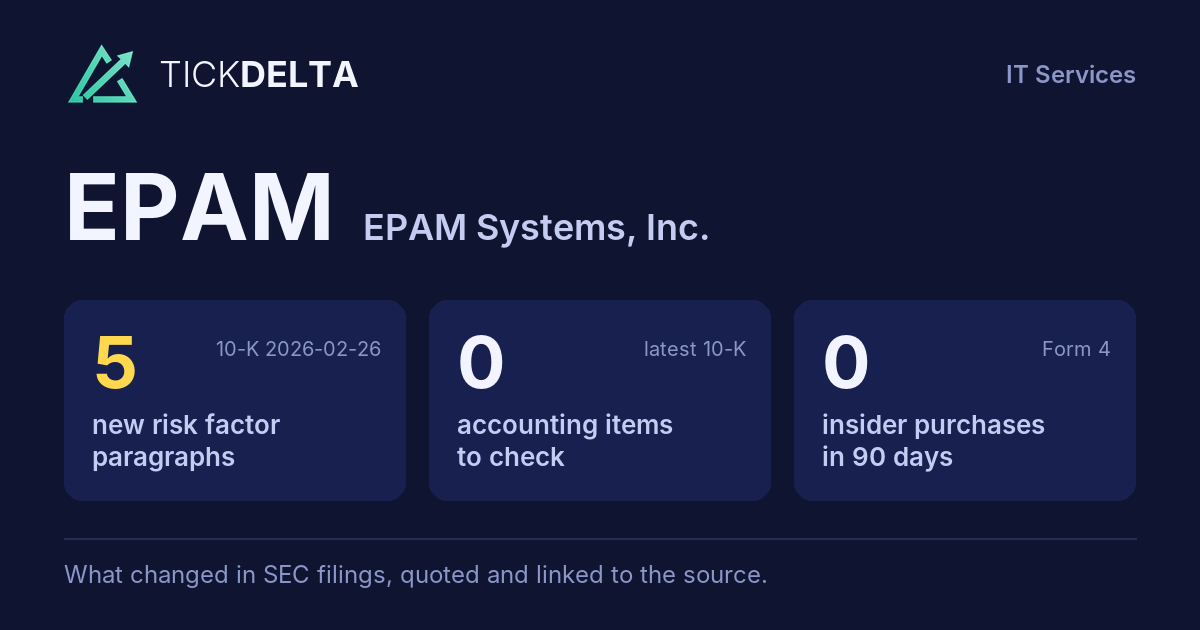
131 paragraphs · 5 new · 58 reworded · 1 gone · 10-K Feb 26, 2026 against Feb 28, 2025
New paragraph Reworded (5% of its words or more) Same or nearly
Paragraph 118 · 49% changed Every version of it
EPAM is subject to the GDPR, the substantially similar U.K. GDPR, the privacy laws of California and other U.S. states, India’s Digital Personal Data Protection Act, and the privacy laws of the other countries where we operate, each of which imposes significant restrictions and requirements relating to the processing of personal data and can include significant financial penalties for non-compliance. These and other state, national and international data protection laws are more burdensome than historical privacy standards, especially in the U.S. California’s privacy laws, the U.K. GDPR, and GDPR each established complex legal obligations which organizations must follow with respect to the processing of personal data, including a prohibition on the transfer of personal information to third parties or to other countries, and the imposition of additional notification, security and other control measures. Recent developments in privacy regulations, including the EU-U.S. Trans-Atlantic Data Privacy Framework, that are designed to secure the transfer of data from the EU to the U.S., have created require significant regulatory uncertainty for businesses transferring data globally. This uncertainty results in increased compliance costs and increases the risk of regulatory enforcement actions which can result in significant financial penalties, private lawsuits, reputational damage, blockage of international data transfers, disruption to business, and loss of clients.
Paragraph 69 · 48% changed Every version of it
Termination, non-renewal, or renegotiation of a client contract or delayed starts to projects cause us to experience a higher-than-expected number of unassigned employees and thus compress our margins until we are able to reallocate our headcount. Clients that delay payment, request modified payment arrangements, or fail to meet their payment obligations increase our cash collection time, cause us to incur bad debt expense, and cause us to incur collection expenses. The loss of any of our major clients, a significant decrease in the volume of work they outsource to us or price they are willing or able to pay us, if not replaced by new service engagements and revenues, could materially adversely affect our revenues and results of operations.
Paragraph 37 · 33% changed Every version of it
Strategic acquisitions involve significant risks but remain a key part of our growth strategy. Acquired companies may not advance our business strategy or achieve a satisfactory return on our investment, we may not be able to successfully integrate acquired employees, businesses, company cultures, client relationships, or operations, and we may not discover significant liabilities in our due diligence or valuation processes. In addition, we may need to implement controls, processes, and policies in our acquired companies so they are consistent and appropriate with the requirements of a multi-national public company especially in areas such as financial reporting, cybersecurity, IT, and privacy and may rely on transition services from the sellers until we are able to implement those controls, processes, and policies. Furthermore, our Our acquired companies’ contracts with their clients sometimes lack terms and conditions that adequately protect us against the risks associated with the services we provide, and our acquired companies’ legacy business operations and contract terms can expose us to potential liability. Acquisitions also divert significant management attention and financial resources from our ongoing business. business and from the integration of other recently acquired companies. If not effectively managed, the disruption to our ongoing business increases our expenses, including significant one-time expenses and costs related to unknown liabilities, including tax, litigation, cybersecurity, and commercial risks, and creates difficulty and complexity when integrating acquired operations that can adversely affect our overall growth and profitability.
Paragraph 100 · 33% changed Every version of it
We rely on our trademarks, trade names, service marks and brand names to distinguish our services and solutions from the services of our competitors. We have registered or applied to register many of these trademarks. Third parties may oppose our trademark applications, challenge our use of our trademarks, or use our trademarks without permission. If our trademarks are successfully challenged, we could be forced to rebrand our services and solutions, which could result in loss of brand recognition, and could require us to devote additional resources to advertising and marketing new brands. Further, when we become aware that third parties are infringing our trademarks, we have to divert resources and management attention to enforce our trademarks, possibly through litigation, which may not be successful and may result in substantial costs.
Paragraph 50 · 29% changed Every version of it
Expectations from our clients, investors, employees, and regulators regarding our environmental, social, and governance, or ESG, strategy and commitments continue to evolve. As investor policy and sentiment changes, and regulations and legislation related to ESG disclosure and climate change initiatives are adopted or suspended regionally and globally, our compliance obligations may not be aligned with investor, political, or legal support for ESG investments, programs, and disclosure. Failure to invest in and comply with ESG initiatives and regulations could limit our access to certain markets, result in fines, or cause reputational harm, and commitment to ESG policies and programs could similarly harm our business and reputation with investors, clients, and the public. Changes in policy and laws may require disclosures and commitments that we are not able to meet, and regulations, treaties or initiatives related to climate change could result in increased operational costs associated with environmental regulations and increased compliance and energy costs, each of which could harm our business and results of operations by increasing our expenses or requiring us to alter our operations. Our processes and controls may not always comply with evolving standards for identifying, measuring, and reporting ESG metrics, including ESG-related disclosures that may be required or expected by regulation or industry norms, and such standards may change over time, which could result in significant revisions to our current goals, reported progress in achieving such goals, or ability to achieve such goals in the future. Additionally, if we are unable to meet our ESG goals and objectives, we could also face scrutiny from certain constituencies related to the scope and nature of those goals or any revisions to those goals, and we may suffer reputational harm with investors, our clients, and current or potential employees.
Paragraph 36 · 26% changed Every version of it
Strategic acquisitions involve significant risks but remain a key part of our growth strategy. Acquired companies may not advance our business strategy or achieve a satisfactory return on our investment, we may not be able to successfully integrate acquired employees, businesses, company cultures, client relationships, or operations, and we may not discover significant liabilities in our due diligence or valuation processes. In addition, we may need to implement controls, processes, and policies in our acquired companies so they are consistent and appropriate with the requirements of a multi-national public company especially in areas such as financial reporting, cybersecurity, IT, and privacy privacy, and may rely on transition services from the sellers until we are able to implement those controls, processes, and policies. Furthermore, our acquired companies’ contracts with their clients sometimes lack terms and conditions that adequately protect us against the risks associated with the services we provide, and our acquired companies’ legacy business operations can expose us to potential liability. Acquisitions also divert significant management attention and financial resources from our ongoing business. If not effectively managed, the disruption to our ongoing business increases our expenses, including significant one-time expenses and costs related to unknown liabilities, including tax, litigation, cybersecurity, and commercial risks, and creates difficulty and complexity when integrating acquired operations that can adversely affect our overall growth and profitability.
Paragraph 49 · 26% changed Every version of it
Expectations from our clients, investors, employees, and regulators regarding our environmental, social, and governance, or ESG, strategy and commitments continue to evolve. As investor policy and sentiment changes, and regulations and legislation related to ESG disclosure and climate change initiatives are adopted or suspended regionally and globally, our compliance obligations may not be aligned with investor, political, or legal support for ESG investments, programs, and disclosure. Failure to invest in and comply with ESG initiatives and regulations could limit our access to certain markets, result in fines, or cause reputational harm, and commitment to ESG policies and programs could similarly harm our business and reputation with investors, clients, and the public. public and subject us to legal liability. Changes and differences in policy and laws in the various jurisdictions where we operate may require inconsistent disclosures and commitments that we are not able to meet, across those jurisdictions, and regulations, treaties or initiatives related to climate change could result in increased operational costs associated with environmental regulations and increased compliance and energy costs, each of which could harm our business and results of operations by increasing our expenses or requiring us to alter our operations. Our processes and controls may not always comply with evolving standards for identifying, measuring, and reporting ESG metrics, including ESG-related disclosures that may be required or expected by regulation or industry norms, and such standards may change over time, which could result in significant revisions to our current goals, reported progress in achieving such goals, or ability to achieve such goals in the future. Additionally, if we are unable to meet our ESG goals and objectives, we could also face scrutiny from certain constituencies related to the scope and nature of those goals or any revisions to those goals, and we may suffer reputational harm with investors, our clients, and current or potential employees.
Paragraph 55 · 23% changed Every version of it
The majority of our professionals are offshore. Companies that outsource services to organizations subsidiaries or third parties operating in other countries remain a topic of political discussion in many countries, including the U. S., U.S., which is our largest source of revenues. The U.S. administration periodically proposes and enacts rules that could impose restrictions on restrict offshore outsourcing and on our ability to deploy employees holding U.S. work visas to client locations, discourage employing non-U.S. residents in the U.S., both of which could adversely impact our business. Such measures could broaden Broadened restrictions on outsourcing by federal and state government agencies and contracts and impact agencies, private industry with tax disincentives, including excise taxes on payments to foreign subsidiaries and personnel, intellectual property transfer restrictions, and restrictions on the use or availability of certain work visas. visas could have a negative effect on our business.

MD&A

89 paragraphs · 10 new · 40 reworded · 8 gone · 10-K Feb 26, 2026 against Feb 28, 2025
New paragraph Reworded (5% of its words or more) Same or nearly
Paragraph 70 · 50% changed
During the year ended December 31, 2024, Software & Hi-Tech remained the largest industry vertical in the North America segment which was a result of the continued focus on engaging with our technology clients. However, a reduction in revenues from a former top 20 client impacted the revenues in this vertical. Financial Services decreased 3.5% in 2024 compared to the prior year, largely impacted by decline in demand from a group of wealth management and insurance clients. Consumer Goods, Retail & Travel declined 4.7% during 2024 compared to the prior year primarily due to declines from clients in the retail industry, partially offset by growth from our travel clients. During the year ended December 31, 2024, 2025, revenues from the Business Information & Media vertical experienced an increase of 4.6% 3.5% primarily due to improvement in demand from clients in the information services publishing and entertainment sectors. Life Sciences & Healthcare increased 13.8% during 2024 compared to sectors, as well as growth from a new client in digital media added in the prior year primarily due to increased demand from pharmaceutical and medical device clients. past twelve months. Emerging Verticals experienced 26.6% 29.3% growth during 2024 2025 compared to the prior year due to revenues from our fourth quarter 2024 acquisitions of NEORIS and First Derivative as well as growth from various clients in industries such as energy, professional services, telecommunications and industrial materials, telecommunications, manufacturing and automotive. Emerging Verticals also benefited from new revenues from clients in several verticals that we gained as part of our acquisitions. materials.
Paragraph 10 · 43% changed
We continue to monitor and respond to the difficult conditions in Ukraine while maintaining a focus on our clients and long-term growth. We execute on our business continuity plans and adapt to developments as they occur to protect the safety of our people and address impacts on our delivery infrastructure, including reallocating work to other geographies within our global footprint. We engage with both our personnel and our clients when navigating delivery challenges and we continue to operate productively in a multitude of locations and provide consistent high-quality delivery to our clients. Our global delivery centers have sufficient resources, including infrastructure and capital, to support ongoing operations while maintaining continuing to focus on the safety and security of our employees and their families in Ukraine as well as in the broader region. The implementation and execution of our business continuity plans, our humanitarian commitment to our people in Ukraine, and other costs related to the war resulted in materially increased expenses. Some of these expenses continued during this year and we expect some of these expenses will continue to occur in subsequent quarters for some time in the future. The information contained in this section is accurate as of the date hereof but may become outdated due to changing circumstances beyond our control or present awareness.
Paragraph 8 · 43% changed
On February 24, 2022, Russian forces attacked Russia’s attack on Ukraine has had, and its people and EPAM has repeatedly called for an immediate end could continue to this unlawful and unconscionable attack. EPAM’s highest priority is the safety and security of its employees and their families in Ukraine as well as in the broader region, and we have continued to support relocating a material adverse effect on our employees to lower risk locations, both within Ukraine and to other countries where we operate. The vast majority of our Ukraine employees are in safe locations and operating at levels of productivity consistent with those achieved prior to the attack. operations. As of December 31, 2024, 2025, Ukraine continues to be a significant delivery location with a large number of delivery professionals. Furthermore, we professionals operating from safe locations at levels of productivity consistent with those achieved prior to the attack. We have maintained our $100 million humanitarian aid commitment to our people in Ukraine in addition Ukraine, and as of December 31, 2025, we have $10.1 million remaining to our other donations and volunteer efforts. be expensed under this humanitarian commitment.
Paragraph 69 · 35% changed
During the year ended December 31, 2024, Software & Hi-Tech remained 2025, Financial Services was the largest industry vertical in the North America Americas segment and grew 16.1% in 2025 compared to the prior year, benefiting from new revenues from clients gained through our 2024 acquisitions and increased demand from insurance and payment processing clients. Software & Hi-Tech grew 6.7% during 2025 compared to the prior year which was a result of the continued focus on engaging with our technology clients. However, a reduction in revenues from a former top 20 client impacted the revenues in this vertical. Financial Services decreased 3.5% in 2024 compared to the prior year, largely impacted by decline in demand from a group of wealth management and insurance clients. Consumer Goods, Retail & Travel declined 4.7% during 2024 compared to the prior year primarily due to declines from clients in the retail industry, partially offset by growth from our travel clients. During the year ended December 31, 2024, revenues from the Business Information & Media vertical experienced an increase of 4.6% primarily due to improvement in demand from clients in the information services and entertainment sectors. Life Sciences & Healthcare increased 13.8% 1.7% during 2024 2025 compared to the prior year primarily due to increased demand from pharmaceutical and medical device clients. Emerging Verticals experienced 26.6% growth Consumer Goods, Retail & Travel increased 6.6% during 2024 2025 compared to the prior year primarily due to growth from various clients in industries such as energy, professional services, industrial materials, telecommunications, manufacturing and automotive. Emerging Verticals also benefited from new revenues from clients in several verticals that we gained as part of our acquisitions. retail clients.
Paragraph 39 · 33% changed
The following table shows presents revenues contributed by service offering as an our clients by amount and as a percentage of our revenues for the years indicated: Year periods indicated:Year Ended December 31, 2025 2024 2023 2022 (in thousands, except percentages) Professional services $ 4,698,183 99.4% $4,661,733 99.4% $4,800,047 99.5% Licensing and other revenues 29,757 0.6% 28,807 0.6% 24,651 0.5% Revenues $ 4,727,940 100.0% $4,690,540 100.0% $4,824,698 100.0% Top five clients $746,169 13.7% $748,324 15.8% Top ten clients $1,180,007 21.6% $1,107,647 23.4% Top twenty clients $1,742,670 31.9% $1,615,267 34.2% Clients below top twenty $3,714,386 68.1% $3,112,673 65.8%
Paragraph 50 · 32% changed
Expressed as a percentage of revenues, selling, general and administrative expenses decreased 0.1% 0.3% to 17.3% 17.0% for the year ended December 31, 2024, 2025, as compared to the prior year primarily driven by reductions a decrease in facility exit costs, bad debt expense and personnel-related costs as a percentage of revenue, including stock-based compensation expense, facilities and infrastructure expenses and professional fee expenses related to our business acquisition efforts, partially offset by additional costs for software licenses as a percentage of revenues.
Paragraph 27 · 27% changed
We continue to diversify our presence across multiple geographies and verticals, both organically and through strategic acquisitions. During the year ended December 31, 2024, 2025, our total revenues increased 0.8% 15.4% from the previous year to $4.728 $5.457 billion. Revenues have been positively impacted from the first twelve months following each acquisition that was made in the fourth quarter of 2024, increased our revenues by stabilizing demand for our services 9.2% and fluctuations in foreign currency exchange rates which increased our revenue growth revenues by 0.1% 1.3% during the year ended December 31, 2024 2025 as compared to the previous year, partially offset by the sale of our remaining holdings in Russia in the third quarter of 2023. Revenues have also been positively impacted by our acquisitions of NEORIS and First Derivative, which in aggregate contributed $65.9 million to our revenues in 2024. year. During the year ended December 31, 2024, 2025, we experienced a decrease in client concentration in our top client groups as a percentage of total revenues as compared to the previous year.
Paragraph 36 · 27% changed
Revenues in our EMEA geography were $1.793 $2.147 billion, a decrease an increase of $29.6 $354.1 million, or 1.6%, 19.7%, from $1.823 $1.793 billion in the previous year. Revenues The increase during the year ended December 31, 2025 compared to 2024, was primarily due to the acquisitions of NEORIS and First Derivative in this geography benefited the fourth quarter of 2024 and increased demand from acquisitions which contributed $28.3 million to revenue growth in 2024. our existing clients across various industries. Revenues from EMEA accounted for 37.9% 39.3% of consolidated revenues in 2024 2025 as compared to 38.9% 37.9% in the previous year. The top three revenue contributing client location countries in EMEA were the United Kingdom, Switzerland and Germany Germany, generating revenues of $597.3 million, $438.5 million and $233.4 million in 2025, respectively, compared to $523.4 million, $407.8 million and $206.1 million in 2024, respectively, compared to $585.2 million, $367.1 million and $178.5 million in 2023, respectively.

A paragraph is matched with the one last year that shares the most of its words; under half in common makes it new. The paragraphs shown are the 8 reworded the most in each section.

The paragraph that changed most in each section

The redline

Marked against last year's 10-K: cut words struck through, new words highlighted.

MD&A261 words changed in this paragraph; it is 30% similar to last year's version.
The impact of Russia’s invasion of Ukraine on our operations, personnel, and physical assets in Ukraine has had, and, along with any escalation of the war that includes Belarus’ territory or military, could continue to have a material adverse effect on our operations. Actions taken by other countries, including new and stricter sanctions by Canada, the United Kingdom, the European Union, the U.S. and other companies and organizations against officials, individuals, regions, and industries in Belarus, and Belarus’ responses to those sanctions, including counter-sanctions and other actions, have had and could continue to have a material adverse effect on our operations. Clients have and may continue to seek altered terms, conditions, and delivery locations for the performance of services, delay planned work or seek services from alternate providers, or suspend, terminate, fail to renew, or reduce existing contracts or services, which could have a material adverse effect on our financial condition. Some of our clients have implemented steps to block internet communications with Ukraine and Belarus to protect against potential cyberattacks or other information security threats, which has caused a material adverse effect on our ability to deliver our services to these clients from those locations. Such material adverse effects disrupt our delivery of services, cause us to shift all or portions of our work occurring in the region to other countries, restrict our ability to engage in certain projects in the region and serve certain clients in or from the region, and could negatively impact our personnel, operations, financial results and business outlook. Our Board of Directors continues and its committees continue their oversight of our strategic, geopolitical, and cybersecurity risks and the risks related to our geographic locations and expansion. Our Board has received updates from management during both regular and special meetings, while also providing oversight of the risks associated with Russia’s invasion of Ukraine and other strategic areas of importance related to the war.

Source: Item 7, 10-K 0001352010-26-000015 vs Item 7, 10-K 0001352010-25-000007

Risk Factors154 words changed in this paragraph; it is 67% similar to last year's version.
Expectations from our clients, investors, employees, and regulators regarding our environmental, social, and governance, or ESG, strategy and commitments continue to evolve. As investor policy and sentiment changes, and regulations and legislation related to ESG disclosure and climate change initiatives are adopted or suspended regionally and globally, our compliance obligations may not be aligned with investor, political, or legal support for ESG investments, programs, and disclosure. Failure to invest in and comply with ESG initiatives and regulations could limit our access to certain markets, result in fines, or cause reputational harm, and commitment to ESG policies and programs could similarly harm our business and reputation with investors, clients, and the public. public and subject us to legal liability. Changes and differences in policy and laws in the various jurisdictions where we operate may require inconsistent disclosures and commitments that we are not able to meet, across those jurisdictions, and regulations, treaties or initiatives related to climate change could result in increased operational costs associated with environmental regulations and increased compliance and energy costs, each of which could harm our business and results of operations by increasing our expenses or requiring us to alter our operations. Our processes and controls may not always comply with evolving standards for identifying, measuring, and reporting ESG metrics, including ESG-related disclosures that may be required or expected by regulation or industry norms, and such standards may change over time, which could result in significant revisions to our current goals, reported progress in achieving such goals, or ability to achieve such goals in the future. Additionally, if we are unable to meet our ESG goals and objectives, we could also face scrutiny from certain constituencies related to the scope and nature of those goals or any revisions to those goals, and we may suffer reputational harm with investors, our clients, and current or potential employees.

Source: Item 1A, 10-K 0001352010-26-000015 vs Item 1A, 10-K 0001352010-25-000007

Legal Proceedings12 words changed in this paragraph; it is 94% similar to last year's version.
Deferred Consideration - During the year ended December 31, 2022, the Company purchased software licenses for use in the regular course of business in exchange for an upfront payment and fixed, subsequent annual payments due over the next 4 years. This agreement was modified during the years ended December 31, 2023 2023, 2024 and 2024. 2025. As of December 31, 2024, 2025, the undiscounted deferred consideration amounts owed totaled approximately $ 35.0 30.1 million and are expected to be paid as follows: $ 17.0 million in 2025 and $ 18.0 million in 2026. See Note 7 “Property and Equipment, Net” for more information regarding the purchase of software licenses.

Source: Item 3, via Note 18 – COMMITMENTS AND CONTINGENCIES, 10-K 0001352010-26-000015 vs Item 3, via Note 18 – COMMITMENTS AND CONTINGENCIES, 10-K 0001352010-25-000007

Sentences and paragraphs added, removed or reworded

Every change, by type

Sentences and paragraphs of EPAM's Risk Factors and MD&A, 10-K Feb 26, 2026 against 10-K Feb 28, 2025. Each links to the text at sec.gov.

Quiet changes are sentences kept from last year with one to four words changed, at least one of them a hedge, a modal or a qualifier (may, could, will, not, significant, material…). A year or date rolling forward is not counted.

The full word list

adverse, adversely, all, although, anticipate, anticipates, any, approximately, believe, believes, can, cannot, certain, could, expect, expects, generally, however, if, intend, intends, largely, likely, many, material, materially, may, might, most, must, never, no, not, possible, primarily, probable, should, significant, significantly, some, substantial, substantially, unlikely, will, would

AddedRisk Factors
Rapidly evolving digital technology innovations, such as AI, machine learning, hyperautomation, low-code/no-code application development, system observability, and predictive insights are creating new forms of competition to our services. These innovations may reduce the need for our services and the services of our clients that develop software and software-as-a-service for their end users. AI, large language model, and machine learning technologies enable clients and potential clients to develop, customize, and maintain software solutions internally and could reduce reliance on third-party service providers such as EPAM and our clients that are software product vendors. Industry-specific plug-ins and agentic features of existing AI software can perform tasks that may replace the need for specialized software to perform common business processes, such as financial analysis, due diligence, and software coding. Our current and prospective clients have and may continue to use AI-powered tools to create or modify software applications themselves, or elect to replace traditional software with agentic AI, rather than purchasing our services or licensing software from our clients.
Read it in 10-K Feb 26, 2026 at sec.gov
AddedRisk Factors
Increased competition, or the perception of increased competition, from new and non-traditional market participants like AI-based task-specific tools, has negatively impacted the price of our stock. If a significant number of our existing or future clients employ AI-driven tools as a replacement for our services or the software we build, our revenues, anticipated growth and prospects, our financial condition, and our results of operations could be materially adversely affected.
Read it in 10-K Feb 26, 2026 at sec.gov
AddedRisk Factors
Although we maintain professional liability insurance, product liability insurance, cyber incident insurance, commercial general and property insurance, business interruption insurance, workers’ compensation coverage, and umbrella insurance for
Read it in 10-K Feb 26, 2026 at sec.gov
RemovedRisk Factors
EPAM is actively monitoring and enhancing security related to our people and the stability of our infrastructure, including communications, physical assets, energy supplies, and internet availability. We execute our business continuity plans in response to developments as they occur and to protect and relocate our personnel and address impacts on our delivery infrastructure. To date we have not experienced any material interruptions in our infrastructure or the utility supply or internet connectivity we use to support our clients.
Read it in 10-K Feb 28, 2025 at sec.gov
RewordedRisk Factors
The important markets for both our clients and our delivery operations are increasingly interdependent and uncertainty Uncertainty about the outcome of changing economic and geopolitical conditions in those markets has caused, and could continue to cause cause, our clients to reduce or defer their spending on new initiatives initiatives, technologies, and technologies, resulting in clients reducing, delaying or eliminating spending on our services services, which negatively affects our business.
Read it in 10-K Feb 26, 2026 at sec.gov
RewordedRisk Factors
In any of the countries in which we operate, If prolonged civil unrest, political instability or uncertainty, military activities, or broad-based sanctions or counter-sanctions, should they counter-sanctions continue for the long-term or escalate, could require us escalate in any of the countries in which we operate, we would need to further rebalance our geographic concentrations and concentrations, which could have a material adverse effect on our personnel, operations, financial results and business outlook.
Read it in 10-K Feb 26, 2026 at sec.gov
Show the other 43
RewordedRisk Factors
We may be unable to obtain price increases in-line increase the prices that our clients are willing to pay at a rate that is commensurate with the increasing compensation levels we need to pay to retain our existing personnel and hire new personnel, which may also have an adverse impact on our profitability.
Read it in 10-K Feb 26, 2026 at sec.gov
RewordedRisk Factors
Changes and differences in policy and laws in the various jurisdictions where we operate may require inconsistent disclosures and commitments that we are not able to meet, across those jurisdictions, and regulations, treaties or initiatives related to climate change could result in increased operational costs associated with environmental regulations and increased compliance and energy costs, each of which could harm our business and results of operations by increasing our expenses or requiring us to alter our operations.
Read it in 10-K Feb 26, 2026 at sec.gov
RewordedRisk Factors
Such measures could broaden Broadened restrictions on outsourcing by federal and state government agencies and contracts and impact agencies, private industry with tax disincentives, including excise taxes on payments to foreign subsidiaries and personnel, intellectual property transfer restrictions, and restrictions on the use or availability of certain work visas. visas could have a negative effect on our business.
Read it in 10-K Feb 26, 2026 at sec.gov
RewordedRisk Factors
Our software development solutions involve a high degree of technological complexity, have unique specifications and could contain design Design defects or software errors that are difficult to detect or correct, including as a result of the introduction of those resulting from new and emerging technologies technologies, such as AI.
Read it in 10-K Feb 26, 2026 at sec.gov
RewordedRisk Factors
Civil, military, energy supply political, energy, and political macroeconomic uncertainty exists and may increase in many of the global regions where we operate and where we derive our revenues and macroeconomic forces largely have global effects with varying intensity across the different regions where we and our clients operate. revenues.
Read it in 10-K Feb 26, 2026 at sec.gov
RewordedRisk Factors
These individual, group, and organized actors have a variety of methods at their disposal, including deploying malicious software, exploiting vulnerabilities in hardware, software, or infrastructure, using social engineering or deceptive techniques to obtain information or gain access to our or our clients’ or vendors’ data, exploiting remote working connectivity and security susceptibilities, using AI to enhance, automate, and scale cyberattacks, and executing coordinated attacks to compromise our services, disrupt our operations, damage our reputation, or gain access to our communications, networks and data centers.
Read it in 10-K Feb 26, 2026 at sec.gov
RewordedRisk Factors
The U.S. administration periodically proposes and enacts rules that could impose restrictions on restrict offshore outsourcing and on our ability to deploy employees holding U.S. work visas to client locations, discourage employing non-U.S. residents in the U.S., both of which could adversely impact our business.
Read it in 10-K Feb 26, 2026 at sec.gov
RewordedRisk Factors
Clients may be unwilling to pay rates for human delivery personnel if they perceive that the same If comparable services can be performed less expensively by generative AI and using AI, clients may seek other service providers or expect price concessions to retain their business, which could adversely affect our financial results.
Read it in 10-K Feb 26, 2026 at sec.gov
RewordedRisk Factors
Furthermore, we believe to the extent that our stock price should reflect reflects future growth and profitability expectations and, if we fail expectations, failure to meet these expectations, expectations will cause our stock price may to significantly decline.
Read it in 10-K Feb 26, 2026 at sec.gov
RewordedRisk Factors
If we are unable or slow to develop, adopt, and deploy generative AI technologies in our business, we will not remain competitive against in our industry peers. industry, and the growth we are expecting to realize from AI-related services may not materialize.
Read it in 10-K Feb 26, 2026 at sec.gov
Quiet changesRisk Factors
We must manage the utilization levels of our professionals by effectively planning for future needs and staffing projects appropriately while accurately predicting the general economy, the geographies and locations where our personnel are will be needed, and our clients’ need for our services.
Read it in 10-K Feb 26, 2026 at sec.gov
Quiet changesRisk Factors
Any such errors could result in disruptions to the proper functioning of the software we build, cause disruptions in our clients’ business, and allow unauthorized access to our or our clients’ proprietary information, resulting in claims for damages against us, litigation, and reputational harm that could materially adversely affect our business.
Read it in 10-K Feb 26, 2026 at sec.gov
AddedMD&A
We leverage AI to deliver transformative solutions that accelerate our clients' digital innovation and enhance their competitive edge. Through platforms like EPAM AI/RUN™ and initiatives like DIALX Lab™, we integrate advanced AI technologies into tailored business strategies, driving significant industry impact and fostering continuous innovation.
Read it in 10-K Feb 26, 2026 at sec.gov
AddedMD&A
Our Board of Directors and its committees continue their oversight of our strategic, geopolitical, and cybersecurity risks and the risks related to our geographic locations and expansion. Our Board has received updates from management during both regular and special meetings, while also providing oversight of the risks associated with Russia’s invasion of Ukraine and other strategic areas of importance related to the war.
Read it in 10-K Feb 26, 2026 at sec.gov
AddedMD&A
We experienced revenue growth across all verticals in 2025 and Financial Services remained our largest vertical, comprising 24.1% of total revenues. See further discussion of our verticals in the section “Revenues by Business Segment” below.
Read it in 10-K Feb 26, 2026 at sec.gov
AddedMD&A
On July 4, 2025, the U.S. federal government enacted tax reform legislation, commonly referred to as the One Big Beautiful Bill Act (“the Act”), which includes a broad range of tax reform provisions. The tax law changes included in the Act did not have a material impact on our effective tax rate for the year ended December 31, 2025; however, we expect an acceleration of certain deductions resulting in a $24.5 million reduction in cash tax payments associated with the 2025 tax year.
Read it in 10-K Feb 26, 2026 at sec.gov
AddedMD&A
Starting in 2025, we renamed our North America segment to Americas. The new name reflects the evolving geographic footprint and growth of operations within the segment, particularly in Latin America. This constitutes a naming change only and no changes were made to amounts reported.
Read it in 10-K Feb 26, 2026 at sec.gov
RemovedMD&A
During the year ended December 31, 2024, we have completed several acquisitions of businesses, including NEORIS and First Derivative. We believe these acquisitions will enhance our client portfolio and service offerings as well as expand our presence in Latin America and Europe.
Read it in 10-K Feb 28, 2025 at sec.gov
RemovedMD&A
The impact of Russia’s invasion of Ukraine on our operations, personnel, and physical assets in Ukraine has had, and, along with any escalation of the war that includes Belarus’ territory or military, could continue to have a material adverse effect on our operations. Actions taken by other countries, including new and stricter sanctions by Canada, the United Kingdom, the European Union, the U.S. and other companies and organizations against officials, individuals, regions, and industries in Belarus, and Belarus’ responses to those sanctions, including counter-sanctions and other actions, have had and could continue to have a material adverse effect on our operations. Clients have and may continue to seek altered terms, conditions, and delivery locations for the performance of services, delay planned work or seek services from alternate providers, or suspend, terminate, fail to renew, or reduce existing contracts or services, which could have a material adverse effect on our financial condition. Some of our clients have implemented steps to block internet communications with Ukraine and Belarus to protect against potential cyberattacks or other information security threats, which has caused a material adverse effect on our ability to deliver our services to these clients from those locations. Such material adverse effects disrupt our delivery of services, cause us to shift all or portions of our work occurring in the region to other countries, restrict our ability to engage in certain projects in the region and serve certain clients in or from the region, and could negatively impact our personnel, operations, financial results and business outlook. Our Board of Directors continues its oversight of our strategic, geopolitical, and cybersecurity risks and the risks related to our geographic expansion. Our Board has received updates from management during both regular and special meetings, while also providing oversight of the risks associated with Russia’s invasion of Ukraine and other strategic areas of importance related to the war.
Read it in 10-K Feb 28, 2025 at sec.gov
RemovedMD&A
We have no way to predict the progress or outcome of the war in Ukraine because the conflict and government reactions change quickly and are beyond our control. Prolonged military activities, broad-based sanctions and counter-sanctions, or escalation of the war that includes Belarus’ territory or military could have a material adverse effect on our operations and financial condition. The information contained in this section is accurate as of the date hereof but may become outdated due to changing circumstances beyond our control or present awareness.
Read it in 10-K Feb 28, 2025 at sec.gov
RemovedMD&A
(4)CEE includes revenues from clients in Belarus, Georgia, Kazakhstan, Russia, Ukraine and Uzbekistan. As a result of the sale of the Company’s remaining holdings in Russia to a third-party on July 26, 2023, revenues from the CEE region are no longer material. Beginning in 2024, revenues from the CEE region are included in the EMEA region.
Read it in 10-K Feb 28, 2025 at sec.gov
RemovedMD&A
On July 26, 2023, the Company completed the sale of its remaining holdings in Russia to a third-party. The Company recorded a loss on sale of $25.9 million during the year ended December 31, 2023, including the recognition of the accumulated currency translation loss related to this foreign entity that was previously included in Accumulated other comprehensive loss.
Read it in 10-K Feb 28, 2025 at sec.gov
RemovedMD&A
Our operations have historically consisted of three reportable segments: North America, Europe, and Russia. On July 26, 2023, we completed the sale of our remaining holdings in Russia to a third party and as a result of this sale, we no longer have operations associated with the Russia segment.
Read it in 10-K Feb 28, 2025 at sec.gov
RemovedMD&A
During the year ended December 31, 2024, the Company revised its CODM report to enhance the presentation of segment expenses by category and to revise the allocation methodology for certain types of shared expenses. The following prior period amounts presented have been revised to align with the current year methodology. No changes were made to historically reported segment revenues.
Read it in 10-K Feb 28, 2025 at sec.gov
RemovedMD&A
The following table summarizes our cash flows for the periods indicated:For the Years Ended December 31, 2024 2023 2022 (in thousands) Consolidated Statements of Cash Flow Data: Net cash provided by operating activities $ 559,168 $ 562,634 $ 464,104 Net cash used in investing activities (884,980) (66,768) (182,927) Net cash used in financing activities (390,407) (165,773) (2,021) Effect of exchange rate changes on cash, cash equivalents and restricted cash (36,497) 29,379 (44,867) Net (decrease)/increase in cash, cash equivalents and restricted cash $ (752,716) $ 359,472 $ 234,289 Cash, cash equivalents and restricted cash, beginning of period 2,043,108 1,683,636 1,449,347 Cash, cash equivalents and restricted cash, end of period $ 1,290,392 $ 2,043,108 $ 1,683,636
Read it in 10-K Feb 28, 2025 at sec.gov
RewordedMD&A
Cost of revenues (exclusive of depreciation and amortization)(1) 3,883,535 71.2 3,277,497 69.3 3,256,514 69.4 3,286,683 68.1 Selling, general and administrative expenses(2) 928,707 17.0 816,300 17.3 815,065 17.4 872,777 18.1 Depreciation and amortization expense 124,811 2.3 89,559 1.9 91,800 1.9 92,272 1.9 Loss on sale of business — — 25,922 0.6 — — Income from operations 520,003 9.5 544,584 11.5 501,239 10.7 572,966 11.9 Interest and other income, net 11,546 0.3 46,876 1.0 51,124 1.0 10,025 0.2 Foreign exchange loss (25,925) (0.5) (7,048) (0.1) (15,778) (0.3) (75,733) (1.6) Income before provision for income taxes 505,624 9.3 584,412 12.4 536,585 11.4 507,258 10.5 Provision for income taxes 127,946 2.4 129,879 2.8 119,502 2.5 87,842 1.8 Net income $ 377,678 6.9% $ 454,533 9.6% $ 417,083 8.9% $ 419,416 8.7% Effective tax rate 25.3 % 22.2 % 22.3 % 17.3 % Diluted earnings per share $6.72 $7.84 $7.06 $7.09
Read it in 10-K Feb 26, 2026 at sec.gov
RewordedMD&A
The following table presents Europe segment revenues by industry vertical for the periods indicated:Year Ended December 31, Change 2025 2024 2023 Dollars Percentage Industry Vertical (in thousands, except percentages) Financial Services $ 712,776 $ 502,631 $ 210,145 41.8% Consumer Goods, Retail & Travel $ 597,579 562,976 $ 596,830 $ (33,854) (5.7)% Financial Services 502,631 472,146 30,485 6.5% 34,603 6.1% Software & Hi-Tech 261,370 177,276 84,094 47.4% Business Information & Media 210,435 225,148 323,985 (98,837) (30.5)% Software & Hi-Tech 177,276 153,683 23,593 15.4% (14,713) (6.5)% Life Sciences & Healthcare 128,776 86,150 60,549 25,601 42.3% 42,626 49.5% Emerging Verticals 380,004 307,420 302,250 5,170 1.7% 72,584 23.6% Revenues $ 2,290,940 $ 1,861,601 $ 1,909,443 $ (47,842) (2.5)% 429,339 23.1%
Read it in 10-K Feb 26, 2026 at sec.gov
RewordedMD&A
The increase in selling, general and administrative expenses during 2024 2025 compared to 2023 2024 was primarily driven by a $14.1 million the acquisitions of NEORIS and First Derivative completed in the fourth quarter of 2024, an increase in personnel-related costs, including a $7.4 $4.2 million increase in stock-based compensation expense, a $10.3 an $11.3 million increase in professional fee expenses related to our business acquisition efforts facilities and infrastructure expenses, and a $4.7 $9.0 million increase in expenses associated with our humanitarian efforts costs for Ukraine. software licenses.
Read it in 10-K Feb 26, 2026 at sec.gov
RewordedMD&A
Expressed as a percentage of revenues, selling, general and administrative expenses decreased 0.1% 0.3% to 17.3% 17.0% for the year ended December 31, 2024, 2025, as compared to the prior year primarily driven by reductions a decrease in facility exit costs, bad debt expense and personnel-related costs as a percentage of revenue, including stock-based compensation expense, facilities and infrastructure expenses and professional fee expenses related to our business acquisition efforts, partially offset by additional costs for software licenses as a percentage of revenues.
Read it in 10-K Feb 26, 2026 at sec.gov
RewordedMD&A
Expressed as a percentage of revenues, depreciation and amortization expense remained the same at 1.9% increased to 2.3% during the year ended December 31, 2024, 2025, as compared to 2023. 1.9% in 2024, primarily due to increased amortization of acquired finite-lived intangible assets largely resulting from the acquisitions of First Derivative and NEORIS in 2024.
Read it in 10-K Feb 26, 2026 at sec.gov
RewordedMD&A
Europe segment operating profit as a percentage of revenues was positively negatively impacted by higher utilization an increase in variable compensation expense and lower government incentives related to conducting R&D activities in Poland, partially offset by an increase in variable compensation expense and negative impact from the fluctuations changes in foreign exchange rates and results of cost optimization programs during 2024 2025 compared to 2023. 2024.
Read it in 10-K Feb 26, 2026 at sec.gov
RewordedMD&A
These year-over-year increases were partially offset by an $8.4 a $5.6 million decrease in bad debt expense, a $5.6 million reduction in facility exit costs and a $3.9 million reduction in facilities and infrastructure professional fee expenses related to our business acquisition efforts as compared to the prior year.
Read it in 10-K Feb 26, 2026 at sec.gov
RewordedMD&A
However, revenues Revenues in this the Consumer Goods, Retail & Travel vertical declined 5.7% experienced growth of 6.1% during the year ended December 31, 2024, 2025, as compared to 2023, 2024, primarily due to decreased improved demand from clients in the retail and consumer goods industries, partially offset by growth from our travel clients. industries.
Read it in 10-K Feb 26, 2026 at sec.gov
RewordedMD&A
This decrease was largely driven by a $4.2 $37.0 million decrease in government grant interest income from our cash, cash equivalents and short-term investments, partially offset by a $2.9 $2.2 million increase decrease in loss due to the change in fair value of contingent consideration, partially offset by a $1.1 million increase in other income. consideration.
Read it in 10-K Feb 26, 2026 at sec.gov
RewordedMD&A
Furthermore, we We have maintained our $100 million humanitarian aid commitment to our people in Ukraine in addition Ukraine, and as of December 31, 2025, we have $10.1 million remaining to our other donations and volunteer efforts. be expensed under this humanitarian commitment.
Read it in 10-K Feb 26, 2026 at sec.gov
RewordedMD&A
This increase decrease is primarily attributable to higher utilization and recognition the impact of lower profitability from acquisitions completed in 2024, lower government incentives related to conducting R&D activities in Poland, partially offset by changes in foreign exchange rates, and an increase in variable compensation expense as a percentage of segment revenues during 2024 2025 compared to 2023. 2024.
Read it in 10-K Feb 26, 2026 at sec.gov
RewordedMD&A
Emerging Verticals experienced 26.6% 29.3% growth during 2024 2025 compared to the prior year due to revenues from our fourth quarter 2024 acquisitions of NEORIS and First Derivative as well as growth from various clients in industries such as energy, professional services, telecommunications and industrial materials, telecommunications, manufacturing and automotive. materials.
Read it in 10-K Feb 26, 2026 at sec.gov

Sources

The two latest 10-Ks on EDGAR, section by section. Each change links to the text at sec.gov.

Also

New risk factors: paragraphs with nothing like them last year, quoted in full.

Work with it

Excel workbook · CSV. Google Sheet that stays up to date: paste =IMPORTDATA("https://tickdelta.com/company/EPAM/export.csv") into a cell.

Next:Related parties
Esc

Type a ticker such as AAPL, a name, an investor such as Buffett, or a topic such as tariffs. ↑ ↓ to move, Enter to open.