EPAM Systems, Inc. EPAM
New risk paragraphs, branching off last year
Each branch is a paragraph in Risk Factors with nothing like it in the 10-K filed Feb 28, 2025. A box jumps to the paragraph as filed, below.
Paragraphs with nothing like them in last year's 10-K
5 paragraphs in Risk Factors of the 10-K filed Feb 26, 2026 with nothing like them in the 10-K filed Feb 28, 2025. Quoted exactly. Paragraphs that were only edited are under 10-K change.
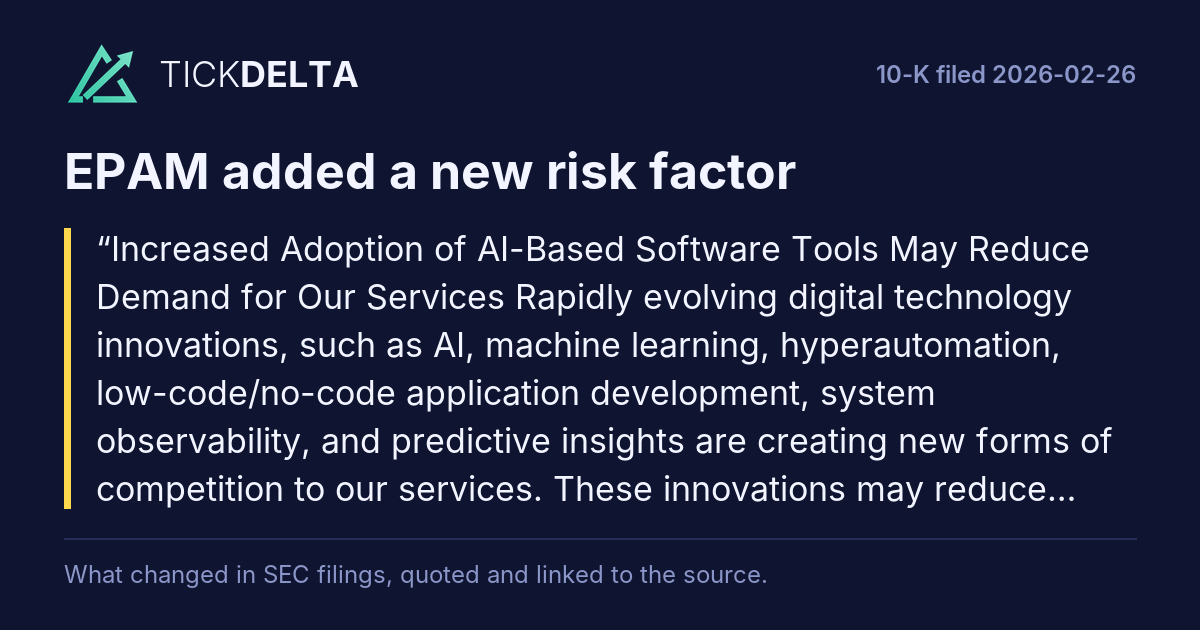
Increased Adoption of AI-Based Software Tools May Reduce Demand for Our Services
Rapidly evolving digital technology innovations, such as AI, machine learning, hyperautomation, low-code/no-code application development, system observability, and predictive insights are creating new forms of competition to our services. These innovations may reduce the need for our services and the services of our clients that develop software and software-as-a-service for their end users. AI, large language model, and machine learning technologies enable clients and potential clients to develop, customize, and maintain software solutions internally and could reduce reliance on third-party service providers such as EPAM and our clients that are software product vendors. Industry-specific plug-ins and agentic features of existing AI software can perform tasks that may replace the need for specialized software to perform common business processes, such as financial analysis, due diligence, and software coding. Our current and prospective clients have and may continue to use AI-powered tools to create or modify software applications themselves, or elect to replace traditional software with agentic AI, rather than purchasing our services or licensing software from our clients.
Increased competition, or the perception of increased competition, from new and non-traditional market participants like AI-based task-specific tools, has negatively impacted the price of our stock. If a significant number of our existing or future clients employ AI-driven tools as a replacement for our services or the software we build, our revenues, anticipated growth and prospects, our financial condition, and our results of operations could be materially adversely affected.
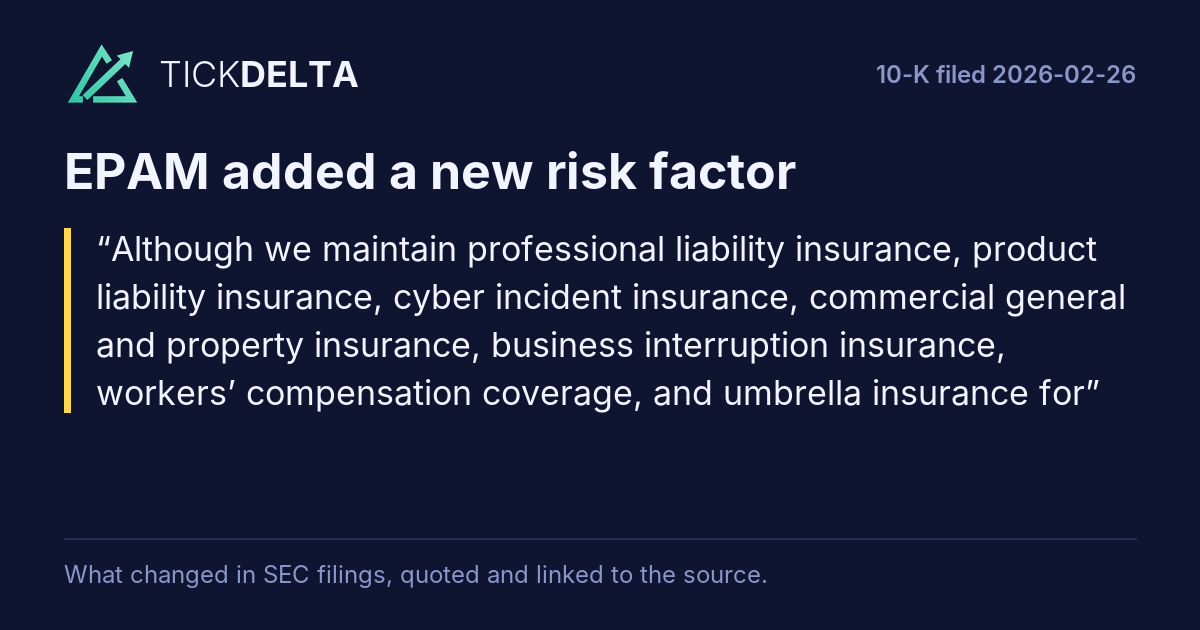
Although we maintain professional liability insurance, product liability insurance, cyber incident insurance, commercial general and property insurance, business interruption insurance, workers’ compensation coverage, and umbrella insurance for
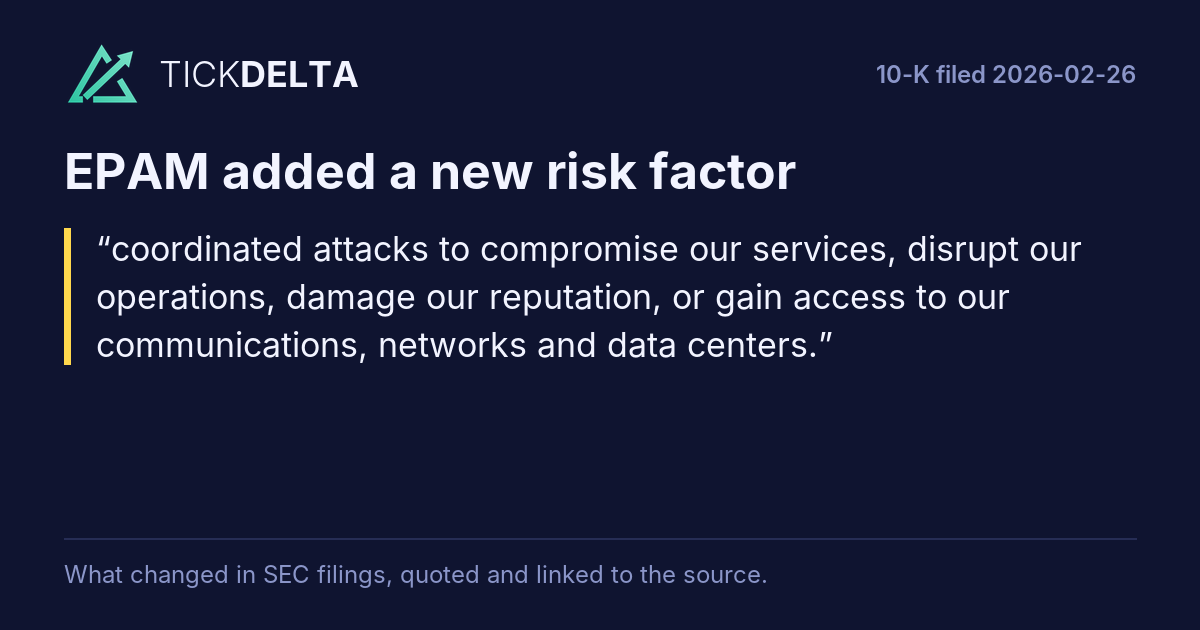
coordinated attacks to compromise our services, disrupt our operations, damage our reputation, or gain access to our communications, networks and data centers.
Paragraphs in the 10-Q filed Nov 5, 2026 that were not in the one before
New in the latest 10-Q
2 paragraphs in the 10-Q filed Nov 5, 2026 with nothing like them in the 10-Q filed Aug 6, 2026 (at least half the words must differ; new numbers alone do not count). Quoted exactly, grouped by the item heading above them. This is text that changed, not a judgement of how serious it is.
Share sales and buybacks
(2) The increase in the approximate dollar value of shares that may yet be purchased in September was due to the termination of the 2025 Repurchase Program and replacement with the 2026 Repurchase Program as noted above.
Read in the 10-Q
Other information
On August 19, 2026, Balazs Fejes, Chief Executive Officer and President, terminated a trading arrangement for the sale of securities of the Company’s common stock that was intended to satisfy the affirmative defense conditions of Securities Exchange Act Rule 10b5-1(c) (a “Rule 10b5-1 Trading Plan”). Mr. Fejes’ Rule 10b5-1 Trading Plan was adopted on August 17, 2026 and provided for the sale of up to 18,819 shares of common stock underlying stock options according to the terms of his Rule 10b5-1 Trading Plan. As of the date of termination of his Rule 10b5-1 Trading Plan, Mr. Fejes did not sell any shares of common stock under the terms of the Rule 10b5-1 Trading Plan. The termination was effected in accordance with the terms of the Rule 10b5-1 Trading Plan and applicable securities laws. On August 20, 2026, Mr. Fejes entered into a Rule 10b5-1 Trading Plan that expires on August 15, 2027 and is otherwise subject to identical terms as his terminated Rule 10b5-1 Trading Plan.
Read in the 10-Q
The 10-Q's risk factors against the 10-K
Item 1A of the 10-Q filed Nov 5, 2026 against Item 1A of the 10-K filed Feb 26, 2026.
A 10-Q repeats only the risks that changed, so a 10-K paragraph that is missing from it is not counted as removed.
Added is a paragraph with nothing like it in the 10-K, Reworded a sentence that is in both with several words changed,
Quiet changes a sentence in both where one to four words changed and one is a hedge or a modal
(cut words struck through, new words highlighted).
Text on the page, not a score; each links to the filing at sec.gov.
What the 10-Q itself says about its risk factors:For a discussion of our potential risks and uncertainties, including the role of AI technologies in our business and workforce and as competition to the services that we sell, and our significant operations in Belarus and Ukraine and the material adverse effect the invasion of Ukraine by Russia has had and may have on our operations, business, and financial results, see the risk factors disclosed under the heading “Part I. Item 1A. Risk Factors” in our Annual Report on Form 10-K for the year ended December 31, 2025.
Read in the 10-Q
Phrases used for the first time
Two-word phrases in Risk Factors of the 10-K filed Feb 26, 2026 that are in none of the 1 earlier 10-Ks stored, back to Feb 28, 2025
Where each one is used
- pricing models: We face a number of risks when pricing our contracts with our clients. Our pricing is highly dependent on our internal forecasts, assumptions and predictions about our clients and their projects, the marketplace, global economic conditions (including foreign exchange volatility and inflation) and the coordination...
- machine learning: Rapidly evolving digital technology innovations, such as AI, machine learning, hyperautomation, low-code/no-code application development, system observability, and predictive insights are creating new forms of competition to our services. These innovations may reduce the need for our services and the services of...
- new pricing: We face a number of risks when pricing our contracts with our clients. Our pricing is highly dependent on our internal forecasts, assumptions and predictions about our clients and their projects, the marketplace, global economic conditions (including foreign exchange volatility and inflation) and the coordination...
- india’s digital: EPAM is subject to the GDPR, the substantially similar U.K. GDPR, the privacy laws of California and other U.S. states, India’s Digital Personal Data Protection Act, and the privacy laws of the other countries where we operate, each of which imposes significant restrictions and requirements relating to the...
- digital personal: EPAM is subject to the GDPR, the substantially similar U.K. GDPR, the privacy laws of California and other U.S. states, India’s Digital Personal Data Protection Act, and the privacy laws of the other countries where we operate, each of which imposes significant restrictions and requirements relating to the...
- protection act: EPAM is subject to the GDPR, the substantially similar U.K. GDPR, the privacy laws of California and other U.S. states, India’s Digital Personal Data Protection Act, and the privacy laws of the other countries where we operate, each of which imposes significant restrictions and requirements relating to the...
Used at least twice, small words left out. Counted, not picked: a phrase can be new because the company renamed something.
What was taken out
1 paragraph of last year's Risk Factors with nothing like them now. The longest are quoted.
Sources
Item 1A of each 10-K and 10-Q on EDGAR, quoted exactly. Each paragraph links to the filing at sec.gov.
Also
10-K change: what was reworded or cut, section by section.
Work with it
Excel workbook · CSV. Google Sheet that stays up to date: paste =IMPORTDATA("https://tickdelta.com/company/EPAM/export.csv") into a cell.