Form 10-K
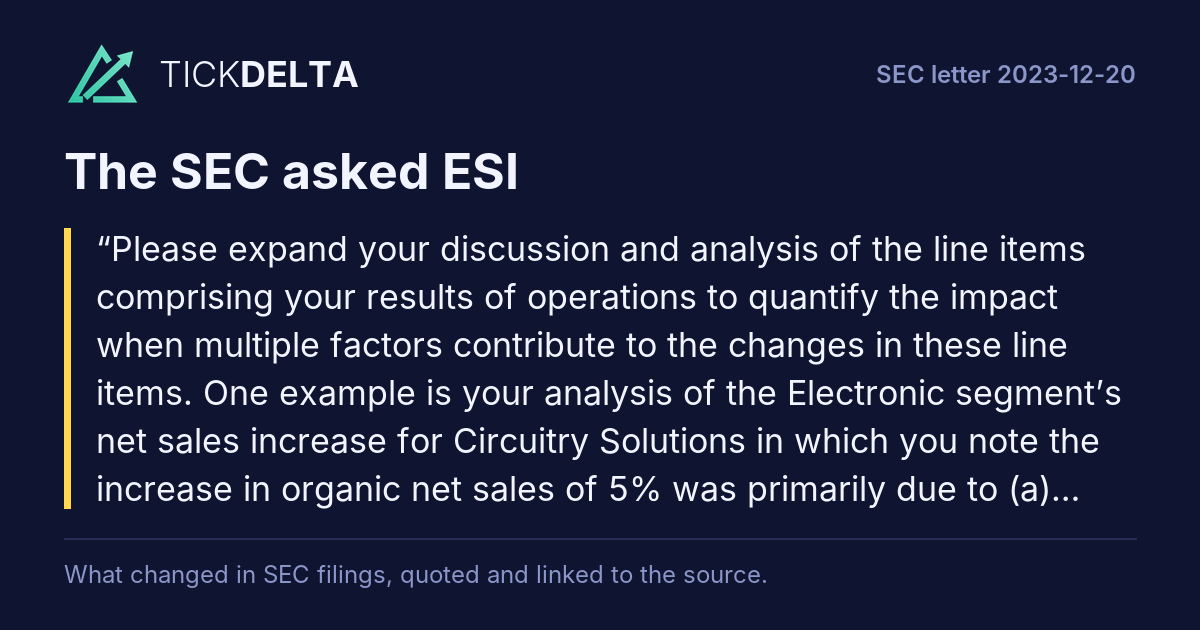
Please expand your discussion and analysis of the line items comprising your results of operations to quantify the impact when multiple factors contribute to the changes in these line items. One example is your analysis of the Electronic segment’s net sales increase for Circuitry Solutions in which you note the increase in organic net sales of 5% was primarily due to (a) growth in the memory disk business in theRest of the question
first half of 2022, (b) new customer wins, and (c) pricing actions, without quantifying these three factors. Further, the analysis of net sales should include the extent to which changes are attributable to changes in prices, to changes in the volume or amount of goods or services being sold, and/or to the introduction of new products. Refer to Item 303(b)(2) of Regulation S-K and Section 501.12 of the Financial Reporting Codification for guidance.
We acknowledge the Staff’s comment and confirm that in future filings, the Company will disclose and quantify factors that we believe materially impacted the Company's results of operations for the relevant period and that are reasonably quantifiable period over period, including the extent to which these changes are attributable to changes in prices, volume or amount of goods or services being sold, and/or to the introduction of new products.Read in the reply
The Company strives to comply with Item 303(b)(2) of Regulation S-K and Section 501.12 of the Financial Reporting Codification.Rest of the answer
However, the Company would like to respectfully clarify that, in certain instances, multiple factors may impact the changes to a line item, some of which might not be reasonably quantifiable. In these instances, the Company cites qualitative information that is based on management’s best judgement and assessment of significant components of the particular line item even though such factors do not lend themselves to separate quantification. For example, our revenue may be impacted by multiple pricing actions taken throughout the year. In that respect, the Company respectfully advises the Staff that due to our diverse customer base and large breadth of products, which are sold directly to end-user customers or through intermediaries and in multiple countries and key industries, our products vary in terms of pricing. Due to these variables, the impact of actual changes in prices on net sales from period to period may not be reasonably quantifiable.
First report after the company's reply of Jan 19, 2024: 10-K filed Feb 21, 2024 ↗, against the 10-K filed Feb 22, 2023 ↗.
Tickdelta does not hold the text of both reports, so they are not compared here.
Please provide a comprehensive discussion of the material factors impacting the line items impact your operating results. One example is income tax expense that refers to the footnote disclosure rather than providing an analysis.Rest of the question
As a global company generating approximately 75% of net sales outside of the United States for the periods presented with foreign earnings before income taxes having a varied percentage of total income before income taxes and non-controlling interests with the earnings from your foreign operations increasing the statutory rate to arrive at the effective tax rate, it would appear a detailed analysis of your effective tax rate for each period presented along with an analysis of your foreign earnings as compared to your US earnings would be useful for investors to better understand the material drivers impacting taxes. Refer to Item 303(b)(2) of Regulation S- K and Section 501.12 of the Financial Reporting Codification for guidance. Exhibit 99.1
The Company acknowledges the Staff's comment and advises the Staff that, beginning with the Company's Form 10-K for the fiscal year ended on December 31, 2023, it will include a comprehensive discussion of the material factors impacting the Company's operating results and other key financial statement line items, such as income tax expense, in the MD&A section.Read in the replyRest of the answer
With respect to income tax expense, these material factors will include a detailed analysis of our effective tax rate, including a geographic mix presentation of taxable income among the United States and the rest of world as well as among key foreign regions or jurisdictions.
First report after the company's reply of Jan 19, 2024: 10-K filed Feb 21, 2024 ↗, against the 10-K filed Feb 22, 2023 ↗.
Tickdelta does not hold the text of both reports, so they are not compared here.
For each non-GAAP measure presented, please present the most directly comparable financial measure or measures calculated and presented in accordance with US GAAP in accordance with Item 10(e)(1)(i)(A) of Regulation S-K and Question 102.10(a) of the Compliance and Disclosure Interpretations for Non-GAAP Financial Measures.Rest of the question
In this regard, we note your presentation of percentage change in Adjusted EBITDA, adjusted EBITDA change on a constant currency basis, Adjusted EBITDA margin along with the basis point / percentage change, and net debt to adjusted EBITDA ratio without presenting the comparable margin, percentage or ratio calculated using the most comparable US GAAP measures. As applicable, also address this comment and any of the other non- GAAP measure comments to your Forms 10-K and 10-Q presentations.
The Company acknowledges the requirements of Item 10(e)(1)(i)(A) of Regulation S-K and the related SEC guidance in Question 102.10(a) of the Compliance and Disclosure Interpretations for Non-GAAP Financial Measures and advises the Staff that in future earnings releases, the Company will enhance its US GAAP presentation by showing net income and net income margin, the directly comparable US GAAP measures to adjusted EBITDA and adjusted EBITDA margin, and presenting basis point and/or percentage changes for both sets of US GAAP and non-US GAAP measures, if and when this information is provided.Read in the replyRest of the answer
With respect to adjusted EBITDA change on a constant currency basis, the Company respectfully advises the Staff that it proposes to comply with the reconciliation requirements in accordance with Question 104.06 of the Division of Corporation Finance's Compliance and Disclosure Interpretations on Non-GAAP financial Measures. With respect to net debt to adjusted EBITDA ratio, the Company will also enhance its disclosure by providing a “Net debt to net income” ratio in its reconciliation table of Net income attributable to common stockholders to
Adjusted EBITDA.
As requested by the Staff, to the extent applicable, conforming changes will also be made to the Company's Form 10-K and 10-Q presentations to be consistent with this enhanced disclosure.
First report after the company's reply of Jan 19, 2024: 10-K filed Feb 21, 2024 ↗, against the 10-K filed Feb 22, 2023 ↗.
Tickdelta does not hold the text of both reports, so they are not compared here.
We note the introduction into your presentation of non-GAAP measures, which refers to all of the measures as performance measures, including free cash flow. We further note the reconciliation of free cash flow is from cash flows from operating activities, a liquidity measure.Rest of the question
As such, please revise your disclosures provided in accordance with Items 10(e)(1)(i)(C) and 10(e)(1)(i)(D) of Regulation S-K to consistently characterize your presentation of free cash flow. Refer to Question 102.07 of the Compliance and Disclosure Interpretations for Non-GAAP Financial Measures for additional guidance.
The Company acknowledges the Staff’s comment and advises the Staff that it will revise the definition of free cash flow in future earnings releases furnished under Item 2.02 of Form 8-K and any other filings where similar disclosure is required to reflect that it uses free cash flow as a liquidity measure, and not as a performance measure, and will clarify any related inconsistencies, including in the Non-GAAP Measures introductory paragraph of the Company's earnings releases.Read in the reply
For illustrative purposes, below is the Company’s proposed disclosure using the above-referenced Exhibit 99.1 to theRest of the answer
Company's Form 8-K filed on February 21, 2023 (updated disclosure indicated textually as follows for ease of reference: added underlined text and stricken text):
Free Cash Flow:
Free cash flow is defined as net cash flows from operating activities less net capital expenditures. Net capital expenditures include capital expenditures less proceeds from the disposal of property, plant and equipment. Management believes that free cash flow, which measures the Company’s ability to generate cash from its business operations, is an important financial measure for evaluating the Company's financial performanceliquidity. However, fFree cash flow should be considered as an additional measure of liquidity toin addition to, rather than as a substitute for, net cash provided by operating activities as a measure of the Company’s liquidity.
Within "Non-GAAP Measures":
Management internally reviews these non-GAAP measures to evaluate performance and liquidity on a comparative period-to-period basis in terms of absolute performance, trends and expected future performance with respect to the Company’s business and believes that these non-GAAP measures provide investors with an additional perspective on trends and underlying operating results on a period-to-period comparable basis.
First report after the company's reply of Jan 19, 2024: 10-K filed Feb 21, 2024 ↗, against the 10-K filed Feb 22, 2023 ↗.
Tickdelta does not hold the text of both reports, so they are not compared here.
We note your disclosure that for fiscal year 2023 you expect free cash flow of approximately $275 million. We further note your statement that you have not provided reconciliations of this forward-looking non-GAAP measure based on the exception provided by Item 10(e)(1)(i)(B) of Regulation S-K.Rest of the question
Please tell us your consideration of disclosing the amount of expected capital expenditures for fiscal year 2023 here or within the Liquidity and Capital Resources section of MD&A with reference to the guidance in Item 303(b)(1) of Regulation S-K and Sections 501.03 and 501.13 of the Financial Reporting Codification to allow an investor to have some insight into the most comparable US GAAP amount.
The Company acknowledges the Staff's comment and advises the Staff that, beginning with the Company's Form 10-K for the fiscal year ended on December 31, 2023, we will disclose the Company's expected capital expenditures in the Liquidity and Capital Resources section of the MD&A section of the Company's future periodic reports.Read in the reply
With respect to the Company's earnings releases and supplementary slides, to the extent both expected capital expenditures and free cash flow are presented, we will add a forward-looking column in the reconciliation table of "Cash flows from operating activities" toRest of the answer
"Free cash flows" in the Non-GAAP measures section under the free cash flow definition to provide the amount of expected cash flows from operating activities and capital expenditures.
For illustrative purposes, below is the Company’s proposed disclosure using the above-referenced Exhibit 99.1 to the Company's Form 8-K filed on February 21, 2023 (updated disclosure indicated textually as follows for ease of reference: added underlined text):
The following table reconciles "Cash flows from operating activities" to "Free cash flow" for the period presented and the Company’s free cash flow outlook for the full year 2023:
Three Months Ended
Twelve Months Ended
December 31,
Outlook
(dollars in millions)
2022
2021
2023
Cash flows from operating activities
$ 100.5 $ 121.3 $ 295.9 $ 326.0
~$345
Capital expenditures
(15.0) (18.6) (47.8) (46.3)
First report after the company's reply of Jan 19, 2024: 10-K filed Feb 21, 2024 ↗, against the 10-K filed Feb 22, 2023 ↗.
Tickdelta does not hold the text of both reports, so they are not compared here.
We note that you include adjustments to income tax expense to arrive at adjusted net income attributable to common stockholders and adjusted earnings per share to arrive at an adjusted effective tax rate of 20%. Considering the US statutory rate is 21% and that 75% of your business is outside of the US that results in a net increase to your effective tax rate, it is unclear how an adjusted effective tax rate of 20%Rest of the question
for non-GAAP purposes is appropriate and reflective of the tax environment in which your business operates. Please advise with reference to Question 102.11 of the Compliance and Disclosure Interpretations for Non-GAAP Financial Measures. 2. Acquisitions
The Company acknowledges the Staff's comment and advises the Staff that the tax environment in which the Company operates is primarily driven by historical US tax losses, which the Company has carried forward and reported in its financial statements as deferred tax assets, and not the concentration of the Company's business outside of the US. The Company’s adjusted tax rate takes into account the economic benefit derived from these loss carryforwards to reflect current period adjusted tax expense.Read in the replyRest of the answer
The Company believes its adjusted tax rate, which has been historically consistent, together with the tax footnote to the Company's Consolidated Financial Statements, provide helpful valuation information to investors based on its projections of future income and a more complete understanding of the Company's business performance by providing a comparable tax rate from period to period. The Company supplementally advises the Staff that a consistent adjusted tax rate is also the methodology our senior leadership uses to evaluate the Company’s performance and make financial and business decisions.
2. Acquisitions
First report after the company's reply of Jan 19, 2024: 10-K filed Feb 21, 2024 ↗, against the 10-K filed Feb 22, 2023 ↗.
Tickdelta does not hold the text of both reports, so they are not compared here.
We note your disclosures regarding your termination of a long-standing distribution agreement related to your ViaForm electrochemical deposition products on June 1, 2023, and that you are accounting for the transaction as a reacquired right.Rest of the question
Please provide us with your analysis of the material terms of the transaction and your assessment of the relevant accounting guidance in concluding that this was an asset acquisition rather than the cancellation of a contract. 7. Financial Instruments
The Company acknowledges the Staff’s comment and respectfully advises the Staff that it considered whether this transaction should be treated as a contract cancellation (or termination) under ASC 420, Exit or Disposal Cost Obligations or ASC 606, Revenue from Contracts with Customers, or an acquisition of an intangible asset when evaluating how to account for this transaction.Read in the reply
By way of background, a legacy subsidiary of the Company entered into an agreement in 2003 which granted a distributor an exclusive right to sell and distribute the Company’s ViaForm products worldwide in exchange forRest of the answer
an upfront payment. This agreement included an initial term of 10 years after which it automatically renewed annually so long as certain minimum metrics were achieved by the distributor. The Company supplementally advises the Staff that these minimal metrics were easily attainable, which effectively resulted in an evergreen contract. The agreement could be cancelled only by the distributor, except in certain events of a material breach by the distributor, which were extremely unlikely given the distributor’s minimal obligations. Even in the event of a termination for material breach by the distributor, the distributor would have continued to maintain broad rights with respect to the underlying products and intellectual property; therefore, such a termination would not have resulted in a complete transfer of the contract rights back to the Company. Because of the economics of the agreement, the distributor did not exercise, and would likely never have had an incentive to exercise, its termination right. The distributor was in compliance with its obligations under the agreement at the time we re-acquired the distribution right relating to our ViaForm products. Additionally, there were no contractual termination payments provided in the agreement.
In order to re-acquire the right to market and distribute the ViaForm products, we entered into an agreement to end the long-standing distribution arrangement in June 2023 for $200 million, of which $170 million was paid at closing and a deferred payment of $30 million was subsequently paid in the fourth quarter of 2023 upon the achievement of certain conditions associated with the transition of customers to the Company.
Both parties valued the agreement as essentially the purchase of a future income stream to the distributor from the distribution agreement. Therefore, the purchase price for the transaction was primarily based on an adjusted EBITDA multiple of approximately 13x (as the run rate of adjusted EBITDA on the closing date was approximately $15 million per year). This is consistent with the manner in which parties typically value acquisitions and consistent with typical market multiples for acquisitions. The Company assessed and concluded that there was no gain or loss to be recognized upon the acquisition of the reacquired right as it was deemed to be at market terms. We then considered whether the transaction met the accounting definition of a business and concluded it did not. As such, we determined that the treatment as an asset acquisition was appropriate. We then considered the guidance in ASC 805-20-25-14 (which indicates that a reacquired right is an identifiable intangible asset), as well as the guidance in ASC 350-30-25-1 and ASC 350-30-30-1 (which indicates that intangible assets acquired individually or with a group of other assets should be recognized).
In light of the Staff's comment, the Company intends to update the disclosure in the Company's Form 10-K for the fiscal year ended on December 31, 2023 to the following (updated disclosure indicated textually as follows for ease of reference: added underlined text and stricken text):
"On June 1, 2023, the Company re-acquired the right to market and distribute directly (rather than through its exclusive distributor) terminated a long-standing distribution agreement related to its ViaForm® electrochemical deposition products by terminating a long-standing distribution agreement for $200 million...."
7. Financial Instruments
First report after the company's reply of Jan 19, 2024: 10-K filed Feb 21, 2024 ↗, against the 10-K filed Feb 22, 2023 ↗.
Tickdelta does not hold the text of both reports, so they are not compared here.
Please expand your disclosures here or in Note 5 to provide the quantified information about the significant unobservable inputs used in the fair value measurement of the Graphic Solutions reporting unit in accordance with ASC 820-10-50-2.bbb.2.Rest of the question
We remind you that the company and its management are responsible for the accuracy and adequacy of their disclosures, notwithstanding any review, comments, action or absence of action by the staff.
The Company acknowledges the Staff’s comment and respectfully advises the Staff that by omitting quantified information, we attempted to comply with the guidance in ASC 350-20-50-3 which we believed was applicable and which provides that ASC 820-10-50-2.bbb.2 does not apply to goodwill after its initial recognition in a business combination.Read in the replyRest of the answer
However, in light of the Staff's comment, starting with the Company’s Form 10-K for the fiscal year ended on December 31, 2023, we will expand our disclosures in the Financial Instruments footnote (corresponding to Note 7, Financing Instruments, in the Company's Forms 10-Q), to the Company's Consolidated Financial Statements, to provide the following quantified information about the significant unobservable inputs used in the fair value measurement of our Graphics Solutions reporting unit in accordance with ASC 820-10-50-2.bbb.2 (updated disclosure indicated textually as follows for ease of reference: added underlined text):
Non-Recurring Fair Value Measurement
As a result of the goodwill impairment test conducted in the third quarter 2023, the Industrial & Specialty segment recorded an impairment charge of $80.0 million to reduce the carrying value of the Graphics Solutions reporting unit to its estimated fair value. This measurement was performed on a non-recurring basis as of August 31, 2023 using significant unobservable inputs (Level 3), including the applicable discount rate (WACC) of 10.5% and the short and long-term projected cash flows, such as future growth rates, of the Graphics Solutions reporting unit. See Note XX, Goodwill and Intangible Assets, to the unaudited Condensed Consolidated Financial Statements for further information.
* * *
We hereby acknowledge that the Company and its management are responsible for the accuracy and adequacy of their disclosures, notwithstanding any review, comments, action or absence of action by the Staff.
If you or any other members of the Staff have any questions with respect to the foregoing, please contact me at (561) 571-5011 or John E. Capps, Executive Vice President, General Counsel and Company Secretary, at (561) 207-9604.
First report after the company's reply of Jan 19, 2024: 10-K filed Feb 21, 2024 ↗, against the 10-K filed Feb 22, 2023 ↗.
Tickdelta does not hold the text of both reports, so they are not compared here.
We note your response to comment 6. Please provide us with a more comprehensive explanation as to how you concluded that a tax rate of 20% is reflective of your global business from a non-GAAP perspective. In this regard, we note your statement, “…the tax environment in which the Company operates is primarily driven by historical US tax losses, which the Company has carried forward and reported in its financialRest of the question
statements as deferred tax assets, and not the concentration of the Company's business outside of the US.” This statement is focusing on your US GAAP results and tax position in which there was a history of losses generating the deferred tax assets. However, the tax rate used to calculate your non-GAAP adjusted net income should focus on your non-GAAP results. To the extent from a non-GAAP perspective, you have consistently and cumulatively reported adjusted net income, this would suggest that from a non-GAAP perspective, loss carryforwards may not be available and therefore, should not be considered in determining your non-GAAP income tax adjustment. It further suggests that on a non-GAAP basis, you may have recorded significant taxes. As such, an adjustment for income tax expense should be commensurate with your non-GAAP measure of profitability. Finally, your disclosures regarding your income tax expense should clearly explain to investor how you estimated the total amount of income tax expense on a non-GAAP basis. Refer to Question 102.11 of the Compliance and Disclosure Interpretations for Non-GAAP Financial Measures.
The Company acknowledges the Staff's comment. Upon further consideration of the guidance in Question 102.11 of the Compliance and Disclosure Interpretations for Non-GAAP Financial Measures, we respectfully advise the Staff that, starting with our earnings release furnished under Item 2.02 of Form 8-K for the year ended December 31, 2023, we will provide additional disclosure with a more comprehensive explanation of our adjusted non-GAAP effective tax rate and a newly-calculated adjusted tax rate that comports with the Staff's comment, primarily by excluding the impact of our U.S.Read in the replyRest of the answer
tax attribute carryforwards.
* * *
We hereby acknowledge that the Company and its management are responsible for the accuracy and adequacy of their disclosures, notwithstanding any review, comments, action or absence of action by the Staff.
If you or any other members of the Staff have any questions with respect to the foregoing, please contact me at (561) 571-5011 or John E. Capps, Executive Vice President, General Counsel and Company Secretary, at (561) 207-9604.
First report after the company's reply of Feb 12, 2024: 10-K filed Feb 21, 2024 ↗, against the 10-K filed Feb 22, 2023 ↗.
Tickdelta does not hold the text of both reports, so they are not compared here.
Also in this review: closing letter, 2024-02-15