Paragraph 146 · 44% changed
Every version of it
Screener
/
SEC EDGAR
/CIK 0001448893
/10-K filed Feb 18, 2026, compared with Feb 19, 2025
/Numbers from the XBRL of the 10-Ks
NYSE
Financials · Surety Insurance
Essent Group Ltd. ESNT
The 10-K against last year's
123 changes: 22 added, 11 removed, 89 reworded, 1 quiet changes
10-K Feb 18, 2026 vs Feb 19, 2025
Risk Factors
7.7%
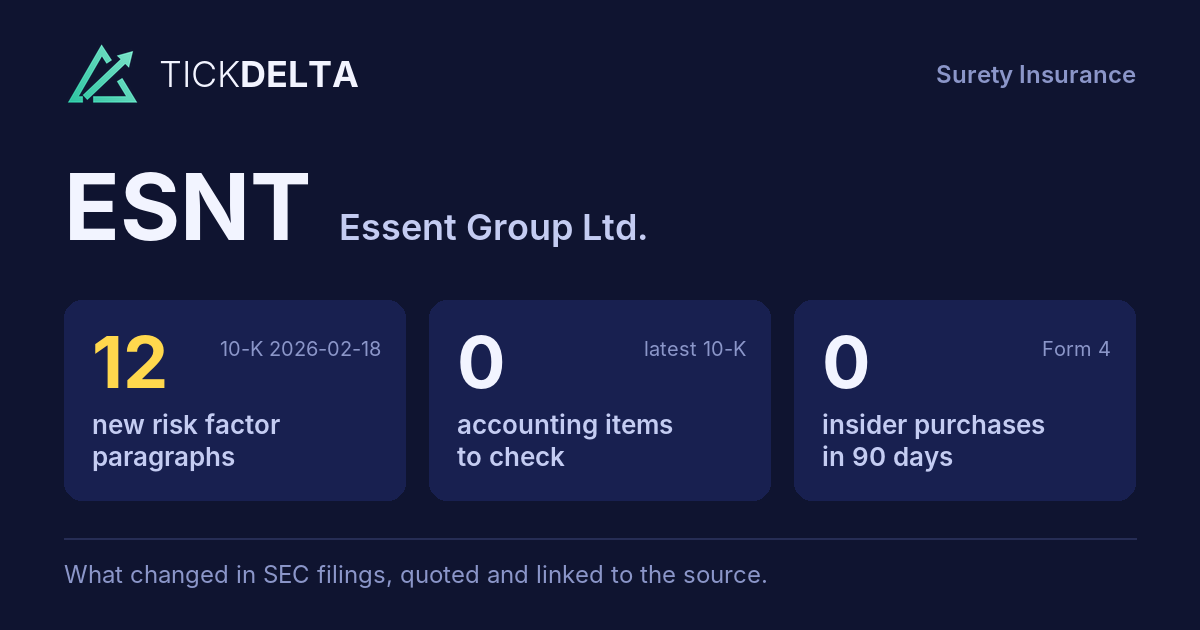
of the text changed · 17,586 words now · 12 new paragraphs, 1 gone
MD&A
20.8%
of the text changed · 13,475 words now · 10 new paragraphs, 10 gone
Legal Proceedings
13.0%
of the text changed · 944 words now
Accounting Policies
13.9%
of the text changed · 3,494 words now
10-K 0001448893-26-000009 (Feb 18, 2026) vs 10-K 0001448893-25-000009 (Feb 19, 2025)
Every paragraph, and how much of it changed
One bar per paragraph, in the order of the 10-K. Height and colour show the share of its words not in the closest paragraph a year earlier; the tallest bars are new paragraphs.
Risk Factors
216 paragraphs · 12 new · 27 reworded · 1 gone · 10-K Feb 18, 2026 against Feb 19, 2025
New paragraph
Reworded (5% of its words or more)
Same or nearly
Paragraph 175 · 40% changed
Every version of it
Paragraph 214 · 39% changed
Every version of it
Paragraph 86 · 26% changed
Every version of it
The volume of title insurance and settlement services that we offer are significantly driven by the level of overall activity in the mortgage, real estate and mortgage finance markets generally. If real estate transaction volumes decline, as they have in the past several years in large part due to elevated interest and mortgage rates, we could experience less demand for our title insurance and settlement services. Additionally, by their nature, title claims are often complex, vary greatly in dollar amounts and are affected by economic and market conditions and the legal environment existing at the time of settlement of the claims. Estimating future title loss payments is difficult because of the complex nature of title claims, the long periods of time over which claims are administered and paid, significantly varying dollar amounts of individual claims and other factors. From time to time, we could experience large losses or an overall worsening of our loss payment experience in regard to the frequency or severity of claims that require us to record additional charges to our claims loss reserve. These loss events are unpredictable and may require us to increase our loss reserves and could adversely affect our financial performance.
Paragraph 185 · 26% changed
Every version of it
Paragraph 26 · 24% changed
Every version of it
Further, at the direction of the FHFA, the GSEs may continue to consider new, and to pursue existing, credit risk sharing programs. These programs have included the use of structured finance vehicles and off-shore reinsurance. The growth of these programs and the perception that some of these risk-sharing structures have beneficial features in comparison to private mortgage insurance (e.g. lower costs, reduced counterparty risk due to collateral on hand or more diversified insurance exposures) may create increased competition for mortgage insurance going forward on loans traditionally sold to the GSEs with private mortgage insurance. As part of their expanded risk sharing programs, the GSEs have also piloted programs to directly place mortgage insurance rather than have lenders place the mortgage insurance with private mortgage insurers. No assurances can be given that these practices may not be expanded to cover more loans traditionally insured by lenders with private mortgage insurance prior to sale to the GSEs, which could impact our business.
Paragraph 184 · 24% changed
Every version of it
Interested Directors: Bermuda law provides that if a director has an interest in a material contract or proposed material contract with us or any of our subsidiaries or has a material interest in any person that is a party to such a contract, the director must disclose the nature of that interest at the first opportunity either at a meeting of directors or in writing to the board. Under Delaware law such transaction would not be voidable if:
Paragraph 198 · 22% changed
Every version of it
We may require incremental capital to support our growth and comply with regulatory requirements. To the extent that we require capital in the future, we may need to obtain financing from the capital markets or other third-party sources of financing. We may also seek to reinsure part of our risk in force with third-party reinsurers in order to obtain reinsurance credit and capital relief under insurance laws applicable to us and the regulations of the GSEs. Potential investors, lenders or reinsurers may be unable to provide us with financing or reinsurance that is attractive to us. Our access to such financing will depend, in part, on:
Paragraph 146 · 44% changed
Every version of it
10-K Feb 19, 2025If the RPII (determined on a gross basis) of Essent Re were to equal or exceed 20% of Essent Re's gross insurance income in any taxable year and direct or indirect policyholders (and persons related to those policyholders) own directly or indirectly through entities 20% or more of the voting power or value of the Company, then a U.S. Person who owns any shares of Essent Re (directly or indirectly through non-U.S. entities) on the last day of the taxable year on which it is an RPII CFC would be required to include in its income for U.S. Federal income tax purposes such person's pro rata share of Essent Re's RPII for the entire taxable year, determined as if such RPII were distributed proportionately only to U.S. Persons at that date regardless of whether such income is distributed, in which case your investment could be materially adversely affected. In addition, any RPII that is includible in the income of a U.S. tax-exempt organization may be treated as unrelated business taxable income. The amount of RPII earned by a non-U.S. insurance subsidiary (generally, premium and related investment income from the indirect or direct insurance or reinsurance of any direct or indirect U.S. holder of shares or any person related to such holder) will depend on a number of factors, including the identity of persons directly or indirectly insured or reinsured by the company. We do not expect gross RPII of Essent Re to equal or exceed 20% of its gross insurance income in any taxable year for the foreseeable future, but we cannot be certain that this will be the case because some of the factors which determine the extent of RPII may be beyond our control. Further, recently proposed regulations were published which could, if finalized in their current form, substantially expand the definition of RPII to include insurance income of Essent Re related to affiliate reinsurance transactions. These regulations would apply to taxable years beginning after the date the regulations are finalized. Although we cannot predict whether, when or in what form the proposed regulations might be finalized, the proposed regulations, if finalized in their current form, could limit our ability to execute affiliate reinsurance transactions that would otherwise be undertaken for non-tax business reasons in the future as that could increase the risk that gross RPII could constitute 20% or more of the gross insurance income of Essent Re in a particular taxable year, which could result in such RPII being taxable to U.S. persons that own our shares.
10-K Feb 18, 2026
would apply to taxable years beginning after the date the regulations are finalized. Although we cannot predict whether, when or in what form the proposed regulations might be finalized, the proposed regulations, if finalized in their current form, could limit our ability to execute affiliate reinsurance transactions that would otherwise be undertaken for non-tax business reasons in the future as that could increase the risk that gross RPII could constitute 20% or more of the gross insurance income of Essent Re in a particular taxable year, which could result in such RPII being taxable to U.S. persons that own our shares.
Paragraph 175 · 40% changed
Every version of it
10-K Feb 19, 2025In general, and except as provided under our bye-laws and as provided below, our shareholders have one vote for each common share held by them and are entitled to vote, on a non-cumulative basis, at all meetings of shareholders. However, if, and so long as, the shares of a shareholder are treated as "controlled shares" (as determined pursuant to sections 957 and 958 of the Code) of any U.S. Person that owns shares directly or indirectly through non-U.S. entities) and such controlled shares constitute 9.5% or more of the votes conferred by our issued shares, the voting rights with respect to the controlled shares owned by such U.S. Person will be limited, in the aggregate, to a voting power of less than 9.5%, under a formula specified in our bye-laws. The formula is applied repeatedly until the voting power of all 9.5% U.S. Shareholders has been reduced to less than 9.5%. In addition, our board of directors may limit a shareholder's voting rights when it deems it appropriate to do so to (i) avoid the existence of any 9.5% U.S. Shareholder; and (ii) avoid certain material adverse legal or regulatory consequences to us, any of our subsidiaries or any direct or indirect shareholder or its affiliates. The amount of any reduction of votes that occurs by operation of the above limitations will generally be reallocated proportionately among our other shareholders whose shares were not "controlled shares" of the 9.5% U.S. Shareholder so long as such reallocation does not cause any person to become a 9.5% U.S. Shareholder.
10-K Feb 18, 2026
(i) avoid the existence of any 9.5% U.S. Shareholder; and (ii) avoid certain material adverse legal or regulatory consequences to us, any of our subsidiaries or any direct or indirect shareholder or its affiliates. The amount of any reduction of votes that occurs by operation of the above limitations will generally be reallocated proportionately among our other shareholders whose shares were not "controlled shares" of the 9.5% U.S. Shareholder so long as such reallocation does not cause any person to become a 9.5% U.S. Shareholder.
Paragraph 214 · 39% changed
Every version of it
10-K Feb 19, 2025The trading market for our common shares depends in part on the research and reports that securities or industry analysts publish about us or our business. If one or more of these analysts downgrades our shares or publishes misleading or unfavorable research about our business, our share price would likely decline. If one or more of these analysts ceases coverage of our Company or fails to publish reports on us regularly, demand for our shares could decrease, which could cause our share price or trading volume to decline.
10-K Feb 18, 2026
Company or fails to publish reports on us regularly, demand for our shares could decrease, which could cause our share price or trading volume to decline.
Paragraph 86 · 26% changed
Every version of it
10-K Feb 19, 2025
insurance and settlement services. Additionally, by their nature, title claims are often complex, vary greatly in dollar amounts and are affected by economic and market conditions and the legal environment existing at the time of settlement of the claims. Estimating future title loss payments is difficult because of the complex nature of title claims, the long periods of time over which claims are administered and paid, significantly varying dollar amounts of individual claims and other factors. From time to time, we could experience large losses or an overall worsening of our loss payment experience in regard to the frequency or severity of claims that require us to record additional charges to our claims loss reserve. These loss events are unpredictable and may require us to increase our loss reserves and could adversely affect our financial performance.
10-K Feb 18, 2026
The volume of title insurance and settlement services that we offer are significantly driven by the level of overall activity in the mortgage, real estate and mortgage finance markets generally. If real estate transaction volumes decline, as they have in the past several years in large part due to elevated interest and mortgage rates, we could experience less demand for our title insurance and settlement services. Additionally, by their nature, title claims are often complex, vary greatly in dollar amounts and are affected by economic and market conditions and the legal environment existing at the time of settlement of the claims. Estimating future title loss payments is difficult because of the complex nature of title claims, the long periods of time over which claims are administered and paid, significantly varying dollar amounts of individual claims and other factors. From time to time, we could experience large losses or an overall worsening of our loss payment experience in regard to the frequency or
Paragraph 185 · 26% changed
Every version of it
10-K Feb 19, 2025Interested Directors: Bermuda law provides that if a director has an interest in a material contract or proposed material contract with us or any of our subsidiaries or has a material interest in any person that is a party to such a contract, the director must disclose the nature of that interest at the first opportunity either at a meeting of directors or in writing to the board. Under Delaware law such transaction would not be voidable if:
10-K Feb 18, 2026
must disclose the nature of that interest at the first opportunity either at a meeting of directors or in writing to the board. Under Delaware law such transaction would not be voidable if:
Paragraph 26 · 24% changed
Every version of it
10-K Feb 19, 2025
exposures) may create increased competition for mortgage insurance going forward on loans traditionally sold to the GSEs with private mortgage insurance. As part of their expanded risk sharing programs, the GSEs have also piloted programs to directly place mortgage insurance rather than have lenders place the mortgage insurance with private mortgage insurers. No assurances can be given that these practices may not be expanded to cover more loans traditionally insured by lenders with private mortgage insurance prior to sale to the GSEs, which could impact our business.
10-K Feb 18, 2026
Further, at the direction of the FHFA, the GSEs may continue to consider new, and to pursue existing, credit risk sharing programs. These programs have included the use of structured finance vehicles and off-shore reinsurance. The growth of these programs and the perception that some of these risk-sharing structures have beneficial features in comparison to private mortgage insurance (e.g. lower costs, reduced counterparty risk due to collateral on hand or more diversified insurance exposures) may create increased competition for mortgage insurance going forward on loans traditionally sold to the GSEs with private mortgage insurance. As part of their expanded risk sharing programs, the GSEs have also piloted programs to directly place mortgage insurance rather than have lenders place the mortgage insurance with private mortgage insurers. No assurances can be given that these practices may not be expanded to cover more loans traditionally insured by lenders with private mortgage insurance prior to sale to the GSEs, which could impact our business.
Paragraph 184 · 24% changed
Every version of it
10-K Feb 19, 2025
Interested Directors: Bermuda law provides that if a director has an interest in a material contract or proposed material contract with us or any of our subsidiaries or has a material interest in any person that is a party to such a contract, the director must disclose the nature of that interest at the first opportunity either at a meeting of directors or in writing to the board. Under Delaware law such transaction would not be voidable if:
10-K Feb 18, 2026
Interested Directors: Bermuda law provides that if a director has an interest in a material contract or proposed material contract with us or any of our subsidiaries or has a material interest in any person that is a party to such a contract, the director
Paragraph 198 · 22% changed
Every version of it
10-K Feb 19, 2025
We may require incremental capital to support our growth and comply with regulatory requirements. To the extent that we require capital in the future, we may need to obtain financing from the capital markets or other third-party sources of financing. We may also seek to reinsure part of our risk in force with third-party reinsurers in order to obtain reinsurance credit and capital
10-K Feb 18, 2026
We may require incremental capital to support our growth and comply with regulatory requirements. To the extent that we require capital in the future, we may need to obtain financing from the capital markets or other third-party sources of financing. We may also seek to reinsure part of our risk in force with third-party reinsurers in order to obtain reinsurance credit and capital relief under insurance laws applicable to us and the regulations of the GSEs. Potential investors, lenders or reinsurers may be unable to provide us with financing or reinsurance that is attractive to us. Our access to such financing will depend, in part, on:
MD&A
182 paragraphs · 10 new · 81 reworded · 10 gone · 10-K Feb 18, 2026 against Feb 19, 2025
New paragraph
Reworded (5% of its words or more)
Same or nearly
Paragraph 72 · 50% changed
Paragraph 113 · 50% changed
The provision for losses reported in Corporate & Other relates Reinsurance for 2025 primarily related to loss provisions recorded for non-payment reinsurance written by our title insurance operations subsequent Essent Re during 2025. The provision (benefit) in 2024 and 2023 were due to our acquisition effective July 1, 2023. Upon acquisition, we recorded $14.1 million of title insurance reserves through purchase accounting. The increase changes in the provision for losses level of loans in 2024 was primarily due to an increase default in title insurance policies issued and related title premium for the full year 2024 as compared to the six months subsequent to the acquisition of the title insurance operations as well as recent industry experience and trends. Title insurance GSE-sponsored risk share transactions. Reinsurance reserves as of December 31, 2025 and 2024 and 2023 were $18.7 $0.4 million and $14.7 $0.1 million, respectively.
Paragraph 155 · 47% changed
Essent Re has entered into GSE and other risk share transactions, including insurance and reinsurance transactions with Freddie Mac and Fannie Mae. Under a Essent Guaranty also reinsures new insurance written ("NIW") to Essent Re. The following table summarizes the quota share reinsurance agreement, coverage that Essent Re reinsures 25% of Essent Guaranty’s NIW under through December 31, 2020 and 35% of Essent Guaranty's NIW after December 31, 2020. During the year ended December 31, 2024 Essent Re paid dividends totaling $300 million has provided to Essent Group. During Guaranty for the year ended December 31, 2023, Essent Re paid $60 million in dividends to Essent Group. As of December 31, 2024, Essent Re had total stockholders’ equity of $1.8 billion and net risk in force of $23.3 billion. respective NIW periods:
Paragraph 15 · 47% changed
Paragraph 82 · 45% changed
Paragraph 62 · 44% changed
Paragraph 91 · 44% changed
The following table presents a rollforward the components of insured loans the change in default for unearned premiums within our U.S. mortgage insurance portfolio Mortgage Insurance segment for the periods indicated: following years:
Paragraph 58 · 42% changed
Essent Group Ltd. ("Essent Group") and its wholly-owned subsidiaries, subsidiary, Essent Re and Essent Agency (Bermuda) Ltd., Re, are domiciled in Bermuda, and their income is currently not subject to a corporate income tax as of December 31, 2024. tax. See "—Legislative and Regulatory Developments—Bermuda Corporate Income Tax" above. Under Essent Re reinsures U.S. mortgage risk in the GSE credit risk transfer market and provide underwriting consulting services to third-party reinsurers. Essent Re also reinsures Essent Guaranty's NIW under a quota share reinsurance agreement, agreement. The following table summarizes the quota share reinsurance coverage that Essent Re reinsures 25% of has provided to Essent Guaranty's Guaranty for the respective NIW through December 31, 2020 and 35% of Essent Guaranty’s NIW after December 31, 2020. Essent Re also provides insurance and reinsurance to Freddie Mac and Fannie Mae. periods:
Paragraph 72 · 50% changed
10-K Feb 19, 2025The increase in net premiums earned for 2024 compared to 2023 is primarily driven by increases in net premiums earned in both our mortgage insurance and title insurance operations in 2024. For more information, see Net Premiums Written and Earned under “Results of Operations: Mortgage Insurance” and Net Premiums Earned under “Results of Operations: Corporate & Other”.
10-K Feb 18, 2026
under “Results of Operations: Mortgage Insurance”, Net Premiums Earned under “Results of Operations: Reinsurance” and Net Premiums Earned under “Results of Operations: Corporate & Other”.
Paragraph 113 · 50% changed
10-K Feb 19, 2025
The provision for losses reported in Corporate & Other relates to loss provisions recorded by our title insurance operations subsequent to our acquisition effective July 1, 2023. Upon acquisition, we recorded $14.1 million of title insurance reserves through purchase accounting. The increase in the provision for losses in 2024 was primarily due to an increase in title insurance policies issued and related title premium for the full year 2024 as compared to the six months subsequent to the acquisition of the title insurance operations as well as recent industry experience and trends. Title insurance reserves as of December 31, 2024 and 2023 were $18.7 million and $14.7 million, respectively.
10-K Feb 18, 2026
The provision for losses reported in Reinsurance for 2025 primarily related to loss provisions recorded for non-payment reinsurance written by Essent Re during 2025. The provision (benefit) in 2024 and 2023 were due to changes in the level of loans in default in the GSE-sponsored risk share transactions. Reinsurance reserves as of December 31, 2025 and 2024 were $0.4 million and $0.1 million, respectively.
Paragraph 155 · 47% changed
10-K Feb 19, 2025
Essent Re has entered into GSE and other risk share transactions, including insurance and reinsurance transactions with Freddie Mac and Fannie Mae. Under a quota share reinsurance agreement, Essent Re reinsures 25% of Essent Guaranty’s NIW under through December 31, 2020 and 35% of Essent Guaranty's NIW after December 31, 2020. During the year ended December 31, 2024 Essent Re paid dividends totaling $300 million to Essent Group. During the year ended December 31, 2023, Essent Re paid $60 million in dividends to Essent Group. As of December 31, 2024, Essent Re had total stockholders’ equity of $1.8 billion and net risk in force of $23.3 billion.
10-K Feb 18, 2026
Essent Re has entered into GSE and other risk share transactions, including insurance and reinsurance transactions with Freddie Mac and Fannie Mae. Essent Guaranty also reinsures new insurance written ("NIW") to Essent Re. The following table summarizes the quota share reinsurance coverage that Essent Re has provided to Essent Guaranty for the respective NIW periods:
Paragraph 15 · 47% changed
10-K Feb 19, 2025The CIT also includes various transitional provisions and elections that we are in the process of evaluating. In particular, we believe that, based on their current structure and operations, our Bermuda companies will be eligible to elect a five-year “limited international presence” exemption under the CIT. We intend to make this election within the timeframe required under Bermuda law, and therefore do not expect the CIT to have a material impact upon our effective tax rate until we no longer meet the exemption criteria, or January 1, 2030, the fifth anniversary of the inception date of the tax, whichever may occur sooner. The exemption criteria are subject to interpretation of existing Bermuda law, as well as any related new regulations that may be issued by the Government of Bermuda. No assurances can be made that we will continue meeting such criteria for the entire five-year period.
10-K Feb 18, 2026
Although our annual revenue meets the CIT threshold for "in-scope" (€750M), our Bermuda companies are not "in scope" because of a statutory exception for entities having “limited international presence” or "LIP". We currently meet the criteria for the LIP exception, which is available to our Bermuda companies for a period of five years, or when the LIP criteria are no longer met, whichever is sooner. The LIP exemption criteria are subject to interpretation of existing Bermuda law, as well as any related new regulations that may be issued by the Government of Bermuda. Also, future strategic business decisions could impact qualification for the LIP exception. Accordingly, no assurances can be made that we will continue meeting the LIP exception criteria during the four years remaining in our five-year exemption period.
Paragraph 82 · 45% changed
10-K Feb 19, 2025For the years ended December 31, 2024 and 2023, we incurred interest expense of $35.3 million and $30.1 million, respectively. Interest expense increased in 2024 compared to 2023 due to an increase in the average outstanding borrowings during the period and a $3.2 million loss on debt extinguishment for the write-off of unamortized debt issuance costs, partially offset by a decrease in the weighted average interest rate. On July 1, 2024, Essent Group issued $500 million of 6.25% senior notes and utilized the proceeds to repay all of the outstanding term loan borrowings under the Credit Facility. For the years ending December 31, 2024 and 2023, our borrowings carried a weighted average interest rate of 6.68% and 6.84%, respectively. For the years ended December 31, 2024 and 2023, the average amount of borrowings outstanding was $462.5 million and $425.0 million, respectively.
10-K Feb 18, 2026
December 31, 2025 and 2024, our borrowings carried a weighted average interest rate of 6.25% and 6.68%, respectively. For the years ended December 31, 2025 and 2024, the average amount of borrowings outstanding was $500 million and $462.5 million, respectively.
Paragraph 62 · 44% changed
10-K Feb 19, 2025In general, the majority of any underwriting profit (premium revenue minus losses) that a book generates occurs in the early years of the book, with the largest portion of any underwriting profit realized in the first year. Subsequent years of a book generally result in modest underwriting profit or underwriting losses. This pattern generally occurs because relatively few of the claims that a book will ultimately experience typically occur in the first few years of the book, when premium revenue is highest, while subsequent years are affected by declining premium revenues, as the number of insured loans decreases (primarily due to loan prepayments), and by increasing losses.
10-K Feb 18, 2026
highest, while subsequent years are affected by declining premium revenues, as the number of insured loans decreases (primarily due to loan prepayments), and by increasing losses.
Paragraph 91 · 44% changed
10-K Feb 19, 2025
The following table presents a rollforward of insured loans in default for our U.S. mortgage insurance portfolio for the periods indicated:
10-K Feb 18, 2026
The following table presents the components of the change in unearned premiums within our Mortgage Insurance segment for the following years:
Paragraph 58 · 42% changed
10-K Feb 19, 2025
Essent Group Ltd. ("Essent Group") and its wholly-owned subsidiaries, Essent Re and Essent Agency (Bermuda) Ltd., are domiciled in Bermuda, and their income is not subject to a corporate income tax as of December 31, 2024. See "—Legislative and Regulatory Developments—Bermuda Corporate Income Tax" above. Under a quota share reinsurance agreement, Essent Re reinsures 25% of Essent Guaranty's NIW through December 31, 2020 and 35% of Essent Guaranty’s NIW after December 31, 2020. Essent Re also provides insurance and reinsurance to Freddie Mac and Fannie Mae.
10-K Feb 18, 2026
Essent Group Ltd. ("Essent Group") and its wholly-owned subsidiary, Essent Re, are domiciled in Bermuda, and their income is currently not subject to a corporate income tax. See "—Legislative and Regulatory Developments—Bermuda Corporate Income Tax" above. Essent Re reinsures U.S. mortgage risk in the GSE credit risk transfer market and provide underwriting consulting services to third-party reinsurers. Essent Re also reinsures Essent Guaranty's NIW under a quota share reinsurance agreement. The following table summarizes the quota share reinsurance coverage that Essent Re has provided to Essent Guaranty for the respective NIW periods:
A paragraph is matched with the one last year that shares the most of its words; under half in common makes it new. The paragraphs shown are the 8 reworded the most in each section.
The paragraph that changed most in each section
The redline
Marked against last year's 10-K: cut words struck through, new words highlighted.
Risk Factors173 words changed in this paragraph; it is 65% similar to last year's version.
The base erosion anti-abuse tax or “BEAT” that could make certain levels of affiliate reinsurance between United States and non-U.S. members of our group economically unfeasible. Although we are not currently impacted by BEAT, there can be no assurance that changes to future taxable income calculations or future changes to BEAT will not have a negative impact on us. Future legislation adverse to the Company's effective tax rate may also extend beyond changes to the BEAT. In addition, the Inflation Reduction Act of 2022 (“IRA”) introduced, among other tax provisions, the Corporate Alternative Minimum Tax (“CAMT”) and a federal excise tax (“FET”) of 1% on certain stock repurchases. Companies are not subject to the CAMT if it does they do not meet a certain net income threshold on a trailing 3-year average calculation. Based on such calculations, the Company is not currently subject to the CAMT. Management will continue to monitor the applicability of CAMT. Generally, Final Treasury Regulations were issued on November 24, 2025 regarding the Excise Tax on certain stock repurchases applies to U.S.-domiciled companies. Proposed regulations issued in 2024, which may apply retroactively if finalized in their present form, provide in part that a foreign-parented MNC’s stock repurchase is FET. Those regulations confirm that we are not subject to the FET if it is funded by its U.S affiliate with a principal purpose of avoiding the FET. The Proposed Regulations provide that the determination of whether a funding by a U.S. affiliate has a principal purpose of avoiding the FET is based on all the facts and circumstances. Final regulations were also issued in 2024 which provide several procedural rules related tax as currently enacted; however, future legislative changes to the payment of the tax and related compliance obligations. The Company may stock repurchase FET could cause us to become subject to the FET on stock repurchases in 2025 and future years based on facts and circumstances regarding sources and uses of Essent Group Ltd capital under the Proposed Regulations. it.
Source: Item 1A, 10-K 0001448893-26-000009 vs Item 1A, 10-K 0001448893-25-000009
MD&A169 words changed in this paragraph; it is 53% similar to last year's version.
For the year ended December 31, 2024, 2025, the Mortgage Insurance segment recorded a provision for losses of $75.2 $145.4 million compared to a provision of $30.1 $75.2 million for the year ended December 31, 2023. 2024. The increase in the provision for losses was primarily due to an increase in new defaults reported as well as an increase in our average reserve per default, partially offset by cure activity for defaults reported in prior years. The increase in average reserve per default was due to aging of defaults remaining within the mortgage insurance portfolio as well as a reduction of hurricane-related defaults without a corresponding change in reserves for hurricane-related defaults. For the year ended December 31, 2023, we recorded a provision for losses of $30.2 million. The increase in the provision for losses in the year ended December 31, 2024 was primarily due to increases an increase in new defaults reported, resulting in an increase in the provision for losses recorded for current year defaults, partially offset by cure activity for defaults reported in prior years. The In 2024, the increase in defaults was due in part to defaulted loans in the areas impacted by Hurricanes Helene and Milton. In 2024, loans in default increased by a total of 3,620, including 2,119 defaults we identified as hurricane-related defaults. For the year ended December 31, 2022, we recorded a benefit to the provision for losses of $174.7 million primarily due to a decrease in the estimate of ultimate loss for Early COVID Defaults as well as cure activity for defaults with reserves using our normal reserve methodology.
Source: Item 7, 10-K 0001448893-26-000009 vs Item 7, 10-K 0001448893-25-000009
Legal Proceedings122 words changed in this paragraph; it is 75% similar to last year's version.
In addition to the indemnifications discussed above, in the normal course of business, we enter into agreements or other relationships with third parties pursuant to which we may be obligated under specified circumstances to indemnify the counterparties with respect to certain matters. Our contractual indemnification obligations typically arise in the context of agreements entered into by us to, among other things, purchase or sell services, finance our business and business transactions, lease real property and license intellectual property. The agreements we enter into in the normal course of business generally require us to pay certain amounts to the other party associated with claims or losses if they result from our breach of the agreement, including the inaccuracy of representations or warranties. The agreements we enter into may also contain other indemnification provisions that obligate us to pay amounts upon the occurrence of certain events, such as the negligence or willful misconduct of our employees, infringement of third-party intellectual property rights or claims that performance of the agreement constitutes a violation of law. Generally, payment by us under an indemnification provision is conditioned upon the other party making a claim, and typically we can challenge the other party's claims. Further, our indemnification obligations may be limited in time and/or amount, and in some instances, we may have recourse against third parties for certain payments made by us under an indemnification agreement or obligation. As of December 31, 2024, contingencies triggering material indemnification obligations or payments have not occurred historically and are not expected to occur. The nature of the indemnification provisions in the various types of agreements and relationships described above are believed to be low risk and pervasive, and we consider them to have a remote risk of loss or payment. We have not recorded any provisions on the consolidated balance sheets related to these indemnifications.
Source: Item 3, via Note 8 – Commitments and Contingencies, 10-K 0001448893-26-000009 vs Item 3, via Note 8 – Commitments and Contingencies, 10-K 0001448893-25-000009
Accounting Policies96 words changed in this paragraph; it is 31% similar to last year's version.
In December 2025, the FASB issued ASU 2025-11, “Interim Reporting (Topic 270) Narrow-Scope Improvements.” The amendments in this Update clarify interim disclosure requirements and the applicability of Topic 270. The objective of the update is to provide clarity about current interim requirements. The amendments in this update also include a disclosure principle that requires entities to disclose events since the end of the last annual reporting period that have a material impact on the entity. The amendments in this ASU are required to be adopted for interim periods within annual reporting periods beginning after December 15, 2027. Early adoption is permitted. The Company is currently evaluating the impact that the ASU will have on our consolidated financial statements.
Source: Item 8, Note 2 – Summary of Significant Accounting Policies, 10-K 0001448893-26-000009 vs Item 8, Note 2 – Summary of Significant Accounting Policies, 10-K 0001448893-25-000009
Sentences and paragraphs added, removed or reworded
Every change, by type
Sentences and paragraphs of ESNT's Risk Factors and MD&A, 10-K Feb 18, 2026 against 10-K Feb 19, 2025. Each links to the text at sec.gov.
Quiet changes are sentences kept from last year with one to four words changed, at least one of them a hedge, a modal or a qualifier (may, could, will, not, significant, material…). A year or date rolling forward is not counted.
The full word list
adverse, adversely, all, although, anticipate, anticipates, any, approximately, believe, believes, can, cannot, certain, could, expect, expects, generally, however, if, intend, intends, largely, likely, many, material, materially, may, might, most, must, never, no, not, possible, primarily, probable, should, significant, significantly, some, substantial, substantially, unlikely, will, would
AddedRisk Factors
losses and claims could be further increased in the future in the event of general economic weakness or decreases in housing values. An increase in the number or size of claims, compared to what we anticipate, could adversely affect our results of operations or financial conditions.
Read it in 10-K Feb 18, 2026 at sec.gov
AddedRisk Factors
Through our reinsurance arrangements with participants in the Lloyd’s insurance markets we are exposed to, and to the extent that we enter into new non-mortgage reinsurance arrangements in the future we may be further exposed to, unpredictable catastrophic events, including, but not limited to, weather-related and other natural catastrophes, as well as political unrest, geopolitical uncertainty and instability, acts of terrorism and wars, pandemics and communicable diseases, and cyber-risks. We cannot predict or eliminate our exposure to these loss events, and as a result, our operating results may be significantly affected by the frequency and severity of such events. Furthermore, the frequency and/or severity of catastrophic events may be impacted in the future by the continued effects of climate change. Climate change and resulting changes in global temperatures, weather patterns, and sea levels may both increase the frequency and severity of natural catastrophes and the resulting losses in the future and impact our risk modeling assumptions. We cannot predict the impact that changing climate conditions, if any, may have on our results of operations or our financial condition. Additionally, we cannot predict how legal, regulatory and/or social responses to concerns around global climate change and the resulting impact on various sectors of the economy may impact our business. The occurrence, or nonoccurrence, of catastrophic events, the frequency and severity of which are inherently unpredictable, may cause significant volatility in our quarterly and annual financial results and may materially adversely affect our financial condition, results of operations and cash flows.
Read it in 10-K Feb 18, 2026 at sec.gov
AddedRisk Factors
Underwriting risks and reserving for losses in our non-mortgage reinsurance business are based on actuarially determined methods and assumptions, which are subject to inherent uncertainties.
Read it in 10-K Feb 18, 2026 at sec.gov
AddedRisk Factors
The success of our non-mortgage reinsurance businesses is dependent upon our ability to assess accurately the risks associated with the businesses that we reinsure. We establish reserves for losses and loss adjustment expenses in our non-mortgage reinsurance business which represent estimates based on actuarial and statistical projections, at a given point in time, of our expectations of the ultimate future settlement and administration costs of losses incurred. We utilize actuarial models as well as available historical insurance industry loss ratio experience and loss development patterns to assist in the establishment of loss reserves. Most or all of these factors are not directly quantifiable, particularly on a prospective basis, and the effects of these and unforeseen factors could negatively impact our ability to accurately assess the risks of the reinsurance policies that we write. Changes in the assumptions used could lead to an increase in our estimate of ultimate losses in the future. In addition, there may be significant reporting lags between the occurrence of the insured event and the time it is reported to the insurer and additional lags between the time of reporting and final settlement of claims. In addition, the estimation of loss reserves is more difficult during times of adverse economic and market conditions due to unexpected changes in behavior of claimants and policyholders, including an increase in fraudulent reporting of exposures and/or losses, reduced maintenance of insured properties or increased frequency of small claims. Changes in the level of inflation also result in an increased level of
Read it in 10-K Feb 18, 2026 at sec.gov
AddedRisk Factors
uncertainty in our estimation of loss reserves. As a result, actual losses and loss adjustment expenses paid can deviate, perhaps substantially, from the reserve estimates reflected in our financial statements.
Read it in 10-K Feb 18, 2026 at sec.gov
AddedRisk Factors
If our loss reserves for our reinsurance business are determined to be inadequate, we will be required to increase loss reserves at the time of such determination with a corresponding reduction in our net income in the period when the deficiency becomes known. It is possible that claims in respect of events that have occurred could exceed our claim reserves and have a material adverse effect on our results of operations, in a particular period, or our financial condition in general. As a compounding factor, the nature of property and casualty insurance and reinsurance is such that losses and the associated expenses could significantly exceed the premiums received on the underlying policies, thereby further adversely affecting our financial condition.
Read it in 10-K Feb 18, 2026 at sec.gov
AddedRisk Factors
that may be available to us, such as our rights to rescind coverage or deny claims, which rights are limited by the terms of our master policy.
Read it in 10-K Feb 18, 2026 at sec.gov
AddedRisk Factors
severity of claims that require us to record additional charges to our claims loss reserve. These loss events are unpredictable and may require us to increase our loss reserves and could adversely affect our financial performance.
Read it in 10-K Feb 18, 2026 at sec.gov
Show the other 50
AddedRisk Factors
United States or any state thereof or of any other jurisdiction, we cannot assure you that Essent Re would be in compliance with such laws or that complying with such laws would not have a significant and negative effect on our business.
Read it in 10-K Feb 18, 2026 at sec.gov
AddedRisk Factors
new legal precedents, new regulations or new practices, or regulatory actions or investigations, which could adversely affect our financial condition and operating results.
Read it in 10-K Feb 18, 2026 at sec.gov
AddedRisk Factors
adversely affect our tax position, which could have a material adverse effect on our results of operations and financial condition.
Read it in 10-K Feb 18, 2026 at sec.gov
AddedRisk Factors
ratings assigned by the rating agencies to us. Any of these risks, if realized, could prevent us from achieving the benefits we expect from such transactions and/or result in a material adverse effect on our business.
Read it in 10-K Feb 18, 2026 at sec.gov
RemovedRisk Factors
RewordedRisk Factors
Although our portfolio consists predominantly of investment-grade fixed income securities and complies with applicable regulatory requirements, the success of our investment activity and the value of our portfolio is affected by general economic conditions, which may adversely affect the markets for credit and interest-rate-sensitive securities, including the extent and timing of investor participation in these markets and the level and volatility of interest rates.
Read it in 10-K Feb 18, 2026 at sec.gov
RewordedRisk Factors
If we were a Delaware company, we would need prior approval from our board of directors or a supermajority of our shareholders to enter into a business combination with an interested shareholder for a period of three years from the time the person became an interested shareholder, unless we opted out of the relevant Delaware statute.
Read it in 10-K Feb 18, 2026 at sec.gov
RewordedRisk Factors
Under this program, a customer could commit us to insure a material number of loans with unacceptable risk profiles before we discover the problem and terminate that customer's delegated underwriting authority or pursue other rights that may be available to us, such as our rights to rescind coverage or deny claims, which rights are limited by the terms of our master policy.
Read it in 10-K Feb 18, 2026 at sec.gov
RewordedRisk Factors
Bermuda law provides that if a director has an interest in a material contract or proposed material contract with us or any of our subsidiaries or has a material interest in any person that is a party to such a contract, the director must disclose the nature of that interest at the first opportunity either at a meeting of directors or in writing to the board.
Read it in 10-K Feb 18, 2026 at sec.gov
RewordedRisk Factors
Any future changes to these rules, and/or new interpretations by relevant jurisdictions of these occurrences could materially adversely affect our tax position, which could have a material adverse effect on our results of operations and financial condition.
Read it in 10-K Feb 18, 2026 at sec.gov
RewordedRisk Factors
From time to time, we could experience large losses or an overall worsening of our loss payment experience in regard to the frequency or severity of claims that require us to record additional charges to our claims loss reserve.
Read it in 10-K Feb 18, 2026 at sec.gov
RewordedRisk Factors
We may also seek to reinsure part of our risk in force with third-party reinsurers in order to obtain reinsurance credit and capital relief under insurance laws applicable to us and the regulations of the GSEs.
Read it in 10-K Feb 18, 2026 at sec.gov
RewordedRisk Factors
Our top ten customers generated 50.2% 59.3% of our NIW during year ended December 31, 2024, 2025, compared to 50.2% and 39.9% and 41.6% for the years ended December 31, 2023 2024 and 2022, 2023, respectively.
Read it in 10-K Feb 18, 2026 at sec.gov
RewordedRisk Factors
RewordedRisk Factors
In addition, our board of directors may limit a shareholder's voting rights when it deems it appropriate to do so to (i) avoid the existence of any 9.5% U.S.
Read it in 10-K Feb 18, 2026 at sec.gov
RewordedRisk Factors
Such events may also have unintended consequences on ratings assigned by the rating agencies to us.
Read it in 10-K Feb 18, 2026 at sec.gov
RewordedRisk Factors
As part of our overall investment strategy, we also allocate a relatively small percentage of our portfolio to limited partnership investments in real estate, consumer credit and traditional venture capital and private equity investments.
Read it in 10-K Feb 18, 2026 at sec.gov
AddedMD&A
Prior to December 31, 2025, we disclosed one reportable segment, Mortgage Insurance, which was comprised of "U.S. mortgage insurance" and "GSE and other mortgage risk share." Our mortgage insurance business and GSE and other mortgage risk share business each represented operating segments that were aggregated and disclosed as one reportable segment based on their shared economic characteristics and the similarities between the two operating segments. In the fourth quarter of 2025, Essent Re entered the Lloyd's of London market to reinsure certain property and casualty risks beginning in the first quarter of 2026. Considering the expansion of business and types of risks reinsured at Essent Re, our Chief Operating Decision Maker began to assess the performance of all third-party reinsurance as an operating segment as of December 31, 2025. To reflect this change, the GSE and other mortgage risk share operating segment is no longer aggregated with mortgage insurance and all third-party reinsurance is now disclosed as a separate reportable segment: Reinsurance. All prior period segment information has been recast to conform to the new segment presentation.
Read it in 10-K Feb 18, 2026 at sec.gov
AddedMD&A
On July 4, 2025, a budget reconciliation package known as the One Big Beautiful Bill Act of 2025 (“OBBBA”) was enacted which includes both tax and non-tax provisions. Based on our analysis of the provisions, the OBBBA did not have a material impact on our financial position or results of operations.
Read it in 10-K Feb 18, 2026 at sec.gov
AddedMD&A
Mortgage insurance premiums are paid either on a monthly installment basis ("monthly premiums"), in a single payment at origination ("single premiums"), or in some cases as an annual premium. For monthly premiums, we receive a monthly
Read it in 10-K Feb 18, 2026 at sec.gov
AddedMD&A
concentrations, etc.), as well as the profile of new business we write in the future. In addition, the default rate and the average reserve per default will be affected by future macroeconomic factors such as housing prices, interest rates and employment.
Read it in 10-K Feb 18, 2026 at sec.gov
AddedMD&A
NIW Period Ceding Percentage January 1, 2025 to Present 50% January 1, 2021 to December 31, 2024 35% Prior to January 1, 2021 25%
Read it in 10-K Feb 18, 2026 at sec.gov
AddedMD&A
Reinsurance net premiums earned primarily relate to premiums earned from Essent Re's participation in the GSE-sponsored mortgage risk share transactions. The decrease in net premiums earned in 2025 compared to 2024 is primarily due to a decline in average risk in force during the period as well as a decrease in the net average premium rate. The increase in 2024 compared to 2023 was due to an increase in the average risk in force. The following table presents the average GSE and other risk share risk in force and the average premium rates for each of the three years presented:
Read it in 10-K Feb 18, 2026 at sec.gov
AddedMD&A
The decrease in other income in 2025 compared to 2024 and in 2024 compared to 2023 was due to a decline in third party consulting service revenues.
Read it in 10-K Feb 18, 2026 at sec.gov
AddedMD&A
•Premium and other taxes within Reinsurance relate to federal excise taxes paid on certain mortgage reinsurance premiums.
Read it in 10-K Feb 18, 2026 at sec.gov
AddedMD&A
NIW Period Ceding Percentage January 1, 2025 to Present 50% January 1, 2021 to December 31, 2024 35% Prior to January 1, 2021 25%
Read it in 10-K Feb 18, 2026 at sec.gov
AddedMD&A
Fannie Mae and Freddie Mac, maintain coordinated Private Mortgage Insurer Eligibility Requirements (PMIERs). The PMIERs represent the standards by which private mortgage insurers are eligible to provide mortgage insurance on loans owned
Read it in 10-K Feb 18, 2026 at sec.gov
RemovedMD&A
RemovedMD&A
RemovedMD&A
RemovedMD&A
RemovedMD&A
RemovedMD&A
RemovedMD&A
RemovedMD&A
RemovedMD&A
RemovedMD&A
RewordedMD&A
Following are the components of other underwriting and operating expenses for the Corporate & Other category Reinsurance for the periods indicated:Year Ended December 31, 2025 2024 2023 2022 ($ in thousands) $ % $ % $ % Compensation and benefits $ 64,236 41% 4,547 45% $ 45,902 42% 4,171 47% $ 33,892 3,993 56% Premium and other taxes 1,497 52 — 56 1 (376) — — — 49 1 Ceding commission 1,410 14 896 10 431 6 Other 89,397 58 64,373 58 26,336 44 4,136 41 3,661 42 2,676 37 Total other underwriting and operating expenses $ 155,130 10,145 100% $ 109,899 8,784 100% $ 60,228 7,149 100% Average number of employees during the period 260 149 47 8 7 6
Read it in 10-K Feb 18, 2026 at sec.gov
RewordedMD&A
Provision (benefit) for losses and LAE 75,182 30,120 (174,704) 145,373 75,156 30,166 Other underwriting and operating expenses 115,744 115,182 111,505 101,889 106,960 108,033 Total losses and expenses before allocations 190,926 145,302 (63,199) 247,262 182,116 138,199 Corporate expense allocations 43,787 47,274 48,100 38,077 43,003 46,709 Total losses and expenses after allocations 234,713 192,576 (15,099) 285,339 225,119 184,908 Income before income tax expense $ 892,284 768,270 $ 860,039 804,867 $ 1,019,608 770,105 Loss ratio (1) 8.1 16.8 % 3.4 8.8 % (20.7) 3.7 % Expense ratio (2) 17.3 % 18.5 % 18.9 % 16.1 17.5 19.0 Combined ratio 25.4 32.9 % 21.9 26.3 % (1.8) 22.8 % (1) Loss ratio is calculated by dividing the provision for losses and LAE by net premiums earned.
Read it in 10-K Feb 18, 2026 at sec.gov
RewordedMD&A
Provision (benefit) for losses and LAE 75,182 30,120 (174,704) 310 26 (46) Other underwriting and operating expenses 115,744 115,182 111,505 10,145 8,784 7,149 Total losses and expenses before allocations 190,926 145,302 (63,199) 10,455 8,810 7,103 Corporate expense allocations 43,787 47,274 48,100 1,491 784 565 Total losses and expenses after allocations 234,713 192,576 (15,099) 11,946 9,594 7,668 Income before income tax expense $ 892,284 77,648 $ 860,039 87,417 $ 1,019,608 89,934 Loss ratio (1) 8.1 0.5 % 3.4 — % (20.7) (0.1) % Expense ratio (2) 17.3 % 18.5 % 18.9 % 19.2 13.9 11.6 Combined ratio 25.4 19.7 % 21.9 13.9 % (1.8) 11.5 % (1) Loss ratio is calculated by dividing the provision for losses and LAE by net premiums earned.
Read it in 10-K Feb 18, 2026 at sec.gov
RewordedMD&A
Net premiums earned $ 924,676 60,609 $ 878,937 68,883 $ 842,527 66,436 Net investment income 183,341 159,868 112,285 20,271 18,872 17,682 Realized investment gains (losses), gains, net (2,343) (6,392) (1,829) Income (loss) from other invested assets 7,171 (490) 33,142 6 — — Other income 14,152 20,692 18,384 8,708 9,256 13,484 Total revenues 1,126,997 1,052,615 1,004,509 89,594 97,011 97,602 Losses and expenses:
Read it in 10-K Feb 18, 2026 at sec.gov
RewordedMD&A
The increase decrease in our operating results in 2025 over 2024 over 2023 was primarily due to an increase in the provision for losses and LAE, partially offset by an increase in net premiums earned and investment income, partially offset by an increase income and a decrease in the provision for losses operating expenses and LAE. corporate allocations.
Read it in 10-K Feb 18, 2026 at sec.gov
RewordedMD&A
Interest expense increased decreased in 2024 2025 compared to 2023 2024 primarily due to an increase in the average outstanding borrowings during the period and a $3.2 million loss on debt extinguishment for the write-off of unamortized debt issuance costs, partially offset by a decrease in the weighted average interest rate. costs during 2024.
Read it in 10-K Feb 18, 2026 at sec.gov
RewordedMD&A
December 31, December 31, (2) The following table summarizes corporate debt securities as of : 2025 2024 2023 Financial 41.8 40.9 % 42.0% 41.8% Consumer, Non-Cyclical 18.1 15.1 15.9 Industrial 9.0 8.2 8.1 Communications 5.7 7.2 Utilities 7.9 8.7 Technology 6.1 6.4 Consumer, Cyclical 6.0 6.3 7.1 Utilities 8.7 6.3 Technology 6.4 6.2 Communications 4.7 5.7 Energy 4.7 5.1 4.7 Basic Materials 2.6 2.7 2.5 Total 100.0 % 100.0%
Read it in 10-K Feb 18, 2026 at sec.gov
RewordedMD&A
The increase decrease in underwriting and operating expenses for 2024 2025 compared to 2023 2024 was primarily due to an increase decrease in compensation expense, including stock compensation, primarily due to increased headcounts, decreased headcount, as well as an increase a decrease in other general operating expenses, both resulting from 12 months of title insurance operations in 2024. expenses.
Read it in 10-K Feb 18, 2026 at sec.gov
RewordedMD&A
Cash flow provided by operating activities totaled $856.1 million for the year ended December 31, 2025, as compared to $861.5 million for the year ended December 31, 2024, as compared to 2024 and $763.0 million for the year ended December 31, 2023 and $588.8 million for the year ended December 31, 2022. 2023.
Read it in 10-K Feb 18, 2026 at sec.gov
RewordedMD&A
Net premiums earned $ 924,676 866,743 $ 878,937 855,793 $ 842,527 812,501 Net investment income 183,341 159,868 112,285 174,358 164,469 142,186 Realized investment gains (losses), net (870) (2,343) (6,392) (1,829) Income (loss) from other invested assets 8,267 7,171 (490) 33,142 Other income 14,152 20,692 18,384 5,111 4,896 7,208 Total revenues 1,126,997 1,052,615 1,004,509 1,053,609 1,029,986 955,013 Losses and expenses:
Read it in 10-K Feb 18, 2026 at sec.gov
RewordedMD&A
As of December 31, 2025 2024 2023 Case reserves (in thousands) (1) $ 285,944 $226,121 396,817 $285,944 Total reserves (in thousands) (1) $ 310,156 $245,402 429,610 $310,156 Ending default inventory 20,210 18,439 14,819 Average case reserve per default (in thousands) $ 15.5 $15.3 19.6 $15.5 Average total reserve per default (in thousands) $ 16.8 $16.6 21.3 $16.8 Default rate 2.27 2.50 % 1.80% 2.27% Claims received included in ending default inventory 313 164 126
Read it in 10-K Feb 18, 2026 at sec.gov
RewordedMD&A
This pattern generally occurs because relatively few of the claims that a book will ultimately experience typically occur in the first few years of the book, when premium revenue is highest, while subsequent years are affected by declining premium revenues, as the number of insured loans decreases (primarily due to loan prepayments), and by increasing losses.
Read it in 10-K Feb 18, 2026 at sec.gov
Quiet changesMD&A
Starting January 1, 2025, the CIT will result in imposes a new 15% corporate income tax on in-scope entities that are resident in Bermuda or that have a Bermuda permanent establishment, without regard to any assurances that had previously been given pursuant to the Exempted Undertakings Tax Protection Act 1966.
Read it in 10-K Feb 18, 2026 at sec.gov
Sources
The two latest 10-Ks on EDGAR, section by section. Each change links to the text at sec.gov.
Also
New risk factors: paragraphs with nothing like them last year, quoted in full.
Work with it
Excel workbook · CSV. Google Sheet that stays up to date: paste =IMPORTDATA("https://tickdelta.com/company/ESNT/export.csv") into a cell.