Paragraphs with nothing like them in last year's 10-K
Quoted exactly
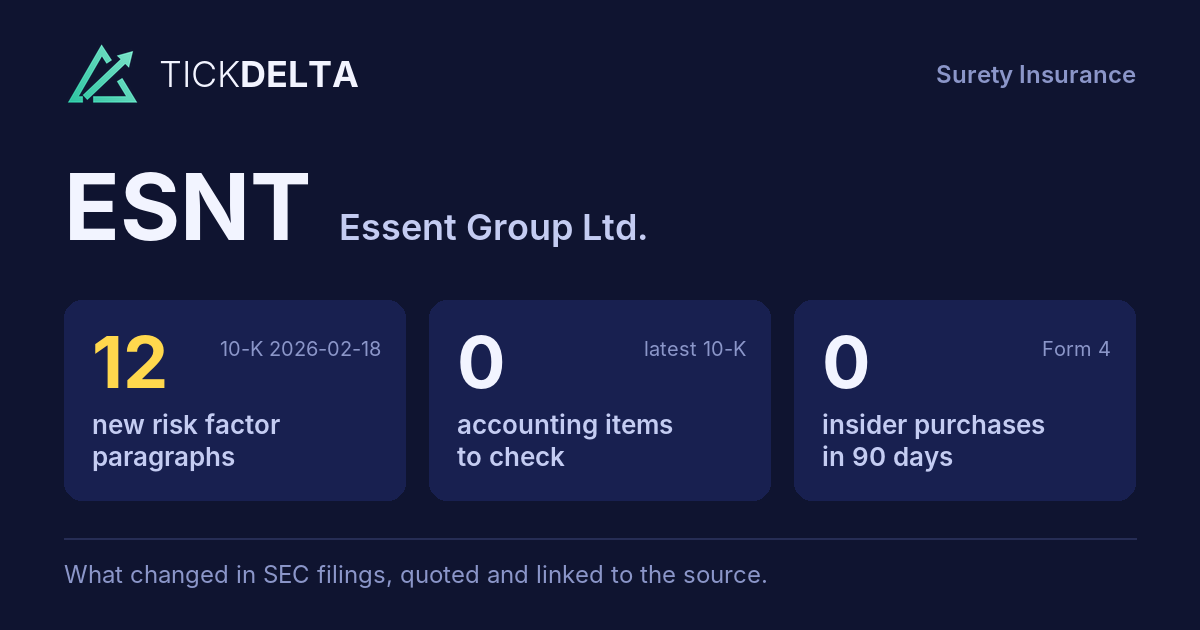
12 paragraphs in Risk Factors of the 10-K filed Feb 18, 2026
with nothing like them in the 10-K filed Feb 19, 2025. Quoted exactly.
Paragraphs that were only edited are under 10-K change.
losses and claims could be further increased in the future in the event of general economic weakness or decreases in housing values. An increase in the number or size of claims, compared to what we anticipate, could adversely affect our results of operations or financial conditions.
Through our reinsurance arrangements with participants in the Lloyd’s insurance markets we are exposed to, and to the extent that we enter into new non-mortgage reinsurance arrangements in the future we may be further exposed to, unpredictable catastrophic events, including, but not limited to, weather-related and other natural catastrophes, as well as political unrest, geopolitical uncertainty and instability, acts of terrorism and wars, pandemics and communicable diseases, and cyber-risks. We cannot predict or eliminate our exposure to these loss events, and as a result, our operating results may be significantly affected by the frequency and severity of such events. Furthermore, the frequency and/or severity of catastrophic events may be impacted in the future by the continued effects of climate change. Climate change and resulting changes in global temperatures, weather patterns, and sea levels may both increase the frequency and severity of natural catastrophes and the resulting losses in the future and impact our risk modeling assumptions. We cannot predict the impact that changing climate conditions, if any, may have on our results of operations or our financial condition. Additionally, we cannot predict how legal, regulatory and/or social responses to concerns around global climate change and the resulting impact on various sectors of the economy may impact our business. The occurrence, or nonoccurrence, of catastrophic events, the frequency and severity of which are inherently unpredictable, may cause significant volatility in our quarterly and annual financial results and may materially adversely affect our financial condition, results of operations and cash flows.
Underwriting risks and reserving for losses in our non-mortgage reinsurance business are based on actuarially determined methods and assumptions, which are subject to inherent uncertainties.
The success of our non-mortgage reinsurance businesses is dependent upon our ability to assess accurately the risks associated with the businesses that we reinsure. We establish reserves for losses and loss adjustment expenses in our non-mortgage reinsurance business which represent estimates based on actuarial and statistical projections, at a given point in time, of our expectations of the ultimate future settlement and administration costs of losses incurred. We utilize actuarial models as well as available historical insurance industry loss ratio experience and loss development patterns to assist in the establishment of loss reserves. Most or all of these factors are not directly quantifiable, particularly on a prospective basis, and the effects of these and unforeseen factors could negatively impact our ability to accurately assess the risks of the reinsurance policies that we write. Changes in the assumptions used could lead to an increase in our estimate of ultimate losses in the future. In addition, there may be significant reporting lags between the occurrence of the insured event and the time it is reported to the insurer and additional lags between the time of reporting and final settlement of claims. In addition, the estimation of loss reserves is more difficult during times of adverse economic and market conditions due to unexpected changes in behavior of claimants and policyholders, including an increase in fraudulent reporting of exposures and/or losses, reduced maintenance of insured properties or increased frequency of small claims. Changes in the level of inflation also result in an increased level of
uncertainty in our estimation of loss reserves. As a result, actual losses and loss adjustment expenses paid can deviate, perhaps substantially, from the reserve estimates reflected in our financial statements.
If our loss reserves for our reinsurance business are determined to be inadequate, we will be required to increase loss reserves at the time of such determination with a corresponding reduction in our net income in the period when the deficiency becomes known. It is possible that claims in respect of events that have occurred could exceed our claim reserves and have a material adverse effect on our results of operations, in a particular period, or our financial condition in general. As a compounding factor, the nature of property and casualty insurance and reinsurance is such that losses and the associated expenses could significantly exceed the premiums received on the underlying policies, thereby further adversely affecting our financial condition.
that may be available to us, such as our rights to rescind coverage or deny claims, which rights are limited by the terms of our master policy.
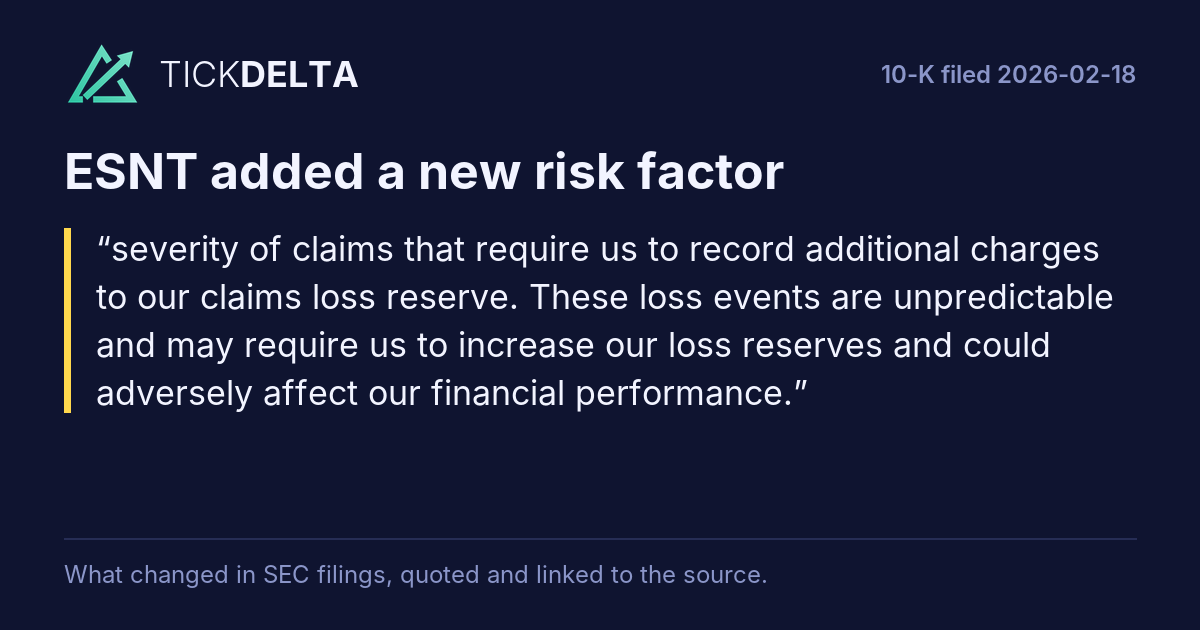
severity of claims that require us to record additional charges to our claims loss reserve. These loss events are unpredictable and may require us to increase our loss reserves and could adversely affect our financial performance.
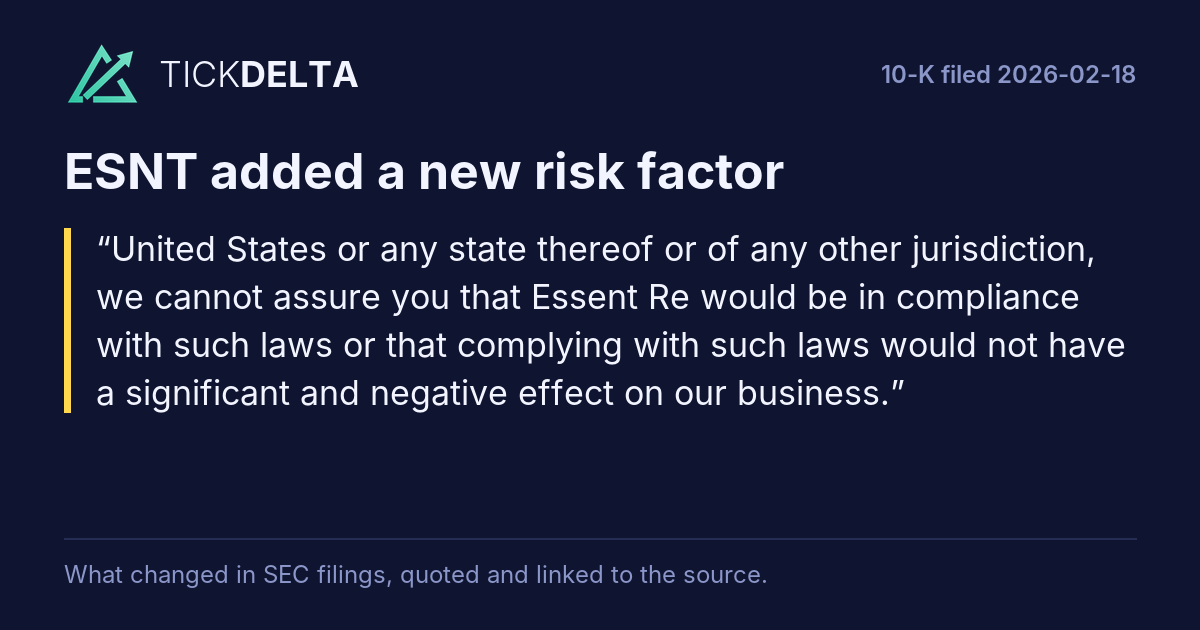
United States or any state thereof or of any other jurisdiction, we cannot assure you that Essent Re would be in compliance with such laws or that complying with such laws would not have a significant and negative effect on our business.
Show the other 3
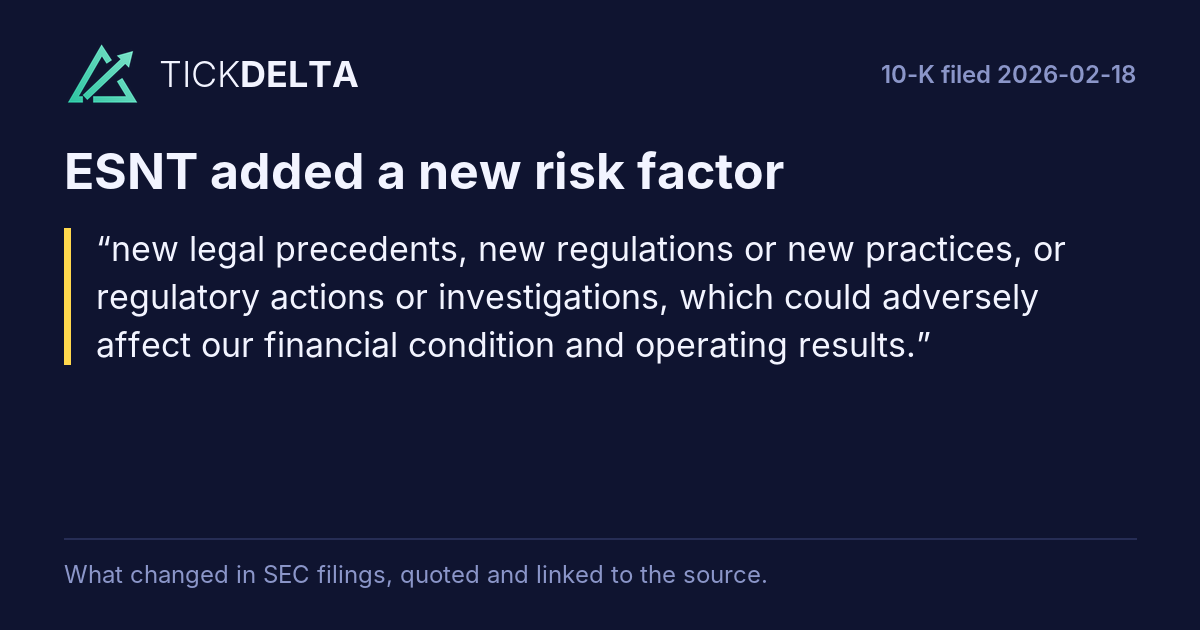
new legal precedents, new regulations or new practices, or regulatory actions or investigations, which could adversely affect our financial condition and operating results.
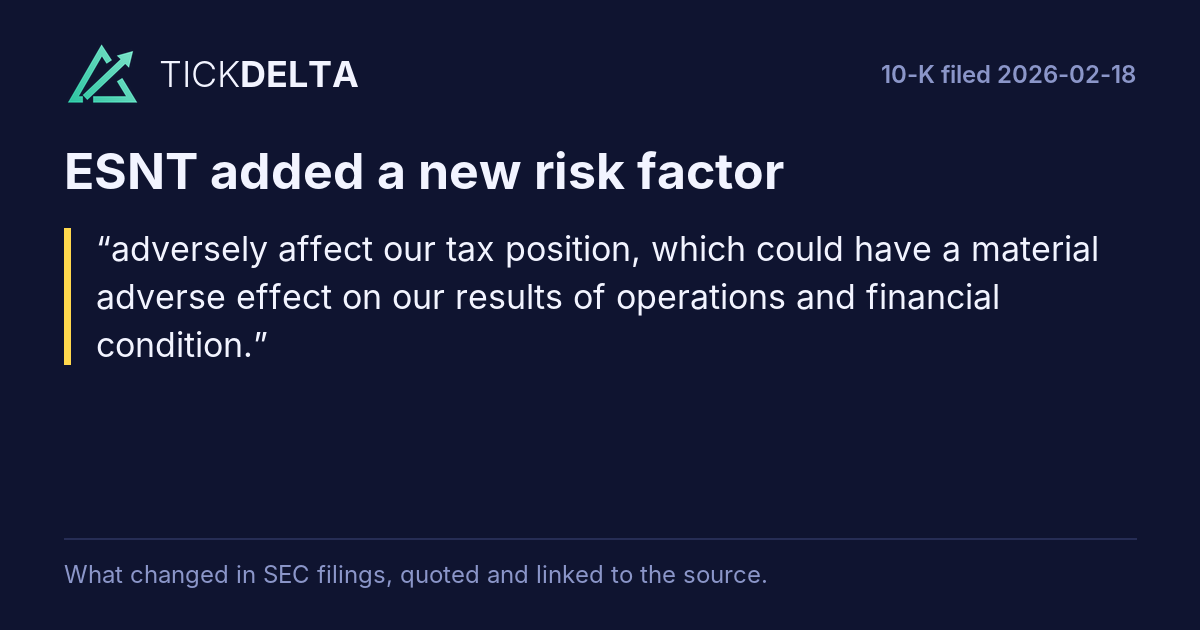
adversely affect our tax position, which could have a material adverse effect on our results of operations and financial condition.
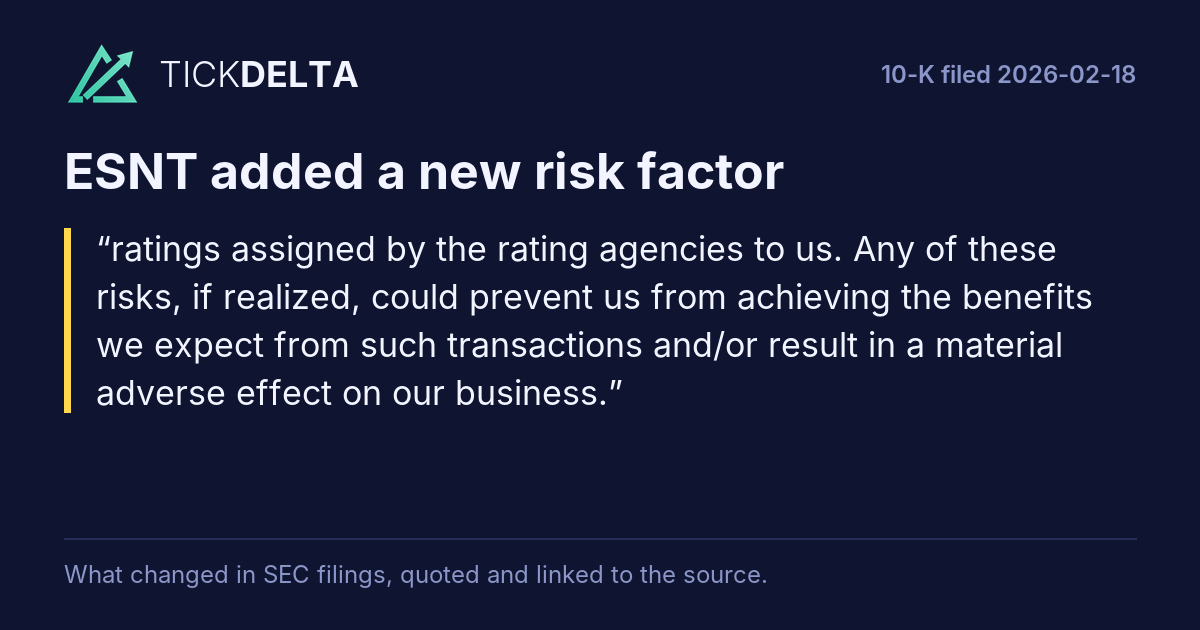
ratings assigned by the rating agencies to us. Any of these risks, if realized, could prevent us from achieving the benefits we expect from such transactions and/or result in a material adverse effect on our business.
Paragraphs in the 10-Q filed Nov 6, 2026 that were not in the one before
New in the latest 10-Q
3 paragraphs in the 10-Q filed Nov 6, 2026 with nothing like
them in the 10-Q filed Aug 7, 2026 (at least half the words must differ; new numbers alone do not count).
Quoted exactly, grouped by the item heading above them. This is text that changed, not a judgement of how serious it is.
Financial statements and notes
In connection with the Radnor Re Transactions, we concluded that the risk transfer requirements for reinsurance accounting were met as each Radnor Re entity is assuming significant insurance risk and a reasonable possibility of a significant loss. In addition, we assessed whether each Radnor Re entity was a variable interest entity ("VIE") and the
Read in the 10-Qopen_in_new
On October 22, 2026, President Donald Trump signed an executive order titled “Decreasing Housing Costs for the American People” which includes a provision directing the U.S. Federal Housing Finance Agency (FHFA) Director to consider establishing a pilot program for the cancellation of private mortgage insurance on future loans. We will evaluate any impact that a pilot program may have on our mortgage insurance portfolio and our future results of operations once the terms of such pilot program are finalized.
Read in the 10-Qopen_in_new
Other income in the Reinsurance segment relates solely to revenues earned associated with underwriting consulting services to third-party reinsurers.
Read in the 10-Qopen_in_new
The 10-Q's risk factors against the 10-K
Item 1A of the 10-Q filed Nov 6, 2026 against Item 1A of the 10-K filed Feb 18, 2026.
A 10-Q repeats only the risks that changed, so a 10-K paragraph that is missing from it is not counted as removed.
Added is a paragraph with nothing like it in the 10-K, Reworded a sentence that is in both with several words changed,
Quiet changes a sentence in both where one to four words changed and one is a hedge or a modal
(cut words struck through, new words highlighted).
Text on the page, not a score; each links to the filing at sec.gov.
Reworded10-Q Nov 6, 2026 vs 10-K Feb 18, 2026
Additional risks and uncertainties not currently known to us or that we currently deem to be immaterial also may impair materially adversely affect our business operations. business, financial condition, and/or operating results.
Read it in the 10-Q at sec.govopen_in_newThe 10-K sentenceopen_in_new
Reworded10-Q Nov 6, 2026 vs 10-K Feb 18, 2026
The risks and uncertainties described in our Annual Report, along with the disclosure below are not the only risks and uncertainties we face.
Read it in the 10-Q at sec.govopen_in_newThe 10-K sentenceopen_in_new
Reworded10-Q Nov 6, 2026 vs 10-K Feb 18, 2026
If any of the following risks actually occur, our business, financial condition, and/or results of operations and financial condition could suffer. be negatively affected.
Read it in the 10-Q at sec.govopen_in_newThe 10-K sentenceopen_in_new
Sources
Item 1A of each 10-K and 10-Q on EDGAR, quoted exactly. Each paragraph links to the filing at sec.gov.
Also
10-K change: what was reworded or cut, section by section.
Work with it
Excel workbook · CSV. Google Sheet that stays up to date: paste =IMPORTDATA("https://tickdelta.com/company/ESNT/export.csv") into a cell.