Screener / SEC EDGAR /CIK 0001707753 /10-K filed Jun 8, 2026, compared with Jun 10, 2025 /Numbers from the XBRL of the 10-Ks
NYSE Technology · Software

Elastic N.V. ESTC

Compare with peers Embed
The 10-K against last year's

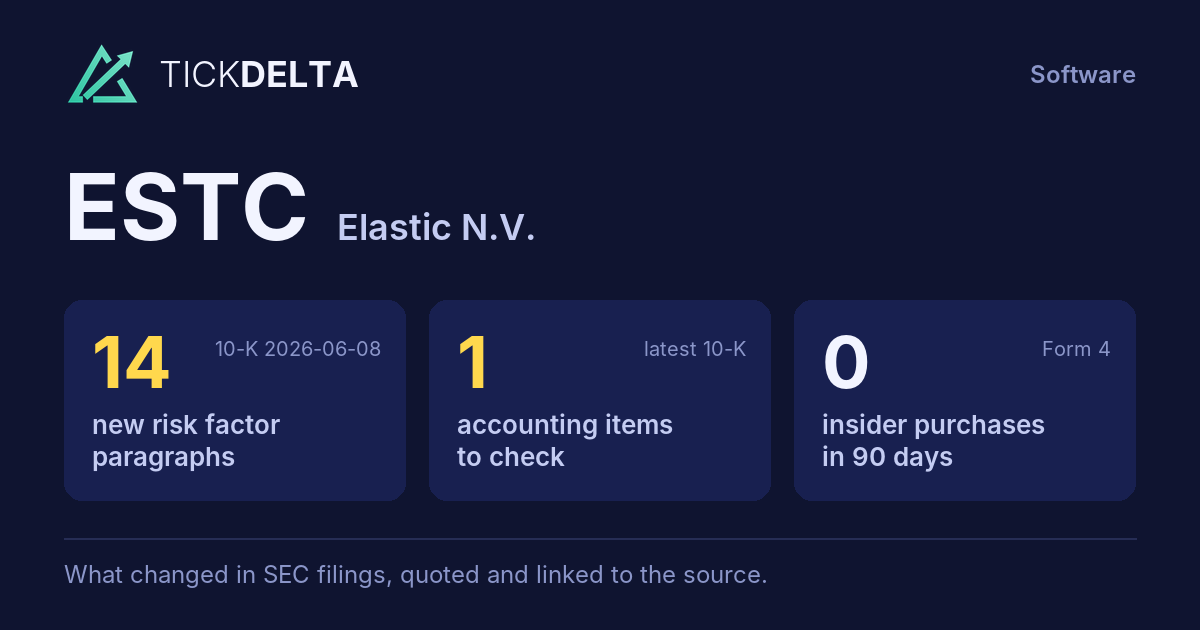
215 changes: 19 added, 19 removed, 163 reworded, 14 quiet changes

10-K Jun 8, 2026 vs Jun 10, 2025

10-K 0001707753-26-000018 (Jun 8, 2026) vs 10-K 0001707753-25-000021 (Jun 10, 2025)

Every paragraph, and how much of it changed

One bar per paragraph, in the order of the 10-K. Height and colour show the share of its words not in the closest paragraph a year earlier; the tallest bars are new paragraphs.

Risk Factors

240 paragraphs · 14 new · 100 reworded · 17 gone · 10-K Jun 8, 2026 against Jun 10, 2025
New paragraph Reworded (5% of its words or more) Same or nearly
Paragraph 237 · 45% changed Every version of it
As a public company in the United States, we are subject to the Sarbanes-Oxley Act, Act and SEC rules and regulations, which requires, require, among other things, that we maintain effective disclosure controls and procedures and internal control over financial reporting. In order to maintain We expect that the requirements of these rules and improve the effectiveness of our disclosure controls and procedures and internal control over financial reporting, we have expended and anticipate that we regulations will continue to expend significant resources, including accounting-related costs and significant management oversight. We have incurred and expect to continue to incur significant expenses and devote substantial management effort toward compliance with the auditor attestation requirements of Section 404 of the Sarbanes-Oxley Act. To assist us in complying with these requirements, we may need to hire more employees in the future, or engage outside consultants, which will increase our operating expenses. legal, accounting and financial compliance costs, make some activities more difficult, time consuming and costly, and place significant strain on our personnel, systems and resources.
Paragraph 136 · 41% changed Every version of it
Our technologies strategically incorporate open source software from other developers, as well as open source and/or open weight large and small language models, and we expect to continue to incorporate such open source software and models in our products in the future. Open weight models are AI systems whose trained parameters are publicly released, allowing users to run, fine-tune, and deploy them. Few of the licenses applicable to open source and open weight software and models have been interpreted by courts, and there is a risk that these licenses could be construed in a manner that could impose unanticipated conditions or restrictions on our ability to commercialize our products. Moreover, we may not have incorporated third-party open source software or models in or associated with our software in a manner that is consistent with the terms of the applicable license license, regulations of certain jurisdictions, or our current policies and procedures. If we fail to comply with these licenses, licenses or regulations, we may be subject to certain requirements, including requirements that we offer our solutions that incorporate the open source software for no cost, that we make available source code for modifications or derivative works we create based upon incorporating or using the open source software, and that we license such modifications or derivative works under the terms of applicable open source licenses. In addition, some open source software licenses or for certain types of AI models that we may include output be restricted from generative AI software or other software that incorporates or relies on generative AI or other AI technologies. The use offering such models in certain jurisdictions. Examples of such open source software may expose us challenges unique to generative and non-generative models that create potential risks as include, without limitation, the intellectual property ownership sources of the data on which such models were trained, their legal status in different jurisdictions, rights of the original controllers of such data, bias training issues, data the models can be prompted to generate, and license rights, including copyright, of generative AI software and tools have not been fully interpreted by U.S. courts or been fully addressed by federal or state regulation or those of other international legal jurisdictions the manner in which we do business. Attempting the models are to ensure our compliance in integrating such open source be used, all subject to different and generative AI components with licensing terms, regulatory changes, evolving laws and our required intellectual property guidelines and legal requirements to do business may result in the expenditure of significant resources and in our failure to meet all relevant, material software release timetables and requirements. Moreover, changes in supply chain and export control regulations imposed by the United States and other governments due to geopolitical changes and government policies may require us to make changes to some of our open source and other third-party dependencies, which may result in additional costs and may adversely impact customer use and adoption of our solutions. across multiple jurisdictions.
Paragraph 12 · 39% changed Every version of it
AI presents new risks and challenges that We may affect our business. We have made, and expect to continue to make, continued investments to integrate AI and machine learning technology into our offerings, including increasing our technical operations and engineering in these applications. Rapid technological progress in the industry regarding new and emerging AI technologies, such as generative AI, may require additional investment in the development, integration, and maintenance of our product offerings, as well as the development of appropriate technical protections and safeguards to maintain a responsible and ethical AI framework. These requirements may add costs and could increase our expenses as we continue to expand the breadth of use and applications of AI technologies, including generative AI, further into our product offerings, or to address changes to AI technologies, frameworks, or regulations. In addition, we may incur substantial costs in our sales and marketing efforts to promote and sell our offerings based on AI technologies, including costs for branding, product promotion, and demand generation, as well as for technical training, training material generation, and investments in resources for our sales personnel and partners. Despite such investments in building our product offerings and in sales and marketing, these investments, our product offerings may not be adopted by customers. We customers, and we may not achieve significant revenue directly related to all of our AI-related initiatives for several years, if at all.
Paragraph 13 · 39% changed Every version of it
Further, AI presents risks, challenges, and unintended consequences that could affect our ability to continue to incorporate the use of AI successfully in our business and solutions in new ways. Further, given Given the complex nature of AI technology, we face an evolving regulatory landscape and significant competition from other companies. Competitors may incorporate AI and ML into their products products, offerings, and solutions more quickly or more successfully than we do, which could impair our ability to compete effectively and adversely affect our financial results. Our ability to effectively implement and market our AI and ML solutions and features will depend, in part, on our ability to attract and retain employees with AI and ML expertise in competition with other enterprises for professionals with the skills and technical knowledge we will require. Data practices by us or others that result in controversy could also impair the acceptance of AI solutions, which could undermine confidence in the decisions, predictions, analysis, or other content that produced by our AI-related initiatives produce. Any initiatives. In addition, the rapid adoption of generative and agentic AI tools may change how software developers design, build and deploy applications, including through increased automation of coding, infrastructure configuration and application architecture. Because a portion of our strategy is focused on being a platform of choice for developers, changes in developer workflows, tooling or decision-making processes resulting from the foregoing adoption of AI-enabled development tools could adversely affect how developers select databases or other data platforms. The demand for our business, reputation, products and services could be negatively affected if these evolving development patterns reduce developer engagement with, or financial results. preference for, our platform or favor alternative technologies or architectures.
Paragraph 11 · 38% changed Every version of it
AI presents new risks and challenges that may affect our business. We are increasingly utilizing and building AI and machine learning (“ML”) capabilities into our business and have made, and expect to continue to make, continued investments to integrate AI and machine learning ML technology into our offerings, including increasing our technical operations and engineering in these applications. Rapid technological progress in the industry regarding new and emerging AI technologies, such as generative and agentic AI, may require additional investment in the development, integration, and maintenance of our product offerings, as well as the development of appropriate technical protections and safeguards to maintain a responsible and ethical AI framework. These requirements may add costs and could increase our expenses as we continue to expand the breadth of use and applications of AI technologies, including generative and agentic AI, further into our product offerings, or to address changes to AI technologies, frameworks, or regulations. In addition, Furthermore, as we expand the number and variety of LLMs and other AI models integrated into or made available through our products and offerings, we face compounding uncertainties arising from the dynamic and evolving performance characteristics of such models. Such performance characteristics may incur substantial costs include changes in our sales model outputs, capabilities, accuracy, and marketing efforts behavior introduced by third-party model providers without advance notice to promote us. These changes may generate novel risks, including risks related to product reliability, customer trust, data integrity, third-party claims, and sell our offerings based on AI technologies, including costs for branding, product promotion, and demand generation, as well as for technical training, training material generation, and investments in resources for our sales personnel and partners. Despite such investments in building our product offerings and in sales and marketing, our product offerings regulatory compliance, that we may not be adopted by customers. We may not achieve significant revenue directly related able to all of anticipate, adequately assess, or promptly mitigate to avoid harmful effects on our AI-related initiatives for several years, if at all. business.
Paragraph 137 · 37% changed Every version of it
Our technologies strategically incorporate open source software from other developers, and we expect to continue to incorporate such open source software in our products in the future. Few of the licenses applicable to open source software have been interpreted by courts, and there is a risk that these licenses could be construed in a manner that could impose unanticipated conditions or restrictions on our ability to commercialize our products. Moreover, we may not have incorporated third-party open source software in our software in a manner that is consistent with the terms of the applicable license or our current policies and procedures. If we fail to comply with these licenses, we may be subject to certain requirements, including requirements that we offer our solutions that incorporate the open source software for no cost, that we make available source code for modifications or derivative works we create based upon incorporating or using the open source software, and that we license such modifications or derivative works under the terms of applicable open source licenses. In addition, some open source software may include output from generative AI software or other software that incorporates or relies on generative AI or other AI technologies. The use of such open source software may expose us to risks as the intellectual property ownership and license rights, including copyright, of generative AI software and tools have not been fully interpreted by U.S. courts or been fully addressed by federal or state regulation or those of other international legal jurisdictions in which we do business. Attempting to ensure our compliance in integrating such open source and generative AI components with licensing terms, regulatory changes, and our required intellectual property guidelines and legal requirements to do business may result in the expenditure of significant resources and in our failure to meet all relevant, material software and technology release timetables and requirements. Moreover, changes in supply chain Increased use of AI-based developer tools may increase the amount of third party-sourced or derived software incorporated into our products, and export control regulations imposed by the United States and other governments due introduces increased risks of compliance related to geopolitical changes and government policies may require us to make changes to some of our open source and other third-party dependencies, which may result licensing, as well as complexities in additional costs title and may adversely impact customer use and adoption intellectual property registration of our solutions. certain AI-generated aspects.
Paragraph 28 · 32% changed Every version of it
Techniques used to sabotage or obtain unauthorized access to systems or networks are constantly evolving and, in some instances, are not identified until launched against a target. We and our third-party vendors and service providers may be unable to anticipate these techniques, react to them in a timely manner, or implement adequate preventative measures. Because of the complexity and interconnectedness of our systems and networks and those on which we rely, the process of upgrading or patching our protective measures could itself create a risk of cybersecurity intrusions or system disruptions, including for customers who rely upon, or have exposure to, such systems and networks.
Paragraph 116 · 32% changed Every version of it
Our success depends in part on our ability to attract users through unpaid (organic) Internet search results on traditional web search engines, such as Google. The number of users we attract to our website from Google, as well as through AI-powered search engines is due in large part to how and where our website ranks in unpaid search results. discovery platforms. These rankings and recommendations can be affected by a number of factors, many of which are not in factors outside our direct control, control and they may change frequently. For example, a search engine may change its ranking algorithms, methodologies, or design layouts. In addition, AI-powered search tools and LLM-based assistants are increasingly influencing how users discover products and services online. Our visibility in these AI-generated experiences depends on factors such as third-party content quality, third-party citations, and the training data and retrieval methodologies used by AI systems, all of which are outside our control and may change without notice. As a result, links to our website may not be prominent enough to drive traffic to our website, traffic, we may not be surfaced or recommended by AI-powered tools, and we may not know how or otherwise be in a position to influence the results. these outcomes. AI-powered tools may characterize our products inaccurately or incompletely, influencing buyer perception before any visit to our website. Any reduction in the number of users directed to our website could reduce our revenue or require us to increase our customer acquisition expenditures.

MD&A

96 paragraphs · 5 new · 52 reworded · 2 gone · 10-K Jun 8, 2026 against Jun 10, 2025
New paragraph Reworded (5% of its words or more) Same or nearly
Paragraph 63 · 37% changed
Year Ended April 30, Change 2026 2025 2024 $ % (in thousands) Restructuring and other related charges (Benefit from) provision for income taxes $ 225 $4,917 (370,067) $76,545 $ (4,692) (95)% (446,612) NM
Paragraph 64 · 30% changed
The provision for benefit from income taxes was $76.5 $370.1 million for the year ended April 30, 2025 2026 compared to a benefit from provision for income taxes of $184.5 $76.5 million for the prior year. Our effective tax rate for the year ended April 30, 2026 was not meaningful due to near break-even net loss before income taxes. Our effective tax rate for the year ended April 30, 2025 was (242)% and 150% of our net loss before income taxes for the years ended April 30, 2025 and 2024, respectively. taxes. Our effective tax rate is affected by recurring items, such as tax rates in jurisdictions both within and outside the Netherlands and the relative amounts of income we earn that is earned in those jurisdictions and jurisdictions, non-deductible stock-based compensation as well as compensation, BEAT legislation in the United States, and one-time tax benefits or charges. The benefit from income taxes for the year ended April 30, 2026 was driven primarily by the release of valuation allowances against deferred tax assets in the Netherlands, the United Kingdom, and California for $390.5 million, $23.7 million, and $20.7 million, respectively, partially offset by tax expense in jurisdictions where we are not subject to a valuation allowance or NOLs.
Paragraph 22 · 26% changed
Growing our customer base by converting users of our software to paid subscribers. acquiring new customers. Our financial performance depends on growing our paid customer base by converting free users of our software into paid subscribers. Our distribution model has resulted in rapid adoption by developers around the world. acquiring new customers. We have invested, and expect to continue to invest, heavily in sales and marketing efforts and leverage our network of partners to convert additional free users to paid subscribers. target new customers and drive further awareness and adoption within our user community. Our investment in sales and marketing is significant given our large and diverse user base. These base and our efforts to engage prospects in executive-level conversations. Because these investments are likely to occur before we realize the anticipated benefits of such investments, such that they may adversely affect our operating results in the near term.
Paragraph 53 · 25% changed
Cost of subscription revenue increased by $36.3 $27.6 million, or 15%, 10%, for the year ended April 30, 2025 2026 compared to the prior year. This increase was primarily due to an increase of $38.4 $20.6 million in cloud infrastructure hosting costs, partially offset by a decrease of $3.1 $4.2 million in intangible assets amortization. personnel and related costs, and $2.0 million in third-party costs. Subscription gross margin increased nominally to 80% 81% for the year ended April 30, 2025 2026 compared to 79% 80% for the prior year. year primarily due to efficiencies realized in managing our cloud hosting costs relative to revenue growth.
Paragraph 79 · 25% changed
Net cash provided by used in financing activities of $40.9 $312.3 million during the year ended April 30, 2025 2026 was due to repurchases of ordinary shares of $340.1 million, partially offset by proceeds from stock option exercises and ESPP purchases under our employee stock purchase plan. of $27.8 million.
Paragraph 59 · 20% changed
Restructuring and other related charges decreased by $4.7 $0.2 million for the year ended April 30, 2025 2026 compared to the prior year due to lower year, as there were no employee-related severance and termination benefit charges. charges pursuant to any restructuring plan for the year ended April 30, 2026.
Paragraph 55 · 17% changed
Research and development expense increased by $23.8 $86.2 million, or 7%, 24%, for the year ended April 30, 2025 2026 compared to the prior year as we continued to invest in the development of new and existing offerings. This The increase was primarily due to increases of $22.2 $64.2 million in personnel and related costs and $4.7 costs, $8.9 million in cloud infrastructure costs related to our research and development activities. These increases were partially offset by a decrease of $3.4 hosting costs, $7.1 million in travel expenses, and $4.0 million in software and equipment costs. The increase in personnel and related costs included increases of $16.5 $39.8 million in salaries and related taxes, $3.8 $15.2 million in stock-based compensation, and $3.1 $7.5 million in employee benefits expense, partially offset by a decrease of $1.4 million in acquisition-related compensation. expense.
Paragraph 54 · 16% changed
Cost of services revenue increased by $13.5 $8.8 million, or 16%, 9%, for the year ended April 30, 2025 2026 compared to the prior year. This increase was primarily due to increases of $6.8 $6.0 million in personnel and related costs and $6.4 costs, $1.8 million in subcontractor costs. travel expenses, and $1.0 million in miscellaneous other expenses. Gross margin for services revenue was 2% (1)% for the year ended April 30, 2025 2026 compared to 8% 2% for the same period of the prior year. The decrease in gross margin was primarily attributable to increases in travel expenses and personnel and related costs and subcontractor costs growing at a higher rate than the growth in services revenue. costs. We continue to make investments in our services organization that we believe will be needed to support our continued growth. Our gross margin for services may fluctuate or decline in the near-term near term as we seek to expand our services business.

A paragraph is matched with the one last year that shares the most of its words; under half in common makes it new. The paragraphs shown are the 8 reworded the most in each section.

The paragraph that changed most in each section

The redline

Marked against last year's 10-K: cut words struck through, new words highlighted.

Risk Factors320 words changed in this paragraph; it is 53% similar to last year's version.
Our technologies strategically incorporate open source software from other developers, as well as open source and/or open weight large and small language models, and we expect to continue to incorporate such open source software and models in our products in the future. Open weight models are AI systems whose trained parameters are publicly released, allowing users to run, fine-tune, and deploy them. Few of the licenses applicable to open source and open weight software and models have been interpreted by courts, and there is a risk that these licenses could be construed in a manner that could impose unanticipated conditions or restrictions on our ability to commercialize our products. Moreover, we may not have incorporated third-party open source software or models in or associated with our software in a manner that is consistent with the terms of the applicable license license, regulations of certain jurisdictions, or our current policies and procedures. If we fail to comply with these licenses, licenses or regulations, we may be subject to certain requirements, including requirements that we offer our solutions that incorporate the open source software for no cost, that we make available source code for modifications or derivative works we create based upon incorporating or using the open source software, and that we license such modifications or derivative works under the terms of applicable open source licenses. In addition, some open source software licenses or for certain types of AI models that we may include output be restricted from generative AI software or other software that incorporates or relies on generative AI or other AI technologies. The use offering such models in certain jurisdictions. Examples of such open source software may expose us challenges unique to generative and non-generative models that create potential risks as include, without limitation, the intellectual property ownership sources of the data on which such models were trained, their legal status in different jurisdictions, rights of the original controllers of such data, bias training issues, data the models can be prompted to generate, and license rights, including copyright, of generative AI software and tools have not been fully interpreted by U.S. courts or been fully addressed by federal or state regulation or those of other international legal jurisdictions the manner in which we do business. Attempting the models are to ensure our compliance in integrating such open source be used, all subject to different and generative AI components with licensing terms, regulatory changes, evolving laws and our required intellectual property guidelines and legal requirements to do business may result in the expenditure of significant resources and in our failure to meet all relevant, material software release timetables and requirements. Moreover, changes in supply chain and export control regulations imposed by the United States and other governments due to geopolitical changes and government policies may require us to make changes to some of our open source and other third-party dependencies, which may result in additional costs and may adversely impact customer use and adoption of our solutions. across multiple jurisdictions.

Source: Item 1A, 10-K 0001707753-26-000018 vs Item 1A, 10-K 0001707753-25-000021

MD&A145 words changed in this paragraph; it is 31% similar to last year's version.
We have also excluded unrecognized tax benefits from the contractual obligations. A variety Our principal commitments consist of factors could affect the timing our purchase obligations under non-cancelable agreements primarily for cloud hosting, subscription software, sales and marketing, and general corporate services, future non-cancelable minimum rental payments under operating leases for our offices, and interest payments due on our Senior Notes. As of payments for the liabilities April 30, 2026, we had purchase commitments of $613.6 million related to unrecognized tax benefits. Therefore, we cannot reasonably estimate the timing cloud hosting services, future minimum lease payment commitments of such payments. We believe that these matters will likely not be resolved in the next 12 months $24.2 million, and accordingly we have classified the estimated liability as non-current in the consolidated balance sheets. purchase commitments of $96.0 million related to other contracts. See Note 13, “Income Taxes,” 8, “Commitments and Contingencies,” and Note 9, “Leases,” of our accompanying Notes to our Consolidated Financial Statements included in Part II, Item 8 of this Annual Report on Form 10-K for additional information.

Source: Item 7, 10-K 0001707753-26-000018 vs Item 7, 10-K 0001707753-25-000021

Accounting Policies92 words changed in this paragraph; it is 77% similar to last year's version.
Compensation expense related to stock awards issued to employees and directors, including stock options and restricted stock units (“RSUs”), which include including those with performance share units (“PSUs”), or market conditions, issued to employees and directors is measured at the fair value on the date of the grant and recognized over the requisite service period. The fair value of stock options and purchase rights issued to employees under the 2022 Employee Stock Purchase Plan (“2022 ESPP”) (the “ESPP”) is estimated on the date of the grant using the Black-Scholes option-pricing model. The fair value of RSUs with service or performance conditions is estimated on the date of the grant based on the fair value of the Company’s underlying ordinary shares. The fair value of RSUs with market conditions is estimated using a Monte Carlo simulation. Compensation expense for stock options and RSUs with only a service condition is recognized on a straight-line basis over the requisite service period, and over the six-month offering period for ordinary shares purchased under the 2022 ESPP. Compensation expense relating to PSUs RSUs with a performance condition is recognized using the accelerated attribution method over the requisite service period when it is probable that the performance condition will be satisfied. Compensation expense for RSUs with a market condition is recognized using the accelerated attribution method over the requisite service period of each tranche, regardless of whether the market condition is ultimately satisfied. The Company recognizes forfeitures as they occur.

Source: Item 8, Note 2 – Summary of Significant Accounting Policies, 10-K 0001707753-26-000018 vs Item 8, Note 2 – Summary of Significant Accounting Policies, 10-K 0001707753-25-000021

Legal Proceedings2 words changed in this paragraph; it is 99% similar to last year's version.
From time to time, we may be subject to legal proceedings and claims that arise in the ordinary course of business, including patent, commercial, product liability, employment, class action, whistleblower and other litigation and claims, as well as governmental and other regulatory investigations and proceedings. In addition, third parties from time to time may assert claims against us in the form of letters and other communications. We are currently not currently a party to any legal proceedings that, if determined adversely to us, would individually or taken together, in our opinion, have a material adverse effect on our business, results of operations, financial condition or cash flows. Future litigation may be necessary to defend ourselves, our partners and our customers by determining the scope, enforceability and validity of third-party proprietary rights, or to establish our proprietary rights. The results of any current or future litigation cannot be predicted with certainty, and regardless of the outcome, such litigation could have an adverse impact on us because of defense and settlement costs, diversion of management resources, and other factors.

Source: Item 3, 10-K 0001707753-26-000018 vs Item 3, 10-K 0001707753-25-000021

Sentences and paragraphs added, removed or reworded

Every change, by type

Sentences and paragraphs of ESTC's Risk Factors and MD&A, 10-K Jun 8, 2026 against 10-K Jun 10, 2025. Each links to the text at sec.gov.

Quiet changes are sentences kept from last year with one to four words changed, at least one of them a hedge, a modal or a qualifier (may, could, will, not, significant, material…). A year or date rolling forward is not counted.

The full word list

adverse, adversely, all, although, anticipate, anticipates, any, approximately, believe, believes, can, cannot, certain, could, expect, expects, generally, however, if, intend, intends, largely, likely, many, material, materially, may, might, most, must, never, no, not, possible, primarily, probable, should, significant, significantly, some, substantial, substantially, unlikely, will, would

AddedRisk Factors
Our business, reputation, or financial results may be adversely affected by any failure by us to be successful in our AI initiatives, by significant competition we face in the AI landscape, and by uncertain market understanding and valuation of AI and machine learning technologies.
Read it in 10-K Jun 8, 2026 at sec.gov
AddedRisk Factors
While adoption of AI and ML is likely to continue and may accelerate, the long-term trajectory of this technological trend, as well as market acceptance, understanding and valuation of solutions and services that incorporate AI and ML technologies, is uncertain, and the perceived value of AI and ML technologies used and provided by our customers could be inaccurate. If AI and ML is not broadly adopted by enterprises to the extent we anticipate, or if new use cases do not arise, then our opportunity may be smaller than we expect. Such risks and challenges could slow or even halt the adoption of AI and ML and negatively affect our business.
Read it in 10-K Jun 8, 2026 at sec.gov
AddedRisk Factors
Social, ethical, security and regulatory issues relating to the use of new and evolving technologies such as AI and ML, including generative and agentic AI and AI models, in our offerings, internal operations or partnerships, may result in reputational harm and liability, and may cause us to incur additional research and development costs to resolve such issues. The use of generative and agentic AI, which are relatively new and emerging technologies in the early stages of commercial use, exposes us to additional risks, such as damage to our reputation, competitive position, and business, legal and regulatory risks and additional costs.
Read it in 10-K Jun 8, 2026 at sec.gov
AddedRisk Factors
AI is the subject of evolving review and scrutiny by various domestic and international governmental and regulatory agencies. Laws, rules, directives, and regulations governing the use of AI, such as the EU Artificial Intelligence Act (“EU AI Act”), are changing and evolving rapidly. The EU AI Act establishes, among other things, a risk-based governance framework for regulating AI systems operating in the EU. This framework categorizes AI systems by their intended purposes into levels of risk, with those deemed unacceptable or high risk being strictly regulated or prohibited and all remaining AI systems being classified as low risk. The EU AI Act prohibits certain uses of AI systems and places numerous obligations on providers and deployers of permitted AI systems, with heightened requirements based on AI systems that are general purpose, which we currently deploy, or considered high risk. In addition, a patchwork of state-level AI-related legislation continues to emerge in the United States. We may not be able to anticipate how to respond to these rapidly evolving frameworks, and we may need to expend resources to adjust our operations or offerings in certain jurisdictions if the legal frameworks are inconsistent across jurisdictions. Furthermore, because AI and ML technology itself is highly complex and rapidly developing, it is not possible to predict all of the legal, operational or technological risks that may arise relating to the use of AI and ML. These and other developments may require us to make significant changes to our use of AI and ML, including by limiting or restricting our use of AI and ML, which may require us to make significant changes to our policies and practices. The cost to comply with such laws or regulations could be significant and would increase our operating expenses, which could adversely affect our business, financial condition and results of operations.
Read it in 10-K Jun 8, 2026 at sec.gov
AddedRisk Factors
Our workforce is exposed to and uses AI technologies for certain tasks related to our business. While we have training and guidelines specifically directed at the use of AI tools in the workplace, use of these AI tools, whether authorized or unauthorized, poses risks relating to intellectual property, data protection, cybersecurity, and exposure of our proprietary confidential information to unauthorized recipients, which could result in the loss of intellectual property protection of such information, the misuse of our or third-party intellectual property, and the inability to claim intellectual property ownership of outputs from AI tools. Use of AI technology by our workforce even when used consistent with our guidelines, may result in allegations or claims against us related to violation of third-party intellectual property rights, unauthorized access to or use of proprietary information and failure to comply with open source software licenses. AI technology may also produce inaccurate responses that could lead to errors in our decision-making, solution development, operations or other business activities, which could have a negative impact on our business, operating results and financial condition. Our ability to mitigate these risks will depend on effective training, monitoring and enforcement of appropriate policies, guidelines and procedures governing the use of AI technology, and compliance by our workforce.
Read it in 10-K Jun 8, 2026 at sec.gov
AddedRisk Factors
Use of generative AI in our code development process, while offering various potential benefits, could also pose certain ownership and security risks with respect to our codebase, given the current legal uncertainties relating to ownership of AI- or ML-generated works and the potential for security flaws in output code. If any of our employees, contractors, vendors or service providers use any third-party AI-powered software in connection with our business or the services they provide to us, such use may lead to the inadvertent disclosure of our confidential information, including inadvertent disclosure of our confidential information into publicly available third-party training sets, which may impact our ability to realize the benefit of, or adequately maintain, protect and enforce our intellectual property or confidential information, harming our competitive position and business.
Read it in 10-K Jun 8, 2026 at sec.gov
AddedRisk Factors
Techniques used to sabotage or obtain unauthorized access to systems or networks are constantly evolving and, in some instances, are not identified until launched against a target. We have seen, and expect to continue to see, the emergence and maturation of AI capabilities lead to new AI-specific attack vectors and vulnerabilities and more sophisticated methods of attack enhanced or facilitated by AI, including fraud that relies upon “deep fake” impersonation technology, automated vulnerability exploitation, inadvertent data exposure, AI supply-chain attacks, or other forms of automation that otherwise scale or accelerate the effectiveness of cybersecurity attacks. AI and ML also make it cheaper for attackers to create malware, phishing, code reviews, or other tools at significantly higher volumes, and much more rapidly deploy those tools than previously. AI and ML may change the way our industry identifies and responds to cybersecurity threats. The use of AI also has resulted in, and may in the future result in, security breaches or other security incidents that implicate the personal data of users of AI-powered applications as well as access to Elastic technology. We and our third-party vendors, open source and open weight dependency providers, and service providers may be unable to anticipate these techniques, react to them in a timely manner, or implement adequate preventative measures. The use of agentic AI is changing the ways that we secure and defend our platform and operations, as both threat actors and security teams are using AI to industrialize their approaches to attacks. Traditional perimeter controls and static security rules are no longer the most effective security mechanisms. We may not succeed in reinforcing our defensive capabilities to attempt to address this threat, as the applicable technology continues to be enhanced and deployed.
Read it in 10-K Jun 8, 2026 at sec.gov
AddedRisk Factors
Conditions in our market are changing rapidly and significantly as a result of technological advancements, including with respect to AI. Our competitors may more successfully incorporate AI into their products, gain or leverage superior access to certain AI technologies, secure more strategic partnerships with key AI providers, and achieve higher market acceptance of their AI solutions. In addition, enterprise adoption of AI may significantly transform our competitive landscape. Customers may seek to vertically integrate their offerings by expanding into the markets in which we participate or using AI to develop their own software, reducing the need to purchase third-party solutions such as ours or consume them at the same or increasing rates. If this occurs, our market share could decline and our business could be harmed.
Read it in 10-K Jun 8, 2026 at sec.gov
Show the other 61
AddedRisk Factors
Changes in supply chain and export control regulations imposed by the U.S. federal government and other governments due to geopolitical changes and government policies may require us to make changes to some of our open source, open weight, and other third-party dependencies, which may result in additional costs and may adversely impact customer use and adoption of our solutions.
Read it in 10-K Jun 8, 2026 at sec.gov
AddedRisk Factors
On July 4, 2025, the One Big Beautiful Bill Act (“OBBBA”) was enacted in the United States. The OBBBA includes significant provisions, such as the permanent extension of certain expiring provisions of the Tax Cuts and Jobs Act of 2017, modifications to the international tax framework, and the restoration of favorable tax treatment for certain business provisions including the immediate expensing of United States research and development expenditures. The legislation has multiple effective dates, with certain provisions effective for us in the current fiscal period and others in our fiscal year ending April 30, 2027. We have completed our assessment of the tax impact of the provisions effective in the fiscal year ended April 30, 2026, and concluded there is no material impact on our consolidated financial statements. We continue to monitor the potential impacts of the provisions effective in future fiscal years, as well as any forthcoming regulatory guidance.
Read it in 10-K Jun 8, 2026 at sec.gov
AddedRisk Factors
We may also be or become subject to new laws and regulations that regulate non-personal information. For example, the European Union’s Data Act (“EU Data Act”) imposes certain data and cloud service interoperability and switching obligations to enable users to switch between cloud service providers without undue delay or cost, as well as requirements concerning cross-border international transfers of, and governmental access to, non-personal information outside the European Economic Area (“EEA”). Although to date our compliance with the EU Data Act has not had a material adverse effect on our financial results, depending on how the EU Data Act and any similar laws or regulations are implemented, interpreted and enforced, we may have to adapt our business practices, contractual arrangements, and services in the EEA to comply with such obligations, which could negatively affect our regional revenue and results of operations.
Read it in 10-K Jun 8, 2026 at sec.gov
AddedRisk Factors
Share repurchases under our share repurchase program may not be fully consummated and could increase the volatility of the trading price of our ordinary shares and diminish our cash reserves.
Read it in 10-K Jun 8, 2026 at sec.gov
RemovedRisk Factors
AI is the subject of evolving review by various domestic and international governmental and regulatory agencies, including the SEC and the Federal Trade Commission (“FTC”), and laws, rules, directives, and regulations governing the use of AI, such as the EU Artificial Intelligence Act, are changing and evolving rapidly. We may not always be able to anticipate how to respond to these legal frameworks for AI use and we may have to expend resources to adjust or audit our products and services in certain jurisdictions, especially if the legal frameworks are not consistent across jurisdictions. Any failure or perceived failure by us to comply with laws, rules, directives, and regulations governing the use of AI could have an adverse impact on our business.
Read it in 10-K Jun 10, 2025 at sec.gov
RemovedRisk Factors
We derive a significant portion of our revenue from renewals of existing subscriptions, although our customers may choose not to renew their subscriptions upon completion of the contract term. Our subscriptions for self-managed deployments typically range from one to three years, while many of our Elastic Cloud customers purchase subscriptions either on a month-to-month basis or on a committed contract of generally one to three years in duration.
Read it in 10-K Jun 10, 2025 at sec.gov
RemovedRisk Factors
Decisions by our customers concerning whether to renew their contracts depend on a number of factors, including their budgets, their satisfaction with our products and our customer support, our products’ ability to integrate with new and changing technologies, the frequency and severity of product outages, our product uptime or latency, and the pricing of our products or competing products. If our customers renew their subscriptions, they may renew for shorter subscription terms or on other terms that are less financially advantageous to us. If our existing customers do not renew their subscriptions, or renew on less favorable terms, our revenue may grow more slowly than expected or decline.
Read it in 10-K Jun 10, 2025 at sec.gov
RemovedRisk Factors
The markets for certain of our products, such as our Search, Observability and Security solutions, are evolving and our products are relatively new in these markets. Accordingly, it is difficult to predict continued customer adoption and renewals for these products, customers’ demand for these products, the size, growth rate, expansion, and longevity of these markets, the entry of competitive products, or the success of existing competitive products. Our ability to penetrate these evolving markets depends on a number of factors, including the cost, performance, and perceived value associated with our products. If these markets do not continue to grow as expected or if we are unable to anticipate or react to changes in these markets, our competitive position could weaken, which could adversely affect our business and results of operations.
Read it in 10-K Jun 10, 2025 at sec.gov
RemovedRisk Factors
We may not be able to maintain our prices and gross profits at levels that will allow us to achieve and maintain profitability. The sales prices for our offerings may decline or we may introduce new pricing models for a variety of reasons, including competitive pricing pressures, discounts, in anticipation of or in conjunction with the introduction of new offerings, or promotional programs. Competition continues to increase in the market segments in which we operate, and we expect competition to continue to increase and lead to increased pricing pressures. Larger competitors with more diverse offerings may reduce the price of offerings that compete with ours or may bundle them with other offerings. Additionally, currency fluctuations in some countries and regions and pressures from uncertain inflation and interest rate environments may negatively impact actual prices that customers and channel partners are willing to pay in those countries and regions. Any decrease in the sales prices for our offerings may reduce our revenue and gross profit, unless accompanied by an increase in volume to offset the effects of price decreases or, in the case of gross profit, unless accompanied by a corresponding decrease of sufficient magnitude in costs. Gross profit could also be adversely impacted by a shift in the mix of our subscriptions from self-managed to our cloud offering, for which we incur hosting costs, as well as by any increase in our mix of services relative to subscriptions.
Read it in 10-K Jun 10, 2025 at sec.gov
RemovedRisk Factors
If we cannot maintain the corporate culture that has contributed to our success, we could lose the innovation, creativity, and entrepreneurial spirit we have worked to foster, which could harm our business.
Read it in 10-K Jun 10, 2025 at sec.gov
RemovedRisk Factors
We believe that our culture has been and will continue to be a key contributor to our success. We expect to continue to hire as we expand. If we do not continue to maintain our corporate culture as we grow, we may be unable to foster the innovation, creativity, and entrepreneurial spirit we believe we need to support our growth. Moreover, many of our existing employees may be able to receive significant proceeds from sales of our ordinary shares in the public markets, which could lead to employee attrition and disparities of wealth among our employees that might adversely affect relations among employees and our culture in general. Additional headcount growth and employee turnover also may contribute to a change to our corporate culture, which could harm our business.
Read it in 10-K Jun 10, 2025 at sec.gov
RewordedRisk Factors
If Our business may suffer if any of these third parties experience experiences difficulty meeting our requirements or standards, become becomes unavailable due to extended outages or interruptions, temporarily or permanently cease ceases operations, face faces financial distress or other business disruptions such as a security incident, or increase their increases its fees, or if our relationships with any of these providers deteriorate, deteriorate or if any of the agreements we have entered into with such third parties are terminated or not renewed without adequate transition arrangements, we could suffer liabilities, penalties, fines, increased costs, and delays in our ability to provide customers with our products and services, our ability to manage our finances could be interrupted, receipt of payments from customers may be delayed, our processes for managing sales of our offerings could be impaired, our ability to generate and manage sales leads could be weakened, or our business operations could be disrupted. arrangements.
Read it in 10-K Jun 8, 2026 at sec.gov
RewordedRisk Factors
If In any of these third parties experience difficulty meeting our requirements or standards, become unavailable due to extended outages or interruptions, temporarily or permanently cease operations, face financial distress or other business disruptions such as a security incident, or increase their fees, if our relationships with any of these providers deteriorate, or if any of the agreements we have entered into with such third parties are terminated or not renewed without adequate transition arrangements, event, we could suffer liabilities, penalties, fines, increased costs, and delays in our ability to provide customers with our products and services, our ability to manage our finances could be interrupted, our receipt of payments from customers may be delayed, our processes for managing sales of our offerings could be impaired, or our ability to generate and manage sales leads could be weakened, or our business operations could be disrupted. weakened.
Read it in 10-K Jun 8, 2026 at sec.gov
RewordedRisk Factors
If Our operations, financial results and growth prospects could be adversely affected if we are unable to maintain successful relationships with our partners, or if our partners fail to perform or we are unable to maintain successful relationships with them, our business operations, financial results, and growth prospects could be adversely affected. perform.
Read it in 10-K Jun 8, 2026 at sec.gov
RewordedRisk Factors
We Depending on the product and version, we make the source code of our products available under Apache 2.0, the Elastic License, as dual licensed under the Elastic License and SSPL, depending on the product and version, or the GNU Affero General Server Side Public License v3. Version 1.0 (“SSPL”), and AGPL.
Read it in 10-K Jun 8, 2026 at sec.gov
RewordedRisk Factors
Some of our current and potential competitors have longer operating histories, significantly substantially greater financial, technical, marketing and other resources, stronger greater brand recognition, larger sales forces and marketing budgets, broader global distribution networks and presence, more established relationships with current or potential customers and partners, more diverse product and services offerings, and larger customer bases than we do. and more mature intellectual property portfolios.
Read it in 10-K Jun 8, 2026 at sec.gov
RewordedRisk Factors
We base our estimates on historical experience and on various other assumptions that we believe to be reasonable under the circumstances, the results of which form the basis for making judgments about the carrying values of assets, liabilities, equity, revenue, and expenses that are not readily apparent from other sources. circumstances.
Read it in 10-K Jun 8, 2026 at sec.gov
RewordedRisk Factors
Although we had net income of $367.8 million and $61.7 million for the year years ended April 30, 2026 and 2024, respectively, we would have incurred net losses in such years as well without the releases of valuation allowances against deferred tax assets and we may incur net losses in future years.
Read it in 10-K Jun 8, 2026 at sec.gov
RewordedRisk Factors
Subscription revenue accounts for the substantial majority of our revenue, constituting 94% of our total revenue for the year ended April 30, 2026 and 93% of our total revenue for the years ended April 30, 2025 and 2024, and 92% of total revenue for the year ended April 30, 2023. 2024.
Read it in 10-K Jun 8, 2026 at sec.gov
RewordedRisk Factors
Federal, state, or non-U.S. government Government bodies or agencies have in the past adopted, have adopted or amended, and may in the future adopt, new laws and regulations may adopt or may enact amendments to existing amend, laws and regulations affecting data protection, data privacy, AI, or information security or regulating the use of the Internet as a commercial medium.
Read it in 10-K Jun 8, 2026 at sec.gov
RewordedRisk Factors
We base our estimates on historical experience and on various other assumptions that we believe to be reasonable under the circumstances, the The results of which these estimates form the basis for making judgments about the carrying values of assets, liabilities, equity, revenue, and expenses that are not readily apparent from other sources.
Read it in 10-K Jun 8, 2026 at sec.gov
RewordedRisk Factors
If we fail to comply with these licenses, licenses or regulations, we may be subject to certain requirements, including requirements that we offer our solutions that incorporate the open source software for no cost, that we make available source code for modifications or derivative works we create based upon incorporating or using the open source software, and that we license such modifications or derivative works under the terms of applicable open source licenses. licenses or for certain types of AI models that we may be restricted from offering such models in certain jurisdictions.
Read it in 10-K Jun 8, 2026 at sec.gov
RewordedRisk Factors
Our future success depends on our ability to sell We may not succeed in selling our subscriptions to new and existing customers, including to large enterprises, and to expand or in expanding the deployment of our offerings with existing customers by selling paid subscriptions to our existing users and expanding the value and number of existing customers’ subscriptions.
Read it in 10-K Jun 8, 2026 at sec.gov
Quiet changesRisk Factors
Our business and operations have experienced rapid significant growth, and if we do not appropriately manage our future growth or are unable to improve our systems and processes, our business, financial condition, results of operations, and prospects may be adversely affected.
Read it in 10-K Jun 8, 2026 at sec.gov
Quiet changesRisk Factors
If we experience a security incident, or if unauthorized access to or other unauthorized processing of confidential information, including personal data, otherwise occurs, our software may be perceived as not being secure, customers may reduce the use of or stop using our products, and we may incur significant liabilities.
Read it in 10-K Jun 8, 2026 at sec.gov
Quiet changesRisk Factors
In addition, many Many of our customers may use our software for processing their confidential information, including business strategies, financial and operational data, personal information and other related data.
Read it in 10-K Jun 8, 2026 at sec.gov
Quiet changesRisk Factors
As we continue to grow rapidly, significantly, a large portion of our sales force will have relatively little experience working with us, our subscriptions, and our business model.
Read it in 10-K Jun 8, 2026 at sec.gov
Quiet changesRisk Factors
Under a proposal of law currently pending before the Dutch Parliament, referred to as the Emergency act conditional exit dividend withholding tax (Spoedwet conditionele eindafrekening dividendbelasting, “DWT Exit Tax”), we will would be deemed to have distributed an amount equal to our entire market capitalization less recognized paid-up capital immediately before the occurrence of certain events, including if we cease to be a Dutch tax resident for purposes of a tax treaty concluded by the Netherlands with another jurisdiction and become, for purposes of such tax treaty, exclusively a tax resident of that other jurisdiction which is a qualifying jurisdiction.
Read it in 10-K Jun 8, 2026 at sec.gov
Quiet changesRisk Factors
A full exemption applies would apply to entities and individuals that are resident in an EU/EEA member state or a state that has concluded a tax treaty with the Netherlands that contains a dividend article, provided we submit a declaration confirming the satisfaction of applicable conditions by qualifying shareholders within one month following the taxable event.
Read it in 10-K Jun 8, 2026 at sec.gov
AddedMD&A
On July 4, 2025, OBBBA was enacted into law, introducing significant changes to U.S. federal tax law. The legislation includes provisions that impacted us in the year ended April 30, 2026, and the tax effects of those provisions have been reflected in our benefit from income taxes. Additional provisions become effective in future periods and we are continuing to evaluate their impacts as regulatory guidance and interpretive clarifications emerge. See Note 13, “Income Taxes,” of our accompanying Notes to the Consolidated Financial Statements included in this Annual Report on Form 10-K for additional information.
Read it in 10-K Jun 8, 2026 at sec.gov
AddedMD&A
Expanding our penetration in enterprise and commercial customer accounts. Our future growth depends on our ability to successfully target strategic enterprise and high-propensity commercial customers using a sales-led motion. We meet our customers where they are, selling Elastic Self-Managed, Elastic Cloud Hosted, and Elastic Cloud Serverless deployments, focusing on high-value existing and new customers.
Read it in 10-K Jun 8, 2026 at sec.gov
AddedMD&A
We assess the need for a valuation allowance against our deferred tax assets on a quarterly basis. In making that assessment, we consider both positive and negative evidence related to the likelihood of realization of our deferred tax assets to determine, based on the weight of available evidence, whether it is more likely than not that some or all our deferred tax assets will not be realized. As of April 30, 2026, we determined that, based on the weight of all available positive and negative evidence, it is more likely than not that our Netherlands, United Kingdom, and California deferred tax assets will be realizable. The release of the valuation allowance in the Netherlands and California was supported by the implementation of a committed tax planning action in fiscal 2027 that is expected to generate future taxable income in each jurisdiction. The release of the valuation allowance in the United Kingdom was attributable to achieving three years cumulative income during the three months ended April 30, 2026 as well as forecasts of future taxable income. As of April 30, 2026, we have a remaining valuation allowance of $4.2 million related to certain U.S. states and foreign jurisdictions.
Read it in 10-K Jun 8, 2026 at sec.gov
AddedMD&A
In October 2025, our board of directors authorized the Share Repurchase Program for up to $500.0 million of our outstanding ordinary shares. Repurchases may be effected, from time to time, through open market purchases, block trades, accelerated or other structured share repurchase programs, or through other transactions in accordance with applicable securities laws. The timing and amount of any repurchases will be determined by management based on the share price, business and market conditions, and other factors. The Share Repurchase Program does not obligate us to acquire any particular amount of ordinary shares, and the program may be modified, suspended, or terminated at any time at our discretion.
Read it in 10-K Jun 8, 2026 at sec.gov
AddedMD&A
During the year ended April 30, 2026, we repurchased 4.4 million of our outstanding ordinary shares for an aggregate purchase price of $340.0 million, excluding transaction costs associated with the repurchases, at a weighted-average price of $76.91 per share. All repurchases were made in open market transactions. As of April 30, 2026, $160.0 million remained available for future repurchases under the Share Repurchase Program. See Note 10, “Ordinary Shares,” to our accompanying Notes to Consolidated Financial Statements included in this Annual Report on Form 10-K for additional details.
Read it in 10-K Jun 8, 2026 at sec.gov
RemovedMD&A
Increasing adoption of Elastic Cloud. Elastic Cloud, our family of cloud-based offerings, is an important growth opportunity for our business. Organizations are increasingly looking for hosted deployment alternatives with reduced administrative burdens. In some cases, users of our source available software that have been self-managing deployments of our platform subsequently become paying subscribers of Elastic Cloud. For the years ended April 30, 2025 and 2024, Elastic Cloud contributed 46% and 43% of our total revenue, respectively. We believe that offering Elastic Cloud is important for achieving our long-term growth potential, and we expect Elastic Cloud’s contribution to our subscription revenue to continue to increase over time. However, we expect that an increase in the relative contribution of Elastic Cloud to our business will continue to have a modest adverse impact on our gross margin as a result of the associated third-party hosting costs.
Read it in 10-K Jun 10, 2025 at sec.gov
RemovedMD&A
The benefit from income taxes for the year ended April 30, 2024 was driven primarily by a release of a valuation allowance against U.S. federal and certain states’ deferred tax assets of $250.7 million.
Read it in 10-K Jun 10, 2025 at sec.gov
RewordedMD&A
Net cash used in provided by investing activities of $118.7 $26.1 million during the year ended April 30, 2025 2026 was primarily due to purchases of marketable securities of $549.6 million and purchases of property and equipment of $4.3 million, partially offset by sales, maturities, and redemptions of marketable securities of $435.3 $597.4 million, partially offset by purchases of marketable securities of $528.9 million, cash paid for business acquisitions, net of cash acquired, of $36.8 million, and purchases of property and equipment of $5.1 million.
Read it in 10-K Jun 8, 2026 at sec.gov
RewordedMD&A
Year Ended April 30, 2026 2025 2024 2023 Revenue Subscription 94% 93% 93% 92% Services 6% 7% 7% 8% Total revenue 100% 100% 100% Cost of revenue (1)(2) Subscription 18% 19% 19% 21% Services 7% 6% 7% 7% Total cost of revenue 24% 26% 26% 28% Gross profit 76% 74% 74% 72% Operating expenses (1)(2)(3) Research and development 26% 25% 27% 29% Sales and marketing 41% 41% 44% 47% General and administrative 11% 12% 13% 14% Restructuring and other related charges —% —% 3% —% Total operating expenses 78% 78% 84% 93% Operating loss (1)(2)(3) (2)% (4)% (10)% (21)% Other income, net Interest expense (1)% (2)% (1)% (2)% Other income, net 3% 3% 2% 3% Loss before income taxes —% (2)% (9)% (21)% Provision (Benefit from) provision for (benefit from) income taxes (21)% 5% (14)% 1% Net income (loss) income 21% (7)% 5% (22)%
Read it in 10-K Jun 8, 2026 at sec.gov
RewordedMD&A
We have experienced significant growth, with revenue increasing to $1.739 billion for the year ended April 30, 2026 from $1.483 billion for the year ended April 30, 2025 from and $1.267 billion for the year ended April 30, 2024 and $1.069 billion for the year ended April 30, 2023, 2024, representing year-over-year growth of 17% for the year years ended April 30, 2025 2026 and 19% for the year ended April 30, 2024. 2025.
Read it in 10-K Jun 8, 2026 at sec.gov
RewordedMD&A
This increase was primarily driven by continued adoption of both Elastic Cloud, Cloud and Other subscriptions, which grew 26% 22% and 14%, respectively, over the prior year and increased to 46% of total revenue for the year ended April 30, 2025 from 43% for the year ended April 30, 2024. year.
Read it in 10-K Jun 8, 2026 at sec.gov
RewordedMD&A
This The increase was primarily due to increases of $22.2 $64.2 million in personnel and related costs and $4.7 costs, $8.9 million in cloud infrastructure costs related to our research hosting costs, $7.1 million in travel expenses, and development activities. $4.0 million in software and equipment costs.
Read it in 10-K Jun 8, 2026 at sec.gov
RewordedMD&A
Net cash provided by used in financing activities of $40.9 $312.3 million during the year ended April 30, 2025 2026 was due to repurchases of ordinary shares of $340.1 million, partially offset by proceeds from stock option exercises and ESPP purchases under our employee stock purchase plan. of $27.8 million.
Read it in 10-K Jun 8, 2026 at sec.gov
RewordedMD&A
Restructuring and other related charges decreased by $4.7 $0.2 million for the year ended April 30, 2025 2026 compared to the prior year due to lower year, as there were no employee-related severance and termination benefit charges. charges pursuant to any restructuring plan for the year ended April 30, 2026.
Read it in 10-K Jun 8, 2026 at sec.gov
RewordedMD&A
Non-cash charges primarily consisted of $257.8 $298.4 million for stock-based compensation expense, $96.7 $111.1 million for amortization of deferred contract acquisition costs, $57.4 and $11.8 million in deferred income taxes, and $12.3 million of for depreciation and intangible asset amortization expense. expense, partially offset by $398.6 million in deferred income taxes.
Read it in 10-K Jun 8, 2026 at sec.gov
RewordedMD&A
The net cash outflow from changes in operating assets and liabilities resulted from a $106.7 $163.7 million increase in deferred contract acquisition costs as our sales commissions increased due to increased business volume, a $48.9 $86.8 million increase in accounts receivable, net, a $36.1 $9.8 million decrease in operating lease liabilities, and a $6.7 million net increase in prepaid expenses and other assets, and a $11.9 million decrease in operating lease liabilities. assets.
Read it in 10-K Jun 8, 2026 at sec.gov
RewordedMD&A
We have invested, and expect to continue to invest, heavily in sales and marketing efforts and leverage our network of partners to convert additional free users to paid subscribers. target new customers and drive further awareness and adoption within our user community.
Read it in 10-K Jun 8, 2026 at sec.gov
RewordedMD&A
This increase was primarily due to an increase of $38.4 $20.6 million in cloud infrastructure hosting costs, partially offset by a decrease of $3.1 $4.2 million in intangible assets amortization. personnel and related costs, and $2.0 million in third-party costs.
Read it in 10-K Jun 8, 2026 at sec.gov
RewordedMD&A
Subscription gross margin increased nominally to 80% 81% for the year ended April 30, 2025 2026 compared to 79% 80% for the prior year. year primarily due to efficiencies realized in managing our cloud hosting costs relative to revenue growth.
Read it in 10-K Jun 8, 2026 at sec.gov
Quiet changesMD&A
Our principal commitments consist of our purchase obligations under non-cancelable agreements primarily for cloud hosting, subscription software, sales and marketing, and general corporate services, future non-cancelable minimum rental payments under operating leases for our offices, and interest payments due on our Senior Notes.
Read it in 10-K Jun 8, 2026 at sec.gov
Quiet changesMD&A
Future valuation allowance releases, if any, would result in the recognition of certain deferred tax assets which may include a material an immaterial income tax benefit for the period in which such release is recorded.
Read it in 10-K Jun 8, 2026 at sec.gov

Sources

The two latest 10-Ks on EDGAR, section by section. Each change links to the text at sec.gov.

Also

New risk factors: paragraphs with nothing like them last year, quoted in full.

Work with it

Excel workbook · CSV. Google Sheet that stays up to date: paste =IMPORTDATA("https://tickdelta.com/company/ESTC/export.csv") into a cell.

Next:Related parties
Esc

Type a ticker such as AAPL, a name, an investor such as Buffett, or a topic such as tariffs. ↑ ↓ to move, Enter to open.