Screener / SEC EDGAR /CIK 0001707753 /10-K filed Jun 8, 2026, compared with Jun 10, 2025 /Numbers from the XBRL of the 10-Ks
NYSE Technology · Software

Elastic N.V. ESTC

Compare with peers Embed
New in the 10-K 14 paragraphs with nothing like them in the 10-K filed Jun 10, 2025 New in the 10-Q 17 paragraphs not in the 10-Q filed Feb 27, 2026 10-Q against the 10-K 3 risk factor paragraphs and sentences added or reworded

New risk paragraphs, branching off last year

Each branch is a paragraph in Risk Factors with nothing like it in the 10-K filed Jun 10, 2025. A box jumps to the paragraph as filed, below.

14 new

Paragraphs with nothing like them in last year's 10-K

Quoted exactly

14 paragraphs in Risk Factors of the 10-K filed Jun 8, 2026 with nothing like them in the 10-K filed Jun 10, 2025. Quoted exactly. Paragraphs that were only edited are under 10-K change.

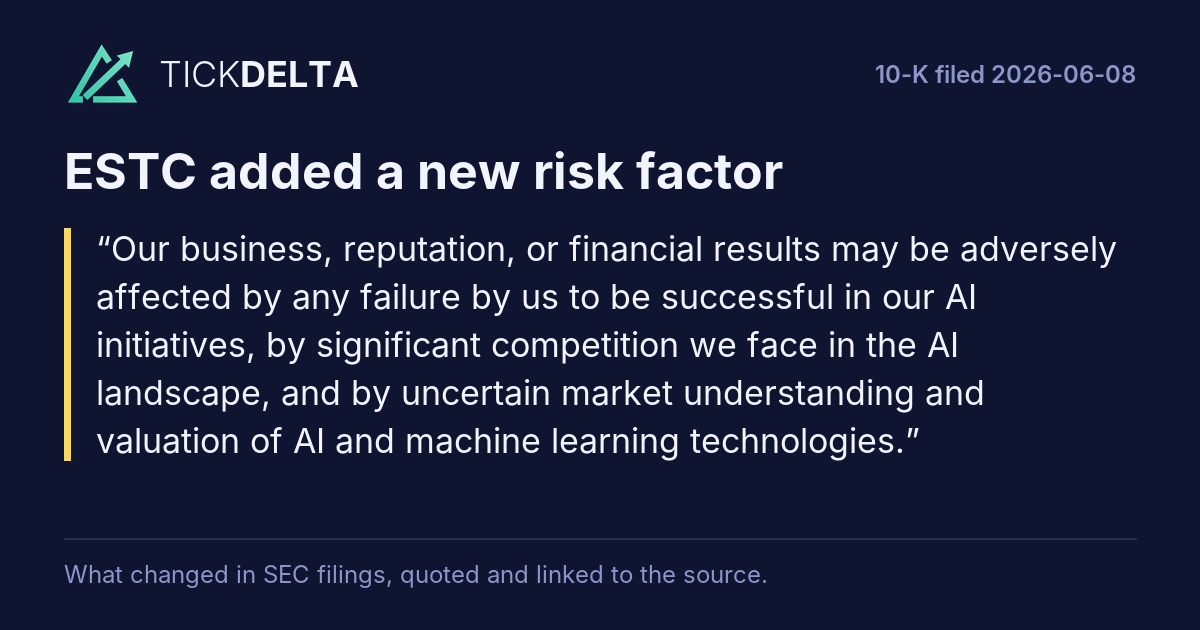
Our business, reputation, or financial results may be adversely affected by any failure by us to be successful in our AI initiatives, by significant competition we face in the AI landscape, and by uncertain market understanding and valuation of AI and machine learning technologies.

Read in the 10-K

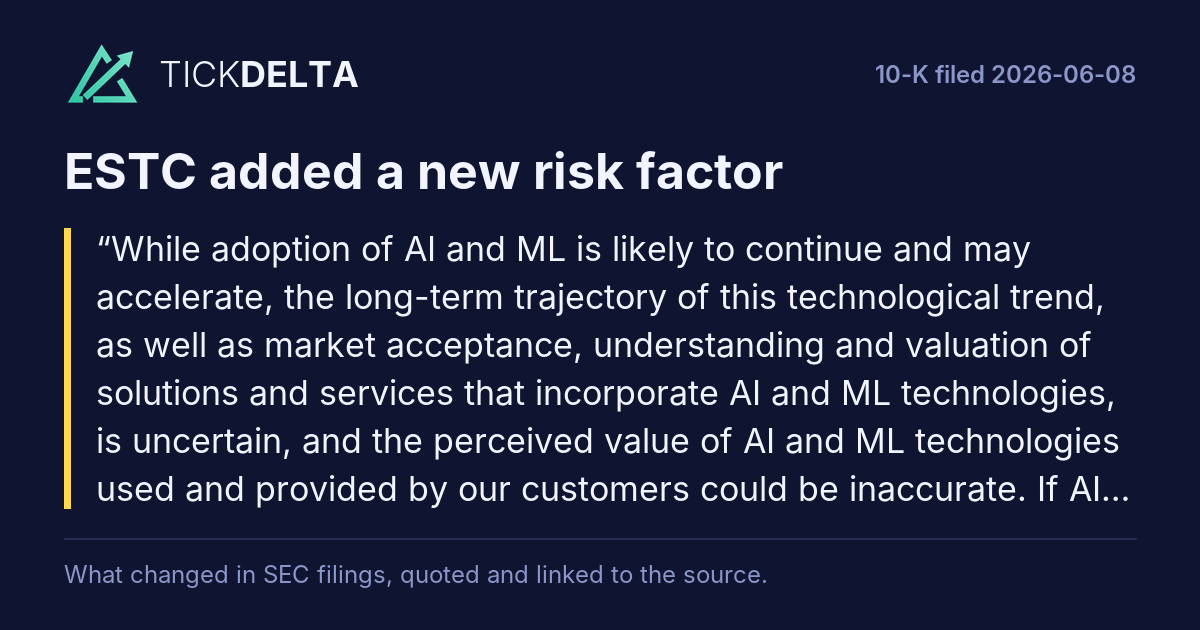
While adoption of AI and ML is likely to continue and may accelerate, the long-term trajectory of this technological trend, as well as market acceptance, understanding and valuation of solutions and services that incorporate AI and ML technologies, is uncertain, and the perceived value of AI and ML technologies used and provided by our customers could be inaccurate. If AI and ML is not broadly adopted by enterprises to the extent we anticipate, or if new use cases do not arise, then our opportunity may be smaller than we expect. Such risks and challenges could slow or even halt the adoption of AI and ML and negatively affect our business.

Read in the 10-K

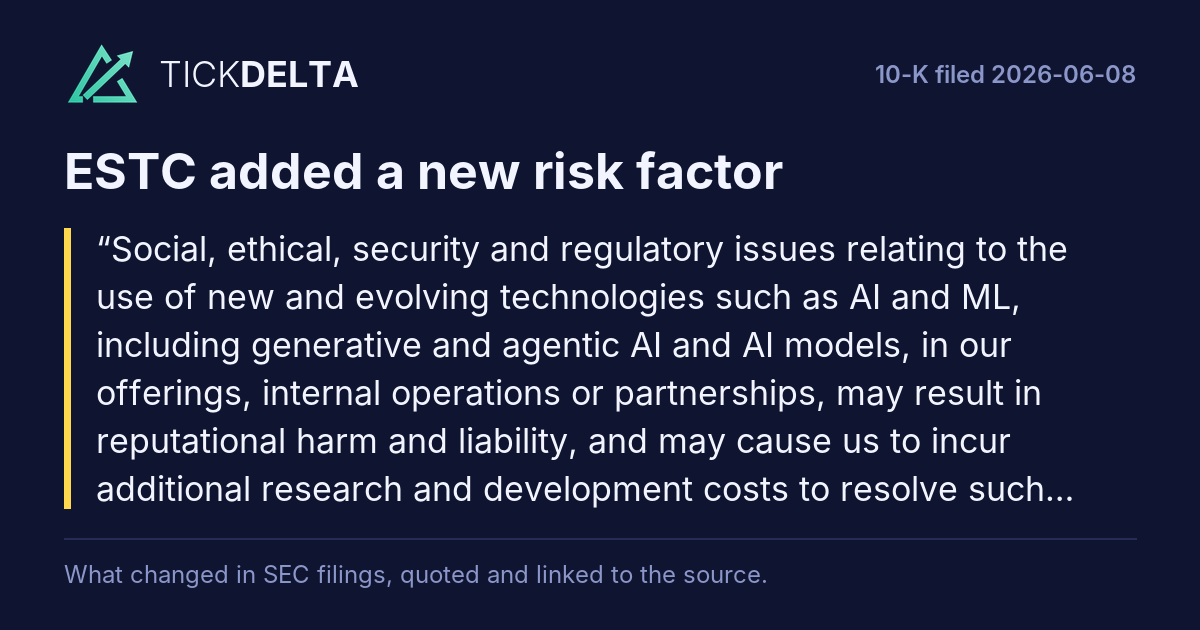
Social, ethical, security and regulatory issues relating to the use of new and evolving technologies such as AI and ML, including generative and agentic AI and AI models, in our offerings, internal operations or partnerships, may result in reputational harm and liability, and may cause us to incur additional research and development costs to resolve such issues. The use of generative and agentic AI, which are relatively new and emerging technologies in the early stages of commercial use, exposes us to additional risks, such as damage to our reputation, competitive position, and business, legal and regulatory risks and additional costs.

Read in the 10-K

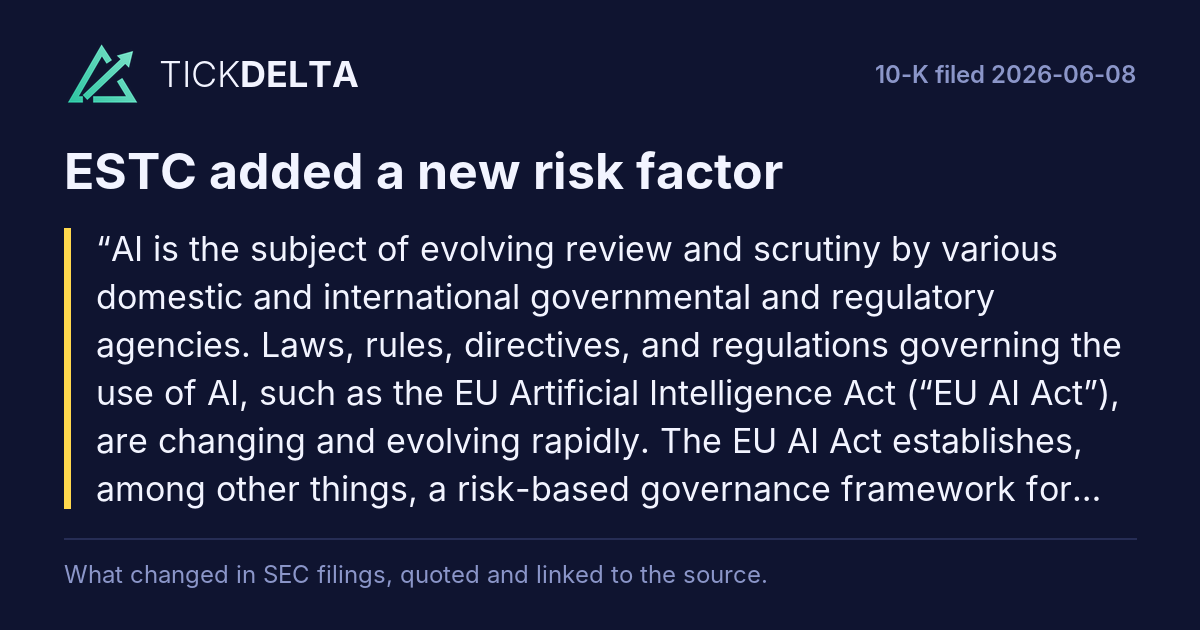
AI is the subject of evolving review and scrutiny by various domestic and international governmental and regulatory agencies. Laws, rules, directives, and regulations governing the use of AI, such as the EU Artificial Intelligence Act (“EU AI Act”), are changing and evolving rapidly. The EU AI Act establishes, among other things, a risk-based governance framework for regulating AI systems operating in the EU. This framework categorizes AI systems by their intended purposes into levels of risk, with those deemed unacceptable or high risk being strictly regulated or prohibited and all remaining AI systems being classified as low risk. The EU AI Act prohibits certain uses of AI systems and places numerous obligations on providers and deployers of permitted AI systems, with heightened requirements based on AI systems that are general purpose, which we currently deploy, or considered high risk. In addition, a patchwork of state-level AI-related legislation continues to emerge in the United States. We may not be able to anticipate how to respond to these rapidly evolving frameworks, and we may need to expend resources to adjust our operations or offerings in certain jurisdictions if the legal frameworks are inconsistent across jurisdictions. Furthermore, because AI and ML technology itself is highly complex and rapidly developing, it is not possible to predict all of the legal, operational or technological risks that may arise relating to the use of AI and ML. These and other developments may require us to make significant changes to our use of AI and ML, including by limiting or restricting our use of AI and ML, which may require us to make significant changes to our policies and practices. The cost to comply with such laws or regulations could be significant and would increase our operating expenses, which could adversely affect our business, financial condition and results of operations.

Our workforce is exposed to and uses AI technologies for certain tasks related to our business. While we have training and guidelines specifically directed at the use of AI tools in the workplace, use of these AI tools, whether authorized or unauthorized, poses risks relating to intellectual property, data protection, cybersecurity, and exposure of our proprietary confidential information to unauthorized recipients, which could result in the loss of intellectual property protection of such information, the misuse of our or third-party intellectual property, and the inability to claim intellectual property ownership of outputs from AI tools. Use of AI technology by our workforce even when used consistent with our guidelines, may result in allegations or claims against us related to violation of third-party intellectual property rights, unauthorized access to or use of proprietary information and failure to comply with open source software licenses. AI technology may also produce inaccurate responses that could lead to errors in our decision-making, solution development, operations or other business activities, which could have a negative impact on our business, operating results and financial condition. Our ability to mitigate these risks will depend on effective training, monitoring and enforcement of appropriate policies, guidelines and procedures governing the use of AI technology, and compliance by our workforce.

Use of generative AI in our code development process, while offering various potential benefits, could also pose certain ownership and security risks with respect to our codebase, given the current legal uncertainties relating to ownership of AI- or ML-generated works and the potential for security flaws in output code. If any of our employees, contractors, vendors or service providers use any third-party AI-powered software in connection with our business or the services they provide to us, such use may lead to the inadvertent disclosure of our confidential information, including inadvertent disclosure of our confidential information into publicly available third-party training sets, which may impact our ability to realize the benefit of, or adequately maintain, protect and enforce our intellectual property or confidential information, harming our competitive position and business.

Read in the 10-K

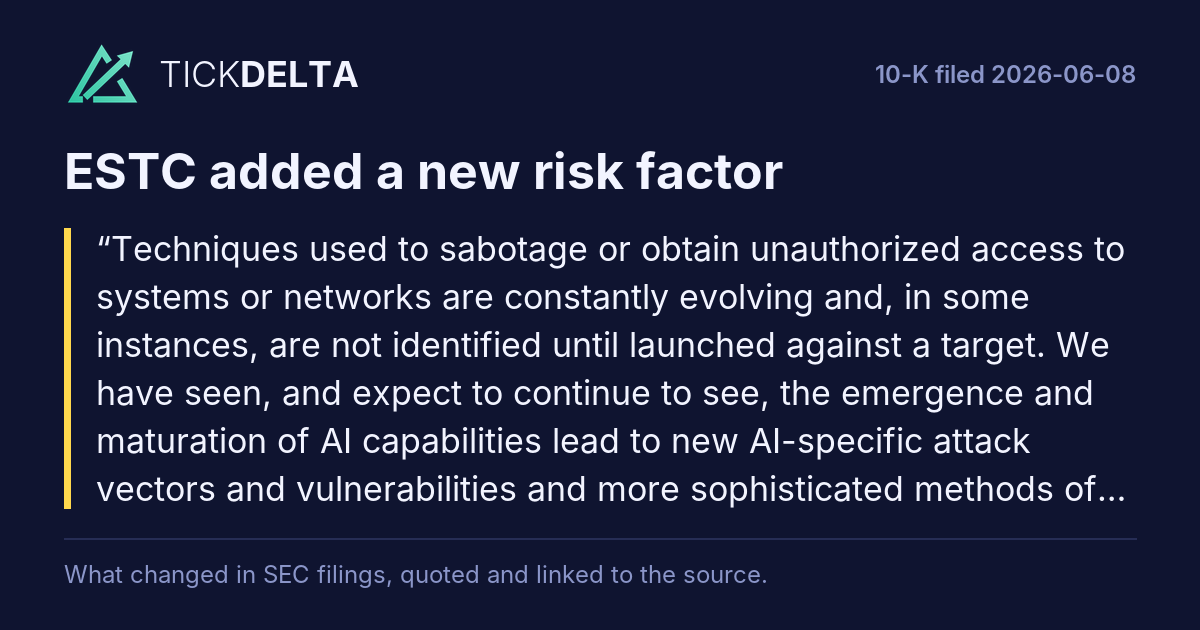
Techniques used to sabotage or obtain unauthorized access to systems or networks are constantly evolving and, in some instances, are not identified until launched against a target. We have seen, and expect to continue to see, the emergence and maturation of AI capabilities lead to new AI-specific attack vectors and vulnerabilities and more sophisticated methods of attack enhanced or facilitated by AI, including fraud that relies upon “deep fake” impersonation technology, automated vulnerability exploitation, inadvertent data exposure, AI supply-chain attacks, or other forms of automation that otherwise scale or accelerate the effectiveness of cybersecurity attacks. AI and ML also make it cheaper for attackers to create malware, phishing, code reviews, or other tools at significantly higher volumes, and much more rapidly deploy those tools than previously. AI and ML may change the way our industry identifies and responds to cybersecurity threats. The use of AI also has resulted in, and may in the future result in, security breaches or other security incidents that implicate the personal data of users of AI-powered applications as well as access to Elastic technology. We and our third-party vendors, open source and open weight dependency providers, and service providers may be unable to anticipate these techniques, react to them in a timely manner, or implement adequate preventative measures. The use of agentic AI is changing the ways that we secure and defend our platform and operations, as both threat actors and security teams are using AI to industrialize their approaches to attacks. Traditional perimeter controls and static security rules are no longer the most effective security mechanisms. We may not succeed in reinforcing our defensive capabilities to attempt to address this threat, as the applicable technology continues to be enhanced and deployed.

Read in the 10-K
Show the other 6

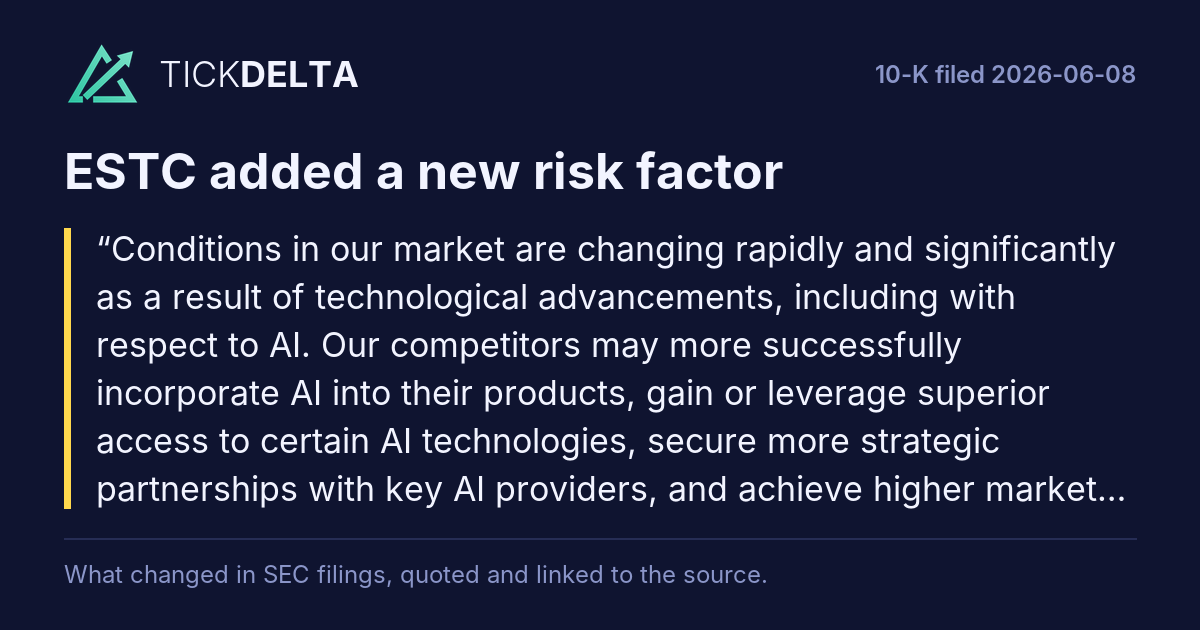
Conditions in our market are changing rapidly and significantly as a result of technological advancements, including with respect to AI. Our competitors may more successfully incorporate AI into their products, gain or leverage superior access to certain AI technologies, secure more strategic partnerships with key AI providers, and achieve higher market acceptance of their AI solutions. In addition, enterprise adoption of AI may significantly transform our competitive landscape. Customers may seek to vertically integrate their offerings by expanding into the markets in which we participate or using AI to develop their own software, reducing the need to purchase third-party solutions such as ours or consume them at the same or increasing rates. If this occurs, our market share could decline and our business could be harmed.

Read in the 10-K

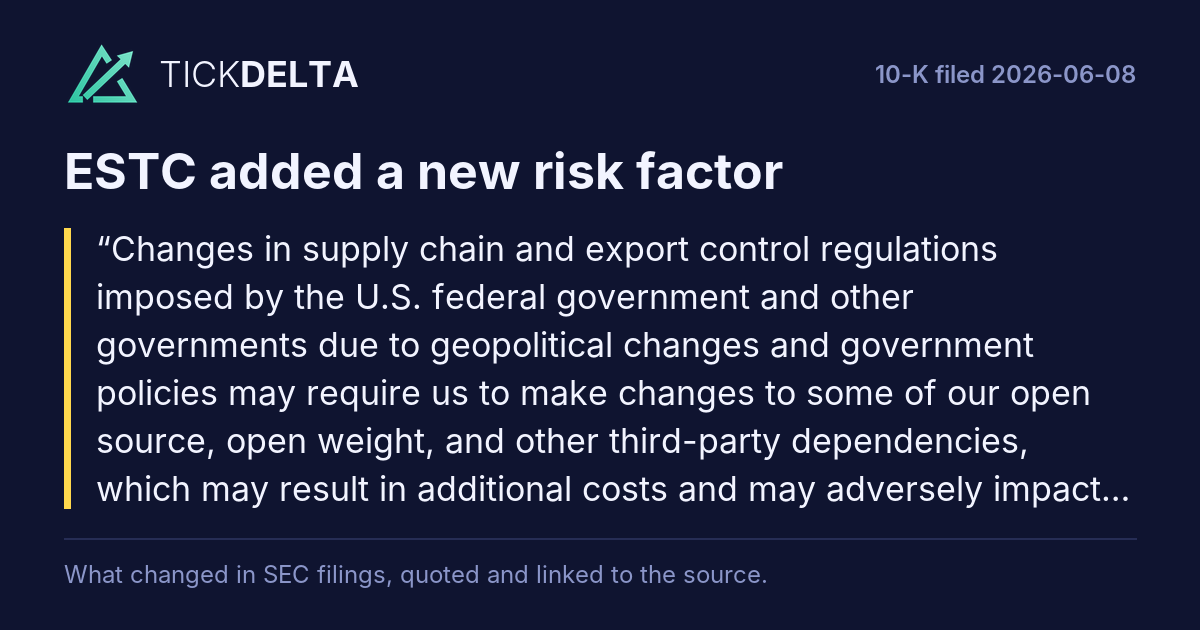
Changes in supply chain and export control regulations imposed by the U.S. federal government and other governments due to geopolitical changes and government policies may require us to make changes to some of our open source, open weight, and other third-party dependencies, which may result in additional costs and may adversely impact customer use and adoption of our solutions.

Read in the 10-K

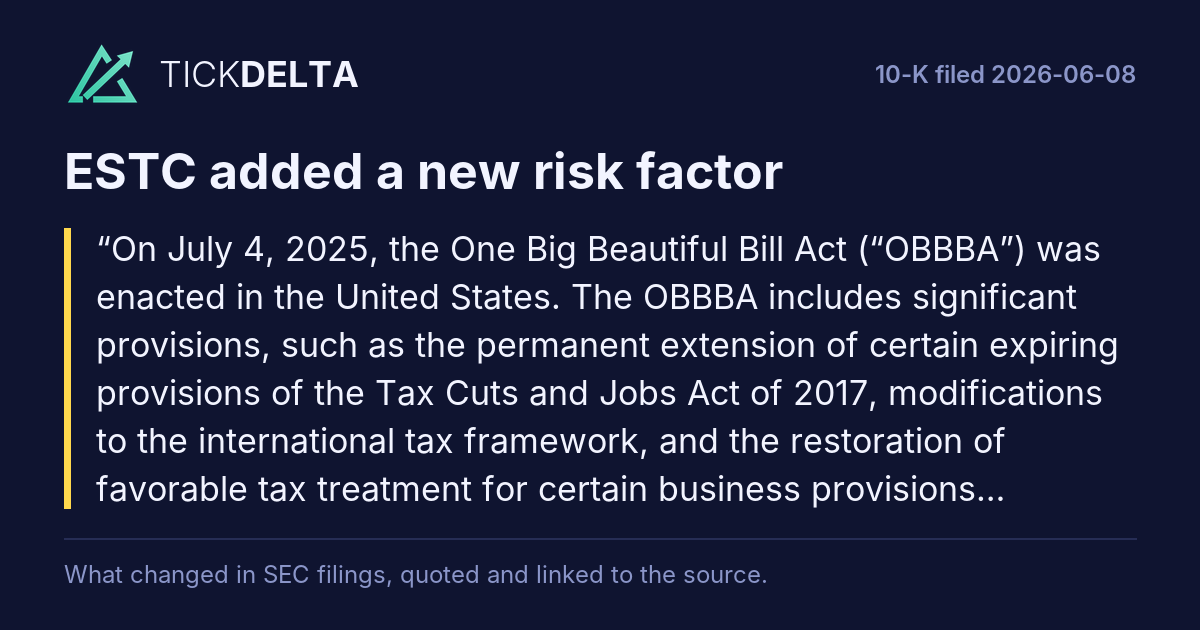
On July 4, 2025, the One Big Beautiful Bill Act (“OBBBA”) was enacted in the United States. The OBBBA includes significant provisions, such as the permanent extension of certain expiring provisions of the Tax Cuts and Jobs Act of 2017, modifications to the international tax framework, and the restoration of favorable tax treatment for certain business provisions including the immediate expensing of United States research and development expenditures. The legislation has multiple effective dates, with certain provisions effective for us in the current fiscal period and others in our fiscal year ending April 30, 2027. We have completed our assessment of the tax impact of the provisions effective in the fiscal year ended April 30, 2026, and concluded there is no material impact on our consolidated financial statements. We continue to monitor the potential impacts of the provisions effective in future fiscal years, as well as any forthcoming regulatory guidance.

Read in the 10-K

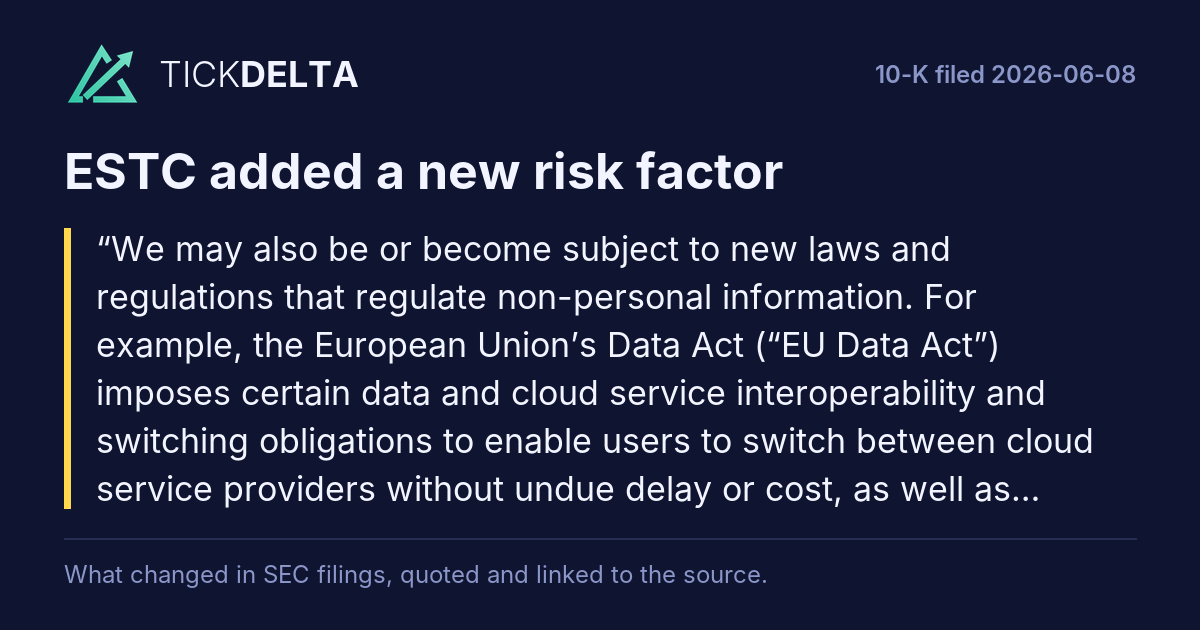
We may also be or become subject to new laws and regulations that regulate non-personal information. For example, the European Union’s Data Act (“EU Data Act”) imposes certain data and cloud service interoperability and switching obligations to enable users to switch between cloud service providers without undue delay or cost, as well as requirements concerning cross-border international transfers of, and governmental access to, non-personal information outside the European Economic Area (“EEA”). Although to date our compliance with the EU Data Act has not had a material adverse effect on our financial results, depending on how the EU Data Act and any similar laws or regulations are implemented, interpreted and enforced, we may have to adapt our business practices, contractual arrangements, and services in the EEA to comply with such obligations, which could negatively affect our regional revenue and results of operations.

Read in the 10-K

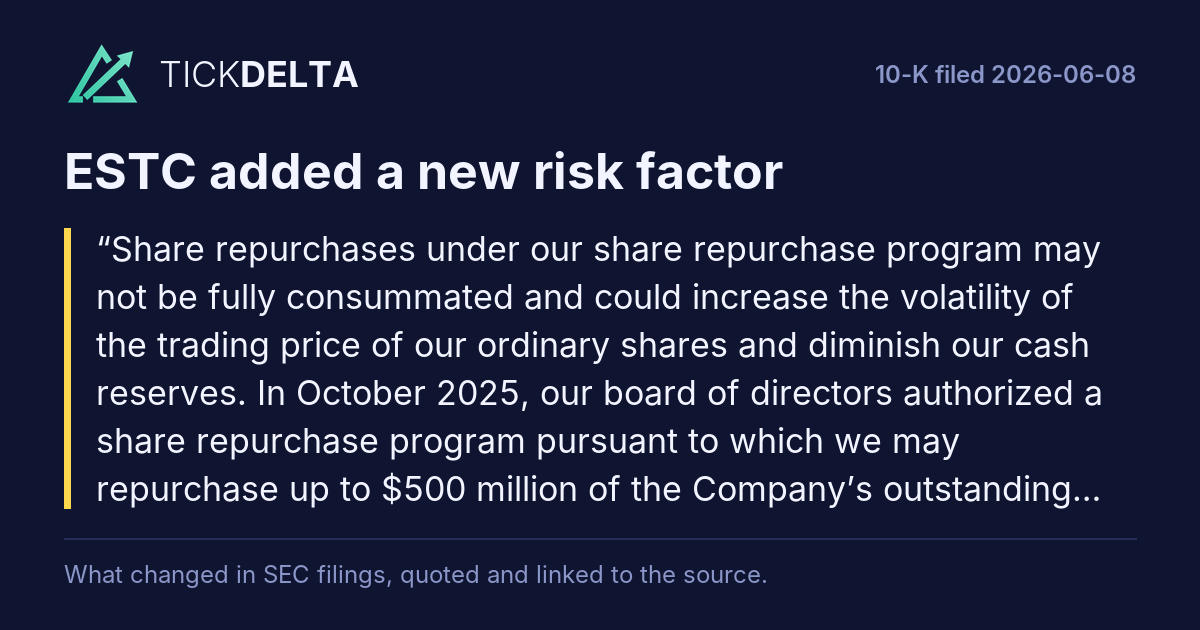
Share repurchases under our share repurchase program may not be fully consummated and could increase the volatility of the trading price of our ordinary shares and diminish our cash reserves.

In October 2025, our board of directors authorized a share repurchase program pursuant to which we may repurchase up to $500 million of the Company’s outstanding ordinary shares, exclusive of any fees, commissions, or other expenses related to such repurchases. The share repurchase program does not obligate us to repurchase any specific amount of ordinary shares. The actual timing and amount of repurchases remain subject to a variety of factors, including share price, trading volume, market conditions and other general business considerations, all of which may be negatively affected by macroeconomic conditions and factors. The share repurchase program may be modified, suspended, or terminated at any time and may not be fully consummated. The share repurchase program could increase the volatility of the trading price of our ordinary shares and will decrease our cash reserves, which may be needed for deployment in our business.

Read in the 10-K

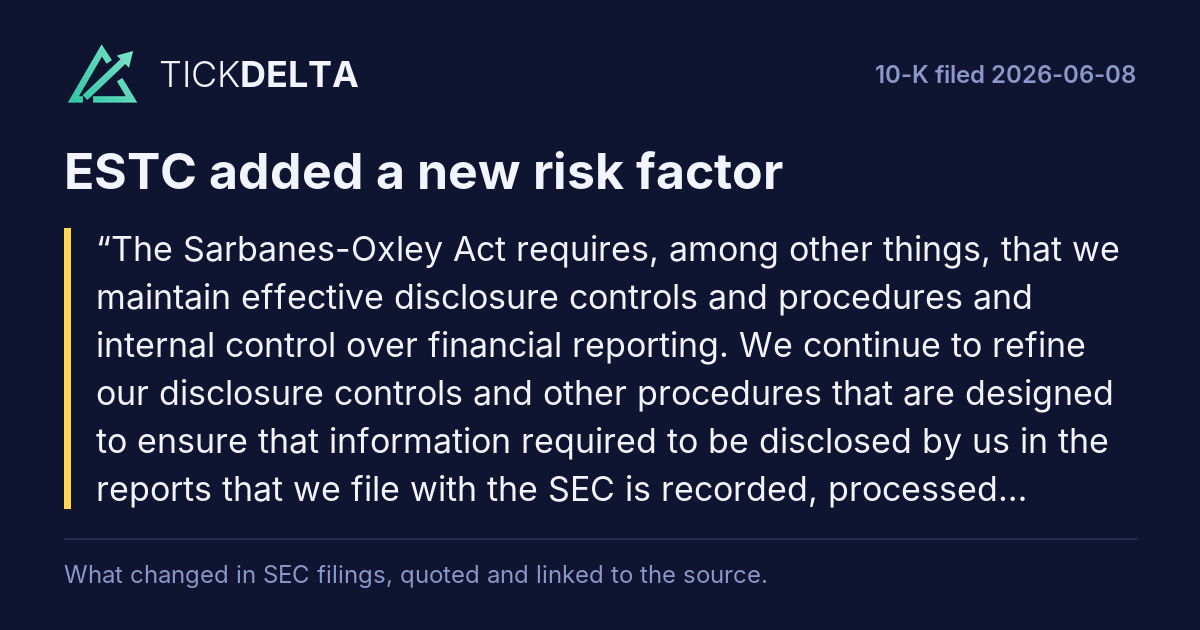
The Sarbanes-Oxley Act requires, among other things, that we maintain effective disclosure controls and procedures and internal control over financial reporting. We continue to refine our disclosure controls and other procedures that are designed to ensure that information required to be disclosed by us in the reports that we file with the SEC is recorded, processed, summarized, and reported within the time periods specified in SEC rules and forms, and that information required to be disclosed in reports under the Exchange Act is accumulated and communicated to our principal executive and financial officers.

Read in the 10-K

Paragraphs in the 10-Q filed Aug 28, 2026 that were not in the one before

New in the latest 10-Q

17 paragraphs in the 10-Q filed Aug 28, 2026 with nothing like them in the 10-Q filed Feb 27, 2026 (at least half the words must differ; new numbers alone do not count). Quoted exactly, grouped by the item heading above them. This is text that changed, not a judgement of how serious it is.

10-Q

Actual outcomes and results may differ materially from those contemplated by these forward-looking statements due to uncertainties, risks, and changes in circumstances, including but not limited to, those related to:

Read in the 10-Q

• our plan to align our investments more closely with our strategic priorities that we announced on June 24, 2026;

Read in the 10-Q

Financial statements and notes

During the three months ended July 31, 2026, the Company increased its non-cancelable cloud hosting capacity commitments to $ 978.8 million over the next five years. The table below reflects the Company’s updated future minimum purchase obligations relating to non-cancelable agreements for cloud hosting (in thousands):

Read in the 10-Q

Actual timing may vary depending on services used and total payments under these capacity commitments may be higher than the total minimum depending on services used.

Read in the 10-Q

On June 24, 2026, the Company announced and began implementing a plan to align its investments more closely with its strategic priorities by simplifying team structures, reducing organizational complexity, improving decision-making speed, reallocating resources towards key growth areas, and investing in the skills and capabilities needed to support the Company’s ongoing growth. As part of the plan, the Company expects to reduce the Company’s workforce by approximately 7 % and expects to incur total non-recurring cash charges of approximately $22 million to $25 million under the plan, which will primarily consist of employee-related costs, including severance and other termination benefits. For the three months ended July 31, 2026, the Company recorded employee-related severance and other termination benefits of $ 19.9 million. The restructuring plan is expected to be substantially completed by the end of the third quarter of fiscal 2027.

Read in the 10-Q
Show the other 12

The following table presents activity related to the liability, which is recorded in accrued compensation and employee benefits in the consolidated balance sheets, for restructuring-related employee severance and benefits for the three months ended July 31, 2026 (in thousands):

Read in the 10-Q

On August 21, 2026, the Company acquired 100 % of the share capital of Deductive AI, Inc. an AI-powered investigation platform, for cash consideration of approximately $ 70 million. Based in the United States, Deductive AI, Inc. has built an AI site reliability engineering (“SRE”) agent that connects to a customer’s code, telemetry sources, and organizational knowledge to help engineering teams investigate alerts and production issues.

Read in the 10-Q

The acquisition will be accounted for as a business combination and, accordingly, the purchase price will be allocated to tangible and intangible assets acquired and liabilities assumed based on their respective fair values on the acquisition date. Due to the timing of the acquisition, the Company is in the process of finalizing the purchase price allocation for the transaction.

Read in the 10-Q

To better align our teams with working in an age of AI automation, we are evolving the organization by simplifying team structures, reducing organizational complexity, improving decision-making speed, reallocating resources towards key growth areas, and investing in the skills and capabilities needed to support our ongoing growth. On June 24, 2026, we announced and began implementing a plan to align our investments more closely with our strategic priorities and to reduce our workforce by approximately 7%. We incurred $19.9 million in restructuring and other related charges during the three months ended July 31, 2026. We expect that the restructuring plan will be substantially completed by the end of the third quarter of fiscal 2027.

Read in the 10-Q

Expanding our penetration in enterprise and commercial customer accounts. Our future growth depends on our ability to successfully target strategic enterprise and high-propensity commercial customers using a sales-led motion. We meet our customers where they are, selling Elastic Self-Managed, Elastic Cloud Hosted, and Elastic Cloud Serverless deployments, focusing on high-value existing and new customers.

Read in the 10-Q

Three Months Ended July 31, 2026 2025 ──────────────────────────────────────────────────────────────────────────────────────── Revenue Subscription 94% 94% Services 6% 6% Total revenue 100% 100% Cost of revenue (1)(2) Subscription 19% 17% Services 7% 6% Total cost of revenue 26% 23% Gross profit 74% 77% Operating expenses (1)(2)(3) Research and development 23% 26% Sales and marketing 42% 42% General and administrative 10% 11% Restructuring and other related charges 4% —% Total operating expenses 79% 79% Operating loss (1)(2)(3) (5)% (2)% Other income, net Interest expense (1)% (2)% Other income, net 2% 4% Loss before income taxes (4)% —% (Benefit from) provision for income taxes (1)% 6% Net loss (3)% (6)%

Read in the 10-Q

We assess the need for a valuation allowance against our deferred tax assets on a quarterly basis. In making that assessment, we consider both positive and negative evidence related to the likelihood of realization of our deferred tax assets to determine, based on the weight of available evidence, whether it is more likely than not that some or all our deferred tax assets will not be realized. As of July 31, 2026, we have a remaining valuation allowance of $4.1 million related to certain U.S. states and foreign jurisdictions.

Read in the 10-Q

Risk Factors

Our plan to align our investments more closely with our strategic priorities that we announced on June 24, 2026 may not result in the anticipated benefits or operational efficiencies, could result in total costs and expenses that are greater than expected, and could disrupt our business.

Read in the 10-Q

On June 24, 2026, we announced a plan to reduce our workforce by approximately 7% and to align our investments more closely with our strategic priorities. We adopted this plan to simplify team structures, reduce organizational complexity, improve decision-making speed, reallocate resources towards key growth areas, and invest in the skills and capabilities needed to support our ongoing growth. We may incur additional expenses associated with the reduction in our workforce not contemplated by our plan, which may have an impact on other areas of our liabilities and obligations and contribute to losses in future periods. We may not realize, in full or in part, the anticipated benefits and savings from our plan due to unforeseen difficulties, delays, or unexpected costs. If we are unable to realize the expected benefits and operational efficiencies, our operating results and financial condition would be adversely affected.

Read in the 10-Q

Furthermore, implementation of our plan may be disruptive to our operations. For example, our workforce reduction could result in voluntary attrition beyond planned staff reductions, increased difficulties and workloads in our day-to-day operations, and reduced employee morale. If employees who were not affected by the reduction in force seek alternative employment, we could incur unplanned additional expenses to ensure adequate resourcing and fail to attract and retain qualified management, engineering, sales, and marketing personnel who are critical to our business. Our failure to do so could harm our business and our future performance. In addition, implementation of the plan may require more than anticipated management time and resources, which may divert attention away from core business objectives and strategic growth initiatives and negatively impact our business.

Read in the 10-Q

Share sales and buybacks

Total Number of Shares Purchased Average Price Paid Per Share (1) Total Number of Shares Purchased as Part of Publicly Announced Program Approximate Dollar Value of Shares That May Yet Be Purchased Under the Program (2)

Read in the 10-Q

Other information

On May 4, 2026, Navam Welihinda, our Chief Financial Officer, terminated a trading plan. The plan, which was adopted on July 7, 2025 and scheduled to expire on July 7, 2026, permitted the sale of up to 27,376 of our ordinary shares, as reduced by any net share settlement, underlying 21,106 restricted stock units and 6,270 performance share units, assuming vesting and payout of the latter awards at the maximum 200% level upon satisfaction of the specified performance criteria.

Read in the 10-Q

The 10-Q's risk factors against the 10-K

Item 1A of the 10-Q filed Aug 28, 2026 against Item 1A of the 10-K filed Jun 8, 2026. A 10-Q repeats only the risks that changed, so a 10-K paragraph that is missing from it is not counted as removed. Added is a paragraph with nothing like it in the 10-K, Reworded a sentence that is in both with several words changed, Quiet changes a sentence in both where one to four words changed and one is a hedge or a modal (cut words struck through, new words highlighted). Text on the page, not a score; each links to the filing at sec.gov.

Added10-Q Aug 28, 2026 vs 10-K Jun 8, 2026
Our plan to align our investments more closely with our strategic priorities that we announced on June 24, 2026 may not result in the anticipated benefits or operational efficiencies, could result in total costs and expenses that are greater than expected, and could disrupt our business.

Read it in the 10-Q at sec.gov

Added10-Q Aug 28, 2026 vs 10-K Jun 8, 2026
On June 24, 2026, we announced a plan to reduce our workforce by approximately 7% and to align our investments more closely with our strategic priorities. We adopted this plan to simplify team structures, reduce organizational complexity, improve decision-making speed, reallocate resources towards key growth areas, and invest in the skills and capabilities needed to support our ongoing growth. We may incur additional expenses associated with the reduction in our workforce not contemplated by our plan, which may have an impact on other areas of our liabilities and obligations and contribute to losses in future periods. We may not realize, in full or in part, the anticipated benefits and savings from our plan due to unforeseen difficulties, delays, or unexpected costs. If we are unable to realize the expected benefits and operational efficiencies, our operating results and financial condition would be adversely affected.

Read it in the 10-Q at sec.gov

Added10-Q Aug 28, 2026 vs 10-K Jun 8, 2026
Furthermore, implementation of our plan may be disruptive to our operations. For example, our workforce reduction could result in voluntary attrition beyond planned staff reductions, increased difficulties and workloads in our day-to-day operations, and reduced employee morale. If employees who were not affected by the reduction in force seek alternative employment, we could incur unplanned additional expenses to ensure adequate resourcing and fail to attract and retain qualified management, engineering, sales, and marketing personnel who are critical to our business. Our failure to do so could harm our business and our future performance. In addition, implementation of the plan may require more than anticipated management time and resources, which may divert attention away from core business objectives and strategic growth initiatives and negatively impact our business.

Read it in the 10-Q at sec.gov

Phrases used for the first time

Two-word phrases in Risk Factors of the 10-K filed Jun 8, 2026 that are in none of the 1 earlier 10-Ks stored, back to Jun 10, 2025

open weight ×10weight models ×6share repurchase ×5repurchase program ×5data act ×4geopolitical turmoil ×3license agpl ×3provisions effective ×3turmoil around ×2performance characteristics ×2providers without ×2high risk ×2third-party intellectual ×2offerings make ×2ai-powered search ×2ai-powered tools ×2
Where each one is used
  • open weight: Techniques used to sabotage or obtain unauthorized access to systems or networks are constantly evolving and, in some instances, are not identified until launched against a target. We have seen, and expect to continue to see, the emergence and maturation of AI capabilities lead to new AI-specific attack vectors and...
  • weight models: Our technologies strategically incorporate open source software from other developers, as well as open source and/or open weight large and small language models, and we expect to continue to incorporate such open source software and models in our products in the future. Open weight models are AI systems whose...
  • share repurchase: Share repurchases under our share repurchase program may not be fully consummated and could increase the volatility of the trading price of our ordinary shares and diminish our cash reserves.
  • repurchase program: Share repurchases under our share repurchase program may not be fully consummated and could increase the volatility of the trading price of our ordinary shares and diminish our cash reserves.
  • data act: We may also be or become subject to new laws and regulations that regulate non-personal information. For example, the European Union’s Data Act (“EU Data Act”) imposes certain data and cloud service interoperability and switching obligations to enable users to switch between cloud service providers without undue...
  • geopolitical turmoil: Our results of operations may vary based on the impact of changes in our industry or the global economy on us or our customers. Current, future, or sustained economic uncertainties or downturns, whether actual or perceived, could adversely affect our business and results of operations. Negative conditions in the...
  • license agpl: Depending on the product and version, we make the source code of our products available under Apache 2.0, the Elastic License, Server Side Public License Version 1.0 (“SSPL”), and AGPL. Apache 2.0 is a permissive open source license that allows licensees to freely copy, modify, and distribute Apache 2.0-licensed...
  • provisions effective: On July 4, 2025, the One Big Beautiful Bill Act (“OBBBA”) was enacted in the United States. The OBBBA includes significant provisions, such as the permanent extension of certain expiring provisions of the Tax Cuts and Jobs Act of 2017, modifications to the international tax framework, and the restoration of...

The 10-K at sec.gov

Used at least twice, small words left out. Counted, not picked: a phrase can be new because the company renamed something.

What was taken out

17 paragraphs of last year's Risk Factors with nothing like them now. The longest are quoted.

Across all companies
If a U.S. person is treated as owning (directly, indirectly, or constructively) at least 10% of the total combined voting power of our shares, or of the total value of our shares, such shareholder may be treated as a “United States shareholder” with respect to each “controlled foreign corporation” in our group (if any). Because our group includes one or more U.S. subsidiaries, certain of our non-U.S. subsidiaries could be treated as controlled foreign corporations (regardless of whether we are treated as a controlled foreign corporation). A United States shareholder of a controlled foreign...
In the 10-K filed Jun 10, 2025
In February 2021, with the release of version 7.11 of our platform, we changed the source code of Elasticsearch and Kibana, which had historically been licensed under Apache 2.0, to be dual licensed under Elastic License 2.0 and the Server Side Public License Version 1.0 (“SSPL”), at the user’s election. Neither the Elastic License nor the SSPL has been approved by the Open Source Initiative or is included in the Free Software Foundation’s list of free software licenses. Further, neither has been interpreted by any court. While the vast majority of downloads of Elasticsearch and Kibana...
In the 10-K filed Jun 10, 2025
We may not be able to maintain our prices and gross profits at levels that will allow us to achieve and maintain profitability. The sales prices for our offerings may decline or we may introduce new pricing models for a variety of reasons, including competitive pricing pressures, discounts, in anticipation of or in conjunction with the introduction of new offerings, or promotional programs. Competition continues to increase in the market segments in which we operate, and we expect competition to continue to increase and lead to increased pricing pressures. Larger competitors with more...
In the 10-K filed Jun 10, 2025
We monitor privacy European case law, regulatory changes, and guidance from privacy authorities, and we have been regularly refining and updating our data transfer risk assessments to document that in relying on the GDPR’s Standard Contractual Clauses (“SCCs”) and their international equivalents we maintain the requisite level of privacy protection for our cross-border transfers of personal data. In July 2023, the European Commission adopted its adequacy decision on data transfers under the EU-U.S. Data Privacy Framework (“DPF”). The adequacy decision provides a new lawful basis for...
In the 10-K filed Jun 10, 2025

Sources

Item 1A of each 10-K and 10-Q on EDGAR, quoted exactly. Each paragraph links to the filing at sec.gov.

Also

10-K change: what was reworded or cut, section by section.

Work with it

Excel workbook · CSV. Google Sheet that stays up to date: paste =IMPORTDATA("https://tickdelta.com/company/ESTC/export.csv") into a cell.

Next:10-K change
Esc

Type a ticker such as AAPL, a name, an investor such as Buffett, or a topic such as tariffs. ↑ ↓ to move, Enter to open.